The Best Cookbook Stands
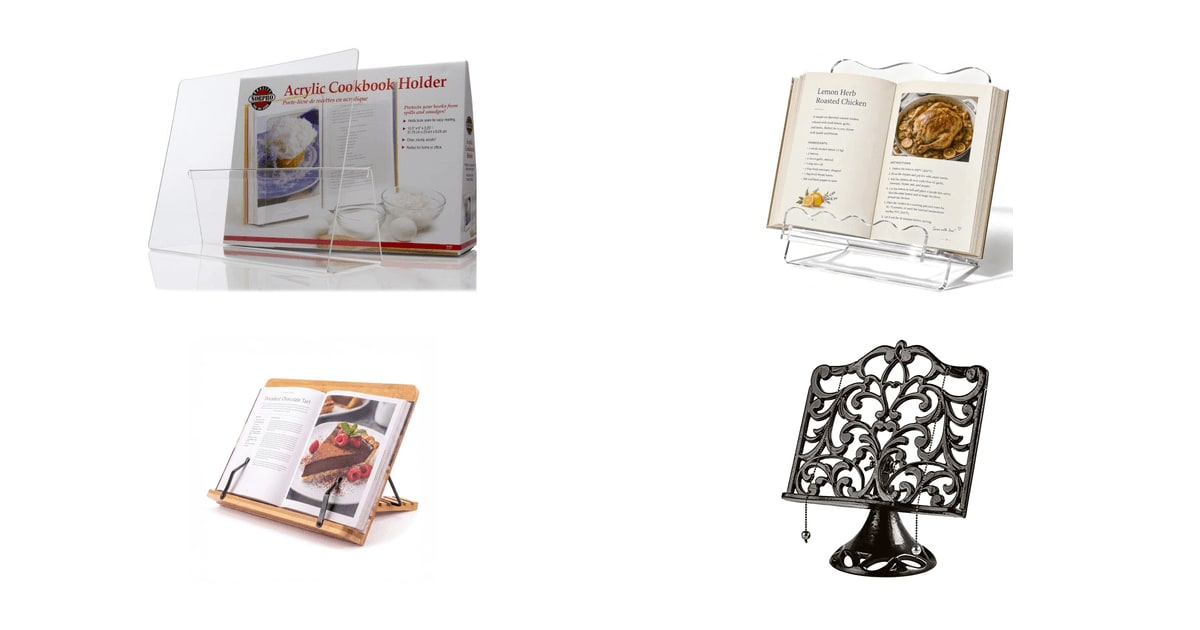
A cookbook stand does one job: it holds your book open, at an angle you can read, somewhere the sauce can't reach it. That sounds trivial until you're mid-recipe with garlic on both hands and the pages snap shut on you. Print cookbooks still sell by the tens of millions of copies, and most of them are thick hardcovers that refuse to lie flat. A good stand takes the weight, pins the pages down, and stays where you put it.
No stand does all of this at once. The ones heavy enough to hold a seven-pound culinary encyclopedia don't fold into a drawer. The ones that fold flat give up the mass that keeps a big book from pulling them over. Clear acrylic gives you the cleanest view of the page, but Better Homes & Gardens found acrylic surfaces picked up visible scratches within about six months of daily kitchen use. So you're really choosing which compromise you can live with.
Start with how you actually cook. If you own a shelf of fat hardcovers and a crowded counter, you want real page clips and a frame that folds away. If you cook from a tablet or a paperback that's already stained, you want a shield between the page and the pan. And if the stand is going to sit out all day, looks matter more than people admit. We think that the Domisso Bamboo Cookbook Stand is the best cookbook stand for most people, and that the Norpro Acrylic Cookbook Holder is the one to buy if you want your pages and your tablet shielded from splatter.
Everything we recommend

Holds a thick hardcover open, then folds into a drawer
A clear splatter shield for your pages and your tablet

Heavy, decorative, and happier with thin books than thick
At a glance
| Product | Material | Adjustable Tilt | Price | |
|---|---|---|---|---|
| Norpro Acrylic CookBook / IPad / TabletRunner-up | Acrylic | — | $21.63 |
 | Singhoow Clear Acrylic Cookbook StandAlso in lineup | Acrylic | — | $27.99On sale |
| Bamboo Cookbook Stand MediumTop pick | Bamboo | 4-Position | $25.99 |
| JOGREFUL Adjustable Cast Iron Cookbook StandAlso great | Cast Iron | — | $41.99 |
How we picked
Stability under weight. Average hardcover cookbooks run 2.5 to 5.5 pounds, and culinary encyclopedias like The Food Lab hit 7.5 — past the point where Good Housekeeping's kitchen lab saw lightweight acrylic and plastic stands tip. We favored stands with mass in the base or a wide lower ledge.
Page-holding power. America's Test Kitchen found that two independent page clips beat ledge-only designs on books over 400 pages, and Serious Eats noted that low-tension clips let pages go under range-hood airflow. Real spring tension counted for more than the number of clips.
Splatter and cleanup. We looked for surfaces that wipe down after oil and tomato sauce. Better Homes & Gardens found acrylic scratched visibly within about six months of daily kitchen use, while bamboo and steel showed no degradation over the same stretch.
Storage and footprint. Small kitchens can't give up a foot of counter permanently, so we weighted fold-flat and low-profile designs. Wirecutter's review of cast iron stands found that none of them collapsed for drawer storage.
Tablet duty. Searches for iPad cookbook stands have grown steadily alongside apps like Paprika and NYT Cooking, according to Google Trends. We checked spec sheets and owner feedback for whether each stand actually holds a screen without an adapter.
Top pick
Holds a thick hardcover open, then folds into a drawer
Bamboo Cookbook Stand Medium
The Domisso takes a book up to an inch thick, pins both sides with spring-loaded clips, and tilts to four angles so you're not craning your neck over the counter. When you're done, it collapses flat and slides into a drawer or back onto the shelf.
$25.99fromAmazonThe clips are the reason to buy this one. America's Test Kitchen found that stands with two independent page clips held books open far more consistently than ledge-only designs, especially on 400-page doorstops that splay and fight back. The Domisso's clips are spring-loaded and sit on both sides of the spread. Serious Eats also noted that weak clip springs let pages go under range-hood airflow. These have real tension.
The base handles the rest. Bamboo is dense for its size, and the weighted foot plus a wide lower ledge keeps a big book from walking forward as you flip. Owners propping oversized art books and a full-size world atlas on it report no tipping, which is a harder job than most recipe collections will ever ask. Bamboo also rates around 1,380 lbf on the Janka hardness scale, harder than red oak, so the ledge shrugs off dings.
Four tilt positions sound like packaging copy until you use them. A heavy book wants a shallow angle so its weight stays over the base. A single laminated recipe card wants a steep one so you can read it from the sink. You'll find the steeper settings useful outside the kitchen too, for a textbook or an iPad propped up at the dining table during a long stretch of work.
It's the rare stand that disappears when you're finished. Cast iron is wonderfully planted, but Wirecutter noted that none of the cast iron models in its review folded flat for storage. The Domisso hinges shut to about the thickness of a hardcover. If your usable counter is the three feet next to the sink, that's worth more to you than any number on the box.
Flaws but not dealbreakers
Bamboo isn't waterproof. Oil and tomato splatter wipe off easily enough, but you'll want to catch it before it sits, and this can't go in the dishwasher. Keep it a burner away from anything that spits.
Owner feedback on the smaller version mentions unsanded, sharp edges on the hinged tilt panel — a finishing miss rather than a design problem, but give yours a once-over when it arrives. And bamboo puts wood grain on your counter, which is either warm or wrong depending on your kitchen.
Runner-up
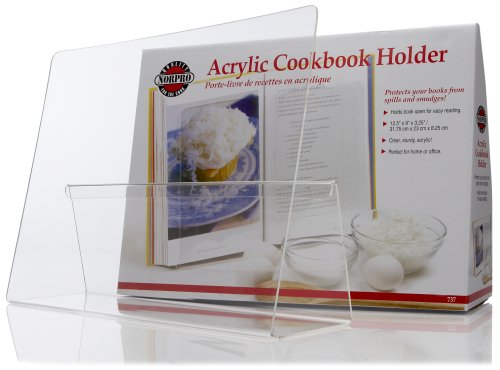
A clear splatter shield for your pages and your tablet
Norpro Acrylic CookBook / IPad / Tablet
The Norpro is a clear acrylic wedge that props up a cookbook, a magazine or an iPad and puts a transparent panel between the page and whatever's spitting on the stove. It's light, low, and claims about a foot of counter.
$21.63fromAmazonThis is the stand for people who keep ruining cookbooks. Butter fingerprints, a splash of vinegar, the fine mist coming off a searing pan — the acrylic front takes all of it and wipes clean with a damp cloth. Owners cooking out of inherited or borrowed books come back to this point over and over. If you've ever winced at a grease stain spreading across a page, you already get the appeal.
It's the most flexible pick here for screens. The wedge holds an iPad or a phone at a readable angle and keeps greasy hands off the glass, which matters if you cook from Paprika or NYT Cooking. Google Trends shows searches for iPad cookbook stands climbing steadily as recipe apps caught on with home cooks. This one was designed around books, but it takes a tablet without an adapter or a second purchase.
The footprint is genuinely small. At roughly a foot wide and a few inches deep, it tucks in behind the cutting board instead of taking over the middle of your counter. That's the trade for a low profile, though. It sits closer to flat than a tall easel, so you'll be reading down at it rather than straight ahead.
Nothing about it is clever. No clips, no adjustable angle, no soft-touch anything — it's a molded piece of acrylic that kitchens have used for decades. That plainness is part of why it survives. Nothing hinges, nothing loosens over time, and there's no small part waiting to snap off in a drawer.
Flaws but not dealbreakers
Big books are a problem. Owners with oversized magazines and coffee-table cookbooks say the panel doesn't cover the full spread, so the outer edges hang past the shield and stay exposed. There's also nothing to clip a stubborn spine open — you're relying on the weight of the panel. If most of your collection is oversized, look at the bamboo stand instead.
Acrylic scratches. Better Homes & Gardens saw visible surface scratches on acrylic within about six months of daily kitchen use, mostly from incidental contact with utensils, and owners note it can haze or yellow if it gets cleaned carelessly. Use a soft cloth and keep it away from the knife block.
Also great
Heavy, decorative, and happier with thin books than thick
JOGREFUL Adjustable Cast Iron Cookbook Stand
The JOGREFUL is a cast iron easel with a lattice back and a non-slip mat, and it weighs more than most of the books you'll put on it. This is the one you leave out on the counter, because it reads as part of the kitchen rather than as a gadget.
$41.99fromAmazonWeight is the entire argument for cast iron. At about six and a half pounds empty, the JOGREFUL doesn't budge when you shove a book into it, and the non-slip mat keeps it from scratching a table. Cast iron stands generally run four to six pounds unloaded, which is why they stay planted on a counter better than anything else in the category.
It's also the best-looking stand here, and for a thing that lives out in the open, that counts. The hollowed lattice pattern and powder-coated finish look like decor instead of equipment, so it can sit on the counter with a book open all week without adding to the visual mess. Owners buy it as a gift for exactly that reason.
It holds a tablet, a Kindle or a phone as easily as a book, and the frame is deep enough that a device doesn't slide off the lip. Plenty of owners use it well outside the kitchen — a study text, a hymnal, a display piece on a shelf. That's not a stretch for this design. It's a plain easel with good bones and a lot of mass.
Flaws but not dealbreakers
It doesn't love heavy books. Owners consistently report that the wingnut holding the tilt won't cinch down hard enough to keep a big hardcover upright, so a thick book slowly pushes the back flat. Thin recipe books, magazines and tablets are its comfort zone. For Jerusalem or The Food Lab, get the bamboo stand.
Finish quality is inconsistent. A minority of owners describe uneven paint and hardware that arrived damaged, which is the risk with a cast, hand-finished piece. Nothing this heavy stores away, either — Wirecutter noted that none of the cast iron stands in its review folded flat, and this one is no exception.
Who this is for
Buy a cookbook stand if you cook from books or a tablet more than once a week and you're tired of holding pages down with a wine bottle. It's a small purchase that fixes a daily annoyance, and it keeps grease off pages you'd rather not replace. It's also one of the easiest kitchen gifts to get right, because almost nobody buys one for themselves. If you cook from your phone propped against the toaster and that's working fine, you don't need one.
This guide covers countertop stands and easels for cookbooks, tablets and recipe cards. It doesn't cover wall-mounted or under-cabinet recipe holders, tablet mounts built for hardware rather than books, or drawer and utensil organizers that happen to turn up in the same searches. We also focused on stands you can move — a stand permanently bolted to a cabinet solves a different problem than the one most people have.
How we picked
We ranked these on the things that decide whether a stand stays on your counter. Stability: hardcovers run 2.5 to 5.5 pounds and reach 7.5 at the extreme, so the base needs mass or a deep ledge. Page holding: America's Test Kitchen found dual independent clips outperformed plain ledges on thick books, and Serious Eats found that weak clip springs surrender to range-hood airflow. Cleanup: bamboo and steel wipe down and hold up, while acrylic scratches with daily use. Storage: fold-flat designs earn their keep in a small kitchen, and cast iron never folds. Screens: the stand should take an iPad or a phone without extra hardware.
The competition
This is what our research turned up, not a survey of everything sold. Cookbook stands are a category full of near-identical listings, and plenty of decent ones never surface in a search. Here's the other stand we looked at and why it didn't make the cut.
The Singhoow Clear Acrylic Cookbook Stand ($27.99) — The Singhoow Clear Acrylic Cookbook Stand is a two-piece slot design with a scalloped edge, and it's the prettiest acrylic option here — it catches light nicely and looks more like a display piece than a kitchen tool. It breaks down flat for storage, which the Norpro doesn't. But it's a slot stand with no clips or splatter panel, so a heavy book relies on the slot alone to stay put, and it carries the same scratching risk as any acrylic. It's also new enough that there's almost no owner feedback to lean on. Consider it if the look is the point and you mostly prop thin books or a tablet.
Care and cleaning
Wherever the stand lives, keep it a burner away from anything that spits — most damage is preventable that way. Bamboo wants a damp cloth and a quick dry. Don't soak it, don't put it in the dishwasher, and rub in a little mineral oil now and then if the grain starts looking chalky. Acrylic scratches easily, so use a soft cloth and mild soap, skip anything abrasive, and never park it next to the knife block or a crock of metal utensils. Cast iron with a powder-coated finish rinses or wipes clean, but dry it properly, since standing water will find any chip in the coating. Check the non-slip pads occasionally and clean out the crumbs underneath.
Questions we get
What's the best cookbook stand for heavy books like The Food Lab or Jerusalem?
Go with the Domisso Bamboo Cookbook Stand. It's rated for books up to an inch thick, the weighted bamboo base and wide ledge keep the weight over the stand, and the spring clips hold a splayed spread open. Books in that range run 4 to 7.5 pounds, which is past the point where light acrylic and plastic stands tip forward.
Can a cookbook stand hold an iPad or tablet?
Most of them can, and all three picks here will. The Norpro was designed to take a tablet and shields the screen from greasy fingers, which is the real advantage when you're following a video recipe. Just check the depth of the ledge — a thin stand meant for recipe cards may not hold a tablet in a case.
How do I keep my cookbook pages from flipping while I cook?
Use a stand with two independent spring clips rather than one that only rests the book on a ledge. America's Test Kitchen found clips held pages far more consistently on books over 400 pages, which are the ones that fight hardest. Spring tension matters too — Serious Eats found weak clips gave up under airflow no stronger than a mid-power range hood.
Is bamboo or acrylic better for a cookbook stand?
Bamboo is tougher. It rates around 1,380 lbf on the Janka hardness scale, harder than red oak, and Better Homes & Gardens saw no surface degradation on bamboo over months of daily kitchen use while acrylic picked up visible scratches. Acrylic wins on visibility and splatter protection, since you're reading through a clear panel that takes the mess instead of the page.
What's the best cookbook stand for a small kitchen?
Look for fold-flat construction. The Domisso collapses to about the thickness of a book and stores in a drawer or on the shelf between cookbooks, so it only occupies counter space while you're actually cooking. Skip cast iron if storage is your problem — those stands stay planted because of their mass, and they don't fold.
Do I really need a stand if I just use my phone for recipes?
Probably not, though a stand keeps the screen at a readable angle and out of the splatter zone, and it stops you from tapping a phone with oily thumbs. If you cook from a phone and it's propped against something that works, save your money. The case for a stand gets much stronger once you own books you don't want stained.
Why you should trust us
For this guide:
- We read published findings from America's Test Kitchen, Serious Eats, Good Housekeeping's kitchen lab, Better Homes & Gardens and Wirecutter on how stands handle page tension, weight and long-term wear.
- We compared manufacturer specs for each stand — dimensions, weight, materials and stated book thickness — against the load a typical hardcover cookbook actually puts on a stand.
- We read owner feedback for recurring themes about tipping, clip strength, finish quality and how each stand holds up to splatter.
- We read owner reviews on every listing, weighted toward the critical ones, because that is where the recurring failures show up.
- We have a systematic way of automatically fetching the latest prices, so the numbers on this page stay current.
- This is a research-focused guide, so the team may not own every product listed — though we often do own the top winners, which gives us extra context for the recommendations.
- We don't accept free products, and the retailer commission never changes which product we recommend.
Sources
Best Cookbook Stands — Wirecutter, Wirecutter
Best Cookbook Holders Tested by Kitchen Pros — Good Housekeeping, Good Housekeeping
Best Cookbook Stands — Serious Eats, Serious Eats
Best Cookbook Stands We Tested — Food & Wine, Food & Wine
Best Cookbook Stands for Every Kitchen Type — Better Homes & Gardens, Better Homes & Gardens
Best Cookbook Stand — America's Test Kitchen Equipment Review, America's Test Kitchen
Best Recipe Stands and Cookbook Holders — The Spruce Eats, The Spruce Eats
Best Cookbook Stands — Epicurious, Epicurious
Kitchen Accessories Market Report 2024–2029 — MarketsandMarkets, MarketsandMarkets
Cookbook Publishing Industry Statistics — Statista, Statista
Amazon product listings and owner reviews for all 4 products
Manufacturer specification pages for each product
Some passages in this guide may be paraphrased with AI help. Prices are refreshed automatically.
More like this.
Continue exploring home reviews and recommendations.

The Best Cookbooks for Beginner Home Cooks
A first cookbook has one job: get you cooking dinner without panic. That sounds simple, but most cookbooks aren't built for someone who has never sweated…

The Best Cookbooks for Kids and Beginner Cooks
A kids' cookbook has one job: get a child cooking something they're proud of, without you hovering over every step. The good ones explain why you fold…

The Best Vegetarian and Plant-Based Cookbooks
A cookbook only earns its shelf space if you actually cook from it. The plant-based ones live or die on a single question: do the recipes taste good…

The Best Cookbooks for Home Chefs
A cookbook earns its place on your counter, or it doesn't earn anything. The good ones get splattered, dog-eared and reopened every week. The bad ones…

The Best Children's Cookbooks for Ages 9 to 12
A kid at this age can do real cooking. Nine- to twelve-year-olds can handle a knife with supervision, read a recipe start to finish, and use a stovetop…

The Best TV Stands and Media Consoles
A TV stand is furniture you stop noticing about a week after you buy it, which is exactly the problem. You notice it again when the cable box runs hot…