The Best TV Stands and Media Consoles
A TV stand is furniture you stop noticing about a week after you buy it, which is exactly the problem. You notice it again when the cable box runs hot behind a closed door, or when the soundbar hangs off the edge because the console is two inches too narrow, or when a cord snakes down the wall in plain sight. The right one solves all of that quietly. It's wide enough for your screen, tall enough that you're not looking down at the picture, and it gives your cables somewhere to go.
Here's the honest part: almost everything in this category is particle board or MDF with a printed wood grain, and that's true well past the entry level. IBISWorld puts particle board and MDF construction at roughly 78% of TV stands sold in the lower price tiers. Good Housekeeping's furniture testing found MDF-core shelves show measurable sag within 18 months once you load them past about 40 pounds — a bar that a receiver and a console clear together without trying. Bob Vila's team also flagged that budget weight ratings tend to be optimistic, with sag showing up at 70 to 80% of the advertised maximum.
So the real decision is how much furniture you actually need. Most people need a wide, low console that hides clutter and doesn't cost much. Home theater owners with a receiver and a center channel need something built for the job, and that's a completely different purchase. We think that the Modway Render 70" is the best TV stand for most people, and that the BDI Corridor 8173 is the one to buy if you're running real AV gear behind closed doors.
Everything we recommend
Wide, low, and better looking than it has any right to be
Nicer doors and hidden storage, in a narrower footprint

Barely a stand, but it's cheap, light, and it works

Real AV furniture, if your gear justifies the expense
The one that fits a corner, in a warmer traditional style
At a glance
| Product | Width | Weight | Price | |
|---|---|---|---|---|
| IKEA 902.432.97 Lack TV StandBudget pick | 35-3/8 in | 0.55 lbs | $59.99 |
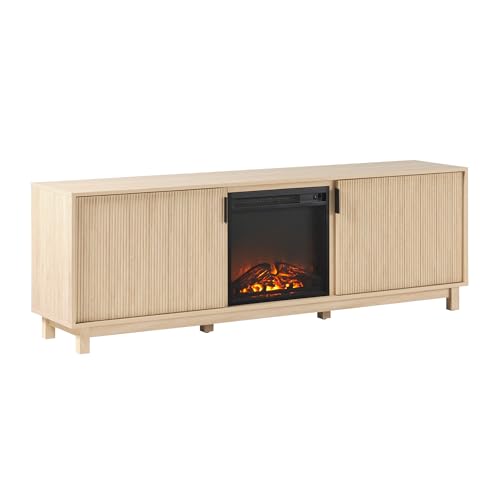 | Walker Edison Arundo Reeded TV Stand withAlso consider | 70 in | 126 lbs | $339.99 |
| Nathan James Dylan Media Console Cabinet orRunner-up | 47 in | 64 lbs | $192.57 |
| Sauder Palladia Corner TV Stand Console EntertainmentAlso great | 61.1 in | 60 lbs | $404.60On sale |
 | HavenlyYouth 55" Floating TV StandAlso consider | 55.2 in | — | $55.99 |
| Modway Render 70" Mid-Century Modern Low ProfileTop pick | 70 in | 56 lbs | $214.36 |
| BDI Corridor 8173 Quad-Width Low Media CabinetUpgrade pick | 79.25 in | 208 lbs | $3,849 |
How we picked
Width and stability. We compared listed widths against the base footprints of common 55- to 85-inch TVs, looking for at least 10 to 12 inches of overhang. Anything narrower than the screen's stance got ruled out for that TV size.
Viewing height. We checked each stand's height against the SMPTE guideline that puts screen center at seated eye level, roughly 42 to 48 inches from the floor. Forbes Home's 18-to-22-inch recommendation for the stand itself was our working target.
Ventilation and depth. We read spec sheets and listing details for airflow paths through enclosed cabinets, using Sony's four-inch PS5 clearance requirement as the benchmark for gaming gear. Depth mattered too, since most consoles can't physically hold a receiver.
Cable routing. We favored stands with rear grommets, pass-throughs, or removable back panels. Tom's Guide found that dedicated cable routing saves about 35 minutes of setup, and owner feedback consistently backs that up.
Build and owner reports. We weighed published furniture testing on MDF shelf sag against recurring themes in owner feedback — shipping damage, hardware fit, and how the finish holds up after a year.
Top pick
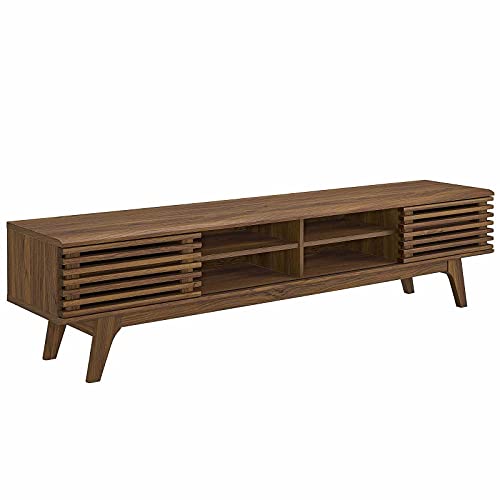
Wide, low, and better looking than it has any right to be
Modway Render 70" Mid-Century Modern Low Profile
The Render is a 70-inch, 17-inch-tall walnut-veneer console with slatted sliding doors, open shelving, and cable routing. It's wide enough for a 65-inch TV with room to spare, low enough to put the screen at seated eye level, and it looks like a much more expensive piece from across the room.
$214.36fromAmazonThe dimensions are the whole argument. At 70 inches wide, the Render clears the base of a 65-inch TV by a wide margin — the 10-to-12-inch overhang that keeps a top-heavy screen from tipping if someone bumps it. And at 17 inches tall, it lands your screen center right around that 42-to-48-inch seated eye level that SMPTE guidelines call for, once you add a typical panel. Modway rates it for flat screens up to 78 inches.
Sliding slatted doors do something clever here. You get to hide the cable box and the mess of DVDs, but the slats leave gaps, so air still moves. Fully sealed doors are where gaming consoles get into trouble. The Render also has open shelving alongside the concealed bays, which is where a soundbar or a streaming box belongs anyway.
Owners describe it as sturdier than the price suggests, and the walnut-grain veneer over particle board reads convincingly at normal viewing distance. Assembly is the usual flat-pack afternoon — some people breeze through it, others fight the instructions for a few hours. Nobody reports it falling apart afterward.
It's a low-profile piece, and that's a deliberate trade. At 13.5 inches deep, it doesn't eat much floor, which matters in an apartment. But shallow depth is also a real limit: this is not the console for a full-size AV receiver. If your gear is a streaming stick, a console, and a soundbar, you're fine.
Flaws but not dealbreakers
The interior bays are shallow and short. Owners note that a PS4-sized console doesn't fit comfortably in the enclosed section, so plan on putting game hardware on an open shelf where it can breathe anyway. A modern receiver is out of the question.
Up close, the finish is clearly veneer over particle board, and a few owners say the illusion breaks when you're standing next to it. Assembly instructions get criticized for being vague in places. If you're not patient with flat-pack furniture, budget more time than you think you need.
Runner-up
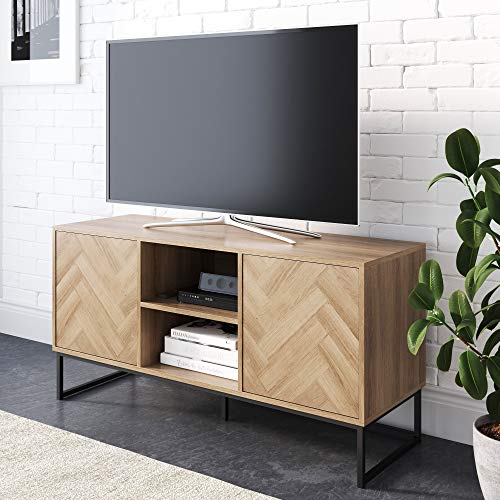
Nicer doors and hidden storage, in a narrower footprint
Nathan James Dylan Media Console Cabinet or
The Nathan James Dylan is a 47-inch console with herringbone-textured push-to-open doors, adjustable interior shelves, and three cord holes in the back panel. It's the pick if you want your gear completely out of sight and your TV is 50 inches or smaller.
$192.57fromAmazonThe doors are the reason to want this one. The herringbone texture and push-latch hardware skip visible pulls entirely, so the front reads as a clean piece of furniture rather than an electronics cabinet. Push, it opens. Push again, it closes. Owners consistently call it the piece guests comment on.
Cable management is handled properly for the price. Three cord holes across the back panel let you route power and HDMI without threading everything through one bottleneck. Tom's Guide found that stands with dedicated rear cable routing cut setup time by an average of 35 minutes compared with stands that have none — and that gap is mostly frustration you never have.
Interior shelves adjust, which matters more than it sounds. You can raise a shelf for a taller receiver or drop it for a stack of consoles. Nathan James covers it with a lifetime manufacturer warranty and a 100-day trial, unusually generous for flat-pack furniture at this level.
Assembly is the friendliest here. Owners with no furniture-building experience report getting it together in about an hour with clear instructions. That's the exception in this category, not the rule.
Flaws but not dealbreakers
At 47 inches, it's narrow. That's fine for a 50-inch TV but too tight for a 65-inch set once you account for the base and the stability overhang. Several owners bought it and then wished it were wider, which is a measuring problem more than a product problem — but check your TV first.
Fully enclosed doors mean airflow depends entirely on those three cord holes. If a game console lives inside, leave a door cracked or move it to a shelf. Sony's PS5 setup guide asks for four inches of clearance on all sides, and a closed cabinet doesn't give you that.
A minority of owners hit hardware problems — missing screws, pre-drilled holes slightly too large for the fasteners. It's not the norm, but it happens often enough to mention.
The Dylan comes with a lifetime manufacturer warranty and a 100-day trial period.
Budget pick
Barely a stand, but it's cheap, light, and it works
IKEA 902.432.97 Lack TV Stand
The IKEA Lack TV unit is a 35-inch, 17.75-inch-tall open shelf with an opening at the back for wires. There's no storage, no doors, and no pretense. For a small TV in a first apartment, dorm room, or bedroom, that's often exactly enough.
$59.99fromAmazonIt does one job and the price reflects that. You get a flat top, a lower shelf, and a gap at the back to gather cords. Nothing is hidden and nothing is enclosed, which incidentally means ventilation is a non-issue. Put a streaming box on the shelf and forget about it.
The height is right by accident. At 17.75 inches, the Lack sits in the 18-to-22-inch band Forbes Home recommends for correct eye-level alignment, so a small TV on top lands where it should. Plenty of far more expensive stands miss this.
Owners like how easy it is to move and assemble, and several use it as a side table or a shelf riser instead of a TV stand. It weighs almost nothing. If you move apartments often, that matters more than it seems on paper.
Flaws but not dealbreakers
It's 35 inches wide, which caps you at roughly a 32-to-40-inch TV if you want a safe overhang. Several owners are surprised by how small it is in person, so measure before you order.
The construction is hollow-core board, and it feels like it. Corner damage in shipping comes up repeatedly in owner feedback, and the material won't survive much weight or many moves. Don't load the shelf with a receiver.
Assembly is simple but some owners needed a drill they didn't own. There's no cable management beyond a hole, no doors, and no way to make the clutter disappear.
Upgrade pick
Real AV furniture, if your gear justifies the expense
BDI Corridor 8173 Quad-Width Low Media Cabinet
The BDI Corridor 8173 is a 79-inch walnut cabinet built specifically for home theater equipment, with flow-through ventilation, IR-friendly doors, removable rear access panels, and integrated cable channels. It costs several times what everything else here does, and for the right owner it's the only thing that works.
$3,849fromAmazonEverything a receiver needs is engineered in, not improvised. Ventilation slots run through the bottom panels, the shelves, and the rear access panels, so heat has somewhere to go instead of pooling around your amplifier. BDI specifies a powder-coated steel frame rated to 200 pounds per shelf, and the tempered glass doors are certified to pass 38kHz IR remote signals without loss. That last spec is why home theater owners buy this cabinet: gear stays hidden and your remote still works.
The rear access panels are the feature you'll appreciate on the third re-cabling. They slide out or come off, so you're reaching in from behind instead of dragging 200 pounds of furniture away from the wall to swap an HDMI cable. Routing channels keep the cords organized once you're back there.
At 79 inches wide and 20 inches deep, it handles an 85-inch TV and full-depth components. That depth is what separates it from every other console here — most of them physically cannot hold a standard receiver, and this one is designed around the idea.
Owners describe it as genuinely well-made furniture rather than assembled panels, with adjustable door alignment and a finish that holds up to inspection. It arrives assembled and it's heavy, which is a compliment and a logistics problem at the same time.
Flaws but not dealbreakers
It's by far the most expensive piece in this guide, and nothing about it makes sense unless you own real AV equipment. If your setup is a TV and a soundbar, you're paying for engineering you'll never use.
The main center bay isn't as deep as some full-size receivers need. At least one owner had to remove a volume knob to make a receiver fit, so measure your components — especially depth including rear connectors — before committing.
Delivery is a project. It weighs over 200 pounds, ships on a pallet you'll have to dispose of, and a handful of owners report shipping damage to the integrated back panel with a frustrating service response afterward.
Also greatOn sale
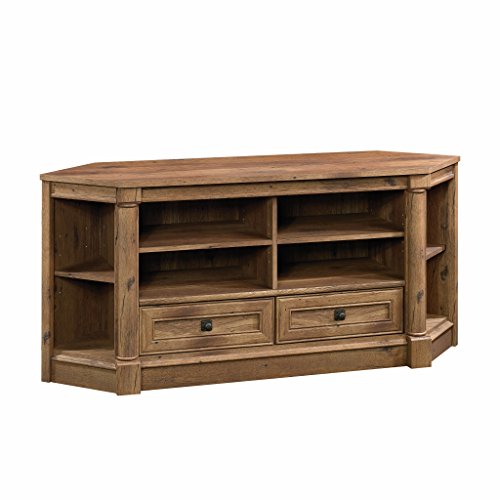
The one that fits a corner, in a warmer traditional style
Sauder Palladia Corner TV Stand Console Entertainment
The Sauder Palladia corner credenza tucks a 61-inch console into a corner, with two adjustable shelves, two drawers on metal runners, and a Vintage Oak finish. If your room has an awkward layout or your decor leans traditional, this solves a problem the modern consoles can't.
$404.60fromAmazonList priceCorner units are rare and this one is done well. It fills a diagonal that would otherwise sit empty, which is often the difference between a workable living room and a furniture puzzle. Owners repeatedly mention they couldn't find a corner cabinet anywhere else.
The style is the point. Nearly everything else in this guide is mid-century or industrial, and plenty of living rooms aren't. Vintage Oak with a traditional profile suits a more formal room, and Better Homes & Gardens and Houzz data shows farmhouse and traditional aesthetics still drive a huge share of what shoppers actually search for.
Storage is practical rather than showy. Two adjustable shelves take gaming and video gear, and two drawers on smooth metal runners handle remotes, controllers, and the cable clutter that has no other home. Owners with 65-inch TVs report they fit fine, though it's officially rated for up to 60 inches.
Flaws but not dealbreakers
Assembly is long. Owners describe multi-hour builds, with several reporting five hours or more. The instructions are generally good, but this is a big piece with a lot of parts, and it's a two-person job.
It's 27.4 inches tall, noticeably higher than the low-profile consoles here. That pushes your screen center above the seated eye-level range if you have a tall TV, so it's better suited to smaller panels or higher seating.
The drawers are the weak point. A few owners report drawer components separating under normal use, and shipping damage to panel edges comes up more than it should.
Who this is for
Buy now if you're setting up a new TV, moving into a place where the old stand doesn't fit, or currently balancing a 65-inch screen on something meant for a 40-inch one. That last situation is more common than you'd think — CTA data shows 65-inch sets overtook 55-inch models as the most popular size sold in the US, and plenty of people upgraded the TV without upgrading the furniture underneath it. If you're a gamer with a console living in a sealed cabinet, this is also worth fixing sooner rather than later.
Skip it if you're planning to wall-mount. A mount plus a small shelf costs less and looks cleaner, and no console can compete with a screen that floats. This guide covers floor-standing and wall-mounted consoles that hold a TV or sit beneath one — not TV mounts, not full entertainment wall systems, and not modular shelving you configure yourself. We also don't cover anything we couldn't confirm as a current listing, so consider this a snapshot of what the research surfaced rather than the entire market.
How we picked
Width: the stand should clear your TV's base by 10 to 12 inches, so we matched listed widths to real screen footprints rather than to marketing claims about supported sizes. Height: we targeted the 18-to-22-inch range Forbes Home recommends, which puts screen center near the 42-to-48-inch seated eye level SMPTE calls for. Ventilation: enclosed cabinets needed a real airflow path, judged against Sony's four-inch PS5 clearance spec. Cables: rear grommets, pass-throughs, or removable back panels, since Tom's Guide measured about 35 minutes of setup time saved by dedicated routing. Build: we read Good Housekeeping's findings on MDF shelf sag past 40 pounds and Bob Vila's warning that budget weight ratings run optimistic, then cross-checked against what owners report a year in.
Other tv stands and media consoles worth considering
If you want a fireplace built into the console: The Walker Edison Arundo Reeded TV Stand with ($339.99) — The Walker Edison Arundo is 70 inches wide with reeded door fronts, adjustable shelves, cable management, and an 18-inch electric fireplace insert with a remote. On a cold night it's genuinely nice, and the Coastal Oak finish photographs well. What you give up is build quality: owners describe the material as thin, with finish peeling reported and cam locks that break during assembly. Several also found holes that didn't line up. It's a two-person, hour-and-a-half job at best and a three-hour fight at worst. Buy it for the fireplace, not for durability.
If you want the floor completely clear: The HavenlyYouth 55" Floating TV Stand ($55.99) — The HavenlyYouth floating console mounts to the wall at 55 inches wide, with open shelving, fabric-fronted drawers, and a metal frame. Floating consoles are the fastest-growing sub-category in TV furniture — CNET and Wayfair data put the growth at 22% year over year — and the appeal is obvious in a small apartment or a toddler-proofed living room. The catch is that it's genuinely light-duty. The drawers are cloth, not wood, and owners warn against loading them. Mounting is also fussy: the keyhole slots sit at different levels, so precise marking matters or you'll be patching drywall.
The competition
TV furniture is an enormous category and this is what our research surfaced, not a survey of everything for sale. Every product below is a legitimate option for someone. Each one lost to a pick on a specific point — width, ventilation, depth, or how it holds up after a year — and we've said which.
Installation notes
Two things are worth doing right the first time. Anchor the stand to the wall if you have kids or pets — most flat-pack consoles include a tip-over strap, and the ten minutes it takes buys a lot of peace of mind. Then think about heat before you close a door. A game console or receiver in a sealed cabinet will throttle, and Sony asks for four inches of clearance on every side of a PS5. If your cabinet doesn't have vents or slats, either leave a door open during long sessions or put that box on an open shelf. Run cables before you push the console against the wall, not after. And if the shelves are MDF, keep each one under about 40 pounds — that's roughly where published furniture testing starts seeing sag.
Questions we get
How wide should a TV stand be for a 65-inch TV?
Aim for at least 10 to 12 inches wider than your TV's base footprint, not the screen's diagonal. Most 65-inch TVs sit on feet or a pedestal that spans well under the full 57-inch screen width, but the extra overhang is what keeps things stable if the stand gets bumped. In practice, a 60-to-70-inch console is the safe zone. Wider also looks better — a TV that overhangs its stand reads as a mistake.
What height should a TV stand be for comfortable viewing?
SMPTE ergonomic guidelines put the center of the screen at seated eye level, which is roughly 42 to 48 inches from the floor for most adults. Forbes Home recommends an 18-to-22-inch stand for 55- to 75-inch TVs, which gets you there once you add the panel height. Taller stands make you look up, which gets uncomfortable over a long movie. If you're between options, go lower.
Do I need ventilation for a PlayStation 5 or Xbox Series X?
Yes. Sony's official PS5 setup documentation calls for a minimum four inches of clearance on all sides, and a sealed cabinet doesn't provide that. Without airflow, consoles can thermal throttle within hours of heavy use, and sustained heat isn't good for any component. Either choose a stand with real ventilation paths — slats, vent slots, open shelving — or keep the console out in the open.
Are floating TV stands better for small rooms?
Often, yes. Clearing the floor makes a room read larger and makes vacuuming trivial, which is why the category is growing fast — CNET and Wayfair data show 22% year-over-year growth. The trade-off is capacity and installation. Wall-mounted units are lighter-duty by design and need to hit studs, so if you're renting or you own heavy AV gear, a floor-standing console is the safer choice.
What's the difference between a TV stand and a media console?
There's no strict line, but generally a TV stand is a functional platform sized to a screen, while a media console is a piece of furniture that happens to hold a TV. Consoles tend to be wider, with enclosed storage, better finishes, and a design that works even when the TV is off. If you want the piece to look intentional in the room, shop consoles.
How much weight can a TV stand actually hold?
Less than the listing says, usually. Bob Vila's testing team found observable shelf sag at 70 to 80% of advertised maximum loads on budget stands, and Good Housekeeping found MDF-core shelves sagging within 18 months once loaded past about 40 pounds. Treat the published number as a ceiling you shouldn't approach. A typical 65-inch OLED runs 50 to 80 pounds, so leave real headroom.
Why you should trust us
For this guide:
- We read manufacturer spec sheets and listing details for every stand here, comparing widths, heights, depths and stated weight capacities against the TV sizes each one claims to support.
- We drew on published furniture testing and reporting from Good Housekeeping, Bob Vila, Tom's Guide and Forbes Home, plus ergonomic guidance from SMPTE and Sony's own PS5 clearance requirements.
- We read through owner feedback for recurring themes — shipping damage, hardware fit, assembly difficulty and how finishes hold up — rather than treating any single account as decisive.
- We read owner reviews on every listing, weighted toward the critical ones, because that is where the recurring failures show up.
- We have a systematic way of automatically fetching the latest prices, so the numbers on this page stay current.
- This is a research-focused guide, so the team may not own every product listed — though we often do own the top winners, which gives us extra context for the recommendations.
- We don't accept free products, and the retailer commission never changes which product we recommend.
Sources
Best TV Stands of 2026 — Wirecutter (NYT), Wirecutter
Best TV Stands and Media Consoles — CNET, CNET
Best TV Stands Tested in 2026 — Tom's Guide, Tom's Guide
Best TV Stands — Good Housekeeping, Good Housekeeping
Best TV Stands — Forbes Home, Forbes Home
Best TV Stands — Better Homes & Gardens, Better Homes & Gardens
Best TV Stands Tested — Bob Vila, Bob Vila
BDI Corridor 8173 AV Cabinet — Product Specifications, BDI USA
PlayStation 5 Official Setup & Ventilation Requirements, Sony PlayStation
How High Should You Mount Your TV? — Architectural Digest, Architectural Digest
TV Furniture Market Size & Forecast 2025–2029 — Grand View Research, Grand View Research
Consumer Technology Association — TV Size Trends 2024, Consumer Technology Association (CTA)
Amazon product listings and owner reviews for all 7 products
Manufacturer specification pages for each product
Some passages in this guide may be paraphrased with AI help. Prices are refreshed automatically.
More like this.
Continue exploring home reviews and recommendations.

The Best 4K OLED TVs
An OLED TV earns its keep in the dark. Every pixel makes its own light, so a starfield looks like actual stars instead of gray smudges on a lit panel.…

The Best TVs
A TV is the one piece of electronics your whole household stares at every day. And most of the specs on the box don't tell you much about how it'll…

The Best Cookbook Stands
A cookbook stand does one job: it holds your book open, at an angle you can read, somewhere the sauce can't reach it. That sounds trivial until you're…

The Best Standing Desk Converters
A standing desk converter sits on the desk you already own and lifts your monitor and keyboard to standing height. That's the whole idea, and it's a good…

The Best Electric Standing Desks
A standing desk earns its keep in small moments. You take a call on your feet, you stretch out your lower back between meetings, you drop the surface an…

The Best Christmas Tree Stands
A tree stand does one job, and you notice it only when it fails. It has to hold a top-heavy tree upright on a floor that's never quite level, through six…