The Best TVs
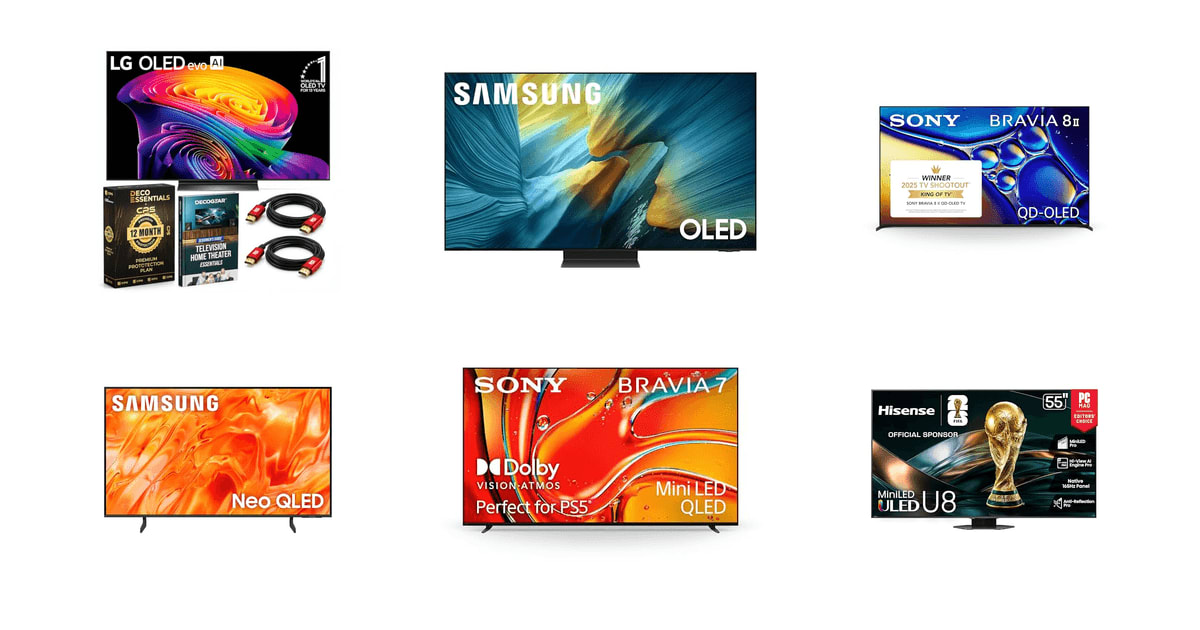
A TV is the one piece of electronics your whole household stares at every day. And most of the specs on the box don't tell you much about how it'll actually look in your room. What matters is simpler than the marketing suggests: how deep the blacks go when you turn the lights off, how well the screen fights the window behind your couch, and whether the menus get out of your way. A great picture in a store's showroom often looks washed out at home. Your room, not the spec sheet, decides a lot.
Here's the honest catch. No TV is great at everything. OLED panels give you perfect blacks and near-instant response, but they still can't match the raw punch of a good mini-LED in a sunny room. Mini-LED sets get blindingly bright, then show halos around bright objects on dark backgrounds. Built-in speakers on every set here are mediocre, and you'll want a soundbar eventually. Smart platforms all nag you with ads and rows of content you didn't ask for. Pick the compromise you can live with.
We looked at flagship OLEDs, mid-range mini-LEDs and the value sets that undercut them, and the trade-offs sort into a few clear buckets. If you watch mostly at night and care about movies and games, an OLED is worth the money. If your living room has three windows and a skylight, brightness beats contrast every time. We think that the LG C6 OLED is the best TV for most people, and that the Hisense U8 is the one to buy if you want mini-LED brightness without paying flagship money.
Everything we recommend

Near-flagship OLED picture without the flagship markup

The OLED to get if your room is full of windows

Mini-LED brightness for far less than the flagships

The picture-processing pick for film and streaming fans

Sony's mini-LED, for bright rooms and big screens
At a glance
| Product | Screen Size | Panel Type | Price | |
|---|---|---|---|---|
| LG 65 inch OLED evo AI C6Top pick | 65 Inch | OLED evo | $1,599.99 |
| Samsung 65-Inch Class OLED S95F 4K GlareUpgrade pick | 65-Inch | OLED | $2,327.95 |
| Sony 65 Inch BRAVIA 8 II QDAlso great | 65 inch | QD OLED | $2,498On sale |
 | Samsung 85-Inch Class QN70H SeriesAlso consider | 85 Inch | Neo QLED Mini LED | $1,797.99 |
| Sony 65 Inch BRAVIA 7 Mini LEDRunner-up | 65 | Mini LED QLED | $1,300.99 |
| Hisense 55" U8 Series ULED Mini-LED 4KBudget pick | 55 inch | ULED Mini-LED | $1,274.99 |
How we picked
Contrast and black level. We compared published lab measurements of contrast ratio and black-level performance across panel types. OLED's per-pixel control is effectively infinite contrast, while mini-LED sets land around 3,000 to 6,000:1 — the single biggest difference between the technologies.
Brightness for real rooms. We prioritized measured peak brightness in HDR highlight windows and any anti-glare treatment on the panel. A set had to be usable with daytime light in the room, not just in a dark home theater.
Gaming specs. We required HDMI 2.1 with its 48Gbps bandwidth, a wide VRR range and ALLM, and we weighted published input-lag measurements heavily. Multiple 2.1 ports mattered for households running a console and a PC.
Smart platform longevity. We favored Google TV and webOS based on app-library size and each platform's track record for multi-year software updates. A TV lasts a decade; the software behind it should not stop improving after two years.
Owner feedback themes. We read through owner reports looking for repeated complaints rather than one-off defects. Recurring themes around firmware bugs, remote design and warranty service shaped our flaws sections.
Top pick
Near-flagship OLED picture without the flagship markup
LG 65 inch OLED evo AI C6
The C6 is LG's mainstream OLED, and it lands within a hair of the company's pricier G-series on picture quality. You get perfect blacks, four HDMI 2.1 ports for a console and a gaming PC, and a 165Hz panel that handles hockey and shooters without smearing.
$1,599.99fromAmazonFor most people, this is the sweet spot in LG's OLED lineup. The step up to the G-series buys you a brighter panel and a flush wall-mount design, and not much else you'll notice from the couch. The C6 uses the same α11 AI processor generation and the same self-lit pixel structure. In a dim living room, the difference between them is the kind of thing you see in a side-by-side comparison, not during a movie.
Every pixel here makes its own light and can switch off completely. That's why OLED contrast is effectively infinite, while mini-LED sets with local dimming land somewhere around 3,000 to 6,000:1 per RTINGS.com. In practice, that means starfields look like stars against black instead of stars against dark gray. Letterbox bars disappear into the bezel. If you watch a lot of dark, moody prestige TV, this is the difference you'll actually notice.
Gamers get the most complete package here. RTINGS.com measured roughly 1.1ms input lag at 4K/120Hz in game mode on LG's C-series, among the lowest of any consumer display. OLED response time sits near 0.1ms versus 2 to 4ms for mini-LED. The C6 supports G-Sync and FreeSync Premium, and all four HDMI ports are 2.1 — so a PS5 Pro, an Xbox and a PC can stay plugged in without you crawling behind the set.
webOS 26 is one of the two platforms we'd bet on for the long haul. LG has a solid record of shipping updates years past a set's launch, and the interface is quick. The app library is smaller than Google TV's — roughly 2,500 apps versus over 10,000 per Digital Trends — but that gap only bites if you subscribe to something obscure. Netflix, Max, Disney+ and the rest are all there.
Brightness Booster gets the C6 further than past C-series panels, and it's genuinely usable in a room with daytime light. But set your expectations. This isn't a screen that wins a fight with direct sun on the glass. Draw the shades for the good stuff and you'll be very happy.
Flaws but not dealbreakers
The listing we're pointing to is a bundle, and bundles come with friction. Owners report thin setup documentation and a remote whose buttons aren't obviously labeled, which makes the first hour more confusing than it should be. If you're the household's designated tech person, budget an evening.
OLED burn-in is far less likely than it used to be, but it isn't zero. If you leave a news channel with a static ticker on for eight hours a day, or use the TV as a PC monitor with a fixed taskbar, a mini-LED set is the safer choice. Normal mixed viewing is fine.
One owner flagged that the always-on artwork screensaver didn't work the way they expected from LG's marketing. If a gallery-style standby display is a reason you're buying, confirm exactly what this model supports before you commit.
This bundle includes a one-year extended protection plan provided by CPS on top of the standard coverage.
Upgrade pick
The OLED to get if your room is full of windows
Samsung 65-Inch Class OLED S95F 4K Glare
Samsung's S95F pairs a QD-OLED panel with a matte anti-glare coating, which is a genuinely unusual combination. You get OLED-level blacks plus enough brightness and reflection control to watch a daytime game with the curtains open.
$2,327.95fromAmazonThe anti-glare screen is the reason to buy this one. Most OLEDs use glossy glass that turns into a mirror the moment a lamp is on behind you. Samsung's matte layer scatters that reflection instead of bouncing it back at you. Owners consistently single this out as the standout feature — one even put the set on a covered patio wall and found it bright enough for daylight viewing.
QD-OLED is the brightest OLED technology you can buy right now. RTINGS.com measures Samsung's S95-series panels at roughly 2,000 to 2,500 nits in a 2% HDR window, about 2.5 to 3 times what a traditional WOLED panel manages at the same size. Highlights in HDR movies — a welding torch, sun on chrome, explosions — punch instead of merely glowing. Color volume at high brightness is better too, so bright reds stay red instead of drifting pink.
The gaming spec keeps pace with the LG. You get VRR up to 4K 165Hz through Motion Xcelerator, and OLED's near-instant pixel response means no smearing behind a fast pan. If you play competitively, this and the C6 are effectively a tie on responsiveness; the S95F just handles a lit room better.
Tizen is fine, and that's about the strongest thing we'll say. The app catalog runs around 3,000 titles per Digital Trends, which covers everything mainstream. Samsung's AI upscaling does clean up older, lower-resolution content noticeably — helpful if you still watch a lot of standard-def cable or old shows.
Flaws but not dealbreakers
Software is the weak spot. Owners have reported the set dropping into screensaver mode during casting from Android devices, and that kind of bug can sit unfixed for months. Samsung's TVs get good hardware and inconsistent firmware attention.
The remote is tiny and takes getting used to. Several owners describe it as fiddly, and the compact multi-function layout isn't friendly for large hands. It's a minor annoyance, but it's a daily one.
The matte coating is polarizing. It slightly softens the deepest blacks in a fully dark room compared with a glossy OLED, and some viewers find the surface texture visible up close. If you watch exclusively at night with the lights off, a glossy panel is the better call.
Budget pick
Mini-LED brightness for far less than the flagships
Hisense 55" U8 Series ULED Mini-LED 4K
The Hisense U8 is the brightness-per-dollar champion here, with a mini-LED backlight, thousands of dimming zones and a native 165Hz panel. It gives up some processing polish and black-level precision, but the core picture holds up against sets costing much more.
$1,274.99fromAmazonHisense's U8 line keeps landing within a few points of LG and Samsung flagships on RTINGS.com's weighted overall score, despite launching 40 to 60% cheaper. That gap is real but small, and it mostly shows up in areas — processing subtleties, off-angle color — that matter less than raw picture impact for most viewers. Owners coming from a decade-old plasma or a mid-range Samsung consistently describe the jump as bigger than they expected.
Brightness is where this set embarrasses its price tier. Mini-LED flagships from Hisense and Samsung now push past 3,000 nits in HDR highlight windows per Tom's Guide, and Hisense rates this panel higher still. Combined with the Anti-Reflection Pro coating, that makes it the easiest TV here to watch in a room with afternoon sun. If your living room fights you, this solves the problem cheaply.
The gaming spec is unusually complete for the money. You get a native 165Hz panel, VRR from 48 to 165Hz, FreeSync Premium Pro, ALLM and a game bar overlay for tweaking settings mid-session. Response time won't match OLED's 0.1ms — mini-LED panels sit in the 2 to 4ms range — but for anything short of ranked competitive play, you won't feel it.
Google TV is the strongest smart platform in this guide. It passed 100 million active devices globally per TechRadar, and its Play Store library exceeds 10,000 apps versus roughly 3,000 on Tizen and 2,500 on webOS per Digital Trends. That matters if you follow a niche sport or a regional streaming service that never gets a Samsung or LG app.
The built-in audio is better than it has any right to be. A 4.1.2 channel array with dedicated surround and up-firing height drivers gets you a rough approximation of Dolby Atmos without a soundbar. You'll still want one eventually. But this is the one set here where you could reasonably put that purchase off.
Flaws but not dealbreakers
Local dimming can't match per-pixel control. On a starfield or scrolling credits, you'll see faint halos around bright objects and some blooming that an OLED simply doesn't produce. In a dark room with letterboxed movies, this is the compromise you're accepting.
Hisense's picture processing is a step behind Sony's and LG's. Low-quality sources — old sitcoms, 480i antenna broadcasts, compressed cable — look rougher here than they would on a set with a better upscaler. If most of your viewing is 4K streaming, this rarely comes up.
The larger sizes in this line are heavy. Owners of the big panels report weights near 140 pounds, which means a heavy-duty mount and a second person. Check your wall bracket's rating before you order.
Also greatOn sale
The picture-processing pick for film and streaming fans
Sony 65 Inch BRAVIA 8 II QD
Sony's Bravia 8 II pairs a QD-OLED panel with the company's XR processor, which remains the best in the business at cleaning up imperfect sources. It's the TV to buy if you care more about how everything looks than about squeezing out the last gaming frame.
$2,498fromAmazonList priceSony's reputation for processing is earned, and it's the reason to pick this over a similarly specced rival. The XR Processor handles motion, noise and upscaling better than anything else here, which matters constantly. Not everything you watch is a pristine 4K HDR master. Old shows, compressed sports feeds and streaming that dips in bitrate all look cleaner on a Sony.
The panel is QD-OLED, same technology family as the Samsung, so you get pure blacks alongside the highest brightness Sony has shipped in an OLED. Quantum dots and XR Triluminos Max push color volume well beyond what a traditional WOLED manages. Skin tones in particular hold up better in bright scenes, where lesser sets flatten them out.
Google TV plus Sony's calibrated modes makes this the streaming household's TV. You get studio-calibrated picture profiles built specifically for Netflix and Prime Video, plus the Sony Pictures Core app for high-bitrate 4K movies with credits and a year of the classics library included. Add the 10,000-plus app Play Store and AirPlay 2 support and it fits neatly into either an Apple or Android house.
The acoustic surface audio approach puts sound through the screen itself rather than out the back or bottom. Voices come from where the mouths are, which sounds like a gimmick and isn't. Owners repeatedly call out the built-in audio as better than they expected, though we'd still pair it with a soundbar for movies.
Flaws but not dealbreakers
Warranty support is the recurring complaint. At least one owner describes a frustrating experience getting a defect handled inside the first year. Sony builds excellent hardware; the service experience behind it doesn't always match, so keep your receipt and consider a card that extends coverage.
The gaming spec is a step behind the LG and Samsung on paper. If you have a high-refresh PC and want every frame the panel can give you, the C6's four HDMI 2.1 ports and 165Hz ceiling make it the more flexible choice. For console play, this is plenty.
Runner-up
Sony's mini-LED, for bright rooms and big screens
Sony 65 Inch BRAVIA 7 Mini LED
The Bravia 7 brings Sony's XR processing to a mini-LED backlight, which means flagship-grade motion handling and upscaling with brightness an OLED can't match. It's the best pick here for a sports-heavy household in a sunlit room.
$1,300.99fromAmazonSports is what this set is built for. Sony's XR Backlight Master Drive controls thousands of mini-LEDs precisely enough to keep contrast honest, and the XR Processor's motion handling is the best-in-class reason people keep buying Sony for football and hockey. Fast pans across a green field stay clean instead of turning to mush.
Brightness is the practical advantage over the OLEDs in this guide. Mini-LED can hold a high full-screen brightness that OLED panels have to dial back to protect themselves. If you watch daytime games in a room with real windows, that sustained output matters more than peak-highlight specs. One owner mounted theirs over a fireplace expecting it to be the backup set and ended up preferring it to their Sony OLED.
You get the same Google TV platform and calibrated streaming modes as the Bravia 8 II. Netflix, Prime Video and Sony Pictures Core all get studio-calibrated profiles, and the set ships with movie credits and a year of the classics subscription. The Play Store's 10,000-plus apps per Digital Trends and long update support make this a platform worth committing to.
Against the Hisense, you're paying more for better processing and worse raw brightness numbers. That's a reasonable trade if you watch a lot of imperfect content — antenna broadcasts, older shows, compressed cable — where Sony's upscaler visibly earns its keep.
Flaws but not dealbreakers
Glare is a real complaint. Unlike the Samsung's matte coating or the Hisense's anti-reflection layer, this screen reflects lamps and windows back at you. An owner upgrading from an older Sony specifically called out reflections as a step backward. Think about what's behind your couch.
The menus are dense. Multiple owners describe spending a week finding settings, and Google TV's home screen buries things under content rows. It's learnable, but it's not the set to buy for a parent who wants one button that works.
Mini-LED means blooming. In a dark room, bright subtitles and stars on black show halos that the OLEDs here don't produce. If night-time movie watching is your main use, an OLED is the better buy.
Who this is for
This guide is for anyone replacing a main TV in a living room, den or bedroom, at sizes from 55 up to 85 inches. If you're coming from a set that's five or more years old, almost anything here will feel like a dramatic upgrade, and you should buy based on your room rather than on spec sheets. Dark room, movies and games? Get an OLED. Sunny room with lots of windows? Get a mini-LED. That single question resolves most of the decision.
You should probably wait if your current TV is a recent 4K set that still looks good to you, since year-over-year gains are incremental now. We also skipped 8K entirely. It accounted for under 1% of U.S. unit sales in 2025 per the Consumer Technology Association, no major streaming platform offers a native 8K library, and upscaling alone doesn't justify the premium. We don't cover projectors, portable screens or commercial displays here either.
How we picked
We built the shortlist around a handful of things that actually change how a TV looks in your house. Contrast: how deep the blacks go, and whether letterbox bars vanish or glow. Brightness: measured peak output in HDR highlights, plus whether the panel has a coating that fights glare from your windows. Gaming: HDMI 2.1 ports, VRR range, ALLM and published input-lag numbers, weighted for households with more than one console. Motion: response time and processing quality for sports and fast action, where OLED's near-instant pixels have a real edge. Software: app library size and how long the manufacturer keeps shipping updates, since you'll live with this platform for years. Owner reports: recurring complaints, not isolated defects.
Other tvs worth considering
If you want the biggest screen for the least money: The Samsung 85-Inch Class QN70H Series ($1,797.99) — Samsung's QN70H is an 85-inch mini-LED set at a price that reflects its position below the Neo QLED flagships. You get Quantum Dot color, the NQ4 AI processor and Samsung's upscaling on a screen large enough to change how your living room feels. What you give up is the dimming-zone count and peak brightness of the higher-end Neo QLEDs, so HDR highlights don't pop the way they do on the Hisense. Owners praise the picture and sound but flag flimsy build quality and a fiddly remote. If sheer size is what you're after and you sit ten feet back, that trade works.
The competition
This is what our research turned up across the current OLED and mini-LED lineups, not a survey of every TV on the market. Plenty of good sets — particularly from TCL and from the lower tiers of each brand's range — didn't come up in the listings we reviewed. If a model you're considering isn't here, that's not a verdict against it.
Setup and placement notes
Measure your wall before you order, and check your mount's weight rating — an 85-inch set can top 90 pounds, and some 100-inch mini-LEDs run near 140. That's a two-person job and a heavy-duty bracket. Once it's up, spend ten minutes in the picture settings: turn off any demo or vivid mode, switch to Filmmaker or Cinema, and disable motion smoothing unless you're watching sports. Those three changes do more for picture quality than anything you can buy. If you own an OLED, vary what's on screen rather than parking a static news ticker for hours, and let the panel run its automatic pixel refresh cycle instead of unplugging the set. Finally, plan on a soundbar. Every TV here has thin built-in audio, and even a modest bar with an eARC connection is a bigger upgrade than most people expect.
Questions we get
Is OLED or mini-LED better?
It depends on your room, not on which is technically superior. OLED wins in a dark room, with per-pixel black levels and roughly 0.1ms response time that mini-LED's 2 to 4ms can't match. Mini-LED wins in a bright one, since flagship models now exceed 3,000 nits in HDR highlights and hold high brightness across the whole screen. Look at where your windows are and decide from there.
Is QD-OLED actually better than regular OLED?
For brightness and color, yes, meaningfully. RTINGS.com measures QD-OLED panels at roughly 2,000 to 2,500 nits in a 2% HDR window, about 2.5 to 3 times a traditional WOLED panel at the same window size. Color volume at high brightness is better too. Both technologies deliver the same perfect blacks, so if you watch mostly in the dark, the gap narrows a lot.
Does OLED burn-in still happen?
It's much rarer than it was, but it's not impossible. Modern panels use pixel-shifting and automatic refresh cycles that handle normal mixed viewing without trouble, and OLED owners report the highest satisfaction of any panel type in Consumer Reports' 2025 survey. The risk shows up with static elements left on screen for many hours daily — a news ticker, a game HUD, a PC taskbar. If that describes your use, buy a mini-LED instead.
Are 8K TVs worth it?
No, not for almost anyone. 8K sets made up less than 1% of U.S. TV unit sales in 2025 according to the Consumer Technology Association, and no major streaming service offers a native 8K library. You'd be paying a premium for upscaling of 4K content, which good 4K sets already handle well. Put the money toward a better panel or a soundbar.
How many HDMI 2.1 ports does a gaming TV need?
Two is the practical minimum, and four is better if you run more than one console. HDMI 2.1's 48Gbps bandwidth is what enables 4K at up to 144Hz with full chroma, so a port that's only 2.0 will cap your frame rate. Remember that one port usually gets used for eARC to a soundbar. That leaves fewer for gaming than the spec sheet suggests.
Which smart TV OS is best?
Google TV has the widest app selection — over 10,000 titles in the Play Store versus roughly 3,000 on Samsung's Tizen and 2,500 on LG's webOS, per Digital Trends. It also passed 100 million active devices globally, which is a good sign for long-term support. That said, webOS is fast and well-supported, and all three cover the mainstream services. The gap only matters if you need something niche.
Why you should trust us
For this guide:
- We compared published lab measurements from RTINGS.com and Tom's Guide on contrast, peak brightness, response time and input lag across every panel technology in this guide.
- We reviewed manufacturer specifications for HDMI port counts, VRR ranges, refresh rates and HDR format support, and cross-referenced platform data from Digital Trends, PCMag, TechRadar and the Consumer Technology Association.
- We read owner feedback for each model, looking for recurring themes around firmware bugs, remote design, glare and warranty service rather than isolated defects.
- We read owner reviews on every listing, weighted toward the critical ones, because that is where the recurring failures show up.
- We have a systematic way of automatically fetching the latest prices, so the numbers on this page stay current.
- This is a research-focused guide, so the team may not own every product listed — though we often do own the top winners, which gives us extra context for the recommendations.
- We don't accept free products, and the retailer commission never changes which product we recommend.
Sources
Best TVs 2026 — RTINGS.com, RTINGS.com
The Best TVs — Wirecutter (NYT), Wirecutter
Best TVs 2026 — Tom's Guide, Tom's Guide
Best TVs 2026 — Digital Trends, Digital Trends
Best TVs 2026 — CNET, CNET
Television Ratings — Consumer Reports, Consumer Reports
Best TVs 2026 — PCMag, PCMag
Best TVs 2026 — TechRadar, TechRadar
Best TVs 2026 — The Verge, The Verge
OLED & Mini-LED TV Panel Market Report 2025 — Display Supply Chain Consultants, Display Supply Chain Consultants (DSCC)
U.S. TV Market Statistics 2025 — Consumer Technology Association, Consumer Technology Association (CTA)
Amazon product listings and owner reviews for all 6 products
Manufacturer specification pages for each product
Some passages in this guide may be paraphrased with AI help. Prices are refreshed automatically.
More like this.
Continue exploring electronics reviews and recommendations.

The Best 4K OLED TVs
An OLED TV earns its keep in the dark. Every pixel makes its own light, so a starfield looks like actual stars instead of gray smudges on a lit panel.…

The Best TV Stands and Media Consoles
A TV stand is furniture you stop noticing about a week after you buy it, which is exactly the problem. You notice it again when the cable box runs hot…

The Best Gifts for Truck Drivers
A truck cab is an office, a bedroom and a dashboard all fighting for the same few square feet. That's the frame for every gift here. Whatever you give has…

The Best Tire Chains and Snow Traction Cables
Chains live in your trunk for years and matter for about twenty minutes. But those twenty minutes tend to happen on a dark shoulder, in falling snow, with…

The Best Trailer Hitches and Towing Accessories
Towing gear is the rare purchase where the boring choice is the right one. A hitch bolts to your frame, sits in road salt and spray for years, and then…

The Best Smartwatches
A smartwatch earns its place on your wrist in small moments. It taps you when a text matters and stays quiet when it doesn't. It counts your laps, nags…