The Best Outdoor Smart Plugs for Christmas Lights
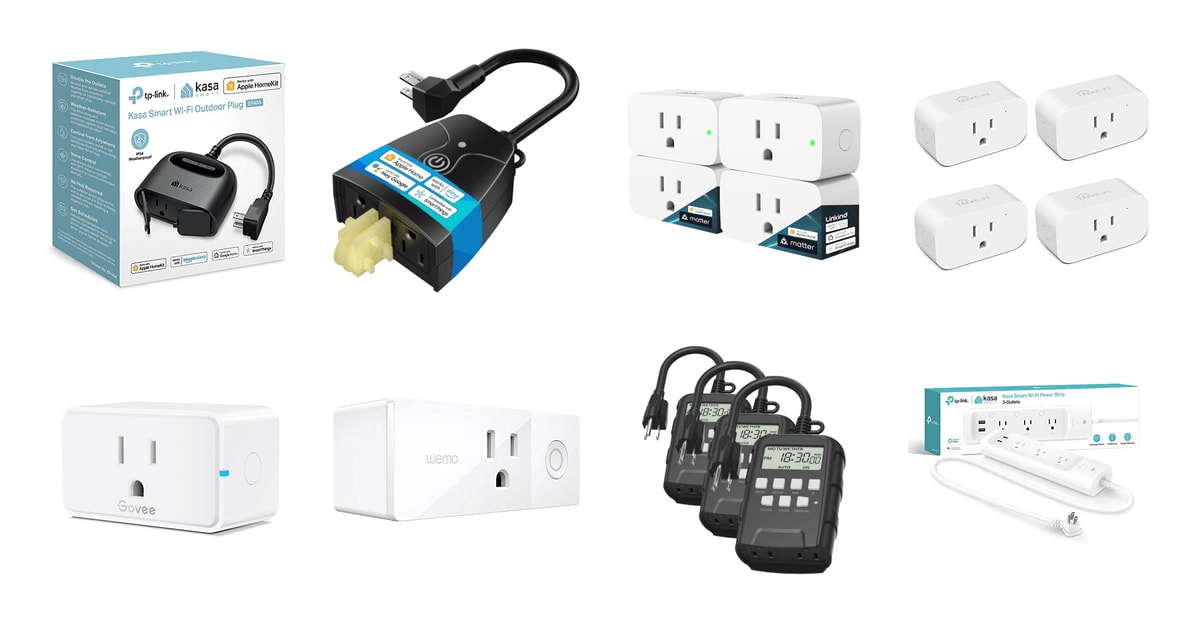
Stringing lights is the fun part. Remembering to unplug them at 11 p.m. in the freezing cold, night after night, is not. An outdoor smart plug fixes that: you set a schedule once in an app, and the lights come on at dusk and shut off while you're asleep. The good ones also let you split your display into zones, so the roofline and the inflatable snowman don't have to share a schedule. And when a neighbor asks you to kill the lights early, you do it from the couch.
Here's the honest part. Every plug in this guide runs on 2.4GHz Wi-Fi, and a weak signal at the far corner of your yard will break the whole illusion — the schedule fires, the plug never hears it. Setup is where most of the one-star frustration lives, especially for HomeKit users chasing QR codes and firmware updates. Weather sealing varies a lot too, and a plug rated only for splashes doesn't belong in an uncovered flower bed. None of these devices solves all three problems at once.
We think that the Kasa EP40A is the best outdoor smart plug for Christmas lights for most people, and that the Meross MSS620HK is the one to buy if you run your home through Apple Home and want Siri in charge of the display.
Everything we recommend

Two outlets, two schedules, and sealing that handles real rain

The pick if Siri and the Home app run your house
No app, no Wi-Fi, nothing to break on Christmas Eve
Three independent zones for a display that keeps growing
Basic app scheduling for a lot less, in a four-pack
At a glance
| Product | Weather Rating | Max Load | Price | |
|---|---|---|---|---|
| Kasa Apple HomeKit Outdoor Smart PlugTop pick | IP64 | 15A/1875W | $25.99 |
| meross Outdoor Smart Plug Work with HomeKitRunner-up | IP44 | — | $25.99 |
 | Linkind Matter Smart PlugAlso consider | — | 15A/1800W | $25.99On sale |
| TREATLIFE 4 Pack Smart Plugs that WorkBudget pick | — | 15A/1800W | $28.04On sale |
 | Govee Smart Plug 15A WiFi Bluetooth OutletAlso consider | — | 15A | $11.03On sale |
 | LNKF7C063 - Belkin Mini Smart PlugAlso in lineup | — | 15A/1800W | $34.63 |
| BN-LINK 7 Day Outdoor Heavy Duty DigitalAlso great | Weatherproof | 1875W | $47.97 |
| Kasa Smart Plug Power StripUpgrade pick | — | — | $29.99 |
How we picked
Weather sealing. We compared published IP ratings against where these plugs actually get used. IP64 or better for anywhere rain, sprinklers, or dew can reach; IP44 only under real overhead cover.
Independent outlets. Holiday displays are rarely one schedule. We favored plugs whose sockets can be programmed separately, since that's the difference between one device and two.
Scheduling that adapts. We looked for 7-day programming at minimum, and gave extra weight to sunrise/sunset geolocation scheduling that tracks December's shifting daylight without you touching the app.
Ecosystem fit. We checked manufacturer compatibility documentation for native Alexa, Google Assistant, HomeKit, and Matter support, and noted which plugs need a home hub for remote control.
Setup and reliability. Owner feedback themes told us where connection headaches cluster — almost always 2.4GHz Wi-Fi negotiation — and which plugs keep their schedules over multiple seasons.
Top pick
Two outlets, two schedules, and sealing that handles real rain
Kasa Apple HomeKit Outdoor Smart Plug
The Kasa EP40A gives you two independently controlled outdoor outlets in one weather-sealed housing, each rated to 15A. It's IP64-sealed against dust and splashes from any direction, and it works with Alexa, Google Assistant, and Siri without a hub.
$25.99fromAmazonTwo outlets that run separate schedules is the feature that matters most for holiday lights. Your roofline probably wants to come on at dusk and shut off at midnight. The inflatable in the yard probably shouldn't run that long. With the EP40A, that's two schedules on one plug, in one app, from one outdoor receptacle. Everything else here either gives you one outlet or ties both outlets to the same timer.
The IP64 rating is the other reason this one wins. IP64 means dust-tight and protected against water splashed from any direction, so the EP40A can live somewhere rain, sprinklers, and morning dew actually reach it. Reviewers at CNET have drawn the line in exactly that place — IP44 is fine under a covered porch, but IP64 or better is what you want anywhere exposed. Most of a holiday display is exposed.
TP-Link rates the plug's Wi-Fi for up to 300 feet of range, which is the spec that quietly decides whether your yard schedule fires. A plug at the end of the driveway is often two exterior walls away from the router. Owners running Christmas lights on these consistently describe the app schedules as set-and-forget, and there are physical buttons on the housing so you can flip a circuit by hand when your phone is dead or the internet is out.
Energy monitoring is built in, showing live wattage and cumulative kWh in the Kasa app. PCMag gave the EP40A an Editors' Choice and pointed at exactly this combination — dual independent outlets plus monitoring — as something single-outlet plugs in the same class don't offer. For an all-LED display the dollars involved are small, since the Department of Energy pegs LED strands at roughly a tenth the cost of incandescent. If you still run old incandescent strands, the numbers get interesting fast.
Flaws but not dealbreakers
Setup can be genuinely rough. Owner feedback splits sharply here: plenty of people are done in five minutes, and a real minority burns an evening on a plug that won't join the network. Most of the pain traces back to 2.4GHz — if your router hides the 2.4GHz band or won't split it out, you'll be digging through router settings before you get anywhere.
The plug body sits at a 90-degree angle, and that shape fights with recessed in-use weatherproof outlet boxes. Owners with those bubble covers have found the EP40A won't seat with the cover closed. Measure your box before you commit. And if you want to control the plug from Apple Home while you're away from the house, you'll need a home hub — a HomePod or Apple TV — sitting on your network.
Runner-up
The pick if Siri and the Home app run your house
meross Outdoor Smart Plug Work with HomeKit
The Meross MSS620HK has two independently controlled outlets and native support for Apple HomeKit, Alexa, Google Assistant, and SmartThings — no hub or bridge needed. Its sunrise and sunset scheduling handles shrinking December daylight for you.
$25.99fromAmazonAlmost no outdoor plug speaks to as many ecosystems as this one does out of the box. HomeKit, Alexa, Google Assistant, and SmartThings, all native, all without a bridge. That matters in a mixed household — an iPhone user and an Echo user can both control the same lights from the interface they already use. Owners who deliberately avoid cloud accounts like that they can set it up and run it entirely inside Apple Home.
It supports sunrise and sunset scheduling, which is more useful in December than it sounds. Between the first of the month and the solstice, sunset in U.S. latitudes drifts by as much as half an hour. A fixed timer means you're either lighting up in daylight or leaving the house dark for twenty minutes each evening, and nudging the time every week. Geolocation scheduling just recalculates each day.
Like our top pick, the two sockets run independently, so a fountain and a light string, or a wreath and a walkway, can keep separate hours. The housing is fire-retardant with overload protection and an ETL certification, and it's rated for LED, CFL, and incandescent bulbs alike. Owners report it holds a connection well over long distances, which Meross credits to the Mediatek radio inside.
Flaws but not dealbreakers
The weather sealing is IP44, not IP64. That's protection against splashing water, and it's meant for a covered porch, a balcony, or a spot under an overhang — not the middle of an open lawn where sprinklers and driving rain hit it directly. If your outlet is exposed, our top pick is the safer choice.
Longevity is the other worry. Some multi-year owners report units that eventually stop taking new programming or drop off HomeKit and need re-pairing. It's not the common experience, but it shows up often enough to note. Setup also takes a couple of tries for some people, though the HomeKit QR code on the unit smooths it considerably for iPhone owners.
Also great
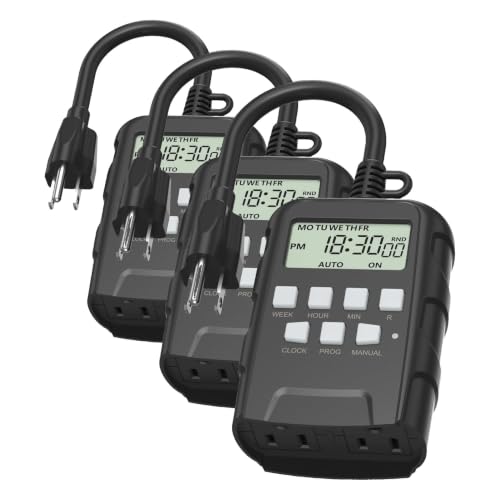
No app, no Wi-Fi, nothing to break on Christmas Eve
BN-LINK 7 Day Outdoor Heavy Duty Digital
The BN-LINK 7-day outdoor digital timer holds up to eight on/off programs across two grounded outlets and needs no phone, account, or internet. It's weatherproof, rated to 1875W, and keeps running when your router doesn't.
$47.97fromAmazonEvery smart plug here shares one failure mode: the schedule lives somewhere other than the plug. Router reboots, an ISP outage, a dead spot at the end of the yard — any of those can leave your display dark. The BN-LINK has no such dependency. You program it with buttons on the face, and it counts the hours whether or not anything else in your house is working.
Eight programs across seven days is more scheduling flexibility than most people will ever use. You can pick individual days or grab a preset combination, set intervals as short as a minute, and flip Daylight Saving mode with a button. There's a random vacation mode too, which shuffles the on/off times to make the house look occupied while you're away for the holidays.
It's built for the job you're buying it for. The housing is flame-retardant PC plastic rated for outdoor use, both outlets are grounded, and it handles 1875W — which, at the 15A residential standard, covers 40 to 50 strands of LEDs. This particular listing ships as a three-pack, so if you've got a display that sprawls across the front and side of the house, you can put a timer at each outlet.
Flaws but not dealbreakers
The two outlets switch together. There's no way to give the porch lights one schedule and the yard display another on a single unit — you'd need a second timer. Our top pick handles that from one device.
You give up everything the smart plugs do well. No phone control from the office, no voice commands, no shutting the lights off from bed, no sunrise/sunset tracking as December daylight shrinks. Reprogramming means walking outside in the cold and pressing small buttons, sometimes with gloves off. That's the trade.
Upgrade pick
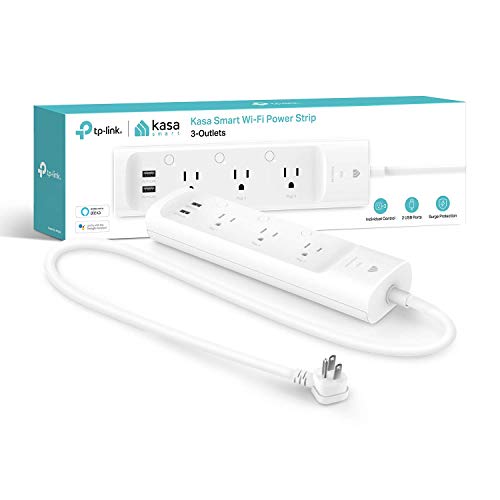
Three independent zones for a display that keeps growing
Kasa Smart Plug Power Strip
The Kasa KP303 power strip puts three independently controlled smart outlets and two always-on USB ports in a single housing with surge protection. It's the practical answer when one outdoor receptacle has to feed a whole yard's worth of lighting zones.
$29.99fromAmazonIf you're the house everyone drives past, three separately timed outlets beats juggling three separate plugs. Roofline, walkway, and the inflatables can each keep their own hours from one strip, controlled in one app. You skip the daisy-chained power strips and the tangle of adapters that a big display usually turns into by the second weekend of December.
Owners describe the KP303 as one of the more dependable things in their smart home, running for years without dropping off the network. It works with Alexa and Google Assistant, sets schedules per outlet, and carries ETL-certified surge protection — worth having when a winter storm knocks the grid around. The two USB ports stay powered all the time, which is handy for whatever's charging nearby.
It's also the flexible choice for the eleven months when nothing is blinking. A three-outlet smart strip earns its keep behind a TV, under a workbench, or over a grow light once the lights come down. Some of the picks here are seasonal by nature. This one isn't.
Flaws but not dealbreakers
This is the big one: the KP303 is not weatherproof. It has no IP rating and no sealed housing, so it needs to live indoors, in a garage, or inside a genuinely weathertight outdoor enclosure with the cords running out. Used the way most people use it for holiday lights — indoor strip, extension cords through a window or garage — it's fine. Left out in the rain, it isn't.
It's a full 10 inches long and takes up real space. And with three outlets plus USB, you'll want to keep the total load in mind rather than assuming each socket gets the full 15A to itself.
Budget pickOn sale
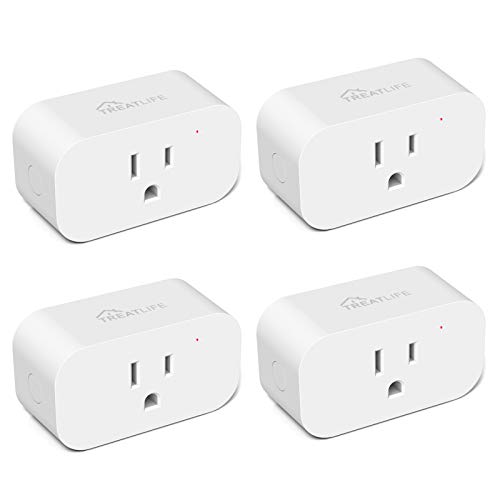
Basic app scheduling for a lot less, in a four-pack
TREATLIFE 4 Pack Smart Plugs that Work
Treatlife's smart plugs handle 7-day programmable schedules, Alexa and Google voice control, and 15A/1800W loads. They ship four to a box, so you can put every zone of a display on its own timer without spending much.
$28.04fromAmazonList priceBuying four plugs at once changes how you decorate. Instead of one schedule for the whole yard, each strand or zone gets its own — tree, porch, walkway, garage — and you group them in the app to flip everything at once. Owners who replaced a drawer of old mechanical timers with these describe exactly that upgrade, and they lean on them season after season.
The scheduling covers what holiday lights actually need. Seven-day programming, on/off timers, group control across plugs, and sharing so your partner can run the lights from their phone too. There's a child lock to stop small hands from cycling the display, and an away mode that randomizes on/off times while you travel. The plugs are rated 15A/1800W, so a heavy LED run is no problem.
One thing to plan for: these plugs are meant for indoor and sheltered use, not open weather. In practice that means running them inside the garage or house with extension cords out to the display, which is how a lot of people wire holiday lights anyway. If your outlet is out in the open and uncovered, buy a sealed plug instead.
Flaws but not dealbreakers
Setup is the recurring complaint, and it's mostly an app problem. You have to install the Treatlife app first and link it to Alexa through the skill — adding the plug directly in the Alexa app won't work, and people who try that route lose a good half hour. Get the order right and it's quick.
There's no energy monitoring and no HomeKit support. And, again, no outdoor rating: a splash of rain on one of these is not something the housing is designed for.
Who this is for
Buy one of these if you're tired of walking outside twice a day from Thanksgiving to New Year's, or if you'd like the lights to run themselves while you're out of town. They're also the easy on-ramp if you want holiday lighting folded into an Alexa or Google routine, or controlled by Siri from the Home app. Heavy decorators with several zones get the most out of them, because independent outlets and grouping are what turn a sprawling display into one tap.
Skip them if your Wi-Fi barely reaches the front yard, or if the idea of debugging a router band in December sounds worse than flipping a switch — a plain digital timer will serve you better. This guide covers plugs and timers that switch power to lights you already own. It doesn't cover the light strands themselves, permanent eave lighting, or smart bulbs, and it doesn't cover indoor-only plugs except where they're a sensible pick used indoors with cords run outside.
How we picked
We built the shortlist around the things that decide whether a holiday display runs itself or annoys you. Weather sealing: IP64 or better for exposed outlets, IP44 only under solid cover, with anything unrated confined to indoor or garage duty. Independent outlets: sockets that can hold separate schedules, so roofline and yard décor don't have to share. Scheduling: 7-day programming at a minimum, with sunrise/sunset geolocation tracking rated higher because December daylight shifts by up to half an hour in three weeks. Ecosystem fit: native Alexa, Google Assistant, HomeKit, or Matter support per the manufacturer's documentation, and clarity about when a home hub is required. Capacity: the 15A/1875W residential standard, which covers 40 to 50 LED strands but only five or six incandescent. Setup and reliability: owner feedback themes about 2.4GHz connection trouble, app quality, and whether schedules keep firing season after season.
Other outdoor smart plugs for christmas lights worth considering
If you want Matter certification and a four-pack: The Linkind Matter Smart Plug ($25.99) — The Linkind Matter plug skips brand apps entirely — you add it straight to Apple Home, Alexa, Google Home, or SmartThings, and because Matter devices talk over your local network, schedules keep running if your internet drops. Owners with Home Assistant setups like it a lot. It's an indoor plug, though, so it belongs inside with cords run out to the display, and a handful of Apple Home users report pairing that sticks at first and then falls apart. Buy it for flexibility, not for weather.
If you already live in the Govee app: The Govee Smart Plug 15A WiFi Bluetooth Outlet ($11.03) — The Govee smart plug is a compact 15A single-outlet plug with both Wi-Fi and Bluetooth, which makes the initial pairing noticeably less painful than most. Owners consistently call setup fast and the app clean, and they use these on Christmas trees and animated decorations year after year. It works with Alexa and Google Assistant, and it's small enough to leave the second socket on a duplex outlet free. There's no HomeKit support, no outdoor rating, and only one controllable outlet — so it's an indoor plug for a single zone.
The competition
This is what our research turned up, not a census of everything you can buy. New outdoor plugs appear every fall, and plenty of solid ones aren't here. What follows is the rest of the lineup we looked at and why each one lost to a pick.
The LNKF7C063 - Belkin Mini Smart Plug ($34.63) — The Belkin WeMo Mini Smart Plug does something none of the others do quite as well: it syncs schedules to sunrise and sunset using your location, recalculating daily so you never re-enter times as December daylight shrinks. It also works with Alexa, Google Assistant, and Apple Home without a hub, and has a randomized away mode. But it's an indoor plug with no weather sealing, and owner feedback over the years describes a rocky app and firmware experience — devices going missing from the app, setups that need several attempts. If you're already invested in WeMo and want that sunset tracking, it still earns a spot indoors. Otherwise the Meross gives you sunrise/sunset scheduling in a housing that can go outside.
Installation notes
Two things sink most holiday-light setups, and both are fixable before you climb a ladder. First, get the plug on 2.4GHz Wi-Fi — nearly every model here refuses 5GHz outright. If your router broadcasts one merged network name, temporarily disable the 5GHz band during pairing, then turn it back on. Second, respect the load. A 15A outlet tops out around 1,875 watts, which is roughly 40 to 50 LED strands but only five or six incandescent ones, so count your strands before daisy-chaining. Mount exposed plugs so the cord exits downward, letting water drip away instead of pooling in the socket. Check the plug's shape against your weatherproof outlet cover — angled bodies often won't let the bubble close. And expect Wi-Fi radios to get flaky below about -20°F even on units rated to -4°F.
Questions we get
Do outdoor smart plugs work in freezing temperatures?
Most are rated to operate down to about -4°F, which covers the great majority of U.S. and Canadian winters. Below roughly -20°F, the Wi-Fi radio can get unstable even when the plug still switches power. If you live somewhere that regularly hits those temperatures, a non-Wi-Fi digital timer is the safer bet.
What IP rating do I need for Christmas lights?
IP64 is the number to look for if the plug sits anywhere rain, sprinklers, or heavy dew can hit it — it means dust-tight and protected against water splashed from any direction. IP44 is only adequate under real overhead cover, like a deep porch. CNET's smart home editors have made the same distinction, and it's the reason our top pick is IP64.
Can I use an indoor smart plug outdoors?
Not directly exposed, no. Indoor plugs have no seals against moisture, and condensation alone can cause a problem. The common workaround is to keep the plug inside the house or garage and run an outdoor-rated extension cord out to the lights, which is how several picks in this guide get used.
How many strands of lights can one plug handle?
A standard 15A outdoor circuit tops out at 1,875 watts. That's roughly 40 to 50 strands of LED lights, or only five or six strands of traditional incandescent — a huge difference. Add up the wattage printed on your strand tags before you connect them all in a chain.
Will these work on a 5GHz Wi-Fi network?
No. Essentially every mainstream outdoor smart plug — Kasa, Meross, Govee, WeMo, Treatlife — needs 2.4GHz and won't join a 5GHz-only network no matter how strong the signal is. If your router combines both bands under one name, you may need to split them or disable 5GHz briefly while pairing.
Do these support automatic sunrise and sunset scheduling?
Some do. The Meross and WeMo plugs use your location to recalculate on and off times daily, which matters because sunset shifts by up to half an hour between early and late December. Fixed timers require you to nudge the schedule manually as the days shorten.
Why you should trust us
For this guide:
- We read manufacturer specification sheets for every plug here, comparing IP ratings, load capacity, operating temperature ranges, and which smart home platforms each one supports natively.
- We reviewed published coverage from outlets including PCMag, CNET, Tom's Guide, and Consumer Reports, along with Department of Energy figures on holiday lighting consumption and the Connectivity Standards Alliance's documentation of Matter.
- We read through owner feedback for each product to find the patterns that specs don't show — where setup goes wrong, which plugs keep their schedules over several seasons, and which housings won't fit a recessed weatherproof outlet cover.
- We read owner reviews on every listing, weighted toward the critical ones, because that is where the recurring failures show up.
- We have a systematic way of automatically fetching the latest prices, so the numbers on this page stay current.
- This is a research-focused guide, so the team may not own every product listed — though we often do own the top winners, which gives us extra context for the recommendations.
- We don't accept free products, and the retailer commission never changes which product we recommend.
Sources
Best Smart Plugs 2026 — Wirecutter, Wirecutter
Best Outdoor Smart Plugs — CNET, CNET
Best Outdoor Smart Plugs — Tom's Guide, Tom's Guide
Best Smart Plugs — PCMag, PCMag
Smart Plugs Buying Guide — Consumer Reports, Consumer Reports
LED Lighting Energy Savings — U.S. Department of Energy, U.S. Department of Energy
Kasa EP40A Official Specifications — TP-Link, TP-Link/Kasa (Manufacturer)
Meross MSS620HK Smart Outdoor Plug — Meross, Meross (Manufacturer)
Matter Smart Home Standard Explained — The Verge, The Verge
Best Christmas Light Timers — Good Housekeeping, Good Housekeeping
Best Outdoor Smart Plugs — ZDNet, ZDNet
Best Outdoor Smart Plugs — Bob Vila, Bob Vila
Amazon product listings and owner reviews for all 8 products
Manufacturer specification pages for each product
Some passages in this guide may be paraphrased with AI help. Prices are refreshed automatically.
More like this.
Continue exploring electronics reviews and recommendations.

The Best Smart Light Bulbs
A smart bulb earns its keep in the small moments. You're carrying groceries and the kitchen lights come on by themselves. You're already in bed when you…

The Best Outdoor Solar Garden Lights
Solar garden lights solve a problem that used to mean digging a trench. You want the front walk lit so nobody trips on the step, or the back fence lit so…

The Best Outdoor Motion Sensor Lights
A good outdoor motion light does three unglamorous jobs. It keeps you from missing a step on a dark walkway, it makes your house a less appealing target…

The Best Outdoor Smart Home Security Cameras
An outdoor camera earns its keep in small moments. A package shows up while you're at work. Something knocks over the recycling bin at 2 a.m. A contractor…

The Best Smart RGB LED Strip Lights for Bedrooms
Bedroom light gets used in a specific way. You want a soft glow behind the headboard at night, something bright enough to find a charging cable, and a…

The Best Outlet Covers and Plug Protectors
A crawling baby finds the outlet behind the couch faster than you'd think. Electrical outlets and cords sit near the top of the home hazard list for kids…