The Best Smart RGB LED Strip Lights for Bedrooms
Bedroom light gets used in a specific way. You want a soft glow behind the headboard at night, something bright enough to find a charging cable, and a color that won't jolt you awake at eleven. A good smart strip does all three from your phone or a voice command. It tucks into a shelf lip or crown molding and disappears. The light shows up; the hardware doesn't. That's really the whole job, and most strips only get part of it right.
Here's the honest part: no strip nails everything. Cheap ones show a row of colored dots instead of a line of light, and their adhesive gives up on painted drywall within a few months. Pricier ones fix the light quality but lean on apps that push accounts, ads and firmware updates you didn't ask for. Controllers tend to die before the LEDs do. And almost every strip trades color punch for clean warm white, or the other way around.
So the question isn't which strip is perfect. It's which compromise you can live with in a room where you sleep. We weighed how the light actually looks on a wall, whether the colors can change across the strip instead of all at once, how warm the white gets, and whether the app stays usable. We think that the Govee COB LED Strip Light Pro is the best smart RGB LED strip light for bedrooms for most people, and that the Kasa Smart LED Light Strip is the one to buy if you want a simpler strip from a brand with a long track record in smart home gear.
Everything we recommend

A smooth, dot-free glow with real warm white in the mix
Fewer tricks, but the app and the connection stay boring
Enough strip to wrap a whole room, if you keep it simple
Brighter light and 24 true color zones, if you'll pay for it
At a glance
| Product | Length | Smart Platform | Price | |
|---|---|---|---|---|
| Govee 9.8ft COB LED Strip Light ProTop pick | 9.8ft | HomeKit, Alexa, Google | $99.99 |
 | Philips Hue Play Gradient 65" Smart TVAlso in lineup | 65-Inch | Hue Bridge | $156.95 |
| DAYBETTER LED Strip Lights 110ft 1Roll RGBBudget pick | 110ft | — | $9.99On sale |
| LIFX Supercolor Smart LED Strip Lights 10ftUpgrade pick | 10ft (120in) | HomeKit, Alexa, Google | $49.98 |
| Kasa Smart LED Light StripRunner-up | 16.4ft | Kasa App | $24.99 |
 | Nanoleaf Lines WiFi Smart RGBW 16M ColorAlso consider | — | Nanoleaf App | $199.99 |
 | Govee TV Backlight 3 LiteAlso consider | 11.8ft | Govee Home App | $69.99On sale |
How we picked
Color mixing. We separated RGBIC strips, which show several colors at once, from plain RGB strips, which can't. Spec sheets and published reviews made the split obvious, and it's the biggest single difference in how a strip reads on a wall.
Warm white quality. We favored strips with a dedicated white chip or tunable white, since the Sleep Foundation ties blue-heavy light above 5000K to melatonin suppression of up to 85%. A bedroom strip needs to go warm and dim, not just colorful.
App and connection. We read owner feedback for the patterns that surface after a few months — Wi-Fi drops, forced accounts, updates that break saved scenes. Matter or Thread support counted as a hedge against an app being abandoned.
Adhesive and mounting. CNET's adhesion comparisons found premium 3M VHB backing outlasted generic tape by about three to one over six months. We noted which strips ship with the good stuff and which ones owners end up re-taping.
Length and brightness. We looked for 16 to 33 feet of usable run, which covers most bedrooms, and 400 to 800 lumens per meter for ambient light. Anything meant to light the room rather than accent it needed more.
Top pick
A smooth, dot-free glow with real warm white in the mix
Govee 9.8ft COB LED Strip Light Pro
This is a COB strip, so the LEDs sit under a silicone sleeve and blend into one continuous line instead of a string of dots. It also mixes a dedicated warm-white chip with RGBIC color, which means it can be a reading light or a party light.
$99.99fromAmazonThe light looks like a line, not a row of bulbs. Older strips space their LEDs out, so you see dots on the ceiling above a shelf. This one packs 1,260 LEDs per meter under a diffusing sleeve, and owners consistently describe the result as dot-free even up close. On a headboard or under a floating nightstand, that's the difference between a designed room and a dorm-room hack.
The warm-white chip matters more in a bedroom than the color does. Most RGB strips fake white by firing red, green and blue together, and the result skews blue or green. Govee adds a real white lamp bead to the mix, so you can drop it to a soft, low glow at bedtime. The Sleep Foundation ties blue-heavy light above 5000K to melatonin suppression of up to 85%, which is a good reason to save the cool scenes for daytime.
You also get segment control, which is the whole point of RGBIC. The Govee Home app splits the strip into twelve segments per meter, so one stretch can sit peach while the next runs lavender. Gradients and chase effects need that; a plain RGB strip can only be one color at a time. Music sync runs off the app's mic, so it reacts to whatever's playing in the room rather than to a cable.
It speaks Matter, which not many strips at this level do. That means it pairs with HomeKit, Alexa, Google Home and SmartThings without a hub or a bridge, and it should keep working if you switch platforms later. The CSA Alliance counts more than 4,000 Matter-certified devices across 600-plus brands, with strip lights among the fastest-growing categories. Buying into that standard now is decent insurance against a dead app three phones from now.
Flaws but not dealbreakers
Ten feet doesn't go far. Run it along a queen headboard and you've used most of the reel; wrap a whole room and you'll need several, plus an outlet for each one. Govee sells longer COB Pro runs, but this is the short version, so measure the wall before you order.
It's genuinely bright, and that cuts both ways. Owners who wanted a subtle accent report dialing it down to single-digit brightness to keep it from lighting the entire room. A few also report a reel arriving with a dead or mismatched section — not common, but power the whole run on before you commit the adhesive.
Runner-up
Fewer tricks, but the app and the connection stay boring
Kasa Smart LED Light Strip
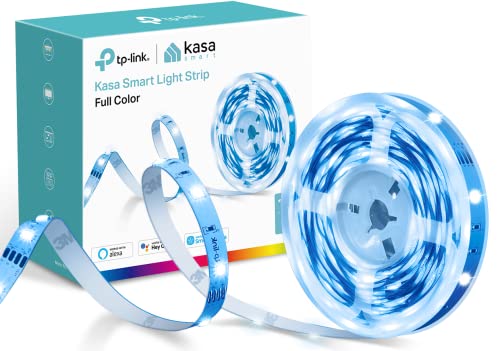
The Kasa strip does the basics without drama: millions of colors, animated presets, schedules, and Alexa or Google voice control with no hub. TP-Link has shipped smart home gear for years, and the app shows it — setup takes a few minutes and then stays out of your way.
$24.99fromAmazonMost strip-light frustration is software, not hardware. Lights drop off Wi-Fi, the app logs you out, a firmware update breaks a scene you set up months ago. Kasa is the one people with a shelf full of smart plugs keep recommending, and owners running home automation setups say it slots in cleanly. If you mainly want the lights to come on at sunset and keep working, that counts for a lot.
At 16.4 feet, it covers a real bedroom. That's enough to run the perimeter of a headboard wall, or the top of a wardrobe with slack to spare. It bends around corners and cuts to length, and the 3M backing is standard-issue — fine on clean, smooth paint, less reliable on texture. It also groups with other Kasa devices, so one scene can dim the strip and kill a lamp together.
The animated scenes are better than what you get on most generic strips. Set a slow color drift for winding down, or something faster when friends are over. Scheduling is where it really earns its place in a bedroom, though. A warm fade-up in the morning beats an alarm, and a hard off at midnight means you stop leaving the things on all night by accident.
It isn't an RGBIC strip, and that's the trade. The whole run shows one color at a time, so you get color changes, not gradients. For plenty of bedrooms that's fine — you're picking a mood, not staging a light show. But if the flowing multi-color look is the reason you want a strip at all, get the Govee or the LIFX instead.
Flaws but not dealbreakers
Single-zone color is the big limitation. No gradients, no chase effects, and music sync isn't a strength. There's no dedicated white chip either, so white gets mixed from color LEDs and reads a little off next to a warm bulb.
Owners occasionally report a segment going dark after a few weeks. TP-Link gets good marks from owners for replacing failed units, but you'll need to register the product and wait out a support ticket.
Budget pickOn sale
Enough strip to wrap a whole room, if you keep it simple
DAYBETTER LED Strip Lights 110ft 1Roll RGB
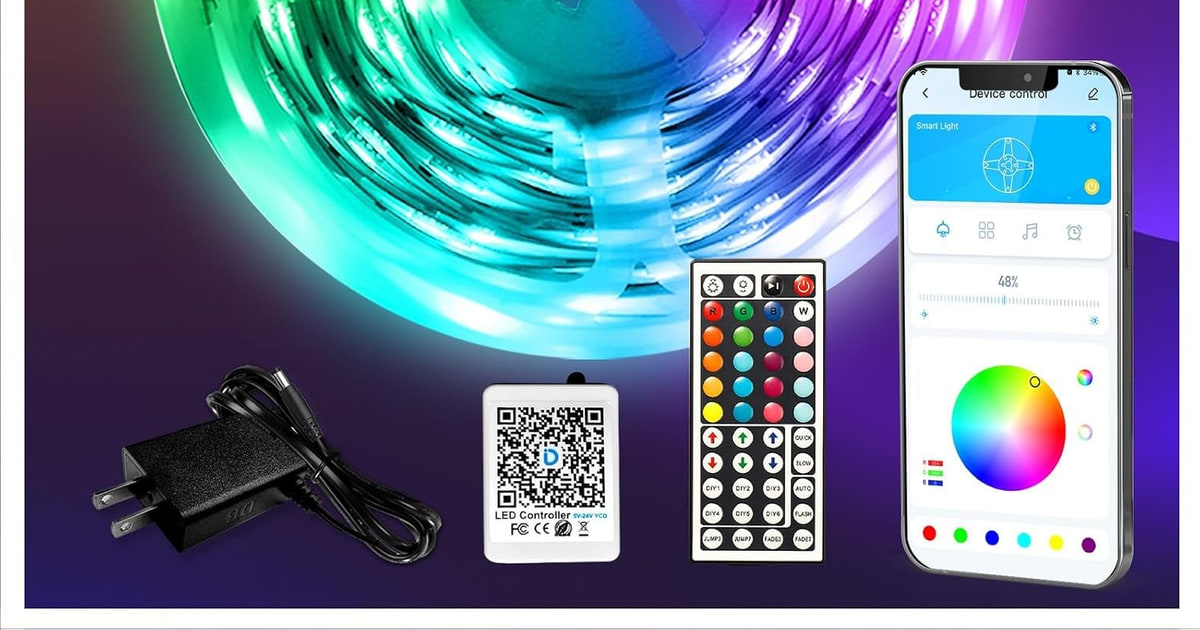
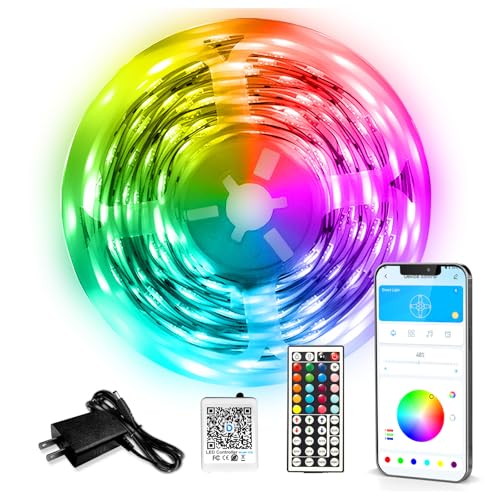
This is 110 feet on a single roll, which is more strip than most bedrooms will ever need. You control it with a phone app or a 44-key infrared remote, and it syncs to music through your phone's mic — basic tools, but they cover how most people actually use these.
$9.99fromAmazonList priceLength is the whole pitch, and it delivers on that. One roll covers the ceiling perimeter of a bedroom, the closet and the desk with plenty left over. If you're decorating a teen's room or a first apartment and want light along every edge, one long roll beats four short ones with four controllers and four outlets to hide. Owners say the run is easy to trim down and share across rooms.
The controls are simpler than the smart strips above, and that isn't always a downside. The remote sits on the nightstand and changes color without unlocking your phone. The app handles timers, color memory and music sync, so the lights can turn themselves on at dusk and off when you're asleep. Owners say installation takes minutes and the adhesive holds well on clean, smooth paint.
Understand what you're buying: standard 5050 RGB LEDs, not RGBIC. The strip shows one color at a time, whites are mixed from color LEDs and lean cold, and the diodes sit far enough apart to show dots on a nearby surface. Tucked into a ceiling cove where you only see the glow, that hardly matters. Pointed at a wall two feet away, it does.
Flaws but not dealbreakers
Quality control is the real risk here. With this much strip on one reel, owners report the occasional dead stretch or a section that flickers out of step with the rest — a miserable discovery after you've stuck forty feet to the ceiling. Unroll the whole thing and power it on before you install any of it. The manual asks for the same.
There's no Matter, HomeKit or Thread, and the listing doesn't promise voice assistant support. Treat this as a good-looking basic strip with an app attached, and you'll be happy with it.
Upgrade pick
Brighter light and 24 true color zones, if you'll pay for it
LIFX Supercolor Smart LED Strip Lights 10ft
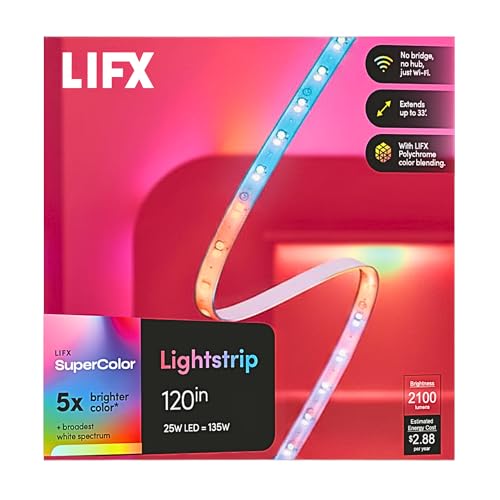
The Supercolor is far brighter than anything else here — 2,100 lumens from a 10-foot run — and it splits into 24 addressable zones that each hold their own color. It connects straight to 2.4GHz Wi-Fi and works with HomeKit, Alexa and Google Home without a hub.
$49.98fromAmazonGet this one if the strip is doing real work, not just accent. Twenty-one hundred lumens over ten feet can light a small bedroom by itself. PCMag measured LIFX's color-zone strips at up to 1,050 lumens per meter, roughly double what typical budget strips put out. If you want to bounce light off the ceiling and actually read under it, nothing else on this list comes close.
The 24 zones each run their own color simultaneously, so gradients look like gradients instead of a slow fade between two states. LIFX leans into that with themed scenes — sunrise, vaporwave, holiday presets — and an EQ visualizer that moves the zones with the beat. It's the closest thing here to a light show that doesn't look cheap, and you can still drop it to one warm tone for bed.
HomeKit support without a bridge is rarer than it should be, and it's a real reason to choose this strip. Siri, Alexa and Google all talk to it directly over Wi-Fi, with no extra hardware in a cabinet somewhere. You can also chain it out to 33 feet on one wall plug using extension strips, which keeps the cord situation behind a bed manageable.
Flaws but not dealbreakers
The LEDs are visible. Owners who mount it somewhere you can see the strip itself — under a shelf edge, along a headboard rail — often end up buying an aluminum channel and a milky diffuser, which adds cost and a second afternoon of work. Hidden in a cove where you only see the wash, it's a non-issue.
The app has a rocky reputation. Some owners describe drops from Wi-Fi, flickering after firmware updates, and scene setup that takes more fiddling than it should. Most people get through setup fine, but this isn't the strip to buy if you want to mount it once and never open an app again.
LIFX backs the Supercolor strip with a two-year warranty.
Who this is for
Buy one of these if your bedroom feels unfinished after dark — a bare ceiling, a headboard with nothing behind it, a desk that's lit by a laptop screen. A strip fixes that for less effort than any other kind of lighting, and it's renter-friendly since nothing gets drilled. It's also a good fit if you're building a sleep routine and want a warm fade-down at night and a gentle fade-up in the morning. Skip it if you need real overhead light for getting dressed. A strip is accent lighting first, and only the brightest one here doubles as a room light.
This guide covers plug-in smart strips and modular wall lights you mount yourself, indoors, in a bedroom. It doesn't cover hardwired channel lighting, ceiling fixtures, outdoor-rated strips, or battery-powered motion night lights, which solve a different problem. It also assumes you're on 2.4GHz Wi-Fi, since almost every strip here needs it.
How we picked
We ranked these on five things. Color mixing: RGBIC strips can hold several colors across the run at once, and plain RGB strips can't, so gradients and chase effects only work on the former. Warm white: we favored a dedicated white chip or tunable white, because a bedroom strip has to go soft and warm at night, not just bright and blue. App and connection: we weighed the complaints that repeat in owner feedback — dropped Wi-Fi, broken scenes after updates — and treated Matter or Thread support as future-proofing. Adhesive: premium 3M VHB backing held roughly three times longer than generic tape in CNET's six-month comparisons. Length and brightness: 16 to 33 feet covers most bedrooms, and 400 to 800 lumens per meter is the ambient sweet spot.
Other smart rgb led strip lights for bedrooms worth considering
If you want the lights themselves to be the decor: The Nanoleaf Lines WiFi Smart RGBW 16M Color ($199.99) — Nanoleaf Lines aren't a strip at all. They're modular light bars you arrange into a geometric pattern on the wall, glowing back at the paint rather than pointing at you. The starter kit gives you nine lines and mounting tape, and you can add more later. They run on Thread and Matter, and 9to5Mac clocked Thread devices under 100ms of control latency against 300 to 700ms for Wi-Fi-only lights, so scene changes feel instant. What you give up is flexibility and light per dollar: you can't hide these behind a headboard, the layout takes planning, and owners report controller failures with replacement parts often out of stock.
If you want lighting that follows what's on screen: The Govee TV Backlight 3 Lite ($69.99) — The Govee TV Backlight 3 Lite mounts a small camera on your TV and matches the strip behind it to the picture in real time, with fish-eye correction to keep the edge colors honest. It uses the same RGBICW lamp beads as our top pick, so warm white is in the mix, and DreamView can pull other Govee lights in the room into the same effect. If your bedroom TV is where you actually spend the evening, it's more fun than any music-sync mode. The catch is that it's built for a 55- to 65-inch set — it's sized to that TV, not to your walls, so it complements a general room strip rather than replacing one.
The competition
This is what our research surfaced, not a survey of everything on the market. Strip lights turn over quickly and plenty of good ones never make a review round-up. Here's the one we looked at closely and didn't pick, and who might still want it.
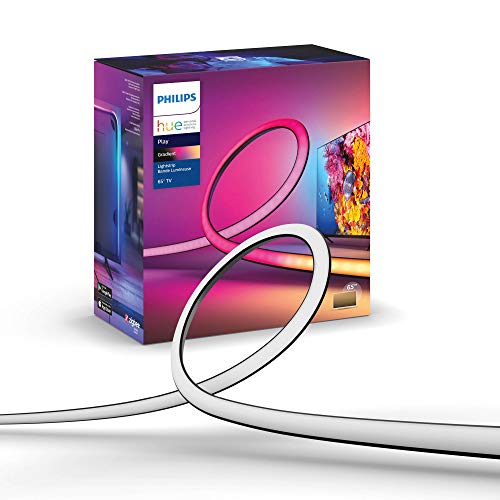
The Philips Hue Play Gradient 65" Smart TV ($156.95) — The Philips Hue Play Gradient Lightstrip has the best light quality in this group and it isn't close. Smart Home Solver measured a Hue gradient strip at CRI 92 with 80% Rec. 2020 coverage, the highest color accuracy in their smart-strip round-up, and Hue's ecosystem is the most dependable in smart home lighting. It lost on fit and cost of entry. This version is cut and bracketed for a 65-inch TV, not for a headboard or a ceiling cove, and it needs both a Hue Bridge and a Sync Box, sold separately, before the screen-sync features work at all. Owners also flag the mounting brackets as the weak point, with strips working loose from the back of the TV. Buy it if you already run Hue, have a large TV in the bedroom, and want the most accurate color you can get.
Installation and mounting
Adhesive failure is the most common complaint about every strip here, and most of it is preventable. Wipe the surface with isopropyl alcohol and let it dry completely — dust and drywall residue kill 3M tape faster than weight does. Press the strip down along its whole length for about thirty seconds rather than tacking it as you unroll. Warm the wall and the tape a little first if the room is cold. Don't fold the strip hard at corners; use the included brackets or a gentle curve, since a sharp crease can break a trace inside. Cut only at the marked intervals, every 8cm on the Govee, and remember that cut ends need connectors to rejoin. Finally, unroll the full run and power it on before anything touches the wall.
Questions we get
What's the difference between RGB and RGBIC LED strip lights?
A plain RGB strip shows one color across its entire length at a time. An RGBIC strip splits into independently controlled segments, so one part can be blue while another is orange. That's what makes gradients, chase effects and convincing music sync possible. If the flowing multi-color look is why you want a strip, you need RGBIC.
How many feet of LED strip do I need for a bedroom?
Most bedrooms need 16 to 33 feet. Measure the specific run you're lighting rather than the room: a headboard wall is usually 8 to 12 feet, a full ceiling perimeter in an average bedroom is closer to 40. Buy a bit more than you measured, since corners eat length and you can always cut at the marked intervals.
Can smart LED strips work without Wi-Fi or a hub?
Some can. Strips with a Bluetooth or infrared remote will change color and brightness with no network at all, though you lose scheduling and voice control. Wi-Fi strips like the Kasa and the LIFX need your 2.4GHz network but no hub. Only the Philips Hue here requires a separate bridge, and its sync features need a sync box on top of that.
Do LED strip lights use a lot of electricity?
No. The U.S. Department of Energy puts a typical 16.4-foot smart strip at 12 to 24 watts at full brightness, about 75% less than an incandescent equivalent. Running one for a few hours each evening costs almost nothing. They're also long-lived — a 50,000-hour rating works out to roughly 17 years at eight hours a day.
What color temperature is best for a bedroom?
Warm white, in the 2700K to 3000K range, for anything you use in the evening. The Sleep Foundation links blue-heavy light above 5000K to melatonin suppression of up to 85%, which is exactly what you don't want an hour before bed. Strips with a dedicated warm-white chip, like our top pick, handle this much better than strips that mix white from color LEDs.
How do I stop LED strip lights from falling off the wall?
Clean the surface with isopropyl alcohol first and let it dry — that alone solves most failures. Press the strip firmly for about thirty seconds instead of tacking it lightly as you unroll. Textured or freshly painted walls are the hardest cases, and there you're better off with small mounting clips or an aluminum channel. CNET's comparisons found premium 3M VHB backing held roughly three times longer than generic tape.
Why you should trust us
For this guide:
- We read the manufacturer spec sheets for every strip here alongside published measurements from PCMag, Tom's Guide, CNET, 9to5Mac and Smart Home Solver covering brightness, zone counts, sync latency, color accuracy and adhesive longevity.
- We compared owner feedback across each listing for the complaints that repeat — adhesive letting go, dead segments, apps dropping off Wi-Fi — rather than one-off problems.
- We relied on the U.S. Department of Energy for energy and lifespan figures and the Sleep Foundation for guidance on color temperature in bedrooms.
- We read owner reviews on every listing, weighted toward the critical ones, because that is where the recurring failures show up.
- We have a systematic way of automatically fetching the latest prices, so the numbers on this page stay current.
- This is a research-focused guide, so the team may not own every product listed — though we often do own the top winners, which gives us extra context for the recommendations.
- We don't accept free products, and the retailer commission never changes which product we recommend.
Sources
Best LED Strip Lights 2025 — The Verge, The Verge
Best Smart LED Strip Lights — Wirecutter / NYT, Wirecutter
LIFX Lightstrip Color Zones Review — PCMag, PCMag
Govee LED Strip Lights Review — Tom's Guide, Tom's Guide
Smart Lighting Market Report 2025 — Grand View Research, Grand View Research
Matter Smart Home Standard Update — CSA Alliance, CSA Alliance (Connectivity Standards Alliance)
LED Strip Light Energy Use Analysis — Energy Star / DOE, U.S. Department of Energy / Energy Star
Philips Hue Gradient Lightstrip Plus Review — Smart Home Solver, Smart Home Solver
Best LED Strip Lights — CNET 2025, CNET
Wyze Light Strip Pro Review — Android Central, Android Central
Nanoleaf Lines Matter Update — 9to5Mac, 9to5Mac
LED Strip Light Sleep & Circadian Rhythm Impact — Sleep Foundation, Sleep Foundation
Amazon product listings and owner reviews for all 7 products
Manufacturer specification pages for each product
Some passages in this guide may be paraphrased with AI help. Prices are refreshed automatically.
More like this.
Continue exploring home reviews and recommendations.

The Best Permanent LED Eave Lighting Kits
Permanent eave lights live under your roofline all year and do two jobs. Most nights they're a warm white accent that makes the house look finished and…

The Best LED String Lights for the Holidays
String lights are the rare decoration you interact with every single day of the season. You plug them in at dusk, you glance at them while washing dishes,…

The Best Rechargeable LED Work Lights
Most of the time you need a work light, both of your hands are already busy. You're under a hood chasing a dropped bolt, or up in an attic splicing wire,…

The Best LED Face Masks and Red Light Therapy Devices
Red light therapy asks very little of you and gives back slowly. You put on a mask, sit still for a few minutes, and repeat that several times a week for…

The Best Aquarium LED Lighting
The light over your tank does more work than anything else you'll buy for it. It decides whether your plants carpet the substrate or melt into brown mush,…

The Best Outdoor Smart Plugs for Christmas Lights
Stringing lights is the fun part. Remembering to unplug them at 11 p.m. in the freezing cold, night after night, is not. An outdoor smart plug fixes that:…