The Best Rechargeable LED Work Lights
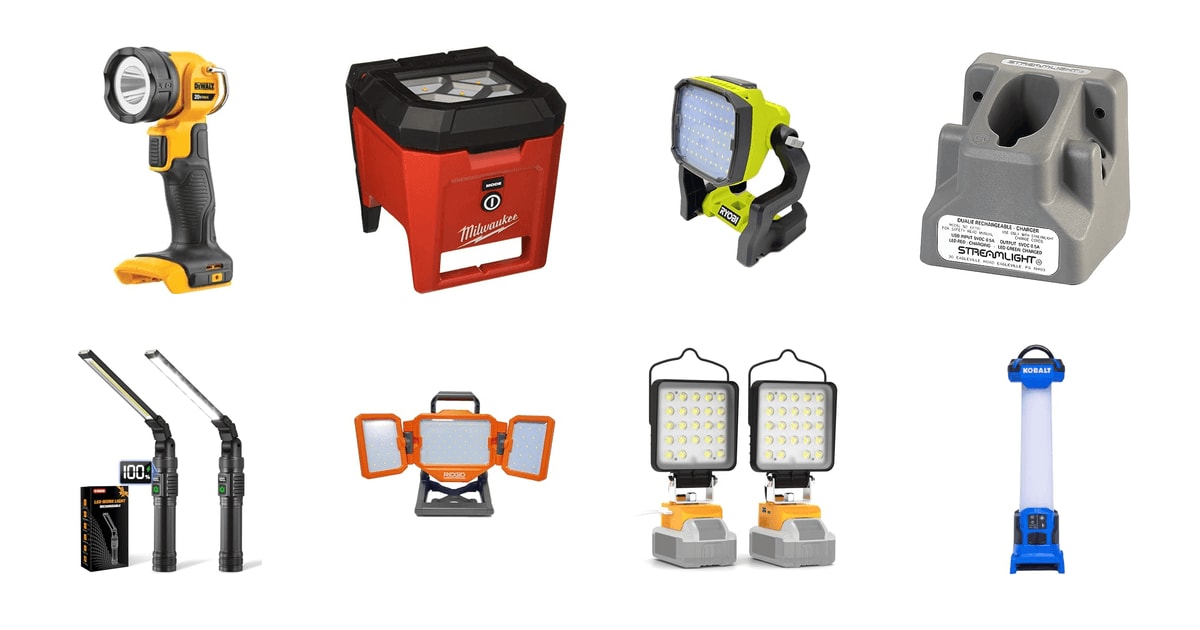
Most of the time you need a work light, both of your hands are already busy. You're under a hood chasing a dropped bolt, or up in an attic splicing wire, and the only overhead bulb is behind you throwing your own shadow across the work. That's the problem a good rechargeable light solves. It sticks to steel, hangs off a length of conduit, or sits on the floor and points where you tell it. Brightness matters, but so does where the light lands and whether it stays put when you bump it.
No light here does everything. The big folding panels that fill a garage bay are too bulky and too broad for tight spaces, and the little magnetic pucks can't light a room no matter how you aim them. Lumen numbers are manufacturer claims, and the ones from smaller brands tend to run optimistic. Runtime figures are almost always quoted on the lowest setting, so plan on a fraction of that at full output. Most of the strongest options ship as bare tools, too, so you'll need a battery and charger you might not own.
So start with the batteries already in your garage, not with the light. If you own a few cordless tools, a light on that same platform costs you the least and runs the longest, because you can swap in a fresh pack instead of waiting on a charger. If you own no cordless tools at all, buy something self-contained and skip the platform math. We think that the RIDGID 18V Cordless Hybrid LED Panel Light R8698B is the best rechargeable LED work light for most people, and that the RYOBI ONE+ 18V Hybrid LED Work Light PCL633B is the one to buy if you're already on the Ryobi ONE+ platform.
Everything we recommend

Bright, aims anywhere, and plugs in when the battery dies

Longer runtime and a cord option, if you're on this platform
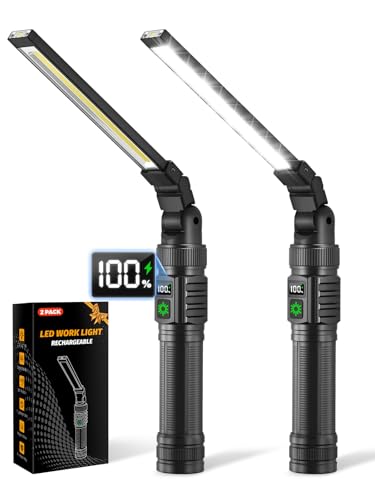
Two magnetic lights that work straight out of the box
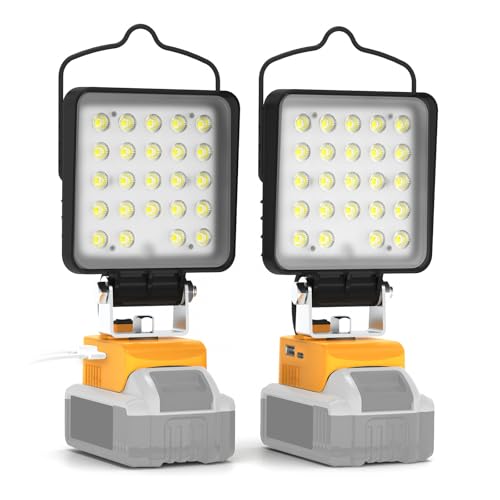
A lot of flood output for DeWalt owners willing to gamble
At a glance
| Product | Lumens | Runtime | Price | |
|---|---|---|---|---|
 | DEWALT 20V MAX* LED Work Light/FlashlightAlso in lineup | 110 Lumens | 11-25 hours | $35.32On sale |
 | Milwaukee Electric Tools 2365-20 M18 Rover MountingAlso consider | 1500 Lumens | Up to 20 hours | $118 |
| RYOBI ONE+ 18V Hybrid LED Work LightRunner-up | 3,000 Lumens | Up to 16 hours | $77.94 |
 | Streamlight 68790 Charger Holder - Dualie RechargeableAlso in lineup | — | — | $26.59 |
| Ruboliy 2Pack Magnetic Rechargeable LED Work Light/FlashlightBudget pick | 1500 Lumens | 5-6 hours | $39.97On sale |
| RIDGID 18V Cordless Hybrid LED Panel LightTop pick | 3,500 Lumens | — | $98On sale |
| wokelux 2 Pack Cordless LED Work LightAlso great | 10000LM | — | $30.99 |
 | Kobalt 24-Volt Lithium ionAlso consider | 1000 Lumens | — | $65 |
How we picked
Usable brightness. We compared published lumen figures against beam type, since a wide flood spreads light better than a brighter spot beam. We treated 3,000 lumens as the threshold for lighting a whole bay and 1,000 to 1,500 as the range for close task work.
Battery and platform. We looked at whether a light runs on a major cordless platform or a sealed built-in cell, because that decides both your real cost and how long you can keep working. Published reviews consistently note that swappable packs stretch practical runtime far past what a sealed light manages.
Mounting options. We read the spec sheets for magnets, hooks, keyholes, folding legs, and rotating heads. A light you can't aim or hang where you need it is a light someone has to hold.
Weather rating. We treated IP54 as the floor for job-site use and IP65 as the target for real outdoor exposure. Where no rating is published, we assumed indoor-only and said so.
Runtime honesty. We checked what brightness each runtime figure was measured at, since headline numbers almost always come from the lowest setting. A 16-hour claim on low can mean a few hours at full output.
Top pickOn sale
Bright, aims anywhere, and plugs in when the battery dies
RIDGID 18V Cordless Hybrid LED Panel Light
This is a folding panel light rated at up to 3,500 lumens that runs off an 18V RIDGID battery or an extension cord. It pivots on three separate axes, so you can wash a ceiling, a wall, or an engine bay without ever moving the base.
$98fromAmazonList priceIt's the brightest light here from a brand you'll recognize. RIDGID rates the R8698B at up to 3,500 lumens across three brightness settings, and the folding panel spreads that output instead of punching a hot spot into one wall. In practice that's enough to light a two-car bay without dragging a second light over. The lower settings exist for a reason, too, since you rarely need full power at a bench.
The three-axis rotation is the part you'll actually use. Most panel lights tilt one way and that's it, which means you end up shoving the whole light around the floor to change the angle. This one lets you aim into a corner, up onto rafters, or straight down into a wheel well from a single placement. If you work alone, that's the difference between good light and a light you keep re-aiming.
The extension cord option quietly solves runtime. RIDGID calls this a hybrid, which just means it takes an 18V pack on the job site and an extension cord in the shop. If you're refinishing a floor or wiring a basement over a weekend, plug it in and stop thinking about charge state. On a site with no power yet, drop a battery in and carry on.
Clear white LEDs help when color has to be right. RIDGID specifies clear white output for accurate colors and fine detail, which matters more than it sounds. Sorting wire colors in a dim panel, matching a paint touch-up, checking a finish coat on trim — all of it gets harder under yellow-cast light. This is the kind of spec you don't notice until you're squinting at two wires that both look brown.
Flaws but not dealbreakers
Battery, charger, and cord are all sold separately. RIDGID lists this as a bare tool, so if you don't already own the platform, you're buying three things to get one working light. For anyone with a RIDGID drill and a couple of packs on the shelf, that's a non-issue. For everyone else, the real cost is a lot higher than the light alone suggests.
It arrives bulk packaged. No retail box, no printed manual, just the light. That's normal for contractors buying tools by the armload, and it's fine if you know what you're doing. It's a poor choice as a gift, though, and you'll be looking up the manual online.
It's the biggest and heaviest pick here. At roughly 4.65 pounds and about a foot on its longest side, this isn't something you tuck into a tool bag. It's a light you set down and work around. For crawling into a crawlspace or working inside a junction box, grab something small instead.
The R8698B is covered by RIDGID's Lifetime Service Agreement, which provides free parts and service once you register the tool.
Runner-up
Longer runtime and a cord option, if you're on this platform
RYOBI ONE+ 18V Hybrid LED Work Light
The PCL633B is Ryobi's hybrid panel light, rated at 3,000 lumens and up to 16 hours on the low setting. It runs on any ONE+ 18V pack or an extension cord, and it mounts to the same LINK wall and mobile storage systems as the rest of the line.
$77.94fromAmazonSixteen hours on low is the longest hybrid runtime in this group. That's a spec you'll appreciate on the second day of a project, when you want ambient light in the corner of the shop and don't want to babysit a charger. Ryobi quotes that figure on the low setting, so treat it as the ceiling rather than what you'll see at full brightness. Even so, nothing else here claims more from a hybrid.
Three thousand lumens is enough for the space most people actually work in. A single-car bay, a basement corner, a driveway at dusk — this covers all of it without shadows crawling up the walls. It's 500 lumens shy of our top pick, which you'd notice in a big open shop and probably not anywhere else. The folding panel spreads light rather than throwing a beam.
ONE+ is the platform an enormous number of people already own. If there's a green battery in your garage, this light costs you nothing extra to power. No new charger, no new pack standard, no second wall bracket. That's the whole argument for buying within an ecosystem, and Ryobi's is the one most likely to already be in your house.
LINK compatibility keeps it off the floor. The light mounts to Ryobi's LINK wall and mobile storage system, and it has integrated hooks and keyholes for everything else. So you can hang it on a stud, clip it to a shelf edge, or dock it on a LINK rail between jobs. A work light you can find and grab is worth more than one buried under a drop cloth.
Flaws but not dealbreakers
It's dimmer than our top pick at a similar tier. Three thousand lumens against 3,500 isn't a huge gap, but RIDGID also adds the three-axis head and the lifetime service coverage. If you own neither platform, that comparison tips away from Ryobi. If you own ONE+ packs, ignore all of it and buy this one.
Tool only, same as the RIDGID. No battery, no charger, no cord in the box. Buying into ONE+ from scratch just for a work light doesn't make much sense, since the platform pays off across drills and saws and mowers, not a single lamp.
Budget pickOn sale
Two magnetic lights that work straight out of the box
Ruboliy 2Pack Magnetic Rechargeable LED Work Light/Flashlight
These are self-contained COB lights, sold in pairs, rated at up to 1,500 lumens each with a strong magnetic base and a folding head that swings a full 360 degrees. A digital readout on each one shows exactly how much charge is left.
$39.97fromAmazonList priceYou can use these the minute they arrive. No platform, no charger to buy, no compatibility chart to read. Both lights have built-in rechargeable batteries and a body of aluminum alloy that shrugs off the knocks a light takes in a car. If you own zero cordless tools and just want light where your hands are, this is the simplest way to get it.
The magnet is the whole point. Ruboliy calls the base a super-strong magnet, and it's meant to hold on vertical steel — a fender lip, a door frame, the underside of a hood. That's what lets you work with both hands in an engine bay instead of clamping a light to something or asking someone to hold it. Cheap magnetic lights slide down a fender when the car settles; this one is built to stay.
The battery readout is a small feature that saves real annoyance. Most lights give you a vague green blob that stays green right up until it isn't. This one shows a percentage, so you know before you crawl under the car whether you've got an hour or five minutes. It's a quality-of-life thing, and you notice it every single time.
Seven modes cover more than shop work. High, medium, and low plus strobe, SOS, a top spotlight, and a red strobe. That makes these useful in the trunk for a roadside breakdown or in a kitchen drawer for a power cut. The one-touch-off long press means you don't have to cycle through every mode to shut it down.
Flaws but not dealbreakers
The battery isn't replaceable. Ruboliy specifies a non-detachable cell, so when capacity fades after a few hundred cycles, the light is done. Every lithium pack degrades, but on a platform light you just buy a new pack. Here you buy a new light. For occasional use that's fine; for daily professional work it's a real limit.
Fifteen hundred lumens lights a task, not a room. Don't buy these expecting to illuminate a garage bay. They're for close-range work — under a hood, inside a panel, along a baseboard. Point one at the ceiling of a two-car garage and you'll be disappointed.
Five to six hours at maximum brightness. That's the manufacturer's own figure, and it's enough for an afternoon, not a full working day. You'll get longer on the lower settings. Plan on charging both units overnight if you're using them hard.
Also great
A lot of flood output for DeWalt owners willing to gamble
wokelux 2 Pack Cordless LED Work Light
These are third-party flood lights, sold in pairs, that clip onto DeWalt 18V and 20V MAX packs you probably already have. Each has 24 LED beads, a head that rotates 180 degrees, and both USB-A and USB-C ports for charging your phone off the battery.
$30.99fromAmazonIt turns DeWalt packs you already own into serious flood light. wokelux lists compatibility with the DCB200 through DCB206 series and their multi-pack variants, which covers most of what a DeWalt owner has lying around. Two lights on two batteries gives you cross-lighting from opposite corners, which kills shadows better than one brighter source ever does. That's a genuinely useful setup for a driveway job at night.
The USB-A and USB-C ports make each light a power bank. Output is listed at 5V and 2.2A, and both ports can run at once. On a new-construction site with no live power, or in a driveway three hours from anywhere, being able to top off a phone from a tool battery is worth more than another few hundred lumens. Few lights at this level bother to include it.
Low-voltage protection looks after your batteries. The base has a chip that reads pack voltage and shuts the light off below 15V. Deep-discharging a lithium pack is how you kill it, and these are expensive packs. It's a thoughtful detail on a budget product.
An IPX4 rating means light rain won't finish it. wokelux lists IPX4, which covers splashing water from any direction. That's enough for a drizzle, a wet driveway, or a damp crawlspace. It isn't a hose-down rating, and there's no dust figure attached, so keep it out of a sandblasting booth.
Flaws but not dealbreakers
Treat the combined 10,000-lumen claim as marketing. That's a manufacturer number with no independent verification behind it, and output claims from smaller brands routinely overshoot what the same lights measure elsewhere. These are bright, and they're bright for what they cost. Just don't expect them to outshine a name-brand panel rated at a third the number.
There's no track record and no real warranty story. wokelux doesn't have the service network of DeWalt or RIDGID behind it, and there's no published warranty term in the listing. Use these as extra light in your kit or as a cheap way in, not as the one light you're depending on for a paying job.
Heat needs watching. The listing touts hollow grooves for heat dissipation and then tells you to stop using the light if it overheats, which is an unusual thing to have to print. Run these on the low setting for long stretches and give them air. Don't bury one in insulation or a fender liner.
Who this is for
Buy one of these if you regularly work somewhere the built-in lighting doesn't reach: under a car, in an attic, inside a panel, out in a driveway after dark. If your garage has decent overhead fixtures and you only need light a few times a year, a self-contained pair like the Ruboliy is plenty and you can stop reading there. If you already own cordless tools, check which platform before you shop, because a light on that platform costs you the least and runs the longest of anything available to you.
This guide covers portable rechargeable lights: battery-powered panels, flood lights, and magnetic task lights, plus hybrids that also accept an extension cord. It doesn't cover permanent shop fixtures, corded halogen tripods, headlamps, or tower lights for large sites. If you need to light an active construction floor rather than a bay, plan on combining two panel lights or looking at gear built for that scale.
How we picked
Usable brightness: we weighed published lumen figures against beam spread, treating 3,000 lumens as the bar for lighting a full bay and 1,000 to 1,500 as the range for close-in task work. Battery and platform: we favored lights that run on packs you likely already own, since published reviews agree that swappable batteries stretch practical runtime well past a sealed cell. Mounting: we read every spec for magnets, hooks, keyholes, and rotating heads, because a light you can't aim is a light somebody has to hold. Weather rating: IP54 was our floor for job-site use, IP65 our target for real outdoor exposure, and anything unrated we called indoor-only. Runtime honesty: we checked which brightness setting each runtime claim came from, since headline figures almost always come from low.
Other rechargeable led work lights worth considering
If you want the longest runtime on a single battery: The Milwaukee Electric Tools 2365-20 M18 Rover Mounting ($118) — The Milwaukee M18 Rover claims up to 20 hours on one M18 pack, which is the longest figure in this whole group, and its built-in 2-inch magnets stick it to steel studs, beams, and duct work without a stand. That combination is genuinely good on a remote site where you're running off a generator and swapping batteries is a hike back to the truck. What you give up is brightness: 1,500 lumens is task-light territory, well under what the RIDGID and Ryobi panels put out. It also costs more than either of them, so this only really makes sense if you're already deep in M18 and value all-day runtime over lighting a room.
If you want a light that also charges your phone: The Kobalt 24-Volt Lithium ion ($65) — The Kobalt 24V MAX flashlight puts a 2.1A USB port right on the body, so a tool battery becomes a phone charger in the middle of a rough-in with no live power in the building. The retractable metal hang hook locks down, which makes it steadier than the flimsy clips on most flashlights, and there's a strobe mode plus 360- and 180-degree radius modes. At 1,000 lumens it's the dimmest dedicated light in the lineup, so this is inspection and task lighting, not area lighting. It's also sold as a bare tool, which means the case for it starts and ends with already owning Kobalt 24V packs.
The competition
This is what our research surfaced across the major cordless platforms and a couple of value brands, not a survey of everything on the market. Plenty of capable lights exist outside these eight, especially from smaller brands that come and go. The one below is worth knowing about even though it didn't earn a pick.
The DEWALT 20V MAX* LED Work Light/Flashlight ($35.32) — The DEWALT DCL040 is a compact hook light for DeWalt 20V MAX packs, with a head that rotates 120 degrees and a listed 11 to 25 hours of runtime depending on the pack you use. It lost on output: 110 lumens is a fraction of what everything else here produces, and it can't light an area at all. The wokelux pair runs on the same DeWalt batteries and puts out vastly more flood for less money. But the DCL040 solves a shape problem the panels can't touch. If you spend your days inside junction boxes, above drop ceilings, or hanging a light off a conduit run in an attic, that integral hook and the rotating head are exactly right, and the low heat output means you can leave it against insulation without worrying.
Setup and care
Charge a self-contained light fully before the first use and don't leave it dead on a shelf for months, since lithium cells don't like sitting empty. For platform lights, rotate your packs rather than always grabbing the same one, and pull a pack out of the light when you're storing it for a while. Wipe the magnet on a magnetic light before you set it on painted sheet metal, because a trapped metal chip will drag a scratch across a fender. Keep panel lights on their lower settings when you can, which cuts heat and stretches runtime at the same time. Give any light room to breathe rather than burying it in insulation or a fender liner. And check the published IP rating before you take one out in the rain — no rating means treat it as indoor gear.
Questions we get
How many lumens do I actually need in a garage or workshop?
For a full two-car garage, plan on 3,000 to 5,000 lumens, which can come from one strong panel or two smaller lights placed in opposite corners. A single 3,000- or 3,500-lumen panel handles one bay comfortably. For bench work or anything under a hood, 1,000 to 1,500 lumens is plenty, and more just creates glare in a small space.
Should I buy a light on my tool battery platform or a self-contained one?
If you already own three or more cordless tools, buy on that platform. You'll spend less because the light ships bare, and you can keep working indefinitely by swapping a fresh pack. If you own no cordless tools, a self-contained light like the Ruboliy pair is the better answer, because buying into a platform just for a lamp doesn't pay off.
What IP rating does a work light need for wet conditions?
IP54 is the practical minimum for a construction site, covering dust and splashing water from any direction. For direct rain or a hose-down, look for IP65, which is dust-tight and resists low-pressure jets. If a listing doesn't publish an IP rating at all, assume it has no meaningful water resistance and keep it indoors.
Can I use my existing DeWalt 20V batteries with these lights?
Yes, with two of them. The DEWALT DCL040 takes any 20V MAX pack natively. The wokelux pair lists compatibility with DeWalt 18V and 20V MAX batteries in the DCB200 through DCB206 range, including the two-pack variants, so it's a cheap way to get real flood output from packs you already own.
Do the built-in batteries wear out, and can they be replaced?
Every lithium cell loses capacity with use, typically dropping meaningfully after a few hundred full charge cycles. On platform lights from RIDGID, Ryobi, Milwaukee, DeWalt, and Kobalt, you just buy a new pack and the light keeps going. The Ruboliy uses a sealed non-detachable cell, so when it fades, you replace the whole light. That's the main argument for a platform light if you're using one daily.
What is CRI, and does it matter for a work light?
CRI, or Color Rendering Index, rates how faithfully a light shows color compared with daylight, on a scale to 100. Look for 80 or higher if you're sorting wire colors, matching paint, or judging a finish. Published reviews link higher-CRI light to less eye strain over a long session. Clear white LEDs, like the ones RIDGID specifies on our top pick, are the shorthand to look for.
Why you should trust us
For this guide:
- We read the manufacturer specification sheets and full listing documentation for all eight lights, paying particular attention to which brightness setting each runtime figure was measured at.
- We compared published reviews and buyer feedback themes across the major cordless platforms to weigh how much practical runtime a swappable battery buys over a sealed cell.
- We flagged output claims that come only from a manufacturer, since unverified lumen figures from smaller brands frequently overstate what a light does in a room.
- We read owner reviews on every listing, weighted toward the critical ones, because that is where the recurring failures show up.
- We have a systematic way of automatically fetching the latest prices, so the numbers on this page stay current.
- This is a research-focused guide, so the team may not own every product listed — though we often do own the top winners, which gives us extra context for the recommendations.
- We don't accept free products, and the retailer commission never changes which product we recommend.
Sources
Best Work Lights of 2026 — Bob Vila, Bob Vila
Best LED Work Lights Tested — Family Handyman, Family Handyman
Best Work Lights — This Old House Reviews, This Old House
Rechargeable Work Light Guide — ToolGuyd, ToolGuyd
Best Portable Work Lights — Popular Mechanics, Popular Mechanics
Amazon product listings and owner reviews for all 8 products
Manufacturer specification pages for each product
Some passages in this guide may be paraphrased with AI help. Prices are refreshed automatically.
More like this.
Continue exploring electronics reviews and recommendations.

The Best LED String Lights for the Holidays
String lights are the rare decoration you interact with every single day of the season. You plug them in at dusk, you glance at them while washing dishes,…

The Best LED Face Masks and Red Light Therapy Devices
Red light therapy asks very little of you and gives back slowly. You put on a mask, sit still for a few minutes, and repeat that several times a week for…

The Best Permanent LED Eave Lighting Kits
Permanent eave lights live under your roofline all year and do two jobs. Most nights they're a warm white accent that makes the house look finished and…

The Best Aquarium LED Lighting
The light over your tank does more work than anything else you'll buy for it. It decides whether your plants carpet the substrate or melt into brown mush,…

The Best Smart RGB LED Strip Lights for Bedrooms
Bedroom light gets used in a specific way. You want a soft glow behind the headboard at night, something bright enough to find a charging cable, and a…

The Best Rechargeable Hand Warmers
Cold hands ruin an otherwise good day outside. A rechargeable hand warmer is a small lithium battery wrapped in a metal or plastic shell that heats up on…