The Best Outlet Covers and Plug Protectors
A crawling baby finds the outlet behind the couch faster than you'd think. Electrical outlets and cords sit near the top of the home hazard list for kids under 3, according to Safe Kids Worldwide, and the Electrical Safety Foundation International counts more than 2,400 children treated in U.S. emergency rooms each year for outlet and extension-cord injuries. Covers are cheap insurance. But the style you pick changes how much protection you actually get, and how annoying your own life becomes.
No outlet cover is perfect. Plug-in caps are what most people buy, and they're also what a determined toddler eventually learns to pop out. Then you have a small plastic part loose on the floor near a kid who mouths everything. Plate-style covers solve that problem, but they cost more per outlet and most of them need a screwdriver. And nothing here does much for a power strip or for the cord that's already plugged into the wall. You'll probably end up mixing two types.
So think in zones. The outlets your kid can reach in the living room and nursery deserve a plate-style cover that can't be removed and lost. The ones behind the dresser can take a basic cap, or nothing at all. A three-bedroom house has 30 to 40 outlets by The Spruce's count, so plating all of them adds up fast. We think that the Qdos Universal Self-Closing Outlet Covers are the best outlet covers for most people, and that the Safety 1st OutSmart Outlet Shield is the one to buy if you don't want to touch a screwdriver.
Everything we recommend

Nothing to remove, nothing to lose, if you'll use a screwdriver

Solid plate-level protection with no tools and no screws

Basic caps that hold tight, best for low-traffic outlets

A self-closing plate for the one outlet the lamp lives in
Prices as of Oct 25, 6:48 AM PT · Details
At a glance
| Product | Cover style | Pieces per pack | Price | |
|---|---|---|---|---|
| Qdos Universal Self-Closing Outlet CoversTop pick | — | — | $14.95 |
| Safety 1st OutSmart Outlet ShieldRunner-up | — | — | $8.98 |
| Mommy's Helper Safe Plate Electrical Outlet CoversAlso great | — | — | $7.95 |
 | Bates- Electrical Outlet Covers Baby ProofingAlso in lineup | Plug cover, 3 prongs | 10 | $5.99 |
 | Prince Lionheart Outlet Covers with Safety KeysAlso in lineup | — | 40 | $9.99 |
| Jool Baby Outlet CoversBudget pick | — | 32 | $7.99 |
 | Clear Outlet CoversAlso consider | Clear plug cover | 50 | $8.99 |
 | Dreambaby Outlet PlugsAlso consider | — | 24 (pack of 2) | $11.98 |
Prices as of Oct 25, 6:48 AM PT · Details
How we picked
No parts to lose. We favored designs with nothing removable, because a cap that's out of the wall is a choking hazard. Guidance from Parents and testing writeups from BabyGearLab both point the same direction.
Child resistance. We looked for evidence on how long a cover holds up against a curious toddler, not just whether it blocks the slots. Outlet protective devices sold here must meet ASTM F1436, which is a floor, not a ranking.
One-handed for adults. Owner feedback repeats the same complaint across brands: a cover you can't open while holding a baby comes off the wall and never goes back on. We gave credit for notches, spring returns and tool-free installs.
Cords that stay put. Self-closing and shield designs protect the empty slot beside a lamp or charger. Good Housekeeping Institute reviewers flag that outlet as the one people most often leave unguarded.
Cost per outlet. A typical three-bedroom home has 30 to 40 outlets, per The Spruce. We weighed pack size and per-outlet cost against how much protection each design actually buys you.
Top pick
Nothing to remove, nothing to lose, if you'll use a screwdriver
Qdos Universal Self-Closing Outlet Covers
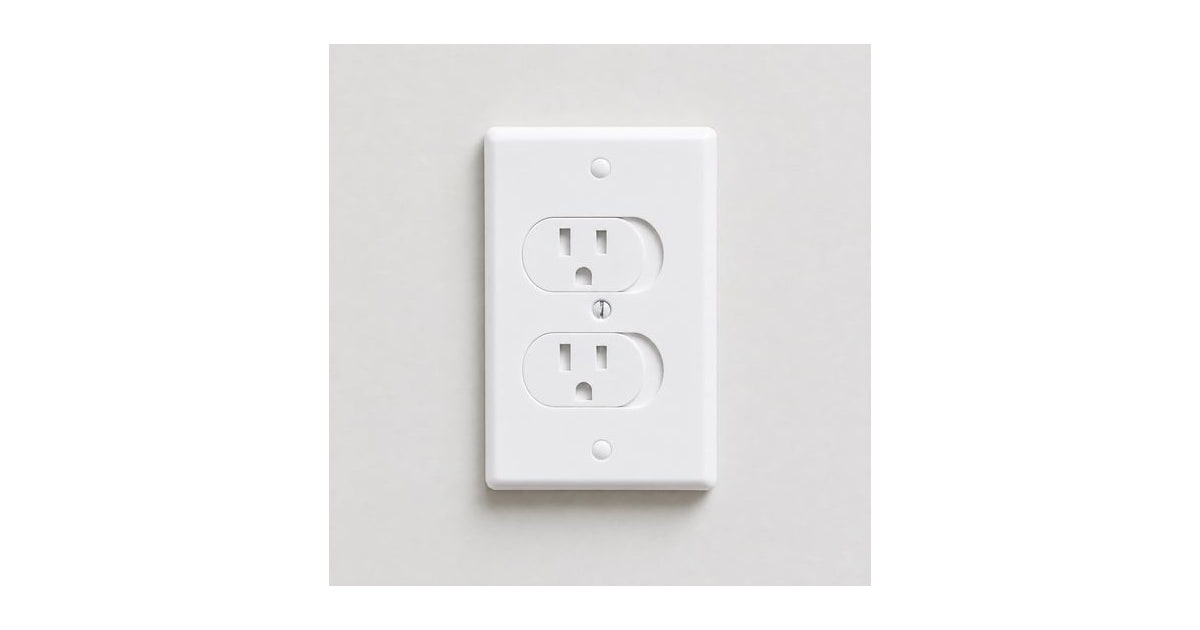
This replaces your existing outlet plate with one that has spring-loaded shutters behind the slots, so the outlet closes itself the moment you pull a plug. There's no cap to pry out, misplace, or hand to a toddler, and it fits both standard duplex and Decora outlets.
$14.95fromAmazonPrices as of Oct 25, 6:48 AM PT · Details
The safest outlet cover is the one your child can't take off the wall. That's the whole case for a self-closing plate. Plug-in caps only work until a toddler gets a fingernail under one, and BabyGearLab's testing found young children could pull caps free within weeks. The Qdos plate has no removable part at all. The shutters live behind the wall plate, and they snap shut on their own when the plug comes out.
Think about the lamp in the corner that's plugged in year-round. A cap can't go there, because the slot is occupied and the second slot sits wide open right next to it. Qdos handles that case. One slot holds your cord, the other stays shuttered. Good Housekeeping Institute reviewers singled out self-closing covers for exactly this problem, the outlet behind the sofa with a charger in it.
Most self-closing plates come in one flavor and force you to check what's on your wall first. This one covers both standard duplex outlets and the wider Decora style, so you can buy a single kind for the whole house. The plate is also oversized, which hides the paint outline and drywall scuffs the old cover was sitting on. That's a small thing until you see it on twelve walls.
For you, it works like a normal outlet. Push the plug in with one hand and the shutters open. Pull it out and they close. No prying, no key, no kneeling on the floor fighting a stuck cap while you're holding a baby. Installation needs a screwdriver and a couple of minutes per outlet, and the plate swaps straight in for the one you already have.
Flaws but not dealbreakers
It's sold three to a box, which is a problem when you're covering a whole house. If a three-bedroom home really has 30 to 40 outlets, plating even the reachable ones means buying a stack of these, and they cost the most per outlet of anything here. Most families use them in the rooms a toddler actually spends time in and put basic caps everywhere else.
You're also working on your home's electrical hardware, which means shutting off the breaker if you want to be careful about it. Owner feedback points to occasional fit trouble on older or slightly out-of-square boxes, and to shutters that feel stiff for the first few plugs. Not a dealbreaker, but install one and live with it before you buy nine more.
Runner-up
Solid plate-level protection with no tools and no screws
Safety 1st OutSmart Outlet Shield
The OutSmart mounts over your existing outlet and hides it behind a decoy panel, so there's nothing for a toddler to grab and nothing small to swallow. It goes on without tools, which makes it the easy pick for renters and for grandparents setting up a room in an afternoon.
$8.98fromAmazonPrices as of Oct 25, 6:48 AM PT · Details
Safety 1st sells more of these than almost anyone sells anything in this category, and the reason is the install. It fits right over the outlet you already have, no screwdriver required. If you're in a rental and nervous about swapping electrical hardware, or you're a grandparent who wants the guest room ready before the grandkids arrive, that matters more than any spec.
The decoy panel is the clever part. Instead of blocking the slots, it covers the whole outlet with a flat panel that has nothing to pull on. A child who tugs at it gets a smooth surface and no grip. That's the same logic childcare centers use, and Parents notes that centers prefer plate-style covers over caps precisely because there's no loose piece to lose or choke on.
You can paint the panels. That sounds like a gimmick until you've stared at a white plastic box on a navy accent wall for six months. A coat of the room's own color makes the cover close to invisible, which is the difference between childproofing your living room and making it look like a daycare.
It also handles the always-plugged-in problem, though differently from Qdos. The shield encloses the outlet and the plug together, so a cord can run out while the unused slot stays sealed behind the panel. That covers the nightstand lamp and the charger by the couch, which are usually the two outlets a crawler heads for first.
Flaws but not dealbreakers
It's bulky. The shield stands off the wall close to an inch, so furniture won't sit flush against that wall anymore, and you'll notice it in a room where you'd rather not. If you want something discreet, a plate-style cover wins.
It comes two to a package, so covering a house means a lot of packages. And because it mounts over the existing plate instead of replacing it, owners report the fit gets fussy on outlets that sit at an angle or on thick, textured plates. Try one before you commit to a dozen.
Budget pick
Basic caps that hold tight, best for low-traffic outlets
Jool Baby Outlet Covers
These are plain clear caps that push into an unused outlet and grip hard enough to frustrate a toddler, and a notch on the edge gives you a fingernail hold so you can pull one out without wrecking a nail. Thirty-two in a box covers most of a small house.
$7.99fromAmazonPrices as of Oct 25, 6:48 AM PT · Details
Nobody plates 38 outlets. You cover the ones your kid can reach and you cap the rest, and this is the box of caps to buy for the rest. The clear plastic disappears against a white plate, which is why these end up in hallways and behind the dresser without anyone noticing them.
The notch is what separates a usable cap from a maddening one. Flat caps sit flush and leave you scraping at plastic with a car key. Jool Baby molds a small lip into the edge and uses slightly flexible plastic, so an adult thumbnail gets purchase on the first try. Owners consistently point to that detail, and to the caps staying put once they're in.
Be honest about what you're buying. A cap is a small removable part, and the moment it's out of the wall it's the size and shape of something a one-year-old will put in their mouth. Use these where a child spends little time, check now and then that they're still seated, and put a plate-style cover on the outlet next to the play mat.
Flaws but not dealbreakers
The choking risk is real, and it's the reason this isn't our top pick. BabyGearLab's testing found children worked plug-in caps loose within weeks of first seeing them, and a loose cap is a small object on the floor. That's a different kind of failure from a plate cover, which either works or doesn't.
They also do nothing for an outlet that's in use. If a lamp cord sits in the top slot, the bottom slot needs some other answer, because a cap can only fill an empty one.
Also great
A self-closing plate for the one outlet the lamp lives in
Mommy's Helper Safe Plate Electrical Outlet Covers
Like the Qdos, this replaces your wall plate with one that has a sliding cap closing automatically when you unplug. It's sold one at a time, so it's the piece to buy for a specific problem outlet rather than the way you cover a whole house.
$7.95fromAmazonPrices as of Oct 25, 6:48 AM PT · Details
Some outlets are just annoying. The one behind the crib with the sound machine in it. The one under the kitchen counter where the toaster lives. You want that outlet handled properly and you don't want a three-pack to do it. Mommy's Helper sells the Safe Plate singly, and that's genuinely useful.
The mechanism does the remembering for you. Slide the cap over, plug your cord in, and when you pull the plug the cap closes on its own. There's no step to forget while you're holding a sleeping baby. That's the same principle as our top pick, and it's why both of these beat a loose cap on any outlet you actually use day to day.
Installation is one screw. You back out the screw holding your current plate, lift it off, and put the Safe Plate in its place. It's a standard-outlet design, so check that your wall has a duplex outlet and not the wide Decora style before you order. That's the main difference from Qdos, which handles both.
Flaws but not dealbreakers
One per package makes whole-home coverage a chore and a costly one. Ordering a dozen is a dozen line items, and the per-outlet cost lands well above a bag of caps.
The sliding cap is more exposed than a spring shutter tucked behind the plate. Owners report it can drift open if a cord tugs the wrong way, and that a persistent toddler will worry at the edge. Still far better than a cap, but it isn't a sealed box.
Who this is for
Buy covers before your baby crawls, not after. Pediatric guidance summarized by What to Expect puts the start line around six months, which sounds early until you watch a seven-month-old cross a room. If you're expecting, if grandkids are about to start visiting, or if you run a home daycare, this guide is for you. So is the rental case, where you want protection you can undo without patching anything.
This guide covers standard U.S. wall receptacles and the covers that fit them. It doesn't cover power strips, extension cords, or the strip boxes and cord shorteners that handle those, and it doesn't get into GFCI outlets near sinks, which have their own quirks. If an outlet is loose, scorched, or warm to the touch, a cover isn't the fix. Call an electrician first.
How we picked
No small parts: we favored covers with nothing a child can remove and swallow, which pushed plate-style designs above plug-in caps. Child resistance: we leaned on published testing and safety-group guidance, including BabyGearLab's finding that toddlers work caps loose within weeks of first seeing them. Adult usability: a cover you can't open one-handed while holding a baby is a cover you'll take off the wall, so we looked for removal notches, spring returns and tool-free installs. Cords that stay in: self-closing and shield designs earned credit for guarding the unused slot next to a lamp or charger. Cost per outlet: with 30 to 40 outlets in a typical three-bedroom home, pack size decides whether a design is realistic for the whole house or just for the nursery.
Other outlet covers and plug protectors worth considering
If you want to cover every outlet in one shot: The Clear Outlet Covers — Fifty clear caps is enough for a three-bedroom house with spares, and they work the same way as our budget pick. You push a flexible plastic plug into an empty slot and it grips. Owners like how firmly these seat, which is also the complaint, because a cap that's hard for a toddler is often hard for you. The listing doesn't describe a removal notch, so plan on working a fingernail under the edge. Same choking caveat as any cap.
If you want caps from a brand you already recognize: The Dreambaby Outlet Plugs — Dreambaby is a familiar name in the childproofing aisle, and these are its standard clear plugs, 24 to a pack in a two-pack. They're BPA-free, need no tools, and fit standard outlets, so they do what a cap does. Nothing here beats our budget pick, and the listing doesn't call out a removal notch, which is the detail that makes caps tolerable to live with. Buy them if the pack size suits your house better.
The competition
This is what our research surfaced, not a census of everything on the market. A lot of outlet covers sell without any reviewer or safety organization looking at them closely, and we left those alone. Here's what the remaining two are, why they didn't beat a pick, and who might still want one.
The Bates- Electrical Outlet Covers Baby Proofing — The Bates covers are plug-in caps in black ABS plastic, ten to a pack, with a three-prong shape and a hidden U-ring that grips inside the outlet. Black is unusual and genuinely helps if your plates are dark or your outlets sit against a charcoal wall. But it's still a cap, with the same small-part concern as any cap, and ten per pack goes fast when you're doing a whole house. If the color solves a problem for you, they're fine on low-traffic outlets.
The Prince Lionheart Outlet Covers with Safety Keys — Prince Lionheart ships 40 caps in two bags and includes removal keys, and that's the trade-off you're making. A key makes the cap much harder for a toddler to pry out. It also means you need the key in hand every time you want the outlet back, and small keys vanish in a house with kids. The listing points to third-party ASTM testing and the count is high enough for a full home. We'd still rather you didn't depend on a loose part, and this design has two of them.
Installation notes
Check the outlet before you check the cover. A plate-style cover only helps if the receptacle behind it is sound, so look for a plug that falls out on its own, a warm plate, or scorch marks, and get those fixed first. Turn the breaker off before you unscrew anything, even though you're only touching the plate. After you install a self-closing cover, plug something in and pull it out a few times to make sure the shutter returns all the way. Recheck your caps every couple of months, because they loosen with use and a loose cap is worse than none. And keep the spare caps in a drawer, not a low bin your toddler can open.
Questions we get
Do I still need outlet covers if my home has tamper-resistant outlets?
Probably fewer of them, but yes. The National Electrical Code has required tamper-resistant receptacles in new U.S. residential construction for well over a decade, and those have internal shutters that block a single object like a fork. They don't stop a child from yanking on a cord that's already plugged in, and they don't exist in older homes. The CPSC still lists outlet covers among its core childproofing devices for homes with kids under 5.
What's the safest type of outlet cover for a whole house?
Plate-style covers, meaning self-closing plates and sliding box shields. There's no small part to remove, so there's nothing to swallow and nothing to lose. Parents reports that childcare centers prefer these over caps for exactly that reason. The catch is cost and install time, so most families plate the rooms a toddler uses and cap the rest.
Are plug-in outlet caps a choking hazard?
Once one is out of the wall, yes. A cap is a small, smooth piece of plastic sized to fit a toddler's mouth. BabyGearLab's testing found young children could work caps loose within weeks of first encountering them. Use caps where a child spends little time, and check regularly that they're still seated.
What should I use for an outlet with a lamp or charger always plugged in?
A self-closing plate or a box-style shield. A cap can't help, because it only fills an empty slot and leaves the second one wide open right beside the cord. Good Housekeeping Institute reviewers point to self-closing covers as the answer for outlets behind furniture that stay in use. Our top pick and both plate picks handle this.
How many outlet covers do I need for a three-bedroom house?
Plan on 30 to 40 outlets total, per The Spruce, though you won't need to cover all of them. Walk each room at your child's eye level and count what's actually reachable. Buy plate-style covers for those, then buy a bulk bag of caps for everything else. Bulk packs make more sense than two-packs once you're past a single room.
Do outlet covers work with power strips?
No. Everything in this guide is designed for wall receptacles, and none of it fits a strip. A power strip needs a purpose-built strip cover or a cord box, or it needs to go somewhere a child can't reach. That's a separate purchase from anything here.
Why you should trust us
For this guide:
- We read published reviews and safety testing writeups from BabyGearLab, Good Housekeeping Institute and Parents, plus guidance from the CPSC, the Electrical Safety Foundation International and Safe Kids Worldwide.
- We compared manufacturer specifications and listing details for every cover here, including pack size, mounting method, outlet compatibility and stated ASTM compliance.
- We looked for repeated themes in owner feedback, especially fit problems, caps working loose over time, and covers that adults find hard to open one-handed.
- We read owner reviews on every listing, weighted toward the critical ones, because that is where the recurring failures show up.
- We have a systematic way of automatically fetching the latest prices, so the numbers on this page stay current.
- This is a research-focused guide, so the team may not own every product listed — though we often do own the top winners, which gives us extra context for the recommendations.
- We don't accept free products, and the retailer commission never changes which product we recommend.
Sources
Electrical Safety Foundation International - Child Safety Facts, ESFI
Best Outlet Covers for Childproofing - BabyGearLab, BabyGearLab
CPSC Childproofing Your Home: 12 Safety Devices, U.S. Consumer Product Safety Commission
The Best Outlet Covers for Babyproofing - The Spruce, The Spruce
Good Housekeeping Institute - Best Baby Proofing Products, Good Housekeeping
NFPA 70 National Electrical Code - Tamper-Resistant Receptacles, National Fire Protection Association
ASTM F1436 Standard Consumer Safety Specification for Electrical Outlet Protective Devices, ASTM International
Baby Proofing Checklist and Product Reviews - What to Expect, What to Expect
How to Baby Proof Outlets - Parents.com, Parents
Safe Kids Worldwide - Home Safety Research, Safe Kids Worldwide
Amazon product listings and owner reviews for all 8 products
Manufacturer specification pages for each product
Some passages in this guide may be paraphrased with AI help.
Product prices and availability are accurate as of the date/time indicated and are subject to change. Any price and availability information displayed on Amazon.com at the time of purchase will apply to the purchase of this product.
More like this.
Continue exploring home reviews and recommendations.

The Best Outdoor Smart Plugs for Christmas Lights
Stringing lights is the fun part. Remembering to unplug them at 11 p.m. in the freezing cold, night after night, is not. An outdoor smart plug fixes that:…

The Best Whole-House Surge Protectors
Most of the damage a power surge does to your house isn't dramatic. A dishwasher control board quits. The garage door opener gets flaky. Your router needs…

The Best Waterproof Mattress Protectors
A mattress protector is about the least expensive insurance you'll ever buy for a big purchase. One spilled glass of wine, one sick kid, one dog who…

The Best iPhone 17 Cases and Screen Protectors
A case is the accessory you touch more than any other. It decides how your phone feels in your hand, whether it slides off the arm of the couch, and…

The Best RV Surge Protectors
Shore power at a campground isn't the same thing as power at home. A pedestal sits outside for years, gets plugged and unplugged thousands of times, and…

The Best Window Well Covers of 2026
A window well is a small pit that fills with whatever falls into it. Leaves, rain, a stray tennis ball, the occasional frog. Left open, it collects water…