The Best Outdoor Solar Garden Lights
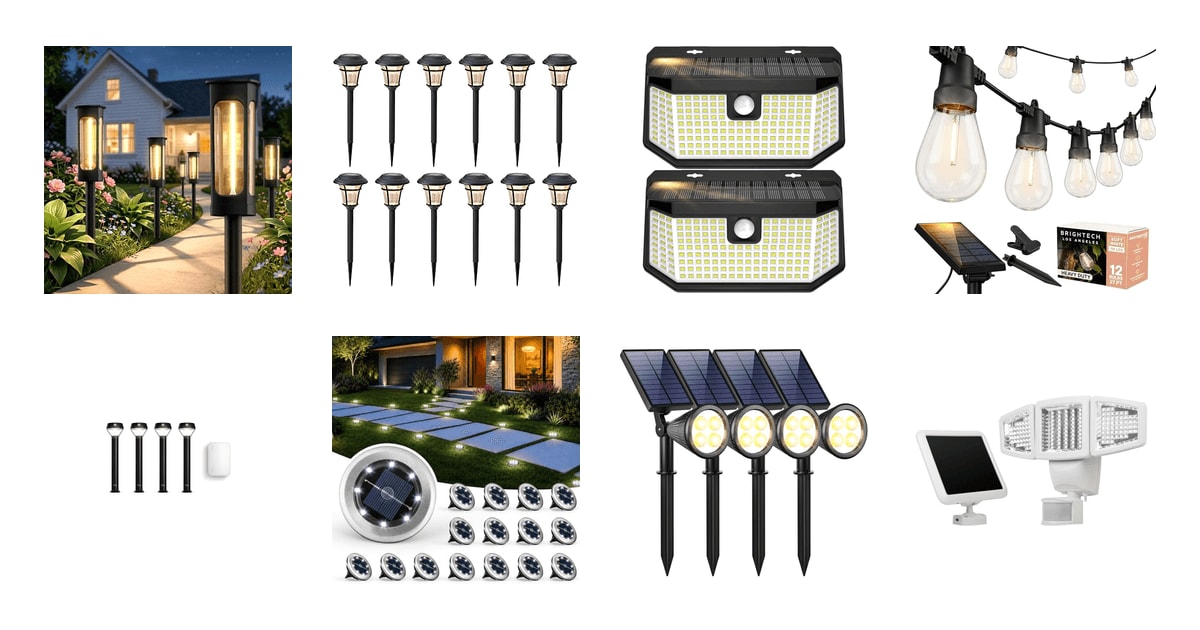
Solar garden lights solve a problem that used to mean digging a trench. You want the front walk lit so nobody trips on the step, or the back fence lit so the dog isn't a shadow at 10 p.m. With solar, you push a stake into the dirt and you're done. No transformer, no conduit, no electrician. The catch is that everything depends on where the panel sits. A light in four hours of dappled sun runs at a fraction of its rated time, no matter what the box promises.
Here's the honest part: no solar light is as bright or as consistent as a wired fixture, and the good ones aren't trying to be. Pathway lights are markers, not floodlights — they show you the edge of the walk, they don't turn night into day. Batteries fade too. NiMH cells often drop below 70% of their original capacity within a year or two, per Consumer Reports, and even lithium units lose ground after a few winters. Expect to replace cells before you replace the fixtures.
So buy for the job. A bulk pack of stake lights lines a driveway cheaply and looks pretty; a motion floodlight covers a dark garage door; string lights make a patio feel like a place you want to sit. We think that the Aootek 182 LED solar motion sensor lights are the best outdoor solar garden lights for most people, and that the Brightech Ambience Pro solar string lights are the ones to buy if you're lighting a patio or pergola for atmosphere rather than safety.
Everything we recommend

Genuinely bright, and the motion mode saves the battery

The patio pick — warm, shatterproof, and built for weather

Aim it anywhere, and aim the panel somewhere else entirely

Worth it only if you already live in the Ring app

Sixteen small markers for the price of one nice fixture
At a glance
| Product | Lumens | Waterproof Rating | Price | |
|---|---|---|---|---|
 | Gahomlumy 2026 Solar Lights Outdoor,6Pack Solar PathwayAlso consider | — | IP65 | $35.89 |
 | MAGGIFT 12 Pack Solar Pathway Lights OutdoorAlso in lineup | 1 Lumen | IP44 | $29.99 |
| Aootek Solar Lights Outdoor 182 LEDs 2500LmTop pick | 2500 Lumens | IP65 | $22.09On sale |
| Brightech Ambience Pro Solar Powered Outdoor StringAlso great | — | — | $21.99 |
| Ring Solar Pathlight 4-PackUpgrade pick | 80 Lumens | — | $131.95On sale |
| SOLPEX 16 Pack Small Solar Ground LightsBudget pick | — | IP44 | $29.99 |
| URPOWER Solar Spot Lights Outdoor Adjustable SpotlightsRunner-up | — | IP65 | $39.99On sale |
 | Sunforce 82153 150-LED Triple Head Solar MotionAlso consider | 1000 Lumens | — | $67.99 |
How we picked
Right brightness for the job. We matched each light to its actual use rather than chasing lumen numbers, since pathway lights need only 5 to 50 lumens while security floodlights need 700 or more. A light that's too bright for a walkway is as wrong as one that's too dim for a driveway.
Panel and battery quality. We favored monocrystalline panels, which Department of Energy figures put around 20% conversion versus roughly 15% for polycrystalline, and lithium batteries over NiMH. Consumer Reports notes NiMH cells commonly fall below 70% capacity within one to two years, while lithium units hold usable capacity for three to five.
Weather sealing. We treated IP65 as the target for anything that will face a sprinkler, since IP65 means dust-tight and resistant to water jets from any angle under IEC 60529. We flagged IP44 products as fine for rain but not for spray or standing water.
Housing durability. Tom's Guide's 60-day outdoor exposure found cracking or discoloration in 3 of 10 ABS-only housings, while units with stainless or die-cast accents showed none. We weighted material choice and long-term owner reports of survival past two winters.
Setup and placement. We looked for stake, wall-mount or detachable-panel designs that let you put the panel in sun and the light where you need it. Old House Journal editors found lights in partial shade reached only 38% of rated runtime, so placement flexibility is a spec, not a nicety.
Top pickOn sale
Genuinely bright, and the motion mode saves the battery
Aootek Solar Lights Outdoor 182 LEDs 2500Lm
The Aootek pairs 182 LEDs with a 2200 mAh lithium battery and a monocrystalline panel rated at 20.5% conversion. It's the rare solar light that's actually bright enough to matter at a side door or driveway, and its three modes let you trade brightness for runtime.
$22.09fromAmazonList priceThis is the one solar light here that does real work. Most solar garden lights are decoration. The Aootek is a security light: 182 LEDs across a 270-degree spread, aimed at a driveway or a dark stretch of fence. If you've ever walked to your car at night and wished something would just turn on, this is the fixture that does it.
The motion sensor is the part that's been independently checked. CNET reports reliable triggering at 26 feet — matching Aootek's own spec — while several budget competitors couldn't manage 15 feet consistently. That gap matters more than lumen numbers do. A light that misses you until you're at the door isn't doing its job.
You get three modes, and picking the right one changes everything. Dim-always-on with a bright flash on motion is the sweet spot for most people. Across manufacturer specs from LITOM, Aootek and URPOWER, motion mode stretches runtime roughly three to five times longer than always-on. The lithium battery helps in the cold too, where NiMH cells fade fast.
The panel is the other reason it holds up. Monocrystalline cells convert around 20% of sunlight versus roughly 15% for polycrystalline of the same size, per Department of Energy figures, and This Old House reviewers found monocrystalline garden lights hit a full charge in about 6.2 hours versus 8.5 for polycrystalline. In a cloudy week, that's the difference between lit and dead.
Flaws but not dealbreakers
It mounts with screws, not a stake. That's fine on a fence post or siding, but it rules out sticking one in a flower bed. You'll need a drill and a spot that gets real sun, which sometimes isn't the same spot you want lit.
The default out-of-the-box mode is the one that stays on all night, and owners routinely report wildlife setting it off and draining the battery before dawn. Switch modes on day one. Owners also mention the bright burst is brief — around 20 seconds — which is plenty for walking past and not enough for taking out the trash.
The housing is ABS plastic. Tom's Guide's 60-day outdoor exposure found cracking or discoloration in 3 of 10 ABS-only units, while models with steel or aluminum accents held up. Long-time owners here report five-year survival through New England winters, so it's not a given — but it's the weak spot.
Also great
The patio pick — warm, shatterproof, and built for weather
Brightech Ambience Pro Solar Powered Outdoor String
Brightech's Ambience Pro strings 12 shatterproof Edison-style bulbs across 27 feet with a detachable, stakeable solar panel. It's the string light to buy if you want a pergola or deck to feel finished, and its plastic bulbs survive what glass ones don't.
$21.99fromAmazonString lights live or die on two things: cable and bulbs. Thin wire frays and glass bulbs shatter the first time a branch drops. Brightech uses commercial-grade cable and S14 bulbs in shatterproof plastic shells rated to 122°F. That's why this set keeps showing up on porches years later instead of in the trash.
Runtime is the usual failure point, and this one clears it. Good Housekeeping Institute testing found the Ambience Pro held consistent brightness across 8-plus hours per charge, outperforming seven competing solar string light brands run at the same time in the same conditions. Most solar strings dim noticeably by hour three. Yours will still be lit when the party ends.
The detachable panel is the quiet feature that makes it work. Your pergola is probably shaded — that's the point of a pergola. The panel runs on six feet of lead with a stake and a clip, so you can plant it out in the yard where the sun actually lands and string the lights where you sit. Very few solar strings let you split those two decisions.
Set your expectations on the layout, though. It's 27 feet total with 20 inches between bulbs, and only about 20 feet of that is lit. For a small deck or a single pergola run, that's right. For wrapping a large patio you'll want two sets, and running two panels means finding two sunny spots.
Flaws but not dealbreakers
Twelve bulbs across 20 lit feet is atmosphere, not illumination. You'll see faces and glasses on the table. You won't read by it, and it won't do anything for a dark corner of the yard.
Solar string lights are the category most punished by shade, and this one still needs its panel in real sun. Owners who love the set after several years also mention cleaning the panel about once a year — dust and pollen build up and quietly cut charge time.
Brightech backs the Ambience Pro with a two-year limited warranty on solar purchases.
Runner-upOn sale
Aim it anywhere, and aim the panel somewhere else entirely
URPOWER Solar Spot Lights Outdoor Adjustable Spotlights
The URPOWER spotlight puts an adjustable 200-lumen head and an independently adjustable panel on one stake, with wall-mount hardware in the box. It's the pick for up-lighting a tree, a flag, or a house number when the sun and the subject aren't in the same place.
$39.99fromAmazonList priceUp-lighting is the fussiest thing you can ask a solar light to do. The tree you want lit is usually in shade — because it's a tree. The URPOWER solves that with two joints: the lamp head swings 90 degrees, the panel swings 180. Point the panel south at the sky and the beam sideways at the trunk. That flexibility is the whole reason this set works.
Four lights, 2200 mAh each, two brightness levels: about 6 hours on high or 10 on low, at up to 200 lumens. That's spotlight territory — enough to graze a trunk or wash a stone wall, not enough for a driveway. Set them low unless you actually need the punch. You'll get more nights out of the same charge.
Longevity is the real argument here. Owner feedback on these skews unusually long-term, with buyers describing sets that are still running after four years and coming back for a third or fourth batch. That's a rarer pattern than it sounds. Most bulk solar lights generate reviews written in week one and silence afterward.
It also mounts two ways. Stake it in a bed, or screw it beside a front door or garage as a wall light. If you're renting, the stake means zero holes and you take them with you. If you own, the same fixture works on siding. Very few lights here give you both without buying an accessory.
Flaws but not dealbreakers
The panel coating is the known weak point. Owners several years in describe the clear finish drying out and flaking, which cuts charging until they clean or re-coat it. It's fixable with a can of clear satin, but it's a chore you shouldn't have to schedule.
At 200 lumens it isn't a security light. If your goal is seeing who's at the side gate, this isn't the fixture — get the Aootek. And the warm white is a deliberate look; if you want crisp modern white, check the color option before you order.
Upgrade pickOn sale
Worth it only if you already live in the Ring app
Ring Solar Pathlight 4-Pack
Ring's Solar Pathlight puts 80 lumens on the walk and, with the included Bridge, ties into Amazon Sidewalk for app scheduling and camera-triggered lighting. It's the only mainstream solar pathlight that talks to your doorbell without a wired hub.
$131.95fromAmazonList priceOrdinary solar lights make one decision: dark, so turn on. These make better ones. With the Bridge, you get schedules, on-off control from your phone, and the ability to have the path light up when your Ring doorbell sees someone. If you already own a Ring camera, this is the pick that changes how the system behaves rather than just adding light.
The camera link is the feature you can measure. Forbes Home found Ring Solar Pathlights connected to Ring cameras cut false motion alerts by up to 35% compared with standalone solar motion detectors. Correlating two sensors filters out the raccoon. If motion alerts on your phone have become background noise, that's the actual fix.
At 80 lumens it's a pathlight, not a floodlight — right in the range that pathway lighting calls for. It marks the walk, the step, the turn to the front door. The four-pack covers a typical front path. Don't expect it to light a yard.
The Bridge is why this bundle costs what it does, and it's what keeps the lights connected when they sit past the edge of your wifi. That's common: the far end of a driveway is usually the weak-signal end. Buy the version with the Bridge if you want the smart features to work reliably out there.
Flaws but not dealbreakers
You're buying into an ecosystem. Setup means the Ring app, an account, and Amazon Sidewalk enabled — which not everyone wants on. Without any of that, these are expensive 80-lumen stake lights, and the URPOWER or a bulk pack does the same job for far less.
It's the most expensive way to light a path here by a wide margin, and the per-light output isn't higher than cheaper competitors. You're paying for the software, not the brightness.
Budget pick
Sixteen small markers for the price of one nice fixture
SOLPEX 16 Pack Small Solar Ground Lights
Solpex's mini ground lights sit flush with the lawn, switch on at dusk, and come sixteen to a box. They're the cheap, practical way to outline a long driveway or a garden border without tripping hazards or mower casualties.
$29.99fromAmazonThe shape is the selling point. At roughly 2.4 inches tall, these sit low enough that a mower rolls over them, a dog leash doesn't snag, and nobody catches a toe. If you've replaced snapped-off stake lights every summer, that alone justifies the switch. Sixteen of them will outline a long border or a full driveway edge.
Owners report about 8 hours of light on a good charge, which covers the hours you'd actually be outside. The stainless steel and plastic build holds up better than all-plastic tops — Tom's Guide's exposure testing found ABS-only housings cracked or discolored while units with steel accents didn't. These are also a cool white, so they read crisp rather than cozy.
Understand what you're buying: markers, not illumination. These show you where the path is. They don't light the path. That's true of nearly every bulk pack, and it's the single biggest source of disappointment in this category. If you want to actually see the ground, you need a spotlight or a motion light, not sixteen little ones.
Buying in bulk also means accepting a failure rate. Owners commonly report a couple of duds in a large box and stakes that pull off the body when you yank a light out of hard soil. Loosen the dirt first. At this price the math still works, but plan on losing a few over a season.
Flaws but not dealbreakers
They're only IP44, not IP65. That covers rain and sleet from above, not a sprinkler hitting them sideways or a low spot that puddles. Keep them out of standing water and off the sprinkler line.
They're smaller than the photos suggest — a common note from buyers who expected something more substantial. And the ground spikes are the weak part; several owners describe bases separating from the light on removal.
Who this is for
Buy these if you want light where there's no outlet — a front walk, a back fence, a shed at the end of the yard, a rented patio you can't drill into. Solar is also the easy answer if you're replacing wired low-voltage landscape lighting and don't want to dig again. And if you move often, stake lights come out of the ground in a minute and go back in at the next place. Just be honest about sun: if the spot gets four hours of direct light, expect roughly a third of the rated runtime.
Skip solar if you need dependable, all-night, full-brightness illumination — a commercial entry, a stair run that has to be lit at 3 a.m. every night through a gray February, a security camera that needs consistent light levels. Wired fixtures still win there. This guide covers stake pathway lights, adjustable spotlights, motion security lights and solar string lights for homes. It doesn't cover wired low-voltage systems, plug-in string lights, or solar panels for powering anything beyond the fixture itself.
How we picked
We built the shortlist around what actually determines whether a solar light is still working next summer. Brightness for the job: 5 to 50 lumens is plenty for a path, but a driveway needs hundreds, so we matched output to use instead of ranking by lumens. Panel and battery: monocrystalline panels convert around 20% of sunlight versus roughly 15% for polycrystalline, and lithium cells hold up in cold far better than NiMH. Weather sealing: IP65 is the target — dust-tight and jet-resistant — with IP44 acceptable only for rain, not sprinklers. Housing: all-ABS units crack and yellow faster than ones with steel or aluminum. Placement: we favored detachable panels and adjustable joints, because shade cuts runtime more than any spec on the box.
Other outdoor solar garden lights worth considering
If you need to light a wide driveway or a dark shed: The Sunforce 82153 150-LED Triple Head Solar Motion ($67.99) — The Sunforce 82153 puts three adjustable heads and 150 LEDs on one fixture, rated at 1000 lumens with a 30-foot detection range across 180 degrees. Popular Mechanics editors found triple-head solar floodlights cover driveways up to 60 feet wide, roughly three times the spread of a single-head unit. Its amorphous panel is the interesting part: it charges in ordinary daylight rather than needing direct sun, which is a real advantage in the Pacific Northwest or under high tree cover. What you give up is precision. It's wall-mount only, the heads don't tilt as far down as some owners want, and the NiMH batteries won't age as gracefully as lithium. Owners also report water finding its way in over time. For a big dark area where you just need coverage, it's still the strongest option here.
If you want pathway lights that look expensive: The Gahomlumy 2026 Solar Lights Outdoor,6Pack Solar Pathway ($35.89) — The Gahomlumy six-pack uses a flexible six-inch filament instead of the usual LED-under-a-plastic-cap, and the effect is a soft, even line of light rather than a starburst pattern. It's IP65, charges in four to five hours on a monocrystalline panel, and adjusts to three heights so it clears mulch or low plantings. Owners describe it as noticeably more upscale-looking than typical stake lights, which matters if these are going along your front walk. The trade-off is brightness — several buyers note it's dimmer than comparable lights — and it's a small pack with a short track record. If looks are what you're buying and you only need six, it's the prettiest option in this group.
The competition
This is what our research surfaced across published reviews, spec sheets and owner feedback — not a census of the category. Solar lighting turns over fast, and a lot of near-identical bulk packs come and go under different brand names. These are the ones that came up often enough to be worth a paragraph.
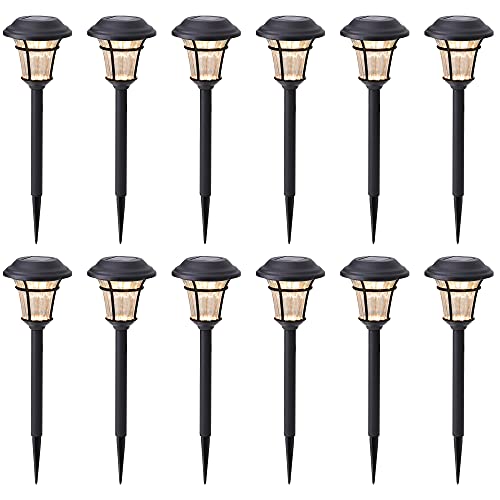
The MAGGIFT 12 Pack Solar Pathway Lights Outdoor ($29.99) — The Maggift 12-pack is one of the most-bought pathway sets anywhere, and it's fine for what it is: a warm, decorative glow along a border. But the listing itself says 1 lumen and warns it may not be bright enough — an unusual bit of candor, and worth believing. It's also IP44, so sprinklers are a risk, and owners report stems snapping during installation and switches that don't always take. Our Solpex budget pick is similarly cheap but sits flush with the ground and adds steel to the build. Choose the Maggift if you specifically want the taller, traditional stake-light silhouette and you're lighting for looks rather than safety.
Placement and upkeep
Placement beats every spec on the box. Old House Journal editors found lights getting four hours of direct sun reached only 38% of the runtime of identical units in full sun, so walk your yard at noon before you commit to a spot. Wipe the panels a couple of times a year — dust, pollen and sprinkler spots quietly cut charging, and it's the first thing to check when a light starts dying at midnight. Flip the switch under the cap on day one; a surprising number of dead-on-arrival lights are just switched off. Choose motion mode over always-on where you can, since it stretches runtime three to five times. And when a light finally fades, replace the battery before you replace the fixture: LEDs are rated for 25,000 to 50,000 hours, which outlasts several battery cycles.
Questions we get
How many hours of sunlight do solar garden lights need to charge fully?
Six to eight hours of direct sun is the usual spec, though panel type matters. This Old House reviewers found monocrystalline-panel lights reached full charge in about 6.2 hours versus 8.5 hours for polycrystalline equivalents under the same conditions. Partial shade is the real problem — four hours of sun can cut runtime to roughly a third of rated.
Do solar garden lights work in winter or cloudy climates?
They work, but shorter days and low sun angles mean less charge and fewer hours of light. A monocrystalline panel helps in gray weather because it converts more of the light that's available. Lithium batteries also hold charge better than NiMH in the cold, which is one reason we favor them for year-round use.
What's the difference between IP44, IP65 and IP67 ratings?
Under IEC 60529, IP44 handles splashing water — rain, sleet, snow from above. IP65 is dust-tight and withstands direct water jets from any angle, which covers sprinklers, and it's what we'd look for on anything staying out all year. IP67 adds immersion to one meter for 30 minutes, worth it only in low spots that puddle.
Are solar pathway lights bright enough to actually see the path?
Mostly no, and that's by design. Pathway lights typically run 5 to 50 lumens — enough to mark the edge of a walk, not enough to light the ground you're stepping on. If you need to genuinely see, use a spotlight in the 100 to 300 lumen range or a motion light with several hundred, aimed down the path.
How long do the batteries last before they need replacing?
Consumer Reports notes NiMH cells in solar garden lights commonly drop below 70% of original capacity within one to two years, while lithium-ion cells in better units hold usable capacity for three to five. The LEDs themselves last far longer — 25,000 to 50,000 hours per Department of Energy figures. So when runtime gets short, swap the battery rather than the light.
Are monocrystalline panels worth paying more for?
In cloudy or partly shaded yards, yes. Monocrystalline cells convert roughly 20% of sunlight versus about 15% for polycrystalline of the same size, and that gap shows up as faster charging and longer nightly runtime. In a yard with eight hours of open sun, either type will fill the battery, and the premium matters less.
Why you should trust us
For this guide:
- We read manufacturer spec sheets for every light here, comparing panel type, battery chemistry and capacity, IP rating and stated runtime.
- We drew on published testing from CNET, This Old House, Good Housekeeping, Popular Mechanics, Tom's Guide, Forbes Home and Old House Journal, plus Department of Energy and Consumer Reports guidance on panel efficiency and battery life.
- We reviewed recurring themes in owner feedback — dead units out of the box, snapped stakes, panel coatings that flake, and which fixtures people say are still running after several winters.
- We read owner reviews on every listing, weighted toward the critical ones, because that is where the recurring failures show up.
- We have a systematic way of automatically fetching the latest prices, so the numbers on this page stay current.
- This is a research-focused guide, so the team may not own every product listed — though we often do own the top winners, which gives us extra context for the recommendations.
- We don't accept free products, and the retailer commission never changes which product we recommend.
Sources
Best Solar Lights for Your Garden and Yard — Wirecutter (NYT), Wirecutter
Best Solar Garden Lights of 2026 — Bob Vila, Bob Vila
Best Solar Lights — This Old House Reviews, This Old House
Best Outdoor Solar Lights Tested by CNET Editors — CNET, CNET
Best Solar Garden Lights — Good Housekeeping Institute, Good Housekeeping
Best Solar Lights for Gardens and Outdoors — Popular Mechanics, Popular Mechanics
Best Outdoor Solar Lights — Tom's Guide, Tom's Guide
Best Solar Pathway Lights — House Beautiful, House Beautiful
Solar Outdoor Lighting Market Size & Growth Report — Grand View Research, Grand View Research
Best Solar Lights — Forbes Home, Forbes Home
Solar Garden Lights Buying Guide — Consumer Reports, Consumer Reports
Outdoor Solar Lights Review Roundup — Old House Journal, Old House Journal
Amazon product listings and owner reviews for all 8 products
Manufacturer specification pages for each product
Some passages in this guide may be paraphrased with AI help. Prices are refreshed automatically.
More like this.
Continue exploring lifestyle reviews and recommendations.

The Best Outdoor Motion Sensor Lights
A good outdoor motion light does three unglamorous jobs. It keeps you from missing a step on a dark walkway, it makes your house a less appealing target…

The Best Outdoor Smart Plugs for Christmas Lights
Stringing lights is the fun part. Remembering to unplug them at 11 p.m. in the freezing cold, night after night, is not. An outdoor smart plug fixes that:…

The Best Portable Solar Generators for Emergencies
A power outage is boring right up until it isn't. The fridge stays cold for a few hours, then it doesn't. The phones drain, the router dies, and if…

The Best Solar Power Banks and Portable Chargers
A charger you carry outside has one job: keep your phone alive when there's no outlet for days. That sounds simple until you're three nights into a trip…

The Best Solar Attic Fans
Your attic is the hottest room in the house, and nobody lives in it. On a clear summer afternoon the air up there can push past 150°F, and that heat…

The Best Expandable Garden Hoses
An expandable hose earns its keep in the two minutes before and after you water. There's no wrestling a stiff coil off a reel, no dragging fifteen pounds…