The Best Deer Repellents for Gardens

Deer don't browse politely. They work through a hosta bed overnight, snap the tops off daylilies, and strip a young arborvitae to the height they can reach. If you garden anywhere near woods or a greenbelt, you've probably watched a season's worth of work disappear in a week. Repellents are the cheap, low-drama answer to this. They make your plants smell wrong or taste wrong, so deer move on to the neighbor's yard instead. And unlike fencing, they don't turn your garden into a compound.
Here's the honest part. No repellent works forever, and none works on a starving deer. University extension research points the same direction again and again: deer get used to a single scent within a month or two, and in late winter they'll eat plants they'd normally ignore. Rain washes product off. New growth comes in untreated. So you're signing up for a routine — spray, wait, spray again, and switch formulas now and then. If you want a guarantee, you want a fence.
We looked at concentrates and ready-to-use sprays, granules and weatherproof stations, and formulas built on putrescent egg, blood meal, mint and botanical oils. What separates the good ones is a mechanism deer can't easily shrug off, a binder that survives a rainstorm, and a smell you can live with. We think that the Bobbex Concentrated Deer Repellent is the best deer repellent for most people, and that the Deer Out 32oz Concentrate is the one to buy if you're protecting vegetables, herbs, or anything you plan to eat.
Everything we recommend

The most proven formula, if you can stand the smell

Safe on food crops, and it actually smells nice

Grab the bottle and spray; no mixing, no bad smell

Scares deer instead of just tasting bad to them
At a glance
| Product | Form | Container Size | Price | |
|---|---|---|---|---|
| Concentrated Deer Repellent - BobbexTop pick | Concentrate | 64 Fl Oz | $44.99 |
| Plantskydd Animal Repellent - Repels DeerAlso great | Granular | 3.5 Lb | $38.12 |
| Deer Out 32oz Concentrate Deer RepellentRunner-up | Concentrate | 32 Fl Oz | $38.95 |
 | Liquid Fence Pet Home & Garden HG-71136Also consider | Concentrate | 40 Oz (Qty 6) | $194.98 |
| I Must Garden Deer Repellent: Mint ScentBudget pick | Ready To Use | 32 Fl Oz | $24.99 |
 | Ortho Lands B-Gon Grass Killer for LandscapesAlso in lineup | Ready To Use | — | $36.12On sale |
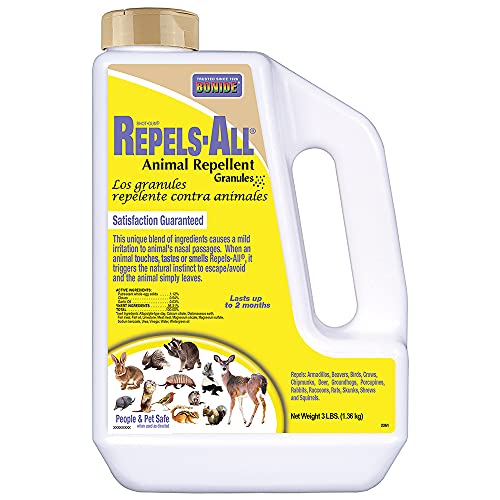 | Bonide Repels-All Animal Repellent GranulesAlso consider | Granules | 48 Oz | $14.68On sale |
 | Havahart DO5600-6 Deer Off Weatherproof Deer RepellentAlso consider | Ready To Use | 4.23 Oz (6-Pack) | $24.18On sale |
How we picked
Proof it works. We leaned on published university extension trials — Rutgers, Penn State and Cornell — over marketing claims. Products with documented field effectiveness got priority over those with only a brand's own numbers.
How it stops deer. We favored formulas that hit more than one sense, or that trigger fear rather than taste aversion. Extension research shows single-mechanism sprays lose ground to habituation faster.
Rain resistance. We looked for named sticking or binding agents in the spec sheets and for owner feedback about how products hold through wet stretches. Anything that rinses off in a shower is a chore, not a solution.
Smell you can live with. We weighed how tolerable each formula is to people, because a repellent nobody wants to apply doesn't get applied. Mint formulas scored well here; egg-based ones traded scent for strength.
Edible-plant safety. We checked labeling for explicit permission to spray food crops rather than assuming natural means edible-safe. Several strong performers here are ornamental-only.
Coverage per bottle. We compared stated coverage area and concentrate ratios so the picks make sense for both a single flower bed and a full property line.
Top pick
The most proven formula, if you can stand the smell
Concentrated Deer Repellent - Bobbex
Bobbex is a concentrate you dilute and spray straight onto foliage, and it's the one with the deepest independent research behind it. The egg-garlic-fish blend hits deer on smell and taste at once, which is why it holds up better than single-mechanism sprays.
$44.99fromAmazonThis is the formula university trials keep putting at the top. Rutgers NJAES ranked Bobbex among the most effective commercial repellents in standardized plot trials, with better than 90% effectiveness. Penn State Extension found separately that putrescent egg and garlic formulas outperform capsaicin-only sprays in real field conditions. That's two independent programs pointing the same way, which is more than almost anything else in this category can claim.
It works on two senses at once, so deer take longer to shrug it off. Putrescent egg solids and fish oil make your plants smell like something dead. Garlic and the secondary deterrents make them taste wrong if a deer tries anyway. A deer that pushes past the smell still gets stopped by the taste. Single-mechanism sprays give deer only one hurdle to clear, and they clear it faster.
Once it dries, rain doesn't undo your work. Bobbex bonds to leaf surfaces as it cures, and the brand's core claim is that it won't wash away after application. Owners who spray ornamentals in wet climates generally back that up — it outlasts thinner formulas through ordinary showers. You'll still want to re-treat after a heavy soaking and after new growth pushes out, but you're not respraying after every drizzle.
The concentrate stretches further than you'd expect. A 64-ounce jug of concentrate makes far more finished spray than a ready-to-use bottle of similar size, which matters a lot once your garden gets past a few hundred square feet. If you're treating shrub borders, a tree line, and a couple of ornamental beds every two or three weeks all season, buying ready-to-use is how you end up restocking constantly.
Flaws but not dealbreakers
It smells genuinely bad while you're applying it. Rotten egg and fish, up close, on a warm day. The odor fades to nothing human-detectable within a day or two, but you'll want to wear old clothes and pick a day you're not hosting anyone. If your beds sit right outside a kitchen window or next to a patio, this is a real consideration and not a nitpick.
It's not labeled for direct use on most edibles. Bobbex isn't designed for edible leaves and herbs, or for rough-skinned berries like strawberries and raspberries. That makes it an ornamental, shrub and tree product first. If you want it near a vegetable bed, spray the perimeter and use an edible-safe formula on the plants themselves.
You have to mix it. Measuring and diluting adds a step, and a mistake at that step means either wasted product or weak coverage. If you want to grab a bottle and start spraying, this isn't that.
Runner-up
Safe on food crops, and it actually smells nice
Deer Out 32oz Concentrate Deer Repellent
Deer Out is a mint-based concentrate you can spray directly on vegetables, herbs and fruit. Two natural sticking agents help it survive rain, and the scent is one you won't mind carrying on your hands for an hour afterward.
$38.95fromAmazonYou can spray this on the food you plan to eat. That's the whole reason it exists. Egg-based formulas keep you spraying around your vegetable beds instead of on them, which leaves the plants deer actually want unprotected. Deer Out goes straight onto tomatoes, beans, lettuce and herbs. If your deer problem is mostly a vegetable-garden problem, this is the more useful product of the two.
The mint scent changes how often you'll actually use it. A repellent only works if you keep applying it, and plenty of people quietly stop using egg-based sprays because of the smell. Deer Out smells like mint to you and like a warning to deer, elk and moose. That makes it the practical choice for beds near a patio, a deck, a play area, or any window you like to leave open.
Two sticking agents give it better staying power than most sprays. Deer Out uses a pair of natural stickers rather than one, and the brand builds its rain-resistance claim on that. Owners who garden in rainy stretches report it holding on better than thinner mint sprays that rinse off in a single storm. You still re-treat after about an inch of rain, but you're not starting over after every shower.
A quart of concentrate covers a serious amount of garden. Diluted properly, it treats up to about 2,500 square feet. For most suburban lots that's the whole growing area with product left over, and it's why the concentrate makes more sense than a ready-to-use bottle if you're spraying every couple of weeks through the season.
Flaws but not dealbreakers
Mint isn't as forceful as rotten egg when deer are desperate. At heavy pressure — rural property, late winter, deer running out of options — the egg-and-blood formulas hold a line that mint-based sprays don't. If your deer are hungry enough, they'll test this one first. Rotating it with Bobbex is a better plan than leaning on it alone.
The mint can bring insects around. Some gardeners notice more insect interest near treated edible beds. It's not a serious problem, and it's not universal, but it's worth knowing if you're already fighting something else in the vegetable patch.
Per ounce, it costs more than the Bobbex concentrate. You're paying for the edible-safe formulation and the pleasant scent. If you're only protecting ornamentals, you're paying for benefits you don't need.
Budget pick
Grab the bottle and spray; no mixing, no bad smell
I Must Garden Deer Repellent: Mint Scent
I Must Garden comes ready to use in a 32-ounce bottle, so there's no measuring or diluting. The mint-and-botanical-oil formula is safe on everything from hostas to tomatoes, and it's one of the most pleasant-smelling repellents you can buy.
$24.99fromAmazonNo mixing means you'll actually spray on schedule. Concentrates are cheaper per ounce, but they add friction, and friction is what makes people skip a week. This one lives on a shelf in the garage and you pick it up and go. For a small suburban bed that needs re-treating every couple of weeks, that convenience is worth more than the savings.
It works on smell and taste, not just one of them. The formula pairs natural compounds that make foliage inedible with botanical oils that irritate a deer's nose. The brand claims triple the active ingredients of typical competing repellents. Whatever the exact count, the two-mechanism approach is the same reason our top pick holds up — deer have to get past both.
You can spray it on nearly anything deer are eating. The label covers hostas, daylilies, tulips, roses, oriental lilies, pansies, impatiens, azaleas, rhododendron and vegetables. That's most of what gets browsed in a residential yard. It's also made to be safe around pets and pollinators, which matters if you have a dog who patrols the beds.
Sticking agents mean average rain won't strip it. I Must Garden builds in natural stickers, and the brand's position is that ordinary rainfall doesn't require a re-spray. Owners generally find it holds through light weather, though heavy downpours are a different story.
Flaws but not dealbreakers
Ready-to-use gets expensive fast on a big property. A 32-ounce bottle doesn't go far if you're treating a shrub border and a tree line. Past roughly a thousand square feet, a diluted concentrate covers the same ground for a fraction of the cost. Know your square footage before you buy this one.
Heavy rain will send you back out with the bottle. The sticking agents help, but a real soaking still calls for re-treatment — and with a ready-to-use spray, that's a noticeable chunk of the bottle each time.
It's a residential-scale product. For late-winter deer pressure on a rural lot, this isn't the formula that holds. Use it where deer have options, not where they're starving.
Also great
Scares deer instead of just tasting bad to them
Plantskydd Animal Repellent - Repels Deer
Plantskydd granules use dried blood to mimic a predator kill site, which triggers a deer's flight instinct rather than teaching it to dislike a flavor. It's OMRI listed for organic use and covers roughly 1,750 square feet per jug.
$38.12fromAmazonFear is harder to habituate to than taste. Cornell Cooperative Extension research found deer get used to taste-aversion repellents within four to six weeks of steady exposure. A blood-meal scent doesn't teach a lesson — it sets off an instinct. That makes Plantskydd a genuinely different tool, and the right partner for a taste-based spray rather than a replacement for one.
In winter, two applications can carry you through. During dormant season you apply once at the start and once before snowfall. That's it. Compare that to biweekly spraying, and it's a real reason to keep a jug around specifically for the cold months, when re-treating a wet, frozen garden is the last thing you want to do.
It handles the rest of the animals eating your yard. Rabbits, voles, squirrels, chipmunks, hares, elk and moose are all on the label. If your deer problem comes with a rabbit problem and a vole problem, one jug at the perimeter replaces a shelf of targeted products.
Granules are the right shape for perimeter work. Shake them along a bed edge, around a tree's drip line, or at the spots deer walk in. It's a boundary product. Pair it with Bobbex sprayed on the foliage inside that boundary and you've got two layers built on two different mechanisms.
Flaws but not dealbreakers
The blood-meal smell is strong going down. It's a different unpleasant than rotten egg, but it's unpleasant. It fades, and the granular format keeps it close to the ground, but the application itself isn't pleasant.
Granules can't coat a leaf. If deer are eating specific hosta leaves, scattering granules nearby is less direct than spraying those leaves. This is protection by boundary, not by contact — which is exactly why it works better alongside a spray than by itself.
Growing-season reapplication comes around faster. Six to eight weeks in the warm months, which is better than most sprays, but it's not the set-once-and-forget cadence you get in dormant season.
Who this is for
This guide is for anyone who gardens where deer come through and doesn't want to fence the whole yard. That's most suburban and semi-rural gardeners with hostas, daylilies, tulips, roses, arborvitae or a vegetable bed — the plants deer go for first. Repellents make the most sense if you can commit to a schedule: spray before damage starts, re-treat every two to three weeks, re-treat after heavy rain, and rotate formulas so deer don't adapt. If that sounds like more upkeep than you want, buy fencing instead and stop reading.
Repellents also aren't the answer for irreplaceable plants. A young fruit tree, a specimen rose, a rare ornamental you waited years for — cage those in chicken wire or deer netting, especially from late winter into early spring, when deer are hungry enough to eat things they'd normally refuse. This guide covers sprays, granules and weatherproof repellent stations. It doesn't cover fencing, motion-activated sprinklers, ultrasonic devices or deer-resistant planting, all of which are worth considering alongside a repellent rather than instead of one.
How we picked
We started from published research rather than brand copy. Proof it works: university extension trials from Rutgers, Penn State and Cornell carried more weight than any manufacturer's own numbers. How it stops deer: we favored formulas that hit smell and taste together, or that trigger a fear response, because extension research shows single-mechanism sprays lose ground to habituation within about a month. Rain resistance: we looked for named sticking agents and for owner reports of how products hold through wet weeks. Smell you can live with: a repellent nobody wants to apply doesn't get applied, so scent tolerability counted. Edible-plant safety: we read labels for explicit permission to spray food crops instead of assuming natural means safe. Coverage per bottle: we compared stated coverage and dilution ratios so the picks work for one bed or a whole property line.
Other deer repellents for gardens worth considering
If you don't want to spray anything at all: The Havahart DO5600-6 Deer Off Weatherproof Deer Repellent ($24.18) — Havahart's Deer Off Weatherproof stations are the closest thing here to set-and-forget. You stake six units at deer entry points, along bed edges and next to high-value plants, and one application is meant to last the season. They're odorless to people, which makes them the obvious choice near a patio, a kitchen window or a play area where egg-based sprays would be socially impossible. They're also safe around vegetable gardens. What you give up is contact protection: stations don't coat individual leaves, so a determined deer can walk past one and start eating. Placement matters more than with a spray, and per-unit coverage is smaller than what a diluted concentrate treats. Think of these as a low-effort baseline rather than a heavy-pressure defense.
If deer are only part of your animal problem: The Bonide Repels-All Animal Repellent Granules ($14.68) — Bonide Repels-All granules cover an unusually wide range — deer, rabbits, squirrels, chipmunks, mice, skunks, rats, beavers, raccoons, porcupines, groundhogs and birds. The blend causes mild nasal irritation, which sets off the same escape-and-avoid instinct across all of them. Shake it around garden edges, garbage cans, woodpiles, decks and shed foundations and you've handled several problems with one jug. It's also biodegradable and won't hurt lawns or beds when used as directed. The trade-off is focus: for deer specifically, it's less pointed than Bobbex or Plantskydd, and granules break down faster than sprays after heavy rain. Buy it when your yard is under pressure from four species at once, not when deer are the only visitor.
If you're treating acreage and hate restocking: The Liquid Fence Pet Home & Garden HG-71136 ($194.98) — This is six 40-ounce bottles of Liquid Fence concentrate, which is a full season of biweekly applications for a large property without a single reorder. The formula handles deer and rabbits together, so one pass covers both, and Liquid Fence is stocked widely enough that replacements are easy to find when you finally run out. It's a putrescent-egg base, so expect the same sharp smell during application that Bobbex has. The catch is scale. Six bottles is far more product than a typical suburban garden will use before you'd rather try something else, and buying this much of one formula works against the rotation strategy that keeps repellents effective. It's a logistics purchase for people managing real acreage.
The competition
Here's what else turned up while we were researching this category. It isn't every deer repellent on the market — it's the products that came up alongside our picks and didn't quite earn one.
The Ortho Lands B-Gon Grass Killer for Landscapes ($36.12) — Ortho Lands B-Gon Grass Killer for Landscapes is a selective herbicide, not a deer repellent, and it won't stop a single deer from eating your hostas. It kills annual and perennial grassy weeds around ornamentals, ground covers, evergreens, shrubs and shade trees without harming those plants, and it comes ready to use. Some gardeners use it as part of a broader landscape plan, on the theory that thinning out weedy grass reduces the easy browsing around high-value plants. That's a stretch as a deer strategy. If you have a grassy weed problem, this is a reasonable tool for it — just don't buy it expecting deer protection, and pair it with an actual repellent.
Application notes
Timing beats everything else. Spray in early spring as new growth emerges, before deer decide your garden is a reliable stop on their route — a deer that's already fed in your beds will test your barrier repeatedly and cost you far more product than one that never started. Plan on re-treating every two to three weeks through the growing season, and again after any rainfall over about an inch, no matter what the rain-resistance claim says. New leaves come in untreated, so hit fresh growth specifically. Rotate between two different formula types every three to four weeks — an egg-and-garlic spray, then a mint one — because Cornell research found deer habituate to a single scent within four to six weeks. And cage anything irreplaceable during late winter, when hungry deer will eat what they normally won't.
Questions we get
What's the best deer repellent for vegetable gardens?
Deer Out concentrate is the one we'd reach for, because it's labeled safe to spray directly on vegetables, herbs and fruit and covers up to about 2,500 square feet per diluted quart. I Must Garden is the ready-to-use alternative if you'd rather not mix anything. Skip putrescent egg formulas like Bobbex on food crops — spray those around the bed perimeter instead.
How often do I need to reapply after rain?
Re-treat after any rainfall over about an inch, whatever the bottle claims. During the growing season, plan on every two to three weeks even in dry stretches. Formulas with sticking agents — Deer Out's two natural stickers, Bobbex's bonding formula — hold up better, but new growth always emerges unprotected and needs its own coat.
Do repellents actually work, or do I need a fence?
They work, as long as you apply them before damage starts and rotate formulas. Rutgers field trials documented better than 90% effectiveness for the top formulas in standardized plots. But effectiveness drops during late-winter food scarcity and once deer have established a feeding habit in your yard. Fencing is still the only thing that's close to absolute — repellents get you most of the way for a lot less trouble.
Which repellent doesn't smell bad to people?
Deer Out and I Must Garden both use mint-forward formulas that most people find pleasant rather than tolerable. Havahart's Deer Off Weatherproof stations are odorless to humans entirely, which makes them the pick for beds next to a patio or an open window. Bobbex, Plantskydd and Liquid Fence all smell strong during application, though the odor fades within a day or two.
How do I keep deer from getting used to a repellent?
Rotate between two different formula types every three to four weeks. Cornell Cooperative Extension found deer habituate to a single unvaried scent within four to six weeks. A workable pattern is Bobbex for a few weeks, then Deer Out, then back again — the egg-and-garlic profile and the mint profile are different enough that deer don't carry the lesson across.
What ingredients actually make these work?
Putrescent egg solids, garlic, blood meal, capsaicin and fish oil are the workhorses. Penn State Extension found egg-and-garlic combinations consistently outperform capsaicin-only sprays in field conditions. Blood meal, which is what Plantskydd uses, works differently — it reads as a predator kill site and triggers instinctive flight rather than teaching a deer that a plant tastes bad.
Why you should trust us
For this guide:
- We read published field-trial results from Rutgers NJAES, Penn State Extension and Cornell Cooperative Extension on repellent effectiveness and deer habituation.
- We compared manufacturer spec sheets and labels across all eight listings for active ingredients, stated coverage area, reapplication intervals and edible-plant safety.
- We reviewed owner feedback themes for recurring complaints about odor, rain durability and how quickly deer resumed browsing.
- We read owner reviews on every listing, weighted toward the critical ones, because that is where the recurring failures show up.
- We have a systematic way of automatically fetching the latest prices, so the numbers on this page stay current.
- This is a research-focused guide, so the team may not own every product listed — though we often do own the top winners, which gives us extra context for the recommendations.
- We don't accept free products, and the retailer commission never changes which product we recommend.
Sources
Deer-Resistant Landscapes and Repellents — Penn State Extension, Penn State Extension
Protecting Gardens from Deer — University of Vermont Extension, University of Vermont Extension
Deer Repellents: Effectiveness and Use — Rutgers NJAES, Rutgers New Jersey Agricultural Experiment Station
Managing White-Tailed Deer in Suburban Environments — Cornell Cooperative Extension, Cornell Cooperative Extension
Best Deer Repellents Tested by Garden Editors — Good Housekeeping, Good Housekeeping
Amazon product listings and owner reviews for all 8 products
Manufacturer specification pages for each product
Some passages in this guide may be paraphrased with AI help. Prices are refreshed automatically.
More like this.
Continue exploring lifestyle reviews and recommendations.

The Best Mosquito Repellents for Outdoors
Mosquitoes decide how long you stay outside. A bite or two on the ankles during dinner on the deck, and everyone drifts indoors an hour early. The right…

The Best Bug Repellents
A good bug repellent is the difference between sitting outside until the fireflies come out and going inside at seven. It's also, in tick country, a…

The Best Deer Feeders With Timers
A deer feeder does one job: put corn on the ground at the same time every day so deer learn to show up then. That sounds simple, and the hopper part…

The Best Ground Blinds for Deer Hunting
A ground blind does one job: it hides you at eye level with the deer. That's harder than it sounds. You're sitting where a whitetail's nose, ears and eyes…

The Best Snake Repellents for Your Yard
If you've ever found a snake coiled under the deck stairs, you know the feeling. Most yard snakes are harmless, but in copperhead, rattlesnake and…

The Best Expandable Garden Hoses
An expandable hose earns its keep in the two minutes before and after you water. There's no wrestling a stiff coil off a reel, no dragging fifteen pounds…