The Best Deer Feeders With Timers
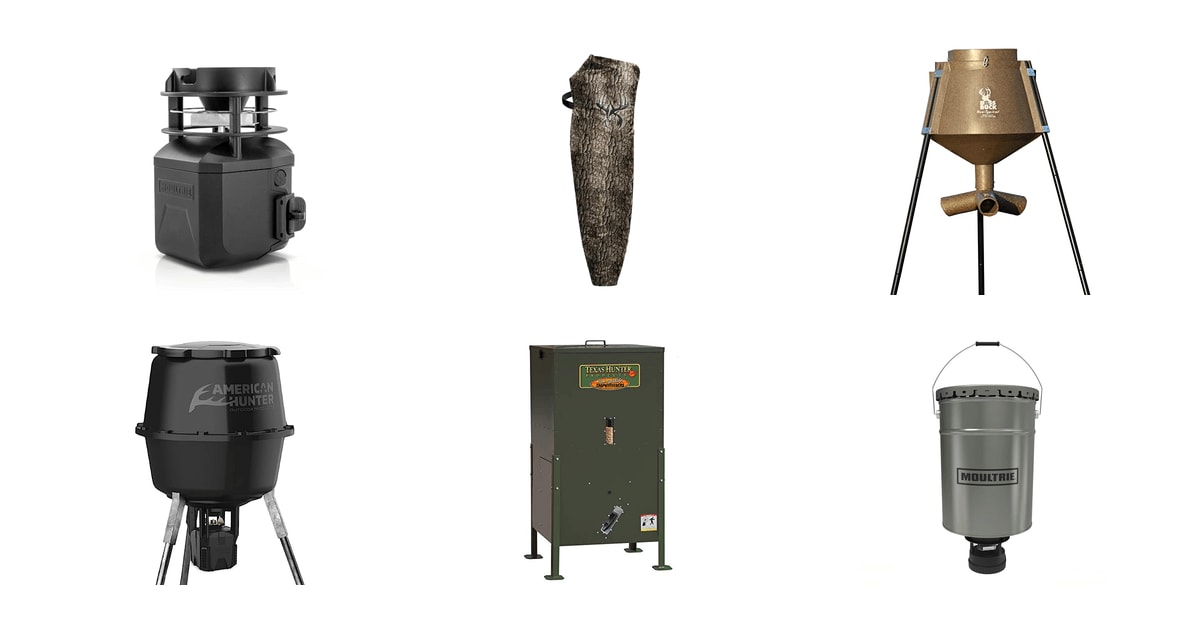
A deer feeder does one job: put corn on the ground at the same time every day so deer learn to show up then. That sounds simple, and the hopper part mostly is. The part that fails is everything else — the timer that drifts, the battery that dies in the cold, the spinner motor that jams on a damp morning, the legs a raccoon can rock until 40 pounds of corn dumps in one pile. You're usually a half-mile walk from the truck when you find out.
Here's the honest catch: no feeder here solves the biggest problems with feeding deer. Concentrating animals at one spot raises disease transmission risk — USGS analysis puts prion transmission at point-source feeders as much as four times higher than dispersed foraging. That's exactly why ten states restrict feeders in CWD zones and five prohibit baiting near an active hunting site. Feeders also can't stop squirrels and coons from eating on your dime. You can reduce that, not eliminate it.
We also want to set expectations on the timer itself. A dial timer and a ten-event programmable timer both throw corn; the expensive one just wastes less of it and lands closer to legal shooting light. Whether that's worth the money depends on how far you drive to refill. We think that the Moultrie Pro Hunter III Feeder Kit is the best deer feeder with a timer for most people, and that the Boss Buck 350 LB Deer Feeder is the one to buy if you'd rather never deal with a motor at all.
Everything we recommend

Phone-controlled timing on whatever hopper you already own

No motor, no timer, no battery — and nothing to break

Hangs from a limb in minutes when you're still scouting

A hundred pounds on a tree strap, if you skip the timer
At a glance
| Product | Capacity | Feed Events/Day | Price | |
|---|---|---|---|---|
| Moultrie Pro Hunter III Feeder Kit -Top pick | — | Up to 10/Day | $59.99On sale |
| WILDGAME INNOVATIONS Treehugger 100 lb Trubark HDBudget pick | 100 lb | — | $24.61On sale |
| BOSS BUCK 350 LB Deer Feeder/Hunting DurableUpgrade pick | 350 lb | — | $320.99On sale |
 | American Hunter 30 Gal Nesting HopperAlso consider | 30 Gal | 1-16/Day | $134.98On sale |
 | Texas Hunter Directional Fish Feeder w/Straight LegsAlso in lineup | 175 lb | 1-9/Day | $1,297 |
| Moultrie All-in-One Hanging Deer Feeder - 40Also great | 40 lb | Up to 4/Day | $79.99 |
How we picked
Timer control. We compared spec sheets for programmable feed events, run duration and spin-speed adjustment, then weighed those against owner reports of drift, lockups and battery-related failures. Fine control over feed time mattered more to us than a high count of daily events.
Hopper and weather. Field & Stream's product testing found UV-resistant roto-molded poly holds up through three-plus seasons of direct sun while standard injection-molded plastic starts cracking by season two. We favored heavy-wall poly and metal hoppers with lids that shed rain and vent condensation.
Varmint resistance. Owner feedback across these listings points consistently at raccoons and squirrels, not deer, as the reason feed disappears. Locking lids, metal hoppers, overhanging feed ports and stable leg systems moved a product up; fabric and thin plastic moved it down.
Capacity and refills. Using the Mississippi State Deer Lab figure of 5 to 8 pounds of corn per deer per day, we matched hopper size to realistic refill intervals. A 200-pound fill feeds eight to ten deer for roughly three weeks, which set our baseline for a weekend hunter.
Power and support. We looked at battery type, stated runtime, solar-panel compatibility and warranty terms in manufacturer specifications, plus what owners say about getting replacement parts. A feeder you can't power in February or repair in October isn't much of a feeder.
Top pickOn sale
Phone-controlled timing on whatever hopper you already own
Moultrie Pro Hunter III Feeder Kit -
This is a timer and spinner kit, not a complete feeder — it bolts onto a barrel, bucket or Moultrie hopper you supply. You get ten daily feed events, one to 60 seconds each, three spin speeds, and Bluetooth programming from up to 300 feet away.
$59.99fromAmazonList priceProgramming from your phone is the feature that actually changes how you hunt. Anyone who's crouched under a tripod in the dark, thumbing tiny buttons with cold hands, knows why. With this kit you stand back and set feed times on the app. If you've paired an Edge 3 Series camera, you can adjust from home over cellular. Owners who've used other spinners describe field programming as the thing they dreaded, and this removes it.
Ten feed events a day sounds like overkill, and for most hunters it is. What matters is the resolution. Realtree's biologists suggest timing the morning feed 30 to 45 minutes before legal shooting light and the evening one about 90 minutes before sunset, and Penn State Extension research finds deer settle into a schedule within one to two weeks and arrive inside a 15-minute window. A timer you can nudge by a few minutes is worth more than one with more slots.
The adjustable spin plate speed is the quiet upgrade here. On low, corn drops in a tight circle near the legs — better for a bowhunter watching one lane. On high, owners report throw out past ten feet, which suits a rifle setup or a bigger clearing. Outdoor Life's testing found broadcast feeders scatter feed over 30-plus feet versus 10 to 15 for directional models, so being able to dial that back matters.
You're also buying flexibility that a bundled feeder can't match. The Quick-Lock adapters mount to any flat-bottom container — a 35- or 55-gallon drum, a bucket, a homemade hopper. If you already own a tripod feeder with a dead timer, this is a straight replacement rather than a whole new purchase. It's solar-ready too, through a port for Moultrie's 6V panel, which matters if your feeder sits an hour off the road.
Flaws but not dealbreakers
The kit runs on a 6V tab-top rechargeable battery that Moultrie sells separately, and the solar panel is separate as well. So the sticker doesn't reflect what you'll actually spend to get it running. Add the hopper if you don't already have one, and this stops being the simple option.
The most worrying owner complaint involves the feeder dumping its whole load at once — one report describes 20 pounds of corn on the ground while the owner was at work, apparently as the battery faded. Low battery voltage causing a stuck spin plate is a known failure mode for motorized feeders generally. If you're running this remotely, a solar panel isn't a luxury.
Setup leans on the app. That's a plus in the field and a minus at the truck if you have no signal, and a handful of owners describe the printed instructions as thin. Budget an evening at the house to pair it and learn the menus before you haul it out.
Upgrade pickOn sale
No motor, no timer, no battery — and nothing to break
BOSS BUCK 350 LB Deer Feeder/Hunting Durable
The Boss Buck holds about 350 pounds of corn or protein and dispenses it by gravity through three feed tubes, with no timer or motor anywhere. It's the choice when you want a feeding station that keeps working whether or not you visit it.
$320.99fromAmazonList priceThe best way to avoid timer failure is to skip the timer. Bass Pro's customer data across hundreds of 30-gallon tripod feeders shows timer reliability, not hopper durability, is what drives the angriest reviews. A gravity head has no motor to seize, no battery to sag in January, no spin plate to jam on wet corn. Owners who've cycled through several feeders keep landing on this one for exactly that reason.
Capacity is the other argument. Mississippi State's Deer Lab puts an adult whitetail at 5 to 8 pounds of supplemental corn a day, climbing to 8 to 10 during the rut. At 350 pounds, this holds nearly twice what a 30-gallon hopper does. If your property is a two-hour drive away or your ranch has six stations to service, cutting refill trips in half is the whole point.
The head design handles the failure that ruins cheap gravity feeders: water. Each 4-inch feed port has an overhang and a drain hole, the ports angle down 10 degrees, and the double-walled lid lets the hopper breathe so condensation doesn't turn corn into a moldy plug. Owners consistently report dry feed after heavy rain, which is not a given in this category.
It also runs protein pellets and odd-shaped feed without clogging. A three-way inner sleeve lets you push or ease the flow rate to match what you're pouring in, so the same unit handles shelled corn in the fall and pellets in the summer. That's harder than it sounds — pellets and powdered attractants bridge and hang up in narrow ports.
Flaws but not dealbreakers
Gravity feeding means feed is available around the clock, to everything. You can't time deer to your morning sit, and raccoons, hogs and squirrels eat whenever they like. Several owners haven't had raccoon trouble here, but the physics don't favor you the way a timed spinner does.
It's heavy when it's full, and the legs sink. More than one owner describes the feeder settling into soft ground until feed poured out of the ports. Plan on setting it on a pad, gravel or something firm, especially if your soil goes to soup after a rain.
Corn on the ground is a constant here. The flow adjusts, but the gravity head still leaves a pile under the ports rather than scattering it, so there's more waste than a spin plate produces. And one owner reported missing hardware plus a rough time getting Boss Buck to help with an Amazon purchase, so check the box against the parts list before you drive out.
Also great
Hangs from a limb in minutes when you're still scouting
Moultrie All-in-One Hanging Deer Feeder - 40
This all-metal 40-pound bucket hangs from a branch with a rope and runs four daily feed events on AA batteries. It's the feeder for the spot you're not sure about yet, or for public-land-adjacent setups where you'll be moving things around.
$79.99fromAmazonNot every feeder needs to be a permanent installation. If you've found sign in a new bottom and want to know whether deer will use it before committing to a tripod, this weighs about 6 pounds empty and needs no tools. Hang it, program it, walk out. Owners doing exactly that — hunting new ground, unsure it's worth a bigger investment — describe it as the right size of commitment.
The metal hopper and locking lid do more work than the spec sheet suggests. Raccoons and squirrels chew through fabric and pry weak plastic lids; a locking metal lid is a genuinely harder problem for them. It also keeps rain out between fills. Given how much feed varmints take from bag-style and open-port feeders, that's not a small thing.
It runs on four AA batteries, or eight for longer runtime, with a slide-out tray. No 6V brick, no charger, no separate purchase — you can carry spares in a pocket. Owners feeding twice a day report going roughly six months on a set, which covers a season. It also takes Bluetooth programming from the app, so you're not fumbling with the spinner in the dark.
Forty pounds is the tradeoff you're making. Using the Deer Lab's 5-to-8-pound daily figure, that's not a herd feeder — it's an attractant station or a supplement to something bigger. For a solo hunter working a small property, or someone photographing deer rather than shooting them, that's often plenty.
Flaws but not dealbreakers
Four feed events at one to 20 seconds each is a narrower window than the Pro Hunter III's ten events at up to 60 seconds, and there's no spread adjustment. Owners who want to tighten or widen the throw pattern can't. What you get is a 360-degree broadcast, which works against you if you're a bowhunter needing feed in one lane.
Programming requires getting at the spinner underneath the bucket, which several owners find awkward — you're taking the bottom off to reach it rather than opening a door at eye level. The app helps once it's paired, but the initial setup is fiddly.
This is the pick with the most reports of missing or wrong parts in the box. Some owners describe arriving at their property with a feeder they couldn't assemble because the motor mounting hardware wasn't included, and instructions that didn't match the product. Open it and dry-fit everything at home.
Budget pickOn sale
A hundred pounds on a tree strap, if you skip the timer
WILDGAME INNOVATIONS Treehugger 100 lb Trubark HD
The Treehugger is a PVC bag that straps to a tree and lets feed spill out the bottom as deer eat. There's no timer and no moving parts, and it holds about 100 pounds — a lot of feed for very little money or weight.
$24.61fromAmazonList priceThis isn't a timed feeder at all, and you should know that going in. It's a gravity bag: feed sits in a roll-top PVC sack and replenishes the pile underneath as deer clean it up. If your goal is patterning deer at a specific hour, buy one of the picks above. If your goal is simply putting corn somewhere deer will find it, this does that for a fraction of the price and weight.
Where it earns its place is scouting and access. It goes around a trunk with two straps and a buckle in under five minutes, weighs almost nothing in a pack, and can be moved as often as you like. Owners running several hunting spots buy multiples for exactly that reason. MeatEater's editors suggest placing feed 50 to 80 yards from a stand; a bag you can move lets you find that distance by trial.
It handles feed that clogs other gravity setups. Corn, protein, mineral, attractant blends — the wide bottom opening isn't fussy. One owner searching for years for something that works with rice bran, which is powdery enough to bridge in most feeders, landed here. That's a real niche and this fills it.
It also holds what it claims. Owners confirm a genuine 100 pounds of feed, which at the Deer Lab's daily consumption figures is a couple of weeks for a small group of deer — assuming they're the only ones eating.
Flaws but not dealbreakers
Squirrels chew through the fabric. Multiple owners describe finding the bag riddled with holes within days, feed pouring out everywhere. Raccoons don't chew, but they'll clean it out. In squirrel-heavy timber this is a short-lived product.
Because feed is always available, consumption can be startling. One owner reports 40 pounds gone in under a day. There's no way to meter it, so you're feeding whatever shows up, whenever it shows up, until the bag is empty.
The plastic clips are the weak link in the hardware. Owners report broken clips on arrival and at least one failure the first time the straps were unclipped to reposition. The straps themselves are sturdy; the buckles are the part that gives.
Who this is for
This guide is for hunters, land managers and wildlife watchers who want corn on the ground at a predictable time — weekend hunters running one or two stations, ranch managers servicing several, bowhunters who need feed in a narrow lane, and first-timers setting up a new property. It's also for people who don't hunt at all and just want deer in front of a camera. Check your state's rules before you buy. The National Deer Association counts 35 states that allow year-round supplemental feeding, 10 that restrict it inside CWD management zones, and 5 that prohibit baiting within a set distance of an active hunting site.
You should skip all of this if you're in a CWD-endemic county, or if you'd rather improve habitat than concentrate deer. Feeding at a point source raises disease transmission risk substantially, and no product here changes that. We've covered feeders you can set on a timer or run by gravity, sized from a 40-pound hanging bucket to a 350-pound station. We haven't covered protein-only feeders, homemade barrel builds, or timers sold on their own without a hopper or mounting kit.
How we picked
We built this guide from manufacturer specifications, published product testing and the themes that run through owner feedback, weighing five things. Timer control: how precisely you can place a feed event, adjust its duration and change the spin speed, and whether the timer keeps working when it's cold and the battery is low. Hopper and weather: UV-resistant poly or metal, a lid that sheds rain and vents condensation, and feed ports that drain rather than hold water. Varmint resistance: locking lids, metal over fabric, overhanging ports and legs a raccoon can't rock. Capacity and refills: hopper size matched to how many deer you're feeding and how far you drive to refill. Power and support: battery type, stated runtime, solar readiness, warranty terms and whether replacement parts are actually obtainable.
Other deer feeders with timers worth considering
If you want a complete tripod feeder in one box: The American Hunter 30 Gal Nesting Hopper ($134.98) — The American Hunter 30 Gal Nesting Hopper is the only pick-adjacent option here that arrives as a finished feeding station — 30-gallon hopper, XDE-Pro timer with a spin plate, and three 8-foot sectional metal legs with twist locks. The timer allows 1 to 16 feedings a day at 1 to 60 seconds, plus two preset configurations if you don't want to think about it, and it's pre-wired for a solar panel. What you give up is refinement. Owners report corn hanging up in the funnel until you slap the hopper, a battery tray that doesn't hold the battery firmly, timer settings that reset on a battery swap, and instructions vague enough that several people couldn't figure out how to connect power at all. Some received controllers with a broken red-wire connector. Buy it for the all-in-one convenience and the legs, not the electronics.
The competition
This is what our research surfaced in this category, not a survey of everything sold. Deer feeders are a fragmented market with a lot of regional brands, farm-store house labels and homemade barrel setups that never show up in an online search. If a feeder you're considering isn't here, that's not a verdict on it.
The Texas Hunter Directional Fish Feeder w/Straight Legs ($1,297) — The Texas Hunter Directional Fish Feeder is sold as a pond feeder, and its blower throws feed in a 20-by-45-foot wedge specifically to clear the bank and land on water. That said, it holds 300 pounds of corn, includes a 12-volt rechargeable battery and a digital timer with a five-year warranty, and runs 1 to 9 feedings a day at 1 to 60 seconds. Some land managers do run these over ground for the directional pattern and the capacity. We didn't make it a pick because the feed pattern is engineered for a pond rather than a shooting lane, it weighs 124 pounds and ships by freight, and there's almost no owner feedback to go on. If you have a pond on the property, it's the obvious choice for that job.
Placement and upkeep
Set your feeder 50 to 80 yards from your stand, per MeatEater's editors — close enough for an ethical shot, far enough that your approach trail doesn't leave scent at the feed site. Put the legs on firm ground or a pad so a full hopper doesn't sink and dump feed out the ports. Time the morning feed 30 to 45 minutes before legal shooting light and the evening feed about 90 minutes before sunset, then give deer one to two weeks to settle into the pattern before you judge the spot. Check the spin plate and feed ports for damp corn every refill, since a wet plug will stop a motor cold. Mossy Oak's GameKeeper land managers suggest relocating the whole station every two or three seasons to limit soil compaction and disease concentration at high-traffic sites.
Questions we get
How many times a day should I set my deer feeder timer?
Two is plenty for most hunters — one morning, one evening. Realtree's biologists suggest running the morning feed 30 to 45 minutes before legal shooting light and the evening feed about 90 minutes before sunset, which lines up with when deer are already moving. Feeding more often mostly feeds raccoons. Start at six to eight seconds per event and adjust based on how much corn is left by midday.
What's the difference between a gravity feeder and a spin feeder?
A gravity feeder lets feed fall out of ports or an opening whenever deer eat, with no motor, timer or battery. A spin feeder uses a timed motor to fling feed at set hours. Gravity feeders are simpler and nearly failure-proof but feed everything all day; spin feeders let you condition deer to show up in a huntable window. The Boss Buck is gravity, the Moultrie kits are spin.
How long do the batteries last?
It depends on the power source and how often you feed. Moultrie rates its 6 D-cell timers at roughly six months at two feed events a day, and owners of the AA-powered hanging feeder report similar. A 6V or 12V rechargeable lasts longer but needs charging. Adding a solar panel can stretch a battery from one season to two-plus, which is worth it for a feeder you rarely visit.
Are deer feeders legal everywhere?
No, and this is worth checking before you spend anything. The National Deer Association counts 35 states allowing year-round supplemental feeding, 10 restricting it inside designated CWD management zones, and 5 prohibiting baiting within a set radius of an active hunting site. Rules can differ by county within a state. Check your wildlife agency's current regulations for the specific property you're hunting.
How do I keep raccoons and squirrels out?
You can't fully, but you can make it hard. A locking metal lid stops the climbing-and-prying approach, and overhanging feed ports with narrow openings limit what a raccoon can paw out. Heavy-gauge legs matter too, since flimsy tripods let coons rock a feeder until feed spills. Fabric bag feeders are the most vulnerable — squirrels chew straight through them.
What size feeder do I need for a 50-acre property?
One 30-gallon station covers 50 acres for most people. Mississippi State's Deer Lab puts a whitetail's fall corn consumption at 5 to 8 pounds a day, rising to 8 to 10 during the rut, so a 200-pound fill runs eight to ten deer about three weeks. If you're driving more than an hour to refill, step up to a 300-pound-plus hopper instead of adding a second station.
Why you should trust us
For this guide:
- We read manufacturer specifications for every feeder here, comparing timer programmability, hopper capacity, power requirements and stated warranty terms side by side.
- We reviewed published product testing from Field & Stream and Outdoor Life on hopper materials and feed-spread patterns, plus wildlife research from Mississippi State's Deer Lab, Penn State Extension, USGS and the National Deer Association on consumption rates, feeding behavior, disease risk and state regulations.
- We read through owner feedback across these listings and tracked the complaints that repeat — varmint damage, timer and battery failures, and missing hardware in the box.
- We read owner reviews on every listing, weighted toward the critical ones, because that is where the recurring failures show up.
- We have a systematic way of automatically fetching the latest prices, so the numbers on this page stay current.
- This is a research-focused guide, so the team may not own every product listed — though we often do own the top winners, which gives us extra context for the recommendations.
- We don't accept free products, and the retailer commission never changes which product we recommend.
Sources
Best Deer Feeders of 2026 — Field & Stream, Field & Stream
Deer Feeder Reviews & Buyer's Guide — Outdoor Life, Outdoor Life
How to Set Up a Deer Feeding Program — Realtree, Realtree
Deer Feeder Regulations by State — Quality Deer Management Association (QDMA/NWDAF), National Deer Association
Adult Deer Nutritional Requirements — Mississippi State University Deer Lab, MSU Deer Lab
Deer Feeder Setup & Placement Tips — MeatEater, MeatEater / Wired to Hunt
Moultrie Pro Hunter II Product Page & Specifications, Moultrie (Manufacturer)
Boss Buck Feeder Product Specifications, Boss Buck (Manufacturer)
Best Deer Feeders — Mossy Oak GameKeeper Blog, Mossy Oak GameKeeper
Deer Behavior & Conditioned Feeding Response — Penn State Extension Wildlife, Penn State Extension
CWD and Supplemental Feeding — U.S. Geological Survey National Wildlife Health Center, USGS / NWHC
Best Deer Feeders Tested and Reviewed — Bass Pro Shops Outdoor Hub, Bass Pro Shops
Amazon product listings and owner reviews for all 6 products
Manufacturer specification pages for each product
Some passages in this guide may be paraphrased with AI help. Prices are refreshed automatically.
More like this.
Continue exploring lifestyle reviews and recommendations.

The Best Ground Blinds for Deer Hunting
A ground blind does one job: it hides you at eye level with the deer. That's harder than it sounds. You're sitting where a whitetail's nose, ears and eyes…

The Best Deer Repellents for Gardens
Deer don't browse politely. They work through a hosta bed overnight, snap the tops off daylilies, and strip a young arborvitae to the height they can…

The Best Windshield De-Icer Sprays
Scraping a frozen windshield is a miserable way to start a day. A de-icer spray shortcuts it: you soak the glass, wait a few seconds, and push the slush…

The Best Bird Feeders for Beginners
A bird feeder is one of the few purchases that pays you back within days. Hang one near a shrub in a suburban yard and you'll often see your first…

The Best Automatic Pet Feeders
An automatic feeder earns its spot on the kitchen floor the first morning you don't get woken at 5 a.m. It also helps if you work long shifts, your cat's…

The Best Squirrel-Proof Bird Feeders
Squirrels aren't casual about this. A gray squirrel can jump roughly ten feet sideways, walk down a metal pole head first, and empty a tube feeder in an…