The Best Ground Blinds for Deer Hunting
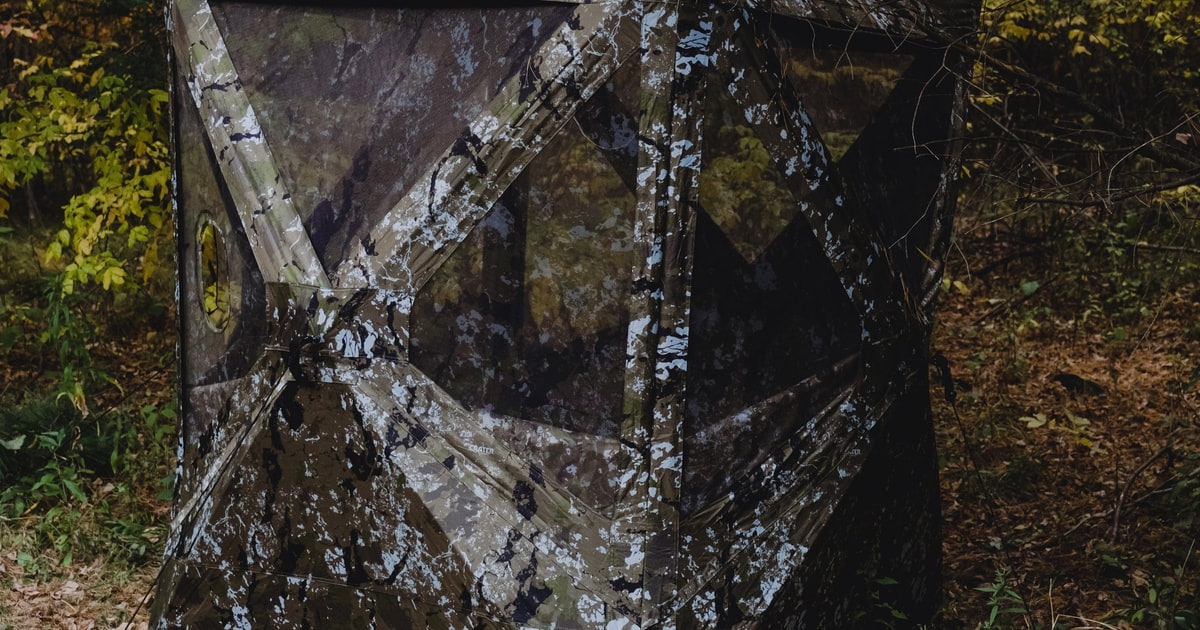
A ground blind does one job: it hides you at eye level with the deer. That's harder than it sounds. You're sitting where a whitetail's nose, ears and eyes all work best, so the blind has to swallow your silhouette, muffle the sound of a window sliding open, and stay put when a November gust hits the broadside. The good ones set up in under a minute and disappear into the brush. The bad ones flap, shine, and teach every deer on the property to route around that corner of the field.
Here's the honest part. No ground blind solves scent. A fully enclosed shell traps and concentrates your odor, then vents it downwind in a plume — Mossy Oak's hunting advisors make the point that wind discipline matters more at ground level, not less. Nothing on this list changes that. Fabric is the other compromise. Sportsman's Guide's fabric testing found 300D shells held waterproofing and structure for about 36 months outdoors, while 150D shells showed seam failure and UV breakdown inside 18. Most blinds you can actually afford use 150D.
You'll also find that the roomy blinds are heavy and the packable blinds are cramped, and no manufacturer has escaped that math. So pick for how you hunt. We think that the Primos Double Bull Raised Hunting blind is the best ground blind for most people, and that the Barronett Big Mike is the one to buy if you shoot a bow and need to stand up at full draw.
Everything we recommend

Quiet, well-built, and sized for one hunter who moves
The one to buy if you shoot a bow standing up
Tough enough to leave standing all season

Cheap, light, and good enough for a first season
At a glance
| Product | Capacity | Height | Price | |
|---|---|---|---|---|
| Primos Hunting Double Bull Raised Hunting GroundTop pick | — | 70" | $665.95 |
| Ameristep Care Taker Ground BlindBudget pick | 2 Hunters | 60" | $99.99On sale |
| Barronett Blinds Big MikeAlso great | 2-Person | 80" | $259.99On sale |
| Rhino Blinds R100-RTE 2 Person Hunting GroundRunner-up | 2 Person | 65" | $80.94 |
 | PRIMOS Hunting Double Bull Blind StakesAlso in lineup | — | — | $15.49 |
 | Guide Gear Dual Hub Turkey Hunting GroundAlso consider | 1-2 Person | — | $49.99On sale |
How we picked
Interior height. We treated Petersen's Bowhunting's 78-inch minimum for compound shooters as the line between a bow blind and a gun blind. American Hunter's editors identify 68-inch ceilings as the most common cause of equipment contact inside a blind, so we noted peak height for every model.
Blackout lining. Bowhunter Magazine's field work puts blackout interiors at roughly 90 percent silhouette reduction inside 30 yards versus camo-printed linings. Any blind without a dark interior coating lost ground immediately, regardless of its exterior pattern.
Fabric and weather. Sportsman's Guide's fabric testing found 300D shells holding waterproofing for about 36 months of exposure while 150D shells failed at seams within 18. We compared shell specs and read owner feedback for the seam and pinhole complaints that show where the number falls short.
Window operation. We favored silent closures — toggles, low-profile flaps, shoot-through mesh — over zippers, and we weighed owner reports about how each system works with cold hands. Windows are where a blind gets loud at the worst possible moment.
Setup and packing. Outdoor Life's gear coverage puts hub blinds at 30 to 60 seconds versus 10 to 15 minutes for frame-style designs, so we looked only at hub blinds. We also read owner feedback on how hard each one is to fold back into its bag.
Top pick
Quiet, well-built, and sized for one hunter who moves
Primos Hunting Double Bull Raised Hunting Ground
This is the blind we'd hand to someone who hunts a few different spots and wants everything to work without fuss. The 60-by-60-inch floor fits one hunter and gear comfortably, the double-wide door opens without a racket, and the pack doubles as your chair.
$665.95fromAmazonThe door is the part you'll notice first. Most blinds make you fold yourself through a narrow zippered flap in the dark, and every catch and scrape carries. This one uses a double-wide door instead, so you step in rather than crawl. That matters more than the spec sheet suggests. If you're getting settled at 5 a.m. with a bow, a pack and a thermos, the difference between a quiet entry and a noisy one is often just the size of the opening.
Primos designed the window layout with the Raised Hunting crew, and it shows in what got prioritized: filming and bowhunting. The openings are cut for a camera arm and a bow, not just a rifle barrel poked through a port. If you film your hunts, that's a real advantage over blinds that force you to choose between the lens and the shot. If you don't, you still get openings that fall where a bowhunter's sight window actually lands.
At 70 inches of peak height with a 60-by-60-inch floor, this is a comfortable one-person blind and a tight two-person one. That's a deliberate trade. Smaller footprint means less fabric to catch wind, a smaller brush pile to build around it, and a shape that tucks into a fencerow or a cedar edge instead of announcing itself in the middle of a field.
The brush strap system is the underrated feature here. Primos upgraded the loops, and they hold real vegetation — cut cedar boughs, corn stalks, whatever the property gives you — rather than the token stems that thinner elastic loops let slip. Deer & Deer Hunting's research suggests deer alertness to a new blind drops sharply once it's been in place 10 to 14 days. Brushing it in properly is how you speed that along, and this blind gives you something to tie to.
Flaws but not dealbreakers
The 70-inch peak height is the real limit. That's short of the 78 inches Petersen's Bowhunting recommends for compound shooters, so you're sitting for the shot. Fine for a rifle or a crossbow, and fine for most seated bow shots, but if you want to stand and draw, this isn't the blind.
The 60-by-60-inch floor is a one-person space that two people can share if they're friendly about it. Add a second chair, a pack and a bow and you're bumping knees. If you're taking a kid out or hunting with a partner regularly, size up.
It's also a premium-priced blind in a category where the entry-level options are genuinely usable. You're paying for the door, the window layout and the brush loops. Those are worth it if you hunt hard, but a first-season hunter won't feel the difference right away.
Also greatOn sale
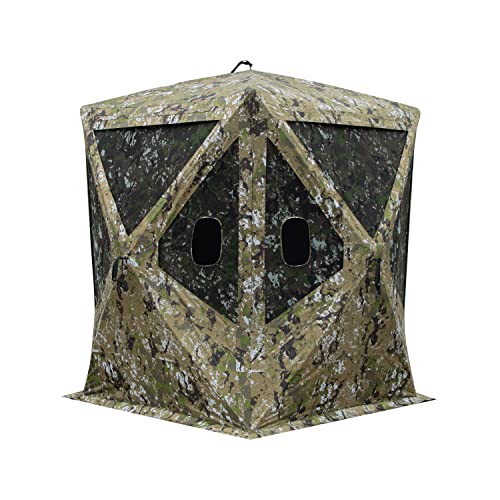
The one to buy if you shoot a bow standing up
Barronett Blinds Big Mike
At 80 inches tall, the Big Mike lets most hunters stand and draw without brushing the ceiling. The 75-by-75-inch floor gives two people room, and the zipperless windows open without the buzz that sends a deer at 15 yards straight out of the county.
$259.99fromAmazonList pricePetersen's Bowhunting recommends at least 78 inches of peak interior height for compound shooters, and American Hunter's editors flag 68-inch budget blinds as the single most common source of in-blind equipment contact. The Big Mike clears the bar at 80 inches. One owner who's 6-foot-9 reports standing up inside it. You still may not have room to draw fully while standing at that height, but for most hunters under six and a half feet, this is the blind that stops the ceiling from being a factor.
The zipperless windows are the reason bowhunters keep buying this thing. Zippers announce themselves. These use low-profile closures you adjust by hand, and they can be set vertically for a bow or horizontally for a rifle, so one blind covers both seasons. The mesh is shoot-through and replaceable, which matters — broadheads will eventually chew it up, and you can swap the panel instead of the blind.
The 75-by-75-inch floor is the other half of the equation. Barronett's own numbers put the larger Big Mike 2 at 88 by 88 inches, more than double an entry-level 57-by-57 blind, and this model sits between the two. Two hunters can sit without knocking elbows, and a single bowhunter has room to rotate through a draw without a wall in the way. A kid can nap in the corner while you watch the plot.
Construction is 150D fabric over 10mm fiberglass poles and die-cast aluminum hubs, with a black interior coating. That's a lighter shell than the premium blinds use, so plan on seam-sealing it and taking it down in the offseason. Owners who've left it out through storms report it holding up with minor damage, which is about what 150D should do.
Flaws but not dealbreakers
The window closures split owners hard. Several report the elastic loop-and-toggle system is genuinely difficult to work — slow to open, worse to close, and frustrating with cold hands or gloves. A few say earlier versions used zippers and they preferred them. If you have arthritis or limited grip strength, handle one before you commit, because this is the most consistent complaint about the blind.
It also folds back up less intuitively than most hub blinds. More than one owner says they got it open easily and then couldn't get it back into the bag. Watch a video before you take it to the woods, and practice in the yard.
Runner-up
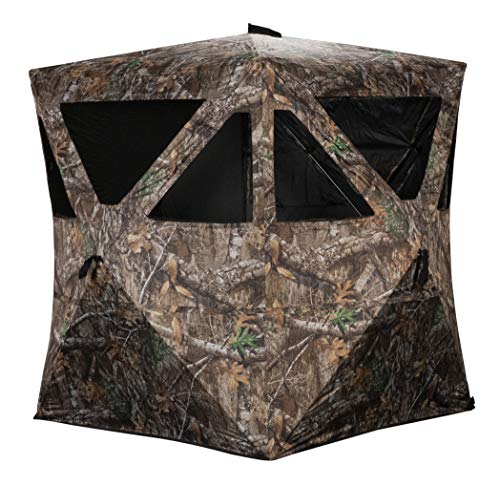
Tough enough to leave standing all season
Rhino Blinds R100-RTE 2 Person Hunting Ground
The Rhino R100 uses a true 150-denier weave in both directions and holds up to months of sitting out in weather. It's a two-person blind at 49.5 by 49.5 inches of floor with a 65-inch center height, which makes it best for gun hunters and seated bow shots.
$80.94fromAmazonThis is the blind for the hunter who sets up in September and doesn't come back for it until January. Rhino builds the R100 around leaving it out, and owners back that up — one in south Georgia reports getting 12 to 14 months out of a blind in extreme heat, which he considers better than other brands he's run. That's the whole pitch. If your hunting is one or two known spots on private ground, durability beats packability.
The fabric spec is more honest than most. Rhino calls out a true 150 denier — 150-denier thread in both the horizontal and vertical weave — which isn't a given at this level. Plenty of blinds quote the heavier number for one direction only. It's still 150D, not 300D, so Sportsman's Guide's durability numbers apply and you shouldn't expect three seasons of nonstop exposure. But it's a fair 150D.
Setup takes about a minute once you've done it a few times, and it packs down without a fight. Owners describe it as quiet to move around in, which is the kind of thing you only appreciate at the moment a doe steps out at 20 yards and you need to shift your feet.
The 65-inch center height is the limiting number. That's fine for a rifle, fine for a crossbow, fine for a seated compound shot with a short bow. It's not enough to stand and draw. If you're primarily a standing bowhunter, take the Big Mike instead.
Flaws but not dealbreakers
Pinhole leaks at the roof seams come up repeatedly in owner feedback, and Rhino owners tend to treat seam sealer as a required first step rather than a defect. It's a fixable annoyance, but you'll want to do it before the first rain rather than during it.
The door hardware draws complaints too. The plastic clips are hard to work with gloves on and bend more easily than they should. A few owners doubt they'll survive a full season of daily use.
Budget pickOn sale
Cheap, light, and good enough for a first season
Ameristep Care Taker Ground Blind
The Care Taker is the blind to buy when you're not sure ground hunting is for you. It's small at 55 by 55 inches, it has integrated wheels so you can drag it rather than carry it, and the black ShadowGuard interior does the one thing that matters most.
$99.99fromAmazonList priceBlackout interior is the feature you shouldn't compromise on, and this blind has it. Bowhunter Magazine's field work found blackout-lined interiors cut a hunter's visible silhouette inside 30 yards by roughly 90 percent compared to camo-printed linings. Deer key on movement and shape, not pattern. The Care Taker's ShadowGuard coating gets you that at the bottom of the price ladder, which is more than a lot of cheap blinds can say.
It's built for hunters who don't want a project. The hub design pops open and collapses in a couple of minutes, and owners consistently describe setup as the easiest part of owning it. Integrated wheels let you roll it out to the field edge instead of shouldering it, which is a genuinely useful touch if you're taking kids and chairs and a cooler out to a food plot.
The footprint is small — 55 by 55 inches with a 60-inch shooting width — but owners fit two adults in it regularly, and one reports running an adult and two kids in chairs. It's a good mentored-hunt blind for that reason. Everyone's close enough to whisper to, and the small shape brushes in quickly with whatever's growing nearby.
The shell is Durashell Plus with shoot-through mesh windows on silent toggles, and it ships with stakes and high-wind tie-downs. Use them. A light blind with a big broadside catches wind, and the tie-downs are the difference between a blind that's there in the morning and one that's in the neighbor's soybeans.
Flaws but not dealbreakers
Needle holes along the seams are the recurring theme in owner feedback, and they show up on new blinds out of the bag. They aren't tears, and seam sealer fixes them in an afternoon, but you should plan on doing that work rather than assuming it arrived weatherproof. Owners who did report sitting through downpours dry.
The window Velcro is the weak point over time — several owners describe it fraying or pulling away from the fabric after a handful of uses. And the shoot-through mesh distorts badly at sunrise and sunset for some people, which is exactly when you're trying to judge a deer. Try looking through it in low light before you count on it.
Who this is for
Buy a ground blind if you hunt field edges, food plots or open country where there's nothing to climb, if you hunt with a kid or a partner who needs to be close enough to coach, or if a tree stand is off the table for you. Ground blinds have grown roughly 25 percent among U.S. deer hunters over the past five years, per Grand View Outdoors, and a big chunk of that is food-plot hunting and accessible hunting programs. The NWTF reports that blinds with 36-inch-plus doorways and flat floors let more than 50,000 hunters with physical disabilities hunt each season. If that's you, prioritize door width and floor space over everything else on this list.
Skip it if you hunt thick timber where you can get above a deer's nose, or if your spots change every sit and every ounce counts. This guide covers portable hub-style blinds — the pop-up kind you stake down and brush in. It doesn't cover elevated box blinds, permanent shooting houses, or the frame-style blinds that take a quarter hour to erect. Blinds without a blackout interior didn't make the cut, and neither did anything that's really a turkey-only setup.
How we picked
We built the shortlist around what actually decides whether a deer walks past you or blows out. Interior height: Petersen's Bowhunting's 78-inch minimum marks the dividing line between a blind you can draw a bow in and one you can't. Blackout lining: Bowhunter Magazine's work on silhouette reduction convinced us a dark interior beats any camouflage pattern, so a coated interior was non-negotiable. Fabric and weather: Sportsman's Guide's exposure findings on 300D versus 150D shells framed how long you can leave a blind standing, and we read owner feedback for the seam leaks that specs never mention. Window operation: silent toggles and shoot-through mesh over zippers, weighted by how each system works with cold, gloved hands. Setup and packing: hub-style only, since Outdoor Life's numbers put frame blinds at 10 to 15 minutes against under a minute for a hub.
Other ground blinds for deer hunting worth considering
If you want the lightest thing that'll hide you: The Guide Gear Dual Hub Turkey Hunting Ground ($49.99) — The Guide Gear Dual Hub isn't a full blind — it's two 36-by-36-inch hub panels you throw up in front of you, and it weighs about four and a half pounds. That's the appeal. You can carry it a mile into public ground in a daypack and set it against a deadfall in seconds. The one-way mesh lets you watch without being watched, and Velcro strips let you join two units for more coverage. What you give up is real: no roof, no back wall, no scent containment, and the windows sit low enough that owners report having to sit on the ground to shoot through them. It's a concealment screen for turkey hunting and low-profile deer sits, not a place to spend a rainy all-day rut sit.
The competition
This is what our research surfaced across these listings, not a survey of every blind on the market. A few well-regarded models — the SurroundView 360, the Big Mike 2, the Rhino R600, the Browning Maximizer — come up constantly in published reviews and manufacturer materials but weren't part of this lineup. What follows is the rest of what we looked at and why it didn't earn a pick.
The PRIMOS Hunting Double Bull Blind Stakes ($15.49) — The Primos Double Bull Blind Stakes are the anchor hardware most hunters end up buying after the flimsy stakes in the box fold on the first windy morning. Owners describe driving them through hard ground without bending, and one reports a blind holding position through 2.5 months of Ohio wind. They're not a blind, so they can't win here, but they're the accessory we'd add to any pick on this list — especially a light blind in open ag country, where wind is the thing most likely to end your setup.
Setup and brushing in
Set your blind at least two weeks before you plan to hunt it. Deer & Deer Hunting's research suggests deer alertness to a new object drops an estimated 60 to 70 percent once it's been in place 10 to 14 days, and nothing else you do buys concealment that easily. Stake every corner and run the guy lines, even on a calm day — wind is what kills blinds. Brush it in with vegetation from within a few yards of the site, working it into the loops until the outline breaks up, and pile some at the base so the blind looks like it grows out of the ground. Seam-seal a new 150D blind before its first rain; pinholes at the stitching are normal, not a defect. And treat scent like you would in a tree stand, only more so. A closed shell concentrates odor and dumps it downwind.
Questions we get
How early should I set up a ground blind before deer season?
Two weeks is the working number. Deer & Deer Hunting's research points to a 60 to 70 percent drop in deer alertness after a blind sits in place for 10 to 14 days. If you can't manage that, tuck the blind into an existing edge — a cedar line, a fencerow, a brush pile — so it doesn't read as a new object standing alone.
Do deer smell or get spooked by ground blinds?
They smell you, and a blind makes that worse, not better. Mossy Oak's advisors point out that an enclosed shell traps and concentrates human scent, then releases it downwind. So hunt the wind harder than you would from a stand, and keep the door and windows on the downwind side closed. Sight is a smaller problem if your blind has a blackout interior and you wear dark clothing.
What is the best ground blind for tall hunters?
Look for at least 78 inches of peak height, which is what Petersen's Bowhunting recommends for compound shooters. Of the blinds here, the Barronett Big Mike is the only one that clears it, at 80 inches. American Hunter's editors note that the 68-inch ceilings common on budget hubs are the leading cause of hunters bumping gear at full draw.
Do I need a blackout interior?
Yes, and it matters more than the camouflage on the outside. Bowhunter Magazine's field work found blackout linings cut a hunter's visible silhouette inside 30 yards by about 90 percent versus camo-printed interiors. Deer pick up movement and shape, not pattern. Every pick in this guide has a dark interior coating.
How do I keep my blind from blowing over?
Stake all four corners and use the guy lines — most blinds ship with high-wind tie-downs that people leave in the bag. If the ground is hard or the wind is a regular problem where you hunt, upgrade to heavy stakes like the Primos Double Bull set; owners report the thin stakes included with blinds bending or pulling loose in a real gust.
Can you use a ground blind in the rain?
Mostly, with a caveat. Blinds shed rain well enough to keep you dry through a normal storm, but 150D shells often arrive with needle holes at the seams that will drip on you. Run seam sealer over the roof stitching before the season. Sportsman's Guide's testing also found 150D shells degrading within about 18 months of continuous exposure, so take yours down in the offseason.
Why you should trust us
For this guide:
- We compared manufacturer spec sheets for interior height, floor footprint, shell denier and window systems across every blind in this lineup.
- We read published gear coverage from Outdoor Life, Petersen's Bowhunting, American Hunter, Bowhunter Magazine and Deer & Deer Hunting, along with Sportsman's Guide's fabric exposure findings.
- We read through owner feedback for each model and looked for repeated themes — seam pinholes, window closure complaints, wind performance — rather than isolated reports.
- We read owner reviews on every listing, weighted toward the critical ones, because that is where the recurring failures show up.
- We have a systematic way of automatically fetching the latest prices, so the numbers on this page stay current.
- This is a research-focused guide, so the team may not own every product listed — though we often do own the top winners, which gives us extra context for the recommendations.
- We don't accept free products, and the retailer commission never changes which product we recommend.
Sources
Best Ground Blinds for Deer Season – Outdoor Life, Outdoor Life
Ground Blind Reviews & Buyer's Guide – Field & Stream, Field & Stream
Best Ground Blinds for Bow Hunting – Petersen's Bowhunting, Petersen's Bowhunting
Ground Blind Gear Guide – Bowhunter Magazine, Bowhunter Magazine
Deer Hunting from Ground Blinds: Tips and Tactics – Deer & Deer Hunting, Deer & Deer Hunting
Hunting Blinds Buyer's Guide – Grand View Outdoors, Grand View Outdoors
Best Ground Blinds – American Hunter, American Hunter
Primos Double Bull SurroundView Product Page, Primos (Manufacturer)
Ground Blinds for Hunters with Disabilities – QDMA / NWTF Accessible Hunting Resources, National Wild Turkey Federation
How to Set Up and Brush In a Ground Blind – Realtree, Realtree
Ground Blind Wind and Scent Control Tips – Mossy Oak, Mossy Oak
Hunting Blind Fabric Durability Comparison – Sportsman's Guide Gear Lab, Sportsman's Guide
Amazon product listings and owner reviews for all 6 products
Manufacturer specification pages for each product
Some passages in this guide may be paraphrased with AI help. Prices are refreshed automatically.
More like this.
Continue exploring lifestyle reviews and recommendations.

The Best Deer Repellents for Gardens
Deer don't browse politely. They work through a hosta bed overnight, snap the tops off daylilies, and strip a young arborvitae to the height they can…

The Best Deer Feeders With Timers
A deer feeder does one job: put corn on the ground at the same time every day so deer learn to show up then. That sounds simple, and the hopper part…

The Best Grounding Mats
Most of us spend our days on floors that don't conduct anything. The EPA puts the average American's indoor time at roughly 90 percent, which means bare…

A Beginner's Guide to POP MART: Everything You Need to Know About Blind Box Toys (2026)
Discover the captivating world of POP MART blind box collectibles. From understanding the thrill of the chase to choosing your first series, this complete guide helps newcomers navigate the exciting hobby of art toy collecting.

The Best Labubu Figures and Blind Boxes
Labubu started as a drawing. Belgian-Hong Kong artist Kasing Lung put the fanged little creature in a self-published picture book called The Monsters in…

The Best Windshield De-Icer Sprays
Scraping a frozen windshield is a miserable way to start a day. A de-icer spray shortcuts it: you soak the glass, wait a few seconds, and push the slush…