The Best Grounding Mats
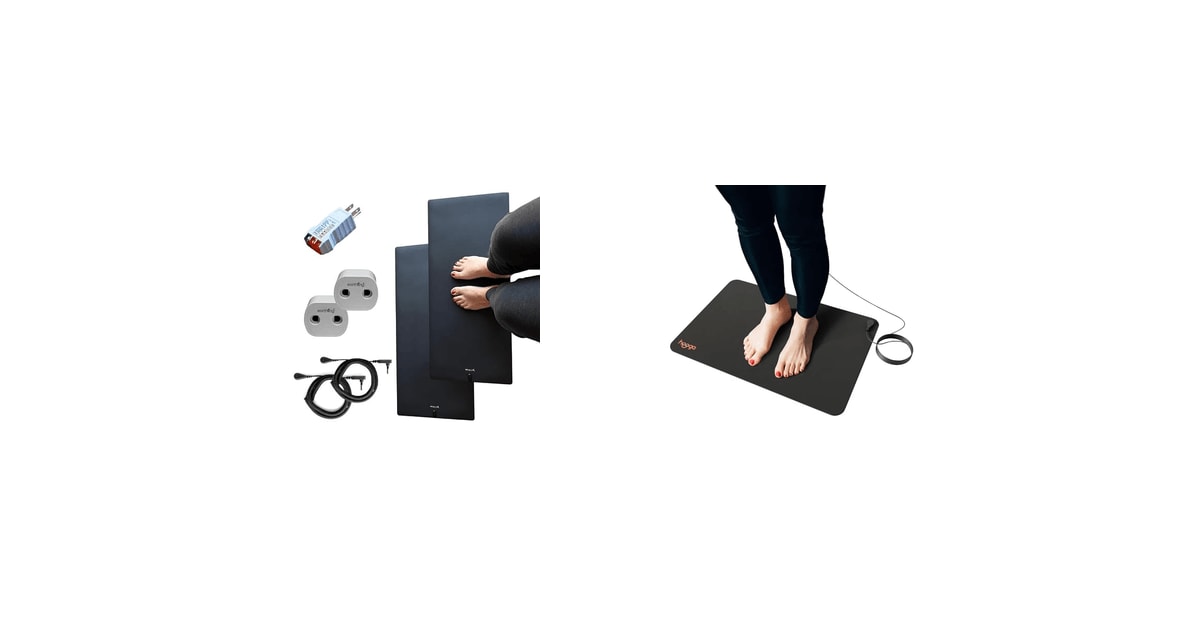
Most of us spend our days on floors that don't conduct anything. The EPA puts the average American's indoor time at roughly 90 percent, which means bare feet on soil or wet grass is something you schedule now, not something that just happens. A grounding mat is the workaround. It's a conductive sheet wired to the ground pin of a wall outlet, so your body sits at the same electrical potential as the earth outside while you answer email in socks.
Here's the honest part. The research is real but small — pilot studies and short trials with a dozen or so subjects, not large randomized trials — and no mat can promise you'll feel a thing. Plenty of owners report calmer evenings and deeper sleep after a week or two. Plenty of others report nothing at all. Every mat also depends on your home having a genuinely grounded outlet, and conductive surfaces wear out, so a mat that works now may not work a year from now.
So buy for your setup, not for the promise. Think about where the mat will actually live, whether you'll be barefoot there, and how you'll confirm months later that it still conducts. We think that the Earthing Universal Mat Kit is the best grounding mat for most people, and that the Hooga Grounding Mat is the one to buy if you want a bigger surface and a money-back window instead of the original brand name.
Everything we recommend

The most complete kit, from the brand that started it all

A bigger wipe-clean surface, and it costs a lot less

Small and portable, for a first try at grounding
At a glance
| Product | Mat Size | Cord Length | Price | |
|---|---|---|---|---|
| Earthing Universal Mat Kit 2 PackTop pick | 12.5 x 29-inch | 15 ft | $99.99 |
| Hooga Grounding Mat for DeskRunner-up | 24 x 16-inch | 15 ft | $29.99 |
| Grounding Mat for FeetBudget pick | 13 x 29-inch | 15 ft | $34.99 |
How we picked
Conductive surface. We compared spec sheets for carbon-impregnated PU leather, silver-thread fabric and vinyl surfaces, since the material determines both how well a mat conducts and how long it keeps conducting. Owner feedback across the category points to surface degradation as the main long-term failure, so durability and wipe-clean construction carried weight.
Cord and resistor. We required a documented inline 100-kilohm current-limiting resistor in the grounding cord, which is what holds any possible current far below the threshold a person can feel. We also looked for cords long enough — around 15 feet — to reach an outlet without rearranging your furniture.
Size and use case. A mat that's too small gets ignored, so we favored surfaces wide enough for both feet with room to shift. We also weighed shape against where people actually put these: under a desk, beside a recliner, or along the edge of a bed.
What's included. An outlet checker is the difference between grounding and thinking you're grounding, since plenty of three-prong outlets in older homes aren't wired to ground. Kits that include a tester, adapter and spare parts scored higher.
Warranty and support. We read stated warranty terms and return windows, and we weighed owner feedback themes about what happens when a cord or connection stops conducting. A money-back window matters more than usual in a category where results are subjective.
Top pick
The most complete kit, from the brand that started it all
Earthing Universal Mat Kit 2 Pack
This kit comes from Clint Ober's company, the outfit that created the indoor earthing category, and it ships as two mats with two coil cords, two US safety adapters and an outlet tester. It's the safest choice if you want one purchase to cover both your desk and your recliner.
$99.99fromAmazonThis is the kit we'd hand to someone who has never grounded before. You get two mats, two 15-foot coil cords, two US safety adapters and an outlet checker in one box. That checker matters more than it sounds like it should. Lots of older homes have three-prong outlets that aren't actually grounded, and without a tester you'd sit on a dead mat for months and blame grounding.
The surface is a carbon-based leatherette that came out of about two decades of Clint Ober's development work. It wipes clean with a damp cloth, the materials are vegan and non-toxic per the company's own documentation, and each mat runs about 12.5 by 29 inches. That's enough for two bare feet under a desk, or a forearm parked next to your keyboard while you work.
Two mats also solve a problem you don't see coming. Most people start with one, put it under the desk, and within a month want a second one by the couch or the bed. Owners commonly keep one in the kitchen to stand on while cooking and another by the recliner. Buying the pair up front saves you a second order.
Both cords carry an inline 100-kilohm current-limiting resistor. That's the part that keeps an outlet-grounded mat boring, in the best sense. Earthing's safety documentation puts any possible current below 0.1 milliamp, well under the roughly 1 milliamp most people can even perceive. You're connecting to the ground pin, not to power, and the resistor is there so a wiring fault can't change that.
Flaws but not dealbreakers
These mats are thin. They're a conductive surface, not a cushion, so a cold tile floor still feels like a cold tile floor under your feet. If you want something to stand on for an hour while you cook, put it over a rug.
Conductivity lives or dies on skin contact, and synthetic socks kill it. Owners rediscover this constantly — bare feet, or thin cotton or wool, are the only reliable way to use it. A minority also report cords or connections that stopped conducting over time, along with friction getting the problem sorted out, so run the outlet tester at setup and check the mat again every few months.
It's also the most expensive option here, and you're paying partly for the name on the box. The conductive material itself isn't fundamentally different from what cheaper carbon mats use.
The Earthing Universal Mat Kit comes with a one-year manufacturer's warranty.
Runner-up
A bigger wipe-clean surface, and it costs a lot less
Hooga Grounding Mat for Desk
The Hooga is a single 24-by-16-inch carbon-infused mat with a non-slip rubber back and a 15-foot cord. It's the roomiest surface of the three, it wipes down in seconds, and it costs roughly half what the Earthing kit does.
$29.99fromAmazonTwenty-four by sixteen inches doesn't sound like a lot until your feet are on it. Both feet fit side by side with room to shift around, and that's the difference between grounding for ten deliberate minutes and forgetting you're doing it for two hours. Set it beside the bed or on top of a yoga mat and there's still room to rest a forearm.
The non-slip rubber backing is the small thing that makes this work day to day. A bare conductive sheet slides across hardwood every time you move your feet, and under a rolling desk chair it ends up bunched against a wall. Hooga's mat stays where you put it. The carbon-infused vegan leather top is waterproof, so spilled coffee wipes off instead of soaking in.
This is the mat that comes up most often in grounding discussions, and the owner feedback runs deep because of it. The recurring themes are steadier sleep, fewer nighttime leg and foot cramps, and a general settling that shows up after a week or two rather than on night one. Hooga says so directly in its own listing, which is more restraint than this category usually shows.
A one-year warranty plus a 60-day money-back window takes most of the risk out. Grounding is a category where you genuinely can't know whether you'll notice anything until you've lived with a mat for a couple of weeks. Being able to send it back after two months is worth more to a skeptic than another inch of surface area.
Flaws but not dealbreakers
You get one mat and one cord. If you want a second station by the bed, that's a second purchase, and two Hooga mats start to close the gap with the Earthing two-pack.
The listing doesn't mention an outlet checker, so plan on buying one separately — or borrowing one — before you decide whether the mat is doing anything. Without confirming your outlet's ground, you're guessing.
A real share of owners feel nothing at all and say so plainly. That's true of every mat here, but it's worth sitting with before you buy: the honest expectation is a subtle shift over weeks, not a switch flipping.
Hooga backs the mat with a one-year warranty and a 60-day money-back guarantee.
Budget pick
Small and portable, for a first try at grounding
Grounding Mat for Feet
This 13-by-29-inch carbon-infused PU leather mat from Earth and Moon is the smallest and lightest of the three, and it still ships with a 15-foot cord, a plug adapter and an outlet tester. It's the low-commitment way to find out whether grounding does anything for you.
$34.99fromAmazonThis is the low-stakes way to answer the only question that matters: does grounding do anything for you? It's a strip of carbon-infused polyurethane leather long enough for both feet, narrow enough to leave under a desk permanently, and light enough to pack. If you conclude after a month that it's not for you, you haven't put much on the line.
The kit is complete, which isn't a given at this end of the market. You get the 15-foot cord, the plug adapter and an outlet tester, so you can confirm your outlet is actually grounded before drawing any conclusions about your sleep. That last piece is easy to skip and easy to regret.
The narrow shape suits some rooms better than a big rectangle does. It slides under a recliner footrest, runs along the edge of a bed, or sits on a chair seat under your legs. Owners often pick this one up as a second or third mat after starting with something larger, which tells you where it fits: the spot you didn't plan for.
Flaws but not dealbreakers
Small is the trade-off you're accepting. Thirteen inches of depth is fine for two feet planted straight ahead and cramped for anything else, and the mat is light enough to slide around when you shift position.
One owner reports measuring meaningful resistance across the whole mat-cord-outlet path, which is a useful reminder that conductivity claims are hard to verify at home without a meter. Buy a cheap continuity tester if you want to know your mat still works six months in. A few buyers have also flagged loose packaging on arrival, so check that the cord, adapter and tester are all in the envelope before you toss it.
Who this is for
Buy a grounding mat if you're indoors nearly all day, you're curious rather than desperate, and you're willing to give it two or three weeks of consistent bare-skin contact before judging. It suits desk workers with restless evenings, people who wake up stiff, and anyone who used to spend time barefoot outdoors and doesn't anymore. The CDC estimates about 35 percent of American adults regularly sleep less than seven hours, and a mat is a low-risk thing to try alongside the boring fixes that actually move the needle — a consistent bedtime, less late caffeine, a dark room.
Skip it if you're expecting a treatment. Grounding isn't a substitute for medical care, and if you have an implanted device like a pacemaker, or you're on blood thinners or thyroid medication, ask your doctor before you start — owners in this category report getting different answers from different physicians. This guide covers indoor mats that connect to a grounded wall outlet. It doesn't cover sleep sheets, wearable bands, outdoor ground rods, or any product we couldn't confirm on Amazon.
How we picked
Conductive surface: we compared carbon-impregnated and fabric surfaces on spec sheets and weighed owner reports of mats that stop conducting after months of daily use. Cord and resistor: we required a documented inline 100-kilohm current-limiting resistor and a cord long enough to reach a real outlet, about 15 feet. Size and use case: the surface has to hold both feet with room to shift, or you'll stop using it. What's included: an outlet checker separates grounding from the appearance of grounding, so kits with a tester and adapter ranked higher. Warranty and support: stated terms, return windows, and how brands respond when a cord fails.
The competition
Grounding is a crowded shelf, and a lot of what's on it is the same carbon sheet under a different logo. The three mats above are the ones we could confirm and compare directly, not a survey of everything for sale. If you're weighing something else, the checklist is short: a documented inline 100-kilohm resistor in the cord, a carbon or silver-thread conductive surface rather than a printed one, a cord that reaches your outlet, and a seller who'll take it back. Anything that can't tell you what's in the cord isn't worth the gamble.
Care and maintenance
Wipe carbon mats with a damp cloth and a little mild soap, then let them dry flat — no bleach, no alcohol, no scrubbing, since all three strip the conductive surface faster than dirt ever will. Never machine-wash a carbon mat; that's a silver-thread fabric feature, not a carbon one. Roll it rather than folding it, because a hard crease is where a conductive layer eventually cracks. Keep skin oils and lotion off it, and give your feet a rinse before a long session. Most importantly, re-run the outlet checker every few months and consider a cheap continuity meter, because a mat that quietly stops conducting looks exactly like one that's working.
Questions we get
Do grounding mats actually work, or is earthing pseudoscience?
The mechanism is real and simple: connect to the ground pin and your body sits at the earth's electrical potential. The health claims rest on a small body of published work — a double-blind pilot study in the Journal of Alternative and Complementary Medicine reported normalized cortisol patterns in grounded sleepers, and a later controlled study from the same journal found improved red blood cell zeta potential after two hours of grounding. These are small studies, and large randomized trials still don't exist. Treat it as promising and unproven, not settled.
How long should you use a grounding mat each day?
Most owners who report a difference are getting at least 30 to 60 minutes a day of bare-skin contact, and many build up to two or three hours at a desk. Sleeping grounded stacks six to eight hours a night, which is why sleep products tend to produce stronger reports than desk mats. Give it two to three weeks of consistency before you decide. Almost nobody describes a dramatic first night.
Do grounding mats work through socks?
Bare skin is the reliable way. Thin cotton or wool socks can still conduct, especially if your feet are slightly damp, but synthetic blends block it completely — this is the single most common reason a working mat seems to do nothing. If you're unsure, take the socks off for the first couple of weeks.
Can I use one in an apartment with no yard?
Yes, and that's exactly what these are for. The mat connects to the ground pin of a standard three-prong outlet, so no outdoor access is needed. The catch is that your outlet has to be genuinely grounded, which isn't guaranteed in older buildings. Use the included outlet checker first — if it fails, you'd need an outdoor ground rod instead.
Are they safe with a pacemaker or other implanted device?
Ask your cardiologist or the device manufacturer before using one. A quality cord includes a 100-kilohm inline resistor that holds current below 0.1 milliamp, far under the roughly 1 milliamp a person can feel, and that makes outlet grounding safe for healthy adults. But implanted devices are a case where general reassurance isn't good enough. The same goes if you take blood thinners or thyroid medication.
How do I know my mat is still conducting?
Use the outlet checker at setup to confirm the outlet's ground, then use a continuity meter or multimeter to check resistance between the mat surface and the cord's ground connection. Good mats read well under 100 kilohms at the surface. Owner reports across the category describe budget mats drifting above a megohm — effectively non-conductive — within six to twelve months of daily use. Check every few months rather than assuming.
Why you should trust us
For this guide:
- We read the manufacturer specifications, safety documentation and listing details for every mat here, including the stated conductive materials, cord lengths and inline resistor ratings.
- We reviewed the peer-reviewed earthing literature cataloged by the Earthing Institute, spanning cortisol, inflammation, blood viscosity and sleep outcomes, and we weighed how small those studies are.
- We read through owner feedback for each mat looking for recurring themes rather than standout stories, particularly reports of surfaces losing conductivity, cords failing, and buyers who noticed nothing at all.
- We read owner reviews on every listing, weighted toward the critical ones, because that is where the recurring failures show up.
- We have a systematic way of automatically fetching the latest prices, so the numbers on this page stay current.
- This is a research-focused guide, so the team may not own every product listed — though we often do own the top winners, which gives us extra context for the recommendations.
- We don't accept free products, and the retailer commission never changes which product we recommend.
Sources
Earthing: Health Implications of Reconnecting the Human Body to the Earth's Surface Electrons, Journal of Environmental and Public Health (2012), Chevalier et al. — reviewed 12 controlled earthing studies and found consistent improvements in sleep, pain scores, cortisol patterns, and stress markers across all reviewed studies
The Biologic Effects of Grounding the Human Body During Sleep as Measured by Cortisol Levels, Journal of Alternative and Complementary Medicine (2004), Ghaly & Teplitz — normalized diurnal cortisol secretion patterns in all 12 grounded subjects; zero normalization observed in controls
The Effects of Grounding on Inflammation, the Immune Response, Wound Healing, and Chronic Inflammatory Disease, Journal of Inflammation Research (2015), Oschman et al. — concluded earthing accelerates wound healing and reduces acute inflammation through free electron transfer from the earth's surface into the body
Earthing (Grounding) the Human Body Reduces Blood Viscosity — A Major Factor in Cardiovascular Disease, Journal of Alternative and Complementary Medicine (2013), Chevalier et al. — a 2-hour grounding session measurably improved red blood cell zeta potential in all 10 subjects tested, indicating reduced cardiovascular clumping risk
Grounding the Human Body Improves Facial Blood Flow Regulation: A Randomized, Placebo-Controlled Pilot Study, Journal of Cosmetics, Dermatological Sciences and Applications (2014), Chevalier et al. — Laser Speckle Contrast Imaging confirmed statistically significant improvement in facial blood flow after 1 hour of grounding vs. sham controls
Earthing Research Database, Earthing Institute — curated index of 20+ peer-reviewed earthing/grounding studies published since 2001, spanning cardiovascular, inflammation, neurological, hormonal, and sleep outcomes
What Is Earthing or Grounding?, Healthline — medically reviewed consumer overview of earthing health claims with evidence quality ratings; notes that while early studies are promising, most sample sizes remain small
Grounding Mat: Benefits, Risks, and What the Science Says, Medical News Today — balanced editorial review of grounding mat evidence, product guidance, conductivity testing methods, and safety considerations
Best Grounding Mats, Sleep Foundation — product-level buying guide focused on grounding mats for sleep quality improvement, with material and conductivity evaluation criteria
Earthing.com Product Safety & Specifications, Earthing.com — manufacturer documentation on inline resistor safety ratings, surface conductivity specifications, cord types, and washing frequency guidelines across all mat product lines
Amazon product listings and owner reviews for all 3 products
Manufacturer specification pages for each product
Some passages in this guide may be paraphrased with AI help. Prices are refreshed automatically.
More like this.
Continue exploring health reviews and recommendations.

The Best Ground Blinds for Deer Hunting
A ground blind does one job: it hides you at eye level with the deer. That's harder than it sounds. You're sitting where a whitetail's nose, ears and eyes…

The Best Yoga Mats for a Home Studio
A yoga mat is the one piece of home fitness gear you touch with your whole body. Your palms slide on it in downward dog. Your knees press into it in low…

The Best Yoga Mats
A yoga mat is one of the few pieces of fitness gear you touch with your whole body. You kneel on it, sweat on it, press your palms into it while upside…

The Best All-Weather Car Floor Mats
Winter doesn't stay outside. Salt, slush, sand and gravel ride in on your boots and grind into the carpet every time you get in. A good all-weather mat…

The Best Anti-Fatigue Kitchen Mats
Standing on tile or concrete for an hour does something quietly awful to your body. Your heels ache first, then your knees, then your lower back around…

The Best Driveway Heating Mats
The worst part of a snowstorm isn't the snow. It's the twenty feet between your door and your car, refrozen into a gray slab by morning. A heating mat…