The Best Windshield De-Icer Sprays
Scraping a frozen windshield is a miserable way to start a day. A de-icer spray shortcuts it: you soak the glass, wait a few seconds, and push the slush off. The chemistry is simple. Alcohol-based liquids stay liquid far below anything a North American winter throws at you, so they melt into ice instead of freezing on top of it. Published testing by The Drive found the better sprays cleared a standard frost panel in under 30 seconds, compared with more than 90 seconds using a scraper alone.
No spray does everything, though. On a quarter-inch sheet of ice after freezing rain, you'll still reach for a scraper to finish the stubborn patches — the spray loosens the bond, it doesn't vaporize the ice. Most formulas leave a little haze until your wipers and washer fluid clear it. Aerosols push weakly when the can itself has been cold-soaked all night. And a de-icer spray isn't a substitute for de-icing washer fluid; they solve different problems, and drivers in hard winters keep both. Expect a helper, not a miracle.
So shop for your worst morning, not your average one. If you're mostly clearing thin frost before a commute, almost anything here works, and you should choose on nozzle type and bottle size. If you park outside in single digits, you want a concentrated formula with a low temperature rating and a can you can grip with gloves on. We think that the Prestone AS244 De-Icer is the best windshield de-icer spray for most people, and that the CRC Ice-Off Windshield Spray De-Icer is the one to buy if you regularly face thick sheet ice.
Everything we recommend
Fast on frost, and the cap doubles as a scraper

More muscle on thick ice, in a smaller can

Plenty for light frost, and a trigger you can aim
A fleet-grade can that still sprays when it's brutal out
At a glance
| Product | Size | Low Temp Rating | Price | |
|---|---|---|---|---|
| Prestone AS244 De-Icer for WindshieldTop pick | 17 oz. | — | $29.99 |
| CRC Ice-Off Windshield Spray De-IcerRunner-up | 12 oz. | — | $6.98On sale |
| Splash Red Hot De-icer Windshield Trigger SprayBudget pick | 32 oz. | — | $18.27On sale |
 | PEAK Pka0f3 Extreme Temperature Windshield De-icerAlso in lineup | 1 gal | — | $10.73 |
| Penray 5216 Windshield Spray De-Icer - 11.0-OunceAlso great | 12.3 oz. | -25°F | $20.24 |
How we picked
Cold-temperature rating. We compared manufacturer specification sheets for the lowest stated working temperature, then sanity-checked them against the chemistry, since NIST puts isopropyl alcohol's freezing point at -128°F. Anything rated to roughly -20°F or below covers nearly every North American driveway.
Speed on real ice. We leaned on published testing from The Drive, which found top sprays cleared a standard frost panel in under 30 seconds versus more than 90 seconds with a scraper alone. Formulas that claim only light-frost performance were judged against that narrower job.
Nozzle and coverage. Popular Mechanics found fan-spray nozzles deliver about 40% more glass coverage per trigger pull than pinhole designs, so we treated nozzle shape as seriously as chemistry. Aerosols were judged partly on whether the maker claims reliable spray in deep cold.
Surface safety. We looked for explicit manufacturer claims about paint, rubber seals, and trim rather than generic safety language. We also flagged ammonia-containing formulas, after Bob Vila's roundup documented micro-cracking and adhesion failure in aftermarket window tint from repeated use.
Size and supply. Using The Drive's coverage math — roughly 8 to 12 windshields per 17 ounces in moderate frost, dropping to 4 to 6 in heavy ice — we asked whether a bottle would realistically last a household through a winter.
Top pick
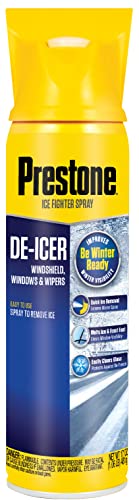
Fast on frost, and the cap doubles as a scraper
Prestone AS244 De-Icer for Windshield
Prestone's AS244 is the de-icer most people should keep by the door. The concentrated, methanol-heavy formula melts frost fast and helps slow the refreeze, and the cap is a polycarbonate ice scraper, so the tool you need next is already in your hand.
$29.99fromAmazonThe formula is built for speed. Prestone calls this a concentrated, high-performance ice-melting spray, and the high methanol content is why it works quickly. Methanol, like the alcohols in every serious de-icer, stays liquid far below anything your driveway will see. It melts into the ice rather than freezing on top of it, and Prestone says it helps cut down on refreeze after you've cleared the glass.
The scraper cap is the part you'll appreciate on a bad morning. The lid is a full ice scraper with a polycarbonate blade, which Prestone notes is stronger than the plastic in many standalone scrapers. That matters, because de-icer alone rarely finishes the job on thick ice. You spray, wait, then push the slush off with the same can you're already holding. Nothing to dig out of the trunk.
The cold rating covers real winters. Prestone rates the AS244 to work down to -40°F, which lines up with the extreme-cold benchmarks AAA applies to northern U.S. and Canadian markets. The underlying chemistry backs that up: NIST lists isopropyl alcohol, the workhorse of this category, as freezing at -128°F. Unless you're parked somewhere genuinely arctic, temperature isn't the limiting factor here.
Six 17-ounce cans is about right for a household. The Drive's coverage methodology puts a 17-ounce bottle at roughly 8 to 12 windshields in moderate frost, and 4 to 6 when the ice is heavy. Spread that across two cars and a real winter, and one can vanishes fast. Consumer Reports suggests keeping a bottle in every vehicle through the cold months, and a six-pack makes that painless.
Flaws but not dealbreakers
Methanol deserves respect. It's what makes the spray quick, and it's also toxic to swallow and unpleasant to breathe in a closed garage. Keep the can away from kids and pets, use it outdoors, and don't let it pool on trim while you wait. Prestone doesn't make the tint-safety claims that some gentler formulas do, so we'd be cautious around aftermarket window film.
Aerosols get sluggish when the can is cold-soaked. Leave it in the trunk through a subzero night and the first few seconds of spray come out weak. Storing it inside, or at least in an attached garage, fixes it. That's a small annoyance, but it's the exact annoyance that shows up on the coldest morning you'll face.
Six cans is a commitment. If you get two frosty weeks a winter, that's more de-icer than you'll use, and aerosol cans don't hold pressure forever in storage. Anyone in a mild climate is better served by a single can, or by a trigger bottle that stores flat on a shelf.
Runner-upOn sale
More muscle on thick ice, in a smaller can
CRC Ice-Off Windshield Spray De-Icer
CRC's Ice-Off is a concentrated spray built for the mornings when frost has hardened into a sheet. It melts ice, snow, and frost on contact, stays effective into sub-zero temperatures, thaws frozen locks, and CRC says it won't harm your car's finish.
$6.98fromAmazonList priceThis one's aimed at ice you can't just wipe away. CRC says Ice-Off melts ice, snow, and frost on contact and works to sub-zero temperatures. That's the profile you want after freezing rain, when the windshield has a real crust rather than a dusting. It loosens the bond quickly, which is most of the battle — the rest is a pass or two with a scraper.
It works past the windshield. CRC lists locks, headlights, and windows alongside the glass, and it thaws frozen door locks. If you drive an older car with key cylinders, or you've had a door frozen shut after wet snow, that's genuinely handy. One can covers the whole exterior instead of just the front glass.
It won't hurt your paint. CRC states the formula is harmless to car finishes, which matters more than you'd guess, because overspray onto the hood and cowl is unavoidable when you're soaking a windshield. You can be sloppy with it. On a freezing morning, spraying fast without second-guessing yourself is worth something.
A 12-ounce can fits where a jug won't. It slides into a door pocket, under a seat, or into a work truck's toolbox, and you can hand it to someone across a parking lot. If you want one can that lives in the car for emergencies rather than a bulk supply for the driveway, this is the right shape.
Flaws but not dealbreakers
Twelve ounces goes fast on bad ice. Using The Drive's coverage figures, a bottle this size is good for a handful of heavy-ice mornings before it's empty. If you're clearing two cars through a northern winter, plan on several, or keep this as the can in the vehicle and use something bigger at home.
There's no scraper on the cap. After freezing rain you'll still want one, and CRC doesn't build it into the lid the way Prestone does. Keep a scraper in the car next to the can, because spray alone won't finish a quarter-inch sheet. It's an easy gap to close, but it's a gap.
It's a single small can, not a season's supply. This listing is one 12-ounce bottle. If you're stocking a family's cars or a couple of work trucks, you'll be reordering, and running out is exactly the failure that sends you back to scraping in the dark.
Budget pickOn sale
Plenty for light frost, and a trigger you can aim
Splash Red Hot De-icer Windshield Trigger Spray
Splash Red Hot comes as three 32-ounce trigger bottles, which is enough de-icer for a couple of cars and a long winter. It's tuned for frost and light ice rather than thick sheets, and the trigger lets you put the spray exactly where you need it.
$18.27fromAmazonList priceA trigger sprayer gives you control an aerosol can't. You aim the fan at the ice, work edge to edge, and stop when the glass is wet. Popular Mechanics found fan-spray nozzles cover roughly 40% more glass per trigger pull than pinhole designs. Fewer passes means less time standing in the cold with numb fingers.
Three 32-ounce bottles cover a household. Put one in each car, keep the third in the garage as a refill, and you're set without rationing. That's the real advantage of a budget formula: you can be generous with it. Soaking the glass properly beats a stingy mist, and you won't hesitate to go back for a second pass.
For frost and light ice, it does what the premium formulas do. Splash says the formula melts frost and light ice quickly and reduces or eliminates scraping, and that's the honest scope. Family Handyman documented a nearly fivefold spread in per-ounce cost across this category. On an easy morning, that spread doesn't show up on your windshield.
It's kind to your wipers. Splash calls out wiper blades specifically, and freeing them matters — yanking a frozen blade off the glass is how rubber tears. Spray along the blade, wait a moment, then lift. It's a ten-second habit, and it's the difference between blades that survive the season and blades that streak by midwinter.
Flaws but not dealbreakers
Trigger sprayers don't love the cold. Leave the bottle in the car overnight and the nozzle and pickup tube can gum with slush, so the first pull gives you nothing. Store it inside or in the garage and the problem goes away. But it does mean this isn't the bottle to keep in the trunk for emergencies.
It's the wrong tool for a sheet of ice. The listing scope is frost and light ice, and that's where it belongs. After freezing rain you'll want something more concentrated plus a scraper. Treat this as your everyday bottle and keep a stronger can for the few brutal mornings a winter hands you.
Thirty-two ounces is a lot to wrangle in gloves. It won't fit most door pockets, and it tips over on a passenger seat. If storage space is tight, or you want to hold the bottle in one hand and scrape with the other, an aerosol is easier to live with.
Also great
A fleet-grade can that still sprays when it's brutal out
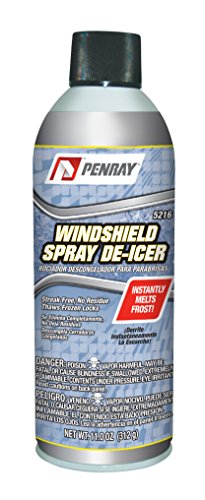
Penray 5216 Windshield Spray De-Icer - 11.0-Ounce
Penray's 5216 is a small aerosol aimed at commercial fleets, and it's rated to spray in temperatures down to -25°F. It melts ice and thaws frozen locks, and Penray says it's safe for all car finishes and harmless to painted rubber components.
$20.24fromAmazonIt's built for people who clear windshields for a living. Penray sells largely into commercial fleet channels, and the 5216 shows it: a plain aerosol that defrosts and melts ice instantly, with nothing bolted on. If you're stocking work trucks, or you just want the no-nonsense version of this product, that focus is the whole appeal.
It sprays when it's genuinely cold out. Penray rates the can to spray in temperatures down to -25°F and says so explicitly. That's a more useful spec than it looks, because an aerosol that won't atomize is useless no matter how good the liquid inside is. It's the failure you actually hit on the worst morning, and it's the one Penray addresses head-on.
Penray is specific about what it won't damage. The listing says the formula is safe for all car finishes and harmless to painted rubber components. Weather seals and painted trim catch most of the overspray around a windshield, so a stated claim there is worth more than a vague reassurance. If you're fussy about your paint, that's reason enough to consider it.
It thaws frozen locks, too. Older cars, work trucks, and anything with a key cylinder benefit, and a frozen lock is the one problem a scraper can't touch. A small can that lives in a glovebox or a jacket pocket handles it. That's a different job from clearing glass, and it's nice not to need a second product for it.
Flaws but not dealbreakers
The listing can't agree on how big the can is. The title says 11 ounces and the size field says 12.3 ounces. Either way it's small — among the smallest here — and it'll empty quickly if you're clearing heavy ice on more than one vehicle. Check what actually arrives before you build a winter's supply around it.
No scraper, no repellent, no extras. You get a can of de-icer and that's all. Prestone puts a blade on the lid, and dual-action formulas leave a water-shedding film behind. If you want your de-icer to do a second job, this isn't the one.
It's a fleet product, so it's not on every shelf. You're unlikely to grab one at a gas station on the way home. That's fine if you plan ahead and order a few. It's awkward if you're the sort who buys de-icer the morning after the first hard freeze.
Who this is for
This guide is for anyone who parks outside where the windshield freezes: daily commuters who need a five-minute morning routine, families running several cars through a northern winter, and fleet managers stocking trucks that leave before dawn. It's also for enthusiasts who care about streaks and tint, since formulas differ a lot there. You can skip all of this if you park in a heated garage, or if frost shows up twice a season and you're happy with a scraper. And if your real problem is a windshield that fogs and refreezes from the inside, that's a defroster or cabin-humidity issue, and no spray fixes it.
We cover ready-to-use de-icer sprays — aerosols and trigger bottles you apply directly to frozen glass. We don't cover de-icing washer fluid, which lives in your reservoir and does a different job during driving; the research is clear that the two complement each other rather than substitute. We also leave out scrapers, snow brushes, heated wands, and windshield covers, all of which are worth owning alongside a spray. Anything in the lineup that turned out to be washer fluid, a glass cleaner, or car wax is listed separately at the end, because it isn't the product this guide is about.
How we picked
Cold rating: we read manufacturer specification sheets for the lowest stated working temperature and checked them against the chemistry, since NIST lists isopropyl alcohol as freezing at -128°F and AAA's northern benchmarks sit near -40°F. Speed: we weighted published testing from The Drive, which cleared a standard frost panel in under 30 seconds with the best formulas against more than 90 seconds for scraping alone. Nozzle: Popular Mechanics found fan sprays cover about 40% more glass per pull than pinholes, so spray pattern counted as much as formula. Surface safety: we favored explicit paint, seal, and trim claims, and flagged ammonia formulas that Bob Vila's roundup tied to tint micro-cracking. Supply: we judged bottle sizes against The Drive's published coverage figures of roughly 8 to 12 windshields per 17 ounces in moderate frost, to see whether a bottle lasts a season.
The competition
Here's what our research surfaced beyond the picks. It isn't a census of every de-icer on the shelf, and a product landing here doesn't mean it's bad — it means something above it does the same job better, or that it's a different shape of product than most people are shopping for.
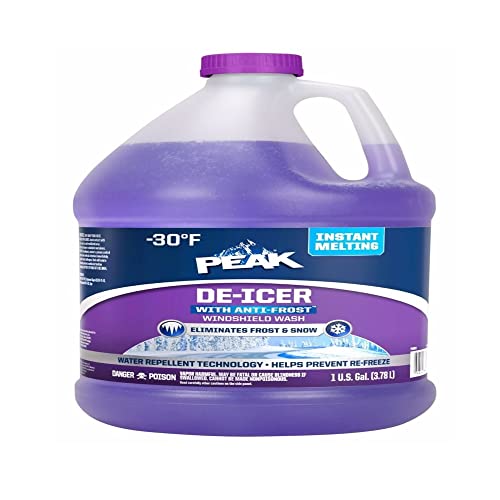
The PEAK Pka0f3 Extreme Temperature Windshield De-icer ($10.73) — PEAK's Extreme Temperature Windshield De-icer comes as a one-gallon jug, and that's the catch for this guide. There's no trigger and no aerosol valve, so you're either decanting it into a spray bottle or pouring it into your washer reservoir, and gallon jugs in this aisle are usually reservoir products. The listing bullets are generic enough that they don't settle it. If you already know you want de-icing fluid in bulk and you've got a sprayer to fill, buying by the gallon makes sense and PEAK is a credible automotive brand. For a grab-it-and-spray morning routine, the trigger bottles and aerosols above are the right shape.
Storage and safe use
Store the bottle or can indoors, or in an attached garage. Aerosols push weakly when they've been cold-soaked, and trigger nozzles can gum up with slush overnight, so the container that lives in your trunk is the one that fails you. Work outdoors and keep the spray out of the cabin, since alcohol vapors in a closed car are unpleasant and methanol is toxic if swallowed. Soak the glass rather than misting it, then give the formula 20 to 30 seconds to work before you scrape or wipe. Free your wiper blades before switching them on, because pulling frozen rubber off glass tears it. And don't run wipers across dry ice — you'll shred the blades and scratch the windshield.
Questions we get
Are windshield de-icer sprays safe for car paint and rubber weather seals?
Most are, and the good ones say so outright. CRC states its formula is harmless to car finishes, and Penray specifies that its spray is safe for all car finishes and harmless to painted rubber components. Overspray onto the hood and cowl is unavoidable, so we'd favor a product that makes the claim explicitly. Rinse the car when the weather breaks if you're particular about your paint.
How long does de-icer spray take to work on thick ice?
On thin frost it's nearly immediate. Published testing by The Drive cleared a standard frost panel in under 30 seconds with the better sprays, against more than 90 seconds for scraping alone. On a real sheet of ice after freezing rain, give it 30 seconds or more, then finish with a scraper. The spray's job is to break the bond between ice and glass, not to make the ice disappear.
Can I use de-icer spray on frozen door locks and mirrors?
Yes, and it's one of the better reasons to keep a can in the car. CRC lists locks, headlights, and windows among its applications, and Penray says its spray thaws frozen locks too. A frozen key cylinder is the one problem a scraper can't solve. Spray a little into the lock, wait, then try the key gently rather than forcing it.
Do de-icer sprays damage aftermarket window tint?
Ammonia-containing formulas can. Bob Vila's roundup documented micro-cracking and adhesion failure in aftermarket tints after repeated seasonal applications of ammonia-based products. If your side and rear glass is tinted, look for a formula that states it's ammonia-free, and keep overspray off the film where you can. Factory-tinted glass, where the color is in the glass itself, isn't at risk.
What's the difference between de-icer spray and de-icing washer fluid?
They do different jobs. A de-icer spray is applied by hand to frozen glass before you drive, to break ice loose fast. De-icing washer fluid lives in your reservoir and keeps the windshield clear of slush and road spray while you're moving, without freezing in the lines. Neither replaces the other, and drivers in hard winters run both.
Can I make my own de-icer with isopropyl alcohol and water?
You can, and the chemistry works — NIST puts isopropyl alcohol's freezing point at -128°F, and University of Minnesota Extension research found alcohol-based de-icers outperform salt and brine on glass below 15°F. Higher alcohol concentrations, in the 70% to 90% range, hold up better in deep cold than heavily diluted mixes. What a homemade mix won't give you is a good nozzle, and Popular Mechanics found fan sprays cover about 40% more glass per pull than pinholes. For most people the convenience of a proper bottle wins.
Why you should trust us
For this guide:
- We read manufacturer specification sheets and listing claims for every product in this lineup, alongside published testing from The Drive and Popular Mechanics and buying guidance from Bob Vila, Family Handyman, and Consumer Reports.
- We compared stated cold-temperature ratings, nozzle designs, container sizes, and surface-safety claims across the category, and checked them against chemistry data from NIST and cold-climate research from University of Minnesota Extension.
- We also weighed recurring themes in owner feedback, particularly complaints about weak aerosol pressure in deep cold and residue left behind on glass.
- We read owner reviews on every listing, weighted toward the critical ones, because that is where the recurring failures show up.
- We have a systematic way of automatically fetching the latest prices, so the numbers on this page stay current.
- This is a research-focused guide, so the team may not own every product listed — though we often do own the top winners, which gives us extra context for the recommendations.
- We don't accept free products, and the retailer commission never changes which product we recommend.
Sources
Best Windshield De-Icers — The Drive, The Drive
Best Windshield De-Icers — Bob Vila, Bob Vila
Best Windshield De-Icers and Ice Scrapers — Popular Mechanics, Popular Mechanics
Best Windshield De-Icers — Family Handyman, Family Handyman
Winter Driving Safety — Consumer Reports, Consumer Reports
Prestone AS244 Windshield De-Icer — Manufacturer Specs, Prestone (Manufacturer)
Rain-X De-Icer Product Line — Manufacturer Page, Rain-X (Manufacturer)
Isopropyl Alcohol Thermophysical Properties — NIST WebBook, NIST (National Institute of Standards and Technology)
Winter Road Safety and Vehicle Preparation — AAA Foundation, AAA Foundation for Traffic Safety
Automotive De-Icing Products Market Forecast — Grand View Research, Grand View Research
Amazon product listings and owner reviews for all 5 products
Manufacturer specification pages for each product
Some passages in this guide may be paraphrased with AI help. Prices are refreshed automatically.
More like this.
Continue exploring electronics reviews and recommendations.

The Best All-Weather Windshield Wipers
Wipers are easy to ignore until the moment you can't see. You merge onto a wet highway, a truck throws up a sheet of spray, and a worn blade smears it…

The Best Car Windshield Sunshades
Park outside on a hot afternoon and your car stops being a car. It becomes an oven. NREL research puts a parked interior at 130 to 172 degrees on a…

The Best Folding Windshield Sun Shades
Park in an open lot on a July afternoon and your car turns into an oven. AAA's research found that a cabin sitting in 80-degree weather climbs to 116…

The Best Windshield Snow Covers
Scraping ice off a windshield is the worst five minutes of a winter morning. Your hands go numb, your coffee gets cold in the cup holder, and you're late…

The Best Deer Feeders With Timers
A deer feeder does one job: put corn on the ground at the same time every day so deer learn to show up then. That sounds simple, and the hopper part…

The Best Deer Repellents for Gardens
Deer don't browse politely. They work through a hosta bed overnight, snap the tops off daylilies, and strip a young arborvitae to the height they can…