The Best Car Windshield Sunshades
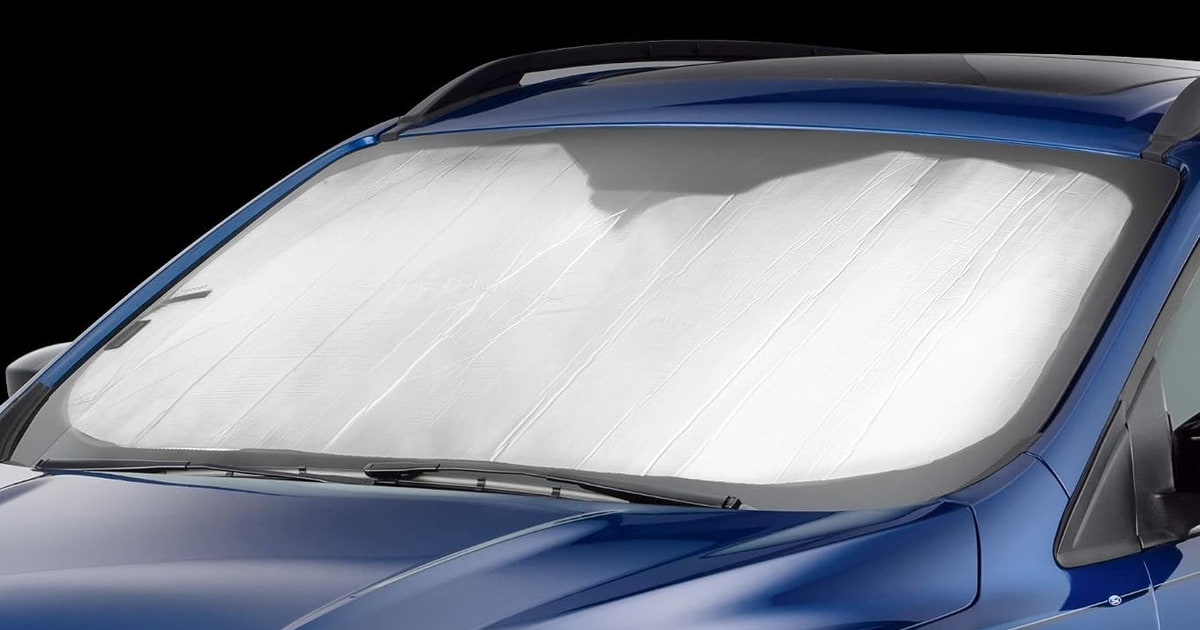
Park outside on a hot afternoon and your car stops being a car. It becomes an oven. NREL research puts a parked interior at 130 to 172 degrees on a 95-degree day, and it gets there within an hour. Car and Driver measured a steering wheel at 127 degrees with no shade, and 89 degrees behind a multi-layer reflective one. That's the difference between wincing and just driving away. A windshield sunshade is the simplest fix there is, and it's the one most people skip.
No shade seals a windshield completely. Light leaks around the mirror mount, along the A-pillars, and past the dash vents, so even a good one leaves you with a warm cabin — cooler, not cool. Custom-cut shades fit one vehicle and one vehicle only, which makes them useless the day you trade the car in. Universal shades fit everything approximately and nothing exactly. And every folding shade eventually creases in the wrong place if you rush it into the trunk.
So the real question is how precisely you want yours to fit. If you know your exact make and model, a custom-cut shade closes the gaps that cost universal shades most of their advantage. If you swap cars often, or need one shade to cover two vehicles, a well-sized universal shade still does most of the job. We think that the Covercraft UVS100 Custom Sunscreen is the best car windshield sunshade for most people, and that the Intro-Tech Automotive Ultimate Reflector is the one to buy if you park in punishing heat and want a shade that earns its keep in winter too.
Everything we recommend

A custom-cut fit that closes the gaps most shades leave open

Reversible tri-layer build for brutal summers and frosty mornings

Fits nearly anything, at the cost of a perfect seal

A stiff foam core that holds its shape and works in winter
At a glance
| Product | Fit Type | Shade Size | Price | |
|---|---|---|---|---|
| Covercraft UVS100 Custom SunscreenTop pick | Custom Fit | 10.5x40.5 in | $82.48On sale |
| Econour Car Windshield Sun ShadeBudget pick | — | 32x64 in | $15.99On sale |
| WeatherTech Sunshade Window Shade for Cadillac EscaladeAlso great | — | — | $73.95 |
| Intro-Tech Automotive LX-37-R Ultimate Reflector Custom FitRunner-up | Vehicle Specific | — | $61.87 |
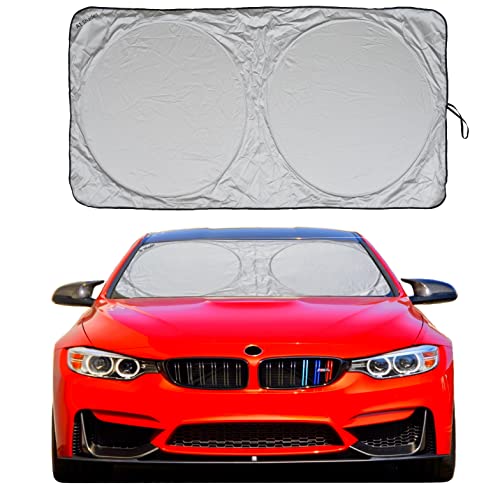 | Car Sun Shade with Storage Pouch byAlso in lineup | — | 18x55 in | $17.99 |
 | Proadsy Custom Fit Car Windshield Sun ShadeAlso in lineup | Custom Fit | 18.5x18.5 in | $22.99 |
How we picked
Fit and coverage. We favored shades with either a vehicle-specific cut pattern or a real size chart, because Popular Mechanics lab testing ties most of the performance gap to edge gaps rather than material. A shade that stops two inches short of the A-pillar gives back much of what it blocks.
Heat and UV rejection. We looked for reflective silver or aluminized faces and manufacturer or independent claims of 99 percent or better UV rejection, which quality shades generally meet. The bigger separator is heat, so we weighted published temperature reductions from NREL, Consumer Reports and Car and Driver.
Materials and layers. Multi-layer builds — reflective face, foam or fiber core, soft liner — insulate better than a single sheet of foil, per Lawrence Berkeley National Laboratory research on solar-reflective treatments. We checked spec sheets for stated layer counts and fabric weights like 210T and 240T polyester.
Everyday hassle. A shade you don't use is worth nothing, so we weighed deployment speed and storage. The Drive's comparison found pop-up shades deploy in about 2.7 seconds versus 8.4 for accordion folds, with the trade-off showing up in edge fit.
Durability. We read owner feedback for recurring complaints about fraying edges, delaminating foil and springs that lose their shape after a season. Reinforced stitching and steel rings instead of suction cups were the details that separated shades that last from shades that don't.
Top pickOn sale
A custom-cut fit that closes the gaps most shades leave open
Covercraft UVS100 Custom Sunscreen
The UVS100 is cut to a pattern for one specific windshield, and that precision is what separates it from the shade you grab off an endcap. It blocks nearly all UV, keeps your dashboard out of cracking territory, and folds flat enough to live behind a seat.
$82.48fromAmazonList priceFit is the whole ballgame here. Popular Mechanics lab testing found that custom-fit shades dropped cabin air temperature by an average of 22 degrees more than poorly fitted universal shades made of the same material. The reason is boring but decisive: no edge gaps. The UVS100 is cut to a pattern for your specific windshield, so it reaches into the corners instead of leaving a bright sliver of glass down each side.
Covercraft's listing claims the laminate blocks up to 99 percent of UV rays, and the company's own lab data puts UV rejection at 99.98 percent with interior temperatures down as much as 38 degrees. That matters more than you'd guess for the people inside, not just the plastic. The Skin Cancer Foundation notes that windshield glass blocks UVB but lets through as much as 75 percent of UVA.
Your dashboard is the part that actually breaks. Consumer Reports puts the crack-and-warp threshold for vinyl and plastic dashboards around 195 degrees, which a car parked in Phoenix or Houston clears without trying. A reflective shade keeps that surface far below it. If you've ever seen a dash split along the defroster vents, you know it isn't something you fix later.
It stores like a folder, not a beach ball. The panels collapse into a flat bundle a couple of inches thick and about forty inches long, which slides behind a seat or into a trunk well without becoming a nuisance. Covercraft has made these for a long time and dealers stock them, so patterns exist for a wide range of vehicles.
Flaws but not dealbreakers
A custom shade is a commitment. This listing is cut for the Tesla Model S and won't fit anything else, so confirm fitment for your exact vehicle before you order. Change cars, and you're buying another shade.
Folding takes longer than a pop-up. The Drive's head-to-head comparison of a dozen shades clocked accordion designs at about 8.4 seconds to deploy versus 2.7 for spring-loaded ones. Five extra seconds is nothing on a Tuesday. It's mildly annoying when you're late and the lot is 100 degrees.
Runner-up
Reversible tri-layer build for brutal summers and frosty mornings
Intro-Tech Automotive LX-37-R Ultimate Reflector Custom Fit
Three layers — a reflective Mylar face, a heat-barrier middle, and a graphite felt back — make this the shade for people whose summers genuinely hurt. Flip it in winter and the felt side works like a thermal blanket against frost, which is a useful second job.
$61.87fromAmazonIt's built in layers, and that's the point. A reflective Mylar face does the heavy lifting, backed by multi-layer heat-barrier material that Intro-Tech says can prevent as much as 40 degrees of heat build-up. Lawrence Berkeley National Laboratory research on solar-reflective treatments found that surfaces reflecting more than half of incoming light cut solar heat gain through glass by 45 to 60 percent. That's the mechanism at work here.
The reversible side is the reason to choose this over our top pick. Turn it around and the graphite felt faces the glass, slowing frost from forming overnight. If you live somewhere with real summers and real winters, that's one product doing two jobs instead of two shades fighting over the same door pocket. You'll use it in February, not just July.
Like the Covercraft, it's cut to a vehicle-specific pattern — this listing is shaped for the Lexus ES350 and ES300h — so it reaches the corners of the glass instead of stopping short. It unfolds and goes up in seconds, and it comes with a leatherette bag, which sounds trivial until you've dug through a trunk for a loose shade with a bent edge.
Flaws but not dealbreakers
All that layering makes it thick. Folded, it takes up noticeably more room than a thin single-layer shade, and it doesn't compress much. If your door pockets are already full of water bottles and umbrellas, plan on the trunk.
The felt side collects dust, crumbs and pet hair, and it's harder to wipe clean than a smooth foil face. And like any custom shade, it's tied to one vehicle — check the fitment link before you order.
Budget pickOn sale
Fits nearly anything, at the cost of a perfect seal
Econour Car Windshield Sun Shade
This is the practical universal shade: several sizes, up to eight inches of adjustable overlap, and a silver reflective face that pops into place in seconds. You give up the last few degrees a patterned shade would win, and you get something that still fits whatever you drive next.
$15.99fromAmazonList priceBuy this one when you don't want to think about fitment charts. EcoNour sells it in several sizes, and the panel expands with up to eight inches of overlap, so the medium covers windshields up to 64 by 32 inches. Measure your glass, check the size chart, and you'll land close. Close is most of the benefit, and it costs you nothing in flexibility.
The material is 240T polyester with a reflective silver face, which is the right kind of surface. Optical benchmarks cited by the Automotive Aftermarket Industry Association put aluminized silver at roughly 97 percent reflection of incoming solar radiation, against 30 to 40 percent for dark, non-reflective shades. Color isn't a style decision on a sunshade. Silver faces out, always.
It pops open instead of unfolding panel by panel, and it tucks behind the visors in a few seconds. A pouch comes in the box. If you park in an open lot every workday, that speed matters more than the last few degrees of performance, because you'll actually bother to put it up — something the fussier shades can't always claim.
Flaws but not dealbreakers
Universal fit means gaps, and gaps cost you. Popular Mechanics measured poorly fitted universal shades running about 22 degrees warmer inside than custom-cut shades of the same material. Size it carefully and you'll avoid the worst of that penalty, but you won't match a patterned shade.
Refolding a pop-up shade is a skill. The spring wants to be a big circle and you want a small one, and the first few attempts in a hot parking lot are undignified. It gets easier.
Also great
A stiff foam core that holds its shape and works in winter
WeatherTech Sunshade Window Shade for Cadillac Escalade
A foam core gives this shade a stiffness the floppy ones don't have, so it stays pressed against the glass instead of sagging away from it. It works both directions — reflecting heat in summer, holding warmth and blocking frost in winter — and it's made in the USA.
$73.95fromAmazonThe foam core is what sets it apart. Most shades are floppy sheets that slump the moment you let go. This one bonds a metalized reflective layer to a foam middle, so it holds its shape against the windshield. Consumer Reports testing of this construction found dashboard surface temperatures held below 120 degrees, well under the roughly 195 degrees where vinyl starts to crack and warp.
It's a dual-purpose shade. In summer the reflective face points out; in winter it helps hold warmth in and keeps frost off the glass, which saves you a scraping session on a cold morning. It rolls up rather than folding into panels, so it never develops the permanent creases that eventually crack a reflective coating along the fold lines.
Fitment is vehicle-specific. This listing covers the Cadillac Escalade and Escalade ESV, the GMC Yukon, and some heavy-duty Chevrolet Silverado trucks — big glass, and exactly the shape where a universal shade leaves the most exposed. Use the fitment link for your exact vehicle before ordering, because the compatibility list is narrower than the brand's reputation suggests.
Flaws but not dealbreakers
Rolled storage is its own problem: the shade becomes a tube. A tube doesn't slide into a door pocket, and the listing pairs it with a separate storage bag rather than including a pouch, so you're finding somewhere to put it.
The fitment list is short next to Covercraft's or Intro-Tech's catalogs. If your vehicle isn't on it, this isn't an option at all — and there's no universal version to fall back on.
Who this is for
Buy one now if you park outside — a driveway, a work lot, a street space with no tree in sight. It matters most in Arizona, Texas, Florida and anywhere else summer is a season you endure rather than enjoy, but a shade pays off anywhere the sun hits your glass for hours. Parents should care extra: Arizona State University researchers found child car seat surfaces reaching 178 degrees after an hour of summer sun, far past the 120-degree threshold treated as dangerous for skin contact. EV and hybrid owners get a second benefit, since NREL research links a 20-degree drop in parked cabin temperature to as much as 30 percent less HVAC cool-down energy.
You can skip this if you park in a garage or a covered structure every day. This guide covers front windshield shades only — not side-window socks, rear shades, tinting, or full car covers, all of which solve different problems. We also cover both custom-cut shades tied to a specific vehicle and universal shades sized by chart, since the right answer depends on how long you plan to keep the car.
How we picked
We built the shortlist around five things. Fit: a cut pattern or a real size chart, because edge gaps account for most of the measured difference between shades of identical material. Heat and UV: a reflective silver or aluminized face, 99 percent or better UV rejection, and published temperature figures from NREL, Consumer Reports or Car and Driver rather than marketing adjectives. Layers: a multi-layer build with a foam or fiber core insulates in a way a single foil sheet can't. Hassle: how fast it goes up, how small it folds, and whether it fits a door pocket, since the shade you leave at home does nothing. Durability: reinforced stitching, steel rings over suction cups, and no pattern of owners reporting flaking foil after one summer.
The competition
This is what our research surfaced, not a census of the market. Sunshades sell in hundreds of near-identical variations, and these two came up often enough to look at closely. They lost to the picks on fit or on evidence, not because they're bad.
The Car Sun Shade with Storage Pouch by ($17.99) — The A1 Shades foldable sunshade is a 210T fabric shade sold in seven sizes with a patented clamping design and a storage pouch; the small version measures roughly 55 by 18 inches. Installing it is about as easy as it gets — slide it above the dash, drop the visors to pin it in place. It lost to the EcoNour because the size steps are coarser and the construction reads lighter, with less to say about layering or insulation. If you drive a compact car and want a shade that vanishes into a door pocket, it still does the job.
The Proadsy Custom Fit Car Windshield Sun Shade ($22.99) — The Proadsy custom-fit shade is cut for the Nissan Altima and uses 240T double-layer reflective polyester with reinforced steel rings instead of suction cups — the right call, since suction cups let go in heat. The design is sound and the shape follows the glass. It lost to the Covercraft and the Intro-Tech mostly on track record: those two have long-established pattern catalogs and published lab claims behind them, while Proadsy's supporting evidence is thinner. If you drive an Altima and want a shaped shade without going to a specialty brand, it's a sensible choice.
Sizing and care
Measure before you order, especially for a universal shade. Take the width at the widest point of your windshield and the height down the center, then check the maker's chart instead of guessing from your vehicle class — two midsize sedans can differ by several inches. Once you have it, fold it along its original creases every time. New creases are how reflective coatings crack and flake, and a flaking face reflects less. Wipe it with a damp cloth and let it dry before it goes back in the pouch, since trapped moisture turns into mildew. Replace it when the silver starts shedding or the edge stitching frays, because a shade that won't hold a flat shape stops sealing at the corners.
Questions we get
Do windshield sunshades actually keep a car cooler?
Yes, and the difference is bigger than most people expect. NREL research puts a parked interior at 130 to 172 degrees on a 95-degree day within an hour, and a quality reflective shade cuts peak dashboard temperatures by 30 to 40 degrees. Car and Driver recorded a steering wheel at 127 degrees bare versus 89 degrees behind a multi-layer shade. Your car will still be warm — just not painful.
What's the difference between a custom-fit and a universal sunshade?
A custom shade is cut to a pattern for one specific make and model, so it reaches the corners of your glass. A universal shade is sized by chart and always leaves some gap along the edges. Popular Mechanics lab testing found custom-cut shades ran about 22 degrees cooler inside than poorly fitted universal shades of the same material. The trade-off is that a custom shade is useless the moment you change vehicles.
Are silver sunshades better than black ones?
For the side facing out, yes, and it isn't close. Optical benchmarks cited by the Automotive Aftermarket Industry Association put aluminized silver at roughly 97 percent reflection of incoming solar radiation, versus 30 to 40 percent for dark, non-reflective surfaces. A black surface absorbs that energy and re-radiates it into your cabin. Reversible shades put the dark side in for winter, which is a different job entirely.
Do sunshades protect passengers from UV, not just the dashboard?
They help when the car is parked. The Skin Cancer Foundation notes that windshield glass blocks UVB but transmits up to 75 percent of UVA, and a shade rated for 99 percent or better UV rejection removes that residual exposure. It matters most for kids: Arizona State University researchers found child car seat surfaces hitting 178 degrees after an hour of summer sun, well above the 120-degree contact threshold considered dangerous.
Will a sunshade help my electric car's range?
A little, on hot days, and the mechanism is straightforward. NREL research on cabin pre-conditioning found that reducing parked cabin temperature by 20 degrees can cut HVAC cool-down energy by as much as 30 percent. That energy comes out of your battery, so a cooler start means less draw before you're comfortable. Don't expect a transformation, but it's free range for ten seconds of effort.
Is a pop-up shade or an accordion-fold shade easier to live with?
Pop-ups are faster and accordions fit better. The Drive's comparison of a dozen shades clocked spring-loaded designs at about 2.7 seconds to deploy versus 8.4 for accordion folds, but rated the pop-ups lower on windshield edge fit. If you're in and out of the car all day, take the speed. If you park once and leave it for eight hours, take the fit.
Why you should trust us
For this guide:
- We read manufacturer spec sheets and lab claims from Covercraft, WeatherTech and Intro-Tech alongside independent temperature research from NREL, Lawrence Berkeley National Laboratory and Consumer Reports.
- We compared published head-to-head results from Car and Driver, Popular Mechanics and The Drive on fit, deployment speed and heat rejection.
- We also read owner feedback themes across every listing here, watching for recurring complaints about sizing, refolding and edges that fray after a season.
- We read owner reviews on every listing, weighted toward the critical ones, because that is where the recurring failures show up.
- We have a systematic way of automatically fetching the latest prices, so the numbers on this page stay current.
- This is a research-focused guide, so the team may not own every product listed — though we often do own the top winners, which gives us extra context for the recommendations.
- We don't accept free products, and the retailer commission never changes which product we recommend.
Sources
Best Windshield Sun Shades 2026 — Car and Driver, Car and Driver
Best Car Sun Shades Tested by Our Editors — Popular Mechanics, Popular Mechanics
Best Windshield Sun Shades — Consumer Reports Ratings, Consumer Reports
How to Choose a Windshield Sunshade — AutoTrader Buyer's Guide, AutoTrader
UV Exposure in Motor Vehicles — Skin Cancer Foundation, Skin Cancer Foundation
Covercraft UVS100 Product Specifications & UV Test Data, Covercraft (Manufacturer)
WeatherTech TechShade Product Page & Material Specs, WeatherTech (Manufacturer)
Thermal Comfort in Parked Vehicles — National Renewable Energy Laboratory (NREL), NREL / U.S. Department of Energy
Effect of Solar Reflective Films on Vehicle Interior Temperatures — Lawrence Berkeley National Laboratory, Lawrence Berkeley National Laboratory
Best Windshield Sun Shades — This Old House Reviews, This Old House
Car Sun Shade Reviews & Recommendations — The Drive, The Drive
Best Windshield Shades Ranked — Bob Vila Automotive, Bob Vila
Amazon product listings and owner reviews for all 6 products
Manufacturer specification pages for each product
Some passages in this guide may be paraphrased with AI help. Prices are refreshed automatically.
More like this.
Continue exploring electronics reviews and recommendations.

The Best Car Windshield Sunshades
Leave your car in an open lot on a hot afternoon and the cabin climbs fast. Interior temperatures reach 130 to 170 degrees within minutes, which is enough…

The Best All-Weather Windshield Wipers
Wipers are one of the easiest safety upgrades on your car, and most people ignore them until a downpour turns the windshield into frosted glass. Bad…

The Best Windshield De-Icer Sprays
Scraping a frozen windshield is a miserable way to start a day. A de-icer spray shortcuts it: you soak the glass, wait a few seconds, and push the slush…

The Best Windshield Snow Covers
Scraping ice off a windshield is the worst five minutes of a winter morning. Your hands go numb, your coffee gets cold in the cup holder, and you're late…

The Best Folding Windshield Sun Shades
Park in an open lot on a July afternoon and your car turns into an oven. AAA's research found that a cabin sitting in 80-degree weather climbs to 116…

The Best DIY Windshield Repair Kits
A rock kicks off the back of a gravel truck, and a second later there's a small white star in your glass. It looks harmless. Then a cold morning and a…