The Best Car Windshield Sunshades
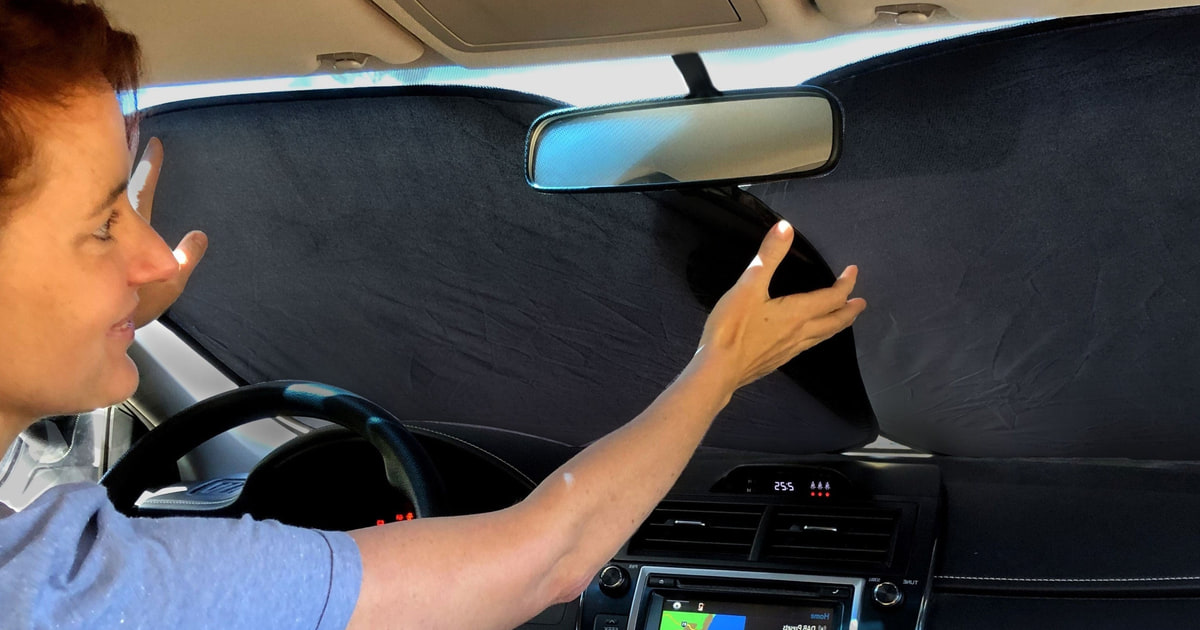
Leave your car in an open lot on a hot afternoon and the cabin climbs fast. Interior temperatures reach 130 to 170 degrees within minutes, which is enough to warp a dashboard, crack leather, and turn a seat belt buckle into something you don't want to touch. A windshield shade is the simplest fix you have. It bounces sunlight back out before it reaches your dash, and research on parked cars credits a well-fitted shade with 30 to 50 degrees of cooling. It also blocks the UV that quietly bakes your interior on mild days.
No shade makes a parked car comfortable. Open the door after eight hours in the sun and it's still warm in there, just less punishing. Universal shades leave an inch or three of bare glass at the corners, and that's exactly where sunlight lands on the dash top. Custom shades close those gaps, but they fit one vehicle and become useless the day you change cars. And every shade depends on you putting it up. The one folded in your trunk protects nothing at all.
So the real question isn't which shade blocks the most heat in ideal conditions. It's which one you'll actually bother with every day, in the car you own, at a size that covers your glass. We weighed coverage, reflective layers, folding hassle and how each design holds up over seasons of creasing. We think that the EzyShade Windshield Sun Shade is the best car windshield sunshade for most people, and that the 5-Layer Bubble Windshield Sunshade is the one to buy if you park in full sun in a very hot climate.
Everything we recommend

Easy to fit, easy to fold, and cool enough for most cars
Thicker insulation for cars that bake in the open all day

Wide coverage and a soft, tint-safe backing on a budget

Edge-to-edge coverage, if there's a version for your car

Pull it across, latch it, drive off — no folding
Prices as of Oct 22, 7:36 AM PT · Details
At a glance
| Product | Size (W x H) | Heat/UV Block | Price | |
|---|---|---|---|---|
| Covercraft UVS100 Custom SunscreenUpgrade pick | Custom Fit | 99% UV Block | $85.69 |
 | Intro-Tech Automotive TT-73 Custom Fit Windshield SunshadeAlso consider | Large | Reduces 40°F | $49.99 |
 | MSD Custom Windshield Sun ShadeAlso in lineup | 33 x 28.5 in | — | $25.98 |
| EzyShade Windshield Sun Shade with Shield-X ReflectiveTop pick | Medium (Standard) | 15% Cooler | $14.99 |
 | BDK Iridescent Matte Black Front Windshield SunshadeAlso consider | 58 x 27 in | Reduces 30-50°F | $24.50 |
| EcoNour Car Windshield SunshadeBudget pick | 64 x 32 in | Blocks 99% Heat | $11.99On sale |
| Windshield Sunshade-Thicken 5-Layer Bubble Block Heat andRunner-up | 58 x 27.5 in | Reduces 30-50°F | Check price |
 | OxGord Car Sunshade - Solar Reflective SilverAlso in lineup | 55 x 28 in | — | $19.56 |
| Dash Designs Universal Fit Retractable Shade AutoAlso great | 25 Inch | Reduces 50°F | Check price |
Prices as of Oct 22, 7:36 AM PT · Details
How we picked
Coverage and fit. We compared published dimensions against typical windshield sizes and favored shades that reach into the corners. Published reviews and owner feedback both point to edge gaps as the weak spot of universal shades.
Reflective layers. We looked at what each shade is actually made of, from plain mylar to dual-layer foil to five-layer bubble. Surface reflectivity and layer count are what determine how much heat stays outside the glass.
Daily deployment. Folding hassle is the most common reason a shade stops getting used, so we gave weight to designs that go up and come down in seconds. A shade in the trunk protects nothing.
Glass and sensor safety. We checked which shades have soft, non-abrasive faces that won't scuff tinted glass. We also looked at which are shaped to clear windshield-mounted cameras, rain sensors and head-up display projectors.
Durability. We weighed how each construction survives repeated creasing, since cracked coatings and delamination along fold lines are the failure modes that dominate feedback on inexpensive shades.
Top pick
Easy to fit, easy to fold, and cool enough for most cars
EzyShade Windshield Sun Shade with Shield-X Reflective
EzyShade splits the job across two identical reflective panels, so you position them to cover your windshield instead of hoping one fixed rectangle fits. It's light, it folds down small, and the Shield-X coating keeps a cabin cooler than plain single-layer mylar does.
$14.99fromAmazonPrices as of Oct 22, 7:36 AM PT · Details
Two panels beat one fixed rectangle. Most universal shades are a single accordion sheet cut to an average windshield, which is why they gap at the corners. EzyShade gives you two identical rectangles instead. You overlap them vertically or horizontally, whichever way covers your glass, and the size chart points you to the standard size or a larger one depending on the car.
The reflective coating is doing real work. Shield-X is a high-reflectivity silver face, and EzyShade claims it runs up to 15 percent cooler than comparable reflective shades. Take the exact number with a grain of salt. What matters is that it's a proper mirror-like surface rather than a printed or dark one, so most of the sunlight goes back out through the glass instead of into your dash.
You'll actually use it, and that beats any spec. The panels fold flat in a couple of moves and slide into a door pocket or a seat back. The whole thing weighs under half a pound. That sounds trivial until you've skipped the shade three days running because refolding it in a hot parking lot felt like a chore you didn't have time for.
It suits a lot of ordinary cars. Because you're placing two pieces rather than wedging one shape behind the mirror, sedans, hatchbacks and small crossovers all work. EzyShade throws in a non-slip dash mat too. It's a small thing, but you notice it the first time your phone stops sliding into the passenger footwell at every stop sign.
Flaws but not dealbreakers
There's a seam, and the seam leaks light. Two panels have to overlap somewhere, and that joint is never as tight as a single custom-cut sheet. You'll see a thin bright line across the dash on a sunny afternoon. It isn't a dealbreaker for most people. But if you want true edge-to-edge coverage, a custom shade is the only way to get it.
Fold lines are the first thing to fail. Any folding reflective shade eventually creases, and the coating cracks along those lines after enough seasons. If you're deploying it twice a day, expect to replace it well before a rigid custom shade would need replacing. Storing it loosely instead of jamming it into a tight pocket buys you extra time.
Ordering the wrong size is easy. EzyShade sells several sizes, and the standard one is aimed at average sedans. If you drive a wide crossover and grab the default, you'll get a shade that doesn't reach the corners. Measure your windshield at its widest point and check that number against the chart before you buy anything.
Runner-up
Thicker insulation for cars that bake in the open all day
Windshield Sunshade-Thicken 5-Layer Bubble Block Heat and
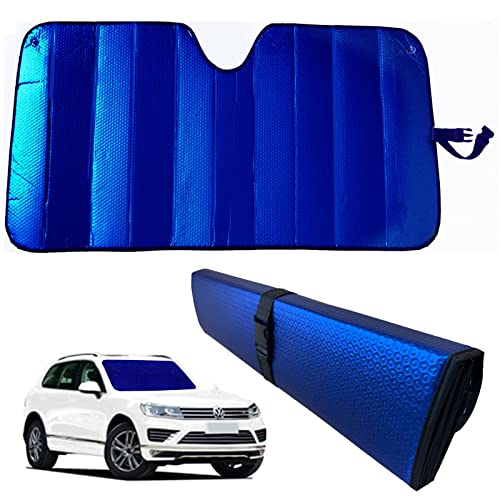
This is the shade to get when your parking spot has no shade at all. Five bubble-foil layers add trapped air behind a reflective face, so it slows the heat that gets through instead of only bouncing sunlight, and the extra thickness keeps it from sagging.
Check priceatAmazonPrices as of Oct 22, 7:36 AM PT · Details
Trapped air is what makes it different. A flat mylar shade reflects light and that's the whole trick. This one stacks five bubble layers behind an aluminum foil face, so air pockets sit between the sun and your dashboard. Reflection handles the radiant heat and the air pockets slow whatever gets past it. When it's over 100 degrees outside, that second mechanism is the one you feel.
The weight tells you it isn't flimsy. At roughly 400 grams it's several times heavier than a thin folding shade, and it holds its shape rather than slumping onto the dash. The edges are sewn instead of heat-sealed, which is usually the first place a cheap shade comes apart. It also ships flat in a long box, so it arrives without a permanent crease down the middle.
It stays where you put it. At 58 by 27.5 inches it covers a typical car windshield, and it braces against the rear-view mirror with a suction cup for backup. A rigid shade that doesn't slump is worth more than it sounds. A shade that slides down an inch overnight leaves the top of your dash exposed to the worst of the morning sun.
Flaws but not dealbreakers
It's bulky. All that insulation has to go somewhere once you drive off. It rolls up with an attached buckle strap, but the roll is fat compared with a flat folded shade, and it won't tuck into a door pocket. Plan on keeping it across the back seat or in the trunk, and plan on it taking up real space there.
The bubble cells flatten if you're rough with it. Crease it hard along the same line every day and the air pockets collapse, which is exactly the thing you paid for. Roll it instead of folding it and the strap makes that easy. Treated as a roll rather than a fold, it holds its loft for a lot longer.
One size, and it isn't a truck size. At 58 inches wide it's aimed at cars and small SUVs. Full-size pickups and vans have windshields that run well past that, so you'd end up with bare glass at both ends and sun falling straight onto the corners of the dash. Measure your own glass before you commit.
Budget pickOn sale
Wide coverage and a soft, tint-safe backing on a budget
EcoNour Car Windshield Sunshade
At 64 by 32 inches, EcoNour covers more glass than most universal shades, and its overlapping panels stretch another 8 inches to help close the corner gaps. The soft polyester face won't scuff tinted glass, and the whole thing collapses into an included pouch.
$11.99fromAmazonList pricePrices as of Oct 22, 7:36 AM PT · Details
It's bigger than most universal shades. Sixty-four by thirty-two inches is a lot of windshield, and the overlapping construction extends up to another 8 inches so you can push coverage into the corners. That flexibility matters more than it sounds. Corner gaps are where sunlight falls directly on the top of the dash, and the dash top is the part that cracks first.
The polyester face is friendly to tinted glass. Aftermarket film scratches, and a stiff foil edge dragged across it twice a day does real damage over a few years. EcoNour's fabric surface is soft enough to slide against film without scuffing. If your windshield is tinted or has a shade band at the top, that's a genuine advantage over a bare mylar shade.
It pops open and folds away fast. It springs into shape rather than demanding an accordion routine, and it collapses back into the supplied pouch in a few seconds. It weighs almost nothing. For a shade you're putting up and taking down every workday, that low friction is what keeps it out of the trunk and on the glass.
There's a size for most cars. The medium suits small sedans and compact SUVs, and EcoNour sells larger versions for bigger glass. Check the chart against your own tape measurement rather than trusting the vehicle names, because windshield width varies more between trims and body styles than you'd expect it to.
Flaws but not dealbreakers
Blocks 99% of heat is marketing, not physics. No fabric shade stops nearly all the heat entering a parked car, since the side glass, doors and roof let plenty through on their own. What a good shade does is block direct sun on the dashboard and cut the UV that fades and cracks it. Read the claim as UV blocking and you'll be about right.
Thin polyester doesn't feel as tough as bubble foil. It's light, which helps with daily handling, but there's less material to absorb abuse. Park in the open all day in a hot climate and a thicker multi-layer shade will both insulate better and last longer. This one is best suited to moderate sun and tight storage space.
Upgrade pick
Edge-to-edge coverage, if there's a version for your car
Covercraft UVS100 Custom Sunscreen
Covercraft cuts the UVS100 to laser-measured dimensions for one specific vehicle, so it reaches the corners a universal shade can't. This listing is cut for Dodge Ram pickups, and it costs more than anything else here, but it's the one to buy if you park in full sun daily.
$85.69fromAmazonPrices as of Oct 22, 7:36 AM PT · Details
Custom cutting eliminates the gaps. Universal shades are sized for an average windshield, so they leave bare glass at the corners and along the bottom edge. Covercraft cuts each UVS100 to the measured shape of one windshield instead. Coverage runs right up to the trim, which is precisely where the sun otherwise lands on the top of your dashboard.
The material is built for years, not seasons. The UVS100 uses a multi-layer heat-shield laminate rather than a thin reflective film, and Covercraft says it blocks up to 99 percent of UV. It's rigid enough to hold its own shape behind the mirror and it still folds compactly. Published reviews in the automotive press consistently put this shade at the top of the category.
Fitment is the whole point, so check it carefully. This particular listing covers a specific run of Dodge Ram 1500 and 2500/3500 pickups. Covercraft cuts the UVS100 for hundreds of other vehicles, so there's very likely a version for whatever you drive. Confirm your exact model and trim before ordering, because a custom shade cut for the wrong windshield is worse than a universal one.
It makes the most sense for a car you plan to keep. A shade cut for one windshield doesn't move to your next vehicle. But dashboards crack, leather fades and center screens haze in direct sun, and any of those costs far more to put right than a shade does. Keeping the truck for years and parking outside? The arithmetic works out in your favor.
Flaws but not dealbreakers
It's the most expensive shade here by a wide margin. For a car that lives in a garage, or one you'll trade in soon, that's money spent on coverage you won't miss. A good universal shade gets you most of the benefit for a fraction of the outlay. The custom cut earns its keep only when the car sits in the sun day after day.
One wrong detail in the fitment and it doesn't work. Year, model and trim all matter, and a shade cut for a neighboring generation will sit crooked or refuse to wedge in at all. Verify the fitment against your own vehicle rather than assuming, because a custom shade isn't the sort of thing you want to be returning.
Custom manufacturing can mean waiting. Popular fitments ship quickly, but less common vehicles are made to order and can take longer to arrive than an off-the-shelf accordion shade. If you need something on the windshield this week, buy a universal shade now and treat the Covercraft as the long-term fix.
Also great
Pull it across, latch it, drive off — no folding
Dash Designs Universal Fit Retractable Shade Auto
The Dash Designs shade rolls out of a housing on a coil spring. You pull it across the windshield and latch it in place, then let it snap back when you leave. If refolding is the reason your current shade lives in the trunk, this design solves that.
Check priceatAmazonPrices as of Oct 22, 7:36 AM PT · Details
The best shade is the one you use, and this is the easiest to use. One motion out, one motion back. There's nothing to wrestle into a rectangle in a hot parking lot and nothing to stow on the seat. If you park and unpark four times a day, that difference is what decides whether the shade goes up at all.
The reflective silver face does the standard job. Dash Designs says the shade cuts cabin temperature by as much as 50 degrees, which lines up with what reflective shades generally manage. There's no bubble insulation here, so think of it as a mirror rather than a blanket. In moderate heat that's plenty, and it's far better than nothing on the hottest days.
It's a good match for an EV. A cooler cabin means the climate system has less work to do before you pull away, so less range goes into cooling and more goes into driving. The saving each time is small. But it repeats every warm day of the year, and the effort this shade asks of you is close to zero.
Flaws but not dealbreakers
A roller can't follow a curved windshield. The shade pulls out as a flat rectangle, so steeply raked or strongly curved glass leaves triangles uncovered at the corners. Check the width against your own measurement first, since this is a 25-inch version and it's easy to end up with noticeably less coverage than you pictured.
Springs wear out. A coil mechanism used twice a day for years eventually loses tension or starts to stick, and there's simply more to go wrong here than in a sheet of folded foil. The guarantee covers defects in materials and workmanship, not a mechanism that's been worn down by thousands of cycles.
Dash Designs guarantees the shade for two years against defects in materials or workmanship.
Who this is for
If you park outside — a driveway, a work lot, a street space — a windshield shade is worth having. It's the simplest protection your dashboard, steering wheel and seats will ever get, and it's the difference between a cabin that's warm and one you can't touch. It matters most if your car has a dark interior, leather seats or a large center screen, since all three take the brunt of direct sun.
This guide covers front windshield shades only, the kind you put up when you park. We're not covering side window shades, rear window shades, or permanent window tint, and we're not covering the mesh screens people clip on for kids in the back. If you park in a garage or under cover most days, you can skip all of this. And if your car came with a custom shade from the factory, keep using it — nothing here will fit better.
How we picked
Coverage: we compared published dimensions against real windshield sizes and favored shades that reach into the corners, because that's where sun falls directly on the dash. Layers: plain mylar, dual-layer foil and five-layer bubble constructions reject heat in roughly that order, so material and layer count carried real weight. Deployment: a shade that takes half a minute to refold is a shade you'll skip, so fast-folding and retractable designs scored well. Glass safety: soft faces and bound edges matter if your windshield is tinted or there's a camera behind the mirror. Durability: we looked at how each construction handles daily creasing, since a flaking coating is the usual end of an inexpensive shade.
Other car windshield sunshades worth considering
If you drive a Toyota Camry and want a custom fit for less: The Intro-Tech Automotive TT-73 Custom Fit Windshield Sunshade — The Intro-Tech TT-73 is cut for the Camry specifically, so it covers the glass corner to corner the way the Covercraft does, for a lot less money. The metalized outer film reflects UV, and Intro-Tech says it drops interior temperature by up to 40 degrees. A UV-resistant velour binding runs all the way around the edge, so nothing hard touches your tint, and it rolls up with an attached strap rather than folding into creases. Intro-Tech backs it with a lifetime warranty. The catch is the usual one for custom shades: it fits a single car, and it's a bit less rigid than the Covercraft across a wide, curved windshield, so it can shift if you don't seat it properly.
If you'd rather not stare at a giant silver rectangle: The BDK Iridescent Matte Black Front Windshield Sunshade — The BDK is an iridescent matte black accordion shade, 58 by 27 inches, with a dual-layer bubble core and tapered edges that tuck into the corners better than a plain rectangle. It props up behind the rear-view mirror in seconds, closes with a hook-and-loop strap, and it's reversible if you want the plain side facing out. It also kills the mirror-bright glare that a silver shade throws at anyone walking past your car. The trade-off is physical, not a matter of opinion: a dark surface absorbs light that a silver one would send back out. In the Pacific Northwest or the upper Midwest you won't notice. In Phoenix you will.
The competition
This is what our research surfaced, not a census of everything on the market. We started from the shades that come up repeatedly in published roundups and among the best-selling universal listings, then worked through their specifications and the themes in owner feedback. Plenty of perfectly decent shades aren't here. The two below came close enough to be worth naming, and each lost out to a pick for a specific reason.
The MSD Custom Windshield Sun Shade — The MSD Custom Windshield Sun Shade prints whatever you like on the outward face: a photo, a logo, a message. It's a genuinely good gift, and it's a real collapsible accordion shade rather than a novelty. But the print is also the problem. Ink on the outer surface absorbs light that a plain silver face would reflect, so heat rejection drops compared with a standard mylar shade. At roughly 33 by 28.5 inches it's on the small side for a wide windshield too. Choose it for personality in a mild climate, not for a car that sits in the sun all day.
The OxGord Car Sunshade - Solar Reflective Silver — The OxGord is a plain reflective silver shade, 55 by 28 inches, with a double-bubble core and storage straps that fold it into a pouch. There's nothing wrong with the recipe — it's the same idea as our picks, executed inexpensively. It's smaller than the EcoNour and much less insulated than the five-layer bubble shade, and shades built to this price tend to crack and delaminate along the folds within a season or two of daily use. Treat it as a spare for a second car, or as a fine choice if you only need a shade for a few weeks a year.
Fit and care
Measure before you buy a universal shade. Run a tape across the widest part of your windshield, dashboard edge to dashboard edge, then top to bottom, and add two or three inches for curvature and dash overhang. If there's a camera housing, rain sensor or head-up display projector near the mirror, check that the shade clears it; custom shades are usually shaped around those, universal ones aren't. Store a folding shade loosely rather than cramming it in, since crease lines are where the coating fails first. Wipe the reflective face with a dry cloth instead of glass cleaner. And replace any shade once the foil starts flaking, because a cracked reflector isn't reflecting much of anything.
Questions we get
Do windshield sunshades actually work?
Yes. Research on parked cars credits a well-fitted shade with 30 to 50 degrees of cabin cooling, because it reflects sunlight before it reaches the dash and seats. Multi-layer and bubble-foil shades do better than thin single-layer mylar in peak heat. Just don't expect a comfortable car — expect a much less punishing one.
What should I buy if I park outside in Arizona, Texas or Florida?
Go for coverage first, then layers. A custom-cut shade like the Covercraft closes the corner gaps entirely, and the five-layer bubble shade adds insulating air pockets behind a reflective face. Either one beats a thin universal accordion shade once it's over 100 degrees outside. If you can only optimize one thing, make it coverage.
Are custom-fit shades worth it over universal ones?
If you park in the sun daily and plan to keep the car, yes. Custom shades cover the corners where sun hits the dash directly, and they're built from heavier material that lasts years rather than seasons. They also cost considerably more and fit exactly one vehicle. Park in a garage or change cars often, and a good universal shade is the smarter buy.
What size do I need for an SUV or a truck?
Measure first, then look for 63 inches of width or more for a full-size vehicle. EcoNour and EzyShade both sell larger sizes, and Covercraft cuts custom versions for most trucks and SUVs. The 58-inch universal shades in this guide are aimed at cars and compact crossovers, so they'll leave bare glass on a full-size pickup.
Will a sunshade scratch my tint or block my camera?
A soft-faced shade won't scratch film. The Intro-Tech's velour binding and EcoNour's polyester surface are both safe against tinted or filmed glass; hard foil edges are the ones to watch. For cameras, rain sensors and head-up displays clustered around the mirror, custom shades are shaped to clear the housing, while a universal shade may press right against it.
How often should I replace a sunshade?
Watch the fold lines. Once the reflective coating cracks or flakes along a crease, that strip stops reflecting and starts absorbing. Inexpensive shades used every day often reach that point after a season or two, while heavier custom and bubble-foil shades go much longer. If it sags behind the mirror or won't hold its shape, it's done.
Why you should trust us
For this guide:
- We read the published specifications and listing details for all nine of these shades, comparing stated dimensions, materials and layer counts rather than marketing language.
- We compared how each design is described in automotive press roundups and in owner feedback, paying particular attention to recurring complaints about sizing, sagging and coating failure.
- We read owner reviews on every listing, weighted toward the critical ones, because that is where the recurring failures show up.
- We have a systematic way of automatically fetching the latest prices, so the numbers on this page stay current.
- This is a research-focused guide, so the team may not own every product listed — though we often do own the top winners, which gives us extra context for the recommendations.
- We don't accept free products, and the retailer commission never changes which product we recommend.
Sources
Best Windshield Sun Shades — Popular Mechanics, Popular Mechanics
Best Windshield Sun Shades 2025 — Car and Driver, Car and Driver
Best Windshield Sun Shades — The Drive, The Drive
Best Car Sunshades — Gear Patrol, Gear Patrol
Best Windshield Sun Shades — Bob Vila, Bob Vila
Excess Heat in Closed Automobiles — San Francisco State University Study, San Francisco State University
Hot Cars: Vehicle Interior Heat Data — Department of Geosciences, San Jose State University, San Jose State University
UV Protection and Vehicle Interior Degradation — AAA Research, AAA
Amazon product listings and owner reviews for all 9 products
Manufacturer specification pages for each product
Some passages in this guide may be paraphrased with AI help.
Product prices and availability are accurate as of the date/time indicated and are subject to change. Any price and availability information displayed on Amazon.com at the time of purchase will apply to the purchase of this product.
More like this.
Continue exploring lifestyle reviews and recommendations.

The Best Car Windshield Sunshades
Park outside on a hot afternoon and your car stops being a car. It becomes an oven. NREL research puts a parked interior at 130 to 172 degrees on a…

The Best DIY Windshield Repair Kits
A rock kicks off the back of a gravel truck, and a second later there's a small white star in your glass. It looks harmless. Then a cold morning and a…

The Best All-Weather Windshield Wipers
Wipers are easy to ignore until the moment you can't see. You merge onto a wet highway, a truck throws up a sheet of spray, and a worn blade smears it…

The Best Windshield Snow Covers
Scraping ice off a windshield is the worst five minutes of a winter morning. Your hands go numb, your coffee gets cold in the cup holder, and you're late…

The Best Folding Windshield Sun Shades of 2026
Park in an open lot on a July afternoon and your car turns into an oven. AAA's research found that a cabin sitting in 80-degree weather climbs to 116…

The Best Windshield De-Icer Sprays
Scraping a frozen windshield is a miserable way to start a day. A de-icer spray shortcuts it: you soak the glass, wait a few seconds, and push the slush…