The Best Folding Windshield Sun Shades
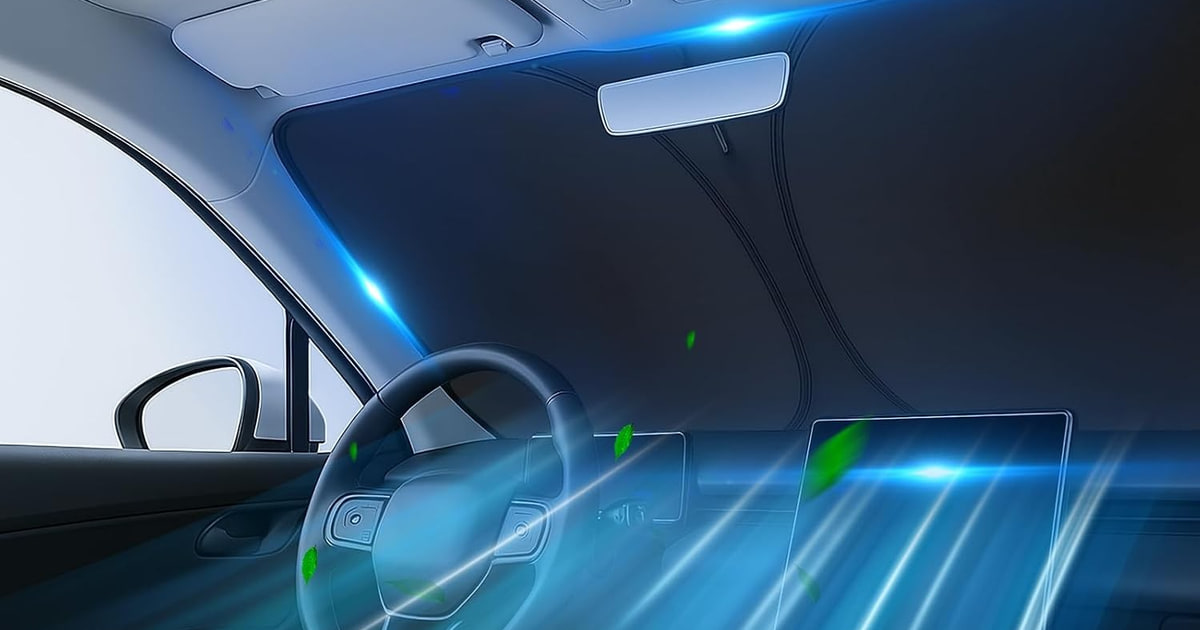
Park in an open lot on a July afternoon and your car turns into an oven. AAA's research found that a cabin sitting in 80-degree weather climbs to 116 degrees within an hour, with dashboard surfaces hitting 157 degrees. That's the difference between sliding into your seat and bracing for a steering wheel you can't hold. A folding windshield shade is the simplest fix for it. It also slows the UV damage that cracks vinyl dashboards and fades leather over the years you own the car.
Here's the honest part: no shade actually keeps your car cool. It slows the heat down. Even a good one leaves you with a warm cabin, just a survivable one instead of a punishing one. Universal shades leave gaps at the corners where heat pours in, and custom shades solve that by fitting exactly one vehicle — which means they're worthless the day you sell it. Every folding design also creases over time, and creases eventually show up as light leaks.
Fit type matters more than brand, and measuring your windshield matters more than the size label on the box. An XL from one company runs 58 inches; another company's XL runs 68. We think that the Econour Car Windshield Sun Shade is the best folding windshield sun shade for most people, and that the WeatherTech Sunshade TS1430 is the one to buy if you drive a Silverado, Tahoe, Yukon or Sierra and park outside all year.
Everything we recommend

Pops open in seconds and fits almost any sedan or small SUV

Edge-to-edge coverage for GM trucks, if your model is on the list
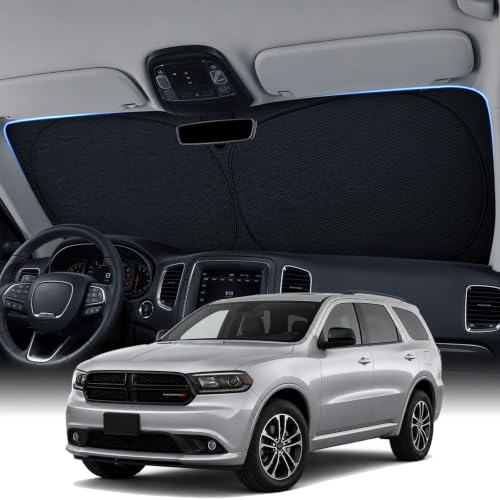
Serious layered insulation, but only if you drive a Durango

Custom-fit precision for an Explorer at near-universal cost
At a glance
| Product | Coverage | UV Block | Price | |
|---|---|---|---|---|
| Econour Car Windshield Sun ShadeTop pick | Medium | — | $11.99On sale |
| WeatherTech Sunshade Window Shade for Chevrolet SilveradoUpgrade pick | Front Windshield | — | $83.95 |
 | Covercraft UVS100 Windshield Sunshade for 2009-2014 FordAlso in lineup | 8x40.5 in | 99% UV Block | $85.49On sale |
| Windshield Sun Shade for Ford Explorer 2020-2026Budget pick | 31x59 in | 99% UV Block | $19.90 |
 | Wigoo Car Windshield Sun Shade UmbrellaAlso consider | 41.7x24.3 in | UPF 80+ | $13.59On sale |
 | 3D MAXpider Wintect Semi-Custom Fit All-Season WindshieldAlso consider | 59x47x65 in | — | $41.99 |
| Large Windshield Sun Shade for Dodge DurangoAlso great | Durango 2011-Present | 99.9% UV Block | $29.99 |
How we picked
Fit and coverage. We compared listed dimensions and fitment ranges against typical windshield widths, and weighted custom-cut shades heavily because published testing shows full coverage removes the side gaps where heat enters fastest. Anything that leaves the A-pillar corners bare lost ground.
Materials and layers. We read spec sheets for fabric type and layer count, treating thin single-layer mylar as a floor rather than a target. Woven polyester, foam cores and multi-layer stacks all insulate better than bare foil, and they survive more summers.
UV blocking. We looked for manufacturer ratings at 99% or above, since UV is what cracks dashboards and fades leather over the years you own a car. Ratings below that mark didn't make the cut.
Setup and storage. We favored shades that deploy in seconds from the driver's seat and fold small enough for a door pocket or glovebox. Owner feedback across this category shows the shades people abandon are the ones that are a hassle to put away.
Owner-reported durability. We read owner feedback themes looking for delamination, sagging panels and bent frames — the three failure modes that turn a working shade into a floppy piece of fabric. Products with recurring complaints in those areas dropped.
Top pickOn sale
Pops open in seconds and fits almost any sedan or small SUV
Econour Car Windshield Sun Shade
The Econour is a pop-open accordion shade in 240T polyester, sized up to 64 by 32 inches with an 8-inch expandable overlap. It covers most sedans and compact SUVs, deploys in about two seconds, and folds into an included pouch that lives in a door pocket.
$11.99fromAmazonList priceIt's the one you'll actually use every day. A shade only works if you bother to put it up. The Econour pops open on its own — you unfold it, press it against the glass, drop the visors, and you're done. Folding it back down takes a twist. When you're running late in a parking garage, that difference decides whether the shade ends up on the windshield or in the back seat for the rest of the summer.
The 240T polyester holds up better than thin foil. Cheap mylar shades delaminate after one hot season — the reflective layer bubbles and flakes, and the shade stops reflecting much of anything. The woven polyester here is a different material class. Owners who've kept these through multiple summers report the panel still holds its shape and the coating stays put, which is most of what you want from a product that bakes against glass every day.
The expandable overlap does real work. Windshields aren't rectangles. The 8-inch overlap lets you widen the shade to reach into the corners on a wider car or pull it in on a narrower one, so you're not stuck with whatever single width the box came in. That flexibility is why one product covers everything from a Civic to a RAV4 reasonably well.
The soft inner lining protects your glass. The side that touches the windshield is fabric, not bare foil or hard plastic. Over hundreds of installs, grit trapped against a rough surface leaves fine scratches you notice at night when headlights hit them. This is a small detail that costs the maker almost nothing and saves you a windshield you'd otherwise squint through.
Flaws but not dealbreakers
Universal fit means gaps, and gaps mean heat. On a deeply curved or unusually wide windshield, the Econour won't reach every corner. Consumer Reports testing found custom-fit shades pull interior temperatures 8 to 12 degrees lower than universal equivalents, and side-gap heat channels are the reason. If your car has an aggressively raked windshield, expect two triangles of exposed glass near the A-pillars.
It runs out of size before trucks do. Sixty-four inches covers a lot of vehicles. It doesn't cover a full-size pickup or a cargo van, where windshields regularly need 66 inches or more. Buy from the size chart, not the size name — and if you drive something big, this isn't your shade.
In brutal heat, it gives up ground to thicker builds. Multi-layer foam-core and 7-layer constructions insulate better than a woven panel, and in a Phoenix parking lot in August that difference is noticeable. For a daily commuter in most of the country it's fine. For someone parking outdoors all day in a 110-degree climate, it's a compromise.
Upgrade pick
Edge-to-edge coverage for GM trucks, if your model is on the list
WeatherTech Sunshade Window Shade for Chevrolet Silverado
WeatherTech cuts the TS1430 for specific Silverado, Tahoe, Yukon and Sierra model years, so it reaches every corner of the glass instead of leaving triangles at the A-pillars. The foam core holds its shape across a wide truck windshield and doubles as frost protection in winter.
$83.95fromAmazonCustom cutting solves the problem universal shades can't. Big truck windshields are where universal shades fail worst — they fall short at the edges, and the edges are exactly where heat streams in. This one is cut to the glass. Consumer Reports puts the gap between custom and universal fit at 8 to 12 degrees of interior temperature, and on a Silverado parked in an open lot that's the difference you feel first.
The foam core makes a large shade manageable. Wrestle a floppy 66-inch panel into a truck windshield and it folds over on itself twice before it sits right. The foam core here gives the shade enough rigidity to stay flat while you position it. That structure also gives it more insulating body than a single reflective layer, which is the second reason it beats a foil shade on a hot day.
It earns its keep in winter too. WeatherTech designs this as a dual-season product: summer heat one half of the year, frost prevention the other. If you park outside through a real winter, the mornings you don't scrape are worth something. Most shades in this category are summer-only, so you'd otherwise buy a second product.
Fitment is spelled out, which saves you a return. The compatibility list covers select 2022–2026 Silverado 1500, 2023–2026 Yukon and Yukon XL, 2024–2025 Silverado 2500HD/3500HD, 2023–2026 Tahoe and 2022–2025 Sierra 1500. Check your year and trim against Amazon's fitment tool before ordering. Custom shades are precise, which cuts both ways.
Flaws but not dealbreakers
It's the most expensive way to shade one specific truck. This costs several times what a good universal shade does, and the moment you trade the truck it's scrap. If you lease, or you swap vehicles every couple of years, the math doesn't work in your favor.
Roll-up storage is slower than pop-open. You roll it and cinch a hook-and-loop strap. It's not difficult, but it's a few more seconds at both ends than an accordion shade that springs into shape. The rolled bundle also takes more room than a flat-folding panel, and it doesn't tuck into a door pocket.
If your model isn't listed, there's nothing to discuss. The precision that makes it good makes it useless one model year outside the range. Owners occasionally find that a mid-cycle trim change throws the fit off, so confirm before you buy rather than after.
Also great
Serious layered insulation, but only if you drive a Durango
Large Windshield Sun Shade for Dodge Durango
Zanch laser-scans the Dodge Durango windshield and builds a 7-layer panel with a titanium silver reflective face, rated to block 99.9% of UV. It's the thickest construction here, aimed squarely at drivers who park outdoors in Florida, Arizona or Nevada heat.
$29.99fromAmazonSeven layers is a real advantage in real heat. Reflection handles the sunlight that hits the surface. Insulation handles the heat that gets through anyway. Stacking a reflective Nano Ice Crystal coating over heat-insulating inner layers does both, and in a climate where the pavement shimmers, that stack outperforms a single woven panel by a wide margin.
The 3D-scanned fit means no sagging corners. Zanch built this from laser scans of actual Durango interiors across 2011–2026, and it follows the windshield contour edge to edge. A high-strength metal frame and reinforced perimeter stitching keep the panel from drooping in the middle — sag is the quiet failure mode on large shades, and it opens a heat gap right where you can't see it.
Silver-out reflects before heat becomes heat. The titanium silver face rejects solar energy at the glass instead of absorbing it and re-radiating it into your cabin. That's why every effective shade here is silver on the outward side, and it's why installing one backwards costs you a good chunk of its benefit.
It covers fifteen model years of one vehicle. A 2011 Durango and a 2026 Durango are different trucks in a lot of ways, but the windshield opening stayed close enough that one shade covers the run. If you own an older Durango, you're not stuck choosing between a universal compromise and nothing.
Flaws but not dealbreakers
Seven layers fold thicker. It twists into a circle like other memory-wire shades, but the bundle is bulkier than a single-layer panel. In a Durango there's room for it. That's a mild point in its favor and a reminder that thickness isn't free.
It's a Durango product, full stop. No other vehicle, no resale value, no flexibility. If you're within a year or two of switching vehicles, a good universal shade is the smarter buy even though it performs worse.
Zanch backs the shade with a one-year warranty covering quality issues, along with 24/7 customer support.
Budget pick
Custom-fit precision for an Explorer at near-universal cost
Windshield Sun Shade for Ford Explorer 2020-2026
Autopect cuts this shade for the 2020–2026 Ford Explorer, including a notch around the rearview mirror mount so the panel sits flush instead of bunching. It's rated to block 99% of UV and uses the same 240T polyester as our top pick, with memory wire for one-motion folding.
$19.90fromAmazonA mirror cut-out fixes the most annoying part of a universal shade. On a generic panel, the mirror mount pushes the top edge away from the glass and the whole shade slides sideways every time you close the door. The notch here lets the panel sit flat all the way to the top edge. It's a small piece of geometry that removes a daily irritation.
You get custom-fit performance without custom-fit pricing. Laser-cut shades used to be a premium-brand product only. Brands like Autopect changed that, and the result is that an Explorer owner can get edge-to-edge coverage for roughly what a decent universal shade costs. Consumer Reports pegs that fit advantage at 8 to 12 degrees inside the cabin.
The materials aren't a downgrade from our top pick. It's built from the same 240T polyester, with ductile wire in the perimeter so it springs open and twists back down without a fight. At half a pound it slides into a glovebox, which matters in a three-row SUV where the cargo area is already spoken for.
Coverage is genuinely edge to edge. At 59 by 31 inches, it's cut to the Explorer's glass rather than approximated. Full coverage is the whole point — the corners a universal shade misses are the corners that heat your dashboard fastest.
Flaws but not dealbreakers
Single-layer construction hits its limit in extreme heat. This reflects well but doesn't insulate the way a foam-core or multi-layer panel does. If you park outdoors all day in Phoenix or Las Vegas, a thicker build will keep the cabin measurably cooler. For most of the country it's plenty.
It fits one SUV and nothing else. The 2020–2026 Explorer, in ST, XLT, Limited or Platinum trim. Anything else and the money's wasted. Confirm your model year before ordering.
Memory-wire shades need to be folded, not crammed. Owners of wire-frame shades routinely report kinks from forcing the panel into a bag the wrong way, and a kinked wire never fully flattens against the glass again. Learn the fold once and it'll last.
Who this is for
Buy a shade if you park outdoors during the day, full stop. It doesn't matter much whether that's a driveway in Ohio or an office lot in Texas — sun through glass is sun through glass, and the dashboard, the steering wheel and anything you leave on the seat all pay for it. If you've got a child seat that lives in the car, a leather interior, or a dashcam and phone mount baking on the glass, the case gets stronger. If you park in a garage at both ends of your commute, you can skip this entirely.
This guide covers folding windshield shades for the front glass: accordion and memory-wire panels, umbrella-style frames, and one exterior cover that also handles frost. It doesn't cover side-window socks, rear-window shades, sunroof panels or the static-cling films people use for kids' windows. We also don't cover the tinting question — a shade and a tint job solve overlapping problems, but tint is a different purchase with different legal limits depending on where you live.
How we picked
Fit: We compared listed dimensions and fitment lists against real windshield widths, and gave custom-cut shades credit because published testing shows edge-to-edge coverage kills the side gaps where heat enters. Materials: We read spec sheets for fabric and layer count, treating thin mylar as the floor and woven polyester, foam cores and multi-layer stacks as the target. UV: We looked for ratings of 99% or better, since UV is what cracks dashboards over time. Setup: We favored shades you can deploy in seconds and store in a door pocket, because the fussy ones get abandoned. Durability: We read owner feedback for delamination, sagging and bent frames, and dropped products where those complaints recurred.
Other folding windshield sun shades worth considering
If you want one product for summer heat and winter frost: The 3D MAXpider Wintect Semi-Custom Fit All-Season Windshield ($41.99) — The 3D MAXpider Wintect is the only cover here that goes on the outside of the glass, and that changes what it's good at. A magnetized tab grabs the metal door frame so it's on in seconds, and a patent-pending mesh channels air so a gust doesn't peel it off your hood — there's a reinforced anchoring loop for the really nasty days. Because it blocks sun before it reaches the glass, and because it lifts off with the ice attached on a January morning, it replaces both a sun shade and a frost guard. Seven semi-custom sizes cover most vehicles, and the UV coating also protects your wiper blades. What you give up is convenience and precision: you have to get out of the car to put it on, and semi-custom fit leaves narrow gaps that a laser-cut interior shade wouldn't. The magnets also need a metal door frame to bite.
If you want the fastest possible one-handed setup: The Wigoo Car Windshield Sun Shade Umbrella ($13.59) — The Wigoo opens like a beach umbrella — a 10-rib frame that springs into shape in one motion, no unfolding and no wrestling. Wigoo rates it at UPF 80+ with up to 100% light blocking, and the rib structure keeps the panel taut against the glass instead of sagging at the edges the way thin foil does. Flexible silicone edges and a widened mirror strap help it settle around the mirror mount, and there are 15 sizes to choose from. The trade-offs are shape and bulk. A rib frame is essentially flat, so on a strongly curved windshield it bridges the curve and leaves small gaps at the periphery. Folded, it's a stubby cylinder rather than a flat panel, so it won't disappear into a door pocket. In a compact car, that's real cargo space.
The competition
This is what our research surfaced in this lineup, not a survey of every shade on the market. Windshield shades are a category where dozens of near-identical products come and go under different brand names, so treat the list below as the alternatives we could evaluate against real listing specs and owner feedback.
The Covercraft UVS100 Windshield Sunshade for 2009-2014 Ford ($85.49) — The Covercraft UVS100 is a custom-cut shade for the 2009–2014 Ford F-150 with a proprietary laminate rated to block up to 99% of UV-A and UV-B. It's a serious piece of gear from a company that's been making fitted covers for decades, and the fit seals the edges the way a good custom shade should. Two things kept it out of the picks. It's the priciest shade in this lineup by a wide margin, and its fitment window is six model years of one truck that's now several generations old. If you still drive a 2009–2014 F-150 and you've got a leather interior you'd rather not see crack, it's a defensible buy — repairing a sun-damaged dash costs far more than any shade here. For everyone else, there's nothing to consider.
Installation and care
Put the silver side facing out, toward the glass and the sun. Installed backwards, the dark side soaks up solar energy and re-radiates it into your cabin, which throws away a good chunk of what you paid for. Tuck the top edge behind the sun visors and flip both visors down — that holds the shade flat without tape or suction cups and keeps it from sliding down while you're away. Before you buy anything, measure your windshield at its widest horizontal point and its tallest vertical point, and shop the brand's size chart instead of trusting a label that says XL. Fold along the creases the shade came with rather than forcing it; memory-wire frames kink permanently when you cram them into a bag sideways. Wipe the reflective face with a damp cloth when it gets dusty, and let it dry fully before folding it away.
Questions we get
What size windshield sun shade do I need?
Measure the glass yourself — width at the widest horizontal point, height at the tallest vertical point. Compact sedans generally land in the 47- to 55-inch range, mid-size sedans and SUVs in the 58- to 64-inch range, and full-size trucks and vans at 66 inches or more. The Econour covers up to 64 by 32 inches with its overlap expanded. Always shop the brand's size chart, because one company's XL can be six inches narrower than another's.
How much cooler does a sun shade actually keep my car?
Published testing puts dashboard surface reductions in the 40- to 55-degree range and overall interior reductions around 15 to 25 degrees compared with an unshaded car in direct sun. University of Arizona research found interiors climb roughly 40 degrees above ambient within 20 minutes of parking, and that shading cuts that rise by about 30 to 40%. Custom-fit shades add another 8 to 12 degrees of benefit over universal ones, per Consumer Reports.
Is a custom-fit shade worth it over a universal one?
It depends on your climate and how you park. If you're outdoors every day in 90-plus heat, the 8- to 12-degree edge that Consumer Reports attributes to full coverage is worth having. If you park in mild weather or you're often in the shade, a good universal shade like the Econour gets you most of the way there. There's also a resale wrinkle: a custom shade is worthless the day you change cars.
What's the difference between single-layer foil and multi-layer shades?
Single-layer foil is a thin reflective film. It bounces sunlight and does almost nothing else, and it tends to delaminate after a hot season or two. Multi-layer designs — double-bubble, foam-core, or the 7-layer stack Zanch uses — add insulation on top of reflection, and they generally run 10 to 20 degrees cooler inside than foil in comparable conditions. If you park outdoors in serious heat, skip the foil.
Can a sun shade prevent frost in winter?
An interior shade helps a little by cutting the temperature swing at the glass, but it isn't built for it and ice still forms on the outside where you have to scrape it. An exterior cover is the real answer — the 3D MAXpider Wintect is the one here designed for it, and the WeatherTech TS1430 is marketed for winter duty as well. If you park outside through real winters, an exterior cover saves you the scraper.
Will a shade interfere with a windshield-mounted dashcam?
Usually not. Most interior shades sit below the mirror mount area at the top center of the glass, where dashcams typically live. Shades with a mirror cut-out, like the Autopect, are designed specifically to clear that hardware. Check that the shade's top edge isn't pressing on your camera's suction cup or adhesive pad before you drive off — heat plus pressure is how mounts let go.
Why you should trust us
For this guide:
- We read the manufacturer spec sheets and fitment lists for every shade in this lineup, comparing stated dimensions, layer counts and UV ratings side by side.
- We reviewed published testing from Consumer Reports, AAA and university researchers on how much interior temperature a windshield shade actually removes, and how custom fit changes that number.
- We read owner feedback across these listings for recurring failure modes — delamination, sagging panels, kinked memory wire and shades that slip out from behind the visors.
- We read owner reviews on every listing, weighted toward the critical ones, because that is where the recurring failures show up.
- We have a systematic way of automatically fetching the latest prices, so the numbers on this page stay current.
- This is a research-focused guide, so the team may not own every product listed — though we often do own the top winners, which gives us extra context for the recommendations.
- We don't accept free products, and the retailer commission never changes which product we recommend.
Sources
Car Sun Shade Reviews — Consumer Reports: custom-fit shades reduced interior temps by 8–12°F more than equivalent universal shades due to full windshield coverage, Consumer Reports
Vehicle Interior Heat Study — University of Arizona Department of Pediatrics: interiors heat to 40°F above ambient within 20 minutes; sun shades reduced this rise by 30–40%, University of Arizona
Amazon product listings and owner reviews for all 7 products
Manufacturer specification pages for each product
Some passages in this guide may be paraphrased with AI help. Prices are refreshed automatically.
More like this.
Continue exploring electronics reviews and recommendations.

The Best Folding Treadmills
A folding treadmill has one job beyond running: it has to disappear when you're done. Most end up in a spare bedroom, a basement corner or a garage, where…

The Best All-Weather Windshield Wipers
Wipers are one of the easiest safety upgrades on your car, and most people ignore them until a downpour turns the windshield into frosted glass. Bad…

The Best Windshield De-Icer Sprays
Scraping a frozen windshield is a miserable way to start a day. A de-icer spray shortcuts it: you soak the glass, wait a few seconds, and push the slush…

The Best Windshield Snow Covers
Scraping ice off a windshield is the worst five minutes of a winter morning. Your hands go numb, your coffee gets cold in the cup holder, and you're late…

The Best Car Windshield Sunshades
Park outside on a hot afternoon and your car stops being a car. It becomes an oven. NREL research puts a parked interior at 130 to 172 degrees on a…

The Best Smart Blinds and Shades
You touch your window shades more than almost anything else in the house, and you never think about it. Up in the morning, down at dusk, halfway when the…