The Best Squirrel-Proof Bird Feeders
Squirrels aren't casual about this. A gray squirrel can jump roughly ten feet sideways, walk down a metal pole head first, and empty a tube feeder in an afternoon. That's your seed gone, and the birds you actually wanted to watch go hungry. A good squirrel-proof feeder solves it one of two ways: it shuts the seed ports when something heavy lands on the perch, or it puts a physical barrier between the animal and the seed. Both approaches work. Neither works if you hang the thing in the wrong spot.
Here's the honest part. No feeder is squirrel-proof by itself. Every model here can be beaten by a squirrel that drops onto it from a branch overhead, and most can be beaten by a raccoon working at night. The mechanisms age, too. Plastic port covers wear through, springs loosen, and the birds you want are sometimes the ones you lock out by accident — a threshold set tight enough to stop starlings will also stop a cardinal. Expect some fiddling in the first few weeks.
So think about the whole setup, not just the feeder. Put it on a pole about five feet up, keep ten feet of clearance from anything a squirrel can leap off, and add a baffle underneath. Then choose based on capacity, materials, and how often you're willing to refill. We think that the Brome Squirrel Buster Plus is the best squirrel-proof bird feeder for most people, and that the Woodlink Absolute II is the one to buy if you're feeding a busy yard and don't want to top it up every couple of days.
Everything we recommend

Reliable weight-activated protection in a chew-proof body
A huge metal hopper you can fill and mostly forget about

Weight-activated ports for less, with parts that wear out
At a glance
| Product | Seed Capacity | Height | Price | |
|---|---|---|---|---|
| BromeTop pick | 5.1 lb | 28"H | $250 |
 | Brome Squirrel Buster Standard Squirrel-Proof Bird FeederAlso in lineup | — | 8.8"H | $142.24 |
 | Droll Yankees Yankee Flipper Replacement Lithium IonAlso in lineup | — | 9.125"H | $79.16 |
| Perky-Pet 334-1SR Squirrel-Be-Gone Max Large Wild BirdBudget pick | 4 lb | 17.5"H | $34.99 |
| Woodlink Absolute II Squirrel Resistant Bird FeederRunner-up | 12 lbs | 11.25"H | $84 |
How we picked
Squirrel exclusion. We looked for a mechanism that works without supervision — a weight-triggered shroud, closing ports, or a physical barrier. Published guides and owner feedback both had to show it holding up against adult gray squirrels, not just discouraging them.
Materials and chewing. Spec sheets told us what each feeder is made of, and owner reports told us what fails first. Anything with soft plastic where a squirrel can reach got marked down, because that's the part that gets gnawed open.
Capacity and refilling. We compared stated seed capacities against how often owners say they're out there topping up. A small tube in a busy yard turns into a daily chore, and that's the complaint that makes people give up on a feeder.
Birds it lets in. A threshold that stops squirrels can also stop cardinals, doves and woodpeckers. We favored feeders where owners describe the birds they wanted still getting fed, and we noted where adjusting the mechanism forces a choice.
Cleaning and hygiene. Ornithologists recommend a deep clean roughly every two weeks to limit disease spread between birds. We preferred feeders that come apart by hand and can go in a dishwasher.
Top pick
Reliable weight-activated protection in a chew-proof body
Brome
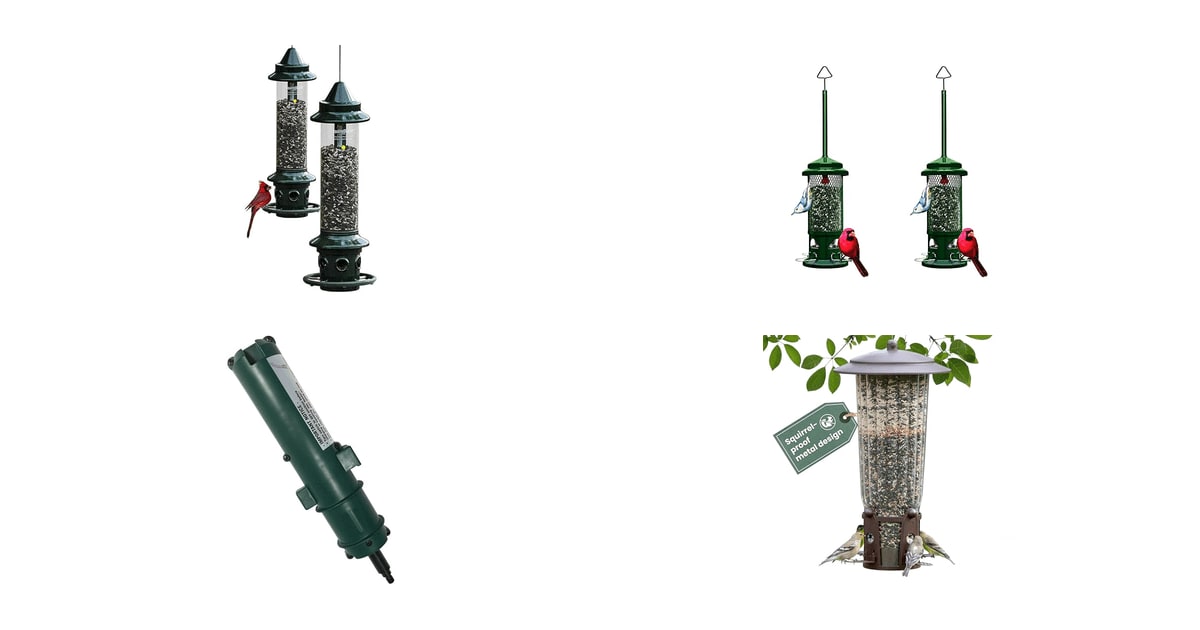
The Squirrel Buster Plus closes its seed ports when anything heavier than a songbird lands on the perch ring, and you can dial in exactly how heavy that is. It holds about five pounds of seed across six ports, and Brome sells it here as a pair.
$250fromAmazonThe mechanism is the whole product, and it's about as simple as squirrel-proofing gets. A weighted metal shroud wraps the seed tube. When something heavy steps onto the perch ring, the shroud slides down and covers every port at once. A chickadee weighs almost nothing, so nothing moves. A gray squirrel weighs more than a pound, so the seed disappears. There's no motor, no battery, and no switch to forget about.
You can tune the threshold with a dial at the base, which is the part owners talk about most. Set it loose and cardinals, blue jays and woodpeckers all feed happily. Tighten it and grackles and starlings trip the shroud instead. The included cardinal ring gives bigger, broader birds a wider place to stand, which matters if cardinals are the whole reason you're doing this.
Squirrels chew, so the parts they can reach aren't the soft kind. Brome makes the exposed components from a hard resin it says squirrels can't gnaw through, and owner feedback backs that up over multiple seasons. The feeder also comes apart by hand without tools and the parts are dishwasher safe. That matters more than it sounds — a dirty feeder spreads disease between birds, and a feeder you dread cleaning is one you won't clean.
Capacity sits at a sensible middle. Roughly five pounds is enough that a busy yard doesn't run dry midweek, but not so much that seed sits around going stale, and a ventilation system in the tube helps with that. Brome asks for about eighteen inches of clearance on every side, so plan your hook accordingly. You get two feeders in this listing, which is handy if you want one out front and one out back.
Flaws but not dealbreakers
It costs more than anything else here, and that's before you consider that raccoons don't care about weight-activated shrouds. Owners in raccoon country describe bringing the feeder in at night, which rather defeats the point of a low-maintenance solution. A baffle helps; a nightly routine helps more.
The sensitivity dial is a genuine trade-off, not a free win. Left at the factory setting, starlings can feed alongside everything else. Tighten it and they stop — but so might the larger birds you were hoping for. It's also a tall feeder at 28 inches, which looks imposing on a small balcony, and the plastic shroud can fade after a few summers of direct sun.
Brome backs the Squirrel Buster Plus with a lifetime guarantee against squirrel damage.
Runner-up
A huge metal hopper you can fill and mostly forget about
Woodlink Absolute II Squirrel Resistant Bird Feeder
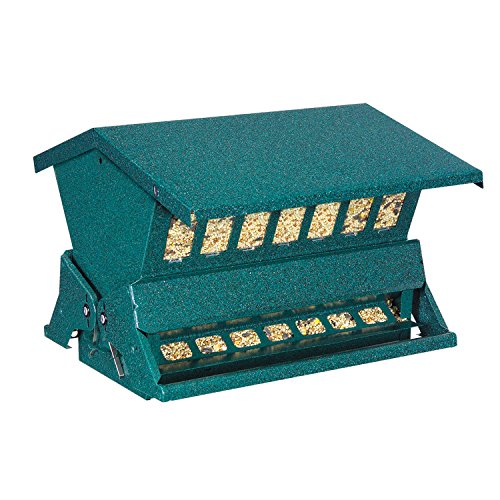
The Absolute II holds two gallons of seed in a steel hopper with feeding ports on both sides, and its spring-loaded perches drop closed under a squirrel's weight. It's the one to buy if refilling is the chore you're trying to get rid of.
$84fromAmazonFill this on Sunday and a busy yard will still be eating from it midweek. Twelve pounds of capacity is a lot of seed, and it's the practical reason to choose the Absolute II over anything else here. If you feed through a cold stretch, or you travel and don't want a neighbor climbing your pole, that reservoir does real work. Ports on both sides also mean more birds feeding at once without squabbling.
Steel is the point. The hopper walls are steel with polycarbonate windows, so you can see the seed level at a glance and squirrels have very little soft material to work on. This is where cheaper feeders lose over the long run — a squirrel will gnaw a plastic port surround open in an afternoon, and then the anti-squirrel design doesn't matter. Owners who've run this feeder for years report it holding up without much drama.
The perches are spring-loaded and adjustable by weight, so heavy visitors close the ports for themselves. Owners consistently mention mourning doves and grackles being too heavy to hold a perch open while chickadees and finches feed normally. Built-in baffles cut down on seed getting flicked to the ground. It ships with a heavy-duty hanger and a four-section steel pole, so you can hang it or plant it.
Flaws but not dealbreakers
Loaded, it's heavy. You'll want a solid pole or a stout hook, and you'll want a baffle under it — owners who describe the best results almost always mention pairing it with a torpedo or dome baffle. That's an extra purchase on top of a feeder that isn't cheap to begin with.
The weight threshold is coarser than Brome's dial. You adjust it, but you don't fine-tune it, so excluding one specific nuisance bird while keeping another is more guesswork. Several owners also mention sharp edges at the perch pinch points and smooth them over themselves. And it's a big, boxy object; on a small patio it dominates.
Budget pick
Weight-activated ports for less, with parts that wear out
Perky-Pet 334-1SR Squirrel-Be-Gone Max Large Wild Bird
The Squirrel-Be-Gone Max uses a weight-activated shield to close its ports and a locking cap squirrels can't lift, and it holds four pounds of seed. It's the least expensive way here to get a mechanism that actually stops squirrels.
$34.99fromAmazonThis is the entry point for real squirrel-proofing, not a compromise version of it. The seed shield closes the ports when a squirrel puts its weight on the perch pads, and the Sure-Lock cap stops the other classic move — lifting the lid off and helping itself from the top. Owners who'd cycled through several feeders describe this one finally ending the raids, at least until the plastic starts aging.
The flexports are the interesting bit. Flexible covers sit over each opening, so birds perch outside the port and pull seed through rather than standing in it. That keeps seed off the ground and out of the wind. The ladder-style perch pads run the length of the tube, so smaller birds and larger ones can both find a comfortable spot, and owners specifically mention cardinals feeding while starlings and grackles get shut out.
Four pounds is a reasonable amount for a yard with steady but not frantic traffic. It takes mixed seed, black-oil sunflower, sunflower chips or safflower, so you can experiment with what your local birds prefer without buying another feeder. If you're setting up your first station, or adding a second feeder somewhere squirrels have found you, this is the sensible thing to try first.
Flaws but not dealbreakers
The flexports are also the failure point. The most common owner complaint by a wide margin is that the plastic port covers wear down or get chewed after a year or two, and once they do, seed spills out every time a bird lands. Replacement ports are hard to come by, which turns a repairable feeder into a disposable one.
Condensation is the other recurring problem. Temperature swings fog the clear tube and dampen the seed inside, and fine material like sunflower chips clumps and cakes as a result. Determined squirrels also tend to solve this feeder eventually if it's hung within jumping range — owners who add a baffle underneath report much better luck than those who don't.
Who this is for
This guide is for anyone whose feeder keeps getting emptied by something with a tail. If squirrels have never found your yard, you don't need any of this — a plain tube feeder costs far less and feeds birds just as well. But if you've watched one hang upside down from your hook and shovel seed onto the lawn, a weight-activated or barrier feeder is the fix, and it pays for itself in seed you stop losing.
We're covering hanging and pole-mounted seed feeders that block squirrels by design. We're not covering nectar feeders, suet cages, ground trays, or the accessories that go with them, and we're not covering the pole baffles you should probably buy alongside any of these. One thing worth saying plainly: a squirrel-proof feeder hung three feet from a tree trunk is just a bird feeder with extra steps. Placement does half the work.
How we picked
We weighted five things. Squirrel exclusion: the mechanism has to stop an adult gray squirrel on its own, without you standing there. Materials: exposed soft plastic is where these feeders die, so steel, polycarbonate and chew-resistant resin scored higher. Capacity: we matched stated seed volume against how often owners actually refill, because a feeder you're filling daily gets abandoned by spring. Bird access: a threshold tight enough to stop starlings can shut out cardinals too, so we favored designs where owners still get the birds they wanted. Cleaning: feeders spread disease when they're dirty, so tool-free disassembly and dishwasher-safe parts mattered.
The competition
This is what our research turned up, not a survey of every feeder sold. The squirrel-proof category is enormous and much of it is the same tube in a different cage. The model below is a genuinely good feeder that lost to a pick on a specific point rather than on quality.
The Brome Squirrel Buster Standard Squirrel-Proof Bird Feeder ($142.24) — The Brome Squirrel Buster Standard uses the same weighted shroud as our top pick, plus four metal perches and a negative grip tube that stops squirrels from hanging off the wire and reaching underneath. It works. The problem is size: at roughly a third of the Plus model's capacity, you'll be refilling it constantly in a busy yard, and owners who moved up from other feeders say the main surprise was how small it is. There's no cardinal ring either, so bigger birds get less room. Buy it if you're feeding from a balcony or a small patio where the Plus would be absurd, and you want Brome's mechanism at that scale.
Placement and upkeep
Placement decides whether any of this works. Keep the feeder at least ten feet horizontally from a trunk, fence, wall or roof edge, and about five feet off the ground — squirrels leap roughly ten feet flat and drop farther than that from above, so overhead clearance counts as much as the distance sideways. Add a torpedo or dome baffle below the feeder on the pole; it closes the climbing route that beats otherwise excellent feeders. Skip wooden fence posts, since squirrels chew soft wood. For upkeep, empty and wash the feeder every couple of weeks to limit disease between birds, and let it dry fully before refilling. Damp seed molds fast and clogs ports.
Questions we get
Do weight-activated bird feeders actually work against squirrels?
Yes, when they're set up properly. The shroud or shield drops the moment an animal above the threshold puts weight on the perch, and owners across every model here describe squirrels giving up within days. The catch is installation: hang one within jumping range of a branch and a squirrel will land on top and work at it from above. Pair it with a baffled pole and clearance on all sides.
What's the best squirrel-proof feeder for cardinals?
The Brome Squirrel Buster Plus, because of the adjustable dial and the cardinal ring. Cardinals weigh well under two ounces while gray squirrels run over a pound, so there's plenty of room to set a threshold that lets one in and keeps the other out. The wider ring also gives cardinals somewhere to stand, since they don't cling to a tube the way finches do.
Can squirrels chew through metal bird feeders?
Not heavy-gauge powder-coated steel or solid cast metal, which is why the Woodlink Absolute II holds up so well outdoors. They can absolutely chew thin sheet metal, soft aluminum, and any exposed plastic — seed tubes, port surrounds, caps. If squirrels are a serious problem in your yard, look for metal or a hardened resin anywhere the animal can get its teeth.
How far from a tree should I hang a bird feeder?
At least ten feet from anything a squirrel can jump off, including trunks, fences, walls and roof overhangs. A squirrel can clear about ten feet horizontally from a standstill and can drop fifteen feet or more onto a feeder from above, so check what's overhead too. Combine that spacing with a pole baffle and you've covered both routes.
What seed do squirrels dislike?
Safflower and nyjer. Safflower has a bitter coat that most squirrels avoid, but cardinals, chickadees, house finches and nuthatches eat it readily, which makes it a strong all-round choice. Nyjer is too small to be worth a squirrel's effort. Black-oil sunflower is the opposite — squirrels prize it above almost anything else you can put out.
Will a squirrel-proof feeder stop raccoons too?
Usually not. Raccoons are heavy enough to trip a weight-activated shroud, but they're also strong and patient enough to hang on, shake the feeder, or work the cap loose. Owners in raccoon country often bring feeders in overnight or rely on a wide pole baffle. Treat raccoon-proofing as a separate problem from squirrels.
Why you should trust us
For this guide:
- We read published guides from birding and consumer outlets alongside each manufacturer's own spec sheet, comparing capacity, materials and how each closing mechanism is described.
- We went through owner feedback for every feeder here, paying particular attention to what fails after a year or two outdoors — worn port covers, condensation inside seed tubes, and raccoons defeating weight-based mechanisms.
- We cross-checked award decisions against the pattern of owner complaints rather than the highlights, so the flaws sections reflect what people actually run into.
- We read owner reviews on every listing, weighted toward the critical ones, because that is where the recurring failures show up.
- We have a systematic way of automatically fetching the latest prices, so the numbers on this page stay current.
- This is a research-focused guide, so the team may not own every product listed — though we often do own the top winners, which gives us extra context for the recommendations.
- We don't accept free products, and the retailer commission never changes which product we recommend.
Sources
Best Squirrel-Proof Bird Feeders — Wirecutter, The New York Times, Wirecutter / NYT
Best Squirrel-Proof Bird Feeders Tested by Bird Watching HQ, Bird Watching HQ
Squirrel-Proof Bird Feeders — Audubon Society, Audubon Society
Best Squirrel-Proof Bird Feeders 2026 — Good Housekeeping, Good Housekeeping
How to Stop Squirrels from Raiding Bird Feeders — Cornell Lab of Ornithology, All About Birds, Cornell Lab of Ornithology
Squirrel-Proof Bird Feeder Reviews — The Spruce, The Spruce
Brome Bird Care Squirrel Buster Product Testing and Lifetime Warranty Information, Brome Bird Care
Best Bird Feeders of 2026 — Popular Science, Popular Science
Amazon product listings and owner reviews for all 5 products
Manufacturer specification pages for each product
Some passages in this guide may be paraphrased with AI help. Prices are refreshed automatically.
More like this.
Continue exploring pet reviews and recommendations.

The Best Smart Bird Feeders With Cameras
A smart bird feeder turns a window chore into something you actually look forward to. Instead of catching a blur of wings while you refill the coffee, you…

The Best Bird Feeders for Beginners
A bird feeder is one of the few purchases that pays you back within days. Hang one near a shrub in a suburban yard and you'll often see your first…

The Best Heated Bird Baths
Winter birds can find seeds almost anywhere. Water is the harder problem. Once puddles, creeks and standing water lock up in ice, a chickadee burns real…

The Best Bird Cages for Parakeets and Cockatiels
A cage isn't furniture. It's the room your bird lives in, sleeps in, and eats in, and for most parakeets and cockatiels it's where they spend the majority…

The Best Rust-Proof License Plate Frames
A license plate frame is a small part that sits in the worst possible place. It's low on the car, right where road spray, salt brine and grit get thrown…

The Best Rust-Proof Shower Caddies
A shower caddy lives in the wettest spot in your house, and most of them aren't built for it. Chrome-plated wire looks great in the product photo and then…