The Best Smart Bird Feeders With Cameras
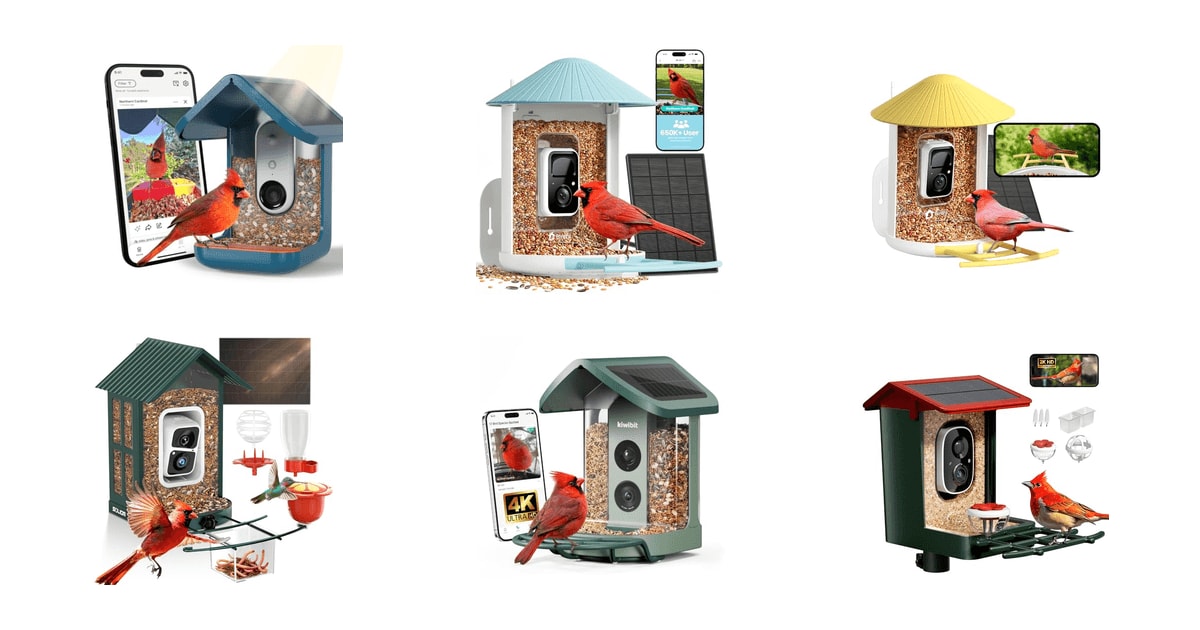
A smart bird feeder turns a window chore into something you actually look forward to. Instead of catching a blur of wings while you refill the coffee, you get a clip on your phone: a cardinal at eye level, a nuthatch working its way down the perch, a woodpecker that shows up every morning at seven. The AI names the species for you. That's the real appeal — you learn your own yard. Most people who set one up end up checking the app more than they expected.
Here's the honest part. Every feeder in this category leans on a paid subscription for the good stuff, and the free tiers are thin. Species identification, longer video history, sharing — those usually sit behind a monthly or yearly plan, and the listings don't always make that obvious before you buy. Wi-Fi is the other weak spot. These cameras need a solid 2.4 GHz signal at the far end of the yard, and owners across every brand report dropped live views when the connection gets marginal. No model here escapes either problem.
Squirrels are a third reality nobody solves completely. A metal build and a well-placed baffle help, but a determined squirrel is a determined squirrel, and your seed bill reflects that. Weigh the subscription and the Wi-Fi range before you weigh the megapixels. We think that the Kiwibit Solar Smart Bird Feeder is the best smart bird feeder for most people, and that the NETVUE by Birdfy Smart Bird Feeder with 2K AI Camera is the one to buy if you want the most established app and the largest birding community behind it.
Everything we recommend

The sharpest picture here, with solar that keeps up

The most established app and the biggest birding community

Better photos and a smarter app, if you'll pay the subscription

Solid solar and 2K video for less, with a thinner app
At a glance
| Product | Video Resolution | Night Vision | Price | |
|---|---|---|---|---|
| Birdbuddy Pro Solar Smart Bird Feeder withUpgrade pick | 2K Video | — | $239.99 |
| NETVUE by Birdfy Smart Bird Feeder withRunner-up | 2K | Color Night Vision | $129.98On sale |
 | NETVUE by Birdfy Smart Bird Feeder withAlso in lineup | 2K | Night Color Vision | $179.99 |
 | SOLIOM Bird Feeder with CameraAlso consider | 2K HD | — | $68.98On sale |
| Kiwibit Solar Smart Bird Feeder with CameraTop pick | 4K Ultra HD | — | $179.97On sale |
| Smart Bird Feeder with Camera Solar PoweredBudget pick | 2K HD Video | — | $53.99On sale |
How we picked
Image quality. We compared sensor specs, video resolution and lens field of view across every listing. Anything below 2K got a hard look, since species identification depends on resolving fine feather detail.
AI identification. We weighed each maker's stated species database against owner feedback about real-world accuracy. Claimed species counts vary from thousands to over 10,000, and owner reports show the claims don't always track with results.
Power and upkeep. We favored solar-supplemented models, since battery-only feeders typically need a recharge every two to four weeks under normal backyard traffic. Solar panels in this class produce enough to run continuously in spots with four or more hours of daily sun.
Subscription honesty. We read the listing terms and owner complaints to see which features stop working without a plan. Feeders that hide the paywall until after setup lost ground.
Build and weather. We looked at materials, seed capacity and stated weather resistance, plus owner reports of how units held up through rain, snow and heat over a full season.
Top pickOn sale
The sharpest picture here, with solar that keeps up
Kiwibit Solar Smart Bird Feeder with Camera
The Kiwibit shoots 4K video and 8MP stills through a 132-degree lens, so a goldfinch fills the frame with feather detail instead of pixels. Dual solar panels feed a 5200mAh battery, and the 1.5-liter dual hopper lets you run two seed blends at once.
$179.97fromAmazonList priceThe picture is the reason to buy this one. Most feeders in this category top out at 2K, and 2K is fine — until you try to tell a house finch from a purple finch by the wash of color on its back. The Kiwibit's 4K sensor and HDR give you that. The 132-degree lens is wide enough that a bird landing off-center still lands in frame, which matters more than the resolution number on days when the wind is up.
The dual-seed hopper is a small thing that changes what shows up. You can run sunflower on one side for cardinals and nyjer on the other for finches, and the 1.5-liter capacity means you're not out there every three days with a scoop. The hopper detaches for rinsing, which you'll be doing every week or two anyway. Audubon recommends cleaning feeders every one to two weeks to keep avian salmonella from spreading, so easy disassembly isn't a luxury.
Kiwibit claims its AI covers more than 10,000 species, and the app builds auto-generated summaries and galleries around each visitor. Owner feedback on identification is genuinely mixed — some people find it nails common backyard species, while others say it misfires often enough to be annoying. Treat the ID as a strong hint, not a verdict. For the birds you'll see most, it's usually right.
You can keep your footage off the cloud entirely. The camera writes to a Micro SD card if you'd rather not subscribe, and Kiwibit points out that the lens frames the feeder rather than your yard — a real consideration if the mounting spot faces a neighbor's window. Between the card slot and the dual solar panels, this is the model here that asks the least of you on an ongoing basis.
Setup runs about as smoothly as owners report anywhere in this category: mount it, join a 2.4 GHz network, done in minutes. The perch extender gives larger birds somewhere to stand, and at 6.3 pounds it's the heaviest unit here — sturdy on a pole, but plan the mount accordingly.
Flaws but not dealbreakers
The AI identification is the soft spot. Several owners describe it as the one part of an otherwise solid product that underdelivers, particularly with less common species. If precise ID of unusual visitors is your main goal, that's worth knowing going in.
4K video is hungry for bandwidth. Owners note that a marginal Wi-Fi signal at the feeder forces you into an SD fallback, which throws away the reason you bought a 4K camera. Check your signal at the mounting spot before you commit to a location.
Kiwibit backs the feeder with a 12-month warranty.
Runner-upOn sale
The most established app and the biggest birding community
NETVUE by Birdfy Smart Bird Feeder with
NETVUE launched the Birdfy line in 2022 and has refined its AI for three years since. The 2K camera does color night vision, the 5200mAh battery and solar panel keep it running for months, and the app connects a very large community of bird watchers.
$129.98fromAmazonList priceMaturity counts for a lot in a category this young. The Birdfy 1 Series has been out since 2022 and has gone through several rounds of updates, and NETVUE says it's now used by more than 650,000 people worldwide. That shows up as software polish — fewer rough edges in the app, faster notifications, an identification engine that's had years of real backyard photos thrown at it rather than months.
The community feature is more useful than it sounds. NETVUE reports over 5 million bird videos flowing through the app daily across 174 countries, and there's a free in-app bird expert you can ask questions of. If you're new to birding, that's a soft landing. You get a name for the bird, then somewhere to ask why it only shows up in the morning.
Color night vision matters at dawn and dusk, which is when your feeder is busiest. Standard infrared gives you a gray silhouette — enough to know something landed, not enough to know what. Color footage at very low light levels, down to around 0.1 lux on cameras like these, keeps plumage color intact, and plumage color is how you identify most birds.
Power is the quiet win. The solar panel plus a 5200mAh battery gives you months of operation rather than the two-to-four-week cycle typical of battery-only feeders. Panels in this class generate roughly 1.5 to 3 watts in direct sun, which is plenty for a 1080p or 2K camera in a spot that gets four or more hours of daylight.
Flaws but not dealbreakers
The camera can lose track of new arrivals when a bird is already sitting on the perch. Owners describe a second visitor landing and the system staying focused on the first, so you miss the interesting moment — two species sharing a perch is exactly the shot you want.
AI identification is a subscription feature, and the listing frames it as such. Budget for the ongoing cost, not just the box.
Upgrade pick
Better photos and a smarter app, if you'll pay the subscription
Birdbuddy Pro Solar Smart Bird Feeder with
The Bird Buddy Pro Solar uses a sensor twice the size of the standard model, with HDR, 5MP stills and 2K video. It shoots slow-motion clips of birds in flight and flags signs of illness in visitors, but the premium subscription isn't optional.
$239.99fromAmazonThe sensor, not the megapixel count, is why photos from this one look different. Bird Buddy doubled the sensor size and added HDR, and that combination is what saves a cardinal from blowing out to a red blob on a bright afternoon. If you want images worth printing or posting rather than just identifying, this is the pick. Owners consistently single out picture quality as the thing that surprised them.
The app does things the others don't attempt. It recognizes individual birds — not just species, but the same jay coming back — and it flags visual signs of illness, which ties into why you're cleaning the feeder in the first place. It also identifies non-bird visitors, so you'll find out exactly what the raccoon situation is.
Slow-motion capture of birds in flight is a genuine novelty that doesn't wear off fast. A chickadee's approach lasts a fraction of a second in real time. Slowed down, you see the wing rotation and the last-instant course correction. It's the feature owners describe showing to visitors.
Mounting options are unusually flexible. A hanger is included and the feeder takes a pole (sold separately), so you can move it after the squirrels find the first spot — and they will find the first spot. Audubon and the American Bird Conservancy suggest placing feeders more than 30 feet from windows to cut collision risk, and a camera feeder is easy to put that far out since you're watching it on a phone anyway.
Flaws but not dealbreakers
The premium subscription is required for the AI features, and this is where the sharpest owner criticism lands. Some buyers feel the app pushes subscriptions and community content harder than it surfaces their own feeder, and a minority are frustrated enough to say so bluntly. If a recurring charge bothers you on principle, skip this one.
Setup takes longer than the four-step instructions suggest. Multiple owners describe it as fiddly — Bluetooth pairing, then the Wi-Fi handoff — though the same people say it runs reliably once it's up.
Budget pickOn sale
Solid solar and 2K video for less, with a thinner app
Smart Bird Feeder with Camera Solar Powered
The HEAPETS feeder covers the basics well: 2K live streaming, solar power with a wired option, arrival alerts, and a spill-proof seed container. AI identification claims 10,000-plus species and comes with a one-month trial before you decide on a plan.
$53.99fromAmazonList priceThis is the one to get if you want to try the hobby without committing much. You get 2K live video, instant arrival notifications, and solar charging — the three things that make a smart feeder feel smart. Owners who came from an older non-camera feeder generally describe it as reliable day to day, and the solar keeps up well enough that most rarely plug it in.
The one-month AI trial is the right way to shop this category. You find out whether species identification is the part you actually use, or whether you just wanted to watch birds on your phone. Plenty of people discover it's the latter, and then the subscription question answers itself.
There's a squirrel alarm you can trigger from the app, plus audio so you can hear song rather than just see movement. Neither is a headline feature, but the alarm is oddly satisfying, and hearing the birds makes the clips feel less like security footage.
Mounting is genuinely flexible — tree, pole or wall — and the spill-proof container keeps the ground below tidier than most. That matters more than you'd think, because a pile of spilled seed under the feeder is what invites the rodents you didn't want.
Flaws but not dealbreakers
The subscription requirement catches people off guard. At least one owner bought it expecting to watch and share video without a recurring fee and found out otherwise after setup. Read the plan terms before you decide this is the cheap option.
Live view reliability is the most common complaint. Some owners report it working beautifully at first, then failing to connect while recorded clips keep arriving normally. Support responsiveness seems decent, but it's a recurring theme.
Who this is for
Buy one of these if you already like watching birds and want to know what you're looking at. They suit families with curious kids, retirees who want something happening outside the window, and anyone who's put up a feeder before and wondered who visits while they're at work. Interest in this hobby has grown fast — the U.S. Fish & Wildlife Service counted roughly 96 million American birdwatchers in its 2022 survey, up from 45 million in 2016 — and camera feeders are a big part of why.
Skip these if your Wi-Fi doesn't reach the yard, or if a recurring subscription is a dealbreaker. Every model here leans on a plan for identification or extended video history, and no amount of shopping around avoids that. This guide covers feeders with a built-in camera; it doesn't cover plain feeders, standalone trail cameras, or mounts that convert a camera you already own. If you want a serious wildlife camera for a wider area, look elsewhere — these deliberately frame the perch and nothing else.
How we picked
Image quality: we compared sensor size, resolution and field of view, treating 2K as the floor for telling similar species apart. AI identification: we set each maker's claimed species database against what owners actually report, because the two often diverge. Power and upkeep: we favored solar, since battery-only units need recharging every two to four weeks and solar panels in this class run a camera indefinitely with four-plus hours of daily sun. Subscription honesty: we checked which features die without a plan and penalized listings that bury it. Build and weather: we looked at materials, hopper size and how units held up through a full season of rain, snow and heat according to owner feedback.
Other smart bird feeders with cameras worth considering
If you want metal construction and more than seed: The SOLIOM Bird Feeder with Camera ($68.98) — The SOLIOM is the sturdiest-feeling feeder here, built from metal rather than plastic, and it ships with accessories for suet, fruit, jelly and nectar alongside standard seed. That variety pulls in birds a seed-only feeder won't — orioles for the jelly, hummingbirds for the nectar. The metal body and squirrel-resistant design also give you a fighting chance against chewers. What you give up is software polish: owners report frequent disconnects and live view that fails often enough to require re-adding the camera to the app. It's a great feeder wrapped around software that's still catching up.
The competition
These are the feeders our research surfaced, not a complete map of the category. New models arrive constantly and older ones get quiet firmware updates that change how well they work. What follows is one product that didn't make the picks, and why.
The NETVUE by Birdfy Smart Bird Feeder with ($179.99) — The yellow NETVUE by Birdfy 2K feeder is essentially the same machine as our runner-up in a different color, with the same 2K camera, color night vision, 5200mAh battery and solar roof. It shares the runner-up's strengths and its quirks, including the tendency to stay locked on a bird already at the perch when a second one lands. Pick it over the blue version purely on looks, or on whichever is easier to get.
Care and maintenance
Clean the feeder every one to two weeks — Audubon recommends that interval to limit the spread of avian salmonella, and a camera feeder makes it easy to forget because you're not walking out there. Pull the hopper, dump any damp or clumped seed, scrub with hot soapy water and let it dry completely before refilling. Wipe the lens while you're there; pollen and rain spots soften the picture more than any setting will. Watch the solar panel too, since a film of dust cuts charging noticeably. If app activity drops off for several days, that's usually your signal that the seed is stale or the feeder needs a wash, not that the birds left. And check your mount every few months — wind, ice and the occasional raccoon loosen hardware over a season.
Questions we get
Do smart bird feeders need a subscription to work?
The camera and live view generally work without one, but AI species identification and video history beyond about a day almost always require a paid plan. That's true across every brand here. Some models, like the Kiwibit, let you save footage to a Micro SD card instead, which reduces what you need the cloud for. Read the plan terms before you buy, because listings tend to bury this.
Do these cameras work at night?
Yes, and the type of night vision matters. Standard infrared gives you black-and-white footage, which is fine for knowing something showed up but poor for identifying it. Color night vision, which the NETVUE Birdfy models offer, keeps plumage color usable at very low light — down around 0.1 lux. That's most useful at dawn and dusk, when your feeder is actually busy.
How accurate is the AI identification?
Better than you'd expect on common backyard birds, and shakier on rare ones. Leading engines draw on the Cornell Lab's eBird database, which has passed 100 million observation records, and top models cover thousands of species with high accuracy in good light. But owners across brands report misfires, especially with unusual visitors or awkward angles. Treat the ID as a strong starting point rather than a final answer.
Which one is best for a small balcony or patio?
None of these are especially compact, but the Bird Buddy Pro Solar has the smallest footprint at roughly 10 by 8 by 8 inches, and it ships with a hanger. The SOLIOM and the NETVUE models are taller and want a pole. Whatever you choose, keep the mount clear of the railing so squirrels can't reach it from a standing start.
How do I keep squirrels away?
Nothing here stops them completely. A metal body like the SOLIOM's resists chewing, and a baffle on the pole below the feeder helps a lot. Placement matters most: mount at least ten feet from anything a squirrel can jump from, including fences, branches and deck rails. Some owners also use hot-pepper-treated seed, which birds don't mind and squirrels dislike.
Where should I put the feeder?
More than 30 feet from your windows is the standard guidance from Audubon and the American Bird Conservancy, since window strikes kill an estimated 600 million to 1 billion birds a year in the U.S. That distance works fine with a camera feeder, because you're watching on a phone rather than through the glass. Just confirm your 2.4 GHz Wi-Fi reaches that far — weak signal is the number one cause of the connection complaints owners report.
Why you should trust us
For this guide:
- We read the full specification sheets and feature listings for every feeder in this guide, comparing sensor resolution, battery capacity, solar output and stated species databases side by side.
- We reviewed owner feedback themes across all six products, paying particular attention to recurring complaints about Wi-Fi reliability, subscription terms and identification accuracy.
- We cross-checked placement, cleaning and bird-population claims against published guidance from the National Audubon Society, the American Bird Conservancy, the Cornell Lab of Ornithology and the U.S. Fish & Wildlife Service.
- We read owner reviews on every listing, weighted toward the critical ones, because that is where the recurring failures show up.
- We have a systematic way of automatically fetching the latest prices, so the numbers on this page stay current.
- This is a research-focused guide, so the team may not own every product listed — though we often do own the top winners, which gives us extra context for the recommendations.
- We don't accept free products, and the retailer commission never changes which product we recommend.
Sources
Best Bird Feeders — Wirecutter / The New York Times, Wirecutter
Smart Bird Feeders Buyer's Guide — CNET, CNET
Best Smart Bird Feeders — Tom's Guide, Tom's Guide
eBird — Cornell Lab of Ornithology Species Database, Cornell Lab of Ornithology
National Survey of Fishing, Hunting, and Wildlife-Associated Recreation — U.S. Fish & Wildlife Service, U.S. Fish & Wildlife Service
Bring Birds Back — Cornell Lab of Ornithology, Cornell Lab of Ornithology
Glass Collisions — American Bird Conservancy, American Bird Conservancy
The Do's and Don'ts of Feeding Wild Birds — National Audubon Society, National Audubon Society
Bird Buddy Official Product & Press Page, Bird Buddy
Netvue Birdfy Product Lineup & Specifications, Netvue
Popular Mechanics — Best Smart Bird Feeders, Popular Mechanics
Good Housekeeping — Best Bird Feeders Tested, Good Housekeeping
Amazon product listings and owner reviews for all 6 products
Manufacturer specification pages for each product
Some passages in this guide may be paraphrased with AI help. Prices are refreshed automatically.
More like this.
Continue exploring home reviews and recommendations.

The Best Squirrel-Proof Bird Feeders
Squirrels aren't casual about this. A gray squirrel can jump roughly ten feet sideways, walk down a metal pole head first, and empty a tube feeder in an…

The Best Bird Feeders for Beginners
A bird feeder is one of the few purchases that pays you back within days. Hang one near a shrub in a suburban yard and you'll often see your first…

The Best Outdoor Smart Home Security Cameras
An outdoor camera earns its keep in small moments. A package shows up while you're at work. Something knocks over the recycling bin at 2 a.m. A contractor…

The Best Smart Home Security Cameras
A security camera earns its keep on ordinary days, not dramatic ones. You want to know the dog walker showed up, the package landed, the kid got home. So…

The Best Gifts for Bird Owners
Bird people are easy to shop for and easy to get wrong. They already own three seed dishes and a drawer of plastic toys their cockatiel ignores. What they…

The Best Bird Cages for Parakeets and Cockatiels
A cage isn't furniture. It's the room your bird lives in, sleeps in, and eats in, and for most parakeets and cockatiels it's where they spend the majority…