The Best Cooling Tents and Hot-Weather Camping Gear
Heat is the one camping problem you can't sleep through. A tent sitting in afternoon sun turns into an oven fast — Wirecutter's summer tent research found interiors climbing 20 to 40°F above the outside air within half an hour. At night, a nylon shell traps the day's warmth and your own body heat, and you wake up at 2 a.m. sticky and annoyed. What actually helps is airflow: big mesh panels, a fly you can prop open, and a spot in the shade. Gear matters, but placement matters more.
Here's the honest part. No tent cools you. Mesh and a light-colored fly only slow the heat gain and let it escape faster once the sun drops — that's it. If the overnight low sits above 80°F and the air is still, the best-ventilated tent on the market will still feel like a warm room. The only gear that genuinely lowers the temperature is a compressor air conditioner, and those are heavy, thirsty, and loud enough that light sleepers notice. Everything else is damage control.
So we sorted this lineup by what job you need done: passive airflow for backpackers, breathable canvas for dry desert heat, big screened volume for family car camping, and real mechanical cooling for anyone with a vehicle and a power budget. We think that the EF ECOFLOW WAVE 3 is the best hot-weather camping gear for most people who can bring power to camp, and that the Coleman Skydome is the one to buy if you're a car camper who just wants a well-ventilated tent without the electronics.
Everything we recommend

Real air conditioning at camp, if you can haul the weight

Big, airy and simple, for campers who skip the electronics
The backpacking tent to carry when nights stay warm

Cotton canvas that breathes, for dry desert heat
At a glance
| Product | Product Type | Cooling Method | Price | |
|---|---|---|---|---|
| EF ECOFLOW WAVE 3 Portable Air ConditionerTop pick | Portable Air Conditioner | 1024Wh LFP Battery | $849On sale |
 | Big Agnes Copper Spur HV UL2 UltralightAlso consider | Bikepacking Tent | — | $434.96 |
| NEMO Equipment Dragonfly OSMO Backpacking Tent -Also great | Backpacking Tent | — | $549.95 |
| Kodiak Canvas 8.5 x 6 ft. Flex-BowUpgrade pick | Camping Tent | — | $449.99 |
 | Clam Quick-Set Rain FlyAlso consider | Rain Fly | — | $89.99 |
 | Zero Breeze Mark 3 BatteryAlso in lineup | Battery | — | $980 |
| Coleman Skydome 2/4/6/8 Person Camping Tent withBudget pick | Camping Tent | — | $179.99On sale |
How we picked
Airflow and mesh. We compared spec sheets and published gear roundups for mesh coverage, vent placement and whether the fly can be pitched high or left off entirely. Anything that couldn't be opened up on a clear night didn't make the cut.
Real cooling capacity. For active gear we looked at rated BTU output, tested-space claims and published field reports of actual temperature drops. Evaporative fans were out — they don't work in humid air.
Power and runtime. For anything with a compressor we read manufacturer runtime ratings alongside owner feedback about real-world battery life, which is consistently shorter than the label. Charging flexibility from car, solar or AC counted.
Fabric and color. Backpacker Magazine reports light and silver flies reflect up to 30% more solar radiation than dark ones, so we favored lighter colorways and fabrics with documented breathability advantages over standard nylon ripstop.
Setup and haulability. Fumbling with poles in 95°F heat is miserable, so we weighted fast, tool-free pitches. We also matched weight to use case rather than treating light as universally better.
Top pickOn sale
Real air conditioning at camp, if you can haul the weight
EF ECOFLOW WAVE 3 Portable Air Conditioner
The WAVE 3 is a compressor air conditioner with a 1024Wh battery built in, so it cools a tent or van without a separate power station. It's the one product here that lowers the actual temperature instead of just moving warm air around.
$849fromAmazonList priceThis is the only kind of gear that lowers the temperature inside a tent. Mesh and shade slow heat gain. A compressor pulls heat out. EcoFlow rates the WAVE 3 for spaces of 120 to 180 square feet, which covers most six-person tents and a lot of van builds. GearJunkie's field reporting on the previous Wave 2 recorded a sealed six-person tent dropping from 98°F to 72°F in roughly 25 minutes under direct sun. That's a different category of relief than a fan.
The built-in battery is what makes it practical. Earlier camping ACs needed a separate power station, another 30-odd pounds of gear and a cable run across your campsite. Here the 1024Wh pack is part of the unit, rated for about eight hours cordless, and it recharges in around 75 minutes on AC. You can also feed it from a car outlet, an alternator charger, or solar — useful on a multi-night trip where you're not near a plug.
It's built for people who arrive by vehicle. The whole thing is about the size of a carry-on with a handle on top, and EcoFlow sells a strap kit for securing it in a truck bed or on a roof rack. The app handles temperature, mode and timer from inside your sleeping bag, and there's a sleep mode rated at 44 decibels. A PetCare setting kicks the compressor on if a vehicle cabin starts overheating.
You do need to plan around it. At 33.7 pounds this is car-camping, overlanding and van gear, full stop. It also has a drain line, because pulling heat out of humid air means pulling water out too, and that water has to go somewhere.
Flaws but not dealbreakers
Owner feedback on this unit is genuinely mixed, and that's worth taking seriously. A meaningful share of buyers report units that arrived dead, tripped a breaker on first use, or leaked condensate onto the ground even when leveled. Others report several trouble-free trips and are delighted. That spread suggests quality control that isn't consistent yet, so buy from a seller with an easy return window and run it at home before the trip.
Runtime claims depend heavily on how hard you push it. Owners running high settings in real heat describe getting closer to three hours than eight from a single charge. If you want to sleep through a whole night on battery alone, plan on a second power source or expect to run the compressor only during the worst of the evening.
It's the heaviest and most expensive way to solve this problem. For a lot of trips, moving your tent under a tree does most of the same work for free.
Budget pickOn sale
Big, airy and simple, for campers who skip the electronics
Coleman Skydome 2/4/6/8 Person Camping Tent with
The Skydome's near-vertical walls create real headroom and a tall column of air above you, and the mesh panels and wide door move a lot of it. It sets up in about five minutes with poles already attached.
$179.99fromAmazonList priceVolume is an underrated cooling feature. Heat rises, and a tent with steep walls gives it somewhere to go that isn't your face. Coleman claims about 20% more headroom than its older dome tents, and owners consistently mention being able to stand up and get dressed inside. On a hot evening that extra air column and the mesh up top make a noticeable difference in how stuffy the tent feels once the sun goes down.
Setup speed matters more in heat than people expect. Wrestling with poles at 3 p.m. in July is how a good trip starts badly. The poles come pre-attached, and the tent goes up in under five minutes, so you can get shade over your head and start moving air right away. The wide door helps too — you're not crouching and sweating to shove an air mattress through a narrow opening.
It's also the tent here that most people will actually buy. It's the least expensive option in this lineup by a wide margin, it's the one with the most owner history behind it, and the feedback skews positive on ventilation specifically. Several owners note pitching it without the fly on clear nights, which turns the whole thing into a bug-proof screen room — the best hot-weather move any tent can offer.
Flaws but not dealbreakers
It's a value tent, and the build reflects that. Coleman rates the frame to 35 mph winds, but owner reports of snapped poles in sudden gusts aren't rare, and warranty support gets described as slow and frustrating. Stake it out properly and don't leave it pitched unattended in exposed sites.
The rainfly covers a lot of the tent, so once it's on, ventilation drops sharply. In humid heat with a chance of storms, you're choosing between staying dry and staying cool. The zipper cover on the wide door also snags, which is annoying when you're trying to close up fast against bugs.
Also great
The backpacking tent to carry when nights stay warm
NEMO Equipment Dragonfly OSMO Backpacking Tent -
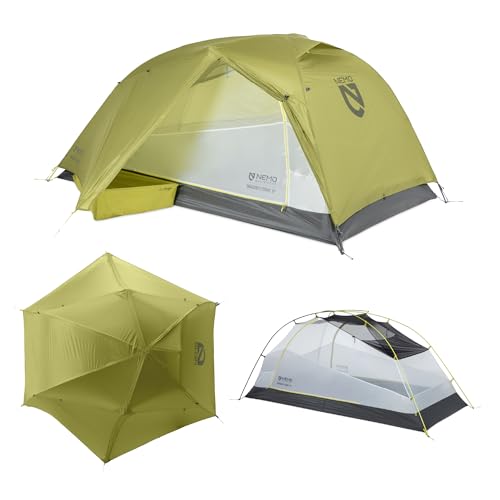
The Dragonfly OSMO pairs a near-full mesh inner with a fly you can pitch high, so warm air moves out instead of pooling around you. At about 3.25 pounds it's light enough for real trail miles in southern summer heat.
$549.95fromAmazonOn a hot trail night, mesh is the whole argument. The Dragonfly's inner is mostly mesh, so with the fly staked high or rolled back you're sleeping in moving air rather than a sealed nylon box. Nemo's OSMO fabric is reported by CleverHiker to be about 15% more breathable than standard 20D nylon ripstop, which shows up as less condensation dripping on you at dawn — the specific misery of humid summer backpacking.
There's more usable space than the weight suggests. A pre-bent cross pole raises volume at the head by 34%, so two people can sit up without shoulder-checking each other, and doors and vestibules on both sides mean you're not climbing over your partner at 2 a.m. Two doors also means two ways to catch a cross breeze, which is the practical reason twin-door tents feel cooler.
Owners describe setup as quick and intuitive, helped by color-coded poles and matched webbing. That's not a small thing when you're pitching in fading light after a long, hot day. Several also report it holding up through wind, rain and even a snowy night, so it's not a fair-weather-only tent.
Flaws but not dealbreakers
This is expensive fabric that you have to treat carefully. A few owners feel the durability doesn't match the price, and ultralight materials in general don't forgive rocky ground or a dragged pack. Use a footprint and pick your tent site.
There have been fulfillment complaints — wrong pole colors, a one-person tent arriving instead of a two-person. Check what shows up before you leave the driveway.
Upgrade pick
Cotton canvas that breathes, for dry desert heat
Kodiak Canvas 8.5 x 6 ft. Flex-Bow
Kodiak's Hydra-Shield cotton duck canvas breathes in a way synthetic tents can't, and four big mesh windows push air through. Camping World reports canvas running 8 to 12°F cooler than comparable synthetics in dry heat above 90°F.
$449.99fromAmazonCanvas works differently than nylon. Cotton duck wicks moisture and lets it pass through the weave, so the fabric sheds some heat instead of sealing it in, and the material's thickness blocks more sun. In dry desert conditions that adds up to a real temperature difference — Camping World puts it at 8 to 12°F cooler than an equivalent synthetic tent once you're above 90°F. It also means far less condensation on the inside walls in the morning.
The frame is why people keep these tents for a decade. Tempered spring steel rods and one-inch galvanized tubing hold the canvas drum-tight, and one person can put it up. Owners describe multi-day trips and thunderstorms with no leaks and no drama, and several say their only regret is not buying one sooner. That kind of feedback is rare and it's the reason this earns the upgrade slot.
The ventilation design suits hot nights. Four large windows with no-see-um mesh sit on the sides, and there are D-shaped doors front and back, so you can open both ends and let a breeze run the length of the tent. The four-foot ceiling in this 8.5-by-6 size means you're not stooped over in the heat while you change clothes.
It's aimed at a specific camper: someone driving to a site and staying a while. If you're setting up a basecamp for a week in high desert country, the weight is a one-time cost you pay at the car and then forget about.
Flaws but not dealbreakers
It weighs 34.2 pounds and packs bulky. That's a two-hands-and-a-trunk situation, and it rules out backpacking entirely. Make sure you can lift it before you commit.
Canvas is worse in humidity than in dry heat — the breathing advantage shrinks when the outside air is already saturated. And owners say the setup instructions are poor, so expect a fumbling first pitch in the yard before the real trip.
A few report seepage around the front door in heavy rain, minor but present. Canvas also needs to be dried fully before storage or it mildews.
Who this is for
This guide is for anyone who camps where summer nights stay warm — Southwest desert trips, southern humidity, festival fields with no shade, and family car camping in July. If you drive to your site and can spare the space and the power, active cooling changes what's tolerable. If you carry everything on your back, your gains come from mesh, a light fly and where you pitch. Either way, you'll get more relief from a shaded site than from any single purchase here.
This isn't for winter or shoulder-season campers, and it isn't a general four-season tent roundup — some of these picks trade weather protection for airflow on purpose. We also stuck to ground shelters and cooling hardware, so hammocks, sleeping quilts and portable fans aren't covered, even though a hammock's underside airflow is genuinely hard for a tent to match in humid conditions. And if you're camping where overnight lows drop below the mid-70s, most decent tents will do fine and you can skip most of this.
How we picked
We weighed five things against published reviews, manufacturer specs and owner feedback themes. Airflow: how much of the tent is mesh, whether the fly can be pitched high or left off, and whether air can cross from one side to the other. Cooling capacity: for active gear, rated BTU output and documented temperature drops in real tents, not just a spec-sheet number. Power: battery capacity, honest runtime, and whether you can recharge from a car, solar panel or wall outlet. Fabric and color: breathability compared to standard nylon ripstop, and lighter colorways that reflect more solar radiation. Setup and haulability: how fast it goes up when you're already overheating, and whether the weight makes sense for how you get to camp.
Other cooling tents and hot-weather camping gear worth considering
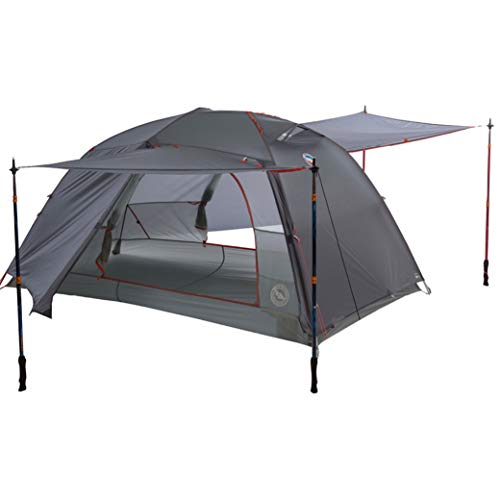
If you want the airiest ultralight tent and don't mind babying it: The Big Agnes Copper Spur HV UL2 Ultralight ($434.96) — The Copper Spur HV UL2 Bikepack has one of the highest mesh ratios of any sub-4-pound two-person tent — OutdoorGearLab pegged the standard Copper Spur inner at roughly 85% mesh — which makes it exceptional on still, warm nights. This bikepacking version adds a compression stuff sack with daisy-chain webbing and a short 12-inch pole set, so it straps to handlebars or panniers instead of riding in a pack. Two doors and two vestibules give you cross-flow and gear storage. The trade-off is fragility: owners describe the fabric as onion-thin and easy to puncture, and several report zippers catching or failing outright. Big Agnes guarantees its products against manufacturing and material defects, which helps, but this still asks for careful sites and a footprint.
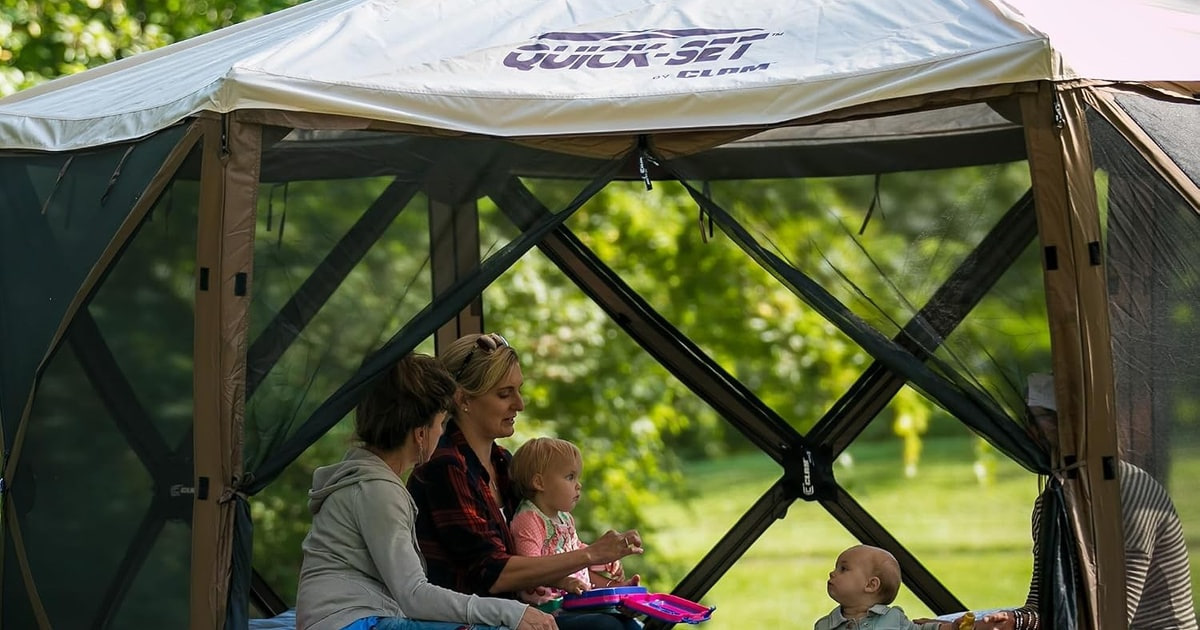
If you already own a CLAM screen shelter: The Clam Quick-Set Rain Fly ($89.99) — This rain fly is the accessory that makes a Quick-Set Pavilion or Escape Sky usable in summer weather. A screen shelter with roughly 90% mesh walls is the best shade-plus-airflow combination in car camping, but it has no roof against sun or storms — this poly-oxford tarp with taped seams adds both. Owners say it fits well on current Pavilion models and keeps things dry through days of rain. Two cautions: it doesn't fit some older Pavilion versions, and the corner hooks work loose in wind, so plan on adding your own tie-downs. It's a tarp only, so you need the shelter first.
The competition
This is what our research surfaced in this category, not a map of everything sold. Hot-weather camping gear spans tents, shelters, cooling hardware and a long tail of accessories, and plenty of good options aren't here simply because they didn't come up in the sources we worked from.
The Zero Breeze Mark 3 Battery ($980) — The Zero Breeze Mark 3 Battery is a 1022Wh power pack built to mount directly under a Mark 3 air conditioner, with a retractable one-meter cable and a flat, stackable, toolbox-style body. Zero Breeze rates it for up to seven hours of runtime depending on mode, with fast AC charging to 80% in about two hours, 500W solar input and 12–60V DC charging from a car port. It also has USB-A, USB-C PD, QC 3.0 and Anderson outputs, so it runs lights and laptops when the AC is off. It lost to our top pick because it isn't a cooling device at all — you need the Mark 3 unit too, which means buying and hauling two components where the WAVE 3 integrates its battery. Choose it if you're already committed to the Zero Breeze system, want stackable batteries for multi-night runtime, or like the flexibility of a power source you can also use for everything else at camp.
Staying cool at camp
Placement beats gear, every time. Pitch in shade that lasts through the afternoon, not shade that's gone by 2 p.m., and orient the doors across the prevailing breeze so air runs through instead of around. Leave the fly off on clear nights, or stake it high so the edges stand off the tent body. REI's hot-weather guidance notes that a reflective silver tarp pitched 12 to 18 inches above the fly cuts solar heat gain by up to 30% — set it before the heat arrives, not after. The National Park Service warns that sustained temperatures above 90°F inside a sealed tent are a real heat-illness risk, so plan to be out of the tent between 10 a.m. and 4 p.m., and use active cooling or genuine shade if you can't be. And take the tent down or open it fully during the day, because a closed tent bakes.
Questions we get
What is the best tent to stay cool in during summer camping?
The one with the most mesh you can pitch without the fly. For backpacking, the Nemo Dragonfly OSMO's near-full mesh inner and high-pitching fly is the best combination here. For car camping, the Coleman Skydome's tall walls and screened panels move a lot of air for very little money.
How do you keep a tent cool without electricity?
Shade is the biggest free win — a tent in direct afternoon sun can run 20 to 40°F above ambient within 30 minutes. Pitch under lasting shade, leave the fly off or staked high, and open doors on both sides for cross-flow. A reflective silver tarp suspended 12 to 18 inches above the fly cuts solar heat gain by up to 30% according to REI's guidance.
Can you actually use a portable air conditioner inside a tent?
Yes, if it's a real compressor unit and the tent is reasonably sealed. The EcoFlow WAVE 3 is rated for 120 to 180 square feet, which covers most large family tents. You'll need to route the exhaust hose and the condensate drain outside, and evaporative or misting fans won't do the same job — they barely work in humid air.
Does tent color really make a difference in how hot it gets inside?
It does. Backpacker Magazine reports that light-colored and silver flies reflect up to 30% more solar radiation than dark ones. That's why summer tent lines default to sand, grey and white. It's not as powerful as shade, but it's free when you're choosing between colorways.
How much cooler is a canvas tent than a nylon one in summer heat?
Camping World reports canvas running 8 to 12°F cooler than comparable synthetic tents in dry desert conditions above 90°F, because cotton wicks moisture and passively transpires. The catch is weight — the Kodiak Flex-Bow VX in this size is 34.2 pounds. The advantage also shrinks in humid climates, where the air is already saturated.
How long does a camping air conditioner run on battery?
EcoFlow rates the WAVE 3's built-in 1024Wh battery at about eight hours, but that's on low settings in mild conditions. Owners pushing it hard in real heat describe closer to three. If you want to run it all night, plan on solar input, a car charge during the day, or a second battery.
Why you should trust us
For this guide:
- We read manufacturer specifications for every product here alongside published roundups from OutdoorGearLab, CleverHiker, GearJunkie, Backpacker Magazine and Wirecutter.
- We compared owner feedback themes across each listing, paying particular attention to recurring complaints about battery runtime, fabric durability and quality control.
- We cross-checked hot-weather guidance against REI's expert guides and National Park Service heat-safety recommendations.
- We read owner reviews on every listing, weighted toward the critical ones, because that is where the recurring failures show up.
- We have a systematic way of automatically fetching the latest prices, so the numbers on this page stay current.
- This is a research-focused guide, so the team may not own every product listed — though we often do own the top winners, which gives us extra context for the recommendations.
- We don't accept free products, and the retailer commission never changes which product we recommend.
Sources
Best Tents of 2026 — OutdoorGearLab, OutdoorGearLab
Best Camping Tents — Wirecutter (NYT), Wirecutter
EcoFlow Wave 2 Portable AC Review — GearJunkie, GearJunkie
Hot-Weather Camping Tips — REI Expert Advice, REI
Zero Breeze Mark 2 Review — Backpacker Magazine, Backpacker Magazine
Best Backpacking Tents 2025 — CleverHiker, CleverHiker
Canvas vs. Synthetic Tents: Heat Performance — Camping World, Camping World
Best Canopy Tents 2025 — OutdoorGearLab, OutdoorGearLab
Heat Safety at National Parks — National Park Service, National Park Service
Hot Weather Camping Tips and Tent Color Science — Backpacker Magazine, Backpacker Magazine
Amazon product listings and owner reviews for all 7 products
Manufacturer specification pages for each product
Some passages in this guide may be paraphrased with AI help. Prices are refreshed automatically.
More like this.
Continue exploring lifestyle reviews and recommendations.

The Best All-Weather Family Camping Tents
The tent that matters is the one you're stuck inside at 2 a.m. when the rain starts. That's when you find out whether the fly reaches the ground, whether…

The Best Family Camping Tents
A family tent is the one piece of camping gear everybody in your family has to live inside. It's where a toddler naps at two in the afternoon, where five…

The Best Cooling Pillows for Hot Sleepers
If you wake up at 3 a.m. flipping your pillow to find the cool side, you already know the problem. Your head and neck sit against the same patch of fabric…

The Best Camping and Hiking Gear Essentials
Gear failures rarely announce themselves at home. They show up at 2 a.m. when a zipper jams, or three miles from the trailhead when your headlamp dies and…

The Best Inflatable Hot Tubs
An inflatable hot tub is one of the few backyard upgrades you can be using the day after it arrives. You unroll it on a flat patch of patio, let the pump…

The Best Truck Bed Tents
A truck bed tent turns the back of your pickup into a bedroom that's level, off the ground, and ready the moment you park. That matters more than it…