The Best Dog Treadmills
Most dogs don't get enough exercise, and most owners know it. Work runs long, it rains for a week, the pavement hits scorching in July, and the walk gets cut short again. A dog treadmill fills that gap. It gives your dog a steady 20 or 30 minutes of movement in the corner of a living room, with no leash and no weather involved. The Association for Pet Obesity Prevention reports that 61% of U.S. dogs are overweight or obese, and a treadmill is one of the few tools that lets you dose exercise precisely.
No treadmill replaces a walk. Sniffing a fence post is mental work, and your dog needs that as much as the cardio. Every machine here also asks for patience up front — Dog Lab's acclimation research puts the average dog at about a dozen sessions, spread over two to four weeks, before it walks calmly on a moving belt. And belt length is the quiet dealbreaker in this category. Most of what's sold for home use is sized for dogs under roughly 60 pounds, whatever the weight capacity on the box says.
So think about your dog's stride before anything else. A Labrador or a shepherd needs a belt long enough that it isn't clipping the front roller at a trot, and that rules out most home machines immediately. Small and medium dogs have far more to choose from, and those treadmills are quieter and much easier to store. We think that the Lifepro PawRunner is the best dog treadmill for most people, and that the Petbobi Dog Treadmill is the one to buy if your dog spooks at beeping electronics.
Everything we recommend

The one most dogs and most living rooms can handle

A mute button and enclosed panels for the noise-sensitive dog

Fewer frills, an incline, and one of the quieter motors

A long belt and a steel frame built for big, strong dogs
At a glance
| Product | Max Weight | Motor Power | Price | |
|---|---|---|---|---|
| Petbobi Dog Treadmill for Small & MediumRunner-up | 265 lbs | 1.5 HP | $239.99 |
 | Lastforever Dog Treadmill for Small & MediumAlso in lineup | — | 2.5 HP | $215.99On sale |
 | GoPet Treadwheel for Small DogsAlso consider | 25 lbs | — | $1,071.02 |
| Lifepro PawRunner Dog Treadmill for Small &Top pick | — | — | $399.99 |
| GoPet PetRun PR720F Dog Treadmill Indoor Exercise/FitnessUpgrade pick | 132 lbs | — | $1,542.21 |
| PETSITE Dog Treadmill for Small & MediumBudget pick | — | 2 HP | $179.99 |
How we picked
Belt length and width. We compared published running-surface dimensions against stride requirements, using the rule that a belt should run at least 1.5 times your dog's stride. Forbes Vetted's guidance on a 16-inch minimum width for medium and large dogs set the floor.
Speed range. We looked for a low end slow enough for acclimation — around half a mile per hour — and a top end fast enough for a real trot. Machines that cap out near 4 mph can't do much beyond a walk.
Motor noise. We weighed manufacturer decibel claims against Dog Lab's independent measurements, which put quieter machines in the mid-50s and budget ones at 70 to 78 decibels. Anything under roughly 65 decibels is generally considered apartment-safe.
Safety hardware. We required an emergency stop or magnetic safety key, plus side panels or rails that keep a dog centered. Owner feedback repeatedly describes a misstep off the side as the moment that ruins a dog's confidence.
Folding and storage. We checked assembled footprint, folded depth and whether the frame has wheels, since most of these live in an apartment rather than a gym. Weight matters here as much as dimensions.
Top pick
The one most dogs and most living rooms can handle
Lifepro PawRunner Dog Treadmill for Small &
The PawRunner is a foldable, remote-controlled treadmill built for small and medium dogs, with preset programs, a magnetic safety key, and a motor quiet enough that a nervous dog will stand on it. It has the deepest pool of owner feedback of anything here, and most of that feedback is good.
$399.99fromAmazonFor most dogs and most living rooms, this is the one to start with. The PawRunner is sized for small and medium dogs, it folds, and it runs off a remote, so you can stay on the couch and nudge the speed up while your dog gets used to the belt. Nothing about it is exotic. That's the point — it's the least intimidating machine here for a dog who has never stood on something that moves.
Assembly takes about twenty minutes with the included tools, and owners consistently describe it as straightforward. After that the controls stay simple: a set of preset programs, a speed you can change without bending down, and a magnetic safety key. If you get an error code on the first run, check that the key is seated against the console. That trips up a lot of first-time owners, and it isn't a defect.
Owners of terriers, beagles, pomeranians and 12-pound mixes report the same two things. The motor is quiet enough that the dog doesn't bolt, and the side bars sit where a dog naturally wants to keep its shoulders. LifePro also says plainly in its own listing that this isn't a machine for large dogs, which is more honesty than this category usually manages.
It's the safest bet if you're not sure your dog will take to a treadmill at all. Between the emergency stop, the safety key and the very low speeds at the bottom of the range, you can spend the first week just letting your dog stand on a barely-moving belt with a handful of treats. Owners with older dogs report that the cushioned surface is noticeably easier on the joints than pavement or hardwood.
Flaws but not dealbreakers
The belt is short. Owners with a Belgian Malinois and an Australian Shepherd both found their dogs clipping the end at a normal trot, and one bought it expecting a large-dog machine and got something closer to a walking pad. Take the small-and-medium label literally. If your dog is over about 50 pounds or has a long stride, go to the GoPet instead.
The removable side screens feel flimsy next to the rest of the frame, and there's no incline. That means the only way to make a session harder is to make it faster, which isn't always what an out-of-shape or arthritic dog needs.
Runner-up
A mute button and enclosed panels for the noise-sensitive dog
Petbobi Dog Treadmill for Small & Medium
The Petbobi runs under 55 decibels by the manufacturer's spec, and its remote has a mute mode, so nothing on the console beeps at a sound-sensitive dog. Enclosed side panels, a leash ring and a magnetic safety key make it the most thoroughly fenced-in option here for small and medium dogs.
$239.99fromAmazonIf your dog flinches at the microwave, this is the machine to look at. The remote has a mute mode that silences the console tones, which sounds like a gimmick until you watch a sound-sensitive dog decide the treadmill is fine after all. Owners of pugs and dachshunds report their dogs stepping on unprompted after a handful of short sessions, which is the whole game with acclimation.
The enclosed side panels do more work than the spec sheet suggests. They stop a wandering dog from putting a paw off the edge mid-stride, and that stumble is exactly what scares dogs off treadmills for good. There's also a leash ring on the upright, a magnetic key that kills power the instant it detaches, and an alloy steel frame that doesn't flex under a moving dog.
It's a genuinely practical piece of furniture, too. The display swivels a full circle, so you can read speed and time from wherever you're sitting. The frame folds and rolls on built-in wheels, and it'll slide under a bed or a sofa. Pop the side panels off and it becomes a compact walking pad for you. Owners in triple-digit heat use it for daily walks and for the slow, controlled sessions after orthopedic surgery.
Flaws but not dealbreakers
The 265-pound number in the name is a total load rating, not a recommendation. Petbobi tells you to keep the dog at 80 pounds or under, and the belt measures 36.2 by 14.2 inches — under the 16-inch width that Forbes Vetted calls the most commonly overlooked spec for medium and large dogs. One corgi owner wished they'd sized up, and a medium-dog owner found it plain too short.
It also needs real assembly, which surprises people, and it's heavier than you'd guess from the listing. Set aside half an hour on the floor with the included hardware.
Petbobi backs the treadmill with a 12-month warranty.
Budget pick
Fewer frills, an incline, and one of the quieter motors
PETSITE Dog Treadmill for Small & Medium
The PETSITE is a stripped-down motorized treadmill with one feature most entry-level machines skip: a three-level incline. It runs from 0.5 to 7.5 mph, the panels and handle come off so you can walk on it yourself, and it rolls out of the way on built-in wheels.
$179.99fromAmazonYou give up less than you'd expect. The PETSITE covers 0.5 to 7.5 mph, the same range as machines that cost several times more, and the LCD tracks time, distance, speed and calories. The belt is anti-slip and shock-absorbing, the frame is metal, and PETSITE even throws in lubricating oil and a pocket for the remote. For a first treadmill, that's a sensible list.
The incline is the real reason to pick this over another entry-level machine. Raising the deck makes a 20-minute session meaningfully harder without asking your dog to move any faster, which matters a lot for a dog who trots comfortably but shouldn't run. Tufts estimates that a brisk 30-minute trot burns 150 to 200 calories for a 50-pound dog. Incline is how you get closer to that at a walking pace.
PETSITE rates the 2 HP motor at under 45 decibels, the lowest claim in this group. Take manufacturer numbers with some salt — Dog Lab's independent measurements put budget machines at 70 to 78 decibels, well past the roughly 65-decibel ceiling that's usually considered apartment-friendly. Still, the one detailed owner account here calls it quiet and light, and nobody's complaining about the drive.
Flaws but not dealbreakers
The console beeps, and it beeps sharply. One owner disliked the high-pitched tone enough to pull the speaker out of the housing. There's no mute mode like the Petbobi's, so a noise-reactive dog may fight you on this one.
PETSITE publishes the overall length but not the belt dimensions, so you're guessing at usable stride room until it arrives. There's also very little owner feedback to lean on. We'd point this at someone with a beagle-sized dog, not someone with a shepherd.
Upgrade pick
A long belt and a steel frame built for big, strong dogs
GoPet PetRun PR720F Dog Treadmill Indoor Exercise/Fitness
The PetRun PR720F is a commercial-grade treadmill with a 52-by-16-inch running surface, a 132-pound capacity, an air-cylinder fold, and both remote and console control. It's the only machine in this guide with a belt long enough for an adult Labrador's stride.
$1,542.21fromAmazonThis is the only treadmill here that genuinely fits a big dog. The running surface measures 52 by 16 inches, and it's rated to 132 pounds. That clears both thresholds that actually matter: a belt of at least 45 inches for an adult Labrador's stride, and the 16-inch width Forbes Vetted flags as the spec buyers miss most often. A shepherd can trot on this without clipping the roller.
The platform sits low to the floor, so a stiff or wary dog steps onto it rather than climbing. Speeds run from 0.6 to 7.5 mph, and 0.6 is slow enough for that first week when you just want the belt creeping under your dog's feet while treats fall from the sky. You can drive it from the remote or the console, and there's an emergency stop and a chain holder.
It's built like gym equipment, not pet furniture. The frame folds on an air cylinder instead of by hand — you push, and it goes. GoPet sells heavily to trainers and rehabilitation clinics, and the design shows it: a drive system quiet enough that it doesn't startle a dog mid-stride, and enough deck to run more than one dog through a session.
Flaws but not dealbreakers
It's huge, and it's the most expensive machine in this guide by a wide margin. Folded, it still eats real floor space, and at 123 pounds you're not sliding it under anything. If you live in a studio apartment, this isn't your treadmill.
Top speed is 7.5 mph. That's a strong trot for a large dog, but it isn't a gallop, so a Husky or a Malinois who needs to run flat out won't be fully drained by it. The AKC puts working and herding breeds at 60 to 120 minutes of vigorous daily exercise, and this is a supplement to that, not a substitute. Published owner feedback is also thin, so we're leaning on the spec sheet and GoPet's standing with professional buyers.
Who this is for
Buy one if your dog's exercise is at the mercy of something you can't control — a job that runs late, a winter that doesn't quit, summer pavement that would burn a paw pad, or an apartment with no yard attached. It's also worth it if you've got a working or herding breed climbing the walls: a Spruce Pets owner survey found that 91% of respondents saw chewing, barking and restlessness meaningfully decrease within four weeks of regular sessions. And if your dog is coming off orthopedic surgery, a treadmill is how you deliver the controlled, repeatable walks a rehab plan asks for.
Skip it if your dog already gets what it needs outdoors, or if you're hoping to hand off the walk entirely — that doesn't work, and it isn't fair to the dog. This guide covers motorized home treadmills for small and medium dogs, plus one commercial machine that fits large breeds and one non-motorized wheel. We don't cover the hardwood slatmills that weight-pull and protection-sport competitors favor, since those are mostly sold direct rather than through this lineup. And whatever you buy, talk to your vet first if your dog has joint disease, a heart condition, or a squashed brachycephalic face — the American Veterinary Medical Association recommends clearance before starting any treadmill program.
How we picked
Belt fit: we compared published running surfaces against stride, holding to a belt at least 1.5 times your dog's stride and, for medium and large dogs, a minimum 16-inch width. Speed: the low end had to creep slowly enough for a first session, and the top end had to allow a genuine trot, which rules out machines capped near 4 mph. Noise: we set manufacturer decibel claims next to Dog Lab's independent measurements, treating roughly 65 decibels as the apartment ceiling. Safety: an emergency stop or magnetic key plus panels that keep a dog centered were non-negotiable. Storage: folded depth, wheels and total weight decided whether a machine can actually live in a small home.
Other dog treadmills worth considering
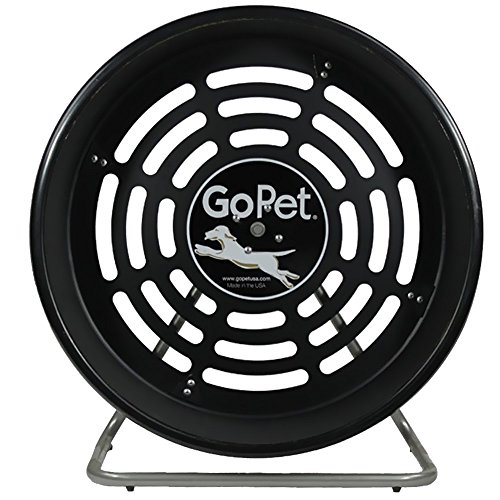
If you want your dog to set its own pace: The GoPet Treadwheel for Small Dogs ($1,071.02) — The GoPet TreadWheel has no motor and no cord. It's a free-standing wheel your dog steps into and turns, so there's no belt speed to get wrong and no way to push a dog past what it wants to do — the reason sport-dog trainers tend to prefer self-powered designs. The running area is 40 by 12 inches and it's rated to 25 pounds, so this is a small-dog machine only. It comes with a training door and a running mat, and it works when nobody's home. The catch is temperament. Plenty of dogs never take to it at all, and one owner's aussiedoodle simply froze inside it and refused treats. It's also tall and wide, so it doesn't tuck away anywhere.
The competition
This is what our research surfaced in the home dog-treadmill market, not a census of everything sold. Several machines that professional trainers and rehab clinics buy weren't available in this lineup, and the handmade slatmills that protection-sport and weight-pull competitors favor are generally sold direct by the builder.
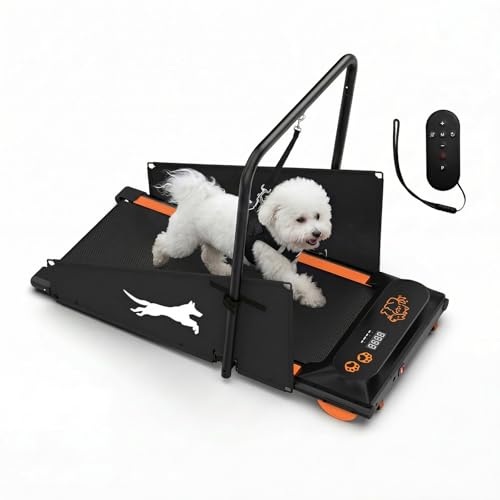
The Lastforever Dog Treadmill for Small & Medium ($215.99) — The Lastforever is a decent-looking small-and-medium machine with a 2.5 HP motor, a five-layer cushioned belt, an LED display, a remote and a safety leash. Owners in hot climates like it, and one with an aging dog says the cushioning is clearly gentler than pavement. It lost on ceiling and safety: this configuration tops out at 4 mph with no incline, so a fit dog gets a walk and a slow trot and nothing more, and there's no way to raise intensity without raising speed. One owner also points out that the belt doesn't stop on its own when a dog missteps backward, which is a real concern if you leave the room. There's a reported case of a dead motor out of the box paired with unhelpful support, too. Consider it if you have a small, older dog who'll never need more than a steady walk.
Acclimation and upkeep
Go slower than you think you need to. Start with the machine off and let your dog stand on the belt for treats, then run it at its lowest speed for a minute or two, ending while your dog still wants more. Dog Lab's research puts the average dog at about a dozen sessions over two to four weeks before it's comfortable working independently, and rushing that is how you get a dog who won't go near the thing again. Use a harness rather than a collar, and never clip a dog to the machine and walk away. On maintenance, belts wear: DogPacer's documentation puts replacement at 500 to 800 hours of use, so check whether your model's belt is replaceable before you buy. Wipe the deck down, keep the belt lubricated per the manual, and check the safety key contact every session.
Questions we get
Are dog treadmills safe for all breeds and ages?
No. The American Veterinary Medical Association recommends veterinary clearance before starting a treadmill program for any dog with joint disease, a heart condition, or a brachycephalic airway — think pugs, bulldogs and boxers, who can overheat fast. Puppies with open growth plates shouldn't do sustained running either. Healthy adult dogs of most breeds are fine, provided the belt fits their stride.
How do I train my dog to use a treadmill for the first time?
Reward first, move second. Let your dog stand on the stationary belt and eat treats there for a few days, then start the belt at its slowest setting for a minute while you stay right beside the machine. Dog Lab's acclimation research found dogs took around a dozen positive-reinforcement sessions over two to four weeks to get comfortable working on their own. Stop every session before your dog wants to stop.
What size treadmill do I need for a German Shepherd or Labrador?
Bigger than almost anything sold for home use. Aim for a belt at least 1.5 times your dog's stride length, which for an adult Labrador means roughly 45 inches minimum, and Forbes Vetted puts the width floor at 16 inches so the dog can move laterally without stepping off. In this guide, only the GoPet PetRun PR720F meets both at 52 by 16 inches.
Can I use a human treadmill for my dog instead?
It's a poor substitute. Human treadmills have side rails at the wrong height, no panels to keep a dog centered, and gaps where fur and tails can get caught. The belts are also usually too short for a large dog's stride and don't go slow enough for acclimation. If you already own one and your dog is small, use it only under close supervision — but a purpose-built machine is far safer.
How long should my dog exercise on a treadmill each day?
Twenty to thirty minutes at a brisk trot is a solid daily session for a healthy adult dog. Tufts estimates that a 30-minute trot burns 150 to 200 calories for a 50-pound dog, roughly what a 45-minute moderate outdoor walk does. Build up gradually over several weeks, and remember the AKC puts working and herding breeds at 60 to 120 minutes of vigorous exercise a day, so the treadmill is one piece of that.
Are non-motorized wheels and slatmills better than electric treadmills?
For high-drive dogs, many sport trainers think so, because the dog controls its own pace and can't be pushed past its limit by a motor. They also cost nothing to run and never break down electronically. The trade-off is that a lot of dogs never engage with a self-powered wheel at all, and you lose the fine speed control that makes motorized machines so useful for rehab and for weight-loss programs.
Why you should trust us
For this guide:
- We compared manufacturer spec sheets across every machine here for belt dimensions, speed range, weight capacity, noise claims and folded footprint.
- We read Dog Lab's independent noise measurements and acclimation research, Forbes Vetted's sizing guidance, and published veterinary rehabilitation findings on treadmill use after orthopedic surgery.
- We read through owner feedback looking for recurring themes rather than one-off complaints — belt-length disappointment, assembly surprises, and how dogs reacted to console beeps came up again and again.
- We read owner reviews on every listing, weighted toward the critical ones, because that is where the recurring failures show up.
- We have a systematic way of automatically fetching the latest prices, so the numbers on this page stay current.
- This is a research-focused guide, so the team may not own every product listed — though we often do own the top winners, which gives us extra context for the recommendations.
- We don't accept free products, and the retailer commission never changes which product we recommend.
Sources
Best Dog Treadmills of 2026 — The Spruce Pets, The Spruce Pets
Best Dog Treadmills Tested — Dog Lab, Dog Lab
Exercise Needs for Dogs by Breed Group — American Kennel Club, American Kennel Club (AKC)
2025 National Pet Obesity Survey — Association for Pet Obesity Prevention, Association for Pet Obesity Prevention (APOP)
Canine Land Treadmill Rehabilitation — Today's Veterinary Practice, Today's Veterinary Practice
Dog Treadmill Safety and Veterinary Guidance — PetMD, PetMD
Best Dog Treadmills — Forbes Vetted, Forbes Vetted
Dog Treadmill Buying Guide — Chewy, Chewy
Land Treadmill Outcomes in Post-TPLO Canine Patients — Journal of Veterinary Rehabilitation, Journal of Veterinary Rehabilitation
Caloric Expenditure in Canine Treadmill Exercise — Tufts Cummings School of Veterinary Medicine, Tufts University Cummings Veterinary School
Amazon product listings and owner reviews for all 6 products
Manufacturer specification pages for each product
Some passages in this guide may be paraphrased with AI help. Prices are refreshed automatically.
More like this.
Continue exploring pet reviews and recommendations.

The Best Treadmills for Home Cardio
A treadmill is the rare piece of home equipment you either use four times a week or hang laundry on. What separates the two outcomes usually isn't the…

The Best Foldable Treadmills for Small Spaces
A treadmill in a small apartment is a negotiation. It has to be big enough that you'll actually use it, and small enough that it doesn't eat your living…

The Best Under-Desk Treadmills
Sitting still for eight hours is the default of desk work, and most of us feel it by mid-afternoon. An under-desk treadmill is a way out that doesn't…

The Best Folding Treadmills
A folding treadmill has one job beyond running: it has to disappear when you're done. Most end up in a spare bedroom, a basement corner or a garage, where…

The Best Dog Gates
A dog gate does one small job over and over. It keeps the puppy out of the kitchen while you cook. It keeps the older dog off the stairs at night. It…

The Best Flea and Tick Prevention for Dogs
Fleas and ticks aren't a summer problem anymore. Flea pupae can sit dormant in your carpet for months, then hatch when a warm foot walks past. Deer ticks…