The Best Under-Desk Treadmills
Sitting still for eight hours is the default of desk work, and most of us feel it by mid-afternoon. An under-desk treadmill is a way out that doesn't require a gym membership or a lunch-hour change of clothes. You walk at one or two miles an hour while you answer email, sit through a status meeting, or read a long document. The CDC reports that only about a quarter of American adults hit federal aerobic activity guidelines. Walking slowly while you work is one of the few ways to close that gap without carving out separate workout time.
Here's the honest part. None of these machines is a real treadmill, and the cheap ones aren't built for the hours you'll want to put on them. Most consumer walking pads are rated for two or three hours of daily use, not eight. Belts are narrower than what you'd find at a gym, so your stride gets a little tighter than it would outdoors. And Verywell Fit's editors note that handrail-free users usually need two or three weeks before walking and screen work feel natural together. Expect an adjustment period.
We looked at motor ratings, belt size, deck height, noise, and what owners say after a year of daily use. Deck clearance trips up more buyers than anything else, so measure from your floor to the underside of your desk before you order. We think that the WalkingPad C2 is the best under-desk treadmill for most people, and that the LifeSpan Fitness TX6 is the one to buy if you're heavier, taller, or planning to walk most of the workday.
Everything we recommend

Quiet, folds flat, and just works for most desks
Built for all-day use and for bigger walkers

Handles, incline, and a high weight limit for less money

The quietest option if you take a lot of calls
At a glance
| Product | Speed Range | Weight Capacity | Price | |
|---|---|---|---|---|
 | UREVO Strol 2E Smart 2-in-1 Folding TreadmillAlso consider | 0.6-6.2mph | — | $189.99On sale |
| WalkingPad C2 Foldable Walking Pad TreadmillTop pick | 1-4mph | 220 lbs | $449 |
 | Goplus 2-in-1 Folding TreadmillAlso consider | 0.6-9mph | — | $199.99 |
 | WALKINGPAD Handlebar Accessory for P1 / A1proAlso in lineup | — | — | $129 |
| FLEXISPOT Foldable Walking Pad Treadmill for HomeAlso great | — | 264 lbs | $309.99 |
| LifeSpan Fitness TX6 Under Desk Treadmill UltraUpgrade pick | 0.4-6.0mph | 400 lbs | $1,299On sale |
| KASSADIN Walking Pad with Handle BarBudget pick | 0.6-7.6mph | 350 lbs | $89.99On sale |
How we picked
Motor and duty rating. We compared published continuous-duty ratings against manufacturer guidance on daily-use limits, leaning on Consumer Reports' finding that motors above 2.0 HP degrade far less after 500 hours. Anything meant for four-plus hours a day needed real motor headroom.
Deck height and belt size. We read spec sheets for folded and unfolded deck height, since desk clearance is the most common fit problem buyers hit. We favored belts at least 15 inches wide and 40 inches long, which is roughly the floor for a comfortable adult stride.
Noise in a shared room. We weighed published noise measurements — Tom's Guide put a good unit at 54 dB versus 69 dB for the loudest in its group — alongside owner reports about video calls and apartment neighbors. Brushless motors got a clear edge.
Weight capacity headroom. We looked for at least a 10 to 20 percent buffer above a buyer's body weight, because sustained use near the rated limit is what kills belts and motors early. Machines with a 220-pound ceiling were scored as light-duty.
Long-term owner reports. We read through owner feedback for recurring failure themes past the one-year mark — error codes, belt slip, dead displays — rather than first-week impressions. Patterns that showed up repeatedly shaped our flaws sections.
Top pick
Quiet, folds flat, and just works for most desks
WalkingPad C2 Foldable Walking Pad Treadmill
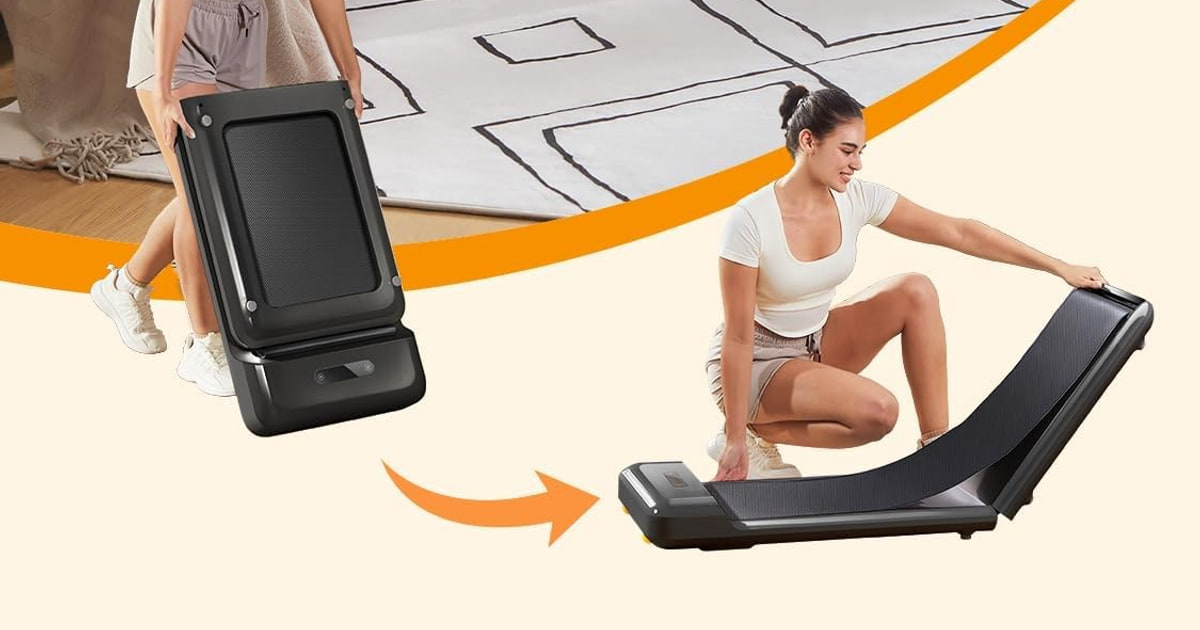
The C2 folds in half to about five inches, so it slides under a bed or couch when you're done. Its 2.0 HP motor handles up to 220 pounds, and the belt is the longest here relative to the machine's footprint.
$449fromAmazonThe fold is the whole point. The C2 hinges 180 degrees in the middle and drops to about 5.4 inches when folded, which is thin enough to go under most beds and a lot of sofas. That matters more than it sounds. A walking pad you have to stare at all evening is a walking pad you eventually resent. This one disappears, and the two wheels at the base mean you're rolling it, not carrying 55 pounds across a room.
It shows up assembled. You unbox it, unfold it, plug it in, and walk. There's no hardware bag, no console to bolt on, no thirty-minute setup that ends with a leftover screw. Owners who bought one as a gift consistently mention that the recipient was walking on it the same day. If you've been putting this purchase off because you don't want another project, that's a real point in the C2's favor.
At just under 57 inches long, the C2 gives you more belt than most fold-flat pads in the same footprint, and owners who've walked on several models call it the quietest of the bunch. Speed tops out at 4 mph, which is fine for working and fine for a brisk walk during a podcast. It's not a running machine. If you want to run, look further down this page.
There's a nice trick buried in the app: switch to metric units and the minimum speed drops to 1 km/h instead of 1 mph. That gives you finer control at the very slow end, which is where you'll actually be during focused work. The remote handles day-to-day speed changes, so you're not reaching for your phone every time a call starts.
KingSmith has the longest track record in this category, and it shows in the small stuff. Five color options, rounded edges instead of industrial black plastic, an app that doesn't demand a subscription. Owners a year in report it still runs. That's not a guarantee, but in a category full of no-name pads that die at thirteen months, a brand with real service behind it is worth something.
Flaws but not dealbreakers
The folding hinge is also the weak spot. Some owners report that stepping directly over the joint produces more noise and a bit of flex than stepping elsewhere on the deck, and that the noise gets worse over time. Keep your stride centered on the forward or rear section and you'll mostly avoid it.
At 220 pounds, the weight capacity is modest. If you're near that number, you're running the motor close to its limit every day, and sustained use near the ceiling wears belts and motors faster. Larger walkers should skip to the TX6.
The 4 mph ceiling means this is a walking machine only. No jogging, no incline, no bursts between meetings.
WalkingPad doesn't publish a warranty term in this listing, so check the current coverage before you buy.
Upgrade pickOn sale
Built for all-day use and for bigger walkers
LifeSpan Fitness TX6 Under Desk Treadmill Ultra
The TX6 has a 4.5 HP motor, a 400-pound capacity, and a 27.6-inch-wide deck — the most headroom of anything here. It's the one to buy if you plan to walk four or more hours a day, or if lighter pads have felt flimsy.
$1,299fromAmazonList priceIf you weigh more than 250 pounds, this is the only machine on this list we'd point you toward. The 400-pound capacity isn't marketing padding — it's the difference between a machine that lasts and one that starts throwing error codes at month thirteen. Buy a walking pad with a 220-pound ceiling when you weigh 240, and you're running the motor at its limit every single day. The TX6 gives you room to spare.
Consumer Reports found that treadmills with continuous-duty motors rated above 2.0 HP showed roughly 40% less performance degradation after 500 hours of use than motors rated below 1.5 HP. Five hundred hours sounds like a lot. At four hours a day, you're there in about six months. That's the argument for a bigger motor in one sentence: it's not about speed, it's about whether the thing survives your second year.
The deck is the widest here at 27.6 inches overall and 60 inches long, which gives you a more natural stride than the narrow pads. If you're tall, this matters. On a short belt, you unconsciously shorten your steps to stay off the front roller, and after two hours that shows up in your hips. Speed runs from 0.4 to 6 mph, so there's room for a brisk stretch between meetings.
LifeSpan is a commercial fitness brand, and the TX6 reflects that in the boring ways that count — a metal frame, a serviceable belt, remote control that doesn't drop connection. One owner two years in reports daily use with nothing more than periodic belt lubrication. That's the sort of feedback you want before committing to the most expensive machine here.
Flaws but not dealbreakers
At 88 pounds and six inches tall, this is not a fold-and-stash machine. It doesn't fold at all. You need a permanent spot for it, and if that spot is under a desk, you're giving up six inches of clearance before your foot even lands on the belt.
Some owners have flagged design annoyances out of the box — wheel and switch placement that makes moving and plugging in more awkward than it should be. Nothing disqualifying, but it's less polished than the price suggests.
Feedback on this specific model is thin compared with the volume behind the WalkingPad and Kassadin listings, so there's less collective evidence about how it holds up in year three.
Budget pickOn sale
Handles, incline, and a high weight limit for less money
KASSADIN Walking Pad with Handle Bar
The Kassadin pairs a 3.0 HP motor with a 350-pound capacity and removable handlebars, which is unusual at this price. Speeds run up to 7.6 mph, so you can jog on it — just verify the units before you trust the display.
$89.99fromAmazonList priceHandlebars change how this feels, especially at first. If you've never walked while typing, the bar gives you something to grab when your balance drifts, and it's the difference between using the machine and letting it collect dust. Older buyers and anyone with vertigo or balance concerns tell the same story across this category: the rail is what makes it usable. When you're confident, the bars come off and it goes under the desk.
The specs on paper are better than the price suggests. A 3.0 HP motor, 350-pound capacity, and incline — features you normally pay considerably more for. At 36 pounds it's also the lightest machine here by a wide margin, so moving it between the office and the living room is genuinely easy rather than technically possible.
There's a real catch, and it's worth knowing before you buy. Multiple owners report the speed display doesn't match miles per hour. One measured 5.0 on the display as roughly 2.6 mph with a measuring wheel. The machine works fine; the numbers just aren't what the label says. If you track distance for a step goal or a health app, calibrate against a phone or watch rather than trusting the console.
This is the highest-volume listing on this page by a distance, which means the feedback pool is deep and the picture is consistent: compact, quiet, easy to store, good enough for daily walking. It's not a precision instrument. It's a machine that gets you moving at a fraction of what the LifeSpan costs.
Flaws but not dealbreakers
The belt is short. Taller walkers and anyone with a long stride report needing to adjust their gait to stay clear of the front, and a few describe the overall build as merely adequate rather than solid. Check the listed dimensions against your own height before ordering.
The speed readout is unreliable, as noted above. Treat it as a relative dial, not a measurement.
Build quality is where the savings come from. Nothing here suggests it's dangerous, but expect more plastic and more flex than the LifeSpan or the WalkingPad.
Also great
The quietest option if you take a lot of calls
FLEXISPOT Foldable Walking Pad Treadmill for Home
FLEXISPOT's pad uses a brushless motor that runs noticeably quieter than typical belt drives, and it folds in half for storage. The 264-pound capacity beats the WalkingPad C2's while keeping the same slim profile.
$309.99fromAmazonNoise is the thing buyers underestimate, and it's what this pad fixes. Brushless motors run quieter than the brushed DC motors in most budget pads, and owners specifically mention taking conference calls without anyone noticing. Tom's Guide measured a quality under-desk unit at 54 dB at 2 mph — roughly office HVAC background level — against 69 dB for the noisiest units in the same group. That gap is the difference between a colleague hearing nothing and a colleague asking what that sound is.
It folds in half like the C2 and stands 4.4 inches tall, the slimmest deck here. If your desk sits low, or you're trying to slide it under a bed frame with limited clearance, that half-inch advantage over the WalkingPad is occasionally what makes it fit. Measure your gap first — this is the compatibility problem that sends more of these machines back than anything else.
The 264-pound capacity is a meaningful step up from the 220 pounds you get on the C2, and it comes without any added bulk. At 51 pounds with built-in wheels and no assembly, it's a machine you can reposition without help. For an apartment where the treadmill has to migrate between the office and a closet, that combination is hard to beat.
If you already own a FLEXISPOT sit-stand desk, the pairing is straightforward — same brand, same design language, and a low-profile setup that doesn't fight your desk's cable routing. That's a convenience argument rather than a performance one, but convenience is what determines whether you use this thing daily.
Flaws but not dealbreakers
The power cord is short. More than one owner has had to rearrange furniture or add an extension to place the pad where they wanted it. Check your outlet distance before you commit to a spot.
There's very little accumulated owner feedback on this model compared with the WalkingPad and Kassadin listings, and at least one buyer received a unit that wouldn't power on. Worth noting: there's a physical switch on the side that must be flipped before the remote does anything, which accounts for some of the reported failures.
No handlebar option. If you're new to walking while working, or you're unsteady on your feet, start somewhere with a rail.
Who this is for
Buy one of these if you work from home, sit most of the day, and want movement that doesn't require changing clothes or blocking off an hour. A PLOS ONE meta-analysis found no meaningful drop in typing accuracy or reading comprehension when people walked at 1 to 2 mph versus sitting, so email, meetings, reading, and most writing are compatible. Fine motor precision work took about an 11 percent accuracy hit, so if your job involves detailed design or drafting, save the walking for calls and reading. Good Housekeeping editors who walked at 1.5 mph for two hours during the workday reported markedly better afternoon energy on walking days.
Skip it if you're mainly after a running machine — these are walking pads with occasional jogging capability at best, and a real treadmill will serve you better. Skip it too if you can't measure at least 10 to 12 inches between your floor and your desk underside, or if you're unwilling to give a permanent spot to something the size of a door. This guide covers standalone under-desk pads and walking-pad-style treadmills sold on their own. It doesn't cover full treadmill-desk bundles with integrated worksurfaces, or gym treadmills that happen to fold.
How we picked
We ranked these on the things that determine whether a walking pad survives its second year and whether you actually use it. Motor: continuous-duty rating and the manufacturer's stated daily-use limit, since sub-1.5 HP motors degrade sharply under sustained load. Fit: deck height unfolded and folded, checked against typical desk clearance, plus belt width and length against a normal adult stride. Noise: published dB figures and owner reports about video calls, with brushless motors favored over cheap DC drives. Capacity: a real buffer above your body weight, not a number you'd be walking right at every day. Storage: whether it folds flat enough to go under a bed or couch, and whether one person can move it. Durability: recurring themes in owner feedback past twelve months — error codes, belt slip, failed displays.
Other under-desk treadmills worth considering
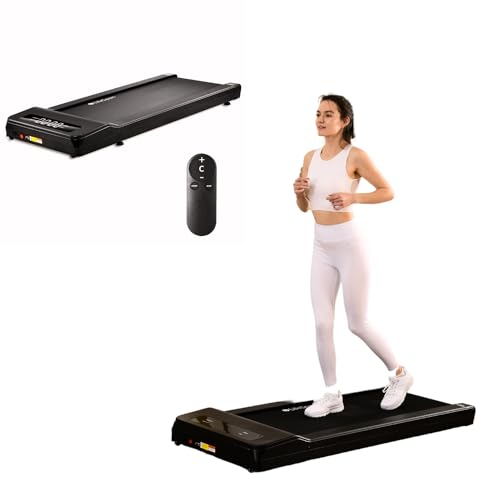
If you want a safety handle and the option to run: The UREVO Strol 2E Smart 2-in-1 Folding Treadmill ($189.99) — The UREVO Strol 2E has a removable handle and two modes — folded walking up to 4 mph, or opened up to 6.2 mph for actual running. The 15-by-40-inch belt sits at the minimum we'd accept but works, and the eight silicone shock absorbers make it easier on knees than the flat pads. Owners like the detachable tray for a phone. The catch is maintenance: UREVO specifies lubricant every 125 miles, and at least one owner who kept up with it still developed a loud noise around the five-month mark. It's a good first walking pad if you want the handle, but it demands more upkeep than the C2.
If you want one machine for both walking and real running: The Goplus 2-in-1 Folding Treadmill ($199.99) — The Goplus 2-in-1 converts from a 2.5 mph under-desk walker to a 9 mph runner with raised handlebars, which is the widest speed range here. It has a 2.25 HP motor, a five-layer cushioned belt, a Bluetooth speaker, and a phone holder. But it's 75 pounds and 43.5 inches tall with the handlebars up, so it never really tucks away. The bigger concern is longevity: multiple owners describe it working well for about a year and then producing error codes, abrupt stops, or a dead display. The three-foot power cord is short, too. Worth it if the dual-purpose appeal outweighs the durability question.
The competition
This is what our research surfaced, not a census of everything sold. New walking pads appear constantly, many of them the same factory hardware under different names. Every product below was worth a look, and each lost to a pick for a specific reason.
The WALKINGPAD Handlebar Accessory for P1 / A1pro ($129) — The WalkingPad handlebar accessory isn't a treadmill — it's a stainless-steel rail that bolts onto a KingSmith P1 or A1 Pro you already own. We're mentioning it because it solves a real problem: if you bought a WalkingPad without a rail and find yourself nervous about balance, this is the fix, and owners who added one describe it as the thing that finally made the pad usable. One important trade-off: installing the rail may disable the automatic foot-sensing speed control, so you'd be on manual speed only. Buy it only if you already own a compatible P1 or A1 Pro.
Fit, setup, and upkeep
Measure before you order. Run a tape from your floor to the underside of your desk, then subtract the treadmill's deck height — most pads need 10 to 12 inches of clearance, and this is the single most common reason these get returned. On carpet, put an anti-static mat underneath; static discharge can damage motor electronics, and carpet fibers work their way into the belt mechanism. Lubricate the belt on the schedule in your manual, usually every hundred miles or so, because a dry belt is what turns a quiet machine into a noisy one and eventually burns out a motor. Start at 1 to 1.5 mph and give yourself two or three weeks before expecting walking and typing to feel automatic. Most people who quit do so in the first fortnight.
Questions we get
What speed should you walk while working?
Start at 1 to 1.5 mph and stay under 2 mph for anything that needs focus. A PLOS ONE meta-analysis found no significant drop in typing accuracy or reading comprehension at 1 to 2 mph compared with sitting. Above that, your upper body starts moving enough to interfere with typing. Save the faster speeds for calls, podcasts, and reading.
How much desk clearance do you need?
Most walking pads need 10 to 12 inches between your floor and the underside of your desk, once you account for deck height plus your own step. Measure your actual gap first, then subtract the treadmill's listed deck height — the slimmest pads here are around 4.4 inches, while the LifeSpan TX6 is six. If your desk doesn't adjust, this is the number that decides which machines are even possible.
Are they quiet enough for video calls?
The good ones are. Tom's Guide measured a quality under-desk unit at 54 dB at 2 mph, which is about the level of office HVAC and effectively inaudible on a call. The loudest units in the same test hit 69 dB, which people on the other end will hear in a quiet room. Brushless motors, like the one in the FLEXISPOT, are the safer bet if you're on camera all day.
Do under-desk treadmills actually help with weight loss?
They help, but slowly and only with consistency. Harvard's MET tables put walking at 2 mph at roughly 140 to 200 calories per hour for a 155-pound adult — about 2.5 times seated desk work. A Mayo Clinic Proceedings study of office workers using treadmill desks for a year found an average loss of 2.2 kg along with improved HDL cholesterol. Think of it as reducing sedentary time rather than as a workout replacement.
How long will the motor last with heavy daily use?
That depends almost entirely on the motor rating. Consumer Reports found motors above 2.0 HP continuous duty showed about 40 percent less performance degradation after 500 hours than motors under 1.5 HP. At four to six hours a day, you'll cross 500 hours in roughly four to six months. Most budget walking pads are rated for two to three hours of daily use, so running one all day is asking for an early failure.
Can you use one on carpet?
Yes, with two precautions. Put an anti-static mat underneath — static discharge on carpet can damage the motor electronics, and it's cheap insurance. Carpet also traps heat under the deck and lets fibers migrate into the belt mechanism, so vacuum around and under the machine more often than you would on a hard floor. Low-pile carpet is fine; deep shag is not.
Why you should trust us
For this guide:
- We compared manufacturer specification sheets for every unit on this list, focusing on motor ratings, deck height, belt dimensions, and stated weight capacity.
- We read published noise and durability findings from Tom's Guide and Consumer Reports, plus health research from Mayo Clinic Proceedings, PLOS ONE, and the CDC on what slow walking during work actually does.
- We read owner feedback for each product with an eye toward recurring problems after the first year, rather than unboxing impressions.
- We read owner reviews on every listing, weighted toward the critical ones, because that is where the recurring failures show up.
- We have a systematic way of automatically fetching the latest prices, so the numbers on this page stay current.
- This is a research-focused guide, so the team may not own every product listed — though we often do own the top winners, which gives us extra context for the recommendations.
- We don't accept free products, and the retailer commission never changes which product we recommend.
Sources
Best Treadmill Desks and Walking Pads — Wirecutter (New York Times), Wirecutter
Best Walking Pads and Under-Desk Treadmills 2026 — Tom's Guide, Tom's Guide
Best Under-Desk Treadmills Tested by Fitness Editors — Good Housekeeping, Good Housekeeping
Best Under-Desk Treadmills for Working From Home — Forbes Health, Forbes Health
Best Under-Desk Treadmill Picks — CNET, CNET
Walking Pad vs. Under-Desk Treadmill: Expert Review — Verywell Fit, Verywell Fit
LifeSpan TR1200-DT3 Full Review — PCMag, PCMag
Effect of Treadmill Desks on Weight and Cardiometabolic Health — Mayo Clinic Proceedings, Mayo Clinic Proceedings
Expert Consensus Statement on Physical Activity in the Workplace — British Journal of Sports Medicine, British Journal of Sports Medicine
Cognitive Performance During Walking: A Meta-Analysis — PLOS ONE, PLOS ONE / PubMed
Physical Inactivity Prevalence Among U.S. Adults — CDC National Center for Health Statistics, CDC
Amazon product listings and owner reviews for all 7 products
Manufacturer specification pages for each product
Some passages in this guide may be paraphrased with AI help. Prices are refreshed automatically.
More like this.
Continue exploring health reviews and recommendations.

The Best Treadmills for Home Cardio
A treadmill is the rare piece of home equipment you either use four times a week or hang laundry on. What separates the two outcomes usually isn't the…

The Best Foldable Treadmills for Small Spaces
A treadmill in a small apartment is a negotiation. It has to be big enough that you'll actually use it, and small enough that it doesn't eat your living…

The Best Folding Treadmills
A folding treadmill has one job beyond running: it has to disappear when you're done. Most end up in a spare bedroom, a basement corner or a garage, where…

The Best Dog Treadmills
Most dogs don't get enough exercise, and most owners know it. Work runs long, it rains for a week, the pavement hits scorching in July, and the walk gets…

The Best Under Desk Ellipticals
You sit more than you think. Between email, meetings and the occasional doomscroll, most desk days pass with your legs completely still. An under-desk…

The Best Posture Correctors for Desk Workers
You feel it around three in the afternoon. Your shoulders have crept forward, your chin juts toward the monitor, and there's a hot band of tension between…