The Best Electric Buffet Warming Trays
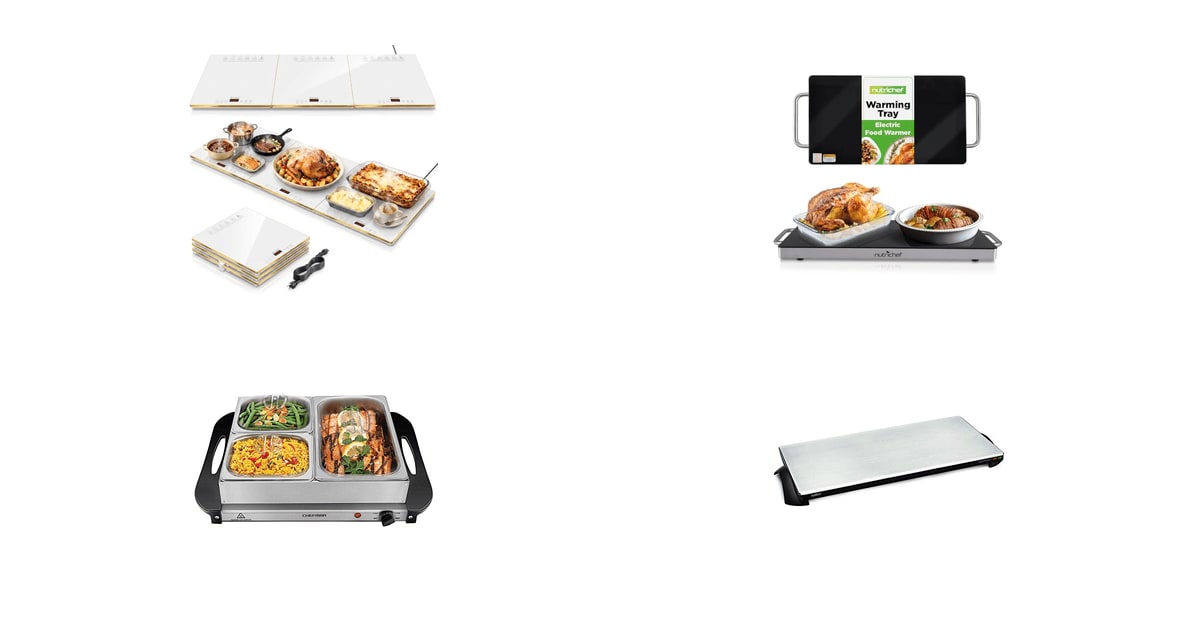
Getting eight dishes hot at the same moment is the hardest part of hosting. The turkey needs to rest, the rolls need the oven, and the mashed potatoes have been sitting since three. An electric warming tray fixes the timing problem. You cook on your own schedule, park everything on a heated surface, and let people eat when they're ready. It also frees up your oven, which is usually the real bottleneck on a holiday morning.
Here's the honest catch: none of these things cook. A warming tray holds hot food hot, and that's all it does. Set a cold casserole on one and you'll have a lukewarm casserole an hour later, plus a food-safety problem. The USDA calls 40°F to 140°F the danger zone, and perishable food that sits below 140°F for more than two cumulative hours should go in the trash. Uncovered dishes also dry out and skin over, no matter which model you buy.
So the choice comes down to how you serve. If you want covered wells for gravy and green beans plus a bare hot surface for a casserole dish, get a buffet server. If you'd rather set your own pans down and forget about it, a flat tray is simpler and stores flatter. We think that the Chefman Electric Buffet Server + Warming Tray is the best electric buffet warming tray for most people, and that the NutriChef Large Electric Warming Tray is the one to buy if you host a couple of times a year and don't want to fuss with settings.
Everything we recommend

Covered pans and a bare hot plate, for the classic holiday spread

One big glass surface, one switch, nothing to fuss with
Separate digital zones for a long table, if you have room to store it
Heats up, unplugs, and moves to the table without a cord
At a glance
| Product | Surface Size | Wattage | Price | |
|---|---|---|---|---|
| BTUVC Electric Warming Trays For Buffets PartyUpgrade pick | 36" x 16" | — | $89.99 |
| NutriChef Large Electric Warming TrayBudget pick | 20" x 12" | 240-watt | $84.99 |
| Chefman Electric Buffet Server + Warming TrayTop pick | 14" x 14" | — | $34.84 |
| Cordless Warming Tray by SaltonAlso great | 23-3/4" x 11-3/4" | 1000-watt | $99.99 |
 | Waring Pro BFS50B Professional Buffet Server andAlso in lineup | — | — | $239.89 |
How we picked
Real holding temperature. The FDA Food Code requires hot food held for service to stay at 135°F or above, and the USDA treats anything under 140°F as the danger zone. We favored models whose specs and owner feedback both point to genuinely hot holding, not warm-ish.
Zones and controls. Published lab testing shows multi-zone trays hold within about ±5°F across zones while single-element trays vary up to ±18°F edge to center. We weighted independent controls heavily for anyone serving proteins and sauces together.
Covered or bare. Lidded wells keep gravies, soups, and casseroles noticeably moister than open flat trays. We looked for designs that give you both — pans with lids plus usable bare surface for your own cookware.
Safety and shut-off. Published reviews flag missing auto shut-off as the top safety concern for consumer buffet trays, since hosts get distracted. Timers, thermal fuses, cool-touch handles, and third-party electrical certification all counted.
Cleaning. Cleaning difficulty is the most common regret in negative owner feedback across this category. We prioritized dishwasher-safe pans and lids, plus flat surfaces without seams where grease collects.
Top pick
Covered pans and a bare hot plate, for the classic holiday spread
Chefman Electric Buffet Server + Warming Tray
The Chefman gives you three lidded stainless pans holding about five quarts total, sitting on a 14-by-14-inch hot plate you can also use bare. It handles the gravy-and-green-beans half of dinner and a casserole dish at the same time.
$34.84fromAmazonThis is the one to buy if you're feeding a table, not a banquet hall. Three stainless pans drop into the frame, and the whole surface is 14 by 14 inches. Pull one pan out and you've got bare hot plate for your own baking dish. That flexibility is why it fits so many holiday setups: stuffing and gravy in the wells, a lasagna pan straight on the metal beside them.
The lids matter more than they look like they should. Covered wells trap steam, so gravy stays pourable and mashed potatoes don't crust over. Open flat trays let that moisture escape, which is exactly how a good sauce turns into a skin by the second helping. If most of what you serve is wet — chili, sauces, braised anything — covered beats flat every time.
It draws 200 watts. That's within the usual 150-to-300-watt range for consumer warming trays, and it's a fraction of what you'd burn keeping an oven at 200°F for four hours. You get cool-touch handles for moving it, a fuse that cuts in if it overheats, and cETL approval on the electronics. None of that is glamorous. All of it is the stuff you want on a table full of guests.
Cleanup is the part people regret most, and this one handles it. Cleaning complaints are the single most common source of buyer's remorse in this category, based on owner feedback across popular models. Here the pans and the domed lids go in the dishwasher, and the stainless base wipes down with a damp cloth once it's cool. You're never scrubbing baked-on cheese out of a heating element.
Flaws but not dealbreakers
It holds, it doesn't reheat. Two hundred watts spread across that much surface takes a while to build, and owners describe roughly fifteen minutes before pans of water start steaming. Plan on food going in hot from the oven or microwave, not cold from the fridge.
One dial controls the whole thing, so you can't run the ham warmer than the gravy. If you need genuinely separate zones, look at the BTUVC. The lids are also plastic and the unit is tall and awkward to store — it won't slide under a counter or behind the cereal boxes.
Chefman covers this buffet server with a one-year warranty.
Budget pick
One big glass surface, one switch, nothing to fuss with
NutriChef Large Electric Warming Tray
The NutriChef is a plain 20-by-12-inch glass hot plate with a single power switch and a 240-watt element that tops out near 200°F. If you host twice a year and want your own dishes kept warm, this is all the appliance you need.
$84.99fromAmazonYou get a lot of surface for very little money here. The heated area runs about 19.8 by 11.9 inches, enough for a couple of half-size foil pans side by side, or a 9-by-13 with room to spare beside it. At 6.2 pounds with cool-touch carry handles, you can move it from kitchen to dining table one-handed, then stand it on edge in a cabinet when you're done.
There's exactly one control, and that's the whole appeal. You press the power switch, a light comes on, and it warms. No dial to second-guess, no menu, nothing a curious relative can knock out of adjustment mid-meal. For anyone who wants an appliance that behaves the same way every single time, simple wins.
The glass surface does ask for patience. Good Housekeeping Institute testing found that stainless steel warming surfaces reach target temperature in eight to ten minutes while glass takes twelve to fifteen. The manufacturer's own instructions say to preheat at least five minutes before you set anything down, and you should treat that as a floor, not a target. Turn it on before you carve, not after.
Glass has a real payoff, though: it wipes clean. Drips of gravy and butter come off a flat sheet of tempered glass with a sponge, and there's no seam or lip for grease to hide in. That's a bigger deal than it sounds, because cleaning frustration is what turns most warming trays into closet clutter.
Flaws but not dealbreakers
There's no thermostat, so you don't get to choose a holding temperature. Owners consistently report that uncovered food drifts toward lukewarm rather than hot. Cover your dishes with foil, and don't expect it to bring anything back up.
It's a single heating element, which means the middle runs hotter than the edges. Lab testing published by Reviewed.com measured edge-to-center variance up to ±18°F on single-element trays, compared with roughly ±5°F across zones on multi-zone designs. Rotate your pans if something is sitting out for a long stretch. The listing also doesn't mention an auto shut-off, so treat this as a plug-it-in-and-keep-an-eye-on-it appliance.
Upgrade pick
Separate digital zones for a long table, if you have room to store it
BTUVC Electric Warming Trays For Buffets Party
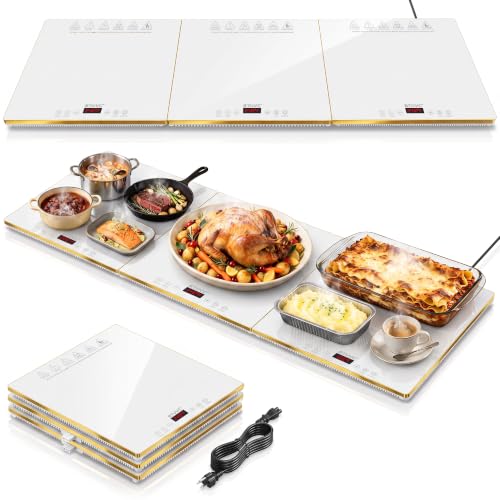
The BTUVC splits into three glass panels you can use alone or link into a 36-by-16-inch warming surface. Each panel has its own digital display, eight heat settings, a delay start, and a shut-off timer, so sauces and mains can hold at different temperatures.
$89.99fromAmazonPicture a rented folding table along one wall with ten dishes on it. That's the setup this thing is built for. Link all three panels and you've got three feet of continuous heated surface. Host something smaller and you use one panel on the kitchen island instead, which is a genuinely different appliance from a fixed-size tray you either fill or waste.
Independent zones are the actual upgrade you're paying for. Each panel has its own display and controls, so gravy can sit gently while the brisket holds higher. Reviewed.com's lab testing found multi-zone trays kept surface temperature within about ±5°F across zones, while single-element designs swung as much as ±18°F from edge to center. If you've ever scorched one side of a dish while the other went cold, that's the difference.
The safety features are the other reason to spend up. You get a shut-off timer, a delay start, and a child lock. The Spruce Eats identified the absence of auto shut-off as the leading safety concern for consumer buffet trays, since hosts get pulled away mid-party. This one lets you set it and stop thinking about it, which is the whole point of a buffet.
It also looks like something you'd want on the table. The white tempered glass with gold trim reads more like serveware than an appliance, and owner feedback about the appearance is consistently warm. Glass wipes clean, too, so a splash of oil is a paper towel problem, not a scrubbing project.
Flaws but not dealbreakers
Owner feedback splits harder here than on our other picks. Plenty of people report foil pans holding at serving temperature for a three-hour event. Others say heavy pots stayed barely lukewarm no matter which setting they used, and that grease works its way into the edges and is a pain to get back out. Uncovered, heavy, cold-ish cookware is where it struggles most.
It's three feet wide and 11.5 pounds. Storage is a real consideration, and there's no graceful way to tuck it away — the box it ships in is worth keeping. Glass also needs the longer twelve-to-fifteen-minute preheat, so start it early.
Also great
Heats up, unplugs, and moves to the table without a cord
Cordless Warming Tray by Salton
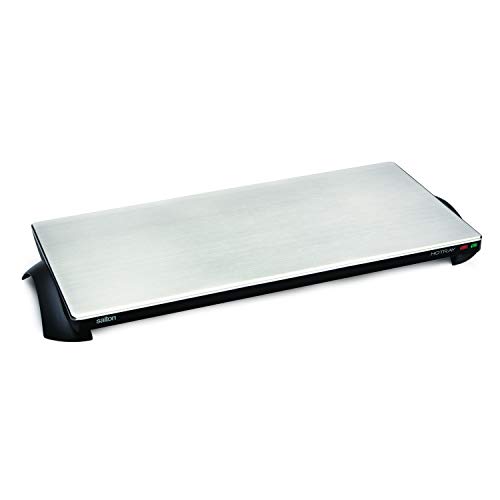
The Salton charges up in about eight minutes on a plug, then holds food warm for roughly an hour with the cord detached. It's the answer when your serving table is nowhere near an outlet and you don't want an extension cord across the floor.
$99.99fromAmazonThe cord is the feature. You plug it in for about eight minutes, pull the cord off, and carry a hot 23¾-by-11¾-inch stainless plate to wherever people are actually eating. No taped-down extension cord across a doorway, no arranging the whole buffet around a wall outlet. For a coffee table on game day or a dining table in the middle of a room, nothing else here does this.
Stainless steel also comes up to temperature faster than glass — eight to ten minutes versus twelve to fifteen, per Good Housekeeping Institute testing. That short charge time is what makes the cordless trick work. It's also why this is the pick for people who decide at the last minute that the appetizers need to stay warm.
The surface is big enough to matter. Owners describe fitting a 9-by-13 plus a small platter, or a few casseroles at once. Stay-cool handles let you move it while it's hot, an automatic thermostat keeps it from cooking anything, and the flat stainless top wipes down in seconds with no crevices to work around.
Flaws but not dealbreakers
An hour is an hour. For a long buffet, you'll be walking it back to an outlet and re-plugging it every so often, which is exactly the chore a plug-in tray doesn't have. If your event runs three hours, buy something corded.
There's no on/off switch — the cord is the switch, and owners point this out regularly. It also draws 1,000 watts while it's charging, far more than the 150-to-300-watt trays here, though only for a few minutes at a time. And the instructions say not to put food directly on the surface, so you're serving from dishes with flat bottoms.
Who this is for
Buy one if you regularly put more food on the table than your oven and stovetop can hold at once — Thanksgiving, a potluck, a graduation party, a Sunday spread for a big family. They're also genuinely useful if someone at your table eats slowly or arrives late, since a plate of food can stay hot without anyone hovering over the microwave. If you host once a year and own a decent oven with a warm setting, you can probably skip the whole category.
This guide covers plug-in electric warming trays and electric buffet servers: heated surfaces and lidded wells that hold already-hot food. It doesn't cover sterno chafing racks, slow cookers, warming drawers, or commercial steam tables. And it's worth being blunt about the limit — nothing here will cook or reheat food, so everything you put down needs to come out of the oven or off the stove hot.
How we picked
We built the shortlist around five things. Holding temperature: the FDA's 135°F service minimum and the USDA's 140°F danger-zone line are the benchmarks that matter, so we favored models whose specs and owner feedback both support genuinely hot holding. Zones and controls: published lab testing found multi-zone trays hold within about ±5°F across zones while single-element designs swing up to ±18°F edge to center. Covered versus bare: lidded wells keep gravies and casseroles moister than open trays, and the best designs give you both. Safety: auto shut-off, timers, thermal fuses, cool-touch handles, and third-party electrical certification. Cleaning: dishwasher-safe pans and flat, seamless surfaces, since cleaning is the single most common complaint owners raise.
The competition
This is what our research turned up, not a survey of everything sold. Warming trays come and go fast, and plenty of models we couldn't find enough independent evidence about aren't here. The one below is worth knowing about anyway.
The Waring Pro BFS50B Professional Buffet Server and ($239.89) — The Waring Pro BFS50B is the biggest server here by a wide margin: three 2½-quart stainless chafing dishes, each holding twenty 4-ounce servings, on a 26-inch brushed stainless base you can also use bare as a warming tray. Clear polycarbonate lids are included. It's built for actual crowds, and owners who like it describe four-hour parties with food staying evenly warm. But owner feedback repeatedly flags the control switch smoking or failing, and the plastic lids cracking after a few seasons of use. Replacement lids aren't cheap or convenient. Choose it if you serve twenty-plus people regularly and you'll baby the switch by turning the heat up gradually — otherwise the Chefman is the safer buy.
Care and cleaning
Let the surface cool completely before you touch it with anything wet — cold water on hot tempered glass is how glass cracks. Never put the base or the electrical housing in the dishwasher or under a faucet; only removable pans and lids go in, and only if the manual says so. For dried-on gravy, lay a damp cloth over the spot for a few minutes and it'll lift without scraping. Skip steel wool and abrasive powders on glass and brushed stainless, since scratches turn into permanent grease traps. Wipe the underside of lids too, because condensation there drips onto whatever's underneath. Store lids upside down or separately so nothing warps, and coil the cord loosely rather than tight around the base.
Questions we get
What temperature does an electric buffet warming tray hold?
Most consumer trays hold a surface temperature somewhere between roughly 150°F and 200°F, depending on the model and setting. That's meant to keep hot food hot, not to cook it. The FDA Food Code calls for hot food held for service to stay at 135°F or above, and the USDA treats 140°F as the safety line, so a tray that only makes food feel warm isn't doing the job.
How long can food safely sit on a warming tray at a party?
Perishable food that drops into the 40°F-to-140°F range should be discarded after two cumulative hours, per USDA guidance. As long as your tray genuinely holds food above 140°F, that clock doesn't start. Use a probe thermometer in the thickest dish once or twice during the party rather than guessing, especially with anything uncovered.
Can I put a cold dish straight onto a warming tray?
No — and this is the mistake that causes most disappointment. These are holding appliances, not cooking appliances, and they don't have the wattage to bring a cold casserole up to a safe temperature. Heat food fully in the oven or microwave first, then move it to the preheated tray. Preheat the tray itself for at least five minutes, and closer to fifteen for glass surfaces.
What's the difference between a warming tray and a chafing dish?
A chafing dish uses sterno fuel canisters and a water bath to hold food, so it needs no outlet but does need open flame and refills. An electric warming tray plugs in, holds a steadier temperature, and has no flame to manage around kids or a crowded table. Trays are better indoors; chafers still win for outdoor events with no power.
Is it safe to leave a buffet server running unattended?
Only if it has an auto shut-off or a timer, and even then we'd check on it. Published reviews call the missing shut-off the top safety concern in this category, because hosts inevitably get pulled into a conversation in another room. The BTUVC has a shut-off timer and a child lock. The Chefman has a thermal fuse, but you should still turn it off when the food is gone.
How much electricity does one of these actually use?
Consumer warming trays typically draw 150 to 300 watts, which is roughly the same as a couple of bright work lamps. That's dramatically less than holding an oven at 200°F for the same stretch, so if your goal is keeping the food hot rather than cooking it, the tray is the cheaper tool. Cordless models like the Salton draw more while charging, but only for a few minutes at a time.
Why you should trust us
For this guide:
- We read published lab testing from the Good Housekeeping Institute and Reviewed.com on surface heat-up times and zone-to-zone temperature consistency.
- We compared manufacturer spec sheets for wattage, surface dimensions, pan capacity, controls, and safety certifications across every model here.
- We read through owner feedback for each product, looking for repeated themes around holding temperature, cleaning frustration, and long-term durability rather than one-off complaints.
- We read owner reviews on every listing, weighted toward the critical ones, because that is where the recurring failures show up.
- We have a systematic way of automatically fetching the latest prices, so the numbers on this page stay current.
- This is a research-focused guide, so the team may not own every product listed — though we often do own the top winners, which gives us extra context for the recommendations.
- We don't accept free products, and the retailer commission never changes which product we recommend.
Sources
Best Warming Trays Tested by Good Housekeeping Institute, Good Housekeeping Institute
Best Buffet Servers — The Spruce Eats, The Spruce Eats
FDA Food Code — Hot Holding Temperature Requirements, U.S. Food & Drug Administration
USDA Food Safety: The Danger Zone, USDA Food Safety and Inspection Service
Cuisinart CWT-240 Product Specifications, Cuisinart
Hamilton Beach 33530 Buffet Server Specifications, Hamilton Beach
Waring Commercial WPT250 Portable Warming Tray Data Sheet, Waring Commercial
Electric Food Warmer Market Report 2025–2030, Grand View Research
NutriChef PKWTR40 Warming Tray Product Page, NutriChef
Best Buffet Warming Trays 2026 — Reviewed.com, Reviewed (USA Today)
Amazon product listings and owner reviews for all 5 products
Manufacturer specification pages for each product
Some passages in this guide may be paraphrased with AI help. Prices are refreshed automatically.
More like this.
Continue exploring appliances reviews and recommendations.

The Best Rechargeable Hand Warmers
Cold hands ruin an otherwise good day outside. A rechargeable hand warmer is a small lithium battery wrapped in a metal or plastic shell that heats up on…

The Best Under-Desk Cable Management Trays
The mess under your desk is the part of your setup nobody photographs. A power strip on the carpet, three adapter bricks piled on top of it, and a knot of…

The Best Boot Trays for a Winter Entryway
A boot tray does one job, and it does it at the exact spot where winter gets into your house. Wet boots come off at the door, the snow melts, and the salt…

The Best Magnetic Parts Trays
Anyone who's dropped a caliper bolt into gravel knows the appeal of a magnetic parts tray. You stick it to a fender, a tool cart rail, or the side of an…

The Best Large Coffee Urns for Parties and Gatherings
Coffee at a party is a logistics problem before it's a taste problem. You need 60 cups ready at the same moment, hot two hours later, and pourable by a…

The Best Ninja Kitchen Appliances
Ninja makes a lot of machines that all promise to be the only one you need. In practice, the question isn't which is best - it's which one fits your…