The Best Large Coffee Urns for Parties and Gatherings
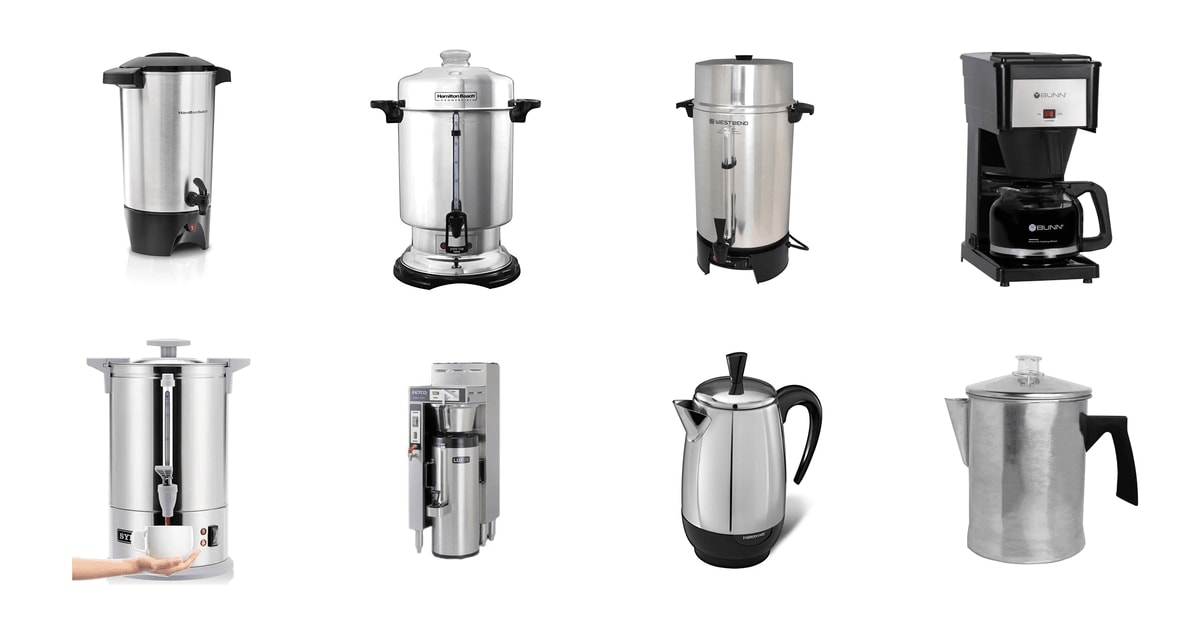
Coffee at a party is a logistics problem before it's a taste problem. You need 60 cups ready at the same moment, hot two hours later, and pourable by a guest holding a plate in one hand. A large urn solves that. It brews a single enormous batch, holds it on a warming element, and dispenses through a spigot so nobody touches a hot carafe. If you host reunions, run a church fellowship hour, or handle the coffee table at a wedding, this is the appliance that keeps the line moving.
Here's the honest part: no urn makes coffee as good as your drip machine at home. Most large urns are percolators, which means brewed liquid cycles back through the grounds again and again. Consumer Reports found that percolator urns left on their keep-warm element past 60 to 90 minutes turn measurably more bitter for exactly that reason. Budget models often brew below the 195–205°F window the Specialty Coffee Association calls for, so the coffee comes out flat instead. You're buying volume and convenience, and you're trading away some flavor to get them.
So pick for your crowd size and your hosting frequency, not for the perfect cup. Plan on 1.5 to 2 cups per adult over a two-hour window, which is what the National Restaurant Association tells caterers. We think that the Hamilton Beach 45 Cup Coffee Urn is the best large coffee urn for most people, and that the Hamilton Beach Commercial 60 Cup urn is the one to buy if you regularly serve 50 guests or more.
Everything we recommend

Enough coffee for a full room, without the commercial bulk

More capacity and better heat retention, in real stainless

A hundred cups at a cup a minute, if your crowd is that big
Commercial 304 stainless and a heavy spigot, at a lower tier
A small stainless percolator for hosts who rarely need volume
At a glance
| Product | Capacity (Cups) | Brew Time | Price | |
|---|---|---|---|---|
| Hamilton Beach 45 Cup Coffee Urn andTop pick | 45 Cup | 1 Min/Cup | $51.99On sale |
| Hamilton Beach Commercial Coffee Urn & HotRunner-up | 60 Cup | — | $159.95 |
| West Bend Commercial Coffee Urn Highly-Polished AluminumUpgrade pick | 100-Cup | 1 Min/Cup | $169.99 |
 | BUNN GRB Velocity Brew 10-Cup Home CoffeeAlso in lineup | 10-Cup | 4 Min | $128.40 |
| SYBO Commercial Grade Stainless Steel Percolate CoffeeAlso great | 50-Cup | 30 Min | $109 |
 | Fetco CBS-51H-15 5000 Series Single Coffee BrewerAlso consider | — | — | $2,633.85 |
| Farberware Electric Coffee PercolatorBudget pick | 8-Cup | 1 Min/Cup | $64.99On sale |
 | MIRRO 9 Cup Aluminum Coffee Percolator withAlso in lineup | 9 Cup | — | $20.58On sale |
How we picked
Capacity versus crowd. National Restaurant Association catering guidance — 1.5 to 2 cups per adult over two hours — gave us the baseline for mapping each urn's rated capacity to a realistic guest count. Anything that couldn't cleanly serve a stated party size without a mid-event refill got framed as a smaller-gathering option.
Heat retention. We compared published temperature findings from Good Housekeeping against the NSF/ANSI 4 commercial standard of 140°F minimum through the service period. Body material mattered here: stainless conducts heat about 12 times more slowly than aluminum, which shows up directly in how long coffee stays drinkable.
Brew speed. We read manufacturer brew-rate specs and converted them into the practical question hosts actually ask — how early do I need to start? A cup-per-minute rate on a 100-cup urn means a 90-minute head start, and we flagged that wherever it applies.
Spigot and dispensing. We looked at whether each urn supports one-handed dispensing, whether it offers both single-cup and continuous pour, and what owner feedback says about drips and leaks. Recurring leak complaints counted against a model even when its other specs were strong.
Cleaning and durability. We weighed mouth width, basket material, and owner reports of rust, residue, and early failure. A wide stainless body you can reach into beat a tall narrow one that needs a bottle brush.
Top pickOn sale
Enough coffee for a full room, without the commercial bulk
Hamilton Beach 45 Cup Coffee Urn and
This 45-cup urn brews about a cup a minute, tells you when it's ready with a light, and pours either a single cup or a continuous stream. It's light enough to carry to a fellowship hall and simple enough that a volunteer can run it.
$51.99fromAmazonList priceFor a party of 20 to 30 people, 45 cups is the right number. That's the math the National Restaurant Association uses — 1.5 to 2 cups per adult across a two-hour window. Oversizing is a real mistake here, because coffee that sits on a warming element too long goes bitter. This urn also brews as few as 15 cups, so a small morning meeting doesn't leave you with two gallons of coffee slowly stewing.
The dispensing lever moves two ways, and that matters more than it sounds. Push it one way for a single cup and it stops when you let go. Push it the other and it stays open so you can fill a carafe or a tall travel mug without standing there holding it. Guests figure this out without instructions, which is the whole point when you're refilling a chafing dish in the next room.
A ready light tells you when brewing finishes, and interior water markings show you how much you've added and how much is left. Owners who run these at churches and offices consistently point to that combination as the reason the urn doesn't need supervision. You set it up, walk away, and come back to a light. Hamilton Beach notes brewing runs about a minute per cup, so a full load takes roughly 45 minutes — start it an hour before doors open.
At about four pounds empty, this is the lightest urn we'd recommend for a real crowd. You can carry it out to a folding table, and the base and handles stay cool enough to move safely. Owners who use it for outdoor events and community meal service mention that portability first. It's also short enough at just under 19 inches to fit under most kitchen cabinets while it brews.
Flaws but not dealbreakers
The body is silver-finished but not the heavy polished stainless of the commercial models, and it shows. Good Housekeeping's testing found stainless urns held serving temperature for up to two hours after brewing while lighter-bodied models dropped below 140°F within about 75 minutes. If your event runs long, plan to brew a second batch rather than counting on hour three.
Cleaning the bottom takes a long-handled brush. The urn is tall and narrow, and the heating well at the base is where coffee oils collect. Owners who clean it regularly say a bottle brush handles it fine, but you can't just reach in with a sponge.
Runner-up
More capacity and better heat retention, in real stainless
Hamilton Beach Commercial Coffee Urn & Hot
The 60-cup Hamilton Beach commercial urn adds polished stainless steel construction and a cup-trip handle you can work with one hand. It holds heat noticeably longer than lighter-bodied urns, which matters when your service window stretches past two hours.
$159.95fromAmazonStainless steel is the reason to step up here. Its thermal conductivity sits around 16 W/m·K versus aluminum's 205 — meaning it sheds heat roughly 12 times more slowly once the element cycles down. Good Housekeeping's testing bears that out, with stainless urns holding a safe 160–175°F serving temperature for up to two hours while aluminum bodies fell under 140°F in about 75 minutes. For a long reception, that's the difference between hot coffee and a lukewarm apology.
The cup-trip handle is the best dispensing setup in this guide. You push a cup against the lever and coffee flows; pull it away and it stops. No free hand needed, no fiddling. If you've ever watched a line of people juggle a plate, a napkin, and a spigot, you'll appreciate it immediately. Owners running church coffee hours and office events single this out as the feature that keeps the line moving.
Sixty cups covers a 30- to 40-person event comfortably, or a 50-person one if you plan a refill. The water and coffee window on the side shows the level at a glance, so you know when to start the next batch before someone tells you the urn is empty. Separate power and ready lights make the state obvious from across a room.
At about 8.4 pounds empty it's twice the weight of our top pick, and full it's genuinely heavy. That's the trade. The polished finish also looks appropriate on a buffet line in a way the silver consumer models don't quite manage, which is a small thing that catering and wedding hosts care about.
Flaws but not dealbreakers
There's no on/off switch. It starts heating the moment you plug it in, so your water and grounds need to be loaded first. Owners new to urns get caught by this.
It doesn't come with a drip tray, and the spigot area can drip onto the table between pours. Put a folded towel or a small tray underneath. Some owners have also reported leaks developing behind the nozzle after several months of use, so check the seal before an event you can't afford to have go wrong.
Upgrade pick
A hundred cups at a cup a minute, if your crowd is that big
West Bend Commercial Coffee Urn Highly-Polished Aluminum
West Bend's 100-cup urn is NSF approved, brews at about a cup per minute, and uses automatic temperature control to hold coffee for hours. It's the right size for a church fellowship, a reunion, or any event where 60 cups won't cover the first hour.
$169.99fromAmazonA hundred cups is the point where you stop planning refills. By catering math, that's a 50- to 65-person event served for two hours with margin. For a church hall or a company all-hands, running one urn straight through beats juggling two smaller ones and losing track of which is empty. The cup-per-minute brew rate means a full load takes roughly an hour and a half, so start early.
The NSF approval isn't marketing. NSF/ANSI 4, the commercial hot beverage standard, requires dispensing equipment to hold contents at or above 140°F throughout the service period — the exact threshold budget urns tend to miss past 90 minutes. Automatic temperature control is what gets this urn there. If you're serving a group where food safety oversight applies, that certification is the thing to point at.
It's a two-way dripless faucet, so single cups and continuous fills both work, and there's a coffee-level gauge on the outside plus interior water markings. The heat-resistant base and handles let you move it, though at 23 inches tall and full of coffee, moving it is a two-person job you should do before brewing rather than after.
The body is highly polished aluminum, not stainless, and that's the compromise for the size and price. Aluminum heats faster — helpful when you're pushing a hundred cups — but it gives that heat back faster once the element cycles down. In practice the automatic temperature control compensates while it's plugged in. Unplug it to carry it across a parking lot and you'll lose heat quickly.
Flaws but not dealbreakers
Some owners report leaks, occasionally on the first use, and coffee stains carpet. Run a full water-only cycle at home over a hard floor before you trust it at an event.
It brews very hot — hot enough that owners mention waiting for a mug to cool. That's the standard doing its job, but set out lids or warn guests if you're serving in paper cups.
At 23 inches tall it won't fit under most cabinets, and it needs real counter or table space with clearance above for filling.
Also great
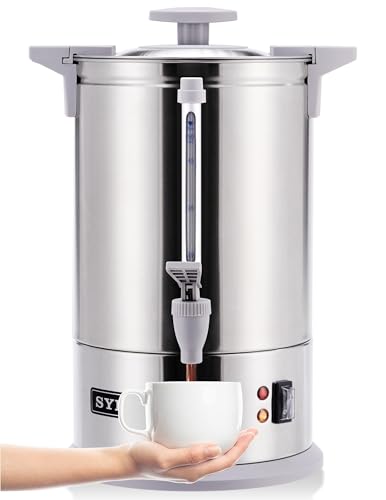
Commercial 304 stainless and a heavy spigot, at a lower tier
SYBO Commercial Grade Stainless Steel Percolate Coffee
SYBO's 8-liter urn brews 50 to 60 cups in about 30 minutes in food-grade 304 stainless, with a heavy-duty spigot built for catering volume. It's the fastest brewer at this capacity and it comes with a two-year replacement warranty.
$109fromAmazonThirty minutes for 50 to 60 cups is genuinely fast. Compare that to roughly an hour for a 60-cup percolator running at a cup a minute. If you're a caterer setting up in a rented hall with a tight load-in window, or a church volunteer arriving 40 minutes before service, that half hour of margin is the whole ballgame.
The body is food-grade 304 stainless, the same grade used in commercial kitchen equipment, and the filter basket is stainless too — no paper filters to buy or forget. Owners running it in busy offices describe it holding up to constant daily use and cleaning up easily, which is the pattern you want from a stainless body. All parts are ETL certified for 110–120V use.
There's automatic shut-off, a keep-warm function, and a heat-and-keep-warm indicator light. The wide mouth makes it far easier to clean than the tall narrow consumer urns — you can actually get your hand and a cloth inside, rather than fishing with a bottle brush.
SYBO covers this with a two-year new-replacement warranty on top of a 30-day refund window, which is unusual at this level. Owner feedback on the company's service response is a recurring theme. That matters for an appliance that sits unused for months and then has to work on the one morning you need it.
Flaws but not dealbreakers
Quality control is the weak spot. A meaningful share of owners report units arriving with manufacturing oil residue that needs a thorough vinegar cleaning before first use, or failing outright within months. The warranty covers it, but a replacement doesn't help you the morning of an event — so unbox and run a water cycle well ahead of time.
Several owners describe the base as less stable than they'd like for a unit this tall and this heavy when full. Put it on a solid table, not a folding one, and keep it away from foot traffic.
SYBO offers a 30-day refund or replacement window plus a two-year new-replacement warranty.
Budget pickOn sale
A small stainless percolator for hosts who rarely need volume
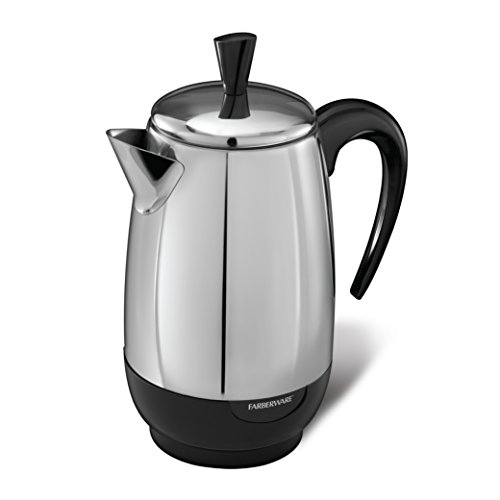
Farberware Electric Coffee Percolator
Farberware's 8-cup electric percolator is stainless steel, brews about a cup a minute, and switches itself to keep-warm when it's done. It's not an urn, but for a dinner party of six it does the job for a fraction of what an urn costs.
$64.99fromAmazonList priceNot every gathering needs 60 cups. If you host a dinner for six a few times a year, an urn is the wrong purchase — it takes up a shelf, brews more than you'll drink, and the leftover sits stewing. This percolator makes eight cups in about eight minutes and then holds them warm on its own.
Stainless steel construction is the reason to pick this over cheaper aluminum pots. The exterior and the coffee basket are both stainless, which means no plastic in the brew path and a pot that survives being packed for an RV trip or a campsite. Owners who moved away from plastic drip machines and pod brewers cite exactly that.
The detachable cord is a small, smart touch. Once the coffee's brewed, unplug the cord and carry the pot to the table like a serving vessel. The no-drip spout means you're not chasing rings on a tablecloth. It's the closest thing here to something you'd actually set down in front of guests.
Flaws but not dealbreakers
Durability is inconsistent. Owners report interior rust developing over time and units failing after moderate use, and the pattern is common enough that we'd treat this as an occasional-use pot rather than a daily driver.
Eight cups is genuinely small. If your gathering ever crosses ten people, you'll be brewing in shifts, and this pot is not the answer for the party scenarios this guide covers.
Who this is for
Buy one of these if you host groups of 20 or more with any regularity — holiday dinners, church coffee hours, office meetings, family reunions, fundraisers. The math on renting stops making sense after two or three events, and an urn you own is an urn that's ready an hour before guests arrive instead of an hour after you drive to pick it up. If you're deciding between renting and buying for a single wedding or one-time party, renting is probably the right call, since a 100-cup urn is a large object to store for something you'll do once.
This guide covers electric urns and percolators meant for serving a crowd from a spigot. It's not about your daily coffee. If you're looking for a machine to make two mugs on a Tuesday, none of these are the answer, and even our budget pick is a compromise built for occasional use. We also don't cover pour-over setups, airpot systems that require a separate brewer, or espresso equipment for events. And we should be clear that urn coffee is a volume solution — if flavor is your priority above all else, brew smaller batches more often, whatever the machine.
How we picked
We built the shortlist around what actually goes wrong at events. Capacity: we sized each urn against catering guidance of 1.5 to 2 cups per adult across a two-hour window, since both undersizing and oversizing cause problems. Heat retention: we compared published temperature findings and body materials against the NSF commercial floor of 140°F through the service period, which is where budget urns tend to fail past 90 minutes. Brew speed: we translated manufacturer rates into how early you need to start, because a cup a minute adds up fast on a big urn. Dispensing: we favored two-way and one-handed spigots and weighed owner reports of drips and leaks heavily. Cleaning: wide stainless bodies you can reach into beat tall narrow ones. Durability: recurring reports of rust, residue, or early failure counted against a model regardless of its spec sheet.
Other large coffee urns for parties and gatherings worth considering
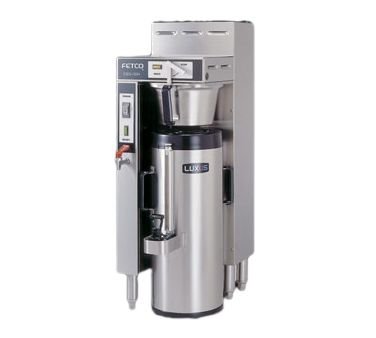
If you're brewing for events every week: The Fetco CBS-51H-15 5000 Series Single Coffee Brewer ($2,633.85) — The Fetco CBS-51H-15 is a single-station commercial brewer with 1.5-gallon capacity, and it belongs to a different world than the rest of this guide. Fetco's larger CBS-2132XTS pushes 3.5 gallons an hour in continuous service, and the 5000 Series shares that professional lineage — precise temperature control in the 195–205°F range the Specialty Coffee Association calls for, built for a service counter rather than a folding table. If you cater, run a busy office pantry, or serve coffee at a venue several times a week, the per-event cost drops fast. What you give up is everything convenient about an urn: it's expensive, it needs a dedicated spot, it typically wants a water line or at minimum a serious electrical situation, and it brews into separate dispensers rather than serving from its own body. Most hosts should not buy this.
The competition
Here's what else our research turned up. This isn't every coffee urn on the market — it's the set of listings we looked at closely, and a couple of them turned out to be solving a different problem than the one this guide is about.
The BUNN GRB Velocity Brew 10-Cup Home Coffee ($128.40) — The Bunn GRB Velocity Brew is a superb coffee maker and the wrong tool for a party. It brews a 10-cup carafe in about four minutes because it keeps 70 ounces of water hot in an internal stainless tank, and Bunn's commercial urns use that same always-hot boiler design to hit full brewing temperature in under 15 minutes. Owners keep them for seven to nine years of daily use. But 10 cups is a household batch, there's no spigot, and someone has to pour. If you want excellent everyday coffee and you're willing to brew four carafes back to back for a small gathering, this is a fine machine — just not a serving solution for a crowd.
The MIRRO 9 Cup Aluminum Coffee Percolator with ($20.58) — The Mirro 9-cup percolator has the look a lot of hosts want — brushed aluminum, glass knob on top, the pot your grandmother used. It makes decent coffee and the permanent filter basket saves you buying papers. The problems are that it's aluminum, which sheds heat quickly once it's off the stove, and that the build is thin. Owners describe a wobbly handle, a plastic rather than glass sight globe, and packaging that lets parts come apart in transit. At nine cups it's a breakfast pot, not a party urn. Buy it if you want the classic look for a small table or a camping trip, and keep your expectations at that scale.
Care and cleaning
Rinse the urn out the same night, not the next morning. Coffee oils set as they cool and turn rancid, and that's what makes the next batch taste stale no matter how fresh your grounds are. Pull the basket and stem, wash them by hand, and get a long-handled bottle brush into the bottom of tall narrow urns where the heating well collects residue. Most bodies shouldn't go in the dishwasher and none should be submerged — check your manual, then wipe the exterior instead. Every few uses, run a cycle of water with a few tablespoons of white vinegar, then two plain water cycles to clear the taste. On measuring: the Specialty Coffee Association's ratio works out to about one tablespoon of grounds per 6-ounce cup, and since almost no urn manual prints it, most event coffee ends up watery. Measure to that and dry the whole thing completely before it goes back on the shelf.
Questions we get
What size coffee urn do I need for 50 guests?
Plan on 1.5 to 2 cups per adult over a two-hour window, which is the standard catering guideline. For 50 guests that's 75 to 100 cups. A 60-cup urn with one planned refill works, but a 100-cup model means you set it once and forget it.
How long does a coffee urn keep coffee hot after brewing?
It depends on the body material. Published testing found stainless steel urns held a safe 160–175°F serving temperature for up to two hours after brewing, while aluminum-bodied models dropped below 140°F within about 75 minutes. Plan to brew a second batch rather than stretching one past the two-hour mark.
Can I use a coffee urn for hot chocolate or apple cider?
Hot water and cider, yes — plenty of owners use these urns for tea and mulled cider, and the two-way spigots handle it fine. Hot chocolate is riskier, because milk and cocoa solids scorch on the heating element and are miserable to clean out. If you want cocoa, heat it separately and use the urn to dispense hot water for instant mixes.
What's the difference between a coffee urn and a percolator?
Most large urns are percolators — they cycle water up a stem and back down through the grounds repeatedly. The difference is scale and serving: an urn holds 40 to 100 cups and dispenses through a spigot, while a percolator is a pot you pour from. Percolators brew at a higher cycle temperature than drip machines, which makes stronger, slightly different-tasting coffee.
Is it safe to leave a coffee urn on unattended for hours?
Leaving one running overnight isn't a good idea, and dry-firing an empty urn can damage the element. Beyond safety, there's a taste reason to turn it off: published testing found percolator urns held on keep-warm past 60 to 90 minutes produced measurably more bitter coffee, since brewed liquid keeps recirculating through spent grounds. Brew fresh batches instead of holding one all day.
Should I rent or buy an urn for a one-time event?
Rent for a single event, especially a large one — a 100-cup urn is a big thing to store for something you'll do once. Buy if you host two or three times a year or more, because the rental fees add up quickly and an urn you own is ready when you are. Churches, offices, and regular entertainers should just buy.
Why you should trust us
For this guide:
- We read manufacturer specifications and listing details for every urn here, including rated capacity, brew rate, body material, and warranty terms.
- We compared published findings from Good Housekeeping and Consumer Reports on heat retention and keep-warm bitterness against the NSF/ANSI 4 commercial holding standard and the Specialty Coffee Association's brewing temperature and ratio guidance.
- We read through owner feedback for recurring themes — leaks, spigot behavior, cleaning access, and early failures — and used those patterns to shape the flaws and caveats above.
- We read owner reviews on every listing, weighted toward the critical ones, because that is where the recurring failures show up.
- We have a systematic way of automatically fetching the latest prices, so the numbers on this page stay current.
- This is a research-focused guide, so the team may not own every product listed — though we often do own the top winners, which gives us extra context for the recommendations.
- We don't accept free products, and the retailer commission never changes which product we recommend.
Sources
Best Coffee Urns for Large Groups — Good Housekeeping, Good Housekeeping
Best Coffee Urns — The Spruce Eats, The Spruce Eats
Hamilton Beach 40515 Coffee Urn — Product Specifications, Hamilton Beach
FETCO CBS-2132XTS Commercial Coffee Brewer — Product Specifications, FETCO
Bunn Commercial Coffee Equipment Overview, Bunn
NSF Certified Commercial Hot Beverage Equipment, NSF International
Coffee Brewing Standards — Specialty Coffee Association, Specialty Coffee Association (SCA)
Large-Volume Coffee Service Best Practices — National Restaurant Association, National Restaurant Association
West Bend 100-Cup Coffee Urn — Product Page, West Bend
Coffee Maker Ratings and Reviews — Consumer Reports, Consumer Reports
Amazon product listings and owner reviews for all 8 products
Manufacturer specification pages for each product
Some passages in this guide may be paraphrased with AI help. Prices are refreshed automatically.
More like this.
Continue exploring appliances reviews and recommendations.

The Best Coffee Makers
Your coffee maker is the appliance you use most and think about least. It runs every single morning, usually before you're awake enough to troubleshoot…

The Best Coffee Grinders
Your grinder shapes your coffee more than your brewer does. Grind size and evenness control how fast water pulls flavor out of the beans, so a pile of…

The Best Magnetic Parts Trays
Anyone who's dropped a caliper bolt into gravel knows the appeal of a magnetic parts tray. You stick it to a fender, a tool cart rail, or the side of an…

The Best Milk Frothers
A milk frother is a small appliance with one job, and it either does that job in the morning or it annoys you forever. The good ones take cold milk, warm…

The Best Kitchen Carts and Islands
A kitchen cart solves a problem most of us live with daily: there's nowhere to put things down. You're rolling out pie dough next to the sink, or the…

The Best Pasta Makers
Fresh pasta takes about an hour, and most of that is the dough sitting still. The machine's job is narrow: turn a lump of dough into sheets or strands of…