The Best Coffee Grinders
Your grinder shapes your coffee more than your brewer does. Grind size and evenness control how fast water pulls flavor out of the beans, so a pile of mismatched particles gives you sour and bitter in the same cup. That's the case for burr grinders in a nutshell: America's Test Kitchen found they cut particle size variation by more than 60% compared with blade grinders. You'll notice it most on the mornings you open a new bag. A good grinder makes a decent bag drinkable and a great bag worth the money.
No grinder is perfect, though. Every one of these makes noise, and the quiet ones are only quiet by comparison. All of them hold onto some grounds between doses, so your first cup after switching beans is a blend of old and new. Static is a fact of life in dry indoor air, and you'll knock grounds off the chute with a chopstick or a damp finger. And nothing here does espresso and French press equally well without some compromise.
Where you land depends on how you brew. If you pull espresso, adjustment resolution and retention matter most, because a fraction of a millimeter changes your shot by seconds. If you're a drip-and-French-press household, consistency and simple controls matter more, and you can spend a lot less. We compared burr size and material, adjustment range, stated retention, noise and repairability across the lineup. We think that the Baratza Encore ESP is the best coffee grinder for most people, and that the Breville Smart Grinder Pro is the one to buy if you want programmable dosing and a setting for every brew method in the house.
Everything we recommend

Espresso-capable grinding with parts you can actually replace
Programmable dosing and a setting for every brew method

Simple, consistent drip grinding without the fuss

Single-dose espresso grinding, if you like tinkering

Espresso-fine grinding by hand, for travel or small counters
Prices as of Oct 23, 7:21 AM PT · Details
At a glance
| Product | Burr type | Grind settings | Price | |
|---|---|---|---|---|
| OXO Brew Conical Burr Electric Coffee BeanBudget pick | 40mm steel conical | 15 plus 43 micro | $109.95 |
| TIMEMORE Chestnut C3 ESP Pro Manual CoffeeAlso great | S2C stainless conical | About 36 levels | $99 |
| Baratza Encore ESP Coffee Grinder ZCG495BLKTop pick | 40mm alloy steel conical | 40 micro/macro steps | $199.95 |
 | Matte Black Coffee Connoisseur Bundle: Fellow StaggAlso consider | Cafe-sized flat burrs | 11 settings, 31 steps | $540 |
| Breville BCG820BSS Smart Grinder ProRunner-up | Conical burr | 60 settings | $199.95 |
| DF64 Gen 2 Single Dose Coffee GrinderUpgrade pick | — | Stepless | $389 |
 | Baratza Sette 270Wi-Grind by Weight Conical BurrAlso in lineup | Conical burr | 270 grind settings | $599.95 |
Prices as of Oct 23, 7:21 AM PT · Details
How we picked
Burr quality. We ruled out blade grinders entirely, since America's Test Kitchen measured more than 60% less particle size variation from burr grinders. Beyond that we looked for hardened steel burrs at 40mm or larger, since burr size and material predict how long a grinder holds its edge.
Adjustment range. Espresso needs resolution measured in fractions of a millimeter, so we favored stepless dials or micro-step scales for any grinder we'd recommend for shots. For drip and French press, published reviews and spec sheets suggest a clear stepped dial is easier to live with.
Retention and static. Home Grounds puts typical hopper-fed retention at 4 to 7 grams versus under 0.3 grams for single-dose designs, which is the difference between switching beans freely and purging every time. We also weighed static-control features like the ionizer on the DF64.
Build and repairs. We favored metal burr carriers, quick-release burr mounts and brands with a documented parts supply, because a grinder you can rebuild lasts a decade. Wirecutter's 200-plus dose cycles on the Encore ESP is the kind of durability evidence we looked for.
Noise and heat. Baratza's engineering notes argue that motors running below roughly 1,600 RPM transfer less heat to the beans and preserve aromatics. We gave credit to slower, quieter designs — Fellow's Ode drops the gearbox specifically to cut noise.
Top pick
Espresso-capable grinding with parts you can actually replace
Baratza Encore ESP Coffee Grinder ZCG495BLK
The Encore ESP grinds fine enough for real espresso and coarse enough for French press, and it's built so you can pull the burrs out and swap wear parts instead of buying a new grinder. It's the one we'd hand a friend who brews two ways.
$199.95fromAmazonPrices as of Oct 23, 7:21 AM PT · Details
The two-speed adjustment is what makes this a genuine espresso grinder. Steps 1 through 20 are micro-steps sized for espresso, and 21 through 40 open up for filter brewing. You get fine resolution exactly where a half-step swings your shot by several seconds, and bigger jumps where you don't need the precision. Most grinders in this class give you a single coarse scale and hope you can live with it.
The burrs are 40mm hardened alloy steel made in Liechtenstein, and they hold up. Wirecutter's testers ran the Encore ESP through more than 200 dose cycles across espresso and drip settings without the burrs degrading. That's the part of a grinder that wears out first, and it's the part cheap grinders get wrong. Conical burrs are also forgiving, which is why Perfect Daily Grind points to them for people brewing several ways.
Cleaning takes about a minute. The burr mount is quick-release, so you twist it out by hand and brush the chamber without tools or a teardown video. That matters more than it sounds, because stale oils in the burr chamber are the reason a grinder starts tasting flat after a few months. If cleaning is annoying, you won't do it.
Baratza's design school is slow grinding: the company's engineering notes argue that grinders running below roughly 1,600 RPM pass much less heat into the beans and keep more of the aromatics. The practical upside for you is a grinder that doesn't heat up on back-to-back doses. And when something does break, Baratza sells the parts and walks people through the repair, which is rare at any price.
Flaws but not dealbreakers
It's hopper-fed, so grounds sit in the chamber between doses. Home Grounds puts typical hopper-fed retention at 4 to 7 grams, against under 0.3 grams for dedicated single-dose designs. If you switch between a light Ethiopian and a dark blend every other day, you'll be grinding a throwaway dose to purge. If you buy the same bag every week, you'll never think about it.
The espresso end is capable, not competitive with dedicated flat-burr grinders. You can dial in a good shot, but you won't get the same clarity a 64mm flat burr gives you. The housing is plastic, it's louder than the Fellow Ode, and static cling in dry air is real.
Runner-up
Programmable dosing and a setting for every brew method
Breville BCG820BSS Smart Grinder Pro
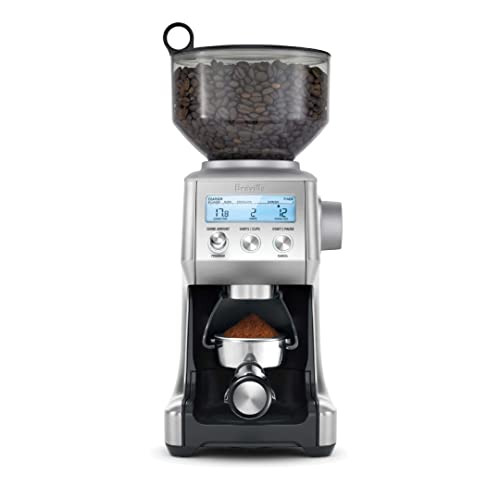
The Smart Grinder Pro has 60 grind settings, a digital timer accurate to 0.2-second increments, and a portafilter cradle so you can grind straight into your basket. It's the pick for a house where one person pulls shots and someone else makes a pot of drip.
$199.95fromAmazonPrices as of Oct 23, 7:21 AM PT · Details
Households are the reason this grinder exists. You set a dose time for espresso, another for the drip machine, and hand the grinder to someone who doesn't want to think about it. The LCD shows your setting, your grind time and the number of shots or cups, so nobody has to remember where the dial was yesterday. Seattle Coffee Gear notes the timer resolves down to 0.2-second steps.
Sixty settings is enough range to cover every brewer you own. The scale runs from espresso-fine to French press coarse, and the jumps between neighboring settings are small enough that dialing in drip or pour-over is quick. You'll spend a morning finding your numbers and then leave them alone.
It's also the most flexible about where the coffee lands. You can grind into the portafilter cradle, the included container, a gold-tone basket or a paper filter, which sounds like a small thing until you've spent a week funneling grounds out of a bin into a basket. The 18-ounce hopper means you're not refilling it constantly either.
Flaws but not dealbreakers
The 60 settings are stepped, and for espresso that's the ceiling. There will be mornings when one setting runs too fast and the next runs too slow, and you'll adjust your dose or tamp to split the difference. Stepless grinders don't put you in that spot.
Dosing by time drifts. Beans grind at different rates as they age and as roast level changes, so the same 18-second dose won't weigh the same in week three as it did on day one. Weigh your dose if you care about repeatability. The build is also plastic-heavy for its size, and static clumping in the chute is a common complaint from owners.
Budget pick
Simple, consistent drip grinding without the fuss
OXO Brew Conical Burr Electric Coffee Bean
The OXO uses 40mm stainless conical burrs and a 15-position dial with micro-adjustments hidden inside, so there's almost nothing to get wrong. If you're leaving a blade grinder behind and you brew drip or French press, this is the upgrade that costs the least.
$109.95fromAmazonPrices as of Oct 23, 7:21 AM PT · Details
Fewer choices is the whole point here. Home Grounds calls the 15-setting dial one of the easiest budget grinders to use consistently for drip, and that tracks: you pick a number, you push the button, and it remembers where you left it. Compare that with a 60-setting scale you have to relearn every time somebody borrows the grinder.
The 40mm stainless conical burrs are real burrs, not a compromise. For drip, pour-over and French press, the grounds come out even enough that your brewer can do its job, and the difference from a blade grinder is not subtle. There are 43 micro-adjustments behind the main dial if you eventually want finer control, but you can ignore them for years.
Small conveniences add up. The hopper holds 12 ounces and lifts off for storage, and the tinted lid blocks UV, which matters if your counter gets afternoon sun. At 4.5 pounds it's easy to move for cleaning. For a first burr grinder, that's the right set of priorities.
Flaws but not dealbreakers
Espresso is not what this is for. The dial's fine end can get close on a forgiving machine, but you don't have the resolution to chase a shot time, and you'll be frustrated if you try.
It's a hopper grinder, so grounds hang around in the chamber between doses, and it's noisy in the way most consumer grinders are noisy. Filling that big hopper is also a trap if you brew a cup a day — beans go stale sitting in there. Load a few days' worth at a time.
Upgrade pick
Single-dose espresso grinding, if you like tinkering
DF64 Gen 2 Single Dose Coffee Grinder
The DF64 Gen 2 is a single-dose grinder with a stepless dial, a plasma ionizer in the chute to kill static, and stated retention under 0.1 gram. It's the pick for someone who weighs every dose and wants espresso clarity from a home machine.
$389fromAmazonPrices as of Oct 23, 7:21 AM PT · Details
Single-dosing changes how you use a grinder. You weigh beans into the top, grind them, and get essentially all of them back — DF64 states retention under 0.1 gram, even without a bellows. If you keep three bags open and switch by mood, that's the difference between a clean shot and a purge dose you pour down the sink every morning.
Flat burrs are the reason enthusiasts keep landing on this grinder. Prima Coffee Equipment notes the 64mm flat burrs are the same size used in commercial machines that cost several times as much. Perfect Daily Grind describes flat burrs as producing a tighter, more uniform particle distribution — the trait people mean when they say a shot tastes clear rather than muddy.
The stepless dial matters just as much for espresso. Instead of jumping between fixed numbers, you nudge the chrome-wrapped ring by a hair and watch your shot time move a second or two. That's the level of control the criteria for espresso actually demand, and stepped grinders can't give it to you.
The Gen 2 fixes the annoyances, not just the grind. A plasma generator in the exit chute neutralizes static, so grounds fall into the 58mm dosing cup instead of clinging to everything. An anti-popcorn disc stops beans from bouncing on top of the burrs, which speeds up the grind and keeps it more even. Small fixes, but they're the ones owners of earlier single-dose grinders complained about.
Flaws but not dealbreakers
There's no hopper, and that's a feature only if you want it. You'll weigh beans on a scale before every grind, which adds a step to a groggy morning and makes grinding for a full pot of drip a chore.
A stepless dial has no numbers to return to. You'll learn to mark your position, and you'll rediscover it by feel when someone bumps the ring. This is also the most expensive grinder here by a wide margin, and it asks the most from you. If you'd rather push a button and walk away, buy the Encore ESP.
Also great
Espresso-fine grinding by hand, for travel or small counters
TIMEMORE Chestnut C3 ESP Pro Manual Coffee
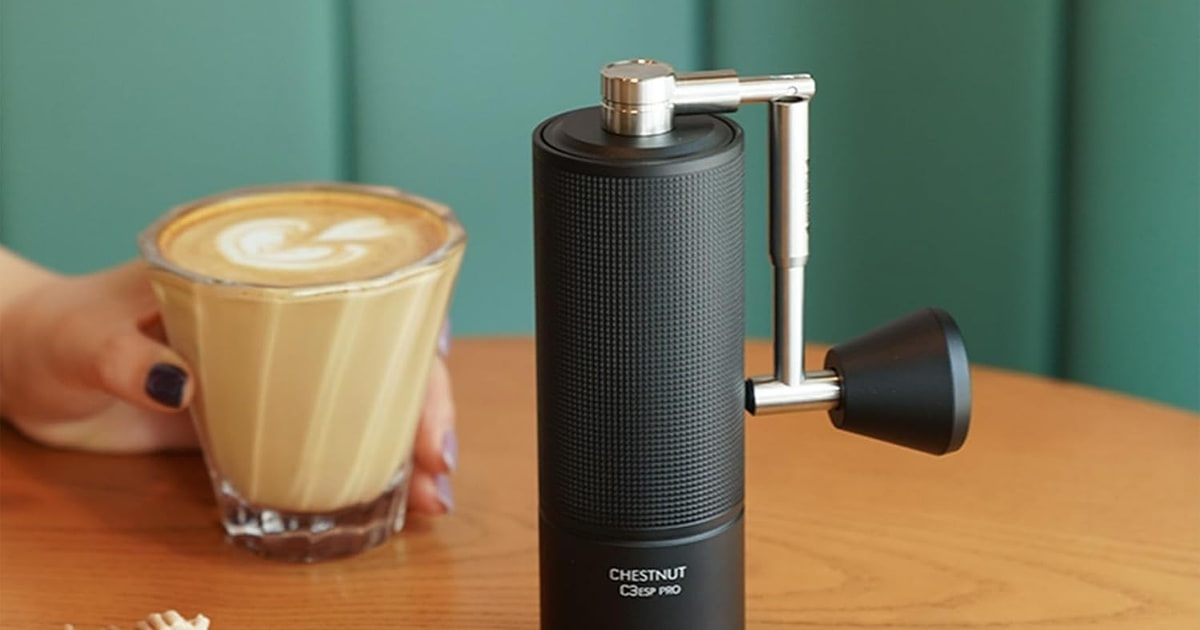
The Chestnut C3 ESP Pro is an all-metal hand grinder with stainless S2C conical burrs and roughly 36 clicks of adjustment, each moving about 0.0233mm. It weighs under a pound and folds down, so it fits a carry-on or a cabin kitchen.
$99fromAmazonPrices as of Oct 23, 7:21 AM PT · Details
A good hand grinder beats a cheap electric one, and this is the clearest example. CoffeeGeek forum testing rated the C3 Pro's grind consistency comparable to electric grinders costing two to three times as much. The burrs are CNC-machined stainless with a double-bearing axle, so the shaft doesn't wobble — wobble is why cheap manual grinders produce dust and boulders in the same dose.
The ESP version is built specifically for espresso, and the click spacing shows it. Each click moves the burrs about 0.0233mm, which is fine enough to chase a shot time in one-second increments. Most hand grinders make you choose between espresso resolution and a usable coarse range. This one commits to espresso.
It also solves problems electric grinders don't. It draws no power, makes almost no noise, and the handle folds flat against the 52mm body. European Coffee Trip clocked roughly 45 to 60 seconds for a standard 18-gram dose, which is quick for a manual grinder. If you're grinding in a hotel room while someone's asleep, that's the whole argument.
Flaws but not dealbreakers
It's physical work, and owners are split on how much. Several describe the crank as smooth and easy; others — particularly people who've moved over from lighter manual grinders — find espresso-fine settings genuinely hard on the hands and wrists. If grip strength is a concern for you, try before you commit.
Capacity is about one cup's worth of beans, so it's a single-serve tool, not a way to grind for a dinner party. And because the ESP burrs are cut for espresso, owners note it grinds fine even at the coarse end of the range, which limits how well it does French press and cold brew.
Who this is for
Buy a burr grinder now if you're still using a blade grinder, or if you're grinding at the store and brewing that coffee over two weeks. Those two changes do more for your cup than a new brewer will. If you already own a working burr grinder and you brew drip, you probably don't need to upgrade — put the money into fresher beans and a scale instead. The exception is espresso: if you're fighting your machine every morning, the grinder is almost always the reason.
This guide covers home grinders for espresso, pour-over, drip, French press and cold brew, in both electric and manual form. We're not covering commercial shop grinders, blade grinders, or the grinder built into an all-in-one espresso machine. We also can't rank these by how they sound or feel on your counter, since we're working from specifications, published reviews and owner feedback rather than firsthand use.
How we picked
We weighed five things. Burr quality: hardened steel burrs, 40mm or larger, since America's Test Kitchen ties burr grinding to more than 60% less particle variation than blades. Adjustment range: stepless or micro-stepped for espresso, a clear stepped dial for filter brewing. Retention and static: the gap between roughly 4 to 7 grams in hopper grinders and under a gram in single-dose designs, plus whatever the grinder does about static cling. Build and repairs: metal where it counts, quick-release burrs, and a brand that sells parts. Noise and heat: slower motors, which Baratza's engineering notes link to less heat transfer and better aromatics.
Other coffee grinders worth considering
If you want the cleanest pour-over grind and a kettle to match: The Matte Black Coffee Connoisseur Bundle: Fellow Stagg — This bundle pairs the Fellow Ode Gen 2 grinder with the Stagg EKG Pro gooseneck kettle, and for a dedicated pour-over setup it's hard to beat. The Ode uses cafe-sized flat burrs with 11 settings and 31 steps, and Seattle Coffee Gear notes the Gen 2's redesigned burr set and smaller grind chamber cut static cling and clumping considerably versus the first version. Fellow ditched the gearbox to make it quiet, which you'll appreciate if your kitchen shares a wall with a bedroom. What you give up: it's built for filter, not espresso — that takes a separate burr kit — and you're paying for a kettle you may already own. If you brew V60 or Chemex every morning and want one purchase to finish the setup, this is it.
The competition
Here's what else the research turned up. This isn't every grinder on the market — it's the group that came up repeatedly in published reviews and owner discussion alongside our picks, and that we could confirm as currently available.
The Baratza Sette 270Wi-Grind by Weight Conical Burr — The Baratza Sette 270Wi is the most interesting near-miss here. It grinds by weight using Acaia's technology, with three programmable dosing buttons, and CoffeeGeek found it hit doses within 0.1 gram in repeated trials — that's a real advantage if you chase espresso recipes. The straight-through grind path keeps retention low, it moves up to 5 grams per second, and 270 settings give you plenty of dial-in room. It lost to the Encore ESP on two counts. It's built around espresso, so its coarse range stops short of French press territory, and it's loud enough that owners bring it up constantly. Owner ratings also skew lower than Baratza's other grinders, which points at long-term durability. If you pull shots daily, weigh every dose, and don't own a French press, it's still worth a look.
Care and cleaning
Coffee oils go rancid, and they build up on burrs faster than you'd think. Brush the burr chamber out every few weeks, and do a full teardown every couple of months — on the Encore ESP that means twisting out the quick-release burr by hand, which takes about a minute. Don't wash burrs with water; brush them dry, or use grinder cleaning tablets if your manual allows them. For static, wait a few seconds before knocking the grounds out, or add a drop of water to the beans before grinding. Home burrs generally last for hundreds of pounds of coffee, so most people never replace them, but if your grinder suddenly runs slow or produces more dust than usual, worn burrs are the likely cause and both Baratza and DF64 sell replacements.
Questions we get
Is a burr grinder really worth it over a blade grinder?
Yes, and it's the single biggest upgrade most people can make. A blade grinder chops beans randomly, so you get dust and chunks in the same dose, and water extracts them at wildly different rates. America's Test Kitchen measured more than 60% less particle size variation from burr grinders in side-by-side extraction. That's the difference between coffee that tastes muddled and coffee that tastes like the bag says it should.
What's the difference between conical and flat burrs?
Flat burrs produce a tighter, more uniform particle distribution, which is why espresso people favor them for clarity — Perfect Daily Grind describes the distinction in exactly those terms. Conical burrs spread the particle range wider, which is more forgiving and works well across immersion methods like French press. If you only brew espresso, lean flat. If you brew three ways, conical is the safer buy.
Can one grinder handle both espresso and drip coffee well?
It can, but you need enough adjustment resolution at the fine end. The Encore ESP does it by splitting its scale — micro-steps 1 through 20 for espresso, macro-steps 21 through 40 for filter. A grinder with one coarse scale across the whole range will feel too jumpy for espresso. Expect to leave a few grams of the old grind in the chamber every time you switch.
How much retention is acceptable in a coffee grinder?
It depends entirely on how often you switch beans. Home Grounds puts hopper-fed grinders at roughly 4 to 7 grams retained, versus under 0.3 grams for dedicated single-dose designs. If you drink one bag at a time, several grams sitting in the chamber never affects your cup. If you rotate between three roasts, that stale coffee shows up in your first shot, and a single-dose grinder like the DF64 Gen 2 is worth the extra effort.
Should a beginner buy a hand grinder or an electric one?
Buy a hand grinder if you brew one cup at a time, travel often, or have almost no counter space. The Timemore C3 ESP Pro grinds an 18-gram dose in roughly 45 to 60 seconds according to European Coffee Trip, and CoffeeGeek rates its consistency alongside electrics costing much more. Buy electric if you make more than a cup at a time or if grip strength is a concern — cranking espresso-fine by hand is real work.
What's the quietest grinder for an apartment?
The Fellow Ode Gen 2 is the one designed around noise: Fellow dropped the gearbox and chose materials specifically to make it quieter. A hand grinder like the Timemore is quieter still, since there's no motor at all. Every electric grinder here makes enough noise to hear through a wall, so if you grind before anyone else is up, those two are your options.
Why you should trust us
For this guide:
- We read published reviews and comparison testing from America's Test Kitchen, Wirecutter, Home Grounds, Seattle Coffee Gear, Prima Coffee Equipment, European Coffee Trip, CoffeeGeek and Perfect Daily Grind.
- We compared manufacturer specifications for burr size and material, adjustment resolution, stated retention and grind speed across every grinder in this guide.
- We read through owner feedback looking for recurring themes around noise, static cling, grinding effort and long-term durability.
- We read owner reviews on every listing, weighted toward the critical ones, because that is where the recurring failures show up.
- We have a systematic way of automatically fetching the latest prices, so the numbers on this page stay current.
- This is a research-focused guide, so the team may not own every product listed — though we often do own the top winners, which gives us extra context for the recommendations.
- We don't accept free products, and the retailer commission never changes which product we recommend.
Sources
The Best Coffee Grinders for 2026 - Wirecutter, Wirecutter
We Tested Coffee Grinders and Here's What We Found - America's Test Kitchen, America's Test Kitchen
Baratza Encore ESP Review, Home Grounds
Fellow Ode Gen 2 Review: Flat Burr Grinding Reimagined, Seattle Coffee Gear
Niche Zero Grinder Review, Home Grounds
DF64 Gen 2 Espresso Grinder Review, Prima Coffee Equipment
Understanding Burr Geometry: Conical vs. Flat, Perfect Daily Grind
Timemore Chestnut C3 Pro Review: Manual Grinding Done Right, European Coffee Trip
Baratza Sette 270Wi Review, CoffeeGeek
Breville Smart Grinder Pro Review, Seattle Coffee Gear
Grind Size and Particle Distribution: Why It Matters, Baratza
OXO Brew Conical Burr Grinder Review, Home Grounds
Amazon product listings and owner reviews for all 7 products
Manufacturer specification pages for each product
Some passages in this guide may be paraphrased with AI help.
Product prices and availability are accurate as of the date/time indicated and are subject to change. Any price and availability information displayed on Amazon.com at the time of purchase will apply to the purchase of this product.
More like this.
Continue exploring appliances reviews and recommendations.

The Best Large Coffee Urns for Parties and Gatherings
Coffee at a party is a logistics problem before it's a taste problem. You need 60 cups ready at the same moment, hot two hours later, and pourable by a…

The Best Coffee Makers of 2026
Your coffee maker is the appliance you use most and think about least. It runs every single morning, usually before you're awake enough to troubleshoot…

The Best Electric Spice Grinders
Pre-ground spice is convenient, and it's also a slow leak. The oils that make cumin smell like cumin start escaping the moment the seed breaks open, so a…

The Best Dog Nail Grinders and Trimmers
If you can hear your dog's nails clicking across the kitchen floor, they're already too long. Overgrown nails push the toes out of alignment, change how a…

The Best Pour-Over Coffee Kettles
A gooseneck kettle is the one piece of coffee gear that changes your cup immediately. The narrow spout slows the water down so you can wet the grounds…

The Best Angle Grinders
An angle grinder is what you reach for when metal needs to be cut, smoothed, or stripped away. It takes a rusted hinge off a gate, cuts through a seized…