The Best Angle Grinders

An angle grinder is what you reach for when metal needs to be cut, smoothed, or stripped away. It takes a rusted hinge off a gate, cuts through a seized bolt, and knocks a weld bead flat. Most home and light-pro work runs on a 4.5-inch wheel, which handles rebar, angle iron, tile and paint stripping without getting unwieldy. This Old House notes that 4.5-inch models remain the most versatile size for DIYers, with 7- and 9-inch grinders reserved for concrete and heavy fabrication.
No grinder is pleasant to use. They're loud, they throw sparks across the garage, and the vibration works into your hands after a few minutes. They also bite. OSHA reports that kickback and wheel fragmentation are among the leading causes of severe hand and eye injuries on jobsites, which is why guards, clutches and brakes keep improving. And the wheel matters as much as the tool. The American Welding Society points out that choosing the wrong wheel type hurts both cutting speed and safety.
So the question isn't really which grinder is strongest. It's which one you'll still be comfortable holding twenty minutes in, whether you can move the guard without hunting for a wrench, and whether you want a cord or a battery. Corded models still make the most sense for long, continuous work, since you're not buying batteries to feed them. Cordless makes sense if you're already on a platform. We think that the DeWalt DWE402K is the best angle grinder for most people, and that the Makita GA4530X is the one to buy if you want the lightest corded grinder for long overhead sessions.
Everything we recommend

Serious power, and guard changes you can do in a second

Lighter and better sealed, with a bit less muscle

Light, simple, and it arrives with wheels and a case
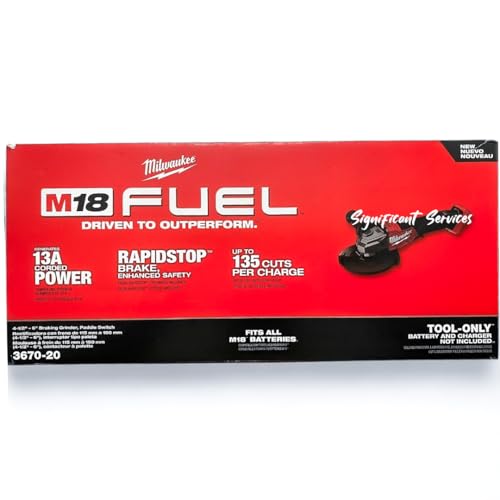
Cordless power, plus a brake that stops the wheel fast

The cordless pick if you already own LXT batteries
Prices as of Oct 22, 7:36 AM PT · Details
At a glance
| Product | Wheel size | Motor | Price | |
|---|---|---|---|---|
| DEWALT Angle Grinder ToolTop pick | 4-1/2 in. | 11 amps, 11,000 RPM | $130.99 |
| Makita GA4530X 4-1/2-Inch Angle Grinder with GrindingRunner-up | 4-1/2 in. | 6.0 amps, 11,000 RPM | $89 |
| Milwaukee Electric - M18 Fuel 4-1/2-6 BrakingUpgrade pick | 4-1/2 / 6 in. | 18V brushless | $149On sale |
 | BOSCH GWS18V-8-2N 18V 4-1/2" Angle Grinder withAlso in lineup | 4-1/2 in. | 18V brushless | Check price |
| Metabo HPT 4-1/2-Inch Angle GrinderBudget pick | 4-1/2 in. | 6.2 amps, 980W | $49 |
 | RYOBI ONE+ HP 18V Brushless Cordless 4-1/2Also consider | 4-1/2 in. | 18V brushless, 9,200 RPM | $98.28 |
| Makita XAG04Z 18V LXT® Lithium-Ion Brushless CordlessAlso great | 4-1/2 and 5 in. | 18V LXT brushless | Check price |
 | Metabo Angle GrinderAlso consider | 5 in. | 2000W brushless | $199.99 |
Prices as of Oct 22, 7:36 AM PT · Details
How we picked
Motor and headroom. We compared amp ratings, wattage and no-load rpm across every spec sheet, and weighted overload protection and speed-under-load features heavily. A grinder that bogs the moment you push on it wastes wheels and your time.
Safety hardware. Paddle switches, lock-offs, electric brakes and kickback shutoffs all moved a tool up our list, given what OSHA reports about grinder injuries. Coast-down time mattered as much as raw power.
Weight and grip. We looked at listed weights and grip dimensions, because fatigue decides which grinder you actually reach for. Anything near 4 pounds got credit for overhead and long-session work.
Guard and wheel changes. Tool-free guard rotation and keyless wheel release came up repeatedly in published reviews as the difference between a tool people use correctly and one they use with the guard in the wrong spot.
Dust and durability. Sealed motor paths, dust ejection and serviceable brushes separate grinders that last years from ones that die in a fabrication shop. Pro Tool Reviews and owner feedback both point to dust as the usual killer.
Top pick
Serious power, and guard changes you can do in a second
DEWALT Angle Grinder Tool
The DWE402K has the strongest corded motor in this group and the fastest guard adjustment. It's built around the jobs most people actually do — cutting angle iron, grinding welds, stripping rust — and it takes dust abuse better than the cheap grinders it sits next to.
$130.99fromAmazonPrices as of Oct 22, 7:36 AM PT · Details
This is the most powerful corded 4.5-inch grinder here. The 11-amp motor spins at 11,000 rpm with no load, and DeWalt builds in overload protection so it won't quit the first time you lean into a cut. When you're slicing angle iron, grinding down a weld, or taking rust off a truck frame, that headroom is what keeps the wheel from bogging under pressure.
Guard adjustment is the small thing you'll appreciate every single week. The One-Touch guard swings a full 360 degrees in one motion, so moving from a cutting position to a grinding position takes a couple of seconds. The Quick-Change wheel release works the same way — no spanner, and no wrench rattling loose in the bottom of your bag.
Grinders usually die from dust, not from work. DeWalt's Dust Ejection System pushes grit back out of the air intake vents before it settles into the motor, which matters if you cut masonry or grind cast iron. The low-profile gear case helps too, getting the head into tight spots like under a car or inside a frame.
The paddle switch is the safety feature most people underrate. You have to keep squeezing for the tool to run, and the lock-off keeps it from starting on its own if something presses the paddle in transit. Let go, or drop it, and the tool stops making power. Slide switches, which are common on cheaper grinders, keep right on spinning until you get back to them.
Flaws but not dealbreakers
It's the heaviest corded grinder here. The kit lists at 8.25 pounds, against 4 pounds for the Makita and Metabo HPT tools, and you'll feel that difference in your shoulders after ceiling-height work. For quick jobs it's a non-issue. For an afternoon of overhead grinding, it's the main reason to look at something lighter.
There's no electric brake, so the wheel coasts for a while after you release the paddle. Get in the habit of holding the tool until it stops instead of setting it down spinning. And a cord is still a cord — on a ladder or up on scaffolding, it snags on everything.
Runner-up
Lighter and better sealed, with a bit less muscle
Makita GA4530X 4-1/2-Inch Angle Grinder with Grinding
The GA4530X weighs 4 pounds and has a barrel grip just 2-1/4 inches around, which makes it the easier tool to hold for a long stretch. It gives up some motor headroom to the DeWalt, but it's built to survive dusty shops.
$89fromAmazonPrices as of Oct 22, 7:36 AM PT · Details
Pick this one up and the difference is immediate. It's 4 pounds, with a slim 2-1/4-inch barrel grip that smaller hands can actually wrap around. If you're grinding overhead, working on a ladder, or cleaning up a long run of welds, that lightness does more for your endurance than an extra couple of amps ever will. Makita designed it around fatigue, and it shows.
Labyrinth construction is the reason fabricators keep buying these. Makita routes the path into the motor housing so dust and debris have a hard time reaching the windings and bearings. Pro Tool Reviews credits that design with extending tool life in dusty fabrication shops. If your grinder lives in a shop full of steel dust and cutoff grit, this is the feature that decides how many years you get.
The 6-amp motor still turns 11,000 rpm, and for most home jobs you won't notice the gap. Push into a thick chunk of steel, though, and the DeWalt's 11 amps hold speed better. Think of the Makita as the tool you use all day for medium work and the DeWalt as the one for heavy removal. This one also ships with grinding wheels, so you can start immediately.
Makita puts the brushes where you can get at them from outside the housing. Brushes are a wear part; on most tools, replacing them means opening the case or shipping the grinder off. Here it's a few minutes of work with the tool on your bench. That's a small thing until the day it isn't.
Flaws but not dealbreakers
The motor is the compromise. At 6 amps, it doesn't have the DeWalt's reserve, and it'll slow down when you force a cut through thick stock instead of letting the wheel do the work. Ease off and it recovers fine, but heavy-duty users will want the bigger motor.
Makita doesn't list a tool-free guard or a keyless wheel release on this model, so plan on keeping the spanner within reach. There's no electric brake either — the wheel coasts down after you shut it off.
Budget pick
Light, simple, and it arrives with wheels and a case
Metabo HPT 4-1/2-Inch Angle Grinder
The G12SR4 costs a fraction of what the cordless tools do and still weighs only 4 pounds. It comes with five grinding wheels and a hard case, which makes it the easiest way to go from no grinder at all to a working setup.
$49fromAmazonPrices as of Oct 22, 7:36 AM PT · Details
If you need a grinder twice a year — sharpening a mower blade, cutting a stuck bolt, cleaning up a fence post — this is enough tool. The 6.2-amp motor puts out 980 watts of max output, which handles the occasional steel cut without complaint. You're not buying pro-level endurance here. You're buying something that works when you need it and doesn't take much of your money.
The kit is the real argument for it. Five grinding wheels and a hard case come in the box, so you're not making a second trip for consumables or leaving the tool loose in a drawer. Wheels are the thing people forget to buy, and having a stack of them ready means you'll replace a worn one instead of grinding on it too long.
At 4 pounds, it's among the lightest 4.5-inch grinders you can buy. Tool Nerds' comparison put it near the bottom of the scale in its class, and the payoff is overhead work that doesn't wreck your arms. The side handle is removable and canted forward, and it mounts for either hand, so lefties get the same control as everyone else.
Small conveniences carry a budget tool a long way. There's a spindle lock for one-handed disc changes, and the slide switch sits on the left with a quick-off action. For an occasional user, that's the difference between a tool you keep and a tool that annoys you into buying another one next year.
Flaws but not dealbreakers
The slide switch is the compromise. Unlike the DeWalt's paddle, it stays on when you let go, so if the grinder ever gets away from you it keeps spinning until you reach it. Keep both hands on the tool and set it down only after the wheel has stopped.
It's a brushed motor with no brake and no kickback electronics. That's normal at this level, but it means longer coast-down and no automatic shutoff if a wheel binds. For heavy, continuous cutting, step up to one of the other picks.
Upgrade pickOn sale
Cordless power, plus a brake that stops the wheel fast
Milwaukee Electric - M18 Fuel 4-1/2-6 Braking
The M18 FUEL braking grinder pairs a brushless motor with an auto-brake and a paddle switch, which is the safest combination in this group. It takes wheels from 4-1/2 up to 6 inches, so it covers both quick cuts and heavier removal.
$149fromAmazonTypical pricePrices as of Oct 22, 7:36 AM PT · Details
The brake is the reason to spend up. Milwaukee says the auto-brake stops the wheel from full speed in under three seconds, against ten seconds or more of coast-down on grinders without one. Three seconds sounds trivial until you've stood there holding a spinning wheel away from your leg, waiting. It also means you can set the tool down and move on instead of babysitting it.
Pair that brake with a paddle switch and you've got the safety setup we'd want on a jobsite. The paddle has to be held for the tool to run, so letting go kills power and the brake does the rest. Given what OSHA reports about grinder injuries, that combination is worth more than a few hundred extra rpm on the spec sheet.
It takes wheels from 4-1/2 all the way up to 6 inches. That flexibility is unusual. Run a 4-1/2-inch wheel for close work and control, then step up to 6 inches when you need to reach deeper into a cut or cover more surface per pass. Most grinders lock you into one size, and you end up owning two tools.
The M18 FUEL brushless motor is what makes cordless viable for real work. Family Handyman's comparison found that brushless cordless grinders now cut about as fast as mid-range corded models for home and light-pro tasks, a gap that used to be obvious. If you're already carrying M18 batteries, this drops into your kit and you skip the extension cord entirely.
Flaws but not dealbreakers
It's sold as a bare tool, so you need an M18 battery and charger before it does anything. If you're not already on the platform, that turns it into the most expensive way into grinding on this list by a wide margin. Existing Milwaukee owners get a much better deal.
At about 6.4 pounds bare, it's not light, and a big battery adds more. It's also a battery tool, which means runtime limits on long grinding sessions. For hours of continuous work at a bench, a corded grinder is still the less frustrating choice.
Also great
The cordless pick if you already own LXT batteries
Makita XAG04Z 18V LXT® Lithium-Ion Brushless Cordless
The XAG04Z is a brushless 18V grinder that takes 4-1/2 and 5-inch wheels and shuts itself off when a wheel binds. If your drill and impact driver are already Makita, it's an easy add — a bare tool that runs on the batteries you own.
Check priceatAmazonPrices as of Oct 22, 7:36 AM PT · Details
The case for this one starts in your battery drawer. Makita's LXT line is enormous, and if you own a few 18V packs already, adding this grinder costs you a fraction of what a new platform would. It's a bare tool, so nothing in the box duplicates what you have. That math is the whole reason to pick it over the Milwaukee.
Active Feedback-sensing Technology is the safety story here. If the wheel is suddenly forced to stop — a pinched cut, a snagged edge — AFT cuts the motor rather than letting the tool twist in your hands. It won't replace a firm grip and a properly positioned guard, but it's the kind of electronic backstop that used to appear only on premium corded tools.
Automatic Speed Change technology adjusts speed and torque as the load changes, so the grinder settles into heavier work instead of straining at a fixed rpm. Makita rates the brushless motor for up to 50% longer runtime per charge than a brushed equivalent, and it runs cooler, which is the other half of why brushless tools last. On a battery tool, runtime is the spec you feel most.
It handles both 4-1/2 and 5-inch wheels, so you get a little more reach than a strictly 4-1/2-inch grinder without moving into big-tool territory. For automotive rust removal, weld cleanup and general fabrication work around a shop, that's a useful range from a tool you can carry up a ladder.
Flaws but not dealbreakers
It uses a slide switch with a lock-off rather than a paddle. The lock-off keeps it from starting accidentally, but once it's running, it stays running if the tool leaves your hands. The Milwaukee's paddle-and-brake setup is the safer arrangement if that's your priority.
Like the Milwaukee, it ships without a battery or charger. If you're starting from zero, the real cost is the battery platform, not the grinder.
Who this is for
Buy a grinder if you work on metal at all — cutting bolts and rebar, grinding welds, stripping rust off a frame, cleaning up cut tile or masonry. A 4.5-inch model covers nearly all of that, and it's the size we focused on here. If you're a homeowner with a few projects a year, a corded budget grinder is plenty. If you weld, fabricate, or run a shop, the extra amps, the brake and the sealing on the pricier tools pay for themselves in wheels, in safety and in years of service.
This guide sticks to 4.5- and 5-inch grinders, corded and cordless. If your work is breaking up concrete, cutting large structural steel, or running abrasive wheels for hours at a stretch, you want a 7- or 9-inch machine, which is a different category with different guards and different risks. We also don't cover die grinders or cut-off tools. And if you're buying cordless, check your battery drawer first: matching a grinder to a platform you already own — M18, LXT, ONE+ — changes the math more than any spec on the box.
How we picked
We built the shortlist around five things. Motor and headroom: amps, watts and no-load rpm, plus whatever overload or constant-speed electronics keep the wheel turning when you lean on it. Safety hardware: paddle switches with lock-off, electric brakes, and kickback shutoffs, all of which address the injuries OSHA associates with grinders. Weight and grip: listed weight and barrel size, because the tool you can hold overhead is the one you'll use. Guard and wheel changes: tool-free rotation and keyless wheel release, since a guard that's a pain to move ends up in the wrong position. Dust and durability: sealed motor paths, dust ejection and serviceable brushes, the features published reviews tie to long service life in dirty shops.
Other angle grinders worth considering
If you already own Ryobi ONE+ batteries: The RYOBI ONE+ HP 18V Brushless Cordless 4-1/2 — The ONE+ HP brushless grinder is the low-cost way into cordless grinding for homeowners. Ryobi's ONE+ platform spans more than 280 tools, according to Tool Craze, so if your drill and blower are green, this is a small add-on rather than a new investment. It's brushless, spins up to 9,200 rpm, and has tool-free wheel removal. It also comes with wheels and guards, which the Milwaukee and Makita bare tools don't. What you give up is sustained output: it turns slower than the other cordless models here, and owners report it heating up and briefly shutting down to cool during longer sessions. For light and medium jobs — rust removal, paint stripping, cutting thin stock, sharpening blades — that's a fair trade.
If you want a 5-inch grinder for heavy fabrication: The Metabo Angle Grinder — The Metabo WEPBA 20-125 Quick is an industrial tool, and it acts like one. The 2000-watt Marathon brushless motor is rated for triple the service life of a brushed motor, with patented cooling and dust protection built around exactly the environment that kills ordinary grinders. Tacho Constamatic electronics hold speed under load, so it keeps cutting when a lesser tool would slow down. The M-Quick system changes discs at the touch of a button, the guard adjusts without tools, and the VibraTech side handle takes some of the buzz out of a long shift. At 5.7 pounds it's heavier than our 4-pound picks, and it's overkill if you grind occasionally. For someone cutting and grinding steel all day, it's the most capable corded tool here.
The competition
Here's what else our research turned up. This isn't every grinder on the market — it's the field we compared against our picks, and a tool landing here usually means it lost on one specific point rather than being a bad buy.
The BOSCH GWS18V-8-2N 18V 4-1/2" Angle Grinder with — The Bosch GWS18V-8-2N is a well-considered cordless grinder with a genuinely good safety feature set: KickBack Control shuts the tool off electronically when the wheel binds, soft start smooths out the jolt at spin-up, restart protection keeps it from firing back up after a power interruption, and overload protection guards the motor. Bosch rates the brushless motor as the equivalent of 8 amps of corded power at 11,000 rpm, and the slim grip is aimed at all-day comfort. It lost to the Milwaukee on two counts. It uses a lock-on slide switch instead of a paddle, so the tool keeps running if it leaves your hands, and there's no brake to stop the wheel quickly. It's also a very new listing with almost no owner history behind it. If you're already carrying Bosch 18V batteries, it's still a reasonable pick, especially for lighter grinding and cutting.
Safety and wheel selection
Most grinder injuries trace back to two things: the wrong wheel and a guard in the wrong place. The American Welding Society notes that wheel type matters more than beginners expect — type 27 depressed-center wheels are for grinding with the face, type 1 flat wheels are for cutting with the edge, and swapping their jobs raises both kickback risk and wear. Match the wheel's rated rpm to your grinder's no-load speed, never below it. Keep the guard between the wheel and your body, and rotate it when you change positions. Wear safety glasses under a full face shield, plus gloves, hearing protection and long sleeves. Sparks travel farther than you think, so clear anything flammable out of the area first. Inspect wheels for cracks before each use and retire anything chipped.
Questions we get
What size angle grinder do I need for home use?
A 4.5-inch grinder handles almost everything a homeowner runs into: cutting bolts and rebar, grinding welds, stripping rust and paint, cutting tile. This Old House calls it the most versatile size for DIYers, and we agree. Save the 7- and 9-inch machines for concrete work and heavy fabrication, where you need the reach and can manage the weight.
Is a cordless angle grinder as powerful as a corded one?
For most jobs, close enough. Family Handyman's comparison found that brushless cordless grinders now cut about as fast as mid-range corded models for home and light-pro work. Where corded still wins is endurance — a cord doesn't run out partway through a long session, and you're not buying batteries. If you already own a battery platform, cordless is an easy call.
Do I need a brushless motor in an angle grinder?
On a cordless grinder, yes, it's worth prioritizing. Brushless motors run cooler and use battery energy more efficiently — Makita rates its BL motor for up to 50% longer runtime per charge — and there are no brushes to wear out. On a corded grinder it matters less, since runtime isn't a constraint. A good brushed corded tool like the DeWalt or Makita will serve you for years.
What is a kickback clutch and do I need one?
Kickback happens when the wheel binds and the tool violently twists toward you. A clutch or electronic shutoff catches that: Makita's AFT and Bosch's KickBack Control cut the motor when the wheel is suddenly stopped, and mechanical clutches decouple the motor from the spindle. OSHA identifies kickback as a leading cause of severe grinder injuries, so it's a feature worth having — though it's no substitute for a proper guard and a firm two-handed grip.
Can you use an angle grinder to cut tile?
Yes, with a diamond blade rated for the material and for your grinder's rpm. A 4.5-inch grinder makes clean straight cuts and, more usefully, notches and curves that a tile saw can't manage. Dry cutting throws a lot of silica dust, so work outside if you can, wear a respirator, and go slowly instead of forcing the blade.
Can angle grinder batteries be used with other tools in the same brand line?
That's the whole point of a battery platform. A Milwaukee M18 pack runs any M18 tool, an LXT pack runs Makita's 18V line, and Ryobi's ONE+ system spans more than 280 tools by Tool Craze's count. So if you're already invested in a brand, buying that brand's bare-tool grinder cuts your effective cost dramatically. Check what's in your drawer before you shop.
Why you should trust us
For this guide:
- We read manufacturer spec sheets and listing details for every grinder here, comparing amps, wattage, no-load rpm, weight, switch type and guard design side by side.
- We drew on published reviews from Pro Tool Reviews, Family Handyman, This Old House and Tool Nerds, plus safety guidance from OSHA and the American Welding Society.
- We read through owner feedback for recurring themes — heat buildup, fatigue, dust intrusion and switch preferences — and used those patterns to shape the flaws sections.
- We read owner reviews on every listing, weighted toward the critical ones, because that is where the recurring failures show up.
- We have a systematic way of automatically fetching the latest prices, so the numbers on this page stay current.
- This is a research-focused guide, so the team may not own every product listed — though we often do own the top winners, which gives us extra context for the recommendations.
- We don't accept free products, and the retailer commission never changes which product we recommend.
Sources
Best Angle Grinders of 2026 - Tested by Pro Tool Reviews, Pro Tool Reviews
Angle Grinder Buying Guide - Popular Mechanics, Popular Mechanics
Milwaukee M18 FUEL Braking Grinder Review - Tools In Action, Tools In Action
Angle Grinder Safety - OSHA Fact Sheet, OSHA
Best Angle Grinders Tested - This Old House, This Old House
Cordless vs. Corded Angle Grinders Compared - Family Handyman, Family Handyman
DeWalt DWE402 Specifications - DeWalt Official, DeWalt
Makita GA4530 Specifications - Makita Official, Makita
Milwaukee M18 FUEL Braking Grinder Specifications - Milwaukee Tool, Milwaukee Tool
Best Angle Grinders Tested by Tool Craze, Tool Craze
Angle Grinder Kickback: Causes and Prevention - American Welding Society, American Welding Society
Best Angle Grinders 2026 - Tool Nerds, Tool Nerds
Amazon product listings and owner reviews for all 8 products
Manufacturer specification pages for each product
Some passages in this guide may be paraphrased with AI help.
Product prices and availability are accurate as of the date/time indicated and are subject to change. Any price and availability information displayed on Amazon.com at the time of purchase will apply to the purchase of this product.
More like this.
Continue exploring home reviews and recommendations.

The Best Meat Grinders And Sausage Stuffers
Grinding your own meat is one of the few kitchen upgrades where the difference shows up on the first bite. You pick the cut, you pick the fat ratio, and…

The Best Dog Nail Grinders and Trimmers
If you can hear your dog's nails clicking across the kitchen floor, they're already too long. Overgrown nails push the toes out of alignment, change how a…

The Best Electric Spice Grinders
Pre-ground spice is convenient, and it's also a slow leak. The oils that make cumin smell like cumin start escaping the moment the seed breaks open, so a…

The Best Coffee Grinders
Your grinder shapes your coffee more than your brewer does. Grind size and evenness control how fast water pulls flavor out of the beans, so a pile of…

The Best Throw Blankets for Your Couch and Living Room
A throw blanket is one of the few things in your living room that you touch every single day. It's the thing you pull over your legs during a movie, the…

The Best Nonstick Frying Pans
A nonstick pan is the one you reach for on autopilot. Eggs on a Tuesday, a grilled cheese, reheated rice, fish that would weld itself to stainless steel.…