The Best Nonstick Frying Pans
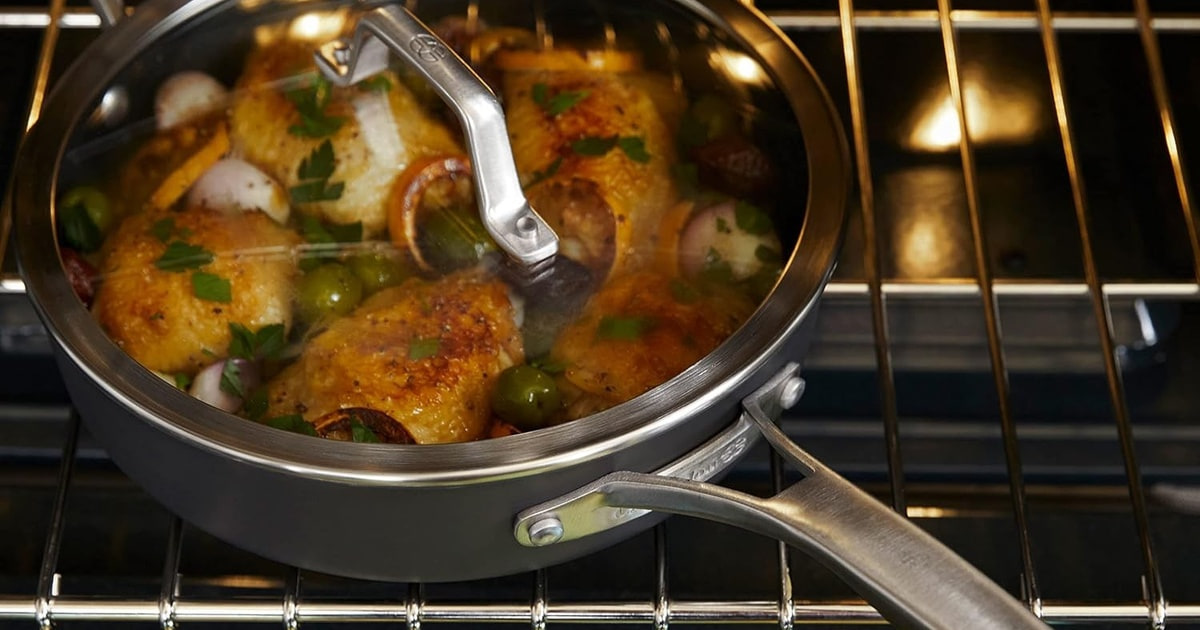
A nonstick pan is the one you reach for on autopilot. Eggs on a Tuesday, a grilled cheese, reheated rice, fish that would weld itself to stainless steel. What you want is simple. Food should slide, cleanup should take thirty seconds, and the handle shouldn't get so hot you need a towel. Heat should spread evenly, too, so the middle of a pancake doesn't scorch while the edges stay pale. Most pans do this well when they're new. The difference shows up later.
Here's the part nobody likes: every nonstick pan is a consumable. Coatings wear out. Food & Wine's cookware guide puts the realistic lifespan at three to five years of regular home use, and that holds at every price. Ceramic pans are the impatient ones. Consumer Reports found they lose noticeable slickness after a few months of regular cooking, faster than comparable PTFE pans. So don't shop for a pan you'll hand down. Shop for one that's pleasant to use, then plan on replacing it.
Price buys you a few real things. Thicker, hard-anodized aluminum spreads heat more evenly, which is why Wirecutter measured about twenty degrees of variance across those pans versus sixty or more on thin stamped ones. It buys a handle that's riveted instead of screwed on, and a coating with more layers under it. It doesn't buy immortality. We think that the Calphalon Premier Hard-Anodized Nonstick Frying Pan Set is the best nonstick frying pan for most people, and that the Tramontina Professional 12-Inch Non Stick Large Frying Pan is the one to buy if you want one big pan and nothing else.
Everything we recommend
Even heat and a tough coating, in the two sizes you'll use
One big restaurant-style pan, if you don't need a small one

Two decent pans, a heat indicator, and very little fuss
The slickest coating here, in a pan that only fits two eggs

Ceramic and PFAS-free, if you'd rather skip PTFE entirely
Prices as of Oct 25, 6:48 AM PT · Details
At a glance
| Product | Coating | Oven-safe max | Price | |
|---|---|---|---|---|
| T-Fal Ultimate Hard Anodized Nonstick Fry PanBudget pick | — | 400°F | $69.99 |
| Tramontina Professional 12-Inch Non Stick Large FryingRunner-up | — | 400°F | $37.95 |
| GreenPan Valencia Pro 8" Ceramic Nonstick FryingAlso great | — | — | $69.99 |
 | Caraway Non-Stick Ceramic Frying PanAlso consider | — | 550°F | $125 |
| Calphalon Premier Hard-Anodized Nonstick Frying Pan SetTop pick | — | 450°F | Check price |
 | Misen Carbon Nonstick™ Skillet - Nitrided CarbonAlso in lineup | Nitrided carbon steel | 1100°F | $109 |
 | HexClad 7 Qt Hybrid Nonstick Sauté PanAlso in lineup | — | 900°F | $229 |
| All-Clad NS1 Nonstick Induction 8" Fry PanUpgrade pick | — | — | $200 |
Prices as of Oct 25, 6:48 AM PT · Details
How we picked
Even heating. We compared spec sheets and published lab findings on body construction, favoring thick hard-anodized or heavy-gauge aluminum. Wirecutter's measurements put those pans within about twenty degrees across the surface, versus sixty or more for thin stamped pans.
Coating durability. We read side-by-side release comparisons from Serious Eats and America's Test Kitchen and weighted coatings that survive repeated wash cycles. Multilayer and metal-utensil-safe interiors moved to the front.
Coating chemistry. Every pan here is PFOA-free, since the EPA confirms the chemical was phased out of U.S.-made nonstick cookware years ago. For buyers skipping PTFE entirely, we made sure the lineup included ceramic and coating-free options.
Handles and heat limits. We checked handle construction and stated oven ratings on every spec sheet. Riveted handles that stay cool on the burner counted, and so did a published temperature ceiling.
Cooktop fit. We flagged induction compatibility for every pan, because several strong performers simply don't work on a magnetic burner. That single line disqualifies two of our picks for a lot of newer kitchens.
Top pick
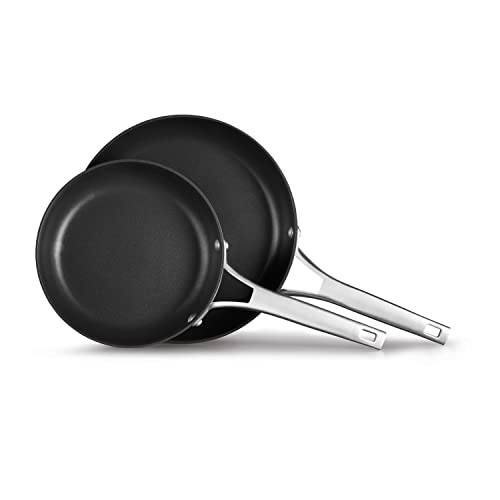
Even heat and a tough coating, in the two sizes you'll use
Calphalon Premier Hard-Anodized Nonstick Frying Pan Set
This pair covers almost everything a home cook does: an 8-inch for eggs and a 10-inch for chicken thighs and stir-fries. The hard-anodized bodies heat evenly, the three-layer coating takes metal utensils, and both pans go in the oven to 450 degrees.
Check priceatAmazonPrices as of Oct 25, 6:48 AM PT · Details
Hard-anodized aluminum is the sweet spot, and this is a clean example of it. Thick, forged bodies spread heat instead of concentrating it under the burner ring. Wirecutter found pans built this way hold heat within roughly twenty degrees across the surface, while thin stamped pans swing sixty or more. In practice that means a pancake browns edge to edge, and the egg you started in the middle doesn't cook faster than its neighbor.
You get an 8-inch and a 10-inch, which is a smarter buy than one big pan. The small one is for two eggs and a quesadilla. The big one handles four chicken thighs or a pound of ground beef without steaming everything. Most of us end up cooking for one or two on weeknights, and a 12-inch pan wastes fuel and counter space on that job.
The coating is the part that ages well. Calphalon layers its MineralShield nonstick three deep over the anodized body and rates the interior metal-utensil safe, so a stray fork won't wreck it. In Serious Eats' side-by-side comparison, the Premier landed among the top performers for oil-free egg release after fifty wash cycles. Hand-washing still roughly doubles coating life, according to Epicurious, but this one isn't fragile.
The handles are long and stay cool on the stovetop, which matters more than it sounds. You can grab the pan bare-handed to jiggle an omelet. Both pans are dishwasher-safe on paper and oven-safe to 450 degrees, so you can start a frittata on the burner and finish it in the oven. That's the whole appeal. Nothing exotic, nothing you have to baby.
Flaws but not dealbreakers
The dishwasher line is technically true and practically a bad idea. Epicurious found hand-washed nonstick pans stay slick about twice as long as the same models run through a machine. Treat that rating as an emergency option, not a routine.
This is a PTFE coating, which the listing states plainly. That's fine at normal cooking temperatures, but Consumer Reports puts the breakdown threshold at 500 degrees, and an empty pan on high heat can get there fast. If you're avoiding PTFE entirely, look at the GreenPan below.
Runner-up
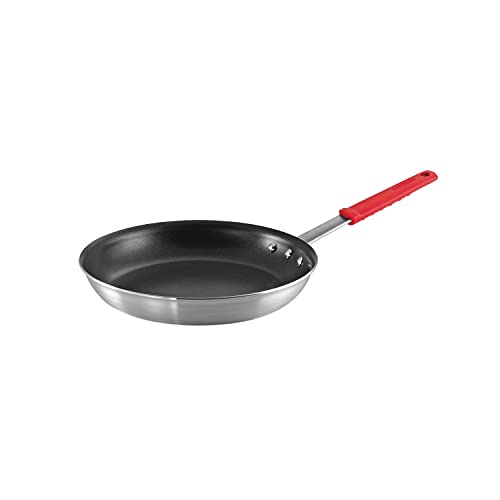
One big restaurant-style pan, if you don't need a small one
Tramontina Professional 12-Inch Non Stick Large Frying
This is the flat, heavy-gauge aluminum pan line cooks use, sold to home kitchens with a removable silicone handle sleeve. At 12 inches it's the one for stir-fries, four burgers, or an omelet big enough to split, and it's NSF-certified.
$37.95fromAmazonPrices as of Oct 25, 6:48 AM PT · Details
Restaurant pans are built around one idea: get hot fast, stay hot when cold food hits. Good Housekeeping's Kitchen Appliance Lab clocked this Tramontina reaching searing temperature, around 400 degrees, in under four minutes on a standard gas burner. That put it level with pans costing several times more. If you sear chicken thighs skin-down and want them to brown instead of sweat, that's the number that matters.
The heavy-gauge aluminum body is why it doesn't have hot spots. Thin pans warp and concentrate heat right over the flame, so the center of a pancake burns while the rim stays blond. This one is thick enough to even that out. It's also genuinely flat, which sounds obvious until you've watched oil pool on one side of a cheap pan.
Twelve inches is a lot of pan, and that's the point. You can brown a pound of ground beef in a single layer instead of two batches. Four eggs fit without crowding. The trade-off is weight and storage: it's heavier than a small skillet and won't slide into a crowded drawer. If you cook mostly for one, the Calphalon pair makes more sense.
The removable silicone sleeve slides off the riveted handle, which is handy for the oven and easy to lose. Tramontina rates the pan oven-safe to 400 degrees and dishwasher-safe, and backs it with a lifetime warranty. NSF certification means it's built to commercial sanitation standards, not that the coating lasts forever.
Flaws but not dealbreakers
It won't work on an induction cooktop. Aluminum with no magnetic base is a hard no there, so induction owners should look at the GreenPan or the All-Clad instead.
The interior is a conventional reinforced nonstick, not a metal-utensil-safe multilayer. Use silicone or wood, hand-wash it, and accept that this is a pan you'll replace well before you replace your stove. The 400-degree oven ceiling is also the lowest among our picks.
Tramontina backs the pan with a lifetime warranty.
Budget pick
Two decent pans, a heat indicator, and very little fuss
T-Fal Ultimate Hard Anodized Nonstick Fry Pan
A 10-inch and a 12-inch with hard-anodized exteriors, forged bodies, and silicone-wrapped riveted handles. The Thermo-Spot indicator turns solid red when the pan is properly preheated, which takes the guesswork out of knowing when to add the oil.
$69.99fromAmazonPrices as of Oct 25, 6:48 AM PT · Details
The heat indicator is a genuinely useful gimmick. Thermo-Spot is a dot in the pan that turns solid red at preheat temperature. It sounds like marketing. But most sticking happens because people add food to a pan that's still coming up to heat, and a visual cue fixes that better than flicking water at the surface. If you're new to cooking, it's worth more than another line on a spec sheet.
The hard-anodized exterior and forged body put this closer to the Calphalon than to a stamped supermarket pan. It's not as thick, and you'll notice a bit more hot-spotting right over the burner. But you're getting two sizes and a titanium nonstick surface for less than most single pans here cost, which is a reasonable way to outfit a first kitchen.
Riveted silicone-wrapped handles are comfortable and stay cool at the stovetop, which is the kind of small thing you notice every day. And two sizes beats one. The 10-inch handles eggs and a couple of chicken cutlets; the 12-inch is for the night you're cooking for the whole table. For a first apartment or a rental, that's a complete setup.
Flaws but not dealbreakers
No induction. T-fal says the set works on every stovetop except induction, which rules it out for a lot of newer apartments. Check your cooktop before you order.
The oven ceiling is 400 degrees, tied for the lowest here. The coating is also the most conventional one in this guide, so expect it to fade sooner than the Calphalon's three-layer surface. That's the trade you're making, and at this level it's a fair one.
T-fal covers the set with a limited lifetime warranty.
Upgrade pick
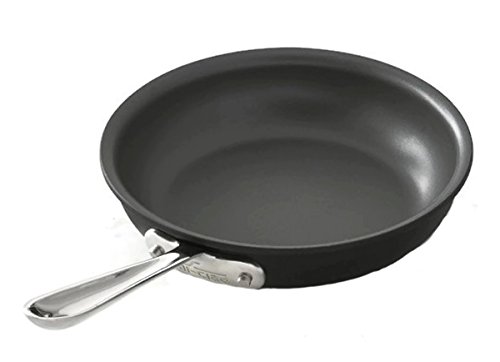
The slickest coating here, in a pan that only fits two eggs
All-Clad NS1 Nonstick Induction 8" Fry Pan
An 8-inch hard-anodized skillet with a bonded three-layer nonstick interior and low, flared sides that let you slide an omelet straight onto the plate. It works on induction and carries a limited lifetime warranty, which none of the ceramic pans here match.
$200fromAmazonPrices as of Oct 25, 6:48 AM PT · Details
Eight inches is a specialist's size. This is the pan for two eggs, a single omelet, toasting nuts, or blooming spices. It is not the pan for four pork chops. All-Clad built it that way on purpose, with low flared sides instead of tall straight ones, so a spatula can get under food and back out without fighting a wall.
The coating is the reason to pay up. All-Clad bonds three layers of nonstick to hard-anodized aluminum instead of spraying one coat on top. In Serious Eats' side-by-side comparison, the NS1 was among the top performers for oil-free egg release after fifty wash cycles. It'll still wear out eventually. It just takes noticeably longer to get there.
The lifetime warranty is unusual in this aisle. Ceramic-coated competitors typically cover one to three years, and coating wear is often excluded anyway. Read the terms before you count on it, since manufacturer coverage generally addresses defects rather than the gradual dulling every nonstick surface goes through. Still, standing behind a coated line that long says something about how it's built.
Induction compatibility is the practical edge over our runner-up and budget picks. If your cooktop is glass with a magnetic burner, the Tramontina and the T-fal are out and this is in. The small size does limit it, though. Most people should treat this as the second pan in the drawer, not the first.
Flaws but not dealbreakers
It's the most expensive pan here and also the smallest, which is a strange combination to pay for. One 8-inch skillet won't cover a family dinner, so plan on a second, larger pan or start with the Calphalon pair instead.
The listing doesn't state an oven-safe temperature, so treat 500 degrees as the hard ceiling for any PTFE surface, per Consumer Reports, and stay well under it. Owner feedback on this size also runs more mixed than the brand's reputation suggests, with some buyers reporting release falling off sooner than they expected.
All-Clad backs the NS1 line with a limited lifetime warranty.
Also great
Ceramic and PFAS-free, if you'd rather skip PTFE entirely
GreenPan Valencia Pro 8" Ceramic Nonstick Frying
An 8-inch hard-anodized skillet with GreenPan's diamond-infused ceramic coating, free of PFAS, PFOA, lead and cadmium. It works on induction, takes metal utensils, and won America's Test Kitchen's nod for the best ceramic nonstick pan in this size.
$69.99fromAmazonPrices as of Oct 25, 6:48 AM PT · Details
If you want out of PTFE, this is the ceramic pan to get. GreenPan's Thermolon coating is mineral-based, and the listing states it's free of PFAS, PFOA, lead and cadmium. The body underneath is hard anodized and pre-treated before anodizing, so it resists the scratches that kill cheaper ceramic pans. The Spruce Eats found the coating passed food-grade safety standards.
It's also the induction option among our picks that costs less than the All-Clad. The magnetized base works on every cooktop, which matters if you rent and don't know what you're moving into next. At 8 inches, though, this is an egg-and-omelet pan. Don't buy it expecting to sear four chicken thighs on a Sunday.
Metal-utensil-safe is a real claim here, and unusual for ceramic. Most ceramic coatings chip if you look at them wrong. The diamond infusion and the pre-treated anodized body are aimed squarely at that problem, and the pan also carries a Good Housekeeping sustainable innovation award. Whether it survives a decade of daily scraping is another matter.
Flaws but not dealbreakers
Ceramic coatings fade faster than PTFE. That's not a GreenPan flaw so much as chemistry. Consumer Reports found ceramic pans lose noticeable nonstick performance after roughly three to six months of regular use, and The Spruce Eats suggests replacing a ceramic pan yearly if you cook on it every day. Owner feedback follows that pattern, with the happiest reports coming from people who stick to low heat and a little oil.
The listing doesn't state an oven-safe temperature, and this comes only as an 8-inch pan, so it's a supporting player in most kitchens. It's dishwasher-safe on paper, but hand-washing is the only way to keep any ceramic surface slick for long.
Who this is for
Buy a nonstick pan if you cook eggs, fish, pancakes, or anything with melted cheese in it. That's most people. It's the pan you use on a Tuesday when you want dinner and not a project. If you mostly braise, deep-fry, or want a fond-heavy pan sauce, a stainless or cast-iron skillet does that better, and nonstick actively works against you there.
This guide covers coated nonstick frying pans and skillets for home kitchens, roughly 8 to 12 inches, from budget to premium. We've included ceramic and PFAS-free options for people avoiding PTFE, and we say plainly where those trade slickness for peace of mind. We haven't covered stainless clad, cast iron, or full cookware sets as categories of their own. If you're already cooking on a pan that's flaking, replace it now rather than nursing it along.
How we picked
Heat: we favored thick hard-anodized or heavy-gauge aluminum bodies, since published measurements show those hold heat within about twenty degrees across the surface while thin stamped pans swing three times that. Coating: we weighted multilayer and metal-utensil-safe interiors, and read side-by-side release comparisons that ran pans through repeated wash cycles. Chemistry: every pick is PFOA-free, and we made sure the lineup includes ceramic and coating-free options for people skipping PTFE. Handles and heat limits: riveted, stay-cool handles and a stated oven rating both counted. Cooktop fit: we flagged induction compatibility, because several good pans here simply won't work on a magnetic burner.
Other nonstick frying pans worth considering
If you want a PFAS-free pan you'll leave out on the stove: The Caraway Non-Stick Ceramic Frying Pan — Caraway's 10.5-inch ceramic pan is the prettiest thing here, and that's not a knock. It comes in colors like navy, it's free of PTFE, PFOA, PFAS, lead and cadmium, and it's oven-safe to 550 degrees, the highest rating among our ceramic options. Owners who cook on low-to-medium heat with a little oil tend to love it. Owners who treat it like a PTFE pan tend not to, and a meaningful share report release falling off within the first months. That tracks with what Consumer Reports found about ceramic coatings generally. You're paying a premium for design and non-toxic materials, not for longevity.
The competition
These are the pans our research surfaced alongside the picks, not a census of everything you can buy. Both are interesting, and both lost for reasons worth knowing before you spend.
The Misen Carbon Nonstick™ Skillet - Nitrided Carbon — Misen's Carbon Nonstick isn't a coated pan at all. It's nitrided carbon steel with an aluminum core, rated to 1100 degrees, metal-utensil-safe, and free of PTFE and PFAS by virtue of having no coating to wear off. Instead it builds a seasoning patina as you cook. That's a legitimate approach, and it's the right answer if you want high-heat searing without chemistry worries. But it won't slide an egg out on day one, it needs upkeep the others don't, and owner feedback on this model runs more divided than on anything else in the lineup. Buy it as a carbon-steel skillet, not as a nonstick replacement.
The HexClad 7 Qt Hybrid Nonstick Sauté Pan — The HexClad Hybrid here is a 7-quart sauté pan with a lid, not a skillet, so it's a different tool from the rest of this group: straight sides, about 12 inches across, deep enough to braise or shallow-fry a whole chicken's worth of pieces. The hybrid surface, laser-etched stainless ridges over a ceramic coating, really is metal-utensil-safe and oven-rated to 900 degrees, and HexClad covers defects for life. CNET found the actual nonstick release inconsistent next to dedicated PTFE pans, though, and this thing is heavy and expensive. If you want one deep pan for braising and frying and you'll live with fussier egg release, it earns its spot.
Care and maintenance
Hand-wash every pan here, even the ones labeled dishwasher-safe. Epicurious found hand-washed nonstick pans stay slick about twice as long as the same models run through a machine. Warm water, a soft sponge, and a minute of soaking handle almost everything. Skip cooking sprays, since the propellants leave a sticky varnish that builds up and ruins release. Cook on low to medium heat, and never preheat an empty pan on a high burner. When you stack pans, slide a paper towel or dish cloth between them so the one on top doesn't scratch the one below. And when food starts sticking no matter what you do, the coating is done. Replace it instead of cooking around it.
Questions we get
What's the best nonstick frying pan for eggs?
An 8- or 10-inch pan with a slick multilayer coating and low, flared sides. The All-Clad NS1 is built for exactly that job, and Serious Eats ranked it among the top performers for oil-free egg release after fifty wash cycles. The smaller Calphalon Premier does nearly as well for a lot less. Whatever you use, let it preheat on medium before the egg goes in.
Are ceramic pans better than traditional nonstick pans?
They're different, not better. Ceramic coatings like GreenPan's Thermolon and Caraway's are free of PFAS and PTFE, which is the whole appeal. But Consumer Reports found ceramic pans lose noticeable nonstick performance after roughly three to six months of regular use, faster than comparable PTFE pans. Pick ceramic if avoiding PTFE matters to you, and go in expecting a shorter slick period.
How long do nonstick pans actually last?
Three to five years of regular home cooking, according to Food & Wine's cookware guide, and that holds across price tiers. Ceramic sits at the shorter end; The Spruce Eats suggests replacing a ceramic pan yearly if you use it heavily every day. Hand-washing roughly doubles useful life compared with the dishwasher, per Epicurious. Treat a nonstick pan as a wear item, not an heirloom.
What temperature ruins a nonstick pan?
Consumer Reports puts the PTFE breakdown point around 500 degrees Fahrenheit, where the coating starts to degrade and give off fumes. An empty pan on a high burner can pass that in a few minutes, so add oil or food before it gets hot. Stick to low and medium heat. Also mind the oven ratings: the Calphalon is good to 450, and the Tramontina and T-fal to 400.
Can you use metal utensils on nonstick pans?
On most of them, no. The Calphalon Premier and the GreenPan Valencia Pro both state metal-utensil-safe interiors, and hybrid pans like HexClad are built around that claim. Even so, silicone or wood costs you nothing and removes the risk entirely. On a conventional coating like the Tramontina's, metal will shorten the pan's life.
Are nonstick pans safe once they're scratched?
A scratch is mostly a performance problem. Modern PTFE cookware from major brands no longer uses PFOA, which the EPA confirms was phased out of U.S. manufacturing, and small flakes of coating pass through the body inertly. The real issue is that a scratched pan stops releasing food, which is the only reason you bought it. Once it's visibly flaking, replace it.
Why you should trust us
For this guide:
- We read the manufacturer spec sheet for every pan here, comparing coating construction, oven ratings and cooktop compatibility side by side.
- We compared published findings from America's Test Kitchen, Wirecutter, Serious Eats, Good Housekeeping, Consumer Reports, Epicurious and CNET on heat distribution, coating longevity and egg release.
- We also read through owner feedback for recurring themes, especially reports of ceramic coatings dulling within the first few months.
- We read owner reviews on every listing, weighted toward the critical ones, because that is where the recurring failures show up.
- We have a systematic way of automatically fetching the latest prices, so the numbers on this page stay current.
- This is a research-focused guide, so the team may not own every product listed — though we often do own the top winners, which gives us extra context for the recommendations.
- We don't accept free products, and the retailer commission never changes which product we recommend.
Sources
The Best Nonstick Pans, Tested by Food Editors, Wirecutter (NYT)
Nonstick Skillet Reviews, America's Test Kitchen
The Best Nonstick Pans of 2026, Tested, Serious Eats
Best Nonstick Cookware, According to Kitchen Appliance Testing Lab, Good Housekeeping
Is Ceramic Cookware Really Safer Than Nonstick?, Consumer Reports
PFOA, PTFE, and Other Nonstick Coatings: What to Know, U.S. Environmental Protection Agency
We Tested the Best Nonstick Pans for Eggs, Fish, and More, Epicurious
How to Choose the Right Nonstick Pan, Food & Wine
All-Clad NS1 Nonstick Cookware Review, All-Clad (Manufacturer)
The Best Ceramic Nonstick Pans, Tested, The Spruce Eats
HexClad Cookware Review: Is the Hype Worth It?, CNET
Nonstick Pan Safety: What Temperature Is Too Hot?, Consumer Reports
Amazon product listings and owner reviews for all 8 products
Manufacturer specification pages for each product
Some passages in this guide may be paraphrased with AI help.
Product prices and availability are accurate as of the date/time indicated and are subject to change. Any price and availability information displayed on Amazon.com at the time of purchase will apply to the purchase of this product.
More like this.
Continue exploring home reviews and recommendations.

The Best Nonstick Cake Pans and Baking Sets
A cake pan does one job, and it's easy to take for granted until it fails you. The batter sticks to the bottom, the edges brown three shades darker than…

The Best Home Deep Fryers
A good deep fryer does one thing an oven can't: it holds a big slug of hot oil at a steady temperature while you drop cold food into it. That's the whole…

The Best Toaster Oven Air Fryer Combos
A countertop oven earns its space by handling the small stuff. Reheating two slices of pizza, roasting a sheet pan of broccoli, crisping frozen fries at…

The Best Baking Sheets and Cookie Pans
A baking sheet is the pan you reach for more than any other. Cookies on Sunday, salmon on Tuesday, a tray of potatoes and onions on a weeknight when…

The Best Roasting Pans
A roasting pan comes out of the cupboard a few times a year for most people, and then it has to do something no sheet pan can: hold a heavy bird, catch a…

The 6 Best Oil Drain Pans on Amazon in 2026: Tested & Reviewed for DIY Mechanics
Find the best oil drain pan for your garage - from ultra-low-profile picks for motorcycles to 12-quart options for SUVs. Expert-tested, ranked by capacity and design.