The Best Nonstick Cake Pans and Baking Sets
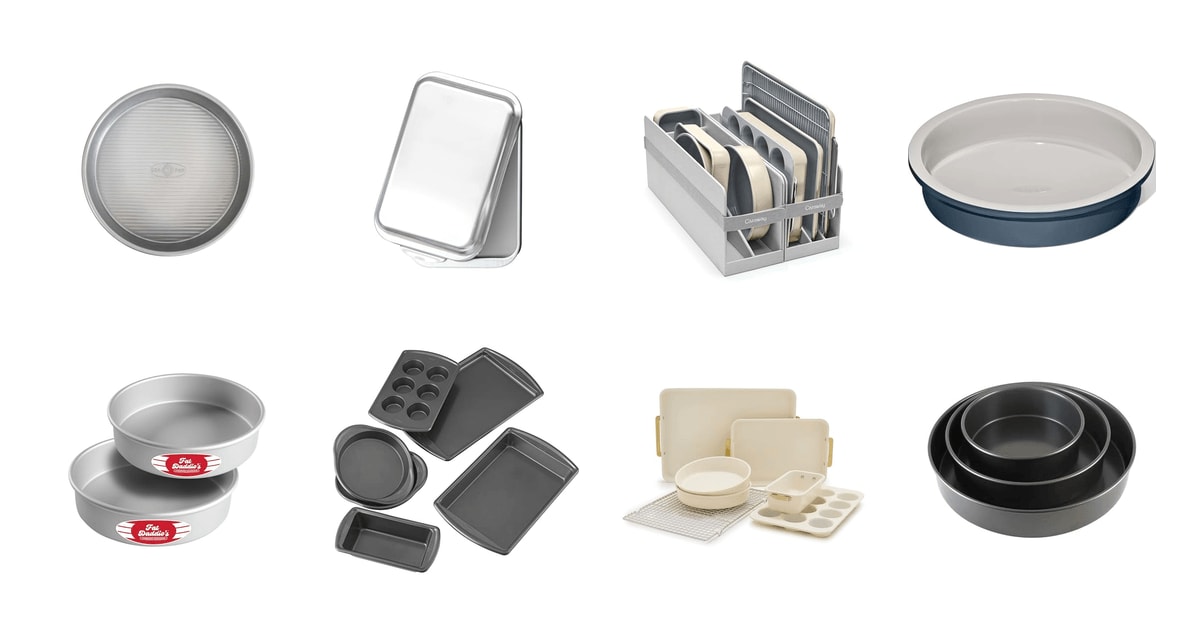
A cake pan does one job, and it's easy to take for granted until it fails you. The batter sticks to the bottom, the edges brown three shades darker than the middle, or the pan buckles in a hot oven and your layer comes out with a wave in it. Good pans make the difference invisible. You grease them, fill them, pull them out, flip them, and the cake drops free. That's the whole standard, and most of the pans people already own don't meet it.
Here's the honest part: no nonstick cake pan lasts forever. Coatings wear. Consumer Reports found that PTFE coatings started degrading after roughly 400 dishwasher cycles, and ceramic coatings after about 150. Food Network's consumer survey found that most home bakers replace nonstick bakeware every two to four years, and coating wear is the top reason. So you're really choosing how long you get before that happens, and whether you'd rather skip coatings entirely and grease your pans by hand every time.
We looked at commercial-grade single pans, big matching sets, and PFAS-free ceramic lines, and the differences come down to metal, gauge and surface texture more than to brand names. We think that the USA Pan Bakeware Nonstick Round Cake Pan is the best nonstick cake pan for most people, and that the Fat Daddio's Anodized Aluminum Round Cake Pans are the ones to buy if you bake layer cakes often and want clean, straight sides.
Everything we recommend

Even browning and clean release, one pan at a time

Straight sides and no coating to wear out, if you grease well
Three tiers of cake for less than two premium pans

A full PFAS-free kitchen's worth of pans, and it looks it

Zero-draft walls and a ceramic coating in one pan
At a glance
| Product | Pan Size | Material | Price | |
|---|---|---|---|---|
| USA Pan Bakeware Nonstick Round Cake PanTop pick | 9-Inch | Aluminized Steel | $22.95On sale |
| Caraway 11-Piece Non-Stick Ceramic Bakeware SetUpgrade pick | 11 Pieces | Ceramic | $396 |
| OXO Good Grips Non-Stick Pro Ceramic CoatedAlso great | 9" Round Cake Pan | Ceramic Coated | $16.95 |
| Fat Daddio's Anodized Aluminum Round Cake PansRunner-up | 8 x 2 Inch, Set of 2 | Anodized Aluminum | $24.69 |
 | GreenPan Bakeware SetAlso consider | 7 Piece Bakeware Set | Ceramic | $249.99 |
| Chicago Metallic Professional Nonstick Round Cake PanBudget pick | 3-Piece Set | Aluminized Steel | $18.10 |
How we picked
Metal and browning. We prioritized light-colored aluminized steel and aluminum over dark coated steel, based on test-kitchen findings from King Arthur Baking and America's Test Kitchen showing dark pans overbrown cake bottoms and edges. Dark carbon steel was a strike against a pan.
Gauge and warping. Cook's Illustrated found pans at 0.8mm or thicker warped in under 5% of high-heat bakes, versus 34% for thin budget pans. We favored heavy-gauge construction and reinforced or rolled rims, and we checked owner feedback for buckling complaints.
Release and surface. Good Housekeeping's testing found corrugated pan bottoms released cleanly 100% of the time against 88% for smooth nonstick. We weighted textured surfaces and read owner feedback for recurring sticking reports.
Coating chemistry. After the Environmental Working Group found PFAS in more than half the nonstick bakeware it sampled, we made sure the lineup included well-supported PFAS-free options — ceramic, silicone-based and uncoated — not just conventional PTFE.
Coating longevity. Consumer Reports' durability data showed PTFE outlasting ceramic by a wide margin under dishwasher cycling. We checked each manufacturer's washing guidance against how the coating actually holds up, and flagged pans where the two don't line up.
Top pickOn sale
Even browning and clean release, one pan at a time
USA Pan Bakeware Nonstick Round Cake Pan
This 9-inch pan is heavy aluminized steel with a corrugated bottom, and it releases cakes more reliably than a smooth coating does. It's the pan professional review kitchens keep returning to, and the one we'd buy two of.
$22.95fromAmazonList priceAluminized steel is the right metal for cake, and this is the clearest example of it. Light-colored steel reflects oven heat instead of soaking it up. King Arthur Baking's test kitchen found that light aluminum and aluminized steel cut over-browning on cake bottoms by roughly 20% compared with dark steel at the same temperature. America's Test Kitchen found dark-coated carbon steel overbrowns edges up to 15% faster at 350°F. If your cakes come out with crunchy rims, the pan is usually why.
The ridged bottom isn't decoration. Good Housekeeping Institute found that corrugated pans released baked goods cleanly every time across 50 bakes, versus an 88% release rate for smooth PTFE pans. The ridges reduce contact area, so the cake has less surface to cling to. In practice that means fewer moments where you tap the pan on the counter and hope.
Owners describe this pan as noticeably heavy for its size, and that's the point. It's a full pound of steel in a nine-inch round. Cook's Illustrated found that pans at 0.8mm gauge or thicker warped in under 5% of high-heat bakes above 425°F, while thin budget pans warped 34% of the time. Heft buys you flat cake layers instead of ones that slope toward one side.
The coating is silicone-based rather than conventional PTFE. USA Pan calls it Americoat, and states it's free of PTFE, PFOA and BPA. That matters if you're avoiding those compounds — the Environmental Working Group found PFAS in 11 of 20 nonstick bakeware products it sampled, which is what pushed the whole category toward reformulation. You get the release without the tradeoff.
Wirecutter has ranked USA Pan as its top round cake pan for four consecutive testing cycles, citing heat distribution and coating longevity. That kind of repeat result is rare in bakeware, where products get reformulated constantly. Owners who've had these for years echo it — the common theme is that the pans still release well long after the cheap ones were thrown out.
Flaws but not dealbreakers
The exterior rim has an open lip where the steel is rolled, and batter or grease can work its way into it. Some owners find that spot annoying to clean and never quite feel it comes fully clean. It doesn't affect baking, but if you're fussy about that, know it's there.
This is one pan. A layer cake needs two or three, so you're buying multiples, and it's already among the more expensive single pans here. USA Pan also asks that you hand wash with a gentle brush, so dishwasher convenience is off the table.
At 9 inches, it's a single size. If you want a tiered cake with 6-, 8- and 10-inch layers, you're shopping elsewhere or buying a lot of pans.
Runner-up
Straight sides and no coating to wear out, if you grease well
Fat Daddio's Anodized Aluminum Round Cake Pans
These uncoated hard-anodized aluminum pans come as a pair of 8-inch rounds with perfectly vertical walls. Nothing can flake off because there's nothing coating them, but you have to grease and line them every single time.
$24.69fromAmazonIf you stack layers, straight sides change the finished cake. Serious Eats found that straight-sided pans like these needed about 40% less trimming than sloped-sided pans to get clean stacked layers. Sloped sides give you a subtle cone shape, and you either trim it off or frost around it. With these you frost a cylinder. That's a real difference on a birthday cake.
There's no nonstick coating here at all, which is the whole argument. Anodized aluminum is the bare metal, hardened. It won't peel, flake or wear thin, because there's nothing to wear. Fat Daddio's states no PFAS, PTFE or PFOA, and says the pans are safe with citrus-based batters that can react with untreated aluminum. Pastry kitchens use these for exactly this reason — they outlive the coated stuff.
Aluminum heats and cools fast, and that helps more than you'd think. Cakes stop baking sooner once they leave the oven, so you get less carryover drying at the edges. Fat Daddio's rates them to 550°F. Owners bake everything from Japanese cheesecake to deep-dish pizza in them, and the recurring note is even browning with no hot spots.
You get two pans in the set, which covers a standard two-layer cake without a second purchase. At 8 inches they also fit inside 8-quart pressure cookers and larger air fryers, so they earn shelf space in a small kitchen. The 16-gauge construction is thick enough that they don't dent when they knock around a cabinet.
Flaws but not dealbreakers
You have to grease these properly, and then line the bottom with parchment. Skip that and your cake will stick — that's not a defect, it's how uncoated aluminum works. Owners who love these pans almost all mention a liner or a spray as part of their routine.
Fat Daddio's recommends hand washing despite the pans being dishwasher-safe on paper, because detergent dulls the anodized finish over time. One owner measured the gauge and found it slightly thinner than the advertised 16, though still thick enough to resist denting.
These are 8-inch, and a lot of American cake recipes assume 9-inch rounds. An 8-inch pan holds less, so batter sits deeper and needs a few extra minutes. Not hard to adjust for, but worth knowing before you follow a recipe blind.
Budget pick
Three tiers of cake for less than two premium pans
Chicago Metallic Professional Nonstick Round Cake Pan
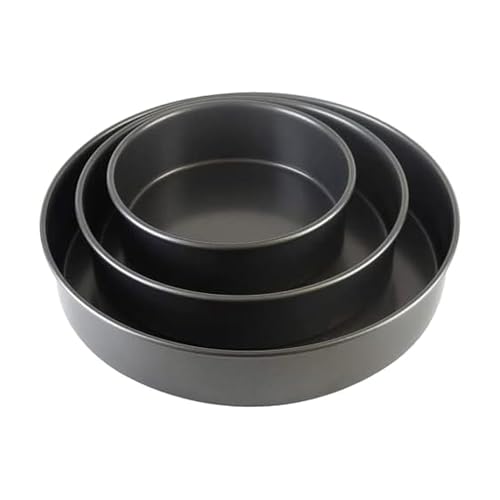
This set gives you 6-, 8- and 10-inch aluminized steel rounds with a nonstick coating, which is exactly what a tiered cake needs. The metal and gauge are close to the top pick's, and the surface is smooth rather than ridged.
$18.10fromAmazonThree graduated sizes in one box solves a specific problem. If you've ever wanted to make a tiered birthday cake, you know you can't do it with matching pans. Buying a 6-, an 8- and a 10-inch separately from a premium brand costs several times what this set does. Owners who bake for small businesses report buying multiple sets, which is a decent signal about whether the pans hold up.
The metal is the same story as our top pick, just cheaper to make. Chicago Metallic uses heavy-weight aluminized steel, so you get the same reflective, even-browning behavior that keeps cake bottoms from going dark. That's the single most important spec in a cake pan, and it's why this set beats similarly priced dark-coated steel from other brands.
The coating is smooth PTFE rather than corrugated, so release depends more on greasing than on pan texture. Good Housekeeping's numbers put smooth coatings at an 88% release rate against 100% for corrugated. That's a real gap, but it's also the gap between almost always and always. Grease the pan and it's rarely an issue.
Chicago Metallic lists these as dishwasher safe while recommending hand washing. Consumer Reports found PTFE coatings hold up through roughly 400 dishwasher cycles before visible degradation, so occasional machine washing won't ruin them. If you bake a few times a month, that's years of runway.
Flaws but not dealbreakers
The rolled edges under the rim are sharp enough that owners have cut themselves handling the pans. Be deliberate when you lift them out of a cabinet, especially with wet hands.
This is a smooth PTFE coating, so it's the least PFAS-conservative option among our picks. If avoiding those compounds is your reason for shopping, look at the Fat Daddio's or the ceramic sets instead.
The 6-inch pan is small enough to be a bit of an odd duck on its own. It's great as the top tier of a stack, less useful as a standalone cake pan for a household.
Upgrade pick
A full PFAS-free kitchen's worth of pans, and it looks it
Caraway 11-Piece Non-Stick Ceramic Bakeware Set
This 11-piece set covers rounds, a rectangle, a square, a loaf, muffins and two sheet pans, all with a PTFE-free ceramic coating. It comes with storage organizers, and it costs more than everything else here combined.
$396fromAmazonIf you want to replace all your bakeware at once with nothing PFAS-related in it, this is the set. Caraway states the coating is free of PTFE, PFOA, PFAS, lead and cadmium. The pieces cover essentially every shape a home baker uses — two 9-inch rounds, a 9x13 with handles, a 9-inch square, a one-pound loaf pan, a 12-cup muffin pan, two sheet pans and a cooling rack.
The storage organizers are a bigger deal than they sound. Bakeware is awkward to store, and sheet pans in particular end up leaning in a cabinet where they scratch each other. The included racks give each piece a slot. Owners consistently mention the storage system as the thing that surprised them, and it's a real reason this set gets bought as a wedding or shower gift.
Ceramic coatings used to be a compromise. The Spruce Eats found this set's sol-gel coating held its nonstick properties through 18 months of regular use with hand washing, well past the six-to-twelve-month window where earlier ceramic coatings gave out. That's meaningful progress, though it's still short of what good PTFE does. Caraway rates the pieces to 550°F.
The pans are also genuinely nice to look at, in cream with matching finishes, and they go straight from oven to table. That's a soft benefit, but it's the reason a lot of people buy this set. If your bakeware lives on an open shelf, it matters.
Flaws but not dealbreakers
Ceramic wears faster than PTFE under abrasion. Consumer Reports found ceramic coatings showed degradation after roughly 150 dishwasher cycles against about 400 for PTFE. Caraway asks you to hand wash, and you should treat that as a requirement rather than a suggestion if you want the 18-month-plus lifespan.
It's expensive — by a wide margin the priciest thing in this guide. If you already own a decent 9x13 and a couple of sheet pans, you're paying for duplicates you don't need. Buy this when you're outfitting a kitchen from scratch, not when you're filling a gap.
The rounds are a fine everyday size, but they're smooth-sided ceramic rather than corrugated aluminized steel. For layer cakes specifically, our top two picks release more reliably.
Also great
Zero-draft walls and a ceramic coating in one pan
OXO Good Grips Non-Stick Pro Ceramic Coated
OXO pairs heavy-gauge aluminized steel with a light ceramic coating and perfectly vertical walls. It's the rare single pan that gets you clean straight layers without asking you to grease bare metal.
$16.95fromAmazonOXO calls the walls zero-draft, which means they don't slope at all. You get the same trimming advantage Serious Eats measured with straight-sided pans — roughly 40% less trimming for clean stacked layers — but with a nonstick surface underneath. That combination is unusual. Most straight-sided pans are uncoated, and most coated pans slope.
The base metal is heavy-gauge aluminized steel with a deliberately light interior color. That's the browning story again: light surfaces reflect, dark ones absorb and scorch. King Arthur's testing put the difference at about 20% less over-browning on cake bottoms. OXO also rounded the interior corners, which sounds minor until you're trying to get crumbs out of a square corner with a sponge.
The rim extends into wide handles, so you can grab the pan with oven mitts without pinching the edge. If you've ever fumbled a hot pan of batter because there was nothing to hold, you'll appreciate it. The square-rolled edge adds stiffness too, which is part of why owners describe the pan as feeling substantial rather than tinny.
This is a newer listing with fewer owners weighing in than the established pans here, so long-term coating data is thinner. What owners do say is consistent: nothing sticks, cleanup is quick, and the pan feels heavier than the cheap ones it replaced.
Flaws but not dealbreakers
These pans don't nest. If you buy two for a layer cake, they stack awkwardly and eat more cabinet space than pans with tapered walls — that's the direct cost of the zero-draft design. At least one owner returned them over exactly this.
Ceramic coatings wear faster than PTFE with abrasive cleaning, and OXO asks for hand washing. Some owners run them through the dishwasher anyway, but Consumer Reports' durability numbers suggest that shortens the coating's life considerably.
It's sold as a single 9-inch pan, so a two-layer cake means buying two.
Who this is for
This guide is for anyone baking cakes at home — birthday layers, a sheet cake for a potluck, banana bread on a Sunday. If your current pans stick, warp, or brown unevenly, replacing them is one of the easiest upgrades you can make in a kitchen. It's also for people avoiding PFAS compounds, since several picks here are ceramic, silicone-based or uncoated. And it's for gift buyers, because complete bakeware sets are a common wedding and housewarming present.
You don't need new pans if what you own still releases cleanly and sits flat. Coatings wear gradually, and the tell is that you start needing more grease for the same result. This guide covers metal cake pans and metal bakeware sets. It doesn't cover glass or ceramic casserole dishes, springform pans, bundt pans, or silicone molds, and it doesn't cover the specialty shapes serious decorators use.
How we picked
Metal and browning: We favored light aluminized steel and aluminum, because test kitchens consistently find dark coated steel scorches cake bottoms and edges. Gauge: Heavier is flatter — thin pans warp in a hot oven at roughly seven times the rate of thick ones, so we looked for substantial construction and reinforced rims. Release: Corrugated and textured surfaces release more reliably than smooth nonstick, and we cross-checked that against what owners report about sticking. Coating chemistry: With PFAS turning up in over half of sampled nonstick bakeware, we made sure PFAS-free ceramic, silicone-based and uncoated options were represented. Longevity: We compared published durability data on how PTFE and ceramic coatings hold up under repeated washing, and matched it against each brand's own care instructions.
Other nonstick cake pans and baking sets worth considering
If you want a PFAS-free set without the top-shelf price: The GreenPan Bakeware Set ($249.99) — GreenPan's 7-piece Craft Series set covers two sheet pans, a cooling rack, a muffin pan, two rounds and a loaf pan with a Thermolon ceramic coating that's rated to 550°F — higher than the roughly 450°F cap most PTFE bakeware carries. It's the same PFAS-free pitch as Caraway for meaningfully less, and it looks good enough to serve from. But the steel is thinner. Owners report sheet pans that buckle under high heat and cake pans that chip or scratch sooner than they should. If you bake gently and hand wash, it's a reasonable way into PFAS-free bakeware. If you're rough on pans, it won't last.
The competition
This is what our research surfaced, not a survey of everything on the market. Bakeware turns over fast, and brands reformulate coatings without changing model names. The pans below are all worth considering under the right circumstances — they just lost to a pick on browning, durability or value.
Care and maintenance
Grease every pan, even the nonstick ones. A coating reduces how much you need, but it doesn't replace the step, and a thin film of butter or spray plus a parchment round on the bottom is cheap insurance on a cake you care about. Skip metal utensils entirely — a knife run around the rim is the single fastest way to kill a coating. Hand wash whenever the manufacturer asks for it, especially with ceramic, which degrades under dishwasher detergent roughly three times faster than PTFE does. Let pans cool before washing; dunking a hot pan in cold water is how thin steel warps. And when you notice you're needing more grease than you used to for the same clean release, that's the coating telling you it's near the end.
Questions we get
What's the best nonstick cake pan for a beginner?
The Chicago Metallic 3-piece set is the easiest starting point, because you get 6-, 8- and 10-inch rounds in aluminized steel for a fraction of what three premium pans cost. Aluminized steel is forgiving — it browns evenly, so slightly-off oven timing doesn't scorch your cake bottom. If you only want one pan, the USA Pan 9-inch is the safest single purchase.
Are PFAS-free ceramic pans as good as traditional nonstick?
For release, yes — modern sol-gel ceramic coatings release cake cleanly, and they handle higher oven temperatures, typically 550°F versus around 450°F for PTFE. For lifespan, no. Consumer Reports found ceramic coatings degrading after roughly 150 dishwasher cycles against about 400 for PTFE. Hand wash ceramic and it closes much of that gap.
How long do nonstick cake pans last?
Most home bakers replace nonstick bakeware every two to four years, according to a Food Network consumer survey, and coating wear is the top reason — ahead of warping and discoloration. How you wash them matters more than how often you bake. Dishwasher detergent and metal utensils are what actually kill coatings.
Do I still need to grease a nonstick cake pan?
Yes. Nonstick reduces how much grease you need, but cake batter is sticky and sugary, and a bare nonstick pan will still hold onto some of it. Butter or spray the pan, and for anything you really don't want to lose, add a parchment circle on the bottom. Uncoated pans like the Fat Daddio's need this every time, without exception.
Are dark cake pans worse than light ones?
For cake, yes. Dark surfaces absorb oven heat while light ones reflect it, so dark pans brown bottoms and edges faster than the center sets. America's Test Kitchen found dark coated carbon steel overbrowning edges up to 15% faster at 350°F, and King Arthur put the bottom over-browning difference at roughly 20%. If you must use a dark pan, drop the oven temperature about 25°F.
What's the difference between aluminized steel and plain aluminum?
Aluminized steel is a steel core coated in aluminum, so you get steel's stiffness with aluminum's heat conduction and rust resistance. Plain aluminum, like the Nordic Ware pan, conducts heat slightly better and weighs less, but it's softer and dents more easily. For cake pans that need to stay flat, aluminized steel is usually the better bet.
Why you should trust us
For this guide:
- We compared published test-kitchen findings from America's Test Kitchen, Cook's Illustrated, King Arthur Baking, Good Housekeeping, Serious Eats and Wirecutter on browning, release and warping.
- We read manufacturer specifications for every pan here — coating chemistry, oven temperature ratings, gauge and washing guidance — and checked each brand's claims against independent durability data from Consumer Reports and the Environmental Working Group.
- We reviewed recurring themes in owner feedback for each listing, paying particular attention to reports of warping, chipping, sharp edges and coatings that faded sooner than expected.
- We read owner reviews on every listing, weighted toward the critical ones, because that is where the recurring failures show up.
- We have a systematic way of automatically fetching the latest prices, so the numbers on this page stay current.
- This is a research-focused guide, so the team may not own every product listed — though we often do own the top winners, which gives us extra context for the recommendations.
- We don't accept free products, and the retailer commission never changes which product we recommend.
Sources
The Best Cake Pans, Tested by Food Network Kitchen, Food Network
The Best Baking Pans of 2026 — Wirecutter, Wirecutter / NYT
Best Bakeware Sets — Serious Eats, Serious Eats
Best Cake Pans — America's Test Kitchen Reviews, America's Test Kitchen
PFAS in Nonstick Cookware and Bakeware: What Consumers Should Know — Environmental Working Group, Environmental Working Group (EWG)
Best Nonstick Bakeware Sets — Good Housekeeping Institute Testing, Good Housekeeping
Bakeware Material Guide: Aluminum vs. Steel vs. Glass — King Arthur Baking, King Arthur Baking
USA Pan Bakeware Review — Cook's Illustrated, Cook's Illustrated
Caraway Bakeware Set Review — The Spruce Eats, The Spruce Eats
How Nonstick Coatings Degrade Over Time — Consumer Reports Bakeware Testing, Consumer Reports
Amazon product listings and owner reviews for all 6 products
Manufacturer specification pages for each product
Some passages in this guide may be paraphrased with AI help. Prices are refreshed automatically.
More like this.
Continue exploring appliances reviews and recommendations.

The Best Nonstick Frying Pans
A nonstick pan is the one you reach for on autopilot. Eggs on a Tuesday, a grilled cheese, reheated rice, fish that would weld itself to stainless steel.…

The Best Baking Sheets and Cookie Pans
A baking sheet is the pan you reach for more than any other. Cookies on Sunday, salmon on Tuesday, a tray of potatoes and onions on a weeknight when…

The Best Digital Kitchen Scales for Precision Baking
Baking by volume is the reason your cookies come out different every time. King Arthur Baking found that a cup of all-purpose flour can weigh anywhere…

The Best Roasting Pans
A roasting pan comes out of the cupboard a few times a year for most people, and then it has to do something no sheet pan can: hold a heavy bird, catch a…

The Best Pizza Stones and Baking Steels
Home ovens are lousy pizza ovens. They top out around 500 or 550°F, and a bare oven rack does nothing to crisp the bottom of a crust. A slab of steel or…

The Best Stand Mixers for Baking
A stand mixer earns its counter space by taking over the jobs your arms hate. Creaming butter and sugar until it's genuinely pale and fluffy. Kneading a…