The Best Stand Mixers for Baking
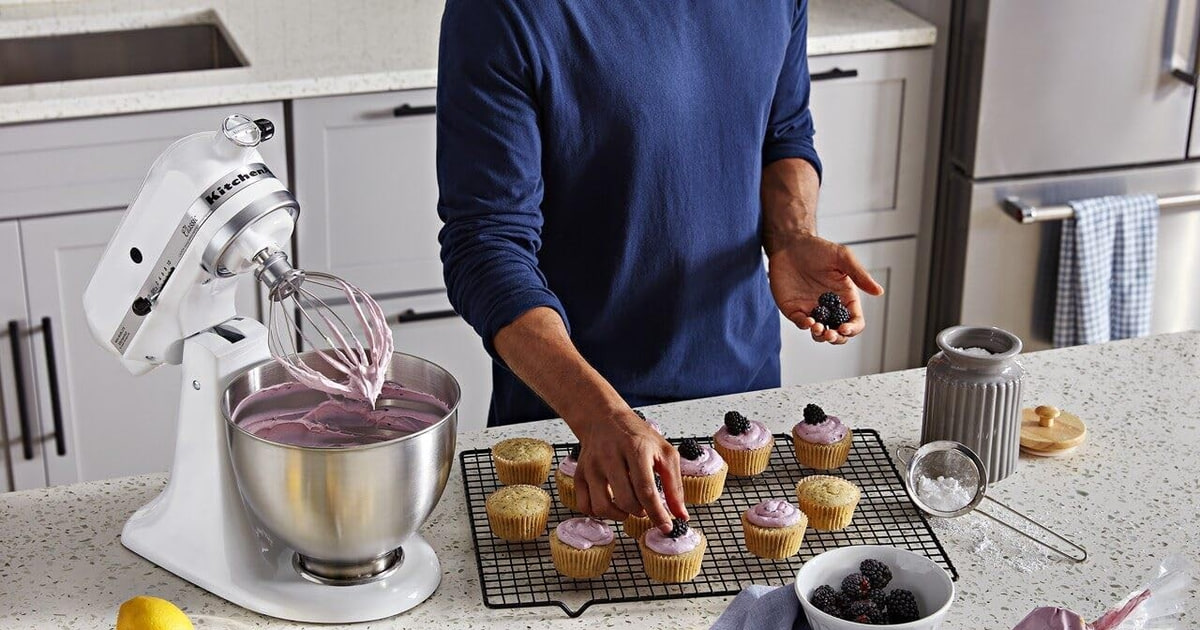
A stand mixer earns its counter space by doing the work your arms don't want to do. Creaming butter and sugar for cookies, whipping egg whites into stiff peaks, kneading a sticky dough for ten minutes while you do something else — that's the job. The differences that actually matter day to day are simple: how much the bowl holds, whether the motor slows down when the dough gets stiff, and how easy the thing is to scrape out and clean afterward.
No stand mixer is quiet, and none of them is genuinely small. Even the compact models weigh enough that you won't want to haul one in and out of a cabinet twice a week, so plan on leaving it out. They're loud enough that you'll notice, too — published noise measurements put a typical KitchenAid tilt-head around 80 decibels at top speed. And every one of them will fling flour across your counter if you start on a high speed. That's user error, but it's an easy mistake to make.
Most people don't need a professional machine. If you bake a few times a month — cookies, banana bread, the occasional pizza dough — a mid-size tilt-head mixer with a metal body will outlast every recipe you throw at it. If you bake bread every week, the math changes, and it's worth paying for a motor that won't strain. We think that the KitchenAid Classic Series 4.5 Quart Tilt-Head Stand Mixer is the best stand mixer for most people, and that the Cuisinart Precision Master 5.5-Quart is the one to buy if you want a bigger bowl and would rather spend less.
Everything we recommend

The proven all-rounder for the way most people actually bake

A bigger bowl and a longer warranty for less money

The bread machine, if kneading is most of what you do
At a glance
| Product | Bowl Capacity | Motor Wattage | Price | |
|---|---|---|---|---|
| KitchenAid Classic Series 4.5 Quart Tilt-Head StandTop pick | 4.5 Qt | — | $399 |
| Cuisinart SM-50BLU Precision Master 5.5-Quart Stand MixerBudget pick | 5.5 Qt | 500W | $289.95 |
| Ankarsrum Original AKM 6230 Basic Package MixerUpgrade pick | 7.4 Qt | 600W | $899.99 |
 | Kenwood Chef Titanium Kitchen MachineAlso consider | 7 Qt | 800W | $549.99 |
How we picked
Power under load. We compared published lab findings on how well each motor holds its speed when dough gets stiff, rather than trusting the wattage number on the box. Consumer Reports has found DC-motor mixers vary less than 5 percent in speed under a six-pound dough load, while some higher-wattage AC motors bog down.
Bowl size and shape. We set 4.5 quarts as the floor, since that's roughly where a standard cookie or cake recipe stops feeling cramped. We also looked at how easily you can reach into the bowl to scrape it mid-mix.
Build and warranty. Metal bodies beat plastic ones for stability and longevity, and we favored machines whose published warranty runs past the one-year category minimum. Manufacturer spec sheets and stated coverage terms did the deciding here.
Attachments that last. A mixer platform is only as good as the accessories you can still buy in five years. We weighed the size and availability of each brand's attachment lineup, not just what ships in the box.
Noise and footprint. Published measurements put these machines between roughly 72 and 80 decibels at top speed, and we noted which ones sit at the quiet end. We also checked height against a standard upper cabinet, since most of these live on the counter permanently.
Top pick
The proven all-rounder for the way most people actually bake
KitchenAid Classic Series 4.5 Quart Tilt-Head Stand
The Classic is the smallest, plainest KitchenAid, and for most home bakers that's fine. You get the same tilt-head design, the same 10 speeds and the same enormous attachment ecosystem as the fancier models, in a 4.5-quart bowl that handles a standard cookie or cake recipe without complaint.
$399fromAmazonThis is the mixer with the longest track record, and that counts for a lot. KitchenAid's tilt-head design has barely changed in decades, and Wirecutter's multi-year reporting on the Artisan — the Classic's near twin, with a slightly larger bowl — logged more than 400 hours of use with no motor failures. Parts are easy to find. Repair shops know these machines. You're buying into a platform that isn't going anywhere.
The 4.5-quart bowl is smaller than what most competitors here give you, and that's the honest trade-off. KitchenAid rates it for eight dozen cookies in one batch, which is more than most households ever make at once. Where you'll feel the limit is tall volumes — a triple batch of meringue, or a double loaf of dough climbing the hook. For weeknight baking, it rarely comes up.
Sixty-odd attachments plug into the front hub: pasta rollers, a meat grinder, a spiralizer, an ice cream bowl. That sounds like marketing until you've owned one for five years and realize you stopped buying single-purpose gadgets. KitchenAid counts 59 compatible accessories across the platform, and they fit the Classic exactly the way they fit the expensive models. That compatibility is the quiet reason the brand holds roughly 70 percent of U.S. stand mixer sales.
The build is metal where it matters. The body is die-cast rather than plastic, which is why it weighs 24 pounds and doesn't walk across the counter when you're kneading. The stainless bowl goes in the dishwasher. Ten speeds cover the whole range, from a stir slow enough that flour stays put to a whip fast enough for stiff peaks in a couple of minutes.
Flaws but not dealbreakers
The motor is the weak point if you bake bread seriously. America's Test Kitchen found that KitchenAid's 325-watt tilt-head struggled with stiff dough beyond about three pounds of flour and sometimes tripped its thermal overload protection, and the Classic sits below that model in the line. If your weekend routine is a big batch of bagel dough, this isn't the machine for you.
It's also loud, and it isn't the prettiest KitchenAid. The Classic comes in far fewer colors than the step-up models, and the plain white finish shows kitchen grime. Neither is a dealbreaker. But if the mixer is going to live on your counter for a decade, you may end up spending more just to get the color you want.
Budget pick
A bigger bowl and a longer warranty for less money
Cuisinart SM-50BLU Precision Master 5.5-Quart Stand Mixer
The Precision Master gives you a 5.5-quart bowl, a 500-watt motor and 12 speeds for well under what a comparable KitchenAid runs. It comes with a splash guard and pour spout that our top pick doesn't include, and it carries a three-year warranty.
$289.95fromAmazonGood Housekeeping's lab whipped cream to stiff peaks with the SM-50 in 2 minutes 18 seconds — just 12 seconds behind the KitchenAid Artisan on the same task. In a kitchen, that gap is a rounding error. You'd never notice it standing at the counter, and it's the clearest illustration of what you actually give up here, which on everyday jobs is close to nothing.
The extra bowl volume changes what you can make in one go. At 5.5 quarts, this is a full quart bigger than our top pick, which is the difference between splitting a double batch of cookie dough and just making it. The 500-watt motor and 12 speeds also give you finer control at the low end, which is exactly where flour clouds happen.
The splash guard with a pour spout is a small thing you'll use constantly. Adding flour to a running mixer without wearing it, streaming oil into a batter, dumping in a bag of chocolate chips — the guard handles all of it, and Cuisinart puts it in the box. The stainless bowl, whisk, flat paddle and dough hook round out a complete starter set.
The die-cast body keeps it planted, and there's a power outlet on the head for Cuisinart's own attachments: a pasta roller and extruder, a meat grinder, an ice cream maker, a spiralizer. That lineup is much smaller than KitchenAid's, but it covers the accessories most people actually buy. If you have no intention of grinding your own burgers, you're not giving anything up.
Flaws but not dealbreakers
The attachment ecosystem is the real compromise. Cuisinart accessories fit only Cuisinart mixers, so if you later want something unusual, you'll find KitchenAid's platform has an option and this one doesn't. You're also less likely to find a local shop that repairs these, which matters on an appliance you hope to keep for fifteen years.
Nothing here makes it a bread machine. Five hundred watts is respectable, but it puts this in the same broad class as our top pick rather than a step above it, and long kneads on stiff dough are hard on any mixer at this level. If sourdough is your weekly habit, keep reading.
Cuisinart backs the SM-50 with a limited three-year warranty.
Upgrade pick
The bread machine, if kneading is most of what you do
Ankarsrum Original AKM 6230 Basic Package Mixer
The Ankarsrum works nothing like a planetary mixer. A roller and scraper press dough against the wall of a rotating 7.4-quart bowl, stretching it the way your hands would, and the 600-watt belt-driven motor will knead up to 11 pounds of it in a single batch.
$899.99fromAmazonFor bread, the mechanism itself is the argument. A standard mixer drags a spiral hook through dough. The Ankarsrum rolls and folds it instead, and bread writers at Serious Eats have noted that the natural stretching motion develops gluten better than a planetary hook does. If you've ever pulled dough out of a conventional mixer, tried a windowpane test and been disappointed, this is the fix.
The bowl sits on the base and spins, and the motor lives beside it rather than above it. Nothing hangs over the opening, so you can add flour, scrape the sides or feel the dough mid-knead without lifting a head or stopping the machine. It looks strange for the first week. Then it starts to feel obvious, and going back to a tilt-head feels cramped.
Capacity is the other reason bread bakers land here. Ankarsrum rates the 7.4-quart bowl for up to 11 pounds of dough, which is a week of sourdough for a big household or a bake sale's worth of dinner rolls. A separate whisk bowl handles cream, egg whites and cake batter, so it isn't a one-trick machine, and the parts come off for cleaning.
It's also quieter than what you're probably used to. The Spruce Eats measured a KitchenAid tilt-head at roughly 80 decibels at top speed and the Ankarsrum at about 72. Over a ten-minute knead that's a real difference, and it matters more than it sounds like it should when the mixer is running and somebody else is on a call in the next room.
Flaws but not dealbreakers
The learning curve is real. The roller wants a specific technique — you set its position, choose a bowl speed, and let the dough find it — so your first few loaves will involve the manual. Cake batter and cookie dough are where it's least intuitive. The whisk bowl works fine, but a planetary mixer is simply easier for creaming butter and sugar.
It's the most expensive machine in this guide by a wide margin, and its attachments are the hardest to find on a shelf. If you bake bread now and then but cakes constantly, you'd be happier with our top pick and the difference left in your pocket.
Ankarsrum covers the motor with a seven-year warranty.
Who this is for
Buy a stand mixer if you bake often enough that the mixing is the part you dread. Cookies, cakes, quick breads, meringue, pizza dough, a weekly sourdough — those are the jobs where a machine pays you back in effort. If you bake twice a year, a hand mixer will do everything you need and it stores in a drawer instead of eating a square foot of counter.
This guide covers full-size countertop stand mixers for home kitchens. We're not covering hand mixers, bread machines or commercial floor mixers, and we're not ranking on color even though that's honestly how a lot of people choose. If you need something that runs back-to-back batches all day in a small bakery, none of these is built for that duty cycle.
How we picked
Power under load: we looked for motors that hold their speed when dough stiffens, leaning on published lab findings rather than the wattage printed on the box — Consumer Reports has shown DC-motor mixers vary less than 5 percent in speed under a six-pound dough load. Bowl capacity: at least 4.5 quarts, roughly where a standard cookie or cake recipe stops being cramped. Build and warranty: metal bodies over plastic, plus coverage that runs longer than the one-year category minimum wherever a manufacturer states it. Attachments: platforms with accessories you can still buy years from now, not just whatever ships in the box. Noise and footprint: published measurements in the 72-to-80-decibel range, and dimensions that clear a standard upper cabinet.
Other stand mixers for baking worth considering
If you want one machine that also replaces your food processor: The Kenwood Chef Titanium Kitchen Machine ($549.99) — The Kenwood Chef Titanium is built around four attachment hubs instead of one. An 800-watt motor with electronic variable speed control drives a 7-quart stainless bowl, and the same base takes a blender, a food processor, a pasta cutter, a grinder and an ice cream maker. Dual motor ventilation is designed to keep it cool through long, heavy dough loads, and the bowl and the three stainless tools go in the dishwasher. What you give up is availability: Kenwood attachments are far more common in Europe than in North America, and the K-beater takes some getting used to if you've only ever used a flat paddle. It's big, too — over 16 inches long and nearly 26 pounds.
The competition
This is what our research surfaced, not a survey of everything on the market. The machines above are the ones we could confirm current listing details for, and plenty of other well-reviewed mixers exist — bowl-lift models, very large-capacity machines, and premium units with DC motors and multi-year warranties are all worth a look if nothing here fits your kitchen. If you're cross-shopping outside this lineup, compare three things first: bowl capacity against your usual batch size, motor type rather than raw wattage, and how long the warranty runs. Those three tell you most of what you need to know before you get into colors and attachments.
Care and maintenance
Wipe the body down after every session, because batter that dries on a die-cast finish takes real effort to get off later. The stainless bowls on all of these go in the dishwasher, and so do most flat beaters, but check yours first: some coated hooks and beaters are hand-wash only, and detergent dulls the coating over time. Never submerge the head or the base. Once or twice a year, check the beater-to-bowl clearance — a paddle that scrapes the bottom or misses it entirely is usually a one-screw adjustment, and the manual walks you through it. And give the motor a break on stiff dough. Long, continuous kneads at high speed are what kills these machines.
Questions we get
Is a KitchenAid still worth buying?
For most home bakers, yes. The tilt-head design has decades of use behind it, parts and repair support are easy to find, and the attachment platform is the largest in the category. You're paying something for the name, but you're also paying for a machine that's genuinely easy to keep running.
What's the difference between a tilt-head and a bowl-lift mixer?
On a tilt-head, the whole motor head pivots back so you can reach the bowl. On a bowl-lift, the head stays put and a lever raises the bowl to meet the beater. Bowl-lift models are generally sturdier under stiff dough because nothing hinges, but they're taller and need more clearance under your cabinets.
How many quarts do I need for a family of four?
Four and a half to five and a half quarts covers almost everything a family of four bakes. That's a standard cake, a full batch of cookies, or a single loaf of bread with room to spare. Go bigger only if you regularly double recipes or bake several loaves at once.
What's the best stand mixer for bread dough?
The Ankarsrum, if bread is most of what you make. Its roller-and-scraper action stretches dough rather than dragging a hook through it, which bread specialists at Serious Eats have noted develops gluten better than a planetary hook. It handles far more dough at once than a tilt-head, too — up to 11 pounds by Ankarsrum's rating.
What wattage do I need for thick cookie dough?
Wattage is a rough guide at best. Roughly 300 watts handles cookie dough fine, but Consumer Reports has found that motor type matters more than the number — DC motors hold their speed under load better than AC motors at similar ratings. For stiff bread dough rather than cookies, look for 500 watts or more, or a DC motor.
Are the bowls and attachments dishwasher safe?
Stainless bowls almost always are, and the ones on our picks all are. Attachments are the part to check. Uncoated stainless whisks and hooks generally go in, while coated aluminum beaters are often hand-wash only, and running them through repeatedly will wear the finish. When you're unsure, wash by hand — it takes a minute.
Why you should trust us
For this guide:
- We read published lab reviews and long-term reports from America's Test Kitchen, Good Housekeeping, Consumer Reports, Serious Eats and The Spruce Eats, and compared their findings against each manufacturer's own published specifications.
- We also weighed recurring themes in owner feedback, particularly motor strain on stiff dough, noise during long kneads, and how bowls and attachments hold up in the dishwasher.
- We read owner reviews on every listing, weighted toward the critical ones, because that is where the recurring failures show up.
- We have a systematic way of automatically fetching the latest prices, so the numbers on this page stay current.
- This is a research-focused guide, so the team may not own every product listed — though we often do own the top winners, which gives us extra context for the recommendations.
- We don't accept free products, and the retailer commission never changes which product we recommend.
Sources
The Best Stand Mixers of 2025 — Wirecutter (NYT), Wirecutter
Best Stand Mixers 2025 — Good Housekeeping Institute Lab Tested, Good Housekeeping
Stand Mixer Reviews & Ratings — Consumer Reports, Consumer Reports
The Best Stand Mixers, Tested by Food Network Kitchen, Food Network
Best Stand Mixers 2025, Tested and Reviewed — Serious Eats, Serious Eats
KitchenAid Artisan KSM150PS Full Specifications — KitchenAid, KitchenAid (Manufacturer)
Ankarsrum Original AKM6230 Technical Specifications — Ankarsrum, Ankarsrum (Manufacturer)
Best Stand Mixers 2025: We Tested 20+ Models — America's Test Kitchen, America's Test Kitchen
Best Stand Mixers for Baking — BBC Good Food, BBC Good Food
Stand Mixer Buying Guide — Williams-Sonoma, Williams-Sonoma
The Best Stand Mixers for Every Baker — The Spruce Eats, The Spruce Eats
Stand Mixer Reviews 2025 — CNET Home Kitchen, CNET
Amazon product listings and owner reviews for all 4 products
Manufacturer specification pages for each product
Some passages in this guide may be paraphrased with AI help. Prices are refreshed automatically.
More like this.
Continue exploring appliances reviews and recommendations.

The Best KitchenAid Stand Mixer Attachments
A stand mixer sits on your counter doing one job. Attachments change that. The hub on the front of the machine turns your mixer into a pasta roller, a…

The Best Stand Mixer Attachments
Your stand mixer is a motor with a bowl bolted to it. That motor spends most of its life whipping cream and kneading bread, but the little hub on the…

The Best Hand Mixers
A hand mixer is the small appliance you actually reach for. It whips cream for a last-minute dessert, creams butter and sugar for a batch of cookies, and…

The Best Gifts for Home Bakers
Baking is the rare hobby where the gear really does change the result. A pan that browns evenly, a thermometer that settles on a number in a second, a pot…

The Best Digital Kitchen Scales for Precision Baking
Baking by volume is the reason your cookies come out different every time. King Arthur Baking found that a cup of all-purpose flour can weigh anywhere…

The Best Gifts for Sourdough Bakers
Sourdough is a hobby that eats countertops. The person on your list probably has a jar of bubbling starter they feed like a pet, a shelf of flour, and…