The Best Baking Sheets and Cookie Pans
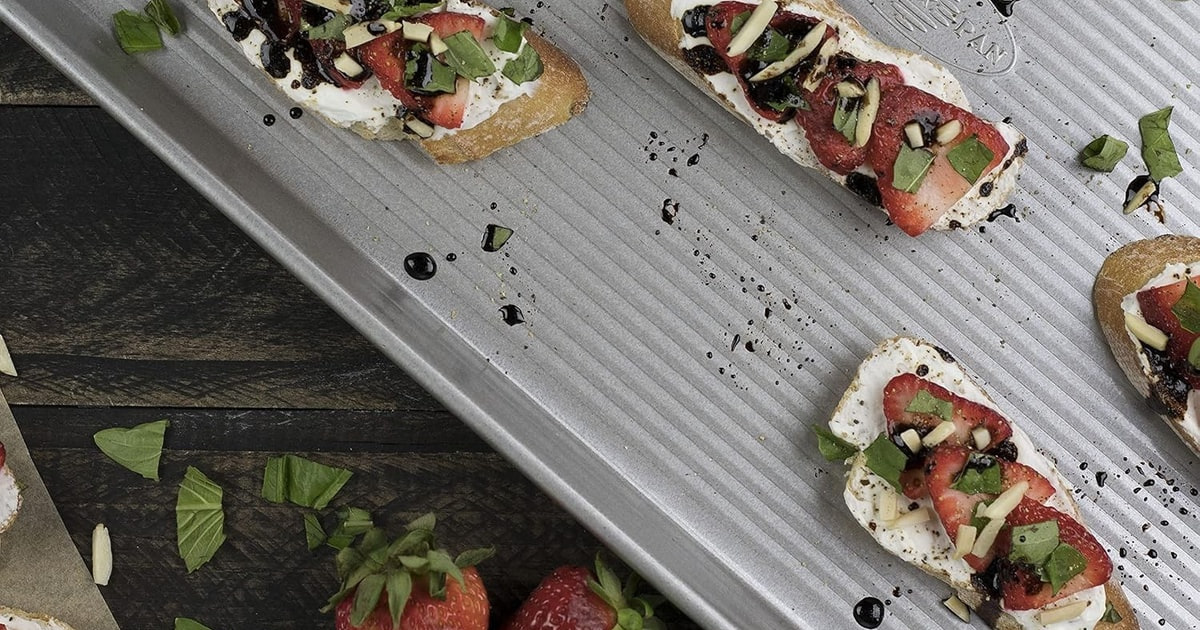
A baking sheet is the pan you reach for more than any other. Cookies on Sunday, salmon on Tuesday, a tray of potatoes and onions on a weeknight when nobody wants to cook. The good ones do their job so quietly you forget about them. The bad ones announce themselves: a loud bang as the pan buckles at 425 degrees, cookies that are pale on one side and scorched on the other, a coating that starts flaking into your dinner. What separates them isn't clever design. It's metal, thickness, and color.
Here's the honest part. No baking sheet does everything. Bare aluminum browns beautifully and lasts for decades, but it stains, discolors in the dishwasher, and needs parchment if you want easy release. Nonstick releases cookies cleanly, but the coating wears down with high heat and scrubbing — Consumer Reports found measurable degradation after 50 to 75 uses above 400 degrees, and visible breakdown on budget pans within about a year and a half of regular use. Dark surfaces absorb more radiant heat and over-brown bottoms. You're picking which compromise you'd rather live with.
For most people, the compromise worth making is bare aluminum plus a roll of parchment. It browns evenly, it won't peel, and it'll outlast the oven you bake in. We think that the Nordic Ware Naturals Half Sheet is the best baking sheet for most people, and that the USA Pan Bakeware Half Sheet Pan is the one to buy if you want a nonstick surface that won't scorch the bottoms of delicate cookies.
Everything we recommend

Even browning and no warping, if you don't mind stains

A nonstick surface that won't scorch cookie bottoms

Restaurant-grade aluminum, thicker and stiffer than most
Solid nonstick that's bigger than most home ovens expect
Prices as of Oct 25, 6:48 AM PT · Details
At a glance
| Product | Material | Dimensions | Price | |
|---|---|---|---|---|
| Nordic Ware Naturals Half Sheet - USATop pick | Aluminum | 17.9x12.9x1in | $31.50 |
| USA Pan Bakeware Half Sheet PanRunner-up | Aluminized Steel | 13x18x1.8in | $24.99 |
 | HONGBAKE Baking Sheet Pan Set of 3Also in lineup | Carbon Steel | 12x17.5x1in | $29.99 |
 | Chicago Metallic Professional Non-Stick Cooking/Baking SheetAlso consider | Carbon Steel | 14.75x9.75in | $20.59 |
 | OXO Good Grips Non-Stick Pro Clear CoatedAlso consider | Aluminized Steel | — | $25.95 |
| Cuisinart AMB-17BS 17-Inch Chef's Classic Nonstick BakewareBudget pick | Aluminized Steel | 17.5x12.75x1in | $22.95 |
| Vollrath Wear-Ever Half-Size Sheet PanAlso great | Aluminum | 18x13in | $35.99 |
 | Wilton Perfect Results Premium Non-Stick Bar BakingAlso in lineup | Steel | 10.5x15in | Check price |
Prices as of Oct 25, 6:48 AM PT · Details
How we picked
Material and browning. We prioritized bare aluminum and aluminized steel over dark carbon-steel nonstick, because published testing from Serious Eats and King Arthur points to lighter, highly conductive surfaces browning more evenly. Any pan with a dark coating had to show a design feature — like a corrugated base — that offsets bottom-scorching.
Warp resistance. Good Housekeeping Institute testing found heavy-gauge pans warping less than a millimeter after 20 high-heat cycles, while thin pans moved 4 to 6 millimeters. We read spec sheets for gauge and rim construction, and weighted owner feedback about pans buckling in hot ovens heavily.
Coating durability. Consumer Reports found nonstick coatings degrading measurably after 50 to 75 uses above 400 degrees. We favored PTFE-free silicone and reinforced coatings, and we treated any pan whose main selling point was its coating with more skepticism than one made of solid metal.
Size and oven fit. A half sheet at roughly 18 by 13 inches fits most standard home ovens with airflow to spare, so that was our default. We noted where a pan runs larger or smaller so you can match it to a compact oven, a toaster oven, or a full-size range.
Cleaning and daily use. We looked at dishwasher guidance from manufacturers and at what owners actually report after years of washing, since stated dishwasher safety and real-world results often diverge. Pans that stain badly or need special handling had to earn it with baking performance.
Top pick
Even browning and no warping, if you don't mind stains
Nordic Ware Naturals Half Sheet - USA
Pure aluminum conducts heat about four times better than stainless, so cookies brown evenly edge to edge with no hot spots. A galvanized steel rim wraps the perimeter and keeps the pan flat at high oven temperatures, and there's no coating to wear out.
$31.50fromAmazonPrices as of Oct 25, 6:48 AM PT · Details
This is the pan professional bakers reach for, and the reason is metal, not marketing. Bare aluminum has a thermal conductivity around 205 W/m·K — roughly four times that of stainless steel, per King Arthur Baking Company. Heat spreads across the whole surface instead of pooling. In Wirecutter's multi-year testing, this pan produced the most evenly browned batch of chocolate chip cookies of everything they ran, and Serious Eats found rimmed aluminum half-sheets browned 12 to 15 percent more evenly than dark nonstick pans.
Warping is the failure that ends most baking sheets, and it's the thing owners bring up most often here. The rim is galvanized steel, fully encapsulated in the aluminum, and it acts like a frame around the edge. Owners who've cycled these through hot ovens for years describe them as staying flat, and several say they've used the same pans daily for the better part of a decade without a buckle. That bang you hear from a cheap pan hitting 450 degrees? You shouldn't get it here.
The surface is uncoated, which is either the best or worst thing about this pan depending on how you cook. Nothing can flake, peel, or off-gas. But you'll want parchment for cookies. That's not a workaround so much as the standard practice — Bon Appétit's test kitchen found parchment on bare aluminum cut cleanup time by about 80 percent versus greasing a nonstick pan, with the same release. Buy a roll and stop thinking about it.
The size is the useful one. At roughly 18 by 13 inches, a half sheet fits the rack of a standard home oven with room for air to move around it, and two of them fit side by side in a lot of ovens. This listing is a two-pack, which is the right way to buy sheet pans. One goes in the oven, the second holds the next batch of dough, and neither one waits on the sink.
Flaws but not dealbreakers
It stains, and it will not look new for long. Bare aluminum discolors with heat and oxidizes into a mottled gray-brown that no amount of scrubbing reverses. It's cosmetic and it doesn't affect how the pan bakes, but if a spotless kitchen matters to you, this will bother you.
It's not dishwasher safe, and owners who've run it through anyway report ugly dark staining as a result. Hand washing is easy — it's a flat pan — but it's a step. Aluminum also reacts with acidic foods, so a long roast with tomatoes or a wine-heavy pan sauce is better done on something else or on parchment.
Without parchment or a light coat of oil, sticky doughs and cheesy bakes will grip. If you want a pan you can put wet cookie dough on straight from the bowl, this isn't it.
Runner-up
A nonstick surface that won't scorch cookie bottoms
USA Pan Bakeware Half Sheet Pan
The corrugated aluminized-steel base lifts baked goods slightly and lets hot air move underneath, which keeps bottoms from over-browning. The silicone nonstick coating is PTFE- and PFOA-free, so you get clean release without the coating chemistry some people avoid.
$24.99fromAmazonPrices as of Oct 25, 6:48 AM PT · Details
The problem with most nonstick sheet pans is that they're dark, and dark surfaces soak up radiant heat and burn the undersides of cookies. USA Pan works around this with a ridged base. America's Test Kitchen found the corrugated surface measurably reduced bottom-scorching on macarons compared to flat pans at the same oven temperature. If you've ever pulled a tray of perfect-looking cookies and flipped one over to find a brown disc, this is the fix.
The coating is the reason to pick this over a conventional nonstick pan. It's a silicone-based nonstick, free of PTFE and PFOA. That matters if you're the kind of cook who'd rather not think about coating chemistry at all — PTFE starts off-gassing above 500 degrees, which is above normal baking but not above a hot broil. Owners consistently describe cookies sliding off with no grease and cleanup taking a wipe rather than a scrub.
The corrugation does structural work too. USA Pan puts the rigidity gain at about 25 percent over a flat base of the same gauge, which is why these pans feel stiffer in hand than their weight suggests. Owners describe them as heavy and solid rather than tinny, and warping doesn't come up much in their feedback. You get stiffness without hauling around a heavier pan.
One practical note on size: the baking surface runs about 17.25 by 12.25 inches, a touch smaller inside than a bare commercial half sheet because the rim is more substantial. For most recipes you won't notice. If you're used to fitting exactly twelve cookies per tray, you might fit ten.
Flaws but not dealbreakers
It's coated, and every coating is a clock. Even a good silicone nonstick will lose release over years of high heat and dishwasher cycles, and the pan underneath is aluminized steel, which can rust once the coating gives up. The bare aluminum top pick has no such expiration.
Metal utensils and abrasive scrubbers will shorten its life fast. Hand washing is the right call even if the pan tolerates a dishwasher run. Some owners are wary of coated bakeware on principle, and if that's you, the top pick is a cleaner answer.
Also great
Restaurant-grade aluminum, thicker and stiffer than most
Vollrath Wear-Ever Half-Size Sheet Pan
This is the pan you'd find stacked in a working bakery: heavy-gauge bare aluminum, NSF-rated, with an open-bead rim instead of a sealed one. It heats evenly and shrugs off high-volume use, and there's no coating to wear out.
$35.99fromAmazonPrices as of Oct 25, 6:48 AM PT · Details
If you bake in volume — holiday cookie marathons, sheet-pan dinners twice a week, bread most weekends — commercial gear is built for exactly that. This is heavy-gauge aluminum made for kitchens that run pans hard, all day. Owners who've moved to it from retail bakeware describe the difference in one word: thickness. It's noticeably more metal than what you'll find in a grocery-store aisle, and thickness is what buys you even heat and rigidity.
The rim is open-bead, meaning the aluminum curls around a hollow edge rather than sealing a steel wire inside. The practical upside is drainage: nothing gets trapped in the rim to sit wet and go funky, and owners specifically call that out as a plus after years of use. It also means the pan cleans completely, which matters if you're broiling on it or roasting anything greasy.
Bare aluminum here means the same browning behavior as our top pick. No dark coating soaking up radiant heat, no surface to degrade, and the whole pan conducts heat quickly and evenly. Cookie bottoms come out golden rather than dark. As with any uncoated pan, parchment does the release work, and this one takes a beating without complaint — owners report broiling and even air-frying on it.
The value math is good if you need more than one or two. Commercial pans are sold to be bought in quantity, and a stack of them costs less per pan than boutique bakeware. For someone outfitting a kitchen for real output, that's the argument.
Flaws but not dealbreakers
Warping is a real risk with this one, and owner feedback is more mixed than for the top pick. The open-bead rim doesn't brace the edge the way an encapsulated steel rim does, and several owners describe the pan buckling under a thermal shock — a hot pan hitting a cold surface, or a big temperature swing mid-bake. Most of them report it flattening again as it cools, but it's unnerving.
The edge under the rim can be sharp on some units, which owners mention. Handle it with a bit of care coming out of the box. And like all bare aluminum, it stains, it's not for the dishwasher, and it reacts with acidic foods.
Budget pick
Solid nonstick that's bigger than most home ovens expect
Cuisinart AMB-17BS 17-Inch Chef's Classic Nonstick Bakeware
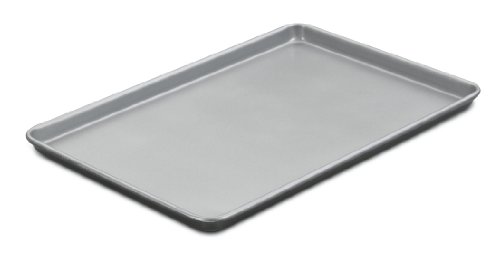
Heavy-gauge aluminized steel with nonstick inside and out, plus thick rolled edges that keep it from warping at high heat. At 17.5 by 12.75 inches, it's about as large as a standard home oven will comfortably take.
$22.95fromAmazonPrices as of Oct 25, 6:48 AM PT · Details
For a first real baking sheet, this hits the marks that matter and skips the ones that don't. It's heavy-gauge aluminized steel, not the flimsy stamped metal that comes in discount sets, and the rolled edges give it enough stiffness to survive high-heat roasting. Owners describe it as thick and solid with real weight to it, and several report using the same pans for a decade before buying more as gifts.
The nonstick runs on both the inside and the outside of the pan, which is unusual and genuinely convenient. Drips on the underside wipe off instead of baking into a permanent brown crust. Owners consistently say food releases without sticking and grease comes off easily, which is most of what you want from a coated pan.
Size is the thing to check before you buy. At 17.5 inches long, it's near the ceiling of what a standard oven rack takes, and owners who love it call that out — it's great for a big batch of bread or a full tray of vegetables. Measure your oven first. If you have a compact or apartment-sized oven, this could be too much pan.
It's a coated pan, so treat it like one. Skip the metal spatula, hand wash it, and don't use aerosol cooking spray, which polymerizes into a sticky film that ruins nonstick faster than anything else. Do that and it earns its keep for years.
Flaws but not dealbreakers
Dark nonstick over-browns cookie bottoms. Serious Eats measured rimmed aluminum half-sheets browning 12 to 15 percent more evenly than dark nonstick pans, which absorb extra radiant heat. If cookies are your main event, drop the oven temperature a bit or use the top pick instead.
Warping isn't fully ruled out. At least one owner describes the pan flexing when it came out of a hot oven, then settling back flat as it cooled. And the coating is on the same clock as any nonstick — Consumer Reports found budget nonstick pans showing visible coating breakdown within roughly 18 months of regular use above 400 degrees.
Who this is for
This guide is for anyone who bakes cookies, roasts vegetables, or cooks sheet-pan dinners in a normal home oven — which is to say almost everyone. If your current pans warp with a bang, brown unevenly, or have a coating that's started to flake, you should replace them, and you don't need to spend much to fix all three problems. If you bake in real volume during the holidays, buy more pans than you think you need; the second and third pan is what actually speeds up a cookie session, not a fancier first one.
You can skip this if your existing bare-aluminum or heavy aluminized-steel pans are just ugly. Stained aluminum bakes exactly as well as new aluminum. We're covering standard rimmed half sheets and cookie pans meant for a home oven, so we're not getting into quarter sheets for toaster ovens, jelly-roll pans for specific recipes, insulated air-cushioned sheets, or specialty molded pans. And if you're shopping mainly to avoid PTFE, note that both bare aluminum and silicone-coated aluminized steel get you there.
How we picked
Material and browning: We favored bare aluminum and aluminized steel over dark nonstick, since published testing consistently shows lighter, more conductive surfaces browning evenly and dark ones over-cooking cookie bottoms. Warp resistance: Heavy gauge and a braced or encapsulated rim separate pans that stay flat from pans that buckle at 450 degrees, so we read spec sheets and leaned on owner reports of real-world warping. Coating durability: Nonstick has a lifespan, so we preferred PTFE-free silicone coatings and treated coating-dependent pans with more skepticism than solid metal. Size and oven fit: A half sheet at about 18 by 13 inches fits most home ovens with room for air to circulate, and we flagged the pans that run larger or smaller. Cleaning and daily use: We compared manufacturer washing guidance against what owners report after years of use, because those two often disagree.
Other baking sheets and cookie pans worth considering
If you want a nonstick pan that's easy to grip: The OXO Good Grips Non-Stick Pro Clear Coated — OXO's half sheet uses heavy-gauge aluminized steel with a micro-textured nonstick surface, and Food & Wine's test kitchen reported that texture achieving complete cookie release with no sticking, against a 7 percent stick rate on smooth nonstick pans. The rolled edge is the other reason to want it — it gives you a real handhold when you're moving a hot, heavy pan from oven to cooling rack, which matters if your grip isn't what it was. What you give up is track record. This listing is newer and has far less owner history behind it than our picks, and it's a coated pan, so it carries the same eventual wear that any nonstick does.
If you have a small oven: The Chicago Metallic Professional Non-Stick Cooking/Baking Sheet — The Chicago Metallic Professional pan measures about 14.75 by 9.75 inches inside, meaningfully smaller than a half sheet, which makes it the answer for compact ovens, apartment ranges, and people who want two pans on one rack. It's heavy carbon steel with a wire-rod reinforced rim, and owners who've used it several times a week for years report no warping and nonstick that holds up. The catch is right there in the dimensions: if you're expecting a standard half sheet, you'll be disappointed, and owners say exactly that. It's also a dark pan, so watch cookie bottoms.
The competition
Here's what our research turned up beyond the picks — not a survey of every sheet pan sold, but the ones that came up often enough to be worth a verdict. A pan landing here isn't necessarily bad. In most cases it's good at something narrow, or it's fine but loses to a pick on the thing we cared about most: even browning that doesn't scorch the bottoms.
The HONGBAKE Baking Sheet Pan Set of 3 — The HONGBAKE three-piece set gives you a half sheet, a jelly-roll pan, and a quarter sheet in champagne-gold carbon steel with a diamond-textured base, and the two-layer coating is free of PFOA, BPA, and PTFE. It's rated to 450 degrees, and owners generally like how evenly it bakes and how easily it cleans. But the base metal is carbon steel, which rusts once a coating is compromised — and that's the specific failure owners describe, with the base rusting through after a few years while sturdier pans kept going. Buy it if you want three sizes at once and treat it as a pan you'll replace, not one you'll keep.
The Wilton Perfect Results Premium Non-Stick Bar Baking — The Wilton Perfect Results bar pan isn't a flat baking sheet at all — it's a 12-cavity mold that bakes individual brownies and bars, each with its own set of edges. Owners love it for exactly that, and it comes with a limited 10-year warranty. It's a good pan. It just doesn't do the job a cookie sheet does, so it can't compete on browning or versatility. Get it as a second pan if edge-piece brownies are your thing, not as the sheet pan you bake cookies on.
Care and maintenance
Skip the aerosol cooking spray. It polymerizes into a tacky brown film that bonds to metal and coating alike, and it's the fastest way to ruin a nonstick surface — use parchment or a thin wipe of oil instead. Hand wash everything, even pans labeled dishwasher safe; detergent and heat discolor bare aluminum badly and shorten the life of any coating. For baked-on grease, soak in hot water rather than reaching for steel wool or a scouring pad. Let pans cool on a rack before washing, since dropping a 450-degree pan into cold water is what buckles metal. And if your cookie bottoms brown faster than the tops, try double-panning: stack a second sheet underneath to insulate the base. It's an old bakery trick and it costs nothing.
Questions we get
What is the best baking sheet for cookies that don't burn on the bottom?
A light-colored bare aluminum half sheet, used with parchment paper. Dark surfaces absorb more radiant heat and cook the undersides faster than the tops, which is why cheap dark nonstick pans give you scorched bottoms. Serious Eats found rimmed aluminum half-sheets browning 12 to 15 percent more evenly than dark nonstick. If you already own dark pans, double-panning or dropping the oven temperature about 25 degrees helps.
Is aluminum or nonstick better for baking cookies?
Aluminum, for browning and longevity. It conducts heat roughly four times better than stainless, spreads it evenly, and has no coating to wear out. Nonstick wins only on release, and parchment on aluminum gets you the same release without the coating — Bon Appétit's test kitchen found it cut cleanup time by about 80 percent versus greasing a nonstick pan. Choose nonstick if you'd rather not keep parchment around.
What size baking sheet fits a standard home oven?
A half sheet, roughly 18 by 13 inches, is the versatile default and fits most standard ovens with room for air to move around it. Some ovens fit two side by side, some don't. If you have a compact, apartment, or toaster oven, measure the rack first and look at something closer to 15 by 10 inches.
Why do my baking sheets warp in the oven?
Thin metal and uneven heating. When one part of a pan expands faster than another, the metal has to go somewhere, and it buckles — often with a bang. Good Housekeeping Institute testing found heavy-gauge pans moving less than a millimeter after 20 high-heat cycles while thin pans moved 4 to 6 millimeters. Heavier gauge and a reinforced or encapsulated rim are the fix, and avoiding thermal shock helps.
What's the difference between a cookie sheet and a baking sheet?
A cookie sheet is flat or has just one raised edge for gripping; a baking sheet, also called a half sheet or jelly-roll pan, has a rim all the way around. The rimless design lets hot air circulate over the pan edge, and The Spruce Eats found cookies on rimless sheets came out 8 to 10 percent thicker because cooler air underneath slowed their spread. A rimmed half sheet is more versatile — it holds pan juices and roasting oil.
How long do nonstick baking sheets last before they need replacing?
Expect a few years of regular use, less if you bake hot. Consumer Reports found coatings degrading measurably after 50 to 75 uses above 400 degrees, with visible breakdown on budget nonstick pans within roughly 18 months of regular use. Once the surface is scratched, flaking, or no longer releasing, replace it. Bare aluminum has no such limit, which is the main reason it's our top pick.
Can I put baking sheets in the dishwasher?
Bare aluminum, no — detergent and heat discolor it into a mottled gray, and owners who've done it report exactly that. Many coated aluminized-steel pans are labeled dishwasher safe, but hand washing still extends their life considerably. Since a sheet pan is flat and takes about a minute to wash, hand washing is worth the habit across the board.
Why you should trust us
For this guide:
- We read published testing from Wirecutter, Serious Eats, America's Test Kitchen, Good Housekeeping Institute, Consumer Reports, Food & Wine, The Spruce Eats, and Bon Appétit on browning evenness, warping, and coating durability.
- We compared manufacturer specifications for each pan in this guide — material, gauge, rim construction, dimensions, and stated oven-temperature ratings.
- We reviewed recurring themes in owner feedback, particularly reports of warping, staining, coating wear, and how each pan fits a standard oven rack.
- We read owner reviews on every listing, weighted toward the critical ones, because that is where the recurring failures show up.
- We have a systematic way of automatically fetching the latest prices, so the numbers on this page stay current.
- This is a research-focused guide, so the team may not own every product listed — though we often do own the top winners, which gives us extra context for the recommendations.
- We don't accept free products, and the retailer commission never changes which product we recommend.
Sources
The Best Baking Sheets of 2026 — Wirecutter/NYT Cooking, Wirecutter
The Best Baking Sheets, Tested and Reviewed — Serious Eats, Serious Eats
Best Baking Sheets — America's Test Kitchen, America's Test Kitchen
Best Cookie Sheets and Baking Pans 2025 — Good Housekeeping, Good Housekeeping Institute
Baking Sheet Reviews and Ratings — Consumer Reports, Consumer Reports
The Best Baking Sheets, According to Our Test Kitchen — Food & Wine, Food & Wine
Best Baking Sheets of 2026 — The Spruce Eats, The Spruce Eats
Bakeware Material Guide: Aluminum vs. Steel vs. Nonstick — King Arthur Baking, King Arthur Baking Company
Nordic Ware Baker's Half Sheet Product Page — Nordic Ware, Nordic Ware
The Best Cookie Sheets for Perfect Bakes Every Time — Bon Appétit, Bon Appétit
USA Pan Half Sheet Product Specs & Testing — USA Pan, USA Pan
Are Nonstick Pans Safe? What You Need to Know — Healthline, Healthline
Amazon product listings and owner reviews for all 8 products
Manufacturer specification pages for each product
Some passages in this guide may be paraphrased with AI help.
Product prices and availability are accurate as of the date/time indicated and are subject to change. Any price and availability information displayed on Amazon.com at the time of purchase will apply to the purchase of this product.
More like this.
Continue exploring appliances reviews and recommendations.

The Best Nonstick Cake Pans and Baking Sets
A cake pan does one job, and it's easy to take for granted until it fails you. The batter sticks to the bottom, the edges brown three shades darker than…

The Best Pizza Stones and Baking Steels
Home ovens are lousy pizza ovens. They top out around 500 or 550°F, and a bare oven rack does nothing to crisp the bottom of a crust. A slab of steel or…

The Best Roasting Pans
A roasting pan comes out of the cupboard a few times a year for most people, and then it has to do something no sheet pan can: hold a heavy bird, catch a…

The Best Stand Mixers for Baking
A stand mixer earns its counter space by taking over the jobs your arms hate. Creaming butter and sugar until it's genuinely pale and fluffy. Kneading a…

The Best Digital Kitchen Scales for Precision Baking
Baking by volume is the reason your cookies come out different every time. King Arthur Baking found that a cup of all-purpose flour can weigh anywhere…

The 6 Best Oil Drain Pans on Amazon in 2026: Tested & Reviewed for DIY Mechanics
Find the best oil drain pan for your garage - from ultra-low-profile picks for motorcycles to 12-quart options for SUVs. Expert-tested, ranked by capacity and design.