The Best Digital Kitchen Scales for Precision Baking
Baking by volume is the reason your cookies come out different every time. King Arthur Baking found that a cup of all-purpose flour can weigh anywhere from 113 to 170 grams depending on how you scoop it. That's a 50 percent swing in the main ingredient of your bread. A scale erases that problem for the price of a couple of takeout dinners. It also means fewer dishes, since you can dump everything into one bowl and tare between additions.
Here's the honest catch: no scale does everything. The ones precise enough to weigh 3 grams of yeast down to a tenth of a gram usually top out around 2 kilos, which won't hold a stand-mixer bowl full of dough. The ones that handle 11 or 33 pounds mostly read in 1-gram steps. You either buy two scales, buy one with two platforms, or accept a compromise. Battery doors, glass tops that show every fingerprint, and auto-off timers that cut out mid-recipe are the other small annoyances nobody mentions.
We looked at what published reviews, spec sheets and owner feedback say about seven scales that home bakers actually buy. Most people are choosing between a workhorse for flour and water and a fine scale for salt and yeast. A few of these try to be both. We think that the Escali Primo is the best digital kitchen scale for most people, and that the KUAIVO dual-platform scale is the one to buy if you bake sourdough and want coarse and fine weighing on one device.
Everything we recommend
The simple, durable one that just keeps working

Two platforms, so one scale covers flour and yeast

Baker's percentages without doing the math yourself

Slim, cheap and accurate enough for everyday baking

A pocket scale for yeast, salt and spice blends
At a glance
| Product | Capacity | Precision | Price | |
|---|---|---|---|---|
| Escali Primo Digital Food Scale Multi-Functional KitchenTop pick | 11 lb (5,000 g) | 0.05 oz (1 g) | $25 |
| Bakers Math Kitchen Scale by My WeightUpgrade pick | 8000 g | — | $46.94 |
| Etekcity Food Kitchen ScaleBudget pick | 11 lb/5 kg | 1 g increments | $9.99On sale |
 | Ozeri Touch Professional Digital Kitchen ScaleAlso in lineup | 12 lbs (5750 g) | 1 g | $33.93 |
 | Brewista Smart Coffee Scale III with TimerAlso consider | 2000 g (70 oz) | 0.1g precision | $55 |
| KUAIVO 0.001oz/33lbs Dual Platform Food Kitchen ScalesAlso great | 33 lbs | 0.1 oz | $29.74On sale |
| WEIGHTMAN Shiny Digital Gram Scale 200g xRunner-up | 200 g | 0.01 g | $14.99 |
How we picked
Resolution that matches use. We prioritized scales whose smallest increment suits what you'll weigh on them. A 1-gram step is fine for flour and water, but published reviews are clear that leavening and salt need 0.1 grams or finer.
Platform size and stability. Allrecipes testers found platforms under 6 inches square couldn't safely hold 9-inch cake pans or stand-mixer bowls. We favored full-size scales with wide, flat stainless tops.
Readable display. We looked for backlit screens with large digits, and for pull-out or offset placement where the spec sheets described it. A display hidden under a big bowl is the most common source of misreads.
Tare and auto-off behavior. Bon Appétit editors found auto-off timers under two minutes caused real errors in multi-step recipes, so we noted each scale's timer. Fast, reliable tare matters just as much when you're adding ingredients in sequence.
Cleaning and durability. Sealed control panels, one-piece stainless surfaces and accessible battery doors came up constantly in owner feedback as the difference between a scale that lasts five years and one that dies in six months.
Top pick
The simple, durable one that just keeps working
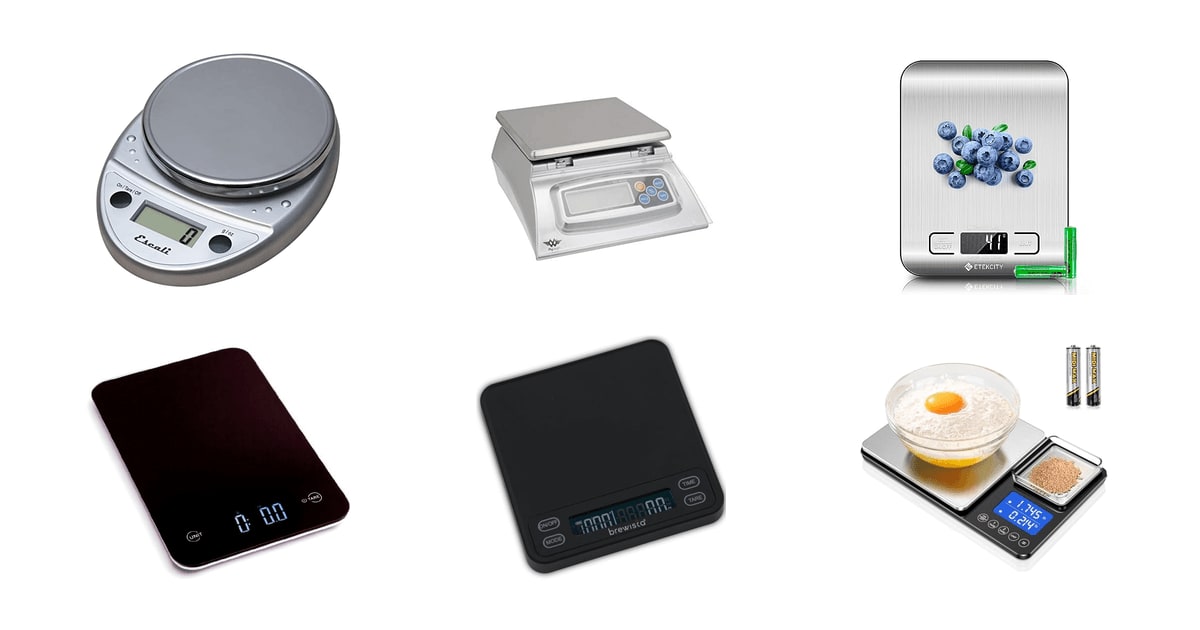
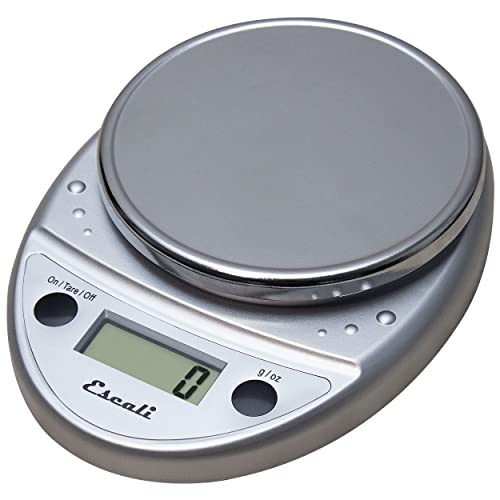
Escali Primo Digital Food Scale Multi-Functional Kitchen
The Escali Primo weighs up to 11 pounds in 1-gram steps, with two buttons and a sealed face that shrugs off spilled batter. It's the scale to buy if you want to weigh flour, water and butter without thinking about the scale at all.
$25fromAmazonTwo buttons is the right number of buttons. One turns it on and switches units, the other tares. That's it. There's no mode you can accidentally get stuck in at 6 a.m. with sticky hands, and no touch panel that ignores you when your fingers are damp. Owners who've had theirs for five or six years describe the same experience on day one and day two thousand, which is about the highest praise a kitchen tool gets.
The whole control panel sits under a sealed shield, so flour dust and dribbled milk wipe off instead of working their way into button gaps. That matters more than it sounds. Scales usually die from grit in the switches or corrosion in the battery bay, not from the load cell wearing out. The rounded chrome body has no seams to trap dough either, and it runs on AA batteries you probably already have in a drawer.
The 11-pound ceiling covers essentially all home baking. A double batch of sourdough, a full bowl of buttercream, a whole chicken for brining — all comfortably under 5 kilos. The platform is about 8.5 by 6 inches, wide enough to hold a large mixing bowl without the bowl tipping or overhanging into your reading line. Allrecipes testers flagged platforms under 6 inches square as genuinely unsafe with 9-inch cake pans; this one clears that bar.
Auto-off waits four minutes, which lands in the range Bon Appétit editors recommend after finding that shorter timers caused real errors in slow, multi-step recipes. If you're browning butter between additions or waiting for a starter to finish dripping, the display is still awake when you come back. Consumer Reports found budget scales in this class, the Primo included, held accuracy within about a gram across twenty repeat weighings.
Flaws but not dealbreakers
It reads in 1-gram steps, and that's the real limit. For a 4-gram dose of instant yeast, a 1-gram error is a quarter of the amount, and Serious Eats found exactly this gap between 0.1g and 1g scales on small measurements. If you bake macarons or work with tiny quantities of leavening, you'll want to pair this with a cheap pocket scale.
The display sits flat on the body rather than pulling out on a tray. With a very tall or very wide bowl you may have to lean over to read it. Most owners work around it easily, but it's a step down from a genuine pull-out design.
Escali backs the Primo with a lifetime warranty.
Also greatOn sale
Two platforms, so one scale covers flour and yeast
KUAIVO 0.001oz/33lbs Dual Platform Food Kitchen Scales
The KUAIVO puts a 33-pound platform and a 1.1-pound fine platform on the same body. That solves the central annoyance of baking by weight — big ingredients and tiny ones usually need two different scales.
$29.74fromAmazonList priceThis is the closest thing here to a one-scale kitchen. The large platform takes up to 33 pounds, enough for a bulk dough tub or a full pot you're weighing as you go. The small side handles up to about 1.1 pounds with much finer resolution, which is where your salt, yeast and diastatic malt live. You stop doing the mental math of which scale to grab.
Sourdough bakers are the obvious audience, and owner feedback skews heavily that way. Hydration math punishes small errors: 8 grams of salt versus 10 grams in a 1,000-gram dough is a noticeably different loaf. Being able to tare the fine platform, add salt, then move to the big platform for water without swapping devices makes a multi-step build faster and less error-prone.
It reads in seven units, including milliliters and a separate milk setting, so measuring liquids by weight doesn't require you to look up a conversion. The accumulation function adds up sequential weighings, which helps when you're portioning rolls or dividing dough into equal pieces. Auto-off is 210 seconds — comfortably past the two-minute threshold Bon Appétit warned about.
The stainless surface is one smooth piece, so batter wipes off rather than settling into seams. At 10.8 by 7 inches it's the largest footprint here, which is a fair trade for stability under a wide bowl. Owners repeatedly describe readings that settle immediately rather than drifting up and down while you pour.
Flaws but not dealbreakers
It's big and it's heavy, close to three pounds. If your counter is short on space or you want something that slides into a drawer, this isn't it.
It's also a much newer, less-established product than the Escali or the My Weigh, with a far shorter track record. The published-review coverage is thin, so most of what we know comes from spec sheets and owner feedback rather than independent lab work.
Upgrade pick
Baker's percentages without doing the math yourself
Bakers Math Kitchen Scale by My Weight
The My Weigh KD-8000 calculates baker's percentages on the fly, so you can scale a bread formula up or down without a calculator. It's built like shop equipment, with a hinged shield that keeps dough out of the buttons.
$46.94fromAmazonIf you bake bread seriously, the percentage mode is the whole reason to buy this. Professional bread formulas are written as ratios against flour weight — 70 percent water, 2 percent salt, and so on. This scale does that arithmetic as you pour. The Bread Geek's review found the feature eliminated hydration-calculation errors across thirty sourdough bakes, while doing the same math by hand produced mistakes in a fifth of the attempts.
The build is the other reason. It weighs two and a half pounds, sits flat, and the stainless platform lifts on a hinge so you can clean underneath instead of chasing crumbs into a crack. There's a backlit display that stays readable in a dim kitchen, and it runs off an AC adapter, so you're not swapping batteries mid-project. Owners who've had one for six years describe the same accuracy they started with.
Capacity is 8,000 grams, which is comfortably more than the Escali and enough for large-batch dough or a stockpot. It also switches into pounds, pounds-and-ounces, ounces and kilograms, so it works fine for the non-baking half of your cooking. Response time is quick enough that owners who upgraded from slow, five-second scales call the difference obvious.
There's a real jump in cost between this and the Escali, and it only pays off if you use the percentage mode. Soap makers and anyone scaling formulas by ratio get the same benefit. If you follow recipes as written in grams and never adjust the batch size, save your money and buy the top pick.
Flaws but not dealbreakers
It reads in 1-gram increments, same as the Escali. That's an odd limitation on a scale aimed at serious bakers, and it means small amounts of yeast still need a finer scale.
It's bulky. Nearly ten inches long and three and a half inches tall, it wants a dedicated spot on the counter rather than a drawer.
The percentage mode has a learning curve. It's well documented, but the first few loaves involve reading the manual, and if you never intend to use it you're paying for a feature you'll ignore.
Budget pickOn sale
Slim, cheap and accurate enough for everyday baking
Etekcity Food Kitchen Scale
The Etekcity EK6015 does the basics well: 11-pound capacity, 1-gram steps, five units, and a stainless face that wipes clean. It's three quarters of an inch thick, so it lives in a drawer instead of on your counter.
$9.99fromAmazonList priceThis is the scale to buy if you're not sure you'll stick with weighing. It costs a fraction of the upgrade pick and does the thing that actually matters — consistent gram readings for flour, water, sugar and butter. Millions of these are in circulation, and the owner feedback is remarkably consistent about accuracy holding up over ordinary home use.
Its best trick is that it disappears. At about three quarters of an inch thick and under half a pound, it slides behind a stack of cutting boards. If your counter space is the reason you've never bought a scale, this removes the objection. The 304 stainless top wipes down in one pass, with no textured plastic to trap flour.
Five units — grams, ounces, pounds-and-ounces, fluid ounces and milliliters — cover baking and liquid measuring. Weighing water and milk by weight is more accurate than a measuring cup anyway, since one milliliter of water weighs one gram. The backlit LCD uses large digits, which helps when you're reading past the edge of a bowl.
The tradeoffs are the ones you'd expect at this price. The platform is roughly 6 by 7.5 inches, adequate for most bowls but tighter than the Escali. And it takes AAA batteries rather than the AAs most people stock.
Flaws but not dealbreakers
Several owners flag a short auto-off. If you're weighing ingredients in stages with pauses in between, the display can shut down before you're finished, and you'll re-tare more often than you'd like.
The 1-gram resolution is the same ceiling as the other big-platform scales here. Fine for flour, not enough for 3 grams of yeast.
The thin body means it's light enough to slide on a slick counter when you set a heavy bowl down off-center.
Runner-up
A pocket scale for yeast, salt and spice blends
WEIGHTMAN Shiny Digital Gram Scale 200g x
The WEIGHTMAN reads 200 grams in 0.01-gram steps, which is finer than any full-size kitchen scale here. It's a companion to a big scale, not a replacement — but it's the piece most bakers are missing.
$14.99fromAmazonSmall ingredients are where recipes actually go wrong. Serious Eats found that on amounts under 5 grams, a 1-gram error can be 20 percent or more of the total — and 1 gram is the smallest step a typical kitchen scale can see. Instant yeast, fine sea salt, baking soda, cream of tartar and citric acid all live in that range. This scale reads to 0.01 grams with roughly 0.03-gram stated accuracy, so those doses stop being guesswork.
It's genuinely tiny, about 5 by 3 inches and a quarter pound, so it stores in the same drawer as your measuring spoons. Three buttons handle power, tare and units, and it switches among six units including grains and carats — more than a baker needs, but harmless. The backlit LCD flags overload and unstable readings, which is useful feedback when you're weighing something as light as 2 grams.
The 200-gram ceiling is the entire catch, and you need to plan around it. Put a small ramekin on it, tare, and you've already spent some of that budget. It works fine for spice blends, leavening and flavor extracts. It cannot weigh flour.
Buying this alongside the Escali costs less than most single mid-range scales and covers both ends of the range better than either does alone. That pairing is what we'd recommend to most bread and pastry bakers who want tenth-of-a-gram control without a big spend.
Flaws but not dealbreakers
It's a pocket scale wearing kitchen clothes. The platform is a few inches across and the chrome mirror finish shows every fingerprint and flour smudge, so you'll be wiping it constantly.
Auto-off is three minutes and there's no way to extend it, which is short if you're weighing several small ingredients into separate dishes.
The iridescent finish is polarizing. Some owners buy it precisely because it looks like a piece of jewelry; others find the rainbow chrome out of place next to plain kitchen gear.
Who this is for
This guide is for home bakers who want repeatable results — sourdough, laminated dough, macarons, layer cakes — plus anyone moving from cups to grams for the first time. If you follow recipes written in weight, or you've noticed the same recipe behaving differently on different days, a scale fixes more problems than any new pan will. It's also useful well outside baking: portioning coffee, tracking food intake, weighing packages for postage.
You can skip most of this if you cook by taste and rarely bake. A basic 1-gram scale is plenty. We've focused on scales sold as kitchen and food scales, so we haven't covered lab balances, hanging scales or bathroom scales, and we don't cover app-connected models beyond what's in this lineup. Every scale here is battery or adapter powered and meant for a countertop, not for commercial legal-for-trade use.
How we picked
We ranked these on a handful of things that actually change your results. Resolution: 1-gram steps work for flour and water, but salt and yeast need 0.1 grams or better, and Serious Eats found the gap shows up plainly in small measurements. Capacity: 5 kilos covers nearly all home baking, though large-batch bakers benefit from 10 kilos or more. Platform: anything under about 6 inches square struggles with cake pans and stand-mixer bowls. Display: backlit, large digits, and positioned so a wide bowl doesn't hide it. Tare and auto-off: instant zeroing, and a shutoff timer past two minutes so the scale doesn't quit mid-recipe. Cleaning: sealed panels and one-piece stainless tops survive spilled batter; textured plastic and button gaps don't.
Other digital kitchen scales for precision baking worth considering
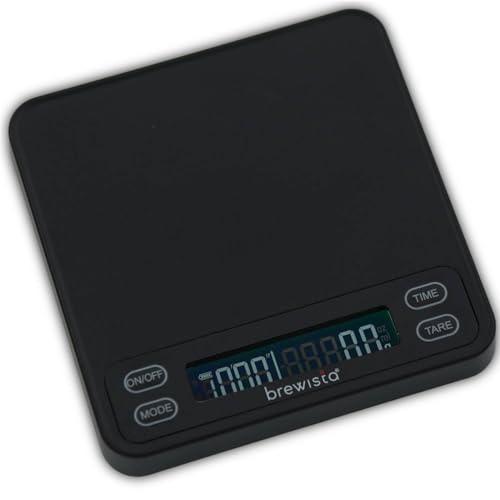
If you weigh coffee as carefully as you weigh flour: The Brewista Smart Coffee Scale III with Timer ($55) — The Brewista Smart Coffee Scale III reads 2,000 grams in 0.1-gram steps and adds a built-in timer with five brewing modes, including automatic espresso and pour-over routines. That timer-plus-weight combination is genuinely useful for ganache, caramel and anything where pour rate matters. It's USB rechargeable, palm-sized, and comes with a silicone pad and cover. But the 2-kilo ceiling rules it out as your only kitchen scale, the platform is too small for a mixing bowl, and some owners report readings that jump around when you add grounds quickly instead of settling smoothly.
The competition
This is what our research surfaced among widely sold kitchen scales, not a survey of everything on the market. A scale missing from this list isn't necessarily bad — it just didn't come up in the reviews, spec comparisons and owner feedback we worked from.
The Ozeri Touch Professional Digital Kitchen Scale ($33.93) — The Ozeri Touch is the best-looking scale in this group. It's a single sheet of tempered glass with touch-sensitive buttons, a thin profile, and readings from 1 gram up to 12 pounds in four unit systems, and the seamless surface means there's nowhere for dough to hide. But the owner feedback splits harder than any other product here, with a meaningful share of buyers reporting drift, instability and fast battery drain after a few months. Glass also stays cold and shows fingerprints. If you want something that looks like furniture on an open counter and you're comfortable with the risk, it's worth a look; for reliability, the Escali is the safer buy.
Care and calibration
Never put a digital scale in the sink or the dishwasher, even if the platform looks like it could take it. Water gets into the load cell and the battery bay, and that's usually fatal. Wipe the surface with a damp cloth and dry it, and for sticky messes lay a sheet of parchment or plastic wrap over the platform before you start. Store it flat, not standing on edge, and never rest anything heavy on top — sustained pressure is what knocks a load cell out of true. Pull the batteries if you're leaving it unused for months, since a leaking cell will corrode the contacts. Check accuracy every so often with a known weight; a nickel is almost exactly 5 grams and a US quarter is about 5.67 grams. If your scale drifts, most models have a calibration routine in the manual.
Questions we get
Do I really need a scale that measures in 0.1-gram increments?
For flour, water, sugar and butter, no — 1-gram resolution is plenty. It matters for the small stuff. Serious Eats found that on amounts under 5 grams, a 1-gram error can be 20 percent or more of the total, which is a real problem for yeast, salt and baking soda. The simplest fix is a full-size 1-gram scale plus a small pocket scale like the WEIGHTMAN.
What's the best kitchen scale for sourdough?
The KUAIVO dual-platform scale, because sourdough is exactly the case where you need both coarse and fine weighing in one session. You'll weigh 800 grams of flour and 8 grams of salt in the same ten minutes. If you want to work in baker's percentages, the My Weigh KD-8000 does that math for you as you pour.
Can I weigh liquids like milk and water?
Yes, and it's more accurate than a measuring cup. One milliliter of water weighs one gram, so 250 ml of water is 250 grams — just tare your container and pour. Milk and other liquids are slightly denser, so a milliliter setting on the scale accounts for that. The Etekcity and KUAIVO both include milliliter modes.
What is baker's math, and do I need it?
It's the convention of writing bread formulas as percentages of the flour weight — 70 percent water, 2 percent salt, 20 percent starter. It lets you scale a recipe to any batch size without redoing the arithmetic. You don't need a scale that calculates it, but if you adjust batch sizes often, the My Weigh KD-8000's percentage mode saves real effort and, per The Bread Geek's review, real errors.
How do I pick a scale that works with a big stand-mixer bowl?
Look for a platform at least 6 inches square, and ideally closer to 7. Allrecipes testers found smaller platforms couldn't safely support 9-inch pans or large bowls, which causes tipping and bad readings. Also think about the display: if the bowl overhangs it, you can't read it. The Escali and the KUAIVO both have wide enough tops for a stand-mixer bowl.
Is a rechargeable scale better than one that takes batteries?
It depends on how often you bake. Food Network Kitchen found USB-C rechargeable scales run 12 to 16 hours of active use per charge, while AA-powered models typically go 6 to 9 months at normal home frequency. If you bake weekly, batteries are less hassle. If you're weighing things daily, or you already charge everything by USB-C, recharging is more convenient.
Why you should trust us
For this guide:
- We read published reviews and lab writeups from Wirecutter, Serious Eats, Consumer Reports, Good Housekeeping, America's Test Kitchen, Bon Appétit, Chef's Pencil, Allrecipes, Food Network Kitchen, Barista Hustle and The Bread Geek, along with baking guidance from King Arthur Baking.
- We compared manufacturer specifications for capacity, resolution, platform size, unit options, auto-off timing and power source across every scale in this lineup.
- We read through owner feedback for each product and looked for recurring themes about accuracy over time, display readability, cleaning and long-term durability.
- We read owner reviews on every listing, weighted toward the critical ones, because that is where the recurring failures show up.
- We have a systematic way of automatically fetching the latest prices, so the numbers on this page stay current.
- This is a research-focused guide, so the team may not own every product listed — though we often do own the top winners, which gives us extra context for the recommendations.
- We don't accept free products, and the retailer commission never changes which product we recommend.
Sources
The Best Kitchen Scale — Wirecutter (NYT), Wirecutter
The Best Kitchen Scales, Tested — Serious Eats, Serious Eats
Best Kitchen Scales — Good Housekeeping, Good Housekeeping
Best Kitchen Scales of 2026 — America's Test Kitchen, America's Test Kitchen
Escali Primo Review — Consumer Reports, Consumer Reports
My Weigh KD-8000 Review — The Bread Geek, The Bread Geek
Kitchen Scale Accuracy Testing — Chef's Pencil, Chef's Pencil
The Science of Baking Precision — King Arthur Baking, King Arthur Baking
Acaia Pearl Scale Review — Barista Hustle, Barista Hustle
Best Digital Scales for Baking — Bon Appétit, Bon Appétit
Best Kitchen Scales — Food Network Kitchen, Food Network
Weightman Kitchen Scale Review — Allrecipes, Allrecipes
Amazon product listings and owner reviews for all 7 products
Manufacturer specification pages for each product
Some passages in this guide may be paraphrased with AI help. Prices are refreshed automatically.
More like this.
Continue exploring appliances reviews and recommendations.

The Best Smart Kitchen Scales
Weighing your food is the fastest way to stop guessing. A cup of flour can swing by a third depending on how you scoop it, and a serving of peanut butter…

The Best Nonstick Cake Pans and Baking Sets
A cake pan does one job, and it's easy to take for granted until it fails you. The batter sticks to the bottom, the edges brown three shades darker than…

The Best Baking Sheets and Cookie Pans
A baking sheet is the pan you reach for more than any other. Cookies on Sunday, salmon on Tuesday, a tray of potatoes and onions on a weeknight when…

The Best Stand Mixers for Baking
A stand mixer earns its counter space by taking over the jobs your arms hate. Creaming butter and sugar until it's genuinely pale and fluffy. Kneading a…

The Best Pizza Stones and Baking Steels
Home ovens are lousy pizza ovens. They top out around 500 or 550°F, and a bare oven rack does nothing to crisp the bottom of a crust. A slab of steel or…

The Best Digital Picture Frames
A digital picture frame earns its place by disappearing into a room and then surprising you. The work is less in the hardware than in the pipeline behind…