The Best Home Deep Fryers
A good deep fryer does one thing an oven can't: it holds a big slug of hot oil at a steady temperature while you drop cold food into it. That's the whole game. Fries come out crisp instead of limp, chicken cooks through without burning, and doughnuts puff instead of soaking. What separates a fryer you'll actually use from one that lives in the basement is usually cleanup. If draining and storing the oil is a chore, you'll fry twice and quit.
Here's the honest part: no home fryer solves the oil problem. Even the models with filtration still leave you with a container of used oil to store, reuse and eventually throw out. Every one of these fills your kitchen with the smell of fried food, charcoal filter or not. Analog dials are the norm at this size, so you're trusting a thermostat you can't read. And none of them are small. A fryer takes real counter or cabinet space, and it doesn't multitask.
We also want to be clear about what this guide is: research, not a test kitchen. We read published reviews, compared manufacturer specs side by side, and looked hard at what owners say breaks and what they wish they'd known. We think that the T-fal Deep Fryer with Basket and Oil Filtration is the best home deep fryer for most people, and that the Cuisinart CDF-200P1 is the one to buy if you're feeding four or more and want a bigger basket instead of automated oil handling.
Everything we recommend

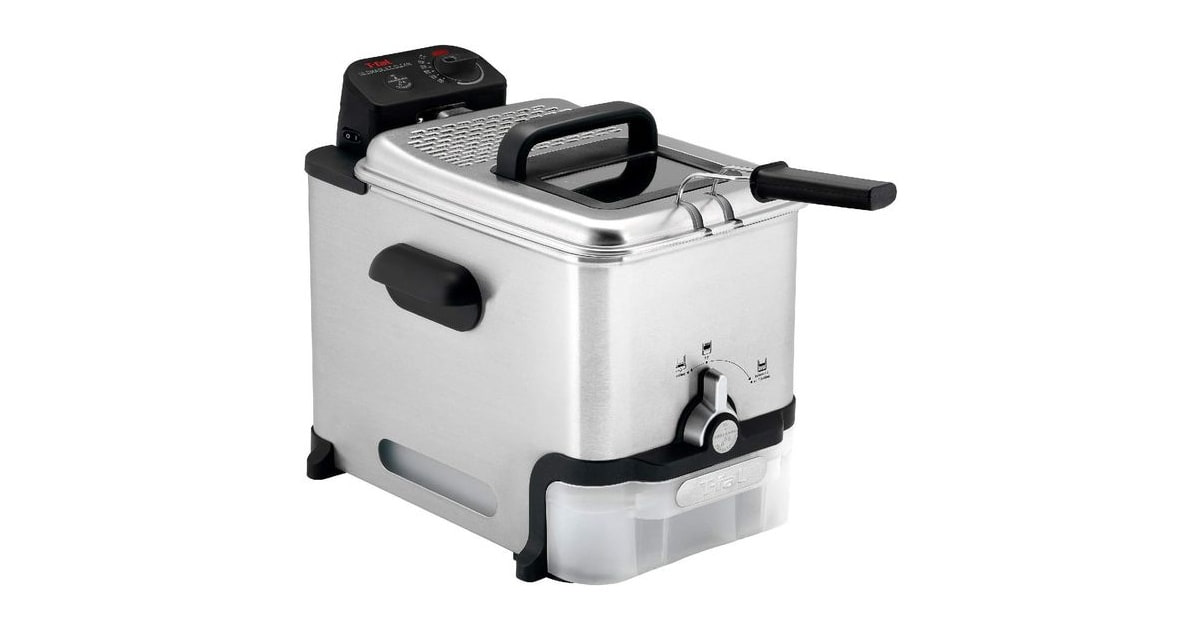
Filters and stores its own oil, so you'll actually keep frying
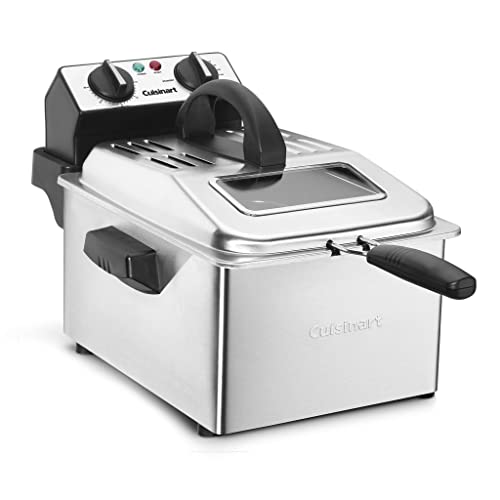
More room and more power, minus the automatic oil handling

Four cups of oil, no settings, nothing to figure out

The most oil capacity here, in mostly plastic housing

T-fal's oil filtration shrunk to fit a one-cook kitchen
Prices as of Oct 22, 7:36 AM PT · Details
At a glance
| Product | Oil Capacity | Wattage | Price | |
|---|---|---|---|---|
| T-fal Deep Fryer with BasketTop pick | 3.5 Liter | 1700W | $175.94 |
| Cuisinart Deep FryerRunner-up | 4 Quart | 1800W | $127.62 |
| Presto 05420 FryDaddy Electric Deep FryerBudget pick | 4 Cups | — | $44.99 |
| Hamilton Beach Electric Deep Fryer with 3Also great | 4.5L / 19 Cups | 1800W | $62.99On sale |
 | Breville Smart Oven Air Fryer CompactAlso consider | — | — | $249.95 |
 | Secura 4 Liters / 17-Cup Stainless-Steel 1700-WattAlso consider | 4L / 17-Cup | 1700W | Check price |
| T-fal Compact EZ Clean Stainless Steel DeepUpgrade pick | 1.8 L | 1200W | $129.95 |
 | Waring Pro DF280 Professional Deep FryerAlso in lineup | 1 Gallon | 1800W | $255.43 |
Prices as of Oct 22, 7:36 AM PT · Details
How we picked
.
.
.
.
.
Top pick
Filters and stores its own oil, so you'll actually keep frying
T-fal Deep Fryer with Basket
A 1700-watt fryer with a 3.5-liter oil tank and a patented filtration system that drains used oil into a sealed box at the flip of a lever. It removes the single biggest reason home fryers end up in a cupboard: dealing with the oil afterward.
$175.94fromAmazonPrices as of Oct 22, 7:36 AM PT · Details
The oil handling is the reason to buy this one. After you fry, a lever drains the hot oil through a mesh filter into a sealed container that lives under the fryer. You're not tipping a heavy pot into a funnel over the sink. The filter catches the crumbs and batter bits that break oil down and give it that stale, fishy smell, so the same oil stays usable across more sessions.
It heats fast and recovers fast, which is what actually makes food crisp. The 1700-watt element sits directly in the oil rather than under the pot. Drop a basket of cold fries in and the temperature dips, as it does in any fryer, but this one climbs back quickly. That matters more than any spec on the box. Oil that stalls at 300°F soaks into food instead of searing it.
The 3.5-liter tank hits a sensible middle. You can fry about two and a half pounds of food, which covers a family dinner without asking you to fill the thing with a gallon of oil every time. The basket has two positions: one for cooking, one for hanging over the pot to drain. Small thing, but you'll use it constantly, and it beats balancing a dripping basket on a plate.
Cleanup past the oil is straightforward too. The bowl, basket and lid all come out, so nothing is trapped inside a fixed housing. The bundled grease container gives you a second place to strain and park used oil, with its own fine-mesh insert. If you fry often enough to care about oil cost, that combination adds up over a year of Friday nights.
Flaws but not dealbreakers
The thermostat is analog, and there's no timer. You set a dial and trust it. There's no readout telling you the oil is actually at 350°F, and no countdown to tell you the wings are done. If you want numbers, you'll be clipping a thermometer to the side and setting your phone. For most frying that's fine, but it's a real gap next to fryers that include a timer.
It costs more than most mid-range fryers, and the filtration is why. You're paying for a mechanism, not more capacity. If you fry three times a year, you won't get that back, and a simpler pot-style fryer will do the same job on the food. The value here depends entirely on frying often enough that oil life matters to you.
The filtration system is one more thing to maintain. Owners of T-fal's EZ Clean fryers consistently point out that the drain path and filter need to be cleaned properly or oil flows slowly and residue builds up. It's not hard, but it isn't zero-effort either. Skip it a few times and the feature you paid for starts working against you.
Runner-up
More room and more power, minus the automatic oil handling
Cuisinart Deep Fryer
Cuisinart's CDF-200P1 pairs an 1800-watt immersion element with a 4-quart oil container and a wide stainless basket. It's the pick if your problem is fitting enough food in at once rather than what to do with the oil afterward.
$127.62fromAmazonPrices as of Oct 22, 7:36 AM PT · Details
The capacity is the point. Four quarts of oil and a wide basket mean a full rack of wings goes in at once instead of in three sad batches. Crowding is what ruins home frying: too much cold food drops the oil temperature and everything comes out greasy. Give the food room and the same recipe comes out crisp. If you cook for four or more, this solves your actual problem.
1800 watts is the most power you'll find at this size. The element is immersion style, sitting in the oil rather than heating the pot from outside, and it's the highest wattage in this lineup alongside the Hamilton Beach and the Waring. Faster preheat, faster recovery. You'll wait less between batches, which matters when you're frying for a table full of people.
Cleanup is genuinely easy, just manual. The oil container, basket and lid all lift out and go in the dishwasher, and the enamel-coated container has a pouring spout so you're not improvising with a funnel. You still handle the oil yourself, but the design doesn't fight you. The basket handle stays cool, so you're not hunting for a mitt mid-fry.
The three-year limited warranty is the longest term stated in this group. That's unusual for a countertop appliance in this class, where one year is the norm. It doesn't make the fryer better on day one. But if the element or thermostat gives out in year two, you're covered, and that's worth something on an appliance that lives with hot oil.
Flaws but not dealbreakers
There's no oil filtration, and no timer or digital readout. You get an adjustable dial and that's it. Straining and storing oil is on you, which for a 4-quart tank means wrestling a container of hot oil after every session. That's exactly the friction that makes people stop frying, and it's the trade you're making against our top pick.
It takes up serious counter space. At over 18 inches long and around 11 and a half pounds, this isn't something you shuffle aside to make room for a cutting board. In a small kitchen it needs a dedicated home or a low cabinet you're willing to lift it out of. Measure before you buy.
The Cuisinart CDF-200P1 comes with a limited three-year warranty.
Budget pick
Four cups of oil, no settings, nothing to figure out
Presto 05420 FryDaddy Electric Deep Fryer
The FryDaddy is a cast-aluminum pot with one job: heat four cups of oil to frying temperature and hold it there. There's no dial, no basket and no timer, and for a first fryer that simplicity is the whole appeal.
$44.99fromAmazonPrices as of Oct 22, 7:36 AM PT · Details
Zero setup is the feature. Plug it in, pour in four cups of oil, wait. It climbs to a preset frying temperature and stays there. Nothing to calibrate, nothing to second-guess. If you've been curious about frying at home but the idea of managing a gallon of hot oil sounds like a project, this is the version that doesn't feel like one.
It's small enough to store, which means you'll use it. It's roughly eight inches square and weighs about three pounds, so it lives in a normal cabinet rather than owning your counter. The handle swings up and the lid snaps on, so you can store the oil right in the pot between sessions. Fryers that are annoying to get out get used once. This one isn't.
Four cups of oil is a modest commitment. It makes about four servings of fries. You're not buying a jug of oil to make a snack, and when the oil's finally done you're throwing out a cup or so, not a quart. For one or two people, or for occasional frying, that ratio is far more sensible than a full-size fryer running half-empty.
The cast-aluminum body and ceramic nonstick surface wipe out easily. There's no removable bowl, but there's also no gasket, filter or drain path to clean. Once it's cool, a paper towel handles most of it. The nonstick coating is PFAS-free, and the heavy cast body is why these things stay in service for years rather than warping.
Flaws but not dealbreakers
The temperature is fixed, so you fry what it's calibrated for. Fries, tenders and doughnuts are well served. Anything that wants a gentler 325°F or a hotter finish, you can't ask for. That's the whole trade for having no dial, and it's the reason this is a starter fryer rather than a forever one.
There's no basket. You get a slotted scoop, which means lifting food out piece by piece and draining on a rack. It works, but it's fussier than hooking a basket over the side, and it's slower when you're doing a real batch.
Capacity caps you at two or three servings. Fine for a couple, frustrating for a family. If you're frying for four you'll be running batches back to back, and the oil will be dropping temperature the whole time.
Also greatOn sale
The most oil capacity here, in mostly plastic housing
Hamilton Beach Electric Deep Fryer with 3
Hamilton Beach's 35034 holds 4.5 liters of oil and comes with three baskets, an 1800-watt immersed element and a vented lid with a view window. It's the choice when volume matters more than build materials.
$62.99fromAmazonList pricePrices as of Oct 22, 7:36 AM PT · Details
Nineteen cups of oil is a lot of frying room. It'll cook up to twelve cups of food, which is enough for a party rather than a dinner. Big batches are also more forgiving: a large volume of oil loses less temperature when cold food goes in, so your third batch comes out like your first. If you're the one who fries for the whole family gathering, capacity is the spec that matters.
Three baskets let you match the batch to the food. There's one twelve-cup basket for a full load, plus two six-cup baskets you can run side by side. Fries in one, onion rings in the other, done at the same time. All three are chrome plated and hook over the pot to drain, so you're not searching for somewhere to park a dripping basket.
The lid actually does something. It's vented to cut splatter but has a window so you can watch the color without lifting it and taking a face full of steam. That's a small quality-of-life thing you'll appreciate the first time you fry something that spits. The breakaway cord is the other safety feature worth naming, since it releases instead of dragging four and a half liters of hot oil off the counter.
Most of it goes in the dishwasher. The oil pot, baskets and lid are all dishwasher safe; the heating element gets washed by hand in soapy water. For a fryer this size, being able to hand off the greasy parts to a machine is the difference between cleaning it tonight and cleaning it tomorrow.
Flaws but not dealbreakers
The housing is largely plastic, and it shows. Next to the stainless bodies from Cuisinart and Waring, this feels like the budget build it is. Owners of large plastic-bodied fryers commonly report handles and lid hinges as the first parts to give out, and heat plus grease is hard on plastic over years of use.
It's an analog dial with no timer. Same limitation as most of this group, but here it's paired with a lot of oil, which takes longer to come back up to temperature if you misjudge. Use a thermometer.
The footprint is large and there's no getting around it. More than fifteen inches long and over ten inches tall, with a lid that needs clearance above. This wants a dedicated spot, not a shared corner.
Upgrade pick
T-fal's oil filtration shrunk to fit a one-cook kitchen
T-fal Compact EZ Clean Stainless Steel Deep
The Compact EZ Clean holds 1.8 liters of oil and still includes the automatic filtration and sealed oil box from T-fal's larger fryers. It's the pick for a small kitchen where you want the good oil handling without the full-size footprint.
$129.95fromAmazonPrices as of Oct 22, 7:36 AM PT · Details
You get the filtration system without the full-size tank. Same idea as our top pick: after frying, oil drains through a filter into a sealed box you can stash in a cabinet. On a small fryer that matters more, not less. Nobody wants to strain and store oil for a two-serving batch, so the fryers that make it easy are the ones you'll actually use on a Tuesday.
The temperature control is a real range, not a preset. You can set it anywhere from 300°F to 375°F, which is the span that covers most home frying, from doughnuts at the low end to fries at the top. That's more control than the FryDaddy gives you at a similar footprint, and it's the reason this can handle a wider set of recipes than a fixed-temperature pot.
The safety design is the most thorough here. There's a locking lid, cool-touch handles, a viewing window and automatic shut-off. If you've got kids in the kitchen or you're nervous about frying in general, a lid that locks down over hot oil is worth more than any capacity number. The odor filter also takes some edge off the smell that lingers in a small apartment.
It's built to be put away. Under two pounds and stainless clad, with the bowl, basket, lid and oil box all removable. It goes in a cabinet after it cools rather than staking a claim on the counter. In a studio kitchen that's the difference between owning a fryer and owning a countertop obstacle.
Flaws but not dealbreakers
1200 watts is the lowest power in this lineup. Less power means slower recovery after cold food goes in. With only 1.8 liters of oil, there's also less thermal mass to buffer that drop. Fry in small batches and give it a minute between them, or you'll get pale, oily results.
The capacity is genuinely limiting. Up to 1.7 pounds of food per batch, which is one or two servings done well. T-fal describes it as suited to a family of four, but that means running batches. It is not an entertaining fryer, and buying it for one is a mistake.
It's expensive for its size. You're paying for the filtration mechanism, not the volume, so on a per-serving basis this is the least efficient buy here. That's defensible if counter space is your binding constraint. It isn't if you just want a small fryer.
Who this is for
This guide is for anyone who wants fried food that tastes like fried food. Immersion frying does something an oven can't: hot oil hits every surface at once, so the crust sets before the inside overcooks. If you make fries, wings, fish, tempura or doughnuts more than a few times a year, a dedicated fryer is safer and steadier than a pot on the stove, and much less likely to end in a scare. It's also the only reliable way to hold 350°F while you're dropping in cold food.
You should skip all of this if you fry twice a year, if you don't have a cabinet to store an appliance and a container of used oil, or if what you actually want is crispy food with less oil. That last case is an air fryer, and it's a different guide. We've limited this one to countertop electric fryers plus one convection oven that comes up constantly in the same shopping searches. Stovetop pots, propane turkey fryers and commercial floor units are out of scope.
How we picked
We started from the specs and worked toward what changes a weeknight. Capacity: we matched oil volume to household size, roughly 1 to 2 liters for one or two people, 3 to 4 for a family, more for entertaining, and we treated an underfilled big fryer as a waste rather than a bonus. Heat and recovery: we favored immersed heating elements at 1700 watts or more, because temperature recovery after cold food goes in is the single best predictor of whether food comes out crisp or greasy. Cleanup and oil handling: we gave real weight to removable, dishwasher-safe bowls and baskets, and more weight to built-in filtration, since published reviews and owner feedback agree that oil management is what makes people abandon a fryer. Safety: we looked for cool-touch exteriors, locking or vented lids, view windows and breakaway cords, which matter most in kitchens with kids. Build and support: we preferred stainless over plastic where the price allowed, and we noted stated warranty terms and whether a model is still in production.
Other home deep fryers worth considering
If you want three baskets and a timer in a stainless body: The Secura 4 Liters / 17-Cup Stainless-Steel 1700-Watt — The Secura 1700-watt fryer is the most feature-complete mid-range option here. Four liters of oil, an immersed 1700-watt element, a removable oil tank, a cool-touch stainless exterior, and three baskets — one jumbo plus two side-by-side — so you can run fries and onion rings at once without the flavors meeting. It's also the only fryer in this lineup with a real 60-minute timer that shuts the element off, plus a 250°F to 375°F range and a spare set of odor filters in the box. What you give up is oil filtration: the tank lifts out, but straining and storing is manual. The handles are plastic, and using all three baskets at once means each one holds less than you'd hope. If a timer and multi-basket flexibility matter more to you than automated oil handling, this is a very reasonable place to land instead of the Cuisinart.
If you want crispy food without a tank of oil: The Breville Smart Oven Air Fryer Compact — The Breville Smart Oven Air Fryer Compact isn't a deep fryer, and we want to be direct about that. It's a countertop convection oven with five air-fry modes and five cooking functions, and it uses moving hot air rather than immersion in oil. The results are different — good, crunchy, less rich, and never quite the shattering crust that hot oil gives you. What you get instead is no oil to buy, filter, store or throw away, plus an appliance that also toasts, bakes, broils, roasts and reheats leftovers without turning them rubbery. The 12-by-10-by-4.25-inch interior takes a 4.5-pound chicken or an 11-inch pizza. It's the most expensive thing in this guide by a wide margin, and it needs both counter space and vertical clearance. Buy it if you want one versatile appliance and can live without true deep frying.
The competition
This is what our research surfaced, not a census of the category. Fryers come and go constantly, and plenty of decent models exist that simply didn't come up in the reviews and listings we compared. The one below is worth understanding, because it's still widely recommended in older roundups and you'll run into it while shopping.
The Waring Pro DF280 Professional Deep Fryer — The Waring Pro DF280 is the closest thing here to a restaurant fryer: brushed stainless throughout, a removable 1800-watt immersion element, a full gallon of oil in a removable stainless container with a pouring spout, three mesh baskets with collapsible cool-touch handles, and a 60-minute digital timer with temperature control. On paper it beats most of our picks on capacity and build, and it's the only unit here that pairs a digital timer with commercial-grade materials. It loses because it's discontinued. That means no reliable warranty path, parts that get harder to find, and listings that are often third-party stock of uncertain age. It's also very large and heavy, and it lacks the breakaway cord that newer fryers include. If you fry large amounts often, you know your way around an appliance like this, and you can verify the seller, the DF280 is still a capable machine. For everyone else, buying a current-production fryer with support behind it is the safer call.
Oil, cleanup and safety
Filter your oil after every session while it's warm but not hot, and store it sealed, away from light and heat. Filtered well, most oil is good for eight to ten sessions; toss it when it darkens, smells sour or starts smoking below your usual frying temperature. Never pour it down the drain. Two habits do most of the work on the food side: bring the oil fully up to temperature before anything goes in, and fry in smaller batches. Cold food can drop oil temperature 25 to 50 degrees instantly, and food sitting in cool oil absorbs it instead of searing. Pat things dry first, since water is what makes oil spit. And keep the fryer back from the counter edge with the cord tucked, especially around kids.
Questions we get
What size deep fryer do I need for a family of four?
Look for roughly 3 to 4 quarts, or about 3 to 4 liters of oil. The Cuisinart CDF-200P1 at 4 quarts and the Hamilton Beach at 4.5 liters are both built for that volume. Smaller fryers will work, but you'll be running several batches and the food from the later ones won't be as good.
How much oil does a home deep fryer use?
It depends entirely on the model. Compact fryers like the T-fal EZ Clean use about 1.8 liters, the FryDaddy needs only four cups, and full-size units want 3.5 to 4.5 liters. Fryers with filtration stretch that supply further, since clean oil can be reused across more sessions before it goes off.
Can you reuse deep fryer oil, and how many times?
Yes, if you filter it. Strain out the food debris after each use and store the oil sealed and away from light and heat, and eight to ten sessions is a reasonable expectation for most foods. Frying fish or heavily breaded items shortens that. Discard the oil when it turns dark, smells off or starts smoking at your normal frying temperature.
What temperature should I use for fried chicken?
Bring the oil to 375°F before the chicken goes in. It'll drop to roughly 325°F to 340°F once you add the pieces, which is the range you want for cooking through while the crust browns. Since most fryers in this class use analog dials, clip a thermometer to the side rather than trusting the mark on the knob.
Is an air fryer a substitute for a deep fryer?
Not really, though it's a good appliance in its own right. An air fryer circulates hot air, so you get a crisp, dry surface rather than the puffed, shattering crust that oil immersion creates. Battered foods in particular don't work well. Choose an air fryer if you want less oil and more versatility, and a deep fryer if you want the actual texture.
Do I really need oil filtration?
It's not essential, but it's the feature most likely to keep you frying. Every fryer here can have its oil strained by hand through a mesh sieve into a jar. Built-in filtration just removes the step where you handle a container of hot oil over the sink, and that step is where good intentions usually die.
Why you should trust us
For this guide:
- We compared manufacturer specifications for every fryer in this guide side by side, focusing on oil capacity, wattage, heating element type and stated temperature range.
- We read published reviews and roundups from established kitchen-appliance publications to understand which features reviewers consistently call out as practically useful.
- We reviewed owner feedback themes across these listings to identify the failure modes and frustrations that show up repeatedly rather than once.
- We read owner reviews on every listing, weighted toward the critical ones, because that is where the recurring failures show up.
- We have a systematic way of automatically fetching the latest prices, so the numbers on this page stay current.
- This is a research-focused guide, so the team may not own every product listed — though we often do own the top winners, which gives us extra context for the recommendations.
- We don't accept free products, and the retailer commission never changes which product we recommend.
Sources
The Best Deep Fryers — Wirecutter (NYT), Wirecutter / NYT
Deep Fryer Ratings & Reviews — Consumer Reports, Consumer Reports
The Best Deep Fryers, Tested by Our Kitchen — Good Housekeeping Institute, Good Housekeeping
The Best Deep Fryers — Serious Eats, Serious Eats
Best Deep Fryers — America's Test Kitchen, America's Test Kitchen
Best Deep Fryers of 2026 — CNET, CNET
Best Deep Fryers — Forbes Home, Forbes Home
Best Deep Fryers for Home Use — The Spruce Eats, The Spruce Eats
Amazon product listings and owner reviews for all 8 products
Manufacturer specification pages for each product
Some passages in this guide may be paraphrased with AI help.
Product prices and availability are accurate as of the date/time indicated and are subject to change. Any price and availability information displayed on Amazon.com at the time of purchase will apply to the purchase of this product.
More like this.
Continue exploring home reviews and recommendations.

The Best Noise-Cancelling Headphones for Focus and Deep Work
Most of us don't get to pick where we work. The open-plan office hums, the espresso machine shrieks, and the guy two desks over takes every call on…

The Best Deep Conditioning Hair Masks
Most people don't think about a hair mask until the damage is already obvious. Your ends feel like straw, a comb snags halfway down, and the conditioner…

The Best Nonstick Frying Pans
A nonstick pan is the one you reach for on autopilot. Eggs on a Tuesday, a grilled cheese, reheated rice, fish that would weld itself to stainless steel.…

The Best Toaster Oven Air Fryer Combos
A countertop oven earns its space by handling the small stuff. Reheating two slices of pizza, roasting a sheet pan of broccoli, crisping frozen fries at…

The Best Toaster Oven Air Fryers
A toaster oven air fryer earns its counter space by replacing three things at once: the toaster, the little baking oven, and the basket fryer you'd…

The Best Air Fryers
An air fryer is really just a small, very fast convection oven, and that's exactly why it's useful. It gets to temperature in a couple of minutes instead…