The Best Expandable Garden Hoses
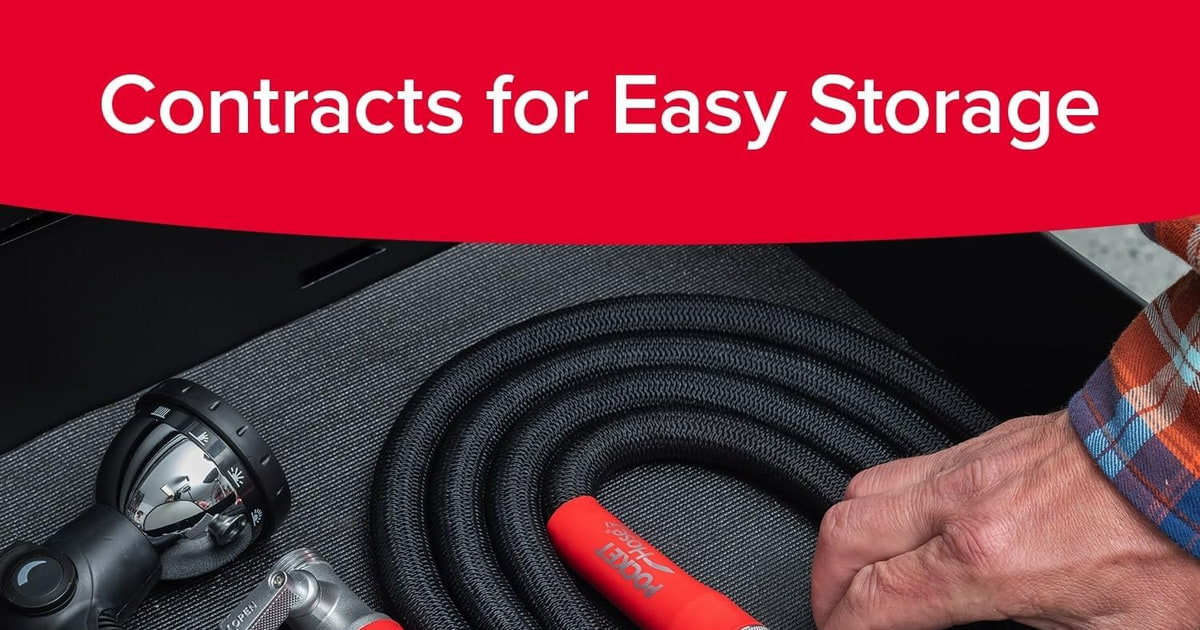
An expandable hose earns its keep in the two minutes before and after you water. There's no wrestling a stiff coil off a reel, no dragging fifteen pounds of rubber across the lawn, no hunting for the kink that stopped the flow. These hoses weigh a fraction of what a rubber hose of the same length does, and a 50-foot model shrinks down to something you can hang on a nail. If you water pots on a patio or rinse a dog by the back door, that's the whole appeal.
Now the honest part: none of them lasts like rubber. The inner tube is latex, and latex eventually gives — usually as a pinhole a few feet from a fitting, often in the second season. Owners of every model here describe it. Sun makes it worse, freezing water makes it much worse, and no sleeve fabric stops either one. They also rarely reach the length printed on the box. A hose labeled 50 feet that stretches to 40 is normal, not defective. Buy one knowing it's closer to a consumable than an heirloom.
So the question isn't which hose lasts forever. It's which one gives you the fewest headaches while it lasts. We looked at what the fittings are made of, how many layers of latex sit inside the sleeve, what the pressure and temperature ratings allow, and which failures owners keep describing. We think that the Flexi Hose is the best expandable garden hose for most people, and that the Linmdec 100-foot hose is the one to buy if you need to reach the far end of a big yard.
Everything we recommend

Brass fittings and a thick latex core, for most yards

Real reach for a big yard, with softer metal at the ends

The lightest, most compact option for a small patio
At a glance
| Product | Length | Fitting Material | Price | |
|---|---|---|---|---|
| Flexi Hose Expandable Garden Hose with 8Top pick | 50ft | 3/4in Solid Brass | $49.99 |
| Expandable Garden Hose 100ft with 10 FunctionRunner-up | 100ft | 3/4in Copper-Aluminum | $49.99 |
| Pocket Hose 25 FT Silver Bullet 2.0Also great | 25ft | — | $29.99 |
How we picked
Fittings and threads. We treated fitting metal as the first cut, because published guidance and owner complaints both point there. Solid brass earns a strong preference; aluminum is workable if you unthread it regularly, and plastic collars are disqualifying.
Core layers and pressure. We compared spec sheets for latex layer count and working pressure, since single-layer cores are the ones that fail inside a season. Anything rated comfortably above the 40 to 60 psi a typical home spigot delivers cleared the bar.
Sleeve fabric and sun. Published reviews put UV exposure at the top of the list for sleeve failure, and Forbes Home found reinforced nylon weaves wore roughly 40 percent less than standard polyester when dragged over concrete. We favored dense 3750D sleeves.
Honest length. We weighted owner feedback about whether a hose reaches its labeled length, because shortfalls are the most common complaint in this category. Consistent, specific reports of a hose landing far under its number counted against it.
Top pick
Brass fittings and a thick latex core, for most yards
Flexi Hose Expandable Garden Hose with 8
The Flexi Hose pairs solid 3/4-inch brass connectors with a four-layer latex core and a tough 3750D sleeve, which is the combination that tends to survive past one season. It's light enough to carry in one hand, and the included eight-pattern nozzle is good enough that you probably won't buy another.
$49.99fromAmazonBrass fittings are the single best predictor of how long an expandable hose lasts. The Flexi Hose uses solid 3/4-inch brass on both ends, and that matters more than any sleeve spec. Plastic collars crack after a few hot-and-cold cycles. Aluminum corrodes right where it threads onto a brass spigot. Bob Vila puts brass at ten-plus years outdoors against two to three for aluminum. You'll feel the difference the first time you hand-tighten it.
Under the sleeve sit four layers of latex, not the single thin tube inside the flimsiest expandable hoses. Flexi Hose rates the assembly to 12 bar, roughly 170 psi, and for water between 41 and 113 degrees. Your outdoor spigot probably runs 40 to 60 psi, so there's real margin. The company also says every hose is endurance-tested to 2,000 uses. The 3750D outer fabric takes the abuse when you drag it across a concrete step.
Coiled up, the 50-foot version is a bundle you can hang by the door. That's the real reason people switch. Expandable hoses stretch to roughly three times their resting length, so a hose labeled 50 feet stores at about 17 to 20 — The Spruce puts the space savings near 65 percent. If your hose lives in a closet, a balcony bench or an RV bay, that number is the whole pitch.
The included nozzle is good enough that you can skip buying another. It's ABS plastic with a rubberized grip, and it rotates through eight patterns: jet for the driveway, shower for seedlings, mist for a hanging basket. Better Homes & Gardens figures an eight-pattern head handles about 90 percent of ordinary yard chores. It won't survive many drops onto concrete. But it doesn't weep at the collar, which is where cheap nozzles usually fail first.
Flaws but not dealbreakers
The 50 on the box is optimistic. Owners who actually measure come up short, and that's true across the category rather than a defect in this hose — the stated length assumes strong pressure and a fully extended run. If you need to reach 45 feet, buy the next size up and give yourself slack.
The other problem is the one every latex hose has. A pinhole shows up somewhere along the length, usually near a fitting, often in the second season. Enough owners describe it that you should plan for it rather than be surprised by it. Repair kits are cheap and people do use them successfully. Still, if you want a hose you never think about, this isn't that hose.
Runner-up
Real reach for a big yard, with softer metal at the ends
Expandable Garden Hose 100ft with 10 Function
The Linmdec starts at about 33 feet and stretches to a claimed 100, which is enough to cross a large lot without a second hose. It weighs a little over four pounds, and the ten-pattern nozzle covers more ground than the usual eight-pattern heads.
$49.99fromAmazonA 100-foot hose that weighs a bit over four pounds is a completely different object than a 100-foot rubber hose. Good Housekeeping pegs comparable rubber hoses at 12 to 15 pounds. You can carry this one out to the back fence in one hand, water the beds, and carry it back without a rest. If your yard runs past 5,000 square feet, that's the difference between watering and putting off watering.
Long runs are where water pressure stops being an abstraction. Linmdec says the hose reaches full length under normal household pressure. Published reviews are blunter about the physics: expandable hoses do their best work between roughly 45 and 75 psi, and below about 30 psi many never reach the labeled number at all. A weak spigot is a bad place to try a 100-foot expandable. Check yours before you commit to this length.
The build is otherwise familiar in a good way. The sleeve is the same heavy 3750D polyester weave used on the better hoses here, with rubber guards at the connector ends where the hose flexes hardest under pressure. The ten-pattern nozzle adds a couple of useful modes over the standard eight — the soaker setting is the one you'll use on vegetable rows. Spare washers come in the box.
Flaws but not dealbreakers
The connectors are copper-infused aluminum, not brass, and that's the meaningful compromise. Bob Vila's rule of thumb gives aluminum two to three years outdoors against ten-plus for brass, and aluminum ends have a habit of seizing onto brass spigots if you leave them threaded on for months. Take it off between waterings and don't crank it tight.
Owner feedback is thin and inconsistent, partly because the listing covers several lengths and the reviews are mixed together. At least one buyer of the long version says it never came close to 100 feet. Treat the labeled length as a ceiling, not a promise, and expect the usual latex pinholes eventually.
Also great
The lightest, most compact option for a small patio
Pocket Hose 25 FT Silver Bullet 2.0
At about a pound and a half, the Pocket Hose Silver Bullet 2.0 is the easiest hose here to pick up, carry and put away. Twenty-five feet won't cross a lawn, but it's plenty for pots, a driveway rinse, or a dog bath by the back step.
$29.99fromAmazonThis is the one to hand someone with sore hands or a bad back. It weighs roughly a pound and a half, and it coils itself when you shut the water off, so there's no winding and no bending over a reel. Older gardeners and apartment dwellers are exactly who this is for. Once it's drained it fits in a bucket, a deck box or a camper bay without a fight.
Inside there are three layers of high-strength latex feeding a 3/4-inch flow diameter, so pressure at the nozzle feels normal rather than pinched. Twenty-five feet is the right length for a patio, a small side yard or a truck bed. Some owners describe units that held up through a couple of seasons left outside in heat and cold, which is a decent showing for latex.
One quirk is worth knowing before the first use. Turn the spigot on and let water fill the hose before you open the shut-off valve at the nozzle, and let the hose extend fully before you start spraying. Do it in the wrong order and the hose won't expand properly, then you'll assume it's defective. Pocket Hose puts this right on the label for a reason.
Flaws but not dealbreakers
The ends are aluminum. One owner describes an end fusing so hard to a brass hose bib over several months that it had to be cut off. That's the known failure mode for aluminum on brass, so unthread it after you water and give the threads an occasional wipe.
The Turbo Shot nozzle underwhelms some buyers, who find the stream weaker than they expected for washing. And three latex layers is one fewer than our top pick has; a handful of owners report a pinhole leak within the first few weeks. Most don't, but it's a real slice of the feedback.
Who this is for
Buy an expandable hose if the weight and the storage are your actual problems. That means a balcony, a small patio, an RV or boat, a garage with no room for a reel, or hands that don't enjoy hauling a rubber coil around. It also makes sense if you've already cracked one or two cheap hoses and want to understand what you're paying for this time. The trade is honest: you get something you can carry with two fingers, and you give up years of service life.
Skip the category if you run sprinklers, fill stock tanks, or need steady volume over a long run. Consumer Reports suggests a 5/8-inch inner diameter for general garden use and 3/4-inch for sprinklers and big containers, and compact expandables often trade diameter for packability. Same if your spigot pressure is low, or if the hose will live outdoors year-round in a frost climate. This guide covers latex-core expandable hoses only. Conventional braided and reel hoses are a different tool with a different lifespan, and we left them out.
How we picked
We ranked these on the things that decide whether a hose survives a second summer. Fittings: solid brass wins, aluminum is a compromise you manage by unthreading it, plastic is out. Core layers: multiple latex layers and a working pressure well above the 40 to 60 psi at a typical home spigot. Sleeve and sun: a dense 3750D weave, since UV and concrete abrasion are what shred the outside. Honest length: owner reports of a hose landing far short of its label counted heavily against it. Nozzle: enough patterns and enough grip that you don't immediately buy a replacement.
The competition
This is what our research surfaced, not a census of everything on the market. A couple of listings that came up in the search turned out to be conventional garden hoses rather than expandable ones, and we set those aside rather than judge them against a category they don't belong to. Among the expandable hoses we did look at, every one earned a spot above — the category is small enough, and the differences between models clear enough, that there wasn't a runner we felt we had to warn you off.
Care and storage
Two habits decide whether you get one season or three. First, kill the pressure. Turn the spigot off, squeeze the nozzle to bleed the line, and let the hose drain and retract before you walk away. Water sitting in a pressurized latex tube is how pinholes start. Second, get it out of the sun. UV is the main thing that frays an outer sleeve, and in the hottest zones an unprotected polyester sleeve can start going in a single season. Hang it in a shed, a garage, or drop it in a lidded bin. Before the first frost, drain it completely and bring it inside — trapped water expands as it freezes and splits the core. Keep the spare washers somewhere you'll find them.
Questions we get
Are expandable hoses worth it compared to a regular rubber hose?
It depends on what annoys you. An expandable weighs roughly 60 to 70 percent less than a rubber hose of the same length and stores in a fraction of the space, which is a genuine daily improvement if you carry your hose around. But rubber lasts years longer and shrugs off sun and cold. If storage and weight aren't problems for you, rubber is still the more durable buy.
How long does an expandable hose usually last before it leaks?
Plan on one to three seasons, with the multi-layer latex models sitting at the long end and single-layer ones often failing inside the first year. The usual failure is a pinhole near a fitting rather than a dramatic burst. Sun exposure and freezing water are what shorten the clock most. Patch kits are widely available and work well enough that a leak doesn't have to mean a new hose.
Can you leave an expandable hose outside in winter?
You shouldn't. Any water left inside expands as it freezes and can split the latex core, and the sleeve degrades in sun regardless of season. The Spruce recommends draining fully and storing indoors anywhere that sees frost. Disconnect it, let it retract and empty, and put it in a garage or basement.
Why doesn't my hose fully expand or hold pressure?
Usually it's the spigot, not the hose. Expandable hoses do their best work at roughly 45 to 75 psi, and below about 30 psi many never reach their labeled length. Also check your sequence: turn the water on and let the hose fill before you open the nozzle valve, and make sure it's fully extended before spraying. A kinked feed line or a partly open spigot will do it too.
Are brass fittings really better than aluminum?
Yes, and it's the biggest single durability difference between two otherwise similar hoses. Brass is rated for ten-plus years of outdoor use, while aluminum tends to give out in two to three and plastic in one to two. Aluminum also tends to seize onto brass spigots if you leave it threaded on for months. If you buy an aluminum-ended hose, unthread it after each use.
Which one is best for someone with limited hand strength?
The Pocket Hose Silver Bullet 2.0, at about a pound and a half. It retracts on its own when the water goes off, so there's no winding, no reel and no bending. The Flexi Hose is the next easiest and gives you more reach. Both are far kinder on wrists and shoulders than any rubber hose.
Why you should trust us
For this guide:
- We read the manufacturer specifications for every hose here, comparing fitting metal, latex layer count, sleeve denier, and stated pressure and temperature limits.
- We reviewed published guidance from outlets including Consumer Reports, Good Housekeeping, Bob Vila, The Spruce and Forbes Home on what makes expandable hoses fail.
- We read through owner feedback for each listing, looking for repeated themes about leaks, fitting corrosion and length shortfalls rather than one-off complaints.
- We read owner reviews on every listing, weighted toward the critical ones, because that is where the recurring failures show up.
- We have a systematic way of automatically fetching the latest prices, so the numbers on this page stay current.
- This is a research-focused guide, so the team may not own every product listed — though we often do own the top winners, which gives us extra context for the recommendations.
- We don't accept free products, and the retailer commission never changes which product we recommend.
Sources
Best Garden Hoses — Wirecutter / NY Times, Wirecutter
Best Expandable Garden Hoses — Good Housekeeping Institute, Good Housekeeping
Best Expandable Garden Hose — Bob Vila, Bob Vila
Best Expandable Garden Hoses — The Spruce, The Spruce
Best Garden Hoses — Popular Mechanics, Popular Mechanics
Best Expandable Garden Hoses — Better Homes & Gardens, Better Homes & Gardens
Garden Hose Buying Guide — Consumer Reports, Consumer Reports
Best Expandable Garden Hose — This Old House, This Old House
Best Expandable Garden Hose — Forbes Home, Forbes Home
Amazon product listings and owner reviews for all 3 products
Manufacturer specification pages for each product
Some passages in this guide may be paraphrased with AI help. Prices are refreshed automatically.
More like this.
Continue exploring lifestyle reviews and recommendations.

The Best Deer Repellents for Gardens
Deer don't browse politely. They work through a hosta bed overnight, snap the tops off daylilies, and strip a young arborvitae to the height they can…

The Best Garden Hose Nozzles and Watering Systems
Watering sounds like the simplest job in the yard, and then you spend a July evening dragging a hose across the driveway for the third time. The tool you…

The Best Garden Tools for Beginners
A first vegetable garden asks more of your hands than you'd expect. You'll dig planting holes, pry rocks loose, snip tomato suckers, scratch weeds out of…

The Best Garden Tools for Spring Planting
Spring gardening lives or dies on a handful of tools. You need something to break ground, something to loosen it, something to cut, and something small…

The Best Raised Garden Bed Kits
A raised bed changes gardening in two boring, useful ways. You control the soil instead of fighting whatever clay or sand came with your yard, and you…

The Best Outdoor Solar Garden Lights
Solar garden lights solve a problem that used to mean digging a trench. You want the front walk lit so nobody trips on the step, or the back fence lit so…