The Best Hydraulic Floor Jacks and Jack Stands
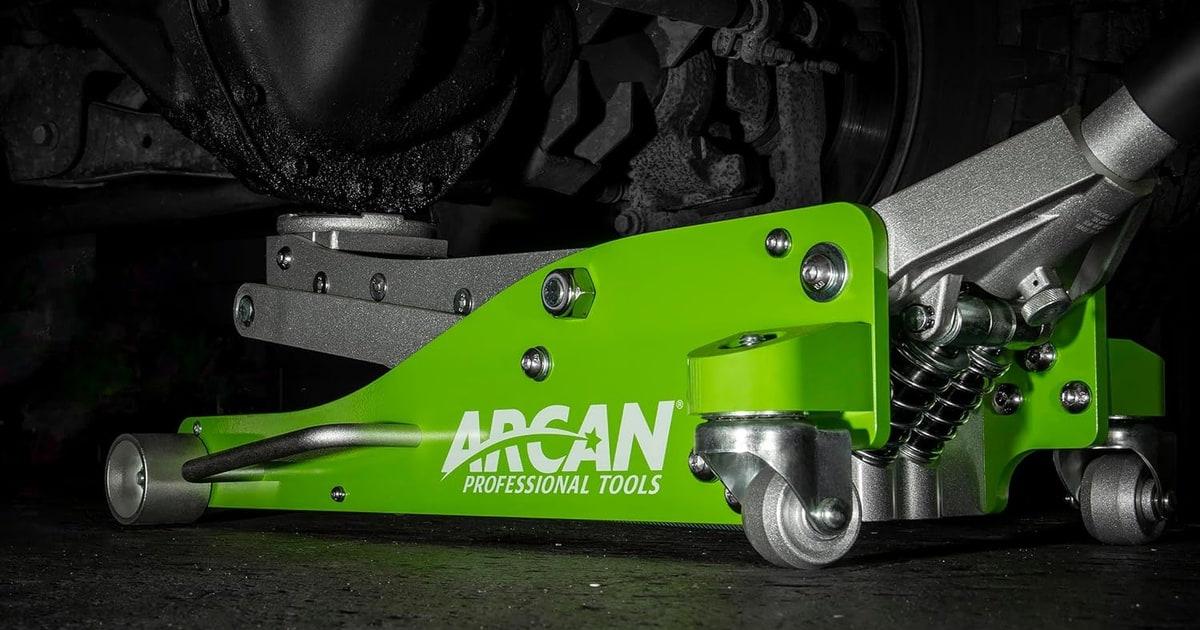
A floor jack and a pair of jack stands are the first real tools most home mechanics buy. Oil changes, tire rotations, brake jobs, swapping snow tires in the driveway — all of it starts with getting the car safely off the ground. The jack does the lifting. The stands hold the weight while you're underneath. You need both, and they need to match, because the jack is never what keeps you alive once you slide under a bumper.
Here's the uncomfortable part: nothing in this category is foolproof. Hydraulic jacks seep fluid, lose pressure and sink slowly under load — even good ones, eventually. Ratchet teeth wear. Welds crack. Safety agencies including the CPSC and NHTSA warn against ever getting under a vehicle supported only by a jack, and NIOSH injury reports document what happens when people do. No purchase changes that. You still have to inspect the gear, work on level concrete and double-check the lift points in your owner's manual.
We read spec sheets, published reviews and owner feedback across steel and aluminum jacks and both ratchet and pin-locking stands. We think that the ARCAN 3-Ton Aluminum Low Profile Floor Jack is the best floor jack for most people, and that the Pittsburgh Automotive 3 Ton Heavy Duty Ultra Low Profile Steel Floor Jack is the one to buy if you want maximum steel for the least money and don't mind the weight.
Everything we recommend
Light enough to drag out for a 10-minute job

All the steel you want, and all the weight you don't

Two locks instead of one, for the price of basic stands

Heavier, taller, and built like shop equipment
At a glance
| Product | Capacity | Lift range | Price | |
|---|---|---|---|---|
| Pittsburgh Automotive 3 Ton Heavy Duty UltraBudget pick | 3 ton | 5 to 18-1/4 in. | $219.99 |
 | BIG RED 3 Ton Floor JackAlso in lineup | 3 ton (6,000 lb) | 3-15/16 to 18-5/16 in. | $241.25On sale |
| ARCAN 3-Ton Aluminum Low Profile Floor JackTop pick | 3 ton (6,000 lb) | 3.75 to 18 in. | $326 |
 | Sunex 6603 3-Ton Low Rider Service JackAlso in lineup | 3 ton | — | $294.99 |
 | Amazon Basics Steel Jack Auto StandsAlso consider | 3 ton (6,000 lb) | — | $32.39On sale |
| Big RED Torin 3 Ton Steel HeavyAlso great | 3 ton (6,000 lb) | 11-5/16 to 16-7/8 in. | $44.84 |
| Hein-Werner HW93506 Blue/Yellow Jack StandsUpgrade pick | 6 ton | 16-1/4 to 25-3/4 in. | $203.95 |
 | ARCAN 6-Ton Ratcheting Jack StandsAlso consider | 6 ton (12,000 lb) | 15.5 to 24 in. | $55.75 |
How we picked
Rated capacity. We treated 3 tons as the floor for a home-garage jack, since a jack lifts only part of a vehicle's weight and 6,000 pounds of rating leaves real margin on a typical SUV. For stands, we looked for a clearly marked rating and manufacturer guidance about which vehicles it actually covers.
Saddle and lift height. We compared published minimum saddle heights, because a jack that won't slide under your pinch weld is useless. Low-profile models in the lineup start near 3.75 inches, while standard steel jacks begin around 5 inches.
Locking mechanism. For stands, we favored designs with a secondary lock — a pin or a counter-weighted pawl backing up the ratchet bar. Published safety guidance and injury reports both point to lock failure as the mode that hurts people.
Base and stability. We compared base footprints from spec sheets and weighted owner feedback about how planted stands feel on concrete. Wider is better, and heavier gauge steel generally tracks with fewer stability complaints.
Durability signals. We read owner feedback for patterns rather than individual complaints — leaking seals, sinking under load, cracked welds, shipping damage. A recurring failure across many owners counted against a product; scattered quality-control gripes we noted as a reason to inspect on arrival.
Top pick
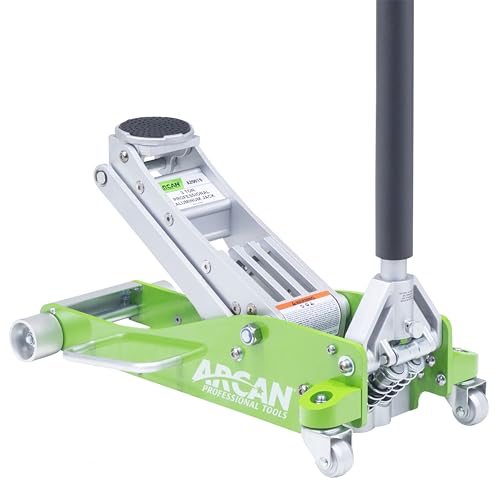
Light enough to drag out for a 10-minute job
ARCAN 3-Ton Aluminum Low Profile Floor Jack
A 3-ton aluminum jack that slides under low cars at 3.75 inches and still lifts to 18. At 56 pounds it's light enough to pull from a corner of the garage without a second thought, which is the difference between using a jack and avoiding it.
$326fromAmazonThe weight is the whole argument. A comparable steel jack in this capacity runs well north of 70 pounds. This one is 56. That sounds like a small gap until you're dragging it across a garage floor for the fourth time during a brake job, or lifting it into a trunk for a track day. Aircraft-grade aluminum costs more than stamped steel, and you're paying for exactly one thing: the willingness to actually go get the jack.
Three tons is 6,000 pounds of rated capacity, and that's plenty for almost any car, crossover or light truck in a home driveway. You're never lifting the whole vehicle at once — you're lifting one corner or one end. So a 3-ton rating gives you a wide margin on a 4,000-pound SUV, not a tight one. Don't talk yourself into more capacity than you need; the heavier jacks get harder to store and harder to drag.
The 3.75-inch minimum saddle height matters if your car sits low. Standard jacks start around 5 inches and simply won't slide under the pinch weld on a lowered Civic or a Miata. This one will. It tops out at 18 inches, which is enough to get a wheel off the ground on most sedans and crossovers, though truck owners with big tires will want more.
Owner feedback is unusually consistent for a jack at this volume. Across a very large pool of buyers, the recurring theme is that it still works years later — the complaints cluster around shipping damage and the occasional leaky unit rather than the design wearing out. That's about the best signal you can get for a hydraulic tool. The reinforced lift arm and the bypass and overload valves are the kind of engineering that separates this from commodity jacks.
The quick-rise pump gets the saddle up to the vehicle fast, so you're not pumping 20 strokes just to make contact. Then the real lift starts. It's a small convenience that you notice every single time you use it.
Flaws but not dealbreakers
It costs considerably more than a steel jack of the same capacity, and you get no extra lifting ability for the money — just less weight to haul around. If your jack lives in one spot in a garage and never moves, that trade isn't worth it.
Aluminum jacks are less forgiving of abuse. Drop a steel jack off a tailgate and it shrugs. Do that with this one and you may have a bent casting. Some owners also report units arriving with hydraulic leaks, so check the fluid and cycle it empty before you trust it with a car.
Eighteen inches of lift is fine for sedans and crossovers but tight for a lifted truck or a full-size SUV on 33s. If that's your vehicle, look at a taller service jack.
Budget pick
All the steel you want, and all the weight you don't
Pittsburgh Automotive 3 Ton Heavy Duty Ultra
A 78-pound all-welded steel jack that reaches max height in about five pumps under load. It's heavy, it's cheap, and owners who've been burned by flimsy discount jacks tend to keep this one for years.
$219.99fromAmazonThis is the jack you buy when you want mass. All-welded steel construction, 78 pounds of it, and a Rapid Pump design that hits full height in roughly five strokes under max load. Owners who came to it after a cheap big-box jack failed on them describe the heft as the point, not the drawback. If your jack lives permanently on a garage floor, that weight costs you nothing.
The 5-inch minimum height is the real limitation. Harbor Freight calls it ultra low profile, and compared with an old bottle-style jack it is. But 5 inches won't clear the pinch weld on a lowered car — the ARCAN starts more than an inch lower. Check the clearance under your actual lift point before you commit, because this is the spec that decides whether the jack is useful to you at all.
Lift range runs from 5 inches up to 18-1/4 inches, which covers most sedans, crossovers and half-ton pickups. The half-turn release valve gives you reasonable control coming down, and that matters more than people expect — a jack that dumps a car fast is a jack that scares you into using it less.
Owner feedback is mostly positive but not uniform. A handful of buyers report units arriving with blown seals, missing handle hardware or crumbling components on first use. The pattern looks like quality control and shipping rather than a design problem, which means your move is simple: unbox it, check the fluid, cycle it with no load, and send it back immediately if anything feels wrong.
Flaws but not dealbreakers
Seventy-eight pounds is a lot to move. If you need to carry this to a friend's house or load it into a car, you'll feel it in your back. It's a garage-floor tool, not a portable one.
A 5-inch minimum saddle height rules it out for genuinely low cars. Measure your clearance first.
Quality control is the weak spot. Enough owners report dead-on-arrival hydraulics that you should treat the first unboxing as an inspection, not a celebration.
Also great
Two locks instead of one, for the price of basic stands
Big RED Torin 3 Ton Steel Heavy
A pair of 3-ton steel stands with both a sawtooth ratchet bar and a secondary locking pin. The 7.95-by-7.2-inch pyramid base is wide for the class, and owners consistently describe the welds and ground stability as better than they expected.
$44.84fromAmazonThe second lock is why these are worth the small premium over bare-bones stands. A sawtooth ratchet bar handles the height adjustment, and then a pin drops through to back it up. If a ratchet tooth ever slips — the failure mode that shows up in injury reports — the pin is still there. You'll never know whether it saved you. That's exactly the kind of redundancy worth paying for.
The lifting range runs 11-5/16 inches to 16-7/8 inches, which puts them in the right zone for sedans, wagons and midsize crossovers. Torin is explicit that these aren't meant for full-size pickups or large off-road SUVs. Take that at face value. The rating is 3 tons, or 6,000 pounds, and the saddle has a large contact surface so you're not balancing a frame rail on a narrow lip.
A 7.95-by-7.2-inch pyramid foot gives you more footprint than many stands in this class, and owners repeatedly bring up how planted they feel on a concrete floor. A few note the stands look a little spindly next to heavier-gauge designs. Looks aren't load ratings — but if you want visual reassurance, the Hein-Werner stands deliver it.
Buy stands as a matched pair and use them that way. These ship as a pair rated 3 tons, and the ratchet bar lets you set both to the same tooth quickly so the car sits level. That's a small thing that makes the difference between confident and uneasy when you slide underneath.
Flaws but not dealbreakers
The maximum height of just under 17 inches limits you. If you want real room to work under a truck or you're installing a lift kit, you need taller stands.
Torin explicitly warns against using these on big pickups and large off-road SUVs, so a 3-ton rating doesn't mean a 3-ton vehicle is appropriate. Read the label and respect it.
The steel is lighter gauge than premium stands, and some owners find the build less reassuring to look at even though it holds fine.
Upgrade pick
Heavier, taller, and built like shop equipment
Hein-Werner HW93506 Blue/Yellow Jack Stands
A 42-pound pair of 6-ton stands with a 10.5-by-13-inch base and a lifting range of 16-1/4 to 25-3/4 inches. These are what you buy when you want serious room under a truck and stands you'll never think twice about.
$203.95fromAmazonPick one up and the difference is immediate. The pair weighs 42 pounds — roughly two and a half times the Torin set — and the base is 10-1/2 by 13 inches instead of under 8 inches square. Formed steel frame, continuous welds around the neck, a multi-position ratchet bar. Owners describe them as twice the size and ten times the sturdiness of commodity stands, and the heft is the reason.
The height range is the real reason to buy these. They go from 16-1/4 inches all the way to 25-3/4 inches. That's a transformation in how much room you have to work. Owners installing lift kits on Jeeps and working under full-size trucks specifically call out the extension as the deciding factor. If you've ever tried to wrestle a transmission crossmember with 14 inches of clearance, you know why this matters.
Six tons across the set gives you a wide margin on anything short of a commercial truck. The dual-purpose handle works as both a carry handle and the saddle column release, which sounds like a small design note until you're moving two 21-pound stands around a garage with greasy hands.
These cost well more than basic stands, and owners say as much — the recurring phrase in their feedback is that you get what you pay for. They're not a necessary purchase for someone doing oil changes on a Camry. They are the obvious purchase if you work on trucks, do suspension jobs, or just want gear you'll hand down.
Flaws but not dealbreakers
The 16-1/4-inch minimum height is too tall for some low cars. You may not be able to get them under the lift points on a lowered sedan at all, which makes them the wrong stands for that garage.
They're heavy and bulky to store. A pair takes up real floor space, and moving them is a two-trip job.
A few owners report rough finishes and fitment issues out of the box, and the two base halves don't always sit perfectly flush. Inspect before use.
Who this is for
This guide is for anyone who wants to do their own oil changes, rotate tires, swap seasonal wheels or tackle a brake job in a home garage or driveway. If you've been paying a shop for a tire rotation, a decent jack and a pair of stands pays for itself fast. The picks here are sized for passenger cars, crossovers and light trucks — the vehicles most people actually own.
If you work on a full-size dually, a motorhome or farm equipment, you need heavier gear than most of what's here. If your car is genuinely slammed, measure the clearance at your lift point before buying anything; even a low-profile jack has a floor. And if you don't have level concrete to work on, solve that first — no jack or stand is rated for soft asphalt or gravel. We've focused on hydraulic floor jacks and jack stands, not bottle jacks, scissor jacks, ramps or two-post lifts.
How we picked
We built this guide from spec sheets, published reviews and themes in owner feedback, and weighed five things. Capacity: 3 tons, or 6,000 pounds, is the sensible minimum for a home-garage jack, with heavier ratings reserved for trucks and lift-kit work. Saddle height: we compared published minimum heights closely, since a jack that won't fit under your pinch weld is worthless no matter how well it's made. Locking mechanism: for stands, we favored a secondary pin or pawl backing up the ratchet bar, because lock failure is the mode that shows up in safety reporting. Stability: we compared base footprints and weighted owner comments about how planted a stand feels on concrete. Durability: we read owner feedback for repeating patterns — leaks, sinking, cracked welds — and treated scattered shipping damage as a reason to inspect rather than a reason to skip.
Other hydraulic floor jacks and jack stands worth considering
If you want cheap, proven stands for a sedan: The Amazon Basics Steel Jack Auto Stands ($32.39) — The Amazon Basics 3-ton pair uses a self-locking ratchet with no separate key, meets the ASME PASE-2014 standard per the listing, and weighs about 12.5 pounds for the set. An enormous number of owners have bought these, and the feedback skews strongly positive. What you give up is the second lock — there's no backup pin like the Torin stands have — and the lighter build means a smaller footprint on the floor. For a Civic in a garage, that's a reasonable trade. For a crossover or anything you'll spend an hour under, we'd rather have the redundancy.
If you want 6-ton height without the premium price: The ARCAN 6-Ton Ratcheting Jack Stands ($55.75) — The ARCAN ALJS6 pair covers 15.5 to 24 inches and uses a counter-weighted pawl that locks as you adjust, with a 33-pound total weight and a base just under 11 by 12.65 inches. It gets you close to the Hein-Werner's working height for noticeably less. The catch shows up in finish quality: owners repeatedly describe sloppy welds, rough castings and a generally crude build, even while agreeing the stands hold weight fine. If you care that your tools look good, spend up. If you just want 24 inches of clearance under a truck, these do it.
The competition
This is what our research surfaced in this category, not a map of everything for sale. Floor jacks and stands are a crowded, commodity-heavy market, and plenty of capable gear sits outside what we looked at. Here's what we read about and passed on, and who might still want it.
The BIG RED 3 Ton Floor Jack ($241.25) — The BIG RED 3-ton aluminum and steel low-profile jack is a genuinely interesting option. It starts at 3-15/16 inches, lifts to 18-5/16, weighs 58.8 pounds, and has a dual-piston quick-lift pump, a foam handle bumper, side carry handles, a built-in overload system and a limited one-year warranty. On paper it's nearly the ARCAN at a lower price. The problem is evidence: only a small handful of owners have weighed in, so we can't say anything useful about how it holds up after a few seasons. If you want the mixed aluminum-steel build and you're comfortable being an early data point, it's worth a look.
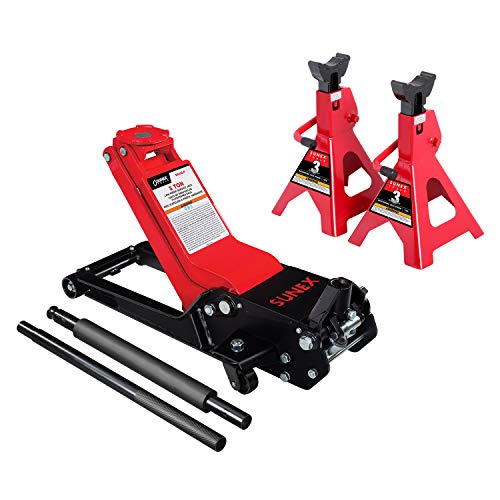
The Sunex 6603 3-Ton Low Rider Service Jack ($294.99) — The Sunex 6603 Low Rider service jack should have been a strong contender. It starts at 2.75 inches — lower than anything else here, which makes it the obvious choice for sports cars and exotics on wide tires — reaches 20 inches, and ships with a bonus pair of 3-ton ratcheting stands. But the owner feedback on this listing is uniformly negative across the few buyers who've reported back, which is a hard signal to ignore when you're buying something that holds a car over your body. The jack itself has a good reputation in professional settings; we'd want to see this particular bundle accumulate a real track record first.
Safety and maintenance
Never get under a vehicle held up only by a jack — lift with the jack, then transfer the weight to stands and give the car a firm shove before you commit. Work on level concrete, chock the wheels that stay down, and set both stands to the same tooth so the car sits square. Check your owner's manual for the correct lift points; never jack on the oil pan, a control arm or a floor panel. Before each use, look for weeping fluid around the ram, bent lift arms and cracks in the welds, especially near a stand's neck. If a stand is bent or a ratchet tooth looks worn, retire it — there's no repair worth trusting. Keep the jack's fluid topped per the manual, and if it sinks under load, bleed the air out or replace it.
Questions we get
What size floor jack do I need for my car?
A 3-ton jack handles almost any car, crossover or light truck in a home garage. The math works because you only lift one corner or one end at a time, not the whole vehicle, so 6,000 pounds of rating gives you a wide margin on a 4,000-pound SUV. Height matters more than capacity for most people — check the clearance at your lift point before you worry about tonnage.
Is a 3-ton floor jack enough for an SUV?
For most crossovers and midsize SUVs, yes. You're lifting part of the weight, not all of it, so the rating holds up with room to spare. Full-size SUVs, three-quarter-ton trucks and anything lifted are a different story — there you want 4 tons or more, and taller stands to match.
Do I need jack stands if I already have a floor jack?
Yes, and this isn't a judgment call. A hydraulic jack can lose pressure and sink, and safety agencies including the CPSC and NHTSA warn specifically against working under a vehicle supported only by a jack. NIOSH injury reports document what happens when that fails. The jack lifts; the stands hold.
How many jack stands do I need to lift a car?
Two if you're lifting one end, four if you're putting the whole car in the air. Always buy them as a matched pair rated at or above your jack's capacity, and set both to the same height so the vehicle sits level. Never mix a tall stand with a short one or use a cinder block as a substitute.
Are aluminum floor jacks worth the extra money?
If you move the jack, yes. The ARCAN weighs 56 pounds against 78 for the comparable Pittsburgh steel jack, and that gap decides whether you drag the thing out for a quick job or put it off. If your jack lives in one spot on a garage floor and never travels, save the money and buy steel.
Can I use jack stands on asphalt or gravel?
No. Stands need level, solid ground — concrete is the standard. A stand's foot will sink into hot asphalt or shift on gravel, and either one can tip a car off. If concrete isn't available, don't go under the vehicle.
Why you should trust us
For this guide:
- We read manufacturer spec sheets for every jack and stand here, comparing rated capacity, minimum and maximum saddle heights, base dimensions and locking design.
- We reviewed published safety guidance from ASME, the CPSC, NHTSA and NIOSH on portable automotive lifting equipment and the failure modes behind reported injuries.
- We looked for repeating themes in owner feedback — leaking seals, sinking under load, weld quality and shipping damage — rather than weighting individual accounts.
- We read owner reviews on every listing, weighted toward the critical ones, because that is where the recurring failures show up.
- We have a systematic way of automatically fetching the latest prices, so the numbers on this page stay current.
- This is a research-focused guide, so the team may not own every product listed — though we often do own the top winners, which gives us extra context for the recommendations.
- We don't accept free products, and the retailer commission never changes which product we recommend.
Sources
ASME PASE-2019: Safety Standard for Portable Automotive Lifting Devices, ASME
Best Floor Jacks - Wirecutter, Wirecutter
Best Jack Stands - Wirecutter, Wirecutter
Jack Safety - Consumer Product Safety Commission, U.S. CPSC
Vehicle Jack Safety - OSHA/NIOSH Fatality Resources, NIOSH
Floor Jack Buying Guide - Popular Mechanics, Popular Mechanics
Jack and Jack Stand Test - Car and Driver / Road & Track, Car and Driver
Torin Big Red product specification pages, Torin (manufacturer)
Harbor Freight Pittsburgh Automotive product pages, Harbor Freight (manufacturer spec)
Arcan product pages, Arcan (manufacturer)
Sunex Tools product pages, Sunex (manufacturer)
Hein-Werner product pages, Hein-Werner (manufacturer)
Amazon product listings and owner reviews for all 8 products
Manufacturer specification pages for each product
Some passages in this guide may be paraphrased with AI help. Prices are refreshed automatically.
More like this.
Continue exploring lifestyle reviews and recommendations.

The Best Garage Floor Containment Mats
Winter doesn't stay outside. Every time you pull into the garage, your tires and wheel wells carry in slush, road salt and grit, and it all melts into a…

The Best Home Gym Flooring
Flooring is the part of a home gym nobody thinks about until something goes wrong. A dumbbell chips the concrete. The treadmill hums through the ceiling…

The Best Steam Mops for Hardwood and Tile Floors
Mopping with a bucket mostly moves dirty water around. A steam mop skips that entirely: you fill the tank with plain water, wait half a minute, and push a…

The Best Tineco Floor Cleaners
If you have hard floors and anything that makes a mess - a dog, a toddler, a partner who cooks - you already know the routine. You vacuum, then you mop,…

The Best Robot Mops And Floor Scrubbers
A robot mop earns its keep on the floors you walk on barefoot. Kitchen tile picks up grease and crumbs. Entryway plank floors collect grit that gets…

The Best All-Weather Car Floor Mats
Winter doesn't stay outside. Salt, slush, sand and gravel ride in on your boots and grind into the carpet every time you get in. A good all-weather mat…