The Best Home Gym Flooring
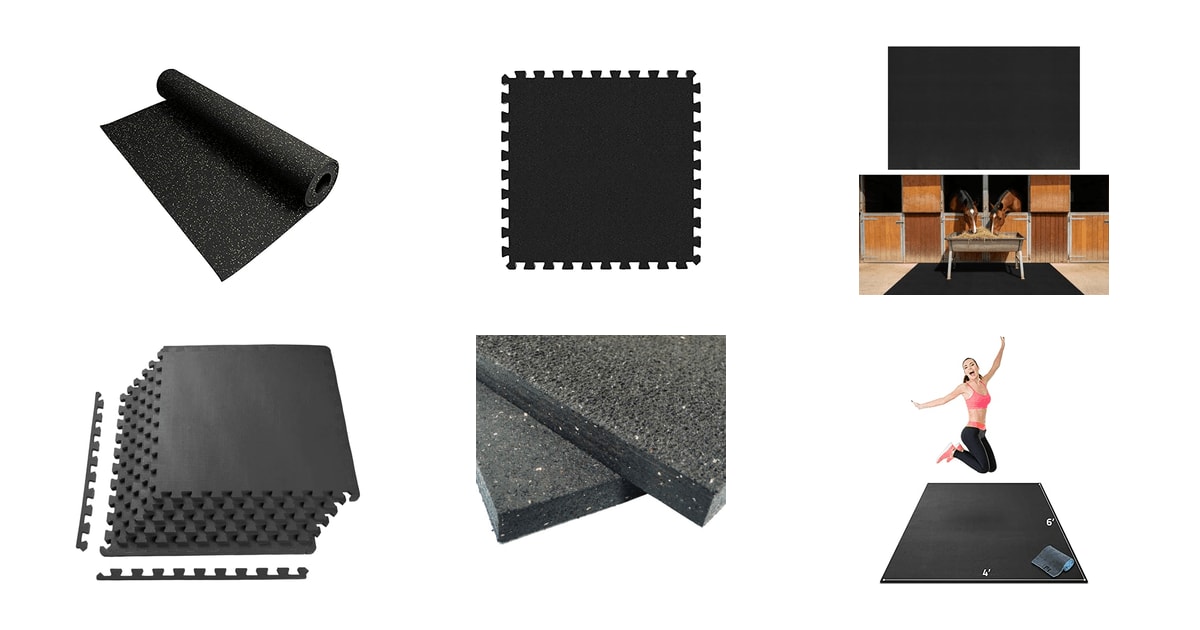
Flooring is the part of a home gym nobody thinks about until something goes wrong. A dumbbell chips the concrete. The treadmill hums through the ceiling into the bedroom below. Your knees start complaining after a month of burpees on bare tile. Good flooring fixes all three at once, and it's one of the simplest upgrades in the room. It protects the slab, it protects your joints, and it keeps a rack or a bench from wandering an inch at a time across a slick floor.
Here's the honest part: no single floor does everything. Rubber thick enough to survive dropped barbells is heavy, awkward to move, and smells like a tire shop for the first few weeks. Foam that's kind to your knees will dent under a loaded bar and give up in a few years. Rolls stay put but arrive as unwieldy 90-pound logs. Tiles are easy to carry and easy to reconfigure, and they also creep apart when you push a sled across them. You're picking which compromise you can live with.
So think about what actually happens in your space. Dropping weights and foam is out. Cardio and stretching in a spare bedroom, and you don't need three-quarter-inch rubber. We think that the IncStores 3/8 Inch Heavy Duty Rubber Flooring Roll is the best home gym flooring for most people, and that the IncStores 3/4" Impact Foam Rubber Floor Tiles are the ones to buy if you're lifting above an occupied room and need real vibration control.
Everything we recommend

Seamless coverage that stays put, if you can wrestle it

The quiet choice when someone's sleeping downstairs

Cheap, light cushioning for bodyweight work — not barbells

The thickest foam here, for standing and stretching
At a glance
| Product | Thickness | Dimensions | Price | |
|---|---|---|---|---|
| IncStores 3/8 Inch Thick Heavy Duty RubberTop pick | 3/8 Inch | 4' x 10' | $209.99 |
| IncStores 3/4" Thick Impact Foam Rubber FloorRunner-up | 3/4" | 40 Sq/Ft | $184.99 |
 | 4x6 Ft Horse Stall Mat Large HorseAlso in lineup | — | 4 x 6 ft | $39.99On sale |
| BalanceFrom Puzzle Exercise Mat 1/2-inch ThickBudget pick | 1/2-inch | 24"L x 24"W | $23.74On sale |
 | Gorilla Mats Large Exercise MatAlso consider | 1/4" (6mm) | 6' x 4' | $127.95On sale |
| ProsourceFit Weaved Pattern Extra Thick Exercise PuzzleAlso great | 1-inch | 24 SQ FT | $54.99 |
How we picked
Thickness and density. We compared published specs and material data across every option, treating three-quarters of an inch of rubber as the minimum for any training with dropped barbells. Density matters as much as thickness: commercial rubber runs about 35 to 45 pounds per cubic foot against 4 to 6 for standard EVA foam.
Impact absorption. Load-absorption specifications published by Rubber Flooring Inc. put three-quarter-inch vulcanized rubber at roughly 40 to 60 percent of peak impact force absorbed, versus 15 to 25 percent for three-eighths-inch EVA. That gap decides which products belong under a barbell and which don't.
Shifting and seams. BarBend reported interlocking tiles migrating one to three inches per session under sled pushes and lateral work, with rolls staying put. We weighted seam count and stability heavily for anyone building a dedicated lifting bay.
Noise and odor. We read owner feedback for recurring themes on off-gassing and structure-borne noise, since both come up constantly in apartment and basement gyms. Family Handyman recommends at least 72 hours of ventilation for new rubber, and ideally two weeks indoors.
Durability in real rooms. Greatmats reports maintained rubber lasting 10 to 20 years in a home gym against 3 to 5 years for EVA tiles under regular use, and quality rubber holding up from −40°F to 140°F. Garages and damp basements ruled out anything that warps.
Top pick
Seamless coverage that stays put, if you can wrestle it
IncStores 3/8 Inch Thick Heavy Duty Rubber
A 4-by-10-foot roll of recycled rubber that covers a gym bay in one piece, with no tile joints to trap chalk dust or creep apart. It's dense enough for dumbbells, benches and machines, and you can trim it around a rack with a utility knife.
$209.99fromAmazonRolls beat tiles once your gym gets bigger than a closet. Interlocking tiles migrate under lateral movement — BarBend's testing found tiles shifting one to three inches per session with sled pushes and band work, while rolls didn't move at all. A roll also gives you almost no seams. That means no gap for chalk, dust and stray hair to work into, and no edge to catch a plate on.
At 90 pounds per roll, this is not a one-person job. Owners describe it as genuinely heavy the moment they try to lift it, which is exactly what you want underfoot and exactly what makes carrying it down basement stairs a two-person afternoon. The upside is that the weight keeps it flat. Once it's down and relaxed for a day or two, it stays where you put it without adhesive.
Three-eighths of an inch is the sweet spot for a mixed-use gym. It handles a treadmill, a rack, a bench and dumbbells you set down rather than drop. Owner feedback repeatedly points out how much better it is than foam for real equipment — machines stay planted, and the floor doesn't dimple where the feet sit. If you're routinely dropping a loaded bar, though, you want thicker rubber under the platform area.
You will need a sharp knife and some patience. The material trims cleanly, and the four-foot width is easy to work around walls, corners and a rack's footprint. Recycled rubber also shrugs off moisture, so a damp garage or basement doesn't bother it. Plan your layout before you cut, because the roll doesn't forgive a bad measurement the way a grid of tiles does.
Flaws but not dealbreakers
Cut length is inconsistent. Several owners report rolls arriving noticeably short of the stated ten feet — some by a couple of inches, some by more than a foot — with ends cut at irregular angles rather than square. Order more coverage than your room calls for and expect to square up the ends yourself.
It smells. New recycled rubber off-gasses for weeks, and owners in enclosed basements notice it long after installation. Family Handyman suggests a minimum 72-hour ventilation period and ideally two weeks for indoor rooms. In a garage with the door open it fades fast. In a finished basement, run a fan and be patient.
Runner-up
The quiet choice when someone's sleeping downstairs
IncStores 3/4" Thick Impact Foam Rubber Floor
These 2-by-2-foot tiles bond a recycled rubber top to a closed-cell EVA foam core, so you get grip and shock absorption in one piece. At three-quarters of an inch, they're the best option here for an apartment or a second-story room.
$184.99fromAmazonSound is the real problem in an upstairs or apartment gym, and layered materials handle it better than a single slab. Forbes Health puts the dual-layer approach — rubber over a foam base — at roughly 20 to 30 dB better on structure-borne impact noise than rubber alone on concrete. These tiles build that sandwich into a single product. Owners on second floors specifically credit them with keeping the peace with neighbors.
The rubber top is what separates these from ordinary foam tiles. Bare EVA gets slick under sweaty feet and tears where equipment corners dig in. The recycled rubber surface grips, resists scuffing, and looks like the flooring at a commercial studio rather than a kids' playroom. Owners who'd used plain foam before consistently describe this as a clear step up.
Tiles have a practical advantage rolls don't: you can carry them one at a time. If your gym is down a narrow staircase, or you rent and expect to move, forty square feet of two-foot squares is a far easier proposition than a 90-pound roll. You can also expand the floor a box at a time as your equipment grows, or pull up a damaged tile and swap it.
Three-quarters of an inch is real protection for a spare-room gym. Owners report it handling a Bowflex, a Smith machine and general strength work without denting or tearing when equipment gets dragged. The foam core keeps floor exercises comfortable, so planks and stretching don't feel like punishment on concrete.
Flaws but not dealbreakers
Edges lift. Several owners note that the interlocking joints don't always sit perfectly flat and that corners can curl slightly, especially early on. Heavy equipment on top solves it in most of the room, but the perimeter can stay a little proud.
The odor complaints here are stronger than for most rubber. A handful of owners describe the smell in an enclosed basement as genuinely hard to live with for the first stretch. If your gym has no window and no ventilation, that's worth taking seriously — air the tiles out in a garage before you bring them inside.
Budget pickOn sale
Cheap, light cushioning for bodyweight work — not barbells
BalanceFrom Puzzle Exercise Mat 1/2-inch Thick
Half-inch EVA puzzle tiles that snap together in minutes and pull apart just as fast. For yoga, stretching, kettlebell flows and a kid's play corner, they're all the floor you need, and you can stack them in a closet afterward.
$23.74fromAmazonList priceMatch the floor to what you actually do on it. If your training is mats-and-bodyweight — yoga, mobility, core work, a dumbbell circuit — half-inch foam is comfortable, warm underfoot and costs a fraction of rubber. The tiles interlock cleanly, the borders finish the perimeter so it doesn't look like a puzzle exploded, and cleanup is soap and water.
Portability is the underrated feature. These weigh a few pounds a box. You can lay a floor in a living room for a morning workout, break it down before guests arrive, and slide it behind a couch. Owners use the same set for a workout corner, a basement play area and a patio, reconfiguring the shape as the room changes.
Longevity is fair rather than great, and that's the trade. Greatmats puts typical EVA tile life at three to five years under regular use, against ten to twenty for maintained rubber. But owners with several years on these report them holding up fine under moderate use, and replacing them once in that window still costs less than rubber up front.
Concrete is cold, hard and unfriendly to knees and elbows. These fix that for very little money, which is why they end up in so many basements. Just know the ceiling on what they'll take. Standard EVA foam runs about 4 to 6 pounds per cubic foot against 35 to 45 for commercial rubber, and that density gap is exactly why heavy loads leave marks.
Flaws but not dealbreakers
Point loads dent them. A rack foot, a bench leg or a loaded barbell resting in one spot will press permanent divots into half-inch foam. Put a rubber mat under anything heavy and use these for the open floor.
They're not for dropped weights. Three-eighths-inch EVA absorbs only around 15 to 25 percent of peak impact force compared with 40 to 60 percent for three-quarter-inch vulcanized rubber. A dropped dumbbell goes right through to the slab, and it takes the tile with it.
Also great
The thickest foam here, for standing and stretching
ProsourceFit Weaved Pattern Extra Thick Exercise Puzzle
One-inch EVA tiles with a woven texture, sold with border pieces for a finished edge. They're the most cushioned floor in this guide, which makes them great under a standing workstation, an elliptical or a stretching corner.
$54.99fromAmazonA full inch of foam changes how a room feels. Owners stand on these for eight-hour shifts in a workshop without the leg fatigue that concrete causes, and they drop to their knees mid-workout without wincing. If your gym doubles as a hobby space or you spend a lot of time on the floor, that extra padding earns its keep.
Foam is quiet in a way rubber isn't. The material and the thickness together take the edge off a machine's hum and the thud of a kettlebell set down between sets. Owners with ellipticals and treadmills on upper floors report noticeably less noise traveling through the house, plus a machine that stops walking across the room.
The woven-texture surface gives you traction without the puzzle-tile look, and the included border strips clean up the perimeter. That matters in a multi-use room. A spare bedroom that's a gym in the morning and an office at noon shouldn't look like a daycare, and these get closer to a finished floor than plain foam does.
Assembly takes minutes and disassembly takes less. Six tiles cover 24 square feet, so you scale the floor to the space by adding boxes. The listing recommends double-sided tape for maximum grip, which is worth doing if you'll be moving laterally — otherwise the whole field can creep.
Flaws but not dealbreakers
It's still foam, and the listing says so plainly: surface compression happens under heavy equipment. Owners doing deadlifts on these report small permanent indentations where the loaded bar rests. It's cosmetic rather than structural, but it's there.
One inch of soft foam can feel unstable under a heavy squat or press. The give that's pleasant for stretching works against you when you want a rigid base. Put a rubber mat under your lifting area and save these for everywhere else.
Who this is for
This guide is for anyone putting a gym in a garage, basement, spare bedroom or apartment and trying to decide what goes under the equipment. If you drop loaded barbells, start with three-quarter-inch rubber or thicker in the platform area and use something lighter everywhere else — mixing materials by zone is normal and usually cheaper than flooring the whole room in premium rubber. If you mostly stretch, do yoga and follow along with a workout video, foam is plenty and you can stop reading after the budget pick.
We're covering flooring you buy and lay yourself: rolls, interlocking tiles and loose-lay mats. We're not covering poured or glued-down permanent installations, subfloor construction, or lifting platforms you build from plywood and rubber. And we're not covering flooring for a basement with an active moisture problem — fix the water first, because no mat solves a wet slab. If you're renting, favor anything you can pull up and take with you.
How we picked
Thickness and density: we treated three-quarter-inch rubber as the floor for barbell training, and weighed density — roughly 35 to 45 pounds per cubic foot for commercial rubber against 4 to 6 for EVA foam — as the real predictor of what a floor will hold. Impact absorption: published load-absorption specs put three-quarter-inch rubber at 40 to 60 percent of peak force absorbed versus 15 to 25 percent for thin EVA, which decides what belongs under a bar. Shifting and seams: tiles have been documented migrating one to three inches per session under lateral work while rolls stay put, so seam count mattered for lifting bays. Noise and odor: we tracked owner feedback themes on off-gassing and impact noise, since both dominate apartment and basement complaints. Durability: rubber can last 10 to 20 years with pH-neutral cleaning against 3 to 5 for foam, and holds together from −40°F to 140°F.
Other home gym flooring worth considering
If you want one mat with no seams and no smell: The Gorilla Mats Large Exercise Mat ($127.95) — The Gorilla Mats Large Exercise Mat is a single 6-by-4-foot piece you unroll and use, with a towel, straps and a carry bag included. Owners repeatedly call out that it has essentially no chemical odor, which is a genuine advantage over any recycled rubber option if you're flooring a bedroom or a small enclosed space. At a quarter inch it's a cushioning surface, not equipment protection — fine under a half rack as a floor saver, wrong under dropped plates. You give up coverage too: one mat handles a workout footprint, not a room.
The competition
Here's what our research turned up, which isn't everything sold. Gym flooring is a category where the best-known budget answer — solid three-quarter-inch horse stall mats from a farm supply store, at roughly 40 to 60 percent less than equivalent specialty gym tiles — usually isn't something you order online, because shipping heavy rubber costs more than the rubber. Keep that in mind as a baseline while you compare.
The 4x6 Ft Horse Stall Mat Large Horse ($39.99) — The Zoketriton 4x6 Horse Stall Mat borrows the format that garage gym builders swear by, but not the material. Real stall mats are dense vulcanized rubber; this one is PVC, and the listing describes it as soft and comfortable rather than heavy and rigid. That's a meaningful difference for a lifting floor, where mass is what absorbs a dropped plate. It's washable, trimmable and light enough to handle alone, so it's reasonable as a treadmill pad or a garage work surface. For barbell work, the classic advice still points to a genuine rubber stall mat from a farm supply store.
Installation and care
Air out new rubber before you commit to it. Unroll or unstack it in a garage or an open area for at least 72 hours, and closer to two weeks if it's going into a finished basement — VOC off-gassing runs two to four weeks and a fan speeds it along considerably. Let rolls and tiles relax flat for a day before you trim; rubber holds a curl from shipping and will lie flatter once it warms up. Cut with a fresh utility blade against a straightedge and score in several passes rather than forcing one. For cleaning, use a pH-neutral solution and a damp mop. Skip bleach, ammonia and citrus degreasers, which break rubber down over time. Rubber cleaned this way can last a decade or two; foam tiles need seams pulled apart and dried occasionally, since moisture that sits in the joints is what shortens their life.
Questions we get
How thick should home gym flooring be for weightlifting?
For any training where you drop a loaded barbell, three-quarters of an inch of rubber is the practical minimum, and an inch is better under a platform. Thinner rubber protects the floor from equipment and general use, but not from impact. If you only set weights down under control, three-eighths of an inch handles most home gyms fine.
Are horse stall mats a good option for a home gym?
Genuine vulcanized rubber stall mats are the classic budget answer, and they cost roughly 40 to 60 percent less than specialty gym tiles of the same thickness. The catch is material and shipping. Check that a mat is actually dense rubber rather than PVC, and buy locally if you can, since freight on heavy rubber often exceeds the price of the mat.
How do I get rid of the rubber smell from new gym mats?
Ventilation and time. New rubber off-gasses for two to four weeks, and Family Handyman recommends at least 72 hours of airing out before use, ideally two weeks in an enclosed room. Lay it flat in a garage or outdoors with a fan running, then wipe it down with a pH-neutral cleaner before bringing it inside.
What's the best flooring for an apartment gym to reduce noise?
Layer it. Putting three-quarter-inch rubber over a five-eighths-inch EVA foam base can cut structure-borne impact noise by an estimated 20 to 30 dB compared to rubber straight on concrete. Our runner-up builds a rubber-over-foam sandwich into one tile, which is the simplest way to get most of that benefit without stacking two separate floors.
Can I put EVA foam puzzle tiles under a barbell?
Not for dropped weights. Standard EVA runs about 4 to 6 pounds per cubic foot against 35 to 45 for commercial rubber, and that density gap means loaded plates dent and eventually tear through. Foam is right for yoga, stretching, bodyweight work and light dumbbells. Use rubber wherever the bar comes down.
Should I choose rubber rolls or interlocking tiles?
Rolls win for large open spaces and dedicated lifting areas — fewer seams to collect debris, and no tile migration. Tiles win on logistics: you can carry them down stairs one at a time, replace a damaged one, or reshape the floor when your equipment changes. If you push a sled or move laterally a lot, go with rolls or tape the tiles down.
Why you should trust us
For this guide:
- We read manufacturer specifications on thickness, density, impact absorption and temperature tolerance for every product here, and compared them against material data published by Rubber Flooring Inc. and Greatmats.
- We reviewed published guidance from BarBend, Garage Gym Reviews, CNET, Forbes Health and Family Handyman on tile migration, dual-layer noise isolation and off-gassing timelines.
- We read owner feedback across all seven listings and looked for the complaints that repeat — short cut lengths, curling edges, odor in enclosed rooms and foam compression under equipment.
- We read owner reviews on every listing, weighted toward the critical ones, because that is where the recurring failures show up.
- We have a systematic way of automatically fetching the latest prices, so the numbers on this page stay current.
- This is a research-focused guide, so the team may not own every product listed — though we often do own the top winners, which gives us extra context for the recommendations.
- We don't accept free products, and the retailer commission never changes which product we recommend.
Sources
Best Home Gym Flooring — Garage Gym Reviews, Garage Gym Reviews
Best Home Gym Flooring — BarBend, BarBend
Best Home Gym Flooring — Forbes Health, Forbes Health
Best Home Gym Flooring — CNET, CNET
Best Gym Flooring for Home — Family Handyman, Family Handyman
Rubber Flooring Rolls & Tiles — Rubber Flooring Inc., Rubber Flooring Inc.
Horse Stall Mat (4 ft x 6 ft) Product Page — Tractor Supply Co., Tractor Supply Co.
Exercise Flooring Products — Regupol, Regupol
Rubber Gym Flooring Guide — Greatmats, Greatmats
Home Gym Flooring Buyer's Guide — Men's Health, Men's Health
Best Home Gym Flooring — Healthline, Healthline
Amazon product listings and owner reviews for all 6 products
Manufacturer specification pages for each product
Some passages in this guide may be paraphrased with AI help. Prices are refreshed automatically.
More like this.
Continue exploring health reviews and recommendations.

The Best Home Gym Equipment for Beginners
The gear that actually gets used is the gear that's already out. That's the whole game when you're starting out. A dumbbell pair sitting by the couch gets…

The Best Power Towers for Home Gyms
A power tower earns its floor space by doing three things you can't easily do anywhere else at home: pull-ups, dips, and hanging knee raises. Those three…

The Best Cable Machines for Home Gyms
A cable machine is the piece that finally makes a home gym feel complete. Dumbbells and a barbell cover the heavy stuff, but cables give you the angles - …

The Best Gym Bags And Workout Backpacks
A gym bag spends its life getting abused. You stuff damp clothes into it, drop it on a locker room floor, sling it over one shoulder on a crowded train,…

The Best Stair Climbers for Home Gyms
Climbing stairs is one of the few cardio movements that feels hard right away. There's no coasting, no downhill, no long warm-up - you step, and your legs…

The Best Smart Home Gym Systems
A home gym only works if you'll walk over to it on a Tuesday night when you're tired. That's the whole game. The best connected systems shrink the…