The Best Microcurrent Facial Devices
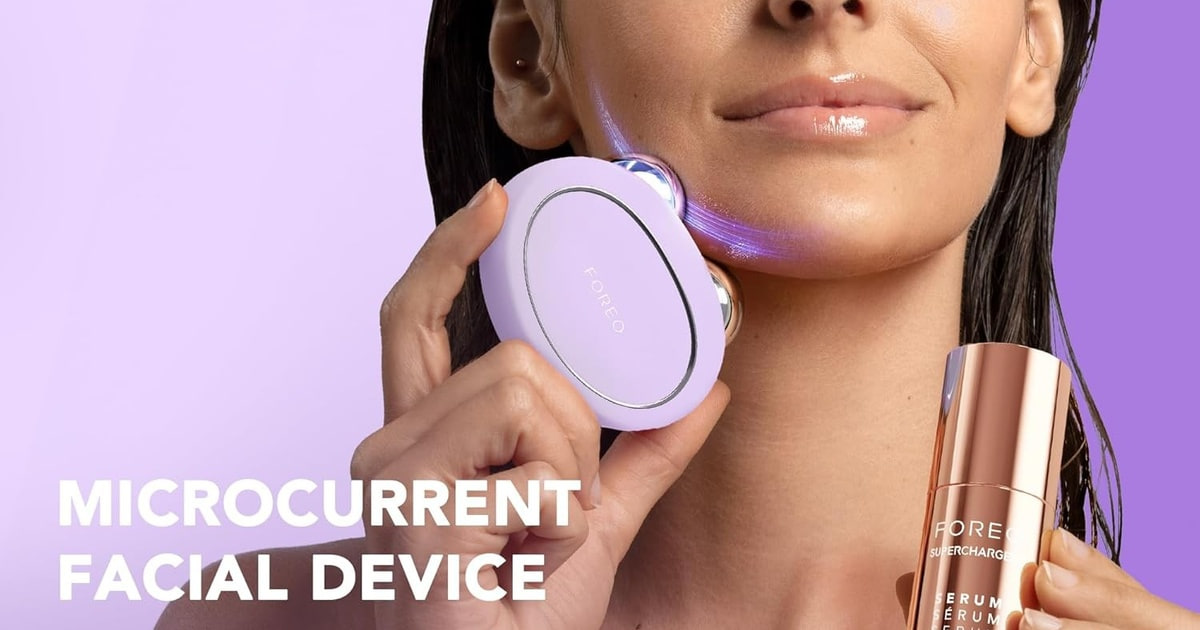
Microcurrent devices send a low-level electrical current through your skin to stimulate the facial muscles underneath. In practice that means five minutes with a wand, a layer of slippery gel, and a face that looks a little more defined along the cheekbone and jaw afterward. You'll use it at the bathroom mirror before work, or the morning of a wedding. The good ones make that routine easy to repeat. The bad ones end up in a drawer because the gel ran out or the battery died.
Here's the part the marketing skips. One session's lift is temporary, and dermatologists interviewed by Byrdie put it at roughly 24 to 72 hours. Anything cumulative takes consistent daily use over about two months, and at-home wands run at lower amperage than the machines an esthetician uses, so the change is gradual and subtle. Healthline notes that large peer-reviewed studies on at-home devices specifically are still thin. If you want a dramatic, permanent change, nothing on this page does that.
So the real question isn't which wand transforms your face. It's which one you'll pick up five days a week without resenting it. That comes down to how many intensity settings you get, how long a session takes, whether the gel is a hassle, and whether the thing still works a year in. We think that the NuFACE Trinity+ is the best microcurrent facial device for most people, and that the FOREO Bear 2 is the one to buy if you want a stronger sensation and fewer accessories to manage.
Everything we recommend

The most complete routine, if you'll actually do it daily

Stronger sensation and less gear to keep track of

The same five-minute routine in a smaller, simpler wand
Probe-and-hold precision for people who want to work slowly
Prices as of Oct 25, 6:48 AM PT · Details
At a glance
| Product | Intensity settings | Session length | Price | |
|---|---|---|---|---|
| NUFACE Trinity+ Skin Tightening & Face LiftTop pick | 3 frequencies, 3 levels | 5 minutes | $395 |
| NUFACE MINI+ Facial Sculpting Tool - MicrocurrentBudget pick | 3 levels | 5 minutes | $187.50 |
| FOREO Bear 2 Advanced Toning Microcurrent FacialRunner-up | 4 microcurrent modes | — | $318.99 |
 | TriPollar Stop Vx 2Also in lineup | — | — | $739 |
| 7E Wellness MyoLift Mini Microcurrent Facial DeviceAlso great | Up to 400 microamps | — | $329 |
Prices as of Oct 25, 6:48 AM PT · Details
How we picked
Real microcurrent. We kept to devices whose spec sheets state a microcurrent output or intensity range. Listings that describe light therapy or heat alone got set aside, no matter what the search results called them.
Clearance and safety. FDA clearance covers temporary improvement of facial contour, not dramatic or lasting change. We treated it as a floor and noted which listings claim it and which stay quiet.
Intensity control. For sensitive skin, adjustable levels matter more than raw power. We compared how many settings each device offers and how finely you can step between them.
Routine and upkeep. We looked for a five-minute protocol you'd realistically repeat every day, and we counted the gel, serum, and attachments you'll keep buying afterward.
Reported reliability. We read owner feedback for patterns rather than one-off gripes, weighing repeated reports of units that stop conducting or stop charging.
Top pick
The most complete routine, if you'll actually do it daily
NUFACE Trinity+ Skin Tightening & Face Lift
The Trinity+ is the most flexible at-home microcurrent wand here, with three frequencies and three intensities plus a boost button for stubborn spots along the jaw. It's FDA-cleared, a session takes five minutes, and the activator gel you need comes in the box.
$395fromAmazonPrices as of Oct 25, 6:48 AM PT · Details
No other wand here gives you this much control over a five-minute session. You get three frequencies and three intensity levels, so you can run something gentle across thin skin near the eye and something firmer along the jawline in the same pass. A boost button adds up to a quarter more power when you hit a spot that needs it. Most people settle into one setting and stay there. It's still nice to have the room.
The routine is short enough to survive a real morning. Gel on, pick your setting, work the wand upward in short strokes for five minutes, rinse. NuFACE's own clinical trial reported that every participant showed improved facial contour after five minutes daily across eight weeks, and the Good Housekeeping Institute lab reported a visible lift right after a single session. Manufacturer data is manufacturer data. But that five-minute protocol is consistent across the whole category.
It's the one device here that grows with you. The Trinity+ takes swappable attachments, including a microwand for the eye and lip area and a red-light head. So if you get eight weeks in and want to work on crow's feet, you're not starting over with a new device. NuFACE also says it's compatible with fillers and injectables when used as directed, which matters if you're already seeing an injector.
Charging is over USB and the gel is included, so nothing about setup requires a trip to the store. If you're brand new to microcurrent, stay on the lowest intensity for the first week. The sensation is a faint tingle, not a shock, and turning it up too fast is the main reason people decide they don't like this stuff at all.
Flaws but not dealbreakers
The gel isn't optional, and it isn't included forever. Microcurrent needs a conductive layer to reach the muscle, and once the tube runs out you're buying more or the device stops registering your skin. Owners get frustrated when a wand cuts out mid-session, and the usual culprit is gel that dried under the probes. Reapply as you go.
It's also the bulkiest option here, and the attachments that make it flexible are sold separately. Owner feedback on NuFACE devices is genuinely mixed. People who use them daily tend to be happy, and people who expected a face lift in a week tend not to be. Go in expecting subtle.
Runner-up
Stronger sensation and less gear to keep track of
FOREO Bear 2 Advanced Toning Microcurrent Facial
The Bear 2 runs four microcurrent modes and a set of T-Sonic massage patterns in one sleek handle, with no attachments to swap or store. Its Anti-Shock system reads your skin 200 times a second and drops the current before you feel a zap.
$318.99fromAmazonPrices as of Oct 25, 6:48 AM PT · Details
Pick this one up and the first thing you notice is that there's nothing to assemble. One handle, one serum, one button. FOREO's design leans minimal. If the Trinity+'s frequency menu and attachment lineup sound like more decisions than you want at 7 in the morning, that's the case for the Bear 2 in a sentence.
The Anti-Shock system is the real reason to choose this one. FOREO says it measures your skin's resistance 200 times per second and adjusts the current to match, which targets exactly the zap people feel when a dry patch meets a live probe. If you've got sensitive skin, or you've abandoned a device before because it stung, this is the design that addresses it.
You get more granular intensity control than the original Bear, and the tapping and sculpting modes feel different enough from each other to be worth switching between. The T-Sonic massage patterns aren't microcurrent at all. They're vibration, aimed at puffiness and circulation. Treat them as a bonus rather than the reason to buy, and you won't be disappointed.
It's also the lightest wand here by a wide margin, at roughly three ounces. That matters more than it sounds like it should when you're holding your arm up at your jaw for five minutes straight. If you travel a lot, it disappears into a toiletry bag, and there's no probe set or charging cradle to pack alongside it.
Flaws but not dealbreakers
FOREO builds the Bear 2 around its own SUPERCHARGED serum, and that's a running cost you should plan on. Other conductive gels will carry current, but the brand's instructions and its collagen claims both assume you're using theirs.
There's no attachment system, so what you buy is what you get. You can't add an eye wand later. And if you like the pinch-and-hold technique estheticians use, this isn't the shape for it. It's a glide-only device.
Budget pick
The same five-minute routine in a smaller, simpler wand
NUFACE MINI+ Facial Sculpting Tool - Microcurrent
The Mini+ puts full-strength NuFACE microcurrent in a smaller body, with three intensity levels instead of the flagship's three frequencies and three intensities. It's rechargeable, it fits in one hand comfortably, and the activator gel is in the box.
$187.50fromAmazonPrices as of Oct 25, 6:48 AM PT · Details
Nothing about the current is downgraded here. NuFACE says the Mini+ runs full-strength microcurrent, just with three intensity levels rather than a frequency menu on top of them. For a beginner that's a feature. Fewer settings means fewer decisions, and the difference between low, medium, and high is easy to feel on your first pass along the jaw.
This is the wand to pack. It's small and light enough to throw in a carry-on without thinking about it, and the routine travels intact: gel, five minutes, rinse. Brides and anyone prepping for an event tend to land here, because the immediate contour effect shows up the day you use it and you don't need much gear to keep a streak going.
The trade-off shows up over time. If you eventually want to work the eye area or add red light, the Trinity+ is the platform that takes those heads. The Mini+ pairs with the FIX MicroWand for eyes and lips, so there's a path forward, just a narrower one. For a simple routine on the cheeks and jawline, that ceiling never comes up.
Flaws but not dealbreakers
Three intensity levels is all you get, and there's no boost button for that stubborn spot along the jowl. A couple of months in, once your skin is used to the routine, you may find yourself reaching for a setting that isn't there.
Owner feedback across NuFACE wands skews mixed, and the recurring complaint is the same up and down the line: units that stop conducting, or stop holding a charge, after a while. Register the device and hang onto your receipt.
Also great
Probe-and-hold precision for people who want to work slowly
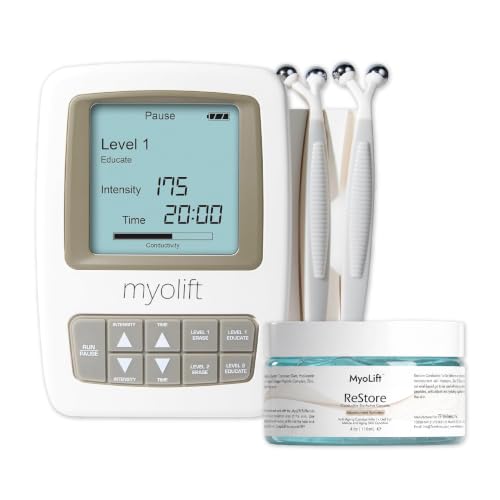
7E Wellness MyoLift Mini Microcurrent Facial Device
The MyoLift Mini uses two separate probes instead of a single glide-over wand, with adjustable output up to 400 microamps and treatment charts to follow. It's the closest thing here to what an esthetician holds, and gel and probes are included.
$329fromAmazonPrices as of Oct 25, 6:48 AM PT · Details
Dual probes change how the treatment works. Instead of sliding a two-ball wand along your cheek, you place one probe at each end of a muscle and hold, then move. That's the pinch-and-hold technique estheticians use, and it lets you work one spot at a time: the brow, the corner of the jaw, a band on the neck, rather than treating a whole side of your face identically.
The adjustable output is why estheticians recommend it for maintenance between appointments. 7E Wellness rates the Mini up to 400 microamps and lets you dial it down, so you can start low on thin skin near the eyes and go higher along the jawline. Most consumer wands hide that number and hand you three presets instead. Here you set the level yourself, which is either the appeal or the problem, depending on how you like to shop.
It's the option that rewards patience. There are treatment charts in the box for a reason, and your first few sessions will run longer than five minutes while you learn where the probes go. Owners who used to pay for in-office microcurrent tend to be the happiest with it, because they already know the technique and they're using this to stretch the gap between visits.
The kit is complete: device, charging adapter, probe set, conductive gel, manual, and treatment charts. There's nothing else to order before your first session, which isn't true of everything on this page. It's rechargeable and small enough to travel with, though the probe set makes it more of a suitcase item than a purse item.
Flaws but not dealbreakers
The learning curve is real. If what you want is to switch a device on and glide it around while you brush your teeth, the probe technique will wear on you inside a week.
Reliability is the bigger concern. Owner reports include a recurring thread of units arriving with no current passing at all, and returns get complicated by the lithium battery inside, which limits how you're allowed to ship it back. Try yours with gel on day one rather than a month later, while the return window is still open.
Who this is for
Buy a microcurrent device if you're in your late thirties or beyond, you've noticed softening along the jaw and cheek, and you'll actually spend five minutes a day on it. The people who like these devices treat them like flossing. If you mainly want a visible lift for a wedding or a shoot, a session the morning of does that nicely, and the effect fades within a few days.
Skip it if you have a pacemaker, epilepsy, active cancer, metal implants in your face, or you're pregnant. Estheticians quoted by Allure are consistent on those contraindications, and no setting makes them safe. This guide covers handheld at-home microcurrent wands. It doesn't cover LED masks, pure radiofrequency machines, or in-office treatments, and it's no substitute for asking a dermatologist about your own skin.
How we picked
Real microcurrent: we kept to devices that state a microcurrent output or intensity range, not light therapy or heat alone. Clearance: FDA clearance covers temporary improvement of facial contour, so we read it as a floor rather than a promise. Control: adjustable levels matter more than raw power, especially if your skin is sensitive. Routine: we favored a five-minute daily protocol you'll repeat, and counted the gel, serum, and attachments you'll keep buying. Reliability: we read owner feedback for recurring failures rather than isolated complaints.
The competition
This is what our research surfaced, not a census of everything sold. The category is crowded with wands that borrow the word microcurrent for something else, and the device below is a real one that simply isn't a microcurrent-first choice.
The TriPollar Stop Vx 2 — The TriPollar Stop Vx 2 isn't really a microcurrent wand. It leads with multi-frequency radiofrequency, which heats the dermis to work on collagen and elastin, and pairs that with dynamic muscle activation. TriPollar aims it at the jawline and neck in short sessions, and its thermal mapping adjusts temperature in real time, which is a genuinely different approach from anything else here. It lost to our picks because the microcurrent is a supporting act, the pool of owner feedback is small, and it's the most complicated device on this list to learn. If sagging along the lower face is your specific complaint and you'd rather have warmth than a tingle, it's worth a look.
Gel, cleaning, and charging
Every device here needs a conductive layer between the probes and your skin, and that's not the place to improvise. Use the gel that came in the box, or the serum the brand specifies. A water-based aloe gel works in a pinch, but anything oily blocks the current. Apply more than feels necessary and reapply as you go, because a dry patch is the most common reason a session cuts out halfway through. Wipe the probes with a soft damp cloth after each use, then dry them, since residue builds up and interferes with conductivity. Charge on a schedule instead of waiting for the battery to die. And keep the thing somewhere you'll see it, because the results come from repetition.
Questions we get
Do microcurrent facial devices actually work?
For temporary contour improvement, yes, and several of these are FDA-cleared on exactly that basis. A study in the Journal of Cosmetic Dermatology found that regular microcurrent stimulation over several weeks improved measurable skin firmness and reduced the visible depth of fine lines. Healthline points out that large peer-reviewed studies on at-home devices specifically are still limited. Expect subtle and gradual, not dramatic.
How often should you use a microcurrent device?
Daily, or close to it. InStyle found that a five-minute daily protocol over roughly 60 days is the pattern most brands recommend for noticeable toning. After that, a few maintenance sessions a week is the usual advice. Skipping a day won't undo anything, but skipping a month probably will.
Can a microcurrent device replace Botox or a professional facial?
No. Botox relaxes a muscle so the wrinkle above it softens. Microcurrent stimulates muscles so the face looks more toned. Those are opposite mechanisms and different results. Dermatologists cited by Real Simple also note that at-home devices run at lower amperage than in-office machines, so results are subtler. NuFACE says its device is compatible with fillers and injectables when used as directed, but check timing with your injector.
Do you need a special gel or serum?
Yes. Microcurrent won't reach the muscle without a conductive medium, and running a device dry is both ineffective and uncomfortable. Each of our picks ships with gel or names a serum to use. Plan on refills as an ongoing cost of ownership.
How long do results last after one session?
Roughly 24 to 72 hours, according to dermatologists interviewed by Byrdie. That's why using one the morning of an event works so well, and why occasional sessions don't add up to much. The cumulative toning people talk about comes from stacking sessions over about eight weeks.
Who shouldn't use a microcurrent facial device?
Anyone with a pacemaker or other implanted electrical device, anyone with epilepsy, anyone who's pregnant, and anyone with metal implants in the face should skip these entirely. Active cancer is on the contraindication list too. Estheticians quoted by Allure are firm about all of it. If you have another heart or nervous-system condition, ask your doctor before you start.
Why you should trust us
For this guide:
- We read the manufacturer specifications and clearance claims for every device in this guide, along with published coverage from Good Housekeeping, Byrdie, Allure, Real Simple, InStyle, and Healthline.
- We compared stated microamperage, intensity settings, and session lengths across the listings rather than relying on brand marketing language.
- We read owner feedback for recurring themes, especially complaints about conductivity, sensation, and units that stopped working.
- We read owner reviews on every listing, weighted toward the critical ones, because that is where the recurring failures show up.
- We have a systematic way of automatically fetching the latest prices, so the numbers on this page stay current.
- This is a research-focused guide, so the team may not own every product listed — though we often do own the top winners, which gives us extra context for the recommendations.
- We don't accept free products, and the retailer commission never changes which product we recommend.
Sources
FDA 510(k) Premarket Notification Database - Microcurrent Devices, U.S. Food & Drug Administration
Best Microcurrent Devices, According to Dermatologists, Allure
Good Housekeeping Institute Beauty Lab Device Testing, Good Housekeeping
What Dermatologists Really Think About Microcurrent Facials, Byrdie
Do At-Home Microcurrent Devices Actually Work?, Healthline
Microcurrent Facial Devices: Safety and Efficacy Overview, Verywell Health
Effects of Microcurrent Stimulation on Facial Skin Firmness, Journal of Cosmetic Dermatology (PubMed)
NuFACE Trinity+ Clinical Study Results, NuFACE
ZIIP Halo Product Specifications and Nexus Technology, ZIIP Beauty
FOREO Bear 2 Product Specifications, FOREO
Tripollar Stop Vx Device Technology Overview, Tripollar
The Best Microcurrent Devices for At-Home Facials, Real Simple
Amazon product listings and owner reviews for all 5 products
Manufacturer specification pages for each product
Some passages in this guide may be paraphrased with AI help.
Product prices and availability are accurate as of the date/time indicated and are subject to change. Any price and availability information displayed on Amazon.com at the time of purchase will apply to the purchase of this product.
More like this.
Continue exploring beauty reviews and recommendations.

The Best Facial Steamers
A facial steamer does one thing. It heats water and floats warm mist at your face for five or ten minutes. That softens the sebum and dead skin sitting in…

The Best Facial Cleansing Brushes
A facial cleansing brush does one small job, and it does it better than your hands. It moves cleanser around your face with a steady, even motion,…

The Best Pore-Minimizing Facial Toners
Pores don't have muscles. You can't shrink them, and anything promising otherwise is selling you a story. What you can change is what's inside them.…

The Best Facial Cleansers of 2026
Washing your face is the one skincare step nobody skips, and it's the step most likely to cause trouble. A cleanser that strips too hard leaves your skin…

The Best At-Home Skincare Devices
A good at-home skincare device does one thing for your evening: it makes five minutes at the bathroom mirror feel worth it. Microcurrent wands nudge…

The Best IPL Hair Removal Devices
Home IPL is a slow-burn purchase. You shave, you flash, you wait, and a few weeks later you notice you're shaving less. That's the whole experience. What…