The Best At-Home Skincare Devices
A good at-home skincare device does one thing for your evening: it makes five minutes at the bathroom mirror feel worth it. Microcurrent wands nudge facial muscles with a low electrical current. LED masks flood your skin with red and near-infrared light to prod fibroblasts into making collagen. Neither works like a light switch. They work more like flossing — small, dull, repeated, and only obvious months later when someone tells you that you look rested. The devices that earn counter space are the ones you'll actually pick up on a Tuesday night.
Here's the honest part. Nothing in this category replaces a needle or a laser. Published research generally points to 8 to 12 weeks of steady use before changes show up in photos, and microcurrent lift fades if you stop, because the effect is cumulative and temporary. You'll also keep buying conductive gel, since microcurrent and many radiofrequency tools need it to complete the circuit safely. And owner feedback for nearly every brand here includes units that quit charging well before they should have.
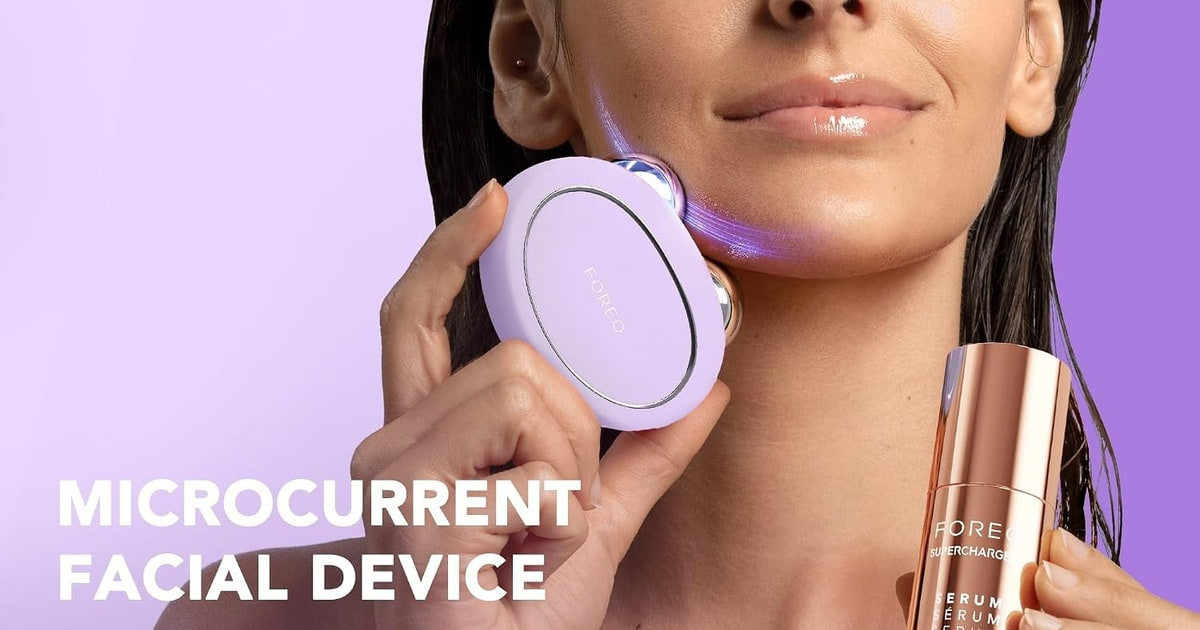
We leaned on FDA clearance, published clinical data, wavelength and current specs, and recurring themes in owner feedback to sort the lineup. We favored sessions short enough to survive a real week — five to ten minutes, not thirty — and brands that publish what their devices actually emit. We think that the NuFACE Trinity+ is the best at-home skincare device for most people, and that the Foreo Bear 2 is the one to buy if your skin is sensitive or you want an app to coach you through every pass.
Everything we recommend

The most proven lift you can get from five minutes a day

Gentler current and app coaching, if you're new to this

Four technologies in one wand for a fraction of the outlay

Full-face, neck and chest light in a mask that conforms

Massage, light and microcurrent from one handle
At a glance
| Product | Technology | Treatment Area & Session Time | Price | |
|---|---|---|---|---|
| Solawave 4-in-1 Radiant Renewal Red Light TherapyBudget pick | Red Light Therapy | Face & Neck, 3 Min | $99.99 |
 | PMD Beauty Clean Pro - Electric FacialAlso in lineup | SonicGlow Technology | — | $143.99On sale |
| NUFACE Trinity+ Skin Tightening & Face LiftTop pick | Microcurrent | Face & Neck, 5 Min | $395 |
| FOREO Bear 2 Advanced Toning Microcurrent FacialRunner-up | Microcurrent | — | $283.99On sale |
| CurrentBody Skin Red Light Therapy for FaceUpgrade pick | — | — | $800.98On sale |
| TheraFace Therabody TheraFace PRO - Microcurrent FacialAlso great | Microcurrent | — | $419.99 |
 | Environ Omnilux Contour FACEAlso consider | — | Face | $439.99 |
How we picked
Clearance and evidence. We prioritized FDA-cleared devices and brands that publish real clinical data or peer-reviewed trials. Marketing language about lifting and firming with nothing behind it didn't count.
Wavelengths and current. For LED we looked for red in the 630 to 660 nm range plus near-infrared at 830 nm, the combination that clinical settings use for anti-aging. For microcurrent we looked for a stated output within the 200 to 400 microamp band.
Minutes per session. Devices that need five to ten minutes get used; devices that need half an hour get abandoned. We favored short sessions and, where possible, hands-free ones.
Cost of keeping it. Conductive gel is mandatory for microcurrent, and some devices assume a specific serum. We noted every recurring purchase a device commits you to, along with replacement heads.
Skin-type safety. We weighed current limiters, intensity ranges and owner reports of stinging or irritation, since sensitive and acne-prone skin has the least margin for a device that runs hot.
Top pick
The most proven lift you can get from five minutes a day
NUFACE Trinity+ Skin Tightening & Face Lift
This is the FDA-cleared microcurrent device dermatologists point to most often, with three frequencies and three intensities for a five-minute daily pass over cheeks, jawline and neck. It's the priciest tool here, the gel is a forever cost, and you have to keep showing up.
$395fromAmazonMicrocurrent has a thin evidence base overall, and NuFACE holds most of it. The Trinity+ is FDA-cleared, and the company's trials report that 85% of participants saw improved facial contour after two months of daily five-minute sessions. That's manufacturer data, so take it with salt. But it's more than most competitors publish, and it lines up with what dermatologists generally say about microcurrent: real, subtle, and completely dependent on you showing up.
You get three frequencies and three intensities, which matters more than it sounds. Start low along the jawline, go higher across the cheeks, ease off near the eyes. A boost button adds up to a quarter more power when you want it. And if you later want red light or targeted eye and lip work, the attachments snap onto the same handle instead of forcing you into a second device.
The routine is five minutes. That's the whole pitch, and it's why this survives a real week better than a mask you have to lie down for. You spread the activator gel, glide across your face and neck, and you're done. Owners who stick with it describe a sharper jawline and a more lifted look in the mirror. Owners who use it twice and forget about it describe nothing at all.
It plays well with whatever else you're doing to your face. NuFACE says the Trinity+ is compatible with fillers and injectables when used as directed, and it's painless enough for all skin types. If you're stretching the gap between in-office appointments, that's the point of owning one. Just don't ask it to do a laser's job — this is muscle tone and contour, not resurfacing or pigment correction.
Flaws but not dealbreakers
The gel isn't optional. Microcurrent needs a conductive medium to complete the circuit, so you'll be rebuying activator gel for as long as you own this, and owners report that skimping on it makes sessions feel weak or prickly.
Support has been a sore spot. Several owners describe video tutorials vanishing from the app and slow replies from customer service, which stings on a device this expensive. A few also report tenderness or puffiness after climbing to a high intensity too fast, so start at the lowest setting and work up over a couple of weeks.
And plenty of people simply don't see it. Skepticism is fair: the changes are subtle, they need a couple of months, and they drift back within weeks once you stop.
Runner-upOn sale
Gentler current and app coaching, if you're new to this
FOREO Bear 2 Advanced Toning Microcurrent Facial
Bear 2 reads your skin's resistance 200 times a second and caps the current it delivers, so it's the least intimidating microcurrent device here. It costs less than our top pick and travels better, but it won't turn on at all until you pair it with your phone.
$283.99fromAmazonList priceMicrocurrent can zap you. It usually happens when your skin's resistance spikes — a dry patch, gel spread too thin, a spot you missed. Bear 2's Anti-Shock System 2.0 measures resistance 200 times per second and adjusts on the fly, and Foreo caps delivery at 250 microamps. These devices generally work in a 200 to 400 microamp band, so this sits at the gentle end. That's the right end for sensitive skin.
If you've never done this before, the app is the reason to choose it. Foreo's guided programs tell you where to glide, how long to hold, and which of the four microcurrent modes to use. There are also five T-Sonic massage patterns layered in for circulation and puffiness. The learning curve that trips people up on other microcurrent tools mostly disappears here.
Owner feedback clusters around one benefit in particular: morning de-puffing. People who get facial swelling say a few minutes with this makes a visible difference before work. Fine lines are a much quieter story. Set your expectations accordingly, and treat the contouring as a slow build rather than something you'll notice this week.
It pairs with Foreo's Supercharged Serum as the conductive layer, which Foreo says increases type 1 collagen production. Any water-based conductive gel completes the circuit, but the serum is what the brand's routine is built around. Either way, budget for the ongoing supply — that's true of every microcurrent device, not just this one.
Flaws but not dealbreakers
The phone dependency is real. The device won't operate until you download the app, create an account and connect, and owners who wanted a simple grab-and-glide tool find that genuinely annoying. If your phone is dead, so is your facial.
The anti-shock system isn't perfect. A minority of owners report getting zapped repeatedly anyway, usually a sign the conductive layer is too thin or the cleanser left oil behind. Sessions also run on a fixed timer that you can't cut short mid-pass.
Some owners say the tightening wears off within hours, which pushes them toward morning and evening use. That's twice the time commitment most people planned on.
Budget pick
Four technologies in one wand for a fraction of the outlay
Solawave 4-in-1 Radiant Renewal Red Light Therapy
This wand stacks red light, galvanic current, gentle warmth and massage into a rotating head you run over one area for three minutes. It won't sculpt a jawline like true microcurrent, but for brightness and puffy under-eyes it's the easiest entry point in the category.
$99.99fromAmazonNothing else here packs this many technologies into this small an outlay. Red light, galvanic current, therapeutic warmth and a massaging head all live in one rechargeable wand, and the 180-degree rotating head follows the curve of a cheekbone or jaw instead of fighting it. It comes with a priming serum built to work with the light, so there's no separate shopping trip before your first session.
Three minutes per area is the routine. Forehead, cheeks, under-eyes, jaw, upper lip, neck — you pick the two or three spots that bother you and you're out in under ten minutes. Good Housekeeping's Beauty Lab reported that 73% of its consumer testers showed measurable improvements in skin brightness after four weeks with this wand, which is a modest claim for a modest device. That's the right framing.
Be clear about what it does. This brightens, warms and de-puffs. It's not multi-frequency microcurrent, and galvanic current works differently from what's inside our top two picks, so don't expect lifted cheeks. Owners describe smoother texture and a better glow after a few weeks, and the honest ones say it isn't a miracle worker. If you want to find out whether you'll stick with a nightly device at all, start here.
Flaws but not dealbreakers
The treatment head is small. Covering your whole face means a lot of three-minute passes, and in practice most people end up treating one or two zones and skipping the rest.
Durability is the recurring complaint. A meaningful slice of owner feedback describes wands that cut out mid-session or stop holding a charge, sometimes within the first couple of months. It's the tradeoff you accept at this end of the category.
And a chunk of buyers see nothing after three or four weeks of faithful use. That may just be the timeline — most research points to two to three months — but it's a long wait on a device that's easy to abandon.
Upgrade pickOn sale
Full-face, neck and chest light in a mask that conforms
CurrentBody Skin Red Light Therapy for Face
This flexible silicone mask puts 633 nm red, 830 nm near-infrared and 1072 nm deep near-infrared light against your face, neck and chest for ten minutes at a time. It's the most expensive thing here, and the ten minutes are yours to spend lying still.
$800.98fromAmazonList priceThree wavelengths do three different jobs. Red at 633 nm reaches 2 to 3 mm into the dermis and stimulates fibroblasts to build collagen and elastin. Near-infrared at 830 nm travels 4 to 5 mm deeper, into muscle tissue, where it helps with post-inflammatory healing — useful if you're dealing with the aftermath of acne. Series 2 adds deep near-infrared at 1072 nm and extends coverage down the neck and chest.
The clinical paper trail here is the strongest of any mask in this guide. A peer-reviewed trial on the CurrentBody mask found a 35% reduction in fine line depth after nine weeks of twice-weekly ten-minute sessions. CurrentBody also cites a 30% wrinkle reduction at eight weeks and includes a Veritace card so you can look at the underlying test results rather than taking the box copy on faith.
Fit is the quiet advantage. Rigid masks bridge over the bridge of your nose and float above your cheekbones, which puts the diodes farther from skin than the specs assume. The pliable silicone here sits flush against contours instead, and it stays put if you shift on the pillow. Ten minutes, twice a week, is the floor.
The neck and chest coverage is what pushes this past a face-only mask. Those are the areas that get sun without sunscreen for decades and go crepey first, and they're also the areas most home devices ignore entirely. If you've already sorted out your face and the mismatch below the jaw bothers you, this is the device that addresses it.
Flaws but not dealbreakers
You have to stop moving. Ten minutes of lying still twice a week sounds trivial until it competes with everything else in your evening, and unlike a five-minute wand you can't do it while brushing your teeth.
It's the largest outlay in this guide by a wide margin, and it does exactly one thing — light. There's no microcurrent, no massage, no cleansing.
This version is new enough that long-term owner feedback is thin. Across LED masks generally, battery and controller failures are the most common late complaint, so the warranty terms are worth reading before you commit.
Also great
Massage, light and microcurrent from one handle
TheraFace Therabody TheraFace PRO - Microcurrent Facial
Magnetic rings snap onto a single handle to give you percussive massage, cleansing, microcurrent, red and infrared LED, plus hot and cold therapy. It's the most versatile device here and the least specialized — no single mode beats the dedicated tool that does only that.
$419.99fromAmazonOne handle, a drawer of attachments. Therabody counts six therapeutic modalities in the TheraFace Pro — percussive, microcurrent, red LED, infrared LED, a cold ring and a warm ring — which Allure and Therabody both describe as the highest modality count of any consumer skincare device. The rings snap on magnetically, so switching from cleansing to microcurrent takes a second, not a rummage.
The percussive head is the part owners keep coming back to. Therabody built its name on percussive therapy, and it shows: people with jaw tension and TMJ pain describe it as the reason the device stays on the counter, with the skincare modes as a bonus. If you clench at night, that alone may justify the purchase in a way the LED ring wouldn't.
The app is genuinely useful for beginners. Routines built by estheticians walk you through technique for each ring, which matters because six modalities is six chances to use something wrong. Therabody says the device is clinically proven to lift, firm and improve texture over 12 weeks — a timeline consistent with what research says about this whole category, and a refreshing change from claims of overnight results.
The catch is spread. The LED ring covers a fraction of what a mask covers, so it takes many passes to treat a full face. And the microcurrent isn't as configurable as a dedicated toning device. It's a strong second tool and a reasonable only tool, but not the best version of any single technology.
Flaws but not dealbreakers
Build quality draws the most complaints. Owners report LED functions failing after a couple of months and the central magnet that holds the attachment rings giving out, sometimes just past the return window. Register it and keep the receipt.
It's chunky and heavy compared with a wand, which you notice partway through a long session.
You're paying for six modalities, and most people settle into using two. If you already know you only want light, a mask does more for the same money.
Who this is for
Buy one of these if you're already consistent with sunscreen and a retinoid and want to add something on top — that's the order that makes sense, because no device compensates for skipping the basics. They suit people looking for non-invasive maintenance between in-office appointments, people dealing with post-acne marks and dullness, and anyone who wants the contour boost of a facial without booking one. A dermatologist survey reported by Harper's Bazaar found 72% of board-certified dermatologists comfortable recommending at-home LED devices as safe maintenance tools between professional treatments.
Skip them if you want deep wrinkles gone, a jawline rebuilt, or sun damage erased — those are jobs for injectables, lasers and a dermatologist, and no home device comes close. Skip them too if you know you won't use something four or five times a week, because inconsistent use produces nothing at all. This guide covers face-focused electrical and light devices: microcurrent tools, LED masks, multi-function handles and cleansing brushes. It doesn't cover body panels, hair-growth caps, at-home lasers or ingestible supplements.
How we picked
Evidence: we favored FDA-cleared devices and brands publishing clinical or peer-reviewed data over ones making bold claims with nothing attached. Specs: for light, red between 630 and 660 nm paired with 830 nm near-infrared; for microcurrent, a stated output inside the 200 to 400 microamp range that these tools operate in. Time: five to ten minutes per session, because anything longer quietly falls out of your routine. Ongoing cost: conductive gels, paired serums and replacement heads all count against a device, since microcurrent won't work safely without a conductive layer. Safety: current limiters, adjustable intensity and owner reports of stinging mattered most for sensitive and acne-prone skin. Support: warranty length, app reliability and how brands handle failures, which owner feedback surfaces faster than any spec sheet.
Other at-home skincare devices worth considering
If you want the LED mask clinics themselves hand out: The Environ Omnilux Contour FACE ($439.99) — Omnilux Contour Face is the mask most often used in dermatology practices as an at-home maintenance protocol, and it has the deepest published evidence base of any consumer LED mask. Omnilux reports that 93% of participants saw visibly firmer, smoother skin after a month of three-times-weekly use. The flexible design is comfortable and the sessions are short. What you give up against our upgrade pick is coverage — this treats the face, not the neck and chest — and a small but real share of owners report batteries that fail outright or a fit that gapes at the chin on smaller faces. The listing itself is bare-bones, so buy it for the clinical record rather than the presentation.
The competition
This is what our research surfaced, not a survey of everything on the market. The at-home device category is growing fast — Grand View Research projects roughly 20% annual growth through the end of the decade — and new brands appear constantly, many of them making clinical claims they can't support. The device below is a real product that we'd steer most readers away from as a primary purchase, for reasons that have nothing to do with it being badly made.
The PMD Beauty Clean Pro - Electric Facial ($143.99) — The PMD Clean Pro is a sonic silicone cleansing brush with 7,000 vibrations per minute, four modes, and a heated rose quartz face that you flip to for massage and product absorption. The silicone head is hypoallergenic and never needs replacing, which is a genuine advantage over bristle brushes. SELF's tester panel reported that 68% of participants saw reduced pore appearance after eight weeks with a sonic silicone cleansing device, so the category does something. But cleansing is preparation, not treatment — it doesn't deliver light or current, so it can't do what the picks do. Owner feedback also includes units that charge but never power on and quartz plates that crack. Buy it as a companion to a treatment device if you like a heated massage step, not instead of one.
Care and technique
Start with clean, dry skin, then add the conductive layer your device asks for — microcurrent and many radiofrequency tools need it to complete the circuit, and a thin coat is where stinging comes from. Move slowly, in upward strokes, and stop before the gel dries. Wipe silicone heads with soap and water afterward and let them air-dry; don't submerge the handle unless the device is rated for it. Charge before a session rather than during. Close your eyes under an LED mask even if the light seems tolerable. Skip the device over active infections, open breakouts or broken skin, and check with your doctor first if you're pregnant or have an implanted electrical device. Then be boring about it — four or five sessions a week for a couple of months is what the research assumes.
Questions we get
Are at-home skincare devices as effective as professional spa treatments?
No, and any brand claiming otherwise is overselling. Home devices run at lower intensities than clinical equipment for safety reasons, so results are gentler and slower. What they're good at is maintenance — keeping the effects of a professional facial or in-office treatment going between appointments. Most surveyed dermatologists are comfortable recommending them in exactly that role.
How often should I use a microcurrent device?
Near-daily at first, then a few times a week to maintain. Microcurrent effects are cumulative and temporary, so skipping sessions causes regression — the muscle response fades within weeks of stopping. Most manufacturers recommend five-minute daily sessions for the first two months, then two or three sessions a week. It's a habit, not a purchase.
What's the difference between red light and blue light therapy?
Red light in the 630 to 660 nm range penetrates 2 to 3 mm into the dermis and stimulates fibroblasts to produce collagen and elastin, which is why it's the anti-aging wavelength. Blue light works at the surface, targeting acne-causing bacteria instead. Near-infrared at 830 nm goes deeper still, into muscle tissue, and helps with post-inflammatory healing after breakouts.
Do I really need a special gel or serum?
For microcurrent, yes — a conductive medium is what lets the current pass into your skin safely and evenly. Running a microcurrent device on dry skin is uncomfortable and doesn't work. Any water-based conductive gel does the job, though brands formulate their own to pair with their devices. Factor the resupply into what the device really costs you.
How long before I see results?
Plan on 8 to 12 weeks of consistent use before changes are meaningful, which is the window most published research uses. Microcurrent gives a short-lived contour boost the same day that fades within hours — nice, but not the point. LED works more slowly and more permanently. Treat any product promising visible transformation in days as a red flag.
What's safest for sensitive skin?
LED masks are the gentlest option, since there's no current, no friction and no heat to speak of. If you want microcurrent, look for a device with a current limiter — Foreo caps the Bear 2 at 250 microamps and adjusts continuously based on skin resistance, which makes it one of the lower-risk choices for unsupervised daily use. Start at the lowest intensity regardless, and give your skin a week or two to adjust.
Why you should trust us
For this guide:
- We read the FDA clearance claims, published clinical summaries and peer-reviewed trial data for every microcurrent and LED device in this lineup, and compared their stated wavelengths and current outputs side by side.
- We reviewed beauty-lab writeups and dermatology reporting from Good Housekeeping, SELF, Allure, Byrdie, Harper's Bazaar and Healthline covering these categories.
- We read through owner feedback for each device looking for repeated themes rather than one-off complaints — charging failures, app requirements, stinging and how quickly results fade once people stop.
- We read owner reviews on every listing, weighted toward the critical ones, because that is where the recurring failures show up.
- We have a systematic way of automatically fetching the latest prices, so the numbers on this page stay current.
- This is a research-focused guide, so the team may not own every product listed — though we often do own the top winners, which gives us extra context for the recommendations.
- We don't accept free products, and the retailer commission never changes which product we recommend.
Sources
The Best At-Home Skin-Care Devices, According to Dermatologists — Allure, Allure
Best At-Home Skincare Devices Tested by Editors — Harper's Bazaar, Harper's Bazaar
Best LED Face Masks, Lab-Tested — Good Housekeeping, Good Housekeeping
Best Microcurrent Devices for Facial Toning — Byrdie, Byrdie
Best At-Home Beauty Devices — Vogue, Vogue
We Tested the Most Popular Skincare Devices — SELF, SELF
NuFACE Clinical Studies — NuFACE Official, NuFACE
CurrentBody Skin LED Mask Peer-Reviewed Clinical Trial — CurrentBody, CurrentBody
Red Light Therapy for Skin: Does It Work? — Healthline, Healthline
Omnilux LED Clinical Evidence — Omnilux Official, Omnilux
Home Use Beauty Device Market Report — Grand View Research, Grand View Research
LED Light Therapy Reduces Hyperpigmentation — JAMA Dermatology, JAMA Dermatology
Amazon product listings and owner reviews for all 7 products
Manufacturer specification pages for each product
Some passages in this guide may be paraphrased with AI help. Prices are refreshed automatically.
More like this.
Continue exploring beauty reviews and recommendations.

The Best LED Face Masks and Red Light Therapy Devices
Red light therapy asks very little of you and gives back slowly. You put on a mask, sit still for a few minutes, and repeat that several times a week for…

The Best IPL Hair Removal Devices
Home IPL is a slow-burn purchase. You shave, you flash, you wait, and a few weeks later you notice you're shaving less. That's the whole experience. What…

The Best Microcurrent Facial Devices
Microcurrent devices send a low-level electrical current through your skin to stimulate the facial muscles underneath. In practice that means five minutes…

The Best Cetaphil Skincare
Skincare gets complicated fast, and most of it doesn't need to be. If your face stings after washing, flakes by lunch, or breaks out every time you try…

The Best CeraVe Skincare Products
CeraVe is the rare drugstore brand that dermatologists actually name out loud. The reason is boring in the best way: every core product is fragrance-free,…

The Best Paula's Choice Skincare
Paula's Choice built its name on a simple promise: no fragrance, no essential oils, and a published reason for every ingredient. That matters more than it…