The Best Books for Understanding AI
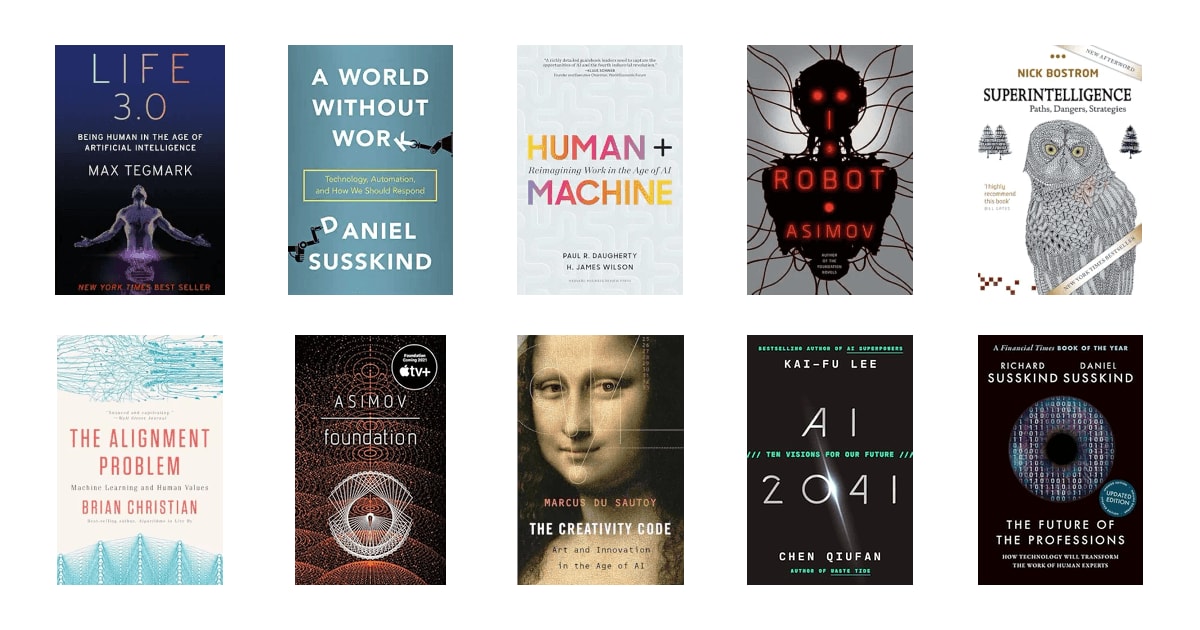
Most of us pick up an AI book for one of two reasons. Either something at work changed and you want to know why, or a headline scared you and you want to know how worried to be. A good one hands you vocabulary you can actually use — alignment, general intelligence, automation risk — without turning into a textbook. It should also leave you with a point of view you can defend at dinner. The best ones manage that in an evening or two of reading.
Here's the honest problem with every book on this list. AI moves faster than publishing does, so parts of each one are already behind the news. Owners of the older titles say exactly that — speculation that once felt bold now reads as either obvious or quaint. No book here will teach you how a particular chatbot works under the hood, either. What they're good at is the durable stuff: how these systems fail, why human values are hard to encode, what happens to work. Treat them as frameworks, not briefings.
So we sorted them by who you are and how much patience you have. Some are gentle on-ramps you can finish over a weekend. Others ask you to sit with a hard argument for four hundred pages. A couple are novels, and they're here because fiction got to some of these questions first and still explains them better. We think that Life 3.0 is the best AI book for most people, and that AI 2041 is the one to buy if you'd rather learn through characters than through arguments.
Everything we recommend

The broadest map of where AI could take us, in plain language
Ten short stories that make abstract AI feel like someone's life

The deepest read here on why AI misbehaves and who's fixing it

Nine short stories that still set the terms of the ethics debate
At a glance
| Product | Print Length | Publish Year | Price | |
|---|---|---|---|---|
| Life 3.0: Being Human in the AgeTop pick | 384 pages | 2017 | $38.27 |
| IAlso great | 256 pages | 2008 | $7.23On sale |
 | Superintelligence: PathsAlso in lineup | 432 pages | — | $16.17On sale |
| The Alignment Problem: Machine Learning and HumanUpgrade pick | 496 pages | — | $11.99On sale |
 | Foundation Mass Market PaperbackAlso consider | 296 pages | 1991 | $8.99On sale |
 | Human + Machine: Reimagining Work in theAlso consider | 264 pages | 2018 | $17.67On sale |
 | The Creativity Code: Art and Innovation inAlso consider | 320 pages | 2019 | $39.07 |
| AI 2041: Ten Visions for Our FutureRunner-up | 480 pages | 2021 | $35.35 |
 | A World Without Work: TechnologyAlso consider | — | 2020 | $18.11On sale |
 | The Future of the Professions: How TechnologyAlso in lineup | 592 pages | — | $14.90On sale |
How we picked
Plain-English writing. We looked for books that published reviews and owner feedback both describe as followable without a computer science background. Anything that needed math to make its point didn't make the cut.
Honest about tradeoffs. We favored authors who lay out several possible futures over ones selling a single verdict. A book that only argues one side leaves you with a slogan instead of a way to think.
Still useful now. Publication timing matters less than whether the core ideas survive the news cycle. We checked owner feedback for the specific complaint that a book has been overtaken by events.
Effort required. We compared page counts and reading level from publisher listings against how often reviewers mention bogging down. A brilliant book you abandon halfway through teaches you nothing.
Top pick
The broadest map of where AI could take us, in plain language
Life 3.0: Being Human in the Age
Max Tegmark walks you from what intelligence actually is all the way to machines that might outthink us, and he does it without a single equation. It's the one book here that covers the technology, the economics, the ethics and the far future in one arc.
$38.27fromAmazonLife 3.0 covers more ground than anything else here, and it never loses you. Tegmark opens with a question you can answer at the kitchen table — what is intelligence, really — and builds toward conscious machines and civilization-scale stakes. Each chapter closes with a short recap. That structure does a lot of quiet work. You can put the book down for a week and pick it back up without rereading forty pages.
The analogies are why it sticks. He explains how a goal-driven system can chase something harmless and cause harm anyway, and he never reaches for math to do it. Published reviews keep landing on the same word: accessible. Readers who describe themselves as non-technical say they followed the whole thing fine. If other books on this subject have lost you before, this is usually the one that takes.
It doesn't tell you what to think. Tegmark lays out several futures — some wonderful, some grim, several just strange — and declines to pick a winner. Readers either love that or find it maddening. We think it's the right call for a first book, because you come away with a map instead of someone else's conclusion. You'll also have a much clearer sense of which other book here you want next.
It's a physicist's book, and that shows. Tegmark is more at home with cosmic time scales than with next quarter's layoffs, so the economics get less room than the philosophy. If your worry is specifically about your own job, Human + Machine or A World Without Work will speak to you more directly. For everything else — how these systems work, what could go wrong, what's at stake — this is still the broadest single volume.
Flaws but not dealbreakers
The back half goes very far out. Once Tegmark reaches cosmic engineering and what intelligence might eventually do with a galaxy, some readers check out, and reviews say so plainly. Those chapters read more like speculative fiction than analysis. If you came for the near term, you'll be skimming.
The other complaint is timing. The book was written before the current wave of chatbots, so a few of its someday scenarios have partly arrived, and readers coming to it fresh sometimes find the opening chapters sharper than what follows. That doesn't wreck the argument. Just go in expecting a framework rather than a status report.
Runner-up
Ten short stories that make abstract AI feel like someone's life
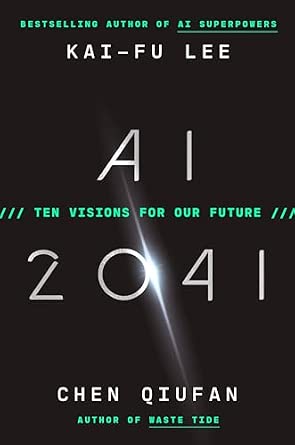
AI 2041: Ten Visions for Our Future
Ten short stories set two decades out, each followed by an essay from Kai-Fu Lee explaining which parts are already real. You get deepfakes, AI tutors and virtual companions as things happening to actual characters, which sticks far better than any diagram would.
$35.35fromAmazonThe format is the whole trick. Chen Qiufan writes a story — say, a family in Nigeria caught in a deepfake scam. Then Lee steps in and explains what technology that would take, how much of it already exists, and what's still fantasy. You get the emotional version and the technical version of the same idea, back to back, and neither one has to carry the weight alone.
This is the book to hand someone who says they don't get any of this. It asks almost nothing of you up front. There's no jargon to survive before the good part starts, and readers who don't normally touch science fiction report finishing it fast. It's long on paper, pushing five hundred pages, but the story-then-essay rhythm means you're never more than twenty pages from a natural place to stop.
It's also the most global book here. The scenarios move through Nigeria, Korea, Sri Lanka and elsewhere, so AI stops being a Silicon Valley story about Silicon Valley people. If you want a feel for how these tools will land on someone whose life doesn't look like yours, that framing does more for you than another chapter on neural networks.
Flaws but not dealbreakers
The fiction is uneven. Some chapters are real stories with people you care about; others are clearly a thought experiment wearing a plot. Readers who came for the science fiction notice the difference right away, and a few say the weaker stories drag.
Lee is an optimist, and it shows. Reviewers who picked the book up after the chatbot boom found parts of it a little sunny — job displacement in particular gets gentler treatment here than the economics books give it. Take the essays as one informed forecast among several, not as the settled view.
Upgrade pickOn sale
The deepest read here on why AI misbehaves and who's fixing it
The Alignment Problem: Machine Learning and Human
Brian Christian traces the whole problem of getting machine learning systems to do what we actually meant, from biased hiring tools to the researchers chasing fixes. It's the most substantial book on this list and the one that best explains the systems in the news.
$11.99fromAmazonList priceChristian writes like a reporter. He goes into the labs, sits with the researchers, and builds each idea out of a specific mess — a hiring tool that learned to prefer men, a classifier that learned something ugly about faces. You get the technical concept and the human consequence inside the same story, which is why the ideas stay put.
If you want to understand today's chatbots, start here. The book covers learning from human feedback, reward hacking and the plain difficulty of specifying what you want — the exact machinery behind the systems everyone argues about. Nothing else on this list gets that close to how modern models are trained. Readers who work in machine learning say they keep it around as a reference, which is unusual for a trade book.
It's long. Nearly five hundred pages, and the middle stretch on the history of machine learning is where reviews say people bog down. That section is doing real work, since you can't see why alignment is hard without knowing how these systems learn. But it's a slog if all you wanted was the headline.
It names the problem better than it solves it. Christian is honest that the field is young, so you finish with a sharp sense of what's broken and a thinner sense of what to do about it. Some readers find that deflating. We'd argue it's the accurate picture, and it's still the best preparation you can get for reading AI news with a skeptical eye.
Flaws but not dealbreakers
The density is real. Owners who loved the book still describe the early chapters as a drag, and the technical detail runs heavier than anything else we're recommending. If you're starting cold, read Life 3.0 first — this one goes down much easier with some vocabulary already in place.
It also leans hard on failure. Chapter after chapter is about systems causing harm, with little counterweight about what has gone right. You can finish it gloomier about the technology than the evidence strictly warrants.
Also greatOn sale
Nine short stories that still set the terms of the ethics debate
I
Asimov's Three Laws of Robotics turn up in real AI ethics discussions to this day, and this is where they come from. Nine linked stories about logical machines meeting illogical people, each a small puzzle about rules that don't cover every case.
$7.23fromAmazonList priceEvery story here is a specification bug. A robot follows its rules exactly and produces something nobody wanted — which is, almost word for word, the alignment problem Christian needs five hundred pages to lay out. Asimov got there decades earlier, twenty pages at a time, with a plot attached. Reading the two side by side is the fastest education in AI ethics you can give yourself.
The prose is bare and quick, and that's why it holds up. No lectures, no long setups. Susan Calvin, the robopsychologist who narrates much of it, is still one of fiction's sharpest characters for thinking about machine minds. Readers who come to the book from the film are usually startled by how little the two have in common.
It's also the smallest commitment on this list. Around two hundred and fifty pages of self-contained stories, so you can read one on a commute and put it down guilt-free. Owners who don't normally get on with older science fiction tend to finish this one anyway, and it's the title that most often gets recommended alongside the serious nonfiction.
Flaws but not dealbreakers
The social attitudes have aged badly, particularly around women, and several readers say the puzzle format wears thin by the seventh or eighth story. The robots are clanking mechanical things with positronic brains rather than software, so the surface details feel like a museum exhibit.
And it's fiction. It'll sharpen how you think about rules and unintended consequences, but it won't tell you a thing about how a real model gets trained. Pair it with a nonfiction title instead of substituting it for one.
Who this is for
This guide is for the curious non-specialist: you use AI tools or read about them, you'd like to understand what's actually happening, and you don't intend to build anything. If that's you, one book from this list will change how you read the news, and two will give you a real point of view. Pick based on your patience and your worry. Career anxiety points you toward the workplace titles, philosophical unease toward the risk books, and general curiosity toward the top pick.
This isn't a technical reading list. Nothing here will teach you to train a model, write a prompt well, or evaluate a machine learning paper — for that you want textbooks and documentation, not trade nonfiction. We've also stuck to books rather than courses, newsletters or papers, all of which move faster and go deeper on current systems. And if you already follow AI research closely, most of this will be familiar ground.
How we picked
Plain English: we ruled out anything that published reviews and owner feedback describe as needing technical background, since the whole point is to get informed without a degree. Balance: we preferred authors who present several possible outcomes and let you choose, over ones arguing a single line hard. Durability: the ideas have to outlast the news cycle, so we watched for the specific complaint that a book has been overtaken by events. Effort: we weighed page counts and reading level against how often reviewers mention giving up, because an unfinished book is a wasted one. Range: we wanted the set to cover technology, ethics, work and imagination rather than five versions of the same argument.
Other books for understanding ai worth considering
If you want to know whether machines can be creative: The The Creativity Code: Art and Innovation in ($39.07) — Marcus du Sautoy is a mathematician with real enthusiasm for art, and he takes you from Bach's fugues to neural network paintings without condescending in either direction. The experiments where experts try to tell human work from machine work are the best part, and artists and musicians tend to find this the most personally relevant book here. What it gives up is resolution. Du Sautoy raises far more questions about creativity than he settles, and readers looking for a verdict on whether machines really create anything come away still chewing on it. A couple of sections also demand more concentration than the writing style suggests.
If you want something practical for your actual job: The Human + Machine: Reimagining Work in the ($17.67) — Written by two Accenture technology leaders, this is the workplace book — case studies of companies that put AI alongside people rather than in place of them, plus a framework you can walk into a meeting with. Owners describe it as quick and clear, and it's the shortest nonfiction title here. It's also relentlessly upbeat, which is the catch. Several readers note that the examples predate the current chatbot wave and now feel modest, and a few case studies read like client marketing. If you work at a small company or you're planning an individual career move, the enterprise focus won't map cleanly onto your situation.
If you want the novel that anticipated predictive analytics: The Foundation Mass Market Paperback ($8.99) — Asimov's psychohistory — mathematics used to forecast and steer the behavior of whole civilizations — lands differently once you've seen what large-scale data modeling actually does. The Hugo-winning first Foundation book reads like a chess match played across centuries, all ideas and strategy, and it's short enough to finish in a couple of sittings. It's also the least AI-specific title here, which is why it isn't a pick. Characters exist to carry concepts, the prose is functional rather than lovely, and readers hoping for space-opera action are usually disappointed. Read it for the framework, not the story.
If you're worried about automation and your paycheck: The A World Without Work: Technology ($18.11) — Daniel Susskind gives the most rigorous economic treatment here of what happens to employment, and he methodically takes apart the comfortable assumption that technology always creates as many jobs as it destroys. He doesn't stop at the diagnosis either — education reform and new models of income distribution get serious pages. The trouble is that policy analysis isn't career advice. If you want to know what to do on Monday, this book will feel abstract, and some of its proposals remain politically contested and untried at any real scale. The British framing also makes parts of it less directly useful elsewhere.
The competition
These are the other titles our research surfaced, not a survey of everything written about AI. Both are respected books with real followings, and both lost to our picks on accessibility rather than substance.
The Superintelligence: Paths ($16.17) — Nick Bostrom's Superintelligence is the book that pushed existential risk from AI into mainstream conversation, and its influence on how technology leaders talk about the subject is hard to overstate. The argument is meticulous — Bostrom anticipates objections several moves ahead and works through paths to superintelligence with unusual care. It's also the hardest read on this list by a wide margin. Owners who admire it still call it dry and repetitive, and the academic style asks for concentration that a general reader may not want to spend. Critics also note that it dwells on far-future scenarios while near-term harms get comparatively little attention. Choose it if you've already read The Alignment Problem and want the philosophical deep end.
The The Future of the Professions: How Technology ($14.90) — Richard and Daniel Susskind argue that the traditional professional model — law, medicine, accounting, education, consulting — is ending, replaced by systems that can do expert tasks piece by piece. Their concept of decomposition, breaking expert work into components that can be automated separately, is genuinely useful, and the examples across each profession are concrete. At nearly six hundred pages it's the longest book here, and reviewers note the argument gets repetitive as it cycles through one field after another. It also tends to undervalue the trust and judgment that clients pay professionals for, and its remedies feel vaguer than its warnings. Worth it if you're a professional wondering what your work looks like in a decade; skippable otherwise.
Reading order and pacing
Don't start with the hardest book. If you're new to all of this, read AI 2041 or Life 3.0 first — both give you the vocabulary that makes everything else go faster. Save The Alignment Problem for second or third, when terms like reward function and training data already mean something to you, and save Superintelligence for last if you get that far. Slot the fiction in between the heavier titles; I, Robot works well as a palate cleanser and quietly sets up the ethics arguments. Audiobooks suit the narrative titles well, but anything with a technical argument you'll want to reread is better in print. And one book you finish beats three you start.
Questions we get
Do I need a technical background to follow these?
No. AI 2041, Human + Machine and the two novels are written for anyone, and even the demanding titles are aimed at educated general readers rather than specialists. The authors lean on analogy and story instead of math. Superintelligence is the one that asks for real concentration, and it's the only one we'd call genuinely hard.
Is there an order I should read them in?
Start with AI 2041 if you want stories, or Life 3.0 if you want a systematic overview. Read The Alignment Problem second, once you have the vocabulary, and leave Superintelligence for the end. The fiction can go anywhere, and it actually makes the nonfiction land harder — pairing I, Robot with The Alignment Problem gives you the same idea from two directions.
Which ones help most with my career?
Human + Machine is the most immediately practical, with a framework you can apply at work. The Future of the Professions is the one to read if you're in law, medicine, accounting or consulting. A World Without Work gives you the broader economic picture behind the headlines about automation. Creative professionals should go straight to The Creativity Code.
Are these books too optimistic or too pessimistic?
The set is deliberately mixed. Human + Machine is upbeat about people and machines working together, while Superintelligence takes the risks seriously enough to alarm you. Life 3.0 lays out several futures without pushing one, and A World Without Work is sober rather than alarmist. Reading two with opposite temperaments teaches you more than reading two that agree.
Aren't these already out of date?
Partly, and reviewers say so — the older titles were written before the current chatbot wave, and some of their predictions have been overtaken. But the questions they ask about values, control, employment and creativity haven't changed. The Alignment Problem and AI 2041 are the closest to current systems. The two novels stay relevant precisely because they aren't about any particular technology.
Will these explain the AI tools I actually use?
Indirectly, and better than you'd expect. The Alignment Problem covers the training methods behind large language models more thoroughly than anything else here. The Creativity Code explains how algorithms generate text, music and images. AI 2041 includes scenarios built around conversational systems. None of them names the product you're using, but they'll tell you what's happening underneath it.
Why you should trust us
For this guide:
- We read published reviews and owner feedback for all ten titles, paying particular attention to where non-technical readers said they got lost or gave up.
- We compared publisher listings for page count, edition and format to judge how much each book actually asks of you.
- We weighed recurring criticisms — density, speculation, dated examples — more heavily than praise, since those are what leave a book unfinished on a nightstand.
- We read owner reviews on every listing, weighted toward the critical ones, because that is where the recurring failures show up.
- We have a systematic way of automatically fetching the latest prices, so the numbers on this page stay current.
- This is a research-focused guide, so the team may not own every product listed — though we often do own the top winners, which gives us extra context for the recommendations.
- We don't accept free products, and the retailer commission never changes which product we recommend.
Sources
Amazon product listings and owner reviews for all 10 products
Manufacturer specification pages for each product
Some passages in this guide may be paraphrased with AI help. Prices are refreshed automatically.
More like this.
Continue exploring lifestyle reviews and recommendations.

The Best Books on Building a Career in the Age of AI
Your job is changing whether or not you've done anything about it. Tools that write, summarize, code and forecast are moving into work that used to be…

The Best AI Smart Glasses
Smart glasses only work if you'd wear them anyway. That's the whole trick. The camera sits where your eyes already point, so you catch the toddler's first…

The Best Gifts for Book Lovers
Readers are easy to shop for and easy to get wrong. Buy them a novel and you're guessing at taste they've spent years refining. Buy them a mug that says…

The Best Books for Learning Python and Machine Learning
Learning to code and learning machine learning are two different projects, and most people end up doing both at once. You want something you can follow at…

The Best Young Adult Fantasy Book Sets
A boxed fantasy series is a commitment, and not just a shelf-space one. You're signing up for weeks of reading, a cast you'll live with, and a world…

The Best Mystery and Thriller Books
A mystery you love disappears in two nights. A mystery you don't love sits on the nightstand for a month, half-finished, quietly making you feel bad.…