The Best Books on Building a Career in the Age of AI
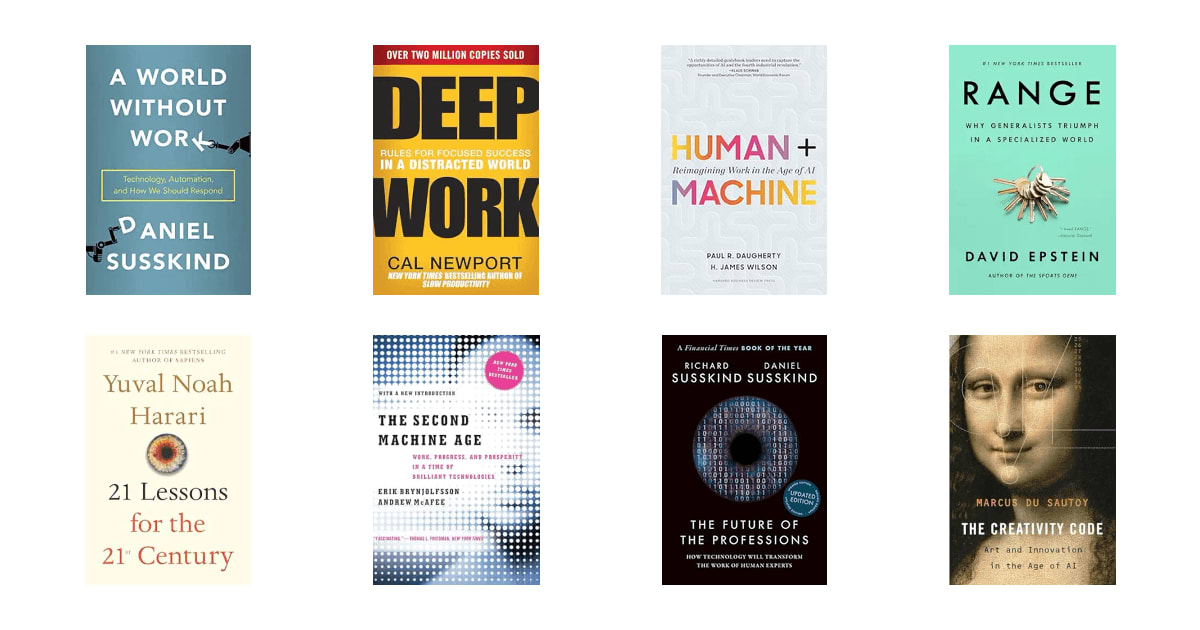
Your job is changing whether or not you've done anything about it. Tools that write, summarize, code and forecast are moving into work that used to be safely human, and the pace isn't slowing. Most of us don't need a technical explainer. We need help deciding what to learn next, what to stop investing in, and how to talk about our value when the obvious answers stop working. A good book on this subject gives you a frame for those decisions — one you can still use after the specific tools change.
Here's the honest catch: no book on this shelf can tell you whether your job is safe. The most rigorous ones are careful about that, and the careful ones can feel frustratingly abstract when you're the person worrying. Several of these were written before the current wave of chatbots, so their examples date faster than their arguments. And nearly every author is writing for knowledge workers with some slack in their lives. If you need a concrete plan by Friday, a book is the wrong tool.
We read through the arguments, the criticisms and what readers say about each of these after finishing them. We think that Range is the best book on this subject for most people, and that Deep Work is the one to buy if you already know what you want to be good at and just need to protect the hours to get there.
Everything we recommend
The most useful frame if you're rethinking your path

Practical focus training, if you have some control over your day

The optimistic, corporate-facing take on working with AI

The deepest read, if your expertise is what's for sale
At a glance
| Product | Pages | Published | Price | |
|---|---|---|---|---|
| Range: Why Generalists Triumph in a SpecializedTop pick | 352 pages | 2019 | $15.15On sale |
| Deep Work: Rules for Focused Success inRunner-up | 304 pages | 2016 | $17.98On sale |
 | 21 Lessons for the 21st Century HardcoverAlso consider | 400 pages | 2018 | $14.69On sale |
 | The Second Machine Age: WorkAlso in lineup | 336 pages | — | $17.21On sale |
 | A World Without Work: TechnologyAlso in lineup | 320 pages | 2020 | $18.11On sale |
| The Future of the Professions: How TechnologyUpgrade pick | 592 pages | — | $14.90On sale |
| Human + Machine: Reimagining Work in theAlso great | 264 pages | 2018 | $17.67On sale |
 | The Creativity Code: Art and Innovation inAlso consider | 320 pages | 2019 | $39.07 |
How we picked
Argument that survives. We favored books whose core claim still holds even though the technology examples have moved on. Published reviews and reader discussion were useful here — they show which arguments people are still citing years later.
Something you can do. A book earned a pick slot if it left you with a frame, a habit, or an exercise rather than only a forecast. Reader feedback about what people actually changed after finishing was the clearest signal.
Readable without a degree. None of these require a background in economics or computer science. We downgraded books where reviewers repeatedly flagged sections that lose a general reader.
Honest about limits. We were wary of books that promise your job is safe or that it's doomed. The ones we recommend say what they don't know, which is why their advice holds up better.
Worth the page count. Length has to earn itself. Where reviewers consistently said a book made its point and then kept going, we said so in the write-up instead of ignoring it.
Top pickOn sale
The most useful frame if you're rethinking your path
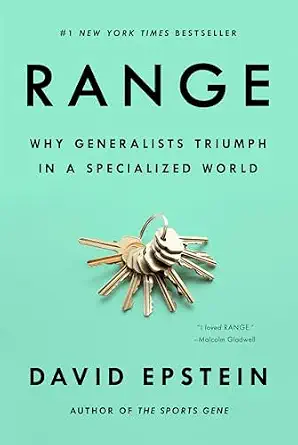
Range: Why Generalists Triumph in a Specialized
David Epstein's argument is that broad, zigzagging experience beats early specialization in unpredictable fields — which is most fields now. It's the rare book here that makes you feel better about a messy résumé while still telling you what to do with it.
$15.15fromAmazonList priceRange wins because it changes how you read your own history. Most career books hand you a system. This one hands you a reframe: the detours, the switched majors, the years in an unrelated industry — those aren't lost time, they're the pattern that shows up in people who solve unfamiliar problems well. If you've ever apologized for a scattered background in an interview, this book gives you a better story to tell about it.
Epstein builds the case with research on what he calls kind and wicked learning environments. Kind ones have clear rules and fast feedback, like chess. Wicked ones don't, and that's where narrow expertise breaks down. It's a genuinely useful filter. You can look at your own work and ask which kind it is, and that tells you a lot about whether going deeper or going wider is the smarter bet right now.
The stories carry it. Roger Federer playing everything before he picked tennis, Nobel winners who wandered between fields, forecasters who beat specialists by borrowing from everywhere. Readers consistently say this is the book they finished and then immediately pressed on someone else. It reads fast for a research book, which matters if you're squeezing it into a commute.
It also happens to be the least anxious book here. That's not a small thing. A lot of writing about AI and work leaves you with a low hum of dread and nowhere to put it. Epstein's argument points somewhere concrete instead: get curious about things outside your lane, take the lateral move, treat experimentation as a skill you practice rather than a phase you outgrow.
Flaws but not dealbreakers
It's more diagnosis than prescription. Epstein tells you why breadth pays off; he mostly doesn't tell you what to do on Monday. Readers who want a plan come away a little empty-handed, and a few say the stories run long and repeat their point.
The argument is also easy to misuse. Breadth is not an excuse to never get good at anything, and the book underplays the fields where deep expertise is still the whole job. If you're a surgeon or a structural engineer, take the thesis as a supplement, not a permission slip.
Runner-upOn sale
Practical focus training, if you have some control over your day
Deep Work: Rules for Focused Success in
Cal Newport argues that sustained, undistracted concentration is getting rarer and more valuable exactly as machines take over the shallow stuff. It's the most immediately actionable book here, with real routines you can start using this week.
$17.98fromAmazonList priceNewport's premise is simple. The work that's hard to automate is also the work that's hard to do while checking Slack. So he treats concentration as a trainable capacity, not a personality trait, and gives you the drills: time-blocking, a shutdown ritual, scheduled distraction rather than scheduled focus. Readers who've applied it report getting noticeably more done within a week or two, which is unusual for a book in this genre.
This is the one to buy if you already know your direction. Range helps you choose a path. Deep Work helps you actually cover ground on the one you've picked. If you're a writer, an analyst, an engineer or a researcher whose value comes from output nobody else could produce, this is the more urgent of the two.
It's also well built as a book. The first half makes the argument, the second half is rules you can apply, and the two halves stay out of each other's way. You can skim the case and live in the tactics, or read straight through. The neuroscience is light-touch and doesn't pretend to be more than framing for the advice.
Flaws but not dealbreakers
The prescriptions assume a life with slack in it. If you're a parent with young kids, a caregiver, or in a role where responsiveness is the job, four uninterrupted hours is a fantasy and the book doesn't really grapple with that. Some of the advice reads as written for people who can close a door.
Newport's dismissal of social media and casual networking has aged unevenly. In plenty of fields, visibility is part of how work finds you, and treating it all as shallow noise is too tidy.
Also greatOn sale
The optimistic, corporate-facing take on working with AI
Human + Machine: Reimagining Work in the
Two Accenture executives argue that AI mostly reshapes jobs rather than deleting them, and they name the new roles that appear in the middle. If you manage a team or have to make decisions about AI tools at work, this is the most directly usable book here.
$17.67fromAmazonList priceHuman + Machine is the book to read if someone expects you to have a plan. Daugherty and Wilson focus on what they call the missing middle — the jobs that appear when people and systems work together, like training a model, explaining its output, or deciding when to overrule it. Those are real roles with real skills attached, and naming them is more useful than another round of will-AI-take-my-job.
The case studies do most of the work. Doctors reading scans alongside AI, designers running dozens of options in the time one used to take, factory floors where the robot and the human share a task. It's short, it's blunt, and readers describe it as a quick read that gets straight to the point — a genuine virtue in a category full of 500-page arguments.
It also gives you vocabulary. Their MELDS framework — mindset, experimentation, leadership, data, skills — isn't profound, but it's a checklist you can walk a team through. If you're the person who has to run the meeting about what AI means for your department, having a structure beats improvising.
Flaws but not dealbreakers
It was written before the current generation of chatbots, and readers point out that a chunk of the case studies now look quaint. The framing holds up better than the specifics.
The optimism is relentless, and some of the examples read like client work. If you've already been displaced by automation, or you want an honest reckoning with inequality and job loss, this book will feel like it's talking past you. It's a management book, and it never really pretends otherwise.
Upgrade pickOn sale
The deepest read, if your expertise is what's for sale
The Future of the Professions: How Technology
Richard and Daniel Susskind take apart professional work — law, medicine, accounting, teaching, consulting — and show which pieces technology is already absorbing. It's long and clinical, but nothing else here is this specific about expert jobs.
$14.90fromAmazonList priceThe central move is decomposition: stop asking whether your profession survives and start asking which tasks inside it do. Break the job into components, and you can see which ones get automated, which get handed to cheaper labor, and which still need a person. For anyone whose income depends on hard-won expertise, this is the most practical exercise in any of these books.
It's also the most thorough. At nearly 600 pages, the Susskinds walk through profession after profession with evidence, which is why readers who work in law or tax describe it as uncomfortably on target. That thoroughness is the point. If you want an argument you can bring to partners or a department head, this is the one with the receipts.
It earns the upgrade slot by being genuinely harder work than the rest. This is not a commute book. The prose is careful and a little cool, the structure is systematic, and it repeats its method across fields on purpose. You're buying depth and rigor rather than momentum, and you should pick it up knowing that.
Flaws but not dealbreakers
The tone is detached. Readers who are personally anxious about their careers often note that the book never quite acknowledges what it feels like to be the expert being decomposed. It analyzes; it doesn't reassure.
It's also repetitive by design, and several of the solutions it lands on look better for institutions than for the individual professional reading it. If you're outside the classic professions, a lot of it won't apply to you.
It's the longest book here by a wide margin. Plenty of people start it and don't finish.
Who this is for
This guide is for people who work with their heads and have started wondering how long the current arrangement lasts. That includes mid-career professionals watching software creep into their tasks, managers who have to say something coherent about AI to a team, and anyone weighing a pivot and wanting a better basis for it than vibes. It's also useful early on, when you're choosing what to get good at and the standard advice to specialize hard is starting to look shakier than it did.
It's not for you if you want a technical education in how these systems work — none of these teach you machine learning. It's also the wrong shelf if you need a job this quarter; a résumé guide will serve you better. We stuck to full-length books arguing about work, skills and the economics of automation. Prompt manuals, tool tutorials and general productivity titles are outside the scope, and we skipped them even where they sell well.
How we picked
We looked for a few things in every book. Durability: the argument has to outlive the examples, since anything written about specific AI tools dates within a couple of years. Usefulness: we favored books that leave you with a frame or a habit rather than only a prediction, and we leaned on reader feedback about what people actually changed afterward. Readability: no technical background required, and we marked down books where reviewers kept flagging sections that lose a general audience. Honesty: the ones that admit what they can't forecast age far better than the ones that promise you'll be fine. Length: if a book makes its case and then keeps going, we say so rather than pretending the page count doesn't cost you anything.
Other books on building a career in the age of ai worth considering
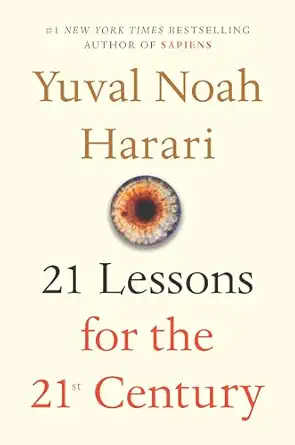
If you want the big-picture, philosophical version: The 21 Lessons for the 21st Century Hardcover ($14.69) — Harari's 21 Lessons for the 21st Century is the widest-angle book here. It's less about your career than about the assumptions underneath it — work, meaning, education, identity — and his chapters on technological unemployment and mental flexibility land hard. He's a wonderful synthesizer, and readers describe finishing chapters with pages full of margin notes. What you give up is any specific guidance. Harari won't tell you what to learn, and if you already came in anxious, his outlook can tip you further that way rather than pointing anywhere. Some readers also find it repeats his earlier books.
If your work has a creative core: The The Creativity Code: Art and Innovation in ($39.07) — The Creativity Code is a mathematician's tour of what machines can do in art, music and proof — and where they still fall short. Marcus du Sautoy is a generous explainer, and the book is genuinely fun on how algorithms compose music or generate paintings. It's the best thing here for thinking about creativity as a defensible skill rather than a vague one. But it's a book of ideas, not advice; it won't tell you how to develop your own creative practice. Some readers find it drifts in the back half, and the focus on high art and mathematics can feel far from everyday design or writing work.
The competition
These are the other books in this lineup, not a survey of everything published on AI and work. Each of them has real readers who'd defend it. They just lost out to the picks on usefulness, durability, or how much effort they ask of you relative to what you get back.
The The Second Machine Age: Work ($17.21) — The Second Machine Age is the economics primer of the group. Brynjolfsson and McAfee explain bounty and spread — how digital technology creates enormous value while distributing it unevenly — and their distinction between technology that complements your labor and technology that substitutes for it is a durable, genuinely useful idea. It lost to the picks mostly on age. It predates the current wave by a long stretch, and its tech-optimist confidence reads differently now. Readers still praise how clearly it explains hard economics, so pick it up if you want the structural forces rather than personal strategy.
The A World Without Work: Technology ($18.11) — A World Without Work is Daniel Susskind arguing that technological unemployment is not a scare story but a plausible destination, then asking what a society organized around something other than jobs would look like. He's a clear writer, and his takedown of the comforting idea that new jobs always appear is bracing. The catch is one readers name repeatedly: he spends most of the book making the case and comparatively little sketching the way forward. The policy chapters lean British, and there's not much here you can act on as an individual. Read it for the long view, not for next steps.
How to actually get through them
Books like these are easy to buy and easy to abandon around page sixty. A few things help. Read one at a time, and pick based on where you are right now rather than starting with the longest and most serious. Keep a running list of things you'd change about your own work as you go — even three or four items beats a fully highlighted book you never revisit. Deep Work is the one to apply immediately; block a single hour tomorrow and see what happens. Range and Human + Machine are better discussed than read alone, so if you can talk one through with a colleague, do. And give yourself permission to skim. Several of these repeat their argument across chapters, and skipping ahead once you've got the point isn't cheating.
Questions we get
Which one should I read first if I'm worried AI is coming for my job?
Start with Human + Machine. It's short, it's the most reassuring without being empty, and it names concrete roles that appear when people work alongside these systems. Then read Range for the longer-term view on staying adaptable. If you're in law, medicine, accounting or consulting, go to The Future of the Professions instead — it's about your work specifically.
Do I need any technical background?
No. None of these teach you how the technology works, and all of the authors write for a general audience. The Creativity Code gets into algorithms in a few places, but du Sautoy explains as he goes. The Second Machine Age handles economics the same way — accessible, with the heavy lifting in the footnotes.
Are these useful if I'm just starting my career?
Very. Range is arguably most valuable early, when everyone's telling you to pick a lane and commit. Deep Work is easier to adopt before you've built a decade of bad habits. And 21 Lessons gives you the wide frame that makes long-horizon choices feel less arbitrary.
Which one gives the most concrete advice?
Deep Work, by a distance. It has actual routines you can start using tomorrow. Human + Machine is second, with frameworks you can bring into a team meeting. Range and 21 Lessons are the opposite — they change how you think, not what you do this week.
Several of these were written before ChatGPT. Does that matter?
It matters for examples, less for arguments. The specific case studies in Human + Machine and The Second Machine Age can look dated, and readers say so. But the underlying ideas — complements versus substitutes, decomposing a job into tasks, breadth as insurance against unpredictable change — hold up fine. Read the examples as illustrations, not as a current market survey.
Should I read all of them or pick two?
Pick two. Range plus Deep Work covers the most ground for the least effort — one for direction, one for execution. Then add the one that matches your situation: The Future of the Professions for expert services, Human + Machine for management, The Creativity Code for creative work, A World Without Work if you want the long horizon.
Why you should trust us
For this guide:
- We read the arguments in each book alongside published reviews and the recurring themes in reader feedback, paying attention to which criticisms came up again and again.
- We compared the books on how well their core claims hold up now that the technology examples have moved on, and on how much practical use readers report getting from them.
- We noted where reviewers consistently flagged a book as too long, too abstract or too optimistic, and reflected that in the write-ups rather than smoothing it over.
- We read owner reviews on every listing, weighted toward the critical ones, because that is where the recurring failures show up.
- We have a systematic way of automatically fetching the latest prices, so the numbers on this page stay current.
- This is a research-focused guide, so the team may not own every product listed — though we often do own the top winners, which gives us extra context for the recommendations.
- We don't accept free products, and the retailer commission never changes which product we recommend.
Sources
Amazon product listings and owner reviews for all 8 products
Manufacturer specification pages for each product
Some passages in this guide may be paraphrased with AI help. Prices are refreshed automatically.
More like this.
Continue exploring lifestyle reviews and recommendations.

The Best Books for Understanding AI
Most of us pick up an AI book for one of two reasons. Either something at work changed and you want to know why, or a headline scared you and you want to…

The Best Books on Building Habits
Most habit advice fails you in the same place. You know what you want to do differently - move more, drink less, actually finish the side project - and…

The Best Personal Finance Books for Building Wealth
Money advice fails for boring reasons. You know you should save more, you know index funds beat stock picking, and then it's Tuesday, you're tired, and…

The Best AI Smart Glasses
Smart glasses only work if you'd wear them anyway. That's the whole trick. The camera sits where your eyes already point, so you catch the toddler's first…

The Best Protein Powders for Muscle Building
Protein powder is a convenience food, not a magic one. If you're lifting three or four times a week, you need somewhere between 1.6 and 2.2 grams of…

The Best Pumpkin Carving Kits
Carving a pumpkin is the most popular Halloween activity in the country. A National Retail Federation survey found that roughly 72% of celebrating…