The Best Automotive Multimeters
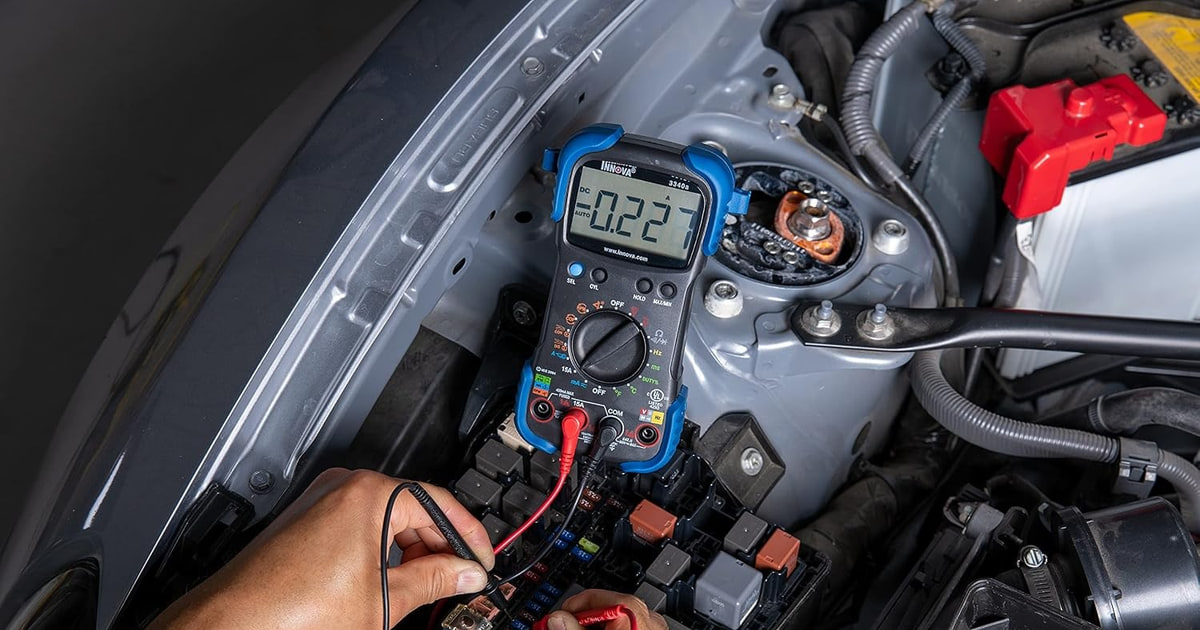
A multimeter turns a vague car problem into a number you can act on. Your battery either rests at 12.6 volts or it doesn't. Your charging system either holds around 14 volts with the engine running or something's wrong. For a lot of people that's the entire job — two or three checks in a driveway, a couple of times a year. But newer cars ask more of the tool. Injectors, cooling fans, idle valves and even alternators are now switched on and off thousands of times a second, and reading those circuits takes a meter built for it.
Here's the honest part: no single meter in this category does everything well. The ones with the automotive extras — an RPM clamp, dwell, a temperature probe — tend to cut corners on measurement accuracy. The ones with the best accuracy skip the automotive extras entirely. And none of them will read a starter's cranking current, because that job needs a clamp-on ammeter no matter what you buy. You're picking a set of compromises, not a do-everything instrument. So it pays to know which three tests you'll actually run.
We read manufacturer specifications, published reviews and owner feedback across eight meters, from a beginner's battery checker to professional Fluke instruments, and sorted them by who they're really for. We think that the Innova 3340 is the best automotive multimeter for most people, and that the Klein Tools MM420 is the one to buy if you want true RMS accuracy and a tougher case more than you want an RPM clamp.
Everything we recommend
The automotive functions most home mechanics actually use

True RMS accuracy and a case that survives the shop floor
Battery and charging checks, with almost nothing to learn

Professional automotive diagnostics, if you bill for the work
At a glance
| Product | Price | |
|---|---|---|
| Fluke 88V Deluxe Automotive MultimeterUpgrade pick | $567.85On sale |
 | Fluke 87V/E2 Industrial Electrician True-rms Digital MultimeterAlso in lineup | $514.48On sale |
 | Fluke - 117CAL 117 Electricians True RMSAlso in lineup | $379.99 |
| Innova 3340 Professional Automotive Digital MultimeterTop pick | $100.87 |
| Klein Tools MM420 Digital MultimeterRunner-up | $64.37 |
 | Extech EX330 Autoranging Mini MultimeterAlso consider | $79.49 |
| INNOVA 3320 Auto-Ranging Digital MultimeterBudget pick | $35.38 |
 | ANCEL BA101 Car Battery TesterAlso consider | $38.99On sale |
How we picked
Automotive-specific functions. We gave weight to meters with an inductive RPM pickup, duty cycle, dwell angle and a temperature input, because those are the functions that save the most diagnostic time on a car. General-purpose meters that skip all four had to earn their place another way.
True RMS measurement. Manufacturer literature and published reviews agree that average-responding meters misread the switched, non-sinusoidal signals modern vehicles produce. We treated true RMS as a strong plus for anything doing sensor or PWM work.
Input impedance and safety. We required 10 megohm input impedance so the meter can't disturb ECU and sensor circuits, and we checked stated safety ratings against the job. CAT III is the floor for under-hood work, and CAT IV is the requirement for high-voltage pack access.
Build and usability. We compared drop ratings, holsters, backlights and display size, and we leaned on owner feedback about what breaks first — usually the leads, the case or the dial. Auto-ranging was close to mandatory.
What's in the box. Meters that list temperature or RPM but leave out the probe or the clamp lose real value, so we checked included accessories against the spec sheet rather than trusting the feature list.
Top pick
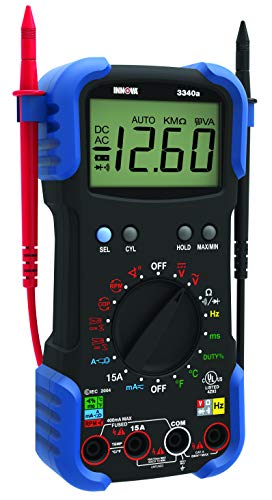
The automotive functions most home mechanics actually use
Innova 3340 Professional Automotive Digital Multimeter
The Innova 3340 is a purpose-built automotive meter that covers RPM, duty cycle, dwell angle and alternator diode testing in one dial. It's the rare tool that costs a fraction of a professional Fluke while handling most of the same driveway and small-shop diagnostic work.
$100.87fromAmazonIt does the automotive jobs a hardware-store meter can't touch. The 3340 reads engine speed from an inductive clamp over a plug wire, so you don't need the OBD port. It measures duty cycle on PWM solenoids and injectors, dwell angle on older ignition systems, and it tests alternator diodes. That last one matters more than it sounds. A failing diode drains a battery overnight and looks exactly like a bad battery if all you have is a voltmeter.
The extras you'd otherwise pay for are in the box. Innova includes the temperature probe, the inductive RPM clamp and a carrying case. Plenty of meters list temperature as a function and then leave the probe out, which means a second order and another week of waiting. Here you can open the box, clamp the pickup over a plug wire and get a reading the same afternoon.
It's safe to put on your car's computer circuits. The 3340 has 10 megohm input impedance, the accepted standard for automotive work. A lower-impedance meter draws enough current to pull down a sensor reference voltage, and then you're chasing a fault your own tool created. Innova also builds in overload protection, so a wrong-jack mistake is more likely to survive than to end the meter's life.
Auto-ranging keeps it out of your way. You don't dial in a range. Set it to DC volts, touch the probes down, read the number. Auto shut-off means you won't find a dead meter next time you need it, which is exactly the failure mode of a tool that lives in a toolbox between jobs. It also measures up to 15 amps, more headroom than most meters at this level for testing components on the bench.
Flaws but not dealbreakers
It isn't true RMS, and that's a real limit. On PWM-controlled circuits — modern alternators, variable-speed fans, some solenoids — an average-responding meter can be off by a meaningful margin. For pass/fail fault-finding it rarely changes your conclusion. For sensor signal work where you're comparing a reading against a tight specification, you want true RMS, and that means the Klein.
The build is functional, not tough. The plastics feel light next to contractor-grade meters, and owners who use one daily tend to note the leads and the case before anything else. It'll live happily in a home garage. On a busy shop floor where meters get knocked off fenders, something sturdier is the better bet.
Runner-up
True RMS accuracy and a case that survives the shop floor
Klein Tools MM420 Digital Multimeter
The Klein MM420 is a true RMS meter with a drop rating and LEDs that tell you when your leads are in the wrong jacks. It skips the engine-management extras, so it's the pick if you chase wiring and charging faults more than driveability complaints.
$64.37fromAmazonTrue RMS is the reason to choose this one. Cars switch things on and off constantly now, and the resulting waveforms aren't smooth sine waves. Average-responding meters guess at them and guess badly. The MM420 calculates the actual effective value regardless of waveform shape, so what you read on a PWM fan circuit or a modern alternator is what's really there.
The Lead-Alert LEDs prevent the mistake that kills meters. LEDs on the face light up to confirm your probes are in the right jacks. Leave a lead in the current input, switch to volts, touch a live circuit, and you've just made a dead short — it's the single most common way people destroy a multimeter. Klein made that error visible before you take the reading rather than after.
It's rated to survive a fall from a stepladder. Klein specifies a 6.6-foot drop rating, and the meter has lead holders on the back, a kickstand, and a mount point for an optional magnetic hanger. Those sound like small things until you're under a hood with both hands busy and nowhere to set the meter down.
The measurement coverage is broad. You get AC/DC voltage to 600V, 10A AC/DC current, resistance to 50 megohms, continuity, capacitance, frequency and duty cycle, diode test and temperature. Duty cycle means you can still check injector and solenoid on-time, which is the automotive function most people miss when they leave a dedicated automotive meter behind.
Flaws but not dealbreakers
There's no RPM clamp and no dwell. If your diagnostic routine involves reading engine speed off a plug wire or setting points on an older engine, the MM420 simply can't do it. That's the trade for the accuracy and the case, and it's why the Innova stays our top pick for general car work.
The current ceiling and the temperature probe both come with caveats. Ten amps covers component testing and not much more, so any real draw test still needs a clamp meter. Temperature is a listed function, but you'll need a probe to use it. Check what's in the box before you count on it.
Budget pick
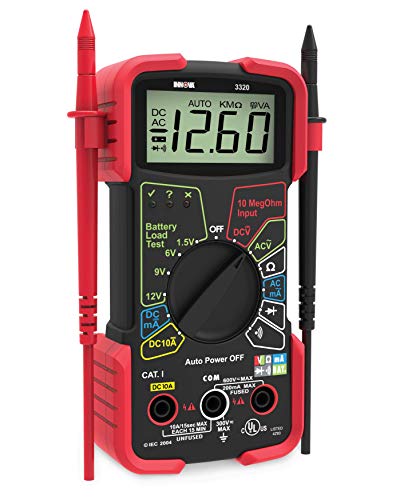
Battery and charging checks, with almost nothing to learn
INNOVA 3320 Auto-Ranging Digital Multimeter
The INNOVA 3320 is the meter to hand someone who has never used one. Color-coded LEDs show battery state without making you interpret a voltage number, and auto-ranging removes the step where beginners usually go wrong.
$35.38fromAmazonIt answers the three questions most people actually have. Is the battery charged? Is the alternator charging? Is that fuse blown? The 3320 covers all three without a manual. For someone whose car trouble shows up twice a year on a cold morning, that's the entire use case, and paying for functions you'll never turn on doesn't make you a better diagnostician.
The color-coded LEDs do the interpreting for you. Instead of reading 12.3 volts and wondering whether that's fine, you get a visual charge indicator. That's a genuine help the first few times. It also builds the habit of checking the battery before assuming the starter is bad, which is where a lot of unnecessary parts get bought.
It's UL certified and safe around your car's electronics. Independent safety certification matters more than usual when you're a beginner probing live circuits with no instinct yet for what's dangerous. The 10 megohm input impedance is the same standard the more expensive meters use, so you're not risking your car's ECU to save money.
Auto-ranging removes the step beginners get wrong. Manually dialing in a range is the classic new-user mistake — pick the wrong one and you get a meaningless reading or a blown fuse. The 3320 selects the range itself. Set the function, probe the circuit, read the display.
Flaws but not dealbreakers
You'll outgrow it, probably faster than you expect. There's no true RMS, no RPM, no duty cycle, no dwell and no temperature input. The moment your curiosity moves past the battery and the alternator, this meter stops being useful and you're shopping again. If you already know you'll get there, buy the 3340 now.
Keep it away from hybrid and EV high-voltage systems. This isn't the tool for anything orange-cabled. Its rating and its intent are conventional 12-volt work, and treating it otherwise is genuinely dangerous, not just inaccurate.
Upgrade pickOn sale
Professional automotive diagnostics, if you bill for the work
Fluke 88V Deluxe Automotive Multimeter
The Fluke 88V Deluxe is the meter dealership technicians reach for when a diagnosis has to be right the first time. It combines pulse width, duty cycle and RPM with Fluke's accuracy and build, and it costs several times what our top pick does.
$567.85fromAmazonList priceFluke built this one for engine management specifically, and it shows. Pulse width measurement lets you check injector on-time right at the harness. Duty cycle quantifies PWM idle air valves and variable valve timing solenoids. The inductive RPM pickup reads engine speed off a plug wire with no scan tool involved. These aren't functions bolted onto a general-purpose meter — they're the reason this model exists.
The display is readable where you'll actually use it. The 88V has a large screen and a bright backlight, and published reviews consistently call it out as legible at arm's length in a dark engine bay. That sounds minor. It isn't. A dim display costs you time on every single reading, and time is the thing you're buying at this level.
Ten megohm input impedance keeps it off your data. Fluke states plainly that the input impedance won't damage computer circuits, and on modern vehicles that protection extends to accuracy as well as safety. A meter that loads a sensor reference circuit changes the very value you're trying to read. This one leaves the circuit alone.
Min/Max/Avg recording catches the fault you can't reproduce. Intermittent driveability complaints are the ones that eat labor hours, because the symptom never appears while you're watching. Leave the 88V recording on a suspect circuit, drive the car, and check what the extremes were. That's a capability the cheaper meters here don't offer at all.
Flaws but not dealbreakers
The cost is the whole argument against it. It costs several times what the Innova 3340 does, and the 3340 covers most of the same automotive functions. If you're diagnosing your own cars on weekends, the accuracy gap almost never changes your conclusion. This meter earns its keep where a misdiagnosis costs more in labor than the tool did.
It's CAT III, not CAT IV. For under-hood work on conventional and hybrid vehicles that's the appropriate rating. For opening up an EV high-voltage pack, an inverter or a DC-DC converter, industry safety standards call for CAT IV, and this meter doesn't carry it. Buy accordingly.
It's big. At around three pounds it's noticeably heavier and bulkier than the compact meters here. On a bench that's fine. Balanced on a radiator support while you reach for a probe, less so.
Who this is for
This guide is for anyone who works on their own vehicles and wants one meter that handles car electrical problems — battery and charging checks, blown fuses, a sensor that reads wrong, a solenoid that won't click. It's also for small independent shops choosing a general-purpose meter for the bench. If you've never owned a multimeter, start at the budget end and see how far your curiosity takes you. If you already own a decent general-purpose meter and only want the automotive extras, the Innova 3340 is a sensible second tool rather than a replacement.
This isn't the guide for high-voltage EV service. Working inside a hybrid or electric vehicle's battery pack, inverter or DC-DC converter requires CAT IV instruments, proper gloves and training, and choosing a meter is the smallest part of that decision. We also don't cover oscilloscopes, scan tools or clamp-on ammeters, and you'll want a clamp meter regardless of what you pick here — none of these meters can read a starter's cranking current.
How we picked
Automotive functions: we favored meters with an inductive RPM pickup, duty cycle, dwell and a temperature input, because those are what separate a car meter from a hardware-store one. True RMS: modern vehicles switch circuits constantly, and average-responding meters misread those waveforms, so true RMS counted heavily for sensor and PWM work. Input impedance and safety: 10 megohms was the floor so the meter can't disturb ECU circuits, and stated CAT ratings had to match the job. Build and usability: we compared drop ratings, holsters, backlight quality and display size, and we treated auto-ranging as close to mandatory. What's in the box: a temperature function without a probe isn't a temperature function, so we checked accessories against the spec sheet.
Other automotive multimeters worth considering
If you want something that fits in a shirt pocket: The Extech EX330 Autoranging Mini Multimeter ($79.49) — The Extech EX330 packs 12 functions into a mini body, including true RMS, Type-K temperature, capacitance, frequency, duty cycle and a non-contact voltage detector that beeps and flashes before you touch a wire. A rubber holster and tilt stand make it tougher than the size suggests, and the 4000-count display uses tall digits so it stays readable. What you give up is the RPM clamp and screen real estate — the display is quick to read but small when you're squinting past a serpentine belt. It's the right buy as a second meter you carry everywhere, not as your primary automotive tool. It also costs close enough to the Innova 3340 that the 3340's fuller function set is worth a look first.
If you mostly chase battery and starting complaints: The ANCEL BA101 Car Battery Tester ($38.99) — The ANCEL BA101 isn't a multimeter and doesn't pretend to be — it's a dedicated 12-volt battery and charging analyzer. Clamp the copper crocodile clips on, enter the battery type and CCA from the label, and it reports state of health, state of charge and a cranking analysis that captures voltage drop under real starter load. That last test catches the battery that passes a static voltage check and still fails on a cold morning, which no meter here can do. It covers 100 to 2000 CCA across cars, trucks, boats, RVs and mowers, with reverse-polarity and short-circuit protection built in. It can't read circuit voltage, resistance or sensor signals, so treat it as a companion to a multimeter rather than a substitute.
The competition
These are the other meters our research turned up, not a survey of everything on the market. Both are excellent instruments. They lost on fit rather than quality — each is built for a job that sits slightly outside general automotive diagnostics, and each costs more than the meters we recommend for that work.
The Fluke 87V/E2 Industrial Electrician True-rms Digital Multimeter ($514.48) — The Fluke 87V/E2 Industrial Electrician Combo Kit is the most precise and the most expensive option here, and it's the only one rated CAT IV 600V. If you access hybrid or EV high-voltage packs, inverters or DC-DC converters, that rating isn't a nice-to-have — industry standards require it, and nothing else in this lineup qualifies. It reads up to 10A continuously and 20A for short bursts, has a selectable filter that strips the electrical noise motor controllers throw off, and an input alert that warns you audibly about the wrong jack. But it has no RPM pickup, no dwell and none of the engine-management extras, so for conventional car work the 88V is the more useful Fluke. Buy this one for high-voltage work specifically.
The Fluke - 117CAL 117 Electricians True RMS ($379.99) — The Fluke 117CAL is a 117 electrician's meter shipped with a NIST-traceable calibration certificate. That paperwork is the entire reason to choose it. If your shop operates under ISO 9001 or a fleet maintenance program that demands documented instrument traceability, an uncertified meter fails the audit no matter how accurate it actually is, and this one arrives compliant on day one. It's true RMS, compact enough for one-handed use, and it has a bright white-backlit LED screen plus non-contact voltage detection for probing around live circuits under a hood. For diagnostics, though, it's the weakest fit of the Flukes here: no RPM, no dwell, no pulse width. You're paying for the certificate, so only buy it if you need the certificate.
Safety, setup and care
Two habits will keep your meter alive. First, look at the jacks before every reading — a lead left in the current input while you switch to volts creates a dead short across whatever you're probing, and it's the most common way these tools die. Second, never use an unrated meter under a hood. Starter cranking and alternator load dumps throw transient spikes that can punch through a meter's insulation, and CAT III is the sensible floor for vehicle work. Beyond that: pull the battery if the meter will sit unused for months, replace leads when the insulation stiffens or a tip gets rounded, and wipe corroded battery terminals before probing them. A bad contact reads like a bad circuit, and you'll spend an hour chasing it.
Questions we get
What's the difference between an automotive multimeter and a regular one?
An automotive meter adds functions built for vehicles: an inductive RPM pickup that reads engine speed off a plug wire, dwell angle for older ignition systems, duty cycle for PWM injectors and solenoids, and often a temperature probe. A regular meter measures voltage, current and resistance and stops there. For battery and fuse work the difference doesn't matter. For driveability diagnosis it matters a lot.
Do I really need true RMS for car diagnostics?
For anything switched, yes. Modern vehicles use pulse-width modulation to control alternator output, fan speed, idle air, injectors and valve timing, and those waveforms aren't sine waves. Average-responding meters can misread them by a wide margin. For checking a 12-volt battery or confirming a blown fuse, an average-responding meter is fine.
Can I test my battery and alternator with a household multimeter?
Yes, for the basics. A healthy 12-volt battery reads about 12.4 to 12.7 volts at rest, and a working charging system reads roughly 13.8 to 14.8 volts with the engine running. Alternator diode testing is harder — detecting rectifier ripple needs accurate AC measurement, and cheap meters aren't reliable there. Anything involving RPM, duty cycle or sensor signals needs an automotive meter.
What safety rating do I need for hybrid and EV high-voltage work?
CAT IV 600V, and in this lineup only the Fluke 87V/E2 carries it. That covers high-voltage battery packs, inverter connections, DC-DC converters and charging inlet circuits. CAT III 1000V — what the Fluke 88V and most professional automotive meters carry — is right for conventional under-hood work but is explicitly not enough for high-voltage pack access.
How do I measure engine RPM with a multimeter?
You need a meter with an inductive RPM pickup, like the Innova 3340 or the Fluke 88V. Clamp the pickup around one ignition wire, switch the meter to RPM, set the cylinder count if it asks, and start the engine. One caution: this doesn't work reliably on coil-on-plug ignition systems, which often don't produce enough field strength for a standard clamp. Check your ignition type first.
What's Lo-Z mode, and why do people mention it for modern cars?
Lo-Z drops the meter's input resistance from 10 megohms down to roughly a kilohm. In tightly bundled modern harnesses, a neighboring live wire can induce a small voltage on a dead circuit, and a high-impedance meter will happily display it. That ghost voltage sends people chasing a wiring fault that doesn't exist. Lo-Z bleeds off the induced charge so the reading collapses to zero and you know the circuit's genuinely dead.
Why you should trust us
For this guide:
- We compared manufacturer specifications for all eight meters side by side, focusing on input impedance, stated safety ratings, current ceilings and which accessories ship in the box.
- We read published reviews and owner feedback for each model, and we weighted recurring complaints — leads, display legibility, case durability — more heavily than one-off reports.
- We cross-checked each meter's advertised automotive functions against its listed specifications rather than taking the marketing copy at face value.
- We read owner reviews on every listing, weighted toward the critical ones, because that is where the recurring failures show up.
- We have a systematic way of automatically fetching the latest prices, so the numbers on this page stay current.
- This is a research-focused guide, so the team may not own every product listed — though we often do own the top winners, which gives us extra context for the recommendations.
- We don't accept free products, and the retailer commission never changes which product we recommend.
Sources
Best Multimeters for Cars — The Drive, The Drive
Best Automotive Multimeters — Popular Mechanics, Popular Mechanics
Fluke 88V Automotive Multimeter Official Specifications — Fluke Corporation, Fluke Corporation
Fluke 87V Digital Multimeter Specifications — Fluke Corporation, Fluke Corporation
Best Multimeters — This Old House Reviews Team, This Old House
Amazon product listings and owner reviews for all 8 products
Manufacturer specification pages for each product
Some passages in this guide may be paraphrased with AI help. Prices are refreshed automatically.
More like this.
Continue exploring electronics reviews and recommendations.

The Best Wire Strippers and Crimpers for Automotive Work
Car wiring punishes sloppy work. Strip a wire with the wrong tool and you nick a few strands you'll never see again under heat shrink. Crimp a terminal…

The Best HVLP Spray Guns for Automotive Painting
Spraying a car isn't like painting a wall. The gun you hold decides how much of that expensive basecoat lands on the panel instead of drifting into the…

The Best GPS Trackers for Vehicles
A GPS tracker earns its keep on ordinary days, not dramatic ones. You want to know your kid got to practice. You want to see whether the work van sat idle…

The Best Portable USB-C Monitors
A second screen changes how a laptop feels. Spreadsheets stop hiding behind browser tabs, and a video call stops covering your notes. What makes a…

The Best Car Detailing Kits
A good detailing kit changes how your car looks from ten feet away. Road film, brake dust and water spots build up in layers, and a quick run through an…

The Best All-Weather Car Floor Mats
Winter doesn't stay outside. Salt, slush, sand and gravel ride in on your boots and grind into the carpet every time you get in. A good all-weather mat…