The Best HVLP Spray Guns for Automotive Painting
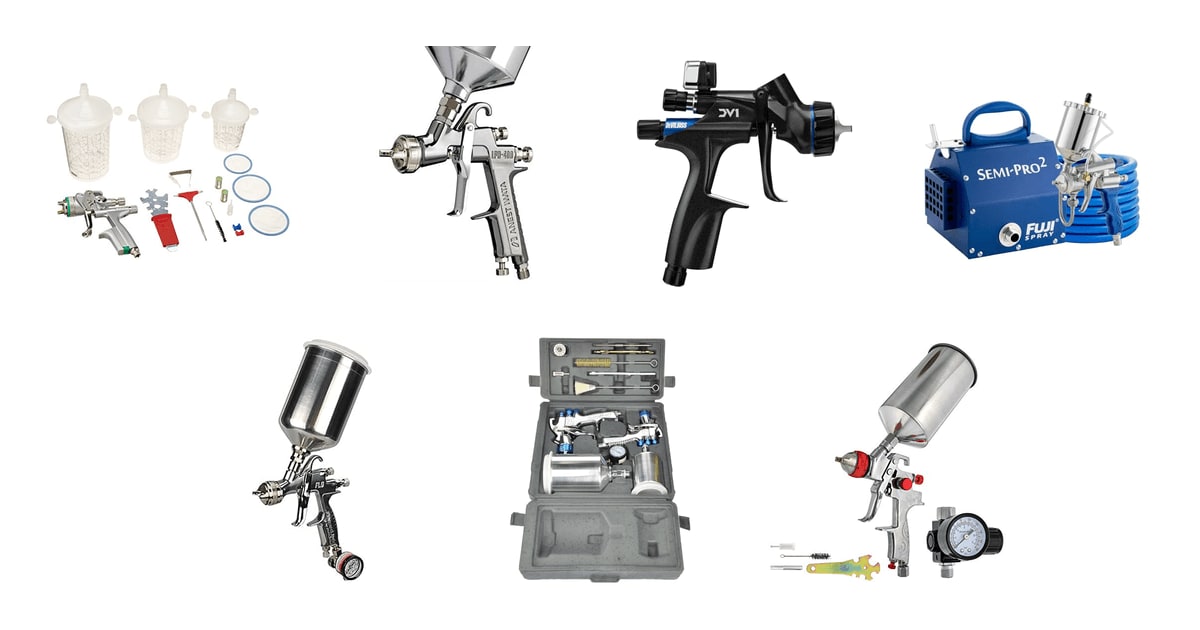
Spraying a car isn't like painting a wall. The gun you hold decides how much of that expensive basecoat lands on the panel instead of drifting into the air, and it decides whether your clear coat dries flat or dries with the dimpled texture everyone calls orange peel. HVLP guns push a lot of air at low pressure, which keeps overspray down and satisfies the transfer-efficiency rules that California and other strict states enforce. Get the fluid tip and the air supply right, and a mid-priced gun can look shockingly good.
Here's the catch nobody puts on the box: the gun is only half the job. Every gun here depends on air you have to supply, and most home compressors can't keep up with what a professional gun wants. A 9-to-11 CFM demand will flatten a small pancake compressor halfway across a hood, and the pressure drop shows up in the paint. Surface prep matters just as much. A great gun sprays your sanding scratches in perfect detail. No gun in this category fixes bad technique or a bad tank.
We also can't test paint guns the way you'd want us to, so this guide is built from manufacturer specifications, published reviews from automotive and tool publications, and what owners report after real respray projects. We weighed atomization quality, air demand, tip range, cleanup, and whether a gun makes sense for the person actually buying it. We think that the DeVilbiss FLG Gravity Kit is the best HVLP spray gun for automotive painting for most people, and that the Fuji Spray 2203G Semi-PRO 2 is the one to buy if you don't have a big shop compressor.
Everything we recommend

Three tips, one kit, and a finish that punches above its class

The answer if you don't have, and don't want, a big compressor

Forgiving enough to learn on, good enough to keep using
The shop standard, if you spray for a living
At a glance
| Product | Tip Size | Cup Capacity | Price | |
|---|---|---|---|---|
| SATA SAT210765 SATAjet 5000 B HVLP StandardUpgrade pick | 1.3mm | — | $1,077.04 |
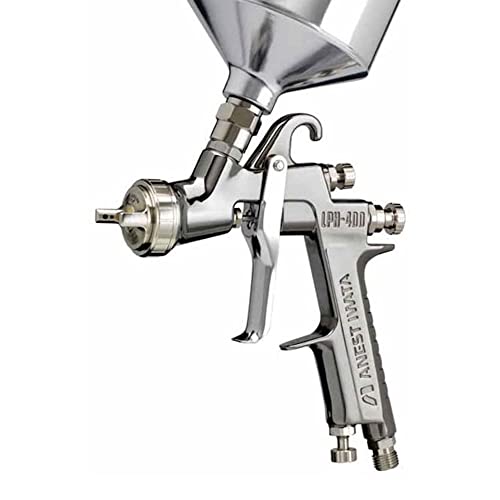 | ANEST IWATA LPH400 LPH-400-144LV 1.4 mm LPH400LVAlso consider | 1.4mm | — | $629.97 |
 | DeVilbiss - Dv1-B Basecost Digital Uncupped HvlpAlso consider | 1.2/1.3/1.4mm | Uncupped | $834 |
| Fuji Spray 2203G Semi-PRO 2 - GravityAlso great | 1.3mm | 400cc | $564.04 |
| DeVilbiss FLG Gravity KitTop pick | 1.3/1.4/1.8mm | 560ml | $258.85 |
| DeVilbiss 802342 StartingLine HVLP Gravity Spray GunBudget pick | 1.0/1.3mm | 250cc | $167.99 |
 | TCP Global Professional HVLP Spray Gun 1.4mmAlso in lineup | 1.4mm | 1-liter | $69.99 |
How we picked
Atomization quality. We read published panel comparisons and manufacturer nozzle specifications to see which guns lay down fine, uniform droplets on clear coat. Guns that reviewers flagged for visible texture at correct viscosity dropped down the list.
Air you can actually supply. We compared each gun's stated CFM and inlet pressure against what typical home and shop compressors sustain. A gun that stalls a 20-gallon tank mid-panel isn't a match for most garages, no matter how well it sprays.
Tip range and versatility. Automotive work spans thin clear coat and thick high-build primer, so we favored guns and kits that cover 1.3 to 1.8 mm without a separate purchase. Single-tip guns had to justify themselves on finish quality alone.
Cleanup and durability. We looked at surface treatments, needle and nozzle materials, and owner reports about wear after repeated solvent cleaning. Stainless components and corrosion-resistant finishes held up better than chrome-plated brass in long-term feedback.
Compliance and waterborne fit. We checked which guns meet the 65% transfer-efficiency threshold CARB and the EPA enforce, and which are rated for waterborne basecoats. Both matter if you're spraying a modern car or painting in a strict-attainment state.
Top pick
Three tips, one kit, and a finish that punches above its class
DeVilbiss FLG Gravity Kit
The DeVilbiss FLG Gravity Kit ships with 1.3, 1.4, and 1.8 mm needle and nozzle sets, so one gun handles primer, basecoat, and clear coat. It's the rare kit that covers a whole respray without a second purchase, and the trigger is light enough to spray all afternoon.
$258.85fromAmazonMost respray projects need three different tip sizes, and this is the only kit here that includes them. You need something around 1.3 or 1.4 mm for basecoat and clear at normal viscosity, and something closer to 1.8 mm for high-build primer. Buy a single-tip gun and you'll be shopping for nozzle sets before you finish bodywork. The FLG comes with all three plus the FLG693 air cap, a 560 ml aluminum cup, and a regulator.
The trigger is the reason you'll still be spraying comfortably at hour three. DeVilbiss built the FLG around a smooth action with an exceptionally light pull, and owners who've come from stiffer budget guns notice it immediately. On a full car you're squeezing that trigger for a long time across doors, a roof, and a hood. Hand fatigue creeps into your passes before you notice it, and inconsistent passes are what you end up wet-sanding out later.
You get real, independent control over pattern, fluid, and inlet pressure. Cheap guns let you turn knobs, but the adjustments interact in ways that make repeatable settings hard. The FLG separates pattern shape, fluid flow rate, and air inlet pressure so you can dial in a wet, even fan on a test panel and then reproduce it on the car. That repeatability is what keeps metallic basecoat from flopping light and dark between passes.
It gets close enough to professional finish quality that most people never need more. Published roundups place the FLG a step below the true shop guns on droplet fineness, but the gap is smaller than the price gap suggests. For restoration builders and serious hobbyists, the limiting factor is almost always technique and prep, not the gun. If you can lay a clean, consistent pass, this gun will show it.
It also supports gravity, suction, or pressure feed setups. Gravity is the modern default for automotive work and what you'll use most, but the flexibility matters if you inherit an older cup or want to run larger volumes for a single-stage job. It's a small thing that quietly extends how long the gun stays useful to you.
Flaws but not dealbreakers
The atomization ceiling is real, and you'll eventually see it. Against a SATA or an Anest Iwata at matched settings, the FLG lays down a slightly coarser droplet. On primer and basecoat you won't care. On a dark, high-gloss clear coat under shop lights, the difference shows up as a bit more texture and a bit more polishing afterward.
Chrome-plated brass wears faster than stainless. The needle and nozzle sets in professional guns hold their geometry longer under daily solvent exposure and daily cleaning. If you spray weekly, plan on replacing tips sooner than you would with a shop-grade gun. For a few projects a year, it's a non-issue.
It isn't set up for waterborne paint out of the box. If you're matching a modern factory finish with a waterborne basecoat, check compatibility before you buy. Solvent-configured guns can spit or throw an uneven fan with waterborne materials unless the needle and nozzle are right for it.
Also great
The answer if you don't have, and don't want, a big compressor
Fuji Spray 2203G Semi-PRO 2 - Gravity
The Fuji Spray 2203G Semi-PRO 2 is a complete turbine system, so it makes its own air and skips the compressor problem entirely. It arrives with a 1.3 mm air cap, a 400 cc gravity cup, and a 25-foot hose, and it sprays consistently no matter how cold your garage is.
$564.04fromAmazonThe compressor is what stops most home painters, and this removes it from the equation. A professional gravity gun wants 9 to 11 CFM sustained. A typical garage compressor delivers a fraction of that, stalls partway down a panel, and leaves you with a pressure-drop stripe you can see in the clear. The Semi-PRO 2's turbine supplies its own air at a steady rate from the first pass to the last, and you don't spend a dime on tank upgrades.
Turbine air is warm and dry, which is quietly a big deal. Compressed air out of a cold tank carries moisture, and moisture in a paint line means fisheyes and contamination you'll be sanding out. The turbine sidesteps that. Warm air also speeds flash-off between coats, which helps a lot with waterborne basecoats and in cold-weather garages where a compressor setup gets fussy.
It's genuinely ready to spray out of the box. You get a professional non-bleed gun with adjustable fan control, the 1.3 mm air cap already installed, the 400 cc gravity cup, a 25-foot hose with an inline air control valve, a wrench, and a cleaning brush. The metal turbine case has a gun holder built in. Published workshop reviews credit the system with noticeably less overspray than comparable compressor-driven mid-range guns, which saves material on two-stage clears.
Consistency beats peak power for a one-car project. You aren't racing a shop clock. What you want is the same fan, the same wetness, and the same pressure on your last door as your first. The turbine holds that better than an undersized compressor cycling on and off, and owners doing full resprays in home garages report exactly that.
Flaws but not dealbreakers
Coverage is slower on big panels. Turbine output sits below what a high-CFM compressor pushes, so a hood or a full quarter takes more time per coat. For one or two cars a year that's fine. If you're spraying twenty panels a week, the clock adds up fast and you'd rather have the compressor.
High-build primer is a stretch without a tip change. The included 1.3 mm cap is aimed at basecoat and clear. Thick primer wants something larger, so you'll be buying an air cap set if your project starts at bare metal.
It's a system, not a gun, and it takes up space. At roughly 25 pounds with a hose and a case, this isn't something you tuck on a shelf next to your sockets. And if you already run a 60-gallon compressor, you're paying for air you already have.
Budget pick
Forgiving enough to learn on, good enough to keep using
DeVilbiss 802342 StartingLine HVLP Gravity Spray Gun
The DeVilbiss StartingLine is the gun automotive trade schools hand to first-year students, and that's the endorsement that matters. It includes a 1.3 mm setup for basecoat and clear, a 1.0 mm setup for spot repairs, a regulator with a gauge, and a carrying case.
$167.99fromAmazonIts fan pattern is deliberately forgiving, which is exactly what a beginner needs. The StartingLine sprays a wider, more tolerant pattern than premium guns at similar settings. That means a pass that's a little too fast or a little too slow doesn't announce itself in the finish. You're still building muscle memory for gun distance and overlap, and this gun gives you room to get it wrong.
Two tips cover two different jobs. The 1.3 mm fluid tip atomizes basecoats, clear coats, and other light-viscosity materials properly. The 1.0 mm setup with the 250 cc cup handles spot repairs and touch-ups with a smaller overspray footprint, so you're not fogging half a fender to fix a chip. For a first gun, that's most of what you'll actually be doing.
It meets the transfer-efficiency rules that matter. Published buying guides single out the StartingLine's CARB compliance as its real differentiator at this level. If you're spraying in California or another strict-attainment state, that's the difference between a tool you can keep using and one you shouldn't be using at all. It's not a shortcut gun.
The kit doesn't leave you hunting for parts on day one. A gun-cleaning brush set, a maintenance wrench, an air regulator with a gauge, and a blow-molded case are all in the box. The regulator matters more than it sounds — setting pressure at the gun inlet, not at the compressor, is how you get a repeatable fan.
Flaws but not dealbreakers
You'll outgrow it, and you'll know when. After two or three respray projects, you'll start seeing defects that your technique can't fix. That's the gun's ceiling, not yours. At that point the FLG or the Fuji is a visible step up in atomization quality.
Parts support isn't as deep as the professional DeVilbiss lines. Replacement needles, nozzles, and caps are available, but the selection is thinner than what shops get for pro models. Owners occasionally report a wait to source specific pieces.
It costs meaningfully more than the barest entry point. If all you want is something to practice gun movement on scrap steel, this is more gun than that requires.
Upgrade pick
The shop standard, if you spray for a living
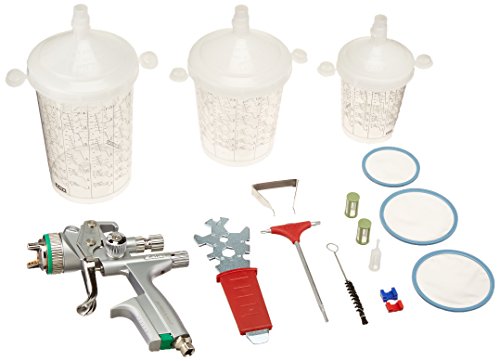
SATA SAT210765 SATAjet 5000 B HVLP Standard
The SATA SATAjet 5000 B is the gun OEM-certified collision shops build their process around, and published panel evaluations put its clear-coat finish at the top of the category. It's light in the hand, cleans in minutes, and demands a serious compressor behind it.
$1,077.04fromAmazonIts finish quality is the benchmark everything else here gets measured against. Independent panel evaluations from automotive publications found no orange-peel defects at recommended viscosity, a result no less expensive gun in the same comparison matched. If your work goes back to a customer or onto a show car, that's the difference between delivering a panel and re-cutting it.
The nozzle design covers an unusually wide range of inlet pressures and spray distances. You can go from a tight quarter-panel spot repair to a full-side pass without rebuilding the gun's setup. The half-turn fan control lets you reset pattern width the same way every time, which is what makes settings repeatable across a whole car rather than approximately right on each panel.
Cleanup is fast, and that adds up. The pearl chrome surface resists chemical attack from solvents and lacquer thinner, and dried paint releases with minimal scrubbing. In a shop where the gun gets stripped and cleaned between every color, minutes saved per cleaning turn into real hours per week. The included RPS disposable cups also keep colors and coating types from cross-contaminating.
It stays comfortable through a long day. At about 590 grams without a cup, it's light enough that overhead and lateral passes don't wear your forearm down over a full-car job. Fatigue is a finish-quality problem disguised as a comfort problem.
It handles waterborne with the right air cap. Since waterborne basecoats have become the factory standard, that flexibility keeps the gun relevant to modern refinish work rather than locked to solvent systems.
Flaws but not dealbreakers
The air demand rules out most home setups. SATA specifies 9 to 11 CFM depending on nozzle set at about 29 PSI inlet. A small pancake or a 20-gallon unit can't sustain that. It'll stall mid-panel and produce exactly the pressure-drop defects this gun exists to prevent, so you'd be paying a premium for a worse finish.
It's hard to justify below professional volume. This gun earns back its cost through fewer rework passes and less wasted material at real throughput. If you spray a car or two a year, that math never closes, and the money does more good spent on paint and prep.
Ownership costs continue after the purchase. Genuine nozzle sets, cups, and service parts are priced like the gun. That's normal for shop equipment and irritating for everyone else.
Who this is for
This guide is for anyone spraying automotive coatings with a handheld HVLP gun — a weekend restorer shooting a single-stage color on a project car, a serious hobbyist doing a full two-stage respray, or a shop technician replacing a daily driver of a gun. If you're painting one panel after a fender bender, the budget pick is plenty. If you're painting cars for other people's money, buy the upgrade pick and stop reading. The thing to sort out before you spend anything is your air supply, because a great gun on an undersized compressor sprays worse than a mediocre gun on adequate air.
This isn't the guide for you if you're spraying furniture, cabinets, or fences — those jobs want different tips, different materials, and often a much cheaper tool. It also doesn't cover airless sprayers, aerosol touch-up systems, or LVLP guns, which trade some atomization quality for lower air demand. And it doesn't cover compressors, booths, respirators, or paint. All four matter as much as the gun, and none of them are what we compared here.
How we picked
We built this from specifications, published reviews, and owner feedback rather than a spray booth of our own, and we weighted five things. Atomization: how fine and uniform the droplet is on clear coat, since that's what decides how much wet-sanding follows. Air demand: whether the gun's stated CFM matches what a real compressor in a real garage can sustain, because pressure drop mid-panel ruins a coat. Tip range: whether one gun or kit covers thin basecoat through high-build primer without a second purchase. Cleanup and wear: corrosion-resistant surfaces and needle and nozzle materials that survive repeated solvent cleaning. Compliance: the 65% transfer-efficiency minimum that CARB and the EPA enforce, plus whether the gun is rated for the waterborne basecoats that modern factories use.
Other hvlp spray guns for automotive painting worth considering
If you spray a lot of waterborne metallic: The ANEST IWATA LPH400 LPH-400-144LV 1.4 mm LPH400LV ($629.97) — The Anest Iwata LPH400-144LV is the gun OEM refinishers reach for when uniform droplet size is the whole ballgame. Its tulip-inspired air cap breaks paint finer than conventional caps, and that consistency is what keeps metallic flake from settling unevenly and going blotchy between passes. The LV technology holds transfer efficiency high while wasting less clear. The 1.4 mm tip is the right universal size for automotive clear at normal viscosity. Two things give you pause: it ships without a cup, so factor that in before your first job, and it wants a high-CFM compressor that most home garages don't have. If your air supply is marginal, the Fuji turbine is the smarter buy.
If you want repeatable settings across a full car: The DeVilbiss - Dv1-B Basecost Digital Uncupped Hvlp ($834) — The DeVilbiss DV1-B Basecoat Digital gets close to SATA on finish quality with a dual-regulation air control system that lets you set and repeat precise adjustments panel to panel. That repeatability is aimed squarely at tiger striping and uneven metallic flop on large flat surfaces, where guessing at settings shows up in the paint. It comes in 1.2, 1.3, and 1.4 mm configurations, so one gun body covers basecoat, clear, and single-stage work. The handle is balanced for long overhead and lateral passes. The trade-offs: it's sold uncupped, and the accessory ecosystem is thinner than SATA's RPS platform, which matters more to shops running several guns than to a single painter.
The competition
This is what our research turned up, not a census of every HVLP gun sold. The category is deep, and plenty of capable guns from other brands never surfaced in the reviews and owner discussions we looked at. What follows is the remaining product from this lineup and where it lands.
The TCP Global Professional HVLP Spray Gun 1.4mm ($69.99) — The TCP Global G6600-13 is the lowest barrier to entry here, and it's honest about what it is once you get past the listing copy. The 1.4 mm tip is the correct universal size, the full baffle head lays a reasonably even pattern for primer and sealer, and the included compressor regulator means you connect to a standard home compressor and start spraying with no extra fittings. The 1-liter aluminum cup cuts refills on big jobs. Where it loses to the picks is atomization: owners consistently report that clear coat comes out with more texture than a StartingLine or an FLG produces on the same material, which turns into more wet-sanding and polishing. Chrome-plated components also show wear faster than stainless needle and nozzle sets, so maintenance comes around sooner. It's still worth owning for two specific jobs — practicing gun movement and overlap on scrap steel before you commit expensive paint, and living as a dedicated primer gun so your good gun never touches high-build. Don't put it on a show car or a customer's vehicle.
Setup and cleaning notes
Match the tip to the material every single time, because getting this wrong is the most expensive rookie mistake in the hobby. Run 1.3 to 1.4 mm for basecoat and clear at roughly 18 to 22 seconds on a DIN #4 cup, and 1.6 to 1.8 mm for high-build primer. A 1.8 mm tip on clear coat is the leading cause of runs and orange peel — the material comes out faster than the air can atomize it. Set 25 to 30 PSI at the gun inlet for basecoat, then adjust fan and fluid on a scrap panel until you see a wet, even fan with no dry dust in the center. Clean the gun immediately after you finish. Empty the cup, spray gun wash through until it runs clear, then pull the tip, needle, and air cap and soak them for about ten minutes. Brush every fluid passage, reassemble dry, and store it without the cup.
Questions we get
What size compressor do I need for an HVLP automotive spray gun?
Professional guns want a sustained 10 to 12 CFM at 40 PSI, and a 60-gallon tank is the practical minimum to avoid pressure drop mid-panel. The SATA SATAjet 5000 B, for example, is specified at 9 to 11 CFM at about 29 PSI inlet. A small pancake compressor delivering 2 to 4 CFM simply can't hold that, and you'll see the shortfall as inconsistent fan patterns and uneven coverage. The exception is a turbine system like the Fuji Semi-PRO 2, which makes its own air and needs no compressor at all.
What fluid tip size should I use for clear coat?
Use 1.3 mm or 1.4 mm. Automotive finishing guides point to 1.4 mm as the universal starting point for both basecoat and clear at roughly 18 to 22 seconds on a DIN #4 cup. Going up to 1.6 or 1.8 mm for clear is the single most common cause of runs and orange peel among first-time painters, because the gun delivers material faster than it can properly atomize it.
Why is my clear coat coming out with orange peel?
It's almost always one of four things: the fluid tip is too large, you're holding the gun too far from the panel, your air pressure is set too high, or the clear is thinned outside the manufacturer's range. Optimal spray distance is typically 6 to 8 inches. Change one variable at a time on a scrap panel rather than guessing on the car. If the texture persists with everything set correctly, the gun's atomization is the limit, and stepping up to the FLG or better will show a real difference.
Can I use an HVLP gun with waterborne automotive paint?
Sometimes, but not universally. Waterborne basecoats need finer, more uniform droplets to keep metallic flake from going blotchy, and some solvent-configured guns spit or throw an uneven fan without a different needle and nozzle. The Anest Iwata LPH400-144LV is built for this work, and the SATA is waterborne-compatible with the right air cap. Turbine systems have a natural edge here too, since warm dry air speeds flash-off between coats.
What's the difference between HVLP and LVLP?
HVLP guns keep pressure under 10 PSI at the air cap and use high air volume to atomize the paint, which is why they're the standard for automotive refinishing and why they clear EPA and CARB transfer-efficiency rules. LVLP guns use less air volume at even lower pressure, so they work with smaller compressors, but atomization is generally a step behind at matched settings. Most professional and OEM-certified shops run HVLP or reduced-pressure configurations.
Do I need separate guns for primer and clear coat?
Not strictly, but shops do it for a reason. Primer wants a 1.6 to 1.8 mm tip while clear wants 1.3 to 1.4 mm, and swapping tips means disassembly and a thorough cleaning between materials. A multi-tip kit like the FLG is a fair compromise — you swap the needle and nozzle instead of buying a second gun. If you spray often, a cheap dedicated primer gun eliminates cross-contamination risk entirely and saves you from re-dialing settings.
Why you should trust us
For this guide:
- We compared manufacturer specifications for every gun here, focusing on nozzle sets, stated CFM and inlet pressure, included tips, and cup arrangements.
- We read published reviews and buying guides from automotive and tool publications, including panel comparisons of clear-coat finish quality and overspray behavior.
- We reviewed owner feedback for recurring themes around cleaning, component wear, and whether each gun matched the compressor buyers already owned.
- We read owner reviews on every listing, weighted toward the critical ones, because that is where the recurring failures show up.
- We have a systematic way of automatically fetching the latest prices, so the numbers on this page stay current.
- This is a research-focused guide, so the team may not own every product listed — though we often do own the top winners, which gives us extra context for the recommendations.
- We don't accept free products, and the retailer commission never changes which product we recommend.
Sources
Best Automotive HVLP Spray Guns — Ranked the DeVilbiss StartingLine as best budget pick, citing CARB transfer efficiency compliance at a sub-$120 price point, Popular Mechanics
California Air Resources Board — Automotive Coating Regulations and Transfer Efficiency Requirements for Spray Equipment in Non-Attainment Air Quality Zones, California Air Resources Board
EPA National Emission Standards for Hazardous Air Pollutants — Surface Coating of Automobiles and Light-Duty Trucks; HVLP Transfer Efficiency Compliance Requirements, U.S. Environmental Protection Agency
Amazon product listings and owner reviews for all 7 products
Manufacturer specification pages for each product
Some passages in this guide may be paraphrased with AI help. Prices are refreshed automatically.
More like this.
Continue exploring lifestyle reviews and recommendations.

The Best Paint Sprayers
A paint sprayer changes what a weekend can hold. A room that takes an hour with a roller takes minutes with a sprayer, and a fence that used to eat a…

The Best Hose-End Sprayers for Lawn Fertilizer
Liquid fertilizer is the fastest way to green up a lawn, and a hose-end sprayer is what makes it practical. You screw it onto the hose, pour concentrate…

The Best Automotive Multimeters
A multimeter turns a vague car problem into a number you can act on. Your battery either rests at 12.6 volts or it doesn't. Your charging system either…

The Best Wire Strippers and Crimpers for Automotive Work
Car wiring punishes sloppy work. Strip a wire with the wrong tool and you nick a few strands you'll never see again under heat shrink. Crimp a terminal…

The Best Nalgene Bottles
A water bottle isn't complicated. You fill it, you carry it, you drink from it, and a couple of times a week you wash it. What separates a good one from…

The Best Ventilated Beekeeping Suits
A hive inspection takes twenty minutes if you're quick, an hour if you're not. You spend that time bent over boxes, in direct sun, wearing a full-body…