The Best Wire Strippers and Crimpers for Automotive Work
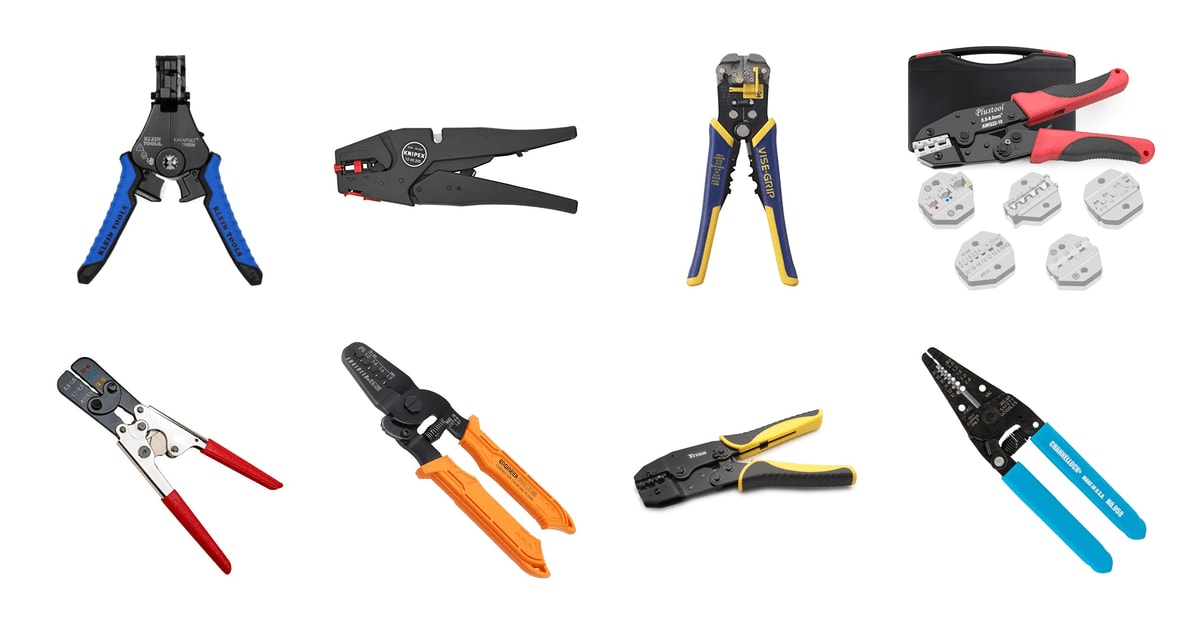
Car wiring punishes sloppy work. Strip a wire with the wrong tool and you nick a few strands you'll never see again under heat shrink. Crimp a terminal with a squeeze plier and you might get a connection that holds on the bench, then backs out on a washboard road two months later. Most automotive circuits sit between 10 and 22 AWG, so you don't need exotic gear. You need a stripper that leaves the copper alone and a crimper that won't let you stop halfway.
Here's the catch nobody puts on the packaging: no single tool covers a modern car. Strippers don't crimp well, crimpers don't strip, and combo tools give up precision at both ends of their range. Then there's the newer problem. Sensors, cameras, CAN bus lines and infotainment harnesses run through tiny JST and Molex housings, and a standard automotive crimper physically can't reach those contacts without wrecking the retaining lances. You'll end up owning at least two tools, and possibly three.
The good news is that the two-tool solution is cheap and it works. A dedicated stripper handles insulation cleanly, a ratcheting crimper handles terminals with a mechanical guarantee, and together they cover nearly everything you'll do to a car's electrical system. We think that the Klein Tools 11063W is the best automotive wire stripper for most people, and that the TITAN 11477 ratcheting crimper is the one to buy if you're terminating wire rather than just stripping it.
Everything we recommend

Clean strips in one squeeze, across almost every gauge you'll touch

A mechanical guarantee that your crimp actually finished

Small, simple and American-made, if you strip wire only now and then

One tool that strips and crimps, if you'd rather not carry two
The only realistic way to crimp sensor and ECU micro connectors
At a glance
| Product | AWG Range | Function | Price | |
|---|---|---|---|---|
| Klein Tools 11063W Wire Cutter/StripperTop pick | 8-20 AWG solid | Cutter/Stripper | $30.97 |
 | Knipex 12 40 200 SB Self-Adjusting InsulationAlso in lineup | 0,03-10mm | — | $149.61 |
| IRWIN Vise-Grip Wire StripperAlso great | 10 to 24 AWG | — | $22.99 |
 | Plustool 6PCS Crimping Tool Set - RatchetingAlso consider | — | — | $28.49On sale |
 | Master Appliance Professional Crimping Tool for HeatAlso consider | 10-22 AWG | Ratcheting Crimper | $33.99 |
| ENGINEER PA-09 Micro Connector Crimping PliersUpgrade pick | AWG #32 to #20 | Crimping Pliers | $39 |
| TITAN 11477 Ratcheting Wire Terminal Crimper ToolRunner-up | 10-22 AWG | — | $19.99 |
| Channellock 958 6-1/4-Inch Wire Stripper and CutterBudget pick | — | — | $21.28 |
How we picked
Gauge coverage. We compared published gauge ranges against what a car actually uses, from 10 AWG power feeds down to 22 AWG accessory circuits. A tool that skips part of that band forces a second purchase, so we treated full coverage as the baseline.
Ratcheting crimps. For crimpers we treated a full-cycle ratcheting mechanism as close to mandatory, since it's the only feature that mechanically prevents a half-crimp. Squeeze-only crimpers had to earn their place some other way.
Conductor damage. We read owner feedback specifically for reports of nicked or shaved strands, since that's the failure that hides under heat shrink and shows up later as resistance. Precision machined or self-adjusting mechanisms scored better here than cast bargain jaws.
Working in tight spots. Engine bay and under-dash work happens at bad angles with one hand, so we weighed tool length, spring return and quick-release features. Spec sheets gave us dimensions; owner feedback told us which tools people actually reach for in a cramped space.
Connector compatibility. We checked which terminal formats each tool is rated for — insulated, non-insulated, open barrel, heat shrink, ferrule and micro. Manufacturer documentation was the source, and mismatches between claims and owner reports counted against a tool.
Top pick
Clean strips in one squeeze, across almost every gauge you'll touch
Klein Tools 11063W Wire Cutter/Stripper
The Klein 11063W strips 8–20 AWG solid and 10–22 AWG stranded with precision machined holes and a compound-action squeeze. It covers ignition, lighting, speaker and accessory wiring, which is nearly everything in a car short of battery cable.
$30.97fromAmazonIf you buy one stripper for car work, this is it. The gauge range does the heavy lifting. 8–20 AWG solid and 10–22 AWG stranded covers ignition circuits, headlight runs, amplifier feeds, speaker wire and accessory taps. You're not going to reach for a second tool halfway through a stereo install. The only common automotive wire it won't handle is heavy battery cable, and that needs a different class of tool anyway.
The compound action matters more than it sounds. You squeeze once, the jaws grip and pull the insulation off in the same motion, and the tool springs back open on its own. No rotating the wire, no second pass, no picking at a half-torn jacket. Once you find a rhythm, you can strip and feed a whole run of speaker wire in a couple of minutes. Owners who wire for a living describe exactly that: it's fast in a way that shows up over dozens of strips.
Precision machined holes are the reason to spend here instead of on a bargain cast tool. Match the hole to the gauge and the blade edges clear the conductor entirely. Owners doing fine work — 18 AWG extensions, silicone-jacketed wire, even mid-run splices where they only need the jacket opened — consistently report clean, square breaks with no frayed strands. That's the difference between a repair that lasts and a hidden hot spot.
It's also built like a tool you'll keep. The cast alloy chassis and E-coat finish hold up to a damp garage, and the tension-loaded wire grip holds the cable without crushing its geometry. Owner feedback skews heavily positive across a very large pool of buyers, with durability the recurring theme rather than any single clever feature. That's the profile you want in something living in a drawer for a decade.
Flaws but not dealbreakers
There's no crimping die. None. If you're terminating a ring lug or a butt connector, you need a second tool, so budget for the pair rather than the one. That's the main reason someone might reach for a combo tool instead.
It's also a bit chunky. In a deeply recessed firewall connector or up behind a dash, the body can get in your way, and a shorter stripper is easier to angle in. And it's fully manual — pick the wrong hole and you'll nick the wire, because nothing in the tool stops you.
Runner-up
A mechanical guarantee that your crimp actually finished
TITAN 11477 Ratcheting Wire Terminal Crimper Tool
The TITAN 11477 is a ratcheting crimper for insulated terminals with a double-crimp die and a quick-release lever. The handles won't let go until full crimp force is reached, which removes the single most common cause of intermittent automotive electrical faults.
$19.99fromAmazonThe ratchet is the whole point, and it's worth more than any brand name. A squeeze crimper lets you stop whenever your hand gets tired. That produces a terminal held on by friction, which passes a casual tug and then heats up under load a year later. The TITAN locks the handles through the cycle and releases only when the force is there. You aren't judging by feel anymore.
The double-crimp die puts two impressions on the barrel instead of one, and owners notice the difference in pull-out resistance. If you've had small wires slide back out of a red butt connector, that's the failure this addresses. One useful habit owners describe: strip a little longer than the barrel calls for so the conductor fills both crimp points.
It's genuinely easier to use one-handed than it looks. The ratchet holds the terminal in the die before you insert the wire, which is a real advantage when you're upside down under a dash with one hand feeding wire. The quick-release lever opens the jaws at any point in the cycle, so a jammed tool in a cramped engine bay is a two-second problem instead of a wrestling match.
Owner feedback runs long here, including buyers reporting years of use without the mechanism drifting. The one recurring caveat is worth repeating: connector quality matters. Cheap steel-barrel terminals crimp inconsistently in any tool, and copper-barrel connectors give noticeably better results in this one.
Flaws but not dealbreakers
It's a fixed jaw. One die profile, insulated terminals only, and you can't swap in anything else. Use it on bare non-insulated lugs and the geometry over-crimps and deforms the barrel. It's also not recommended for heat shrink connectors, since the die can bite into the tubing.
You'll also have to lean on it. On the larger yellow-range terminals, completing the cycle takes real hand force, and owners with weaker grip strength mention this. It's manageable, just not effortless.
Budget pick
Small, simple and American-made, if you strip wire only now and then
Channellock 958 6-1/4-Inch Wire Stripper and Cutter
The Channellock 958 is a compact manual stripper and cutter covering the core automotive gauges. It has no self-adjusting mechanism and no crimping die, but it's well-made, it fits in a pocket, and it goes places bigger tools can't.
$21.28fromAmazonAt six and a quarter inches, this is the one you can actually get into a tight spot. Behind a kick panel, up under a dash, along a door harness — the Klein is a better tool on a bench, but the Channellock is the one that fits. Owners who keep a pair in a pants pocket rather than a toolbox are describing the real use case.
The stripping holes are cut properly, and that's most of the job. Gauge spacing covers 10–20 AWG solid and 12–22 AWG stranded, which handles ignition, lighting and accessory circuits. The cutter section severs 12 AWG cleanly without mashing the conductor. Owners who've had the same pair for a decade or more report it still strips as cleanly as it did new, which says something about the steel.
Channellock has made tools in Meadville, Pennsylvania for well over a century, and owner feedback repeatedly contrasts these with cast bargain strippers that arrive slightly out of true. If buying domestically made hand tools matters to you, this is the only one here that qualifies without qualification.
Flaws but not dealbreakers
It's fully manual, so hole selection is on you every time. Grab one size too small on stranded wire and you'll shave strands off. For someone who strips wire a few times a year, that learning curve is a real cost — a self-adjusting tool removes the decision entirely.
The handles are the common complaint. They're short, thin, and the rubber molding doesn't give you much cushion, so a long session leaves your hand sore. And there's no crimping function at all.
Also great
One tool that strips and crimps, if you'd rather not carry two
IRWIN Vise-Grip Wire Stripper
The IRWIN Vise-Grip 2078300 self-adjusts across 10–24 AWG, crimps insulated and non-insulated terminals, and includes a 7–9mm ignition terminal slot. The adjustable strip-length stopper is the feature that makes it genuinely useful for connector work.
$22.99fromAmazonThe self-adjusting jaw is what sells this. You don't pick a hole. Clamp the wire, squeeze, and the mechanism finds the cross-section itself, which matters when a single job has you jumping between 14 AWG speaker wire and 22 AWG signal lines. Owners who resisted this style of stripper for years — assuming it was a gimmick — tend to become converts after one project.
The strip-length stopper is the underrated part. In connector work, terminal seating depth depends on strip length, and eyeballing it wire after wire produces a harness where half the contacts sit a millimeter short. Set the stopper once and every strip matches. If you're batching a dozen wires into the same connector housing, it saves you real time and real rework.
The crimping side covers 10–22 AWG insulated and non-insulated terminals plus 7–9mm ignition terminals, which is a thoughtfully automotive-specific inclusion. It's adequate for standard butt connectors, ring lugs and spades. Combined with a swivel knob that micro-adjusts for gauges under 20 AWG, you get one tool that handles most of a weekend accessory install without a trip back to the bench.
IRWIN warrants each of its hand tools against defects in material and workmanship for the life of the tool, which takes some of the sting out of a mechanism with moving parts. Owners doing marine and automotive electrical work report years of service, and the ProTouch grip is comfortable enough that fatigue doesn't set in on longer sessions.
Flaws but not dealbreakers
The crimp is squeeze-type, not ratcheting. There's no mechanical lockout telling you the terminal is fully compressed — you're back to judging by feel. For an ignition circuit, a trailer connector or anything safety-critical, that's a meaningful step down from the TITAN.
The self-adjusting mechanism also gets less precise at the edges of its range. Very fine 24 AWG wire occasionally picks up a nick, and 10 AWG solid takes firm pressure to clamp properly. In the 14–20 AWG middle it's consistently clean.
IRWIN warrants the 2078300 against defects in material and workmanship for the life of the tool.
Upgrade pick
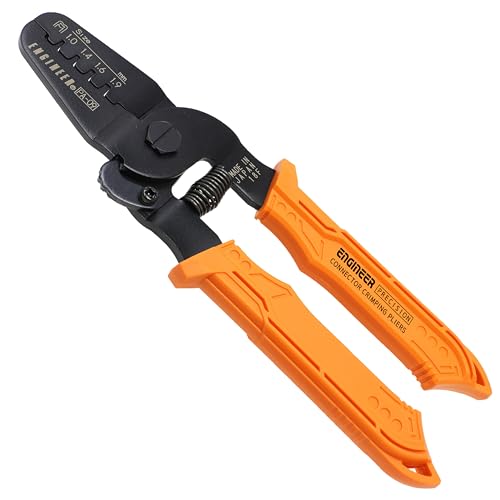
The only realistic way to crimp sensor and ECU micro connectors
ENGINEER PA-09 Micro Connector Crimping Pliers
The ENGINEER PA-09 crimps open-barrel micro contacts from AWG 32 to 20 across JST, Molex, TE, Hirose and D-sub housings. It's narrow and specialized, and it does a job no standard automotive crimper can physically do.
$39fromAmazonThis solves a problem the rest of the list can't touch. Modern cars run sensors, cameras, CAN bus and infotainment through 1.25mm to 2.5mm pitch micro connectors. The contacts inside are tiny folded-metal open barrels, and a standard crimper's jaws simply won't fit without crushing the retaining lances. If you're repairing a sensor pigtail or modifying an ECU harness, this is the tool.
Four die widths — 1.0mm, 1.4mm, 1.6mm and 1.9mm — cover the contact sizes in over a hundred terminal types. That range is what makes it practical rather than a single-connector novelty. Owners crimping JST-XH and ZH1.5 contacts, some of the fussiest housings out there, report a hit rate they couldn't get near with anything else they'd tried.
It's a two-stage crimp: conductor first, then the insulation strain relief. That sounds like extra work, and it is, but it's also what OEM-specification contacts need to survive vibration and heat cycling in a car. Owners who initially wanted a one-squeeze ratcheting alternative generally come back around once they see how the finished contacts hold up.
The build reflects the price. S55C high carbon steel, a joint screw designed not to loosen, a locking latch and a coiled spring, in a 175mm body light enough to work with for an hour. Owner feedback on precision electronics work is strong enough that many buyers end up with a second pair in a different size.
Flaws but not dealbreakers
The learning curve is steep. Getting a 1.0mm contact seated in the right die at the right orientation takes practice, and your first several attempts will likely go in the bin. Owners are candid about this — even experienced users describe a period of ruined contacts before it clicks.
It's also strictly a micro tool. You can't crimp a standard insulated ring terminal with it, so it supplements your crimper rather than replacing it. If your work never touches sensor pigtails or signal-level audio wiring, it'll sit unused.
One more thing worth knowing: the listing states Made in Japan, but some owners report receiving units marked as made in Taiwan. If country of origin is the reason you're buying, check what actually arrives.
Who this is for
This guide is for anyone terminating wire in a vehicle: a weekend stereo install, a light bar, a trailer harness, a sensor repair, or daily harness work in a shop. If that's you, the honest answer is that you want two tools — a dedicated stripper and a ratcheting crimper — rather than one that does both adequately. Buy the combo tool only if carrying a single tool genuinely matters to you, and accept that its crimp is the weaker half.
We don't cover battery, starter or alternator cable here. Anything 4 AWG and up needs a heavy cable lug crimper or a hydraulic tool, which is a different product class entirely, and none of these will form a proper lug on it. We also stayed away from soldering irons and heat guns — related gear, different guide. What's in scope is the 10–22 AWG terminal work that makes up the bulk of automotive electrical repair, plus the micro connectors modern vehicles keep adding.
How we picked
Gauge coverage: we checked published ranges against the 10–22 AWG band real car wiring lives in, plus the finer sensor gauges newer vehicles add. Ratcheting crimps: for anything that terminates a wire, we treated a full-cycle mechanism as close to required, because it's the only thing that stops you from quitting a crimp early. Conductor damage: we read owner feedback hunting for reports of nicked strands, the failure that hides under heat shrink and comes back as heat. Working in tight spots: we compared dimensions and looked for spring returns and quick-release levers, since real automotive work happens at bad angles. Connector compatibility: we matched each tool's rated terminal formats against what you'll actually meet in a car, from insulated butt connectors to open-barrel OEM contacts.
Other wire strippers and crimpers for automotive work worth considering
If you crimp several terminal types in one session: The Plustool 6PCS Crimping Tool Set - Ratcheting ($28.49) — The Plustool 6PCS set gives you one ratcheting body and six interchangeable dies — heat shrink, insulated nylon, non-insulated, ferrule, open barrel and solar connectors. For a car audio install where you're doing insulated butt connectors on speaker runs, ring terminals on chassis grounds and the occasional open-barrel OEM contact, that's the whole job in one case. The 40CR forged jaws hold their alignment under load, the dies are AWG-marked, and an adjustable star wheel lets you dial in crimp height. What you give up is brand history and speed: it's a newer name, and swapping dies takes a tool rather than a lever, which slows you down mid-session. Owners also note it takes more hand force to reach the release point than expected, and a few report the contents not matching the listing photos.
If heat shrink connectors are most of what you crimp: The Master Appliance Professional Crimping Tool for Heat ($33.99) — The Master Appliance 35084 is built around one idea: compress the barrel without cutting or puncturing the heat shrink tubing wrapped around it. Damage that tubing and you've lost the weatherproofing that made you choose the connector in the first place, which matters on trailer wiring, engine bay accessories and anything marine. Three crimp nests cover 22–18, 16–14 and 12–10 AWG, the narrow profile makes it easy to line up on a barrel, and the heat-treated steel holds its geometry. Owners report using theirs for years on ring terminals and butt connectors without the crimp quality drifting. The trade-off is focus — it's optimized for insulated and heat shrink terminals, so bare non-insulated barrels aren't its job. Worth noting: some buyers expecting US manufacturing were surprised by where the tool is made.
The competition
Here's what our research turned up rather than everything sold in this category. Hand tools like these have long product lifecycles and a lot of near-identical variants, so treat the list below as the alternatives worth knowing about, not an exhaustive market survey.
The Knipex 12 40 200 SB Self-Adjusting Insulation ($149.61) — The Knipex 12 40 200 SB is the professional's self-adjusting stripper, and its mechanism is genuinely the best here — a spring-loaded jaw centers on any cross-section from 0.03 to 10mm² and pulls insulation without touching the conductor, plus there's an integrated cutter for copper and aluminium. On fine 22–26 AWG sensor wire, where a mismatched manual hole shaves strands, that's a real advantage. It lost to the Klein on value: it costs several times as much, and neither the Klein nor the Channellock nicks conductors when you match the hole correctly. Its payoff is speed and zero attention across dozens of strips per session, which only shows up in professional-volume work. It's also longer and bulkier than the alternatives here, so under-dash access is worse. Owner feedback is thinner than for the rest of the lineup and a bit more mixed, though the complaints tend to be about the price rather than the mechanism. Buy it if you build harnesses for a living and strip wire all day.
Getting good crimps and clean strips
A few habits matter more than which tool you bought. Match the stripping hole to the wire gauge before you squeeze, and if you're unsure, start one size larger and work down — a loose strip is a redo, a nicked strand is a hidden fault. Strip only as much jacket as the terminal barrel needs, and check the exposed conductor for shiny scrape marks before crimping. After a crimp, look at the barrel: you want even compression, no cracked insulation sleeve, no strands escaping at the entry. Then pull on it. Grip the wire and terminal separately and lean into it — a good crimp on standard automotive gauge won't slip. Keep the jaws clean and put a drop of oil on the pivot occasionally, especially if the tool lives in a damp garage.
Questions we get
Do I really need a ratcheting crimper, or will a squeeze tool do?
You want the ratchet. A squeeze crimper lets you stop before the barrel is fully compressed, and that half-crimp holds the wire by friction alone — it passes a quick tug and fails months later. A ratcheting mechanism locks the handles through the full cycle and releases only when the force is there. In a car, a half-crimped terminal under load builds resistance, makes heat, and causes the intermittent faults that are miserable to trace.
What AWG range do I need for most car projects?
Plan for 10 AWG down to 22 AWG. That covers main power feeds and amplifier wiring at the heavy end and switches, turn signals and low-current accessories at the light end, with 14–18 AWG handling most standard accessory and lighting work. Newer vehicles add 24–28 AWG for sensor signals, CAN bus and ECU communication, which needs either a wide-range self-adjusting stripper or a dedicated micro tool. The Klein covers the standard band comfortably.
Can I use a regular electrician's wire stripper on car wiring?
Yes, as long as the gauge range matches. Copper doesn't care whether it's going to an outlet or an ignition coil, and most electrician's strippers cover 10–22 AWG or thereabouts. The gap is at the fine end: vehicles increasingly use 24–28 AWG sensor wire and micro connectors that household tools were never designed for. That's where a micro crimper like the PA-09 comes in.
How do I know a crimp will actually hold?
Look, then pull. A good crimp on an insulated terminal shows even barrel compression through the plastic sleeve, no cracking in the sleeve, and no damaged strands where the wire enters. Then grip the wire and terminal separately and apply firm force — it shouldn't slip at all. If you used a ratcheting crimper and the handles completed their cycle and released on their own, the geometry is mechanically confirmed.
Can one crimper handle both battery cable and small sensor wire?
No, and it's not close. Battery cable at 4 AWG and larger needs a dedicated heavy cable lug crimper or a hydraulic tool — a different class of equipment entirely. Run a battery lug crimper on an 18 AWG terminal and you'll flatten the connector. For starter, alternator and battery work, buy the right tool for that job separately.
What's the difference between a stripper and a crimper, and do I need both?
A stripper removes the insulation jacket to expose bare conductor. A crimper deforms a metal terminal barrel around that conductor to make the connection. Any terminated wire needs both operations, in that order. Combo tools like the IRWIN do both in one body and trade some precision for it, which is fine for occasional work — for regular use, separate tools give better results at each step.
Why you should trust us
For this guide:
- We read manufacturer specifications and product documentation for every tool here, focusing on stated gauge ranges, crimp mechanisms and rated terminal types.
- We compared those claims against published reviews and against themes in owner feedback, paying particular attention to reports of nicked conductors, incomplete crimps and jaw alignment problems.
- We did not use, install or measure any of these tools ourselves; every judgment here comes from documentation and other people's reported experience.
- We read owner reviews on every listing, weighted toward the critical ones, because that is where the recurring failures show up.
- We have a systematic way of automatically fetching the latest prices, so the numbers on this page stay current.
- This is a research-focused guide, so the team may not own every product listed — though we often do own the top winners, which gives us extra context for the recommendations.
- We don't accept free products, and the retailer commission never changes which product we recommend.
Sources
Best Wire Strippers of 2026 — ToolGuyd, ToolGuyd
Best Wire Crimpers for Automotive Work — The Drive, The Drive
Best Wire Strippers, Tested by Editors — This Old House, This Old House
Best Wire Strippers — Popular Mechanics, Popular Mechanics
Best Wire Crimpers, Tested — Bob Vila, Bob Vila
Amazon product listings and owner reviews for all 8 products
Manufacturer specification pages for each product
Some passages in this guide may be paraphrased with AI help. Prices are refreshed automatically.
More like this.
Continue exploring electronics reviews and recommendations.

The Best Automotive Multimeters
A multimeter turns a vague car problem into a number you can act on. Your battery either rests at 12.6 volts or it doesn't. Your charging system either…

The Best Phone Tripods and Ring Lights
Good video comes down to two boring things: your phone has to hold still, and your face has to be lit. That's it. Everything else - the camera in your…

The Best Wireless Charging Pads and Stands
Wireless charging isn't about speed. It's about the small friction you stop noticing: no fumbling for a cable in the dark, no worn-out port on a…

The Best Gifts for Vinyl Record Collectors
Records are a hobby with a long tail of small problems. Dust down in the grooves. Albums stacked on the floor because there's nowhere to put them. A…

The Best Car Organization Gadgets
Cars accumulate junk. Receipts slide under the seat, a phone drops into the console gap, and grocery bags tip over the second you take a left turn. The…

The Best Smart Home Security Cameras
A security camera earns its keep on ordinary days, not dramatic ones. You want to know the dog walker showed up, the package landed, the kid got home. So…