The Best Phone Tripods and Ring Lights
Good video comes down to two boring things: your phone has to hold still, and your face has to be lit. That's it. Everything else — the camera in your pocket, the app you edit in — is already good enough. A cheap tripod that sags mid-take or a light that turns your skin orange will wreck a shot faster than any lens ever could. And if you shoot alone, you need gear you can set up in under a minute, because nobody's holding the phone for you.
Here's the frustrating part: almost nothing does both jobs well in one box. The combo kits that bundle a ring light with a stand tend to skimp on the tripod, and the tripods built to survive a windy hillside don't come with any light at all. Cheap ring lights also share a flaw you can't fix in editing — a low color rendering index, which leaves skin looking waxy and washed out. Budget lights typically land around CRI 80. Better ones reach the mid-90s.
So think of this as two shopping lists that happen to overlap. We looked at flexible tripods, full-height stands, pocketable selfie sticks, desk mounts, ring lights and panel lights, and we'd steer most people toward one from each column. We think that the Joby GorillaPod 5K Kit is the best phone tripod for most people, and that the NEEWER Basics 8-inch RGB LED Ring Light is the one to buy if you mostly need light and a stand that gets it to face height.
Everything we recommend
Wraps around anything, holds far more than a phone

Enough light and enough stand, for very little money
Packs like a water bottle, sets up in seconds

Two adjustable panels beat one ring for close work
Prices as of Oct 22, 7:36 AM PT · Details
At a glance
| Product | Price | |
|---|---|---|
| JOBY GorillaPod 5K Stand. Premium Flexible TripodTop pick | Check price |
 | UBeesize 67" Auto Face Tracking Tripod withAlso in lineup | $44.42 |
| NEEWER Basics 8" RGB LED Ring LightBudget pick | $22.94 |
| Lume Cube Flex Light Pro - PortableAlso great | $319.99 |
| Peak Design Travel TripodUpgrade pick | $399.95 |
 | Magnetic Tripod for PhoneAlso consider | $24.99 |
 | Rotolight NEO On-Camera LED LightAlso in lineup | $299.90 |
Prices as of Oct 22, 7:36 AM PT · Details
How we picked
Light quality. We compared manufacturer specs for color rendering index and color temperature range, since CRI in the mid-90s produces visibly more accurate skin tones than the CRI 80 common in budget lights. Anything that couldn't reach roughly 5600K was hard to justify, because that's what matches daylight from a window.
Brightness. We looked at published lumen and lux figures and at review-site measurements to judge whether a light could act as a key light in a normal room rather than a weak fill. Numbers vary wildly between marketing claims and lab figures, so we weighted independent measurements higher.
Load and stability. We checked rated payload against real use, and read published comparisons of how tripods hold up on uneven ground. Owner feedback about sagging joints and tipping bases carried a lot of weight here, since that's the failure people notice months in.
Packed size and weight. We compared folded dimensions and weight from spec sheets, because a tripod you leave at home has no value. Anything over a couple of pounds needed a strong reason to justify the carry.
Setup speed. We favored designs that deploy without flipping multiple locks or hunting for a lost phone clip, based on published reviews and repeated owner comments. If it takes a minute to set up, you'll skip it on the shots that matter.
Top pick
Wraps around anything, holds far more than a phone
JOBY GorillaPod 5K Stand. Premium Flexible Tripod
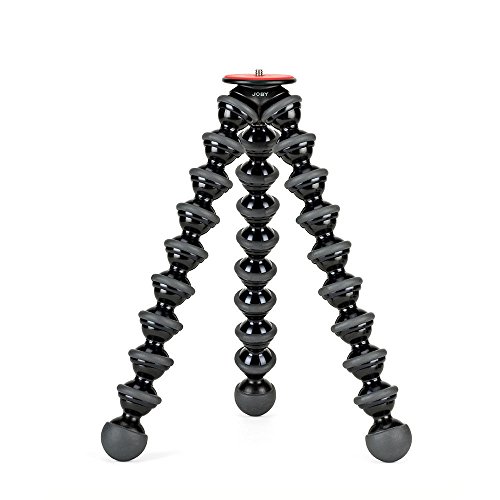
The GorillaPod 5K's segmented legs bend around a stair railing, a tree branch or a chair back, so you're not hunting for a flat surface. It's rated for 5 kg, which covers your phone plus whatever camera you graduate to later.
Check priceatAmazonPrices as of Oct 22, 7:36 AM PT · Details
Most tripods make you find a level spot; this one doesn't care. You wrap the legs around a fence post, a car mirror, a bike frame — anything with a shape to grab. For anyone filming outdoors, that's the whole argument. Straight-leg tripods need ground. The GorillaPod needs a thing to hold onto, and there's almost always a thing.
The payload rating is the other reason to buy this one over a phone-only clamp. Joby rates it for 5 kg, roughly 11 pounds. Your phone weighs a fraction of that. So if you pick up a mirrorless camera in a year, you're not shopping again. Owners regularly mount full DSLRs on it, and the Arca-Swiss quick-release plate means it drops onto other tripods too.
Tom's Guide compared flexible tripods on uneven ground and found that cheaper models wobbled visibly at 1/30 of a second, while the 5K held steady down to 1/8. That gap matters for anything low-light or long-exposure. It also explains why the price difference between this and a generic bendy tripod is real rather than branding.
The ball head is better than it needs to be. There's a numbered scale on the base so you can repeat a 360-degree pan, and the pan locks separately from the tilt — handy when you've framed a shot and only want to swing sideways. Small thing, but it's the difference between nudging your composition every adjustment and leaving it alone.
Flaws but not dealbreakers
The joints are the weak point. Some owners report that after a few months of regular use, certain positions won't hold anymore — the legs slowly droop under a heavy camera, and it gets worse over time. A handful describe a leg segment separating outright. With a phone you're unlikely to see this, but if you're loading it near its rating, treat the payload number as a ceiling rather than a cruising speed.
It's also fiddly with a big rig. Balancing a heavy camera on bent legs takes patience, and you'll spend a minute or two adjusting before you trust it. For quick handheld-to-tripod switching at a desk, a rigid tripod is faster.
Budget pick
Enough light and enough stand, for very little money
NEEWER Basics 8" RGB LED Ring Light
This NEEWER kit pairs an 8-inch RGB ring with an aluminum stand that climbs past 53 inches, so you can get the light to eye level instead of pointing it up your nose. It runs off USB, including a power bank.
$22.94fromAmazonPrices as of Oct 22, 7:36 AM PT · Details
The stand is what makes this kit worth buying, not the ring. Plenty of cheap lights come with a desk tripod that tops out around a foot, which lights you from below and makes everyone look like they're telling a ghost story. This one extends to about 53 inches and folds to under 18, with flip locks and a swivel ball head. Get the ring to eye height and the whole look changes.
For a talking-head video at a desk, 8 inches of ring is plenty. Our research notes suggest 10 inches as the comfortable floor for solo video, and you'd want 14 to 18 for two people or a wider scene, but at close range the difference between 8 and 10 is smaller than the spec sheet implies. NEEWER rates it at 700 lux at half a meter — enough to be your key light in a normal room, not enough to fight a sunny window.
The color temperature range runs 3200K to 6500K, which covers the setting that actually matters. Daylight sits around 5600K, and matching it keeps window light and lamp light from fighting each other in the same frame. Set it warm in a daylight room and you'll get an orange cast you can't fully edit out. There are seven RGB colors too, mostly good for a colored wash on the wall behind you.
USB power is an underrated convenience. It runs off a laptop, a wall adapter or a portable charger, so you can take the whole kit to a kitchen table or a hotel room without hunting for the right brick. NEEWER sells this as a stripped-down line — no case, no extras — and that's the trade you're making.
Flaws but not dealbreakers
The included phone holder is the weak link. Owners describe it as flimsy and awkward, and several ended up ignoring it entirely and using their own mount. Plan on that.
Longevity is a real question. Among owner complaints, the recurring one is a light that simply stops working after several months of light use. NEEWER has replaced units for some buyers who reported problems, but you're buying an economy product and should treat it that way — this isn't the light for a job where a failure costs you a shoot.
Upgrade pick
Packs like a water bottle, sets up in seconds
Peak Design Travel Tripod
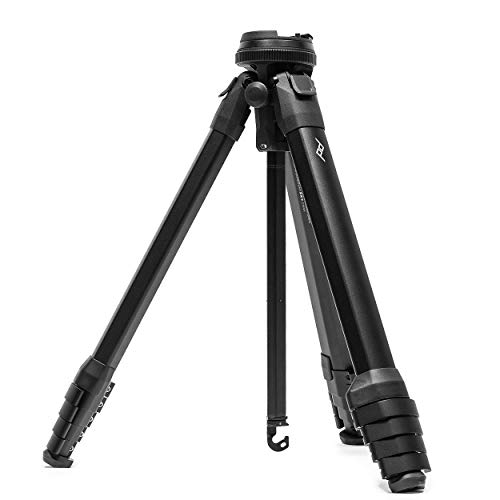
The Peak Design Travel Tripod collapses to roughly the diameter of a water bottle and still reaches usable height, with a phone mount that pops out of the center column. It handles up to 20 pounds, so a full camera setup is no problem.
$399.95fromAmazonPrices as of Oct 22, 7:36 AM PT · Details
If you've ever left a tripod at home because it wouldn't fit in the bag, this is the fix. The aluminum version packs down to about 39.5 cm and roughly 1.27 kg by Peak Design's numbers, with no protruding knobs — the legs nest into a cylinder. It's the most compact full-height tripod in its class, and the reason people who own three tripods keep reaching for this one.
Setup speed is the underrated part. The legs deploy and lock without flipping, rotating or fumbling, and the ball head uses a single ring for every axis. You can go from bag to shooting in a handful of seconds. If you shoot street or travel, where the moment is gone in twenty, that's not a luxury feature.
The built-in phone mount lives in the center column and pops out when you need it, so there's no clip to lose. And with a 20-pound capacity, this handles a full-frame body with a telephoto lens. Owners report it staying steady in wind despite the low weight, which is the usual sacrifice compact tripods make.
It's the most expensive thing here by a wide margin, and we'd only point you to it if you shoot enough to feel the difference. But the people who own it tend to say the same thing: they resented the price until they used it, and then stopped shopping. That's a rare pattern.
Flaws but not dealbreakers
Light it isn't — not by travel-tripod standards. The aluminum model runs about 3.3 pounds in practice, and several owners who hike with gear say that's too much for long days on foot. The carbon fiber version costs substantially more and cuts roughly 40 percent of the weight, which is the trade you'll have to weigh.
It's also overbuilt for a phone. If your camera is your phone and it'll stay that way, you're paying for capacity you'll never use, and a far cheaper tripod will hold a phone just as still.
Also great
Two adjustable panels beat one ring for close work
Lume Cube Flex Light Pro - Portable
The Lume Cube Flex Light Pro uses two edge-lit panels on flexible arms instead of a single ring, so you can light from two angles and kill shadows a ring can't reach. It puts out 2,300 lumens at 96+ CRI.
$319.99fromAmazonPrices as of Oct 22, 7:36 AM PT · Details
A ring light gives you one direction; this gives you two. The two 13-inch panels sit on 11-inch flexible arms and rotate 270 degrees each, so you can put one high and one low, or bracket a subject from both sides. For anything where you're looking down at detail work — crafts, nails, a product on a table — that's a genuinely different tool, and it's why tattoo artists and estheticians have adopted it.
The color quality is the spec worth caring about. Lume Cube rates it at 96+ CRI, versus the CRI 80 that's typical in budget ring lights. High CRI means skin reads as skin rather than sallow or plasticky, and it's the one thing you can't correct later in editing. The range runs 3000K to 6200K, so you can match a warm lamp or a bright window.
Edge-lit diffusion does the rest. Instead of a bare circle of LEDs throwing hard spots, the panels spread the output across their whole face, which softens shadows without a separate diffuser. Brightness runs from 5 to 100 percent and the unit remembers your last setting, so you're not re-dialing it every session.
Flaws but not dealbreakers
The base is the common complaint. Owners describe the stand as underweighted for the height and reach of the arms, and at least one replaced it with a flat base and a pair of weights. If you extend both arms out to one side, expect it to feel tippy.
It's also not a portrait light in the ring-light sense. There's no catchlight ring in the eyes, which is exactly the look some creators buy a ring light for.
Who this is for
This guide is for anyone shooting video or photos with a phone and getting frustrated by shaky footage or bad light — creators posting to TikTok and Reels, remote workers who want to look decent on calls, streamers building a desk setup, and parents filming a recital from the back of a gym. Most people need one tripod and one light, not a kit of eight things. If you already own a sturdy tripod and shoot next to a north-facing window, you may need nothing at all.
We stuck to gear sized for phones and lightweight cameras. That means no studio light stands, no softbox kits, no gimbals, and no heavy-duty video tripods with fluid heads. If you're lighting a two-person interview or shooting with a cinema camera, this isn't the right list — you want a proper stand-and-softbox setup instead.
How we picked
We built the shortlist around a handful of things that actually change how your footage looks. Light quality: color rendering in the mid-90s keeps skin tones honest, and a range that reaches roughly 5600K lets you mix with window light without an orange cast. Brightness: published lumen and lux figures, weighted toward independent measurements, told us whether a light could carry a shot or only fill in. Load and stability: we checked rated payload against how gear behaves on uneven ground and in wind, and we took recurring owner complaints about sagging joints seriously. Packed size: folded dimensions and weight decide whether you actually bring it. Setup speed: anything that takes a minute to deploy will get skipped when the moment is short.
Other phone tripods and ring lights worth considering
If you want something that fits in a jacket pocket: The Magnetic Tripod for Phone — The MQOUNY magnetic selfie stick folds to under 5 inches and weighs about 190 grams, so it genuinely disappears into a bag or a coat pocket. It snaps onto MagSafe iPhones with no clip to fumble with, includes metal rings for Android phones, and comes with a rechargeable remote that ranges out to about 33 feet. It converts between a selfie stick and a mini tripod, and for handheld travel clips that's all you need. What you give up is stability — owners note it feels flimsy at certain angles under a larger phone, and it tips over if you tilt it down toward a table. Fine for quick clips, not for a locked-off time-lapse.
The competition
These are the products our research surfaced in this category, not a complete map of what's for sale. Phone tripods and ring lights turn over constantly, and plenty of decent gear never crosses a review site's desk. The ones below either lost to a pick on a specific point or serve a narrower job than most buyers need.
The UBeesize 67" Auto Face Tracking Tripod with — The UBeesize 67-inch auto face tracking tripod is the most interesting idea here: an AI camera in the head rotates 360 degrees to keep you centered while you move, so you can film alone without stopping to reframe. It extends to 67 inches, folds to about 13.5 inches, weighs under a pound, and runs about six hours on a charge. Early owners are enthusiastic about how fast the tracking responds. We held off recommending it because the tracking hardware is a new and largely unproven layer on top of a tripod, and the feedback pool is still thin. If you teach, demo products, or film workouts where you leave the frame, it's worth watching.
The Rotolight NEO On-Camera LED Light — The Rotolight NEO is a small circular on-camera panel with dial-controlled brightness and color temperature, and owners who shoot interviews and portraits praise how well it holds up as a key or a fill next to window light. It ships with an AC adapter, D-Tap cable, a four-filter set and a limited one-year warranty. It lost out for a simple reason: it's a professional's accessory light, not a phone-creator's kit — there's no stand, no phone mount, and no app. Some owners also find it better suited to video than to still photography. If you already shoot with a camera and want a portable light that mounts to a hot shoe, it makes sense.
Setup and care
Placement does more for your footage than any spec. Put a ring or panel light 18 to 24 inches from your face at eye level — that's the standard cinematographers and makeup artists use, and it's what produces the catchlight in your eyes while keeping shadows off your nose and chin. Match your color temperature to the room: around 5600K if daylight is coming through a window, warmer only if every other light in the room is warm. Mixing the two gives you an orange face against a blue background. For tripods, wipe grit off flexible legs and leg locks after outdoor shoots, since sand in a joint is what starts the slow slide toward sagging. And if you're filming long takes, keep your phone out of direct sun and pull off a thick case, which traps heat and triggers thermal throttling.
Questions we get
What size ring light works best for video calls and Zoom meetings?
For one person at a desk, an 8- or 10-inch ring is plenty. You're sitting close, so the light doesn't have far to travel, and a bigger ring mostly adds bulk and desk clutter. Step up to 14 or 18 inches only if you're lighting two people or a wider scene.
Do I need a ring light if I already have a good window?
Not necessarily — a north-facing window at midday is excellent, free light. The problem is that it disappears at night and changes character every time a cloud passes. A light gives you the same look at 8 a.m. and 10 p.m., which matters more if you post on a schedule. If you shoot only during the day and can sit facing the window, save your money.
What does CRI mean, and why does it matter for skin tones?
CRI stands for color rendering index, a 0-to-100 score for how accurately a light source shows colors compared to natural light. Budget ring lights usually land around 80, which leaves skin looking a little flat or sallow. Lights in the mid-90s render skin much more faithfully, and the difference shows in side-by-side footage. It's also the one thing you can't fix in editing.
Is a flexible tripod or a straight-leg tripod better for travel?
It depends on what you'll be standing on. Flexible legs win when there's no flat ground — you wrap them around a railing, a branch or a signpost. Straight legs win when you need height, since a flexible tripod puts your phone a few inches off whatever it's gripping. If you're mostly shooting cities and trails, the flexible one is more useful more often.
Can I use a phone tripod with a mirrorless camera or DSLR?
Check the payload rating first, and then treat it as a ceiling rather than a target. A tripod rated for 5 kg handles a mirrorless body with a normal lens comfortably, but small phone tripods and pocket selfie sticks are rated for a few hundred grams and will tip. Owner reports across flexible tripods suggest that sustained loading near the maximum is what wears out ball joints over time.
Will a ring light do anything in a brightly lit room?
Only if it's strong enough to compete. A light in the range of 700 lux at half a meter reads clearly in a normal indoor room but gets swallowed next to a sunny window. Brighter panels — in the thousands of lumens — can hold their own in daylight conditions. If you shoot in a bright room, prioritize output over ring diameter.
Why you should trust us
For this guide:
- We read manufacturer specifications for every product here, comparing rated payload, folded size, weight, lumen and lux output, color temperature range and CRI.
- We reviewed published coverage from outlets including Tom's Guide, PCMag, DPReview, The Verge and Digital Camera World, along with cinematography guidance on light placement and color temperature.
- We read owner feedback across all eight listings, looking for the failures that show up months in — sagging joints, tippy bases, and lights that stop working — rather than first-week impressions.
- We read owner reviews on every listing, weighted toward the critical ones, because that is where the recurring failures show up.
- We have a systematic way of automatically fetching the latest prices, so the numbers on this page stay current.
- This is a research-focused guide, so the team may not own every product listed — though we often do own the top winners, which gives us extra context for the recommendations.
- We don't accept free products, and the retailer commission never changes which product we recommend.
Sources
Best Ring Lights 2025: Tested by Our Photo and Video Team, RTINGS.com
The Best Tripods for 2025 - PCMag, PCMag
Best Ring Lights of 2025 — Wirecutter, Wirecutter / NYT
Best Phone Tripods 2025 — Tom's Guide, Tom's Guide
Best Tripods for Smartphones 2025 — Digital Camera World, Digital Camera World
Joby GorillaPod 5K Kit Review — Photography Blog, PhotographyBlog
Peak Design Travel Tripod Review — The Verge, The Verge
Lume Cube Ring Light Pro Review — Creator IQ, Lume Cube / Creator IQ
Best Streaming Lights and Ring Lights 2025 — StreamerSquare, StreamerSquare
Rotolight NEO 3 Pro Review — DPReview, DPReview
Best Budget Ring Lights Tested — Reviewed.com, Reviewed / USA Today
Elgato Multi Mount System Review — IGN, IGN
Amazon product listings and owner reviews for all 7 products
Manufacturer specification pages for each product
Some passages in this guide may be paraphrased with AI help.
Product prices and availability are accurate as of the date/time indicated and are subject to change. Any price and availability information displayed on Amazon.com at the time of purchase will apply to the purchase of this product.
More like this.
Continue exploring electronics reviews and recommendations.

The Best Ring Lights for Content Creators
A ring light does one job: it puts even light straight onto your face so your camera isn't guessing. That matters most in the rooms creators actually work…

The Best Wireless Charging Car Phone Mounts of 2026
Your phone is the navigation system in most cars now. It's also the thing that dies fastest when you're running maps, music and CarPlay on a long drive. A…

The Best Magnetic Car Phone Mounts
A phone mount is one of those small purchases you either forget about or curse daily. You reach for it a dozen times a drive - snapping the phone up for…

The Best Motorcycle Phone Mounts
Your phone is your GPS, your music player, and the thing that tells you where the next gas station is. On a motorcycle, it also sits a few inches from an…

The Best Sleep Tracker Rings
A sleep ring earns its place by being something you forget you're wearing. That's the whole pitch. A watch on your wrist gets in the way when you roll…

The Best Smart Light Bulbs
A smart bulb earns its keep in the small moments. You're carrying groceries and the kitchen lights come on by themselves. You're already in bed when you…