The Best GPS Trackers for Vehicles
A GPS tracker earns its keep on ordinary days, not dramatic ones. You want to know your kid got to practice. You want to see whether the work van sat idle for an hour on a job you're billing by the mile. And if the car ever rolls away without you, you want to hand police an address instead of a description. The good ones do all of that quietly, in an app you check for ten seconds. The bad ones bury you in alerts you learn to ignore.
Here's the part that isn't on the box. Every tracker here needs a paid cellular plan, and none of them work where there's no signal. A parking garage, a rural stretch of highway, a steel shipping container, and your dot goes stale until the device reconnects. Accuracy wanders too. Consumer GPS puts you on the right block, not in the right parking space. And a tracker a thief can find is a tracker a thief can toss in a ditch. These improve your odds. They don't guarantee anything.
So you're choosing among three trade-offs: how often it reports, how it gets power, and how much you'll keep paying to keep it talking. Plug-in units are easiest to live with. Magnetic pucks go where there's no port at all. Wired units are the hardest to yank out in a hurry. We think that the Bouncie GPS Tracker is the best GPS tracker for vehicles for most people, and that the Vyncs GPS Tracker is the one to buy if you'd rather prepay for a year than watch a charge hit every month.
Everything we recommend
Fast updates and engine data, with the easiest install here

Pay once a year, then mostly forget about it

The one that yells before your car is gone

Sticks to anything steel and hides where a plug-in can't
Prices as of Oct 25, 6:48 AM PT · Details
At a glance
| Product | Install type | Fastest update | Price | |
|---|---|---|---|---|
| Bouncie GPS Tracker for Vehicles with Real-TimeTop pick | — | Up-to-the-minute | $89.99 |
| Vyncs - GPS Tracker for VehiclesBudget pick | — | Every minute | Check price |
| LandAirSea 54 GPS Tracker - Made inAlso great | Magnetic, waterproof | Every 3 seconds | $14.95 |
 | Spytec GPS Tracker for Vehicles & KidsAlso consider | — | Every 5 seconds | $17.95On sale |
 | Tracki Universal GPS Tracker for VehiclesAlso in lineup | — | 1 min auto, 5 sec manual | $11.30On sale |
| CARLOCK Wired Hidden GPS Vehicle Tracker -Upgrade pick | Wired, 12-24v | — | $59.95 |
 | Amcrest GPS GL300 GPS Tracker for VehiclesAlso consider | Magnetic, weatherproof | Every 5 seconds | $29.99 |
Prices as of Oct 25, 6:48 AM PT · Details
How we picked
Update interval. We compared the reporting rates each maker publishes, from three seconds up to one minute. PCMag's coverage of the category convinced us that anything slower than a minute while driving is a trip logger, not a recovery tool.
Power and install. We sorted every tracker by how it gets electricity: OBD-II port, hardwired, or its own battery. Each type fits a different vehicle, so we made sure the lineup covers cars with a port, trailers without one, and anything you'd rather a thief never found.
Subscription terms. Every device here needs a plan, so we read the fine print on contract length, activation fees and cancellation. We favored month-to-month flexibility and honest annual prepay, and we docked anything that locks you in without a clear way out.
Alerts that matter. We looked for geofencing with adjustable zones, speed alerts, and behavior flags like hard braking and rapid acceleration. ConsumerAffairs reports most consumer trackers can set a geofence as tight as roughly 500 feet, which we treated as the bar.
App and sharing. We read published reviews and recurring owner feedback about the phone apps, since that's where you'll live. Multi-vehicle views, family sharing and readable trip history separated the ones people keep using from the ones they abandon.
Top pick
Fast updates and engine data, with the easiest install here
Bouncie GPS Tracker for Vehicles with Real-Time
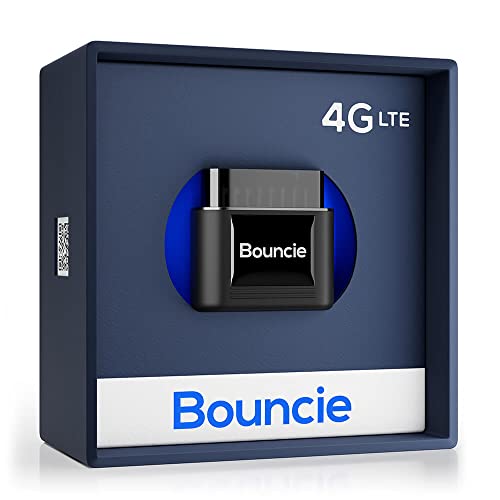
Bouncie plugs into the diagnostics port under your dash and starts reporting in about the time it takes to buckle a seatbelt. You get location refreshed as often as every minute while the engine runs, plus speeding and hard-braking alerts, crash detection and check-engine codes in one clean app.
$89.99fromAmazonPrices as of Oct 25, 6:48 AM PT · Details
Bouncie refreshes your car's location about once a minute while it's moving, and that number is the whole ballgame. PCMag notes that plenty of budget trackers check in only every 15 to 30 minutes. That's fine for a mileage log. It's close to useless when the car is moving and you're on the phone with a dispatcher. A minute-old dot keeps you within a few blocks of a vehicle in motion, which is what recovery actually depends on.
Setup is a two-minute job. You find the OBD-II port below the steering column, push the tracker in until it seats, and pair it in the app. It works on most vehicles from 1996 onward, so it covers nearly everything on the road. There's nothing to charge, nothing to hide under a bumper, no wires to run behind a panel. If you've been putting this off for months, this is the version that actually gets done.
The driving data is what turns it from a dot on a map into something you use. Bouncie tracks speed, acceleration, hard braking and idle time, with color-coded speed bands so a trip reads at a glance. It flags impacts and sends an SMS. It also reads engine trouble codes, so a check-engine light arrives with an explanation attached. Parents lean on the speed alerts. Small-fleet owners lean on idle time.
The plan is month-to-month with no contract, and that flexibility is worth more than it sounds. You can cancel when the teen leaves for college, or when the seasonal van goes back in the barn until spring. There's no activation fee and no return fee to argue about later. Compared with trackers that want a year up front before you know whether the thing works in your driveway, you're renting certainty instead of buying it.
Flaws but not dealbreakers
The obvious limit is the port. Anything without an accessible OBD-II connector is out: a boat trailer, a motorcycle, a tractor, a utility trailer. And because the tracker sits in plain sight under the dash, someone who knows what to look for can unplug it in about three seconds. That makes it a strong monitoring tool and a weaker anti-theft one.
There's no way around the subscription either. If the plan lapses, you own a small black brick with a plug on it. The app also leans hard on notifications, and if you switch everything on at once your phone buzzes more than you'd like. Most owners end up turning half of them back off in the first week.
Budget pick
Pay once a year, then mostly forget about it
Vyncs - GPS Tracker for Vehicles
Vyncs sells its service in annual chunks instead of monthly ones, which cuts what you spend over a year to roughly half what month-to-month rivals charge. You still get real-time location over 4G LTE, unlimited trip history, geofences, driving alerts and engine fault codes.
Check priceatAmazonPrices as of Oct 25, 6:48 AM PT · Details
The math here is simple. You pay for a year of service up front instead of every month, and Vyncs puts the annual savings at roughly 40 to 50 percent against competitors that bill monthly. Stretch that across three years on a family car and the gap stops being trivia. If you hate recurring charges more than you hate one bigger charge, this is your tracker. Nothing else in the lineup structures it this way.
Feature for feature, it gives up less than you'd expect. It collects data every second and pushes an update to the server every minute. You get unlimited trip history on a map, zones you can draw in any shape, and alerts for speeding, hard braking, rapid acceleration and sharp turns. It also surfaces fuel economy, engine fault codes and manufacturer recalls. If someone pulls it from the port, you get a tamper alert.
It draws power from the OBD-II port and sleeps when the ignition is off, so it isn't nibbling at your car battery in the driveway overnight. Vyncs says the service works in more than 200 countries on its world SIM. If you cross a border a few times a year, or you're keeping an eye on a car that gets loaned to relatives two states away, that's one less thing to plan around.
The app won't win any design awards. Screens are dense, maps are plain, and finding a setting sometimes takes two tries. But what's underneath is complete: street addresses for every start and stop, routes you can scrub through, push notifications that show up without a lag. For a parent checking a commute or a landscaper checking a crew, complete beats pretty most days of the week.
Flaws but not dealbreakers
Owner feedback is the most mixed of anything here, and it's fair to weigh that. The complaints cluster around getting started and getting help: devices that take a while to come online, renewals that need a phone call, support that answers slower than people expect. Buy it assuming setup may cost you an evening rather than ten minutes.
The annual model cuts both ways too. You commit before you know how it behaves on your car, and short-term needs don't fit the billing at all. A two-month loaner or one summer with a new driver is the wrong use for this. And like every OBD unit, it's visible to anyone who thinks to look under the dash.
Upgrade pick
The one that yells before your car is gone
CARLOCK Wired Hidden GPS Vehicle Tracker -
CarLock wires into your vehicle's 12- to 24-volt power and watches for what happens right before a theft: the engine starting, unusual vibration, the car moving without you. It pushes an alert to your phone immediately, and it tells you if someone disconnects the device.
$59.95fromAmazonPrices as of Oct 25, 6:48 AM PT · Details
Most trackers tell you where your car went. CarLock tries to tell you while it's going. You get push notifications when the vehicle moves without you, when the engine starts, when it senses the odd vibration of a tow truck hooking up, and when the device itself gets unplugged. CNET has singled out exactly this behavior as what separates CarLock from trackers that only log trips for you to read afterward.
The trade-off starts with installation. This is a wired unit, so you're either comfortable behind a dash panel or you're paying a shop for an hour of labor. The payoff is that it hides. A thief who checks the OBD-II port, finds nothing and moves on has done you an enormous favor. Wiring it in also means the tracker isn't sitting in the footwell announcing itself to anyone who glances down.
It isn't only an alarm. CarLock flags harsh acceleration, hard braking, sharp cornering and speeding, then rolls them into a running driver safety score you can watch over weeks. If you're handing keys to a 17-year-old or to an employee in a company truck, that score gives you something specific to talk about instead of a vague worry. Routes, stops, mileage and full trip history sit in the same app.
The battery-voltage warning is the sleeper feature. CarLock watches your car's battery health and warns you when it's running low or draining faster than it should. In a cold climate, that's a heads-up a day or two before the morning it won't turn over. It also catches parasitic drain, the slow leak that kills batteries on cars that mostly sit. Owners tend to discover they wanted this after they've had it.
Flaws but not dealbreakers
This is the newest and least-proven product in the lineup. Owner feedback exists, but the pool is thin compared with trackers that have been on sale for years. You're leaning more on the maker's claims and published coverage than on a deep pile of accumulated complaints. If a well-worn track record is what helps you sleep, our top pick has one and this doesn't yet.
Installation is the real barrier for most people. Running power and ground behind a dash isn't hard, but it isn't quick either, and doing it sloppily can trip warning lights or drain a battery. You also give up the engine fault-code readout an OBD-II tracker hands you. What you get here is security data, not maintenance data.
Also great
Sticks to anything steel and hides where a plug-in can't
LandAirSea 54 GPS Tracker - Made in
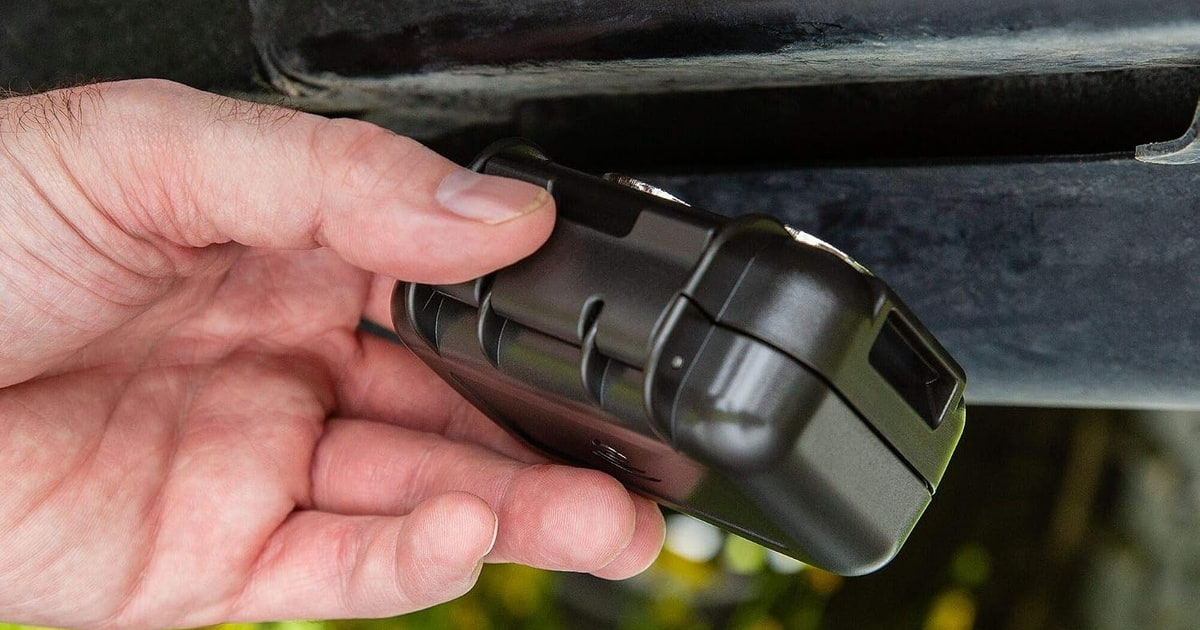
The LandAirSea 54 is a puck about the size of a small jar lid, with a magnet inside and a sealed waterproof shell. It clamps under a bumper, on a trailer tongue or inside an equipment box, and it can report as fast as every three seconds.
$14.95fromAmazonPrices as of Oct 25, 6:48 AM PT · Details
Some things simply don't have an OBD-II port. A boat trailer, a golf cart, a skid steer, a motorcycle, a horse trailer parked behind a barn: none of them will take a plug-in tracker. The 54 sidesteps that by needing nothing from the vehicle at all. It runs on its own battery, grabs onto steel with an internal magnet, and shrugs off rain and road spray because the case is sealed.
Three-second updates are the fastest reporting in this lineup. That matters in exactly one situation, and it's the situation you're buying for. When something is being driven away, a dot that moves in near real time on Google Maps is the difference between following and guessing. LandAirSea also keeps historical playback for up to a year, so you can reconstruct where a vehicle has been across months rather than days.
Battery life depends entirely on how much the thing moves. It sleeps when it sits still for a stretch and wakes on motion, which stretches a charge a long way on a trailer that's parked three weeks out of four. A daily-driven car is a different story, and you'll be pulling it off to recharge more often than you'd like. Either build a routine or mount it somewhere you can actually reach.
Placement is the whole skill with a magnetic tracker. You want steel, out of sight, shaded from a casual glance, and not so deep in the chassis that metal swallows the signal. Under a rear bumper and along a frame rail both work well. Owners who complain about spotty accuracy have usually buried it. And keep it legal: track vehicles you own or are authorized to track.
Flaws but not dealbreakers
You'll be charging it, and there's no getting around that on a battery tracker. Forget for a week and you own a magnet. Owners also find the app and web software feel dated next to the phone-first apps from Bouncie and CarLock, with more menus, more clicks and less polish for the same task.
Signal is the other soft spot. Inside a metal box, under a thick chassis or three levels down in a parking structure, updates go quiet until the device sees sky again. A magnet-mounted puck can also shake loose on a washboard road, or get spotted by whoever puts the car on a lift for an oil change.
LandAirSea backs the 54 with an unconditional lifetime warranty covering manufacturing defects under normal use.
Who this is for
Buy one of these if you're handing car keys to a new driver, running a couple of work vehicles, or parking something valuable where you can't see it. Parents get speed and geofence alerts instead of nagging texts. Small-business owners get idle time, routes and mileage, which Forbes Advisor points to as the main reason fleet tracking pays for itself. And if you live somewhere cars disappear, the National Insurance Crime Bureau's recovery data shows vehicles with tracking and recovery technology come back at meaningfully higher rates than the national average.
Skip it if you just want to find your own car in an airport lot; a phone and a parking app do that for free. This guide covers cellular trackers for vehicles and towable assets, the kind that report over 4G LTE and need a subscription. We're not covering Bluetooth tags, which only work when another phone wanders past, and we're not covering built-in automaker services like OnStar. One more thing: laws on tracking a car you don't own vary by state, and this guide assumes you own the vehicle or have permission.
How we picked
We built the shortlist around five things you'll actually notice. Update interval: anything slower than about a minute while the engine's running is a trip log, not a way to follow a moving car. Power and install: we made sure the lineup covers OBD-II plug-ins for ordinary cars, wired units you can hide, and battery pucks for trailers and equipment with no port at all. Subscription terms: every one of these needs a plan, so we read the contract length, activation fees and cancellation rules and favored the ones you can walk away from. Alerts: geofences with tight adjustable zones, speed warnings, and hard-braking flags, since ConsumerAffairs puts the practical geofence floor around 500 feet. App and sharing: published reviews and repeated owner feedback told us which apps people keep opening and which ones they quietly stop checking.
Other gps trackers for vehicles worth considering
If you want covert tracking with real support behind it: The Spytec GPS Tracker for Vehicles & Kids — The Spytec GPS tracker covers a lot of the same ground as the LandAirSea 54. It's a magnetic, weatherproof puck about three inches long, it updates as fast as every five seconds, and its Time Machine view rebuilds where a tracker was and what was around it at any point. Spytec claims up to 14 days of battery, and the company runs support in English and Spanish. The catch is cost: plans here run higher than most of this lineup unless you commit to a long prepaid term, and you're still recharging a battery on any vehicle that gets driven daily.
If you want the longest stretch between charges: The Amcrest GPS GL300 GPS Tracker for Vehicles — The Amcrest AM-GL300 pairs a 2600 mAh battery with twin magnets and an IP65 weatherproof case, and Amcrest rates it at 10 to 14 days on a charge at 30-second updates, or up to three weeks in standby. Push it to five-second updates for live following and you're down to two or three days, so the number you pick matters. Alerts arrive by text, email or push, and geofencing, speed limits and harsh-braking warnings are all there. The dealbreaker for some: it's configured for the US, Canada and Mexico only, and it gives you no engine diagnostics.
The competition
This is what our research turned up, not a census of everything for sale. Trackers appear and vanish, plans change without much warning, and plenty of competent devices never make it into a published review. Here's the one we looked at closely that didn't earn a spot above.
The Tracki Universal GPS Tracker for Vehicles — The Tracki Universal is the smallest thing here, roughly 1.77 by 1.46 by 0.55 inches and about 1.26 ounces, with a replaceable 600 mAh battery good for five to seven days of active use or up to 45 days in battery-save mode. It updates automatically every minute, pings on demand every five seconds, and adds an SOS button, a beep locator and Bluetooth proximity for finding it in a room. Tom's Guide notes its global SIM plan covers more than 140 countries on one subscription, which is genuinely unusual. It lost to our picks because it's built to track everything rather than to track a car well: the small battery means frequent charging on a daily driver, the magnetic waterproof box is a separate add-on, and there's no engine data at all. Still, if you want one device that moves between a car, a suitcase and a tool bag, and you travel abroad, it's the obvious choice.
Installation and placement
For a plug-in tracker, find the OBD-II port under the driver's side dash, push until it's fully seated, and check the app before you drive off. U.S. News reports these draw so little power that a healthy battery won't notice, though a car that sits for weeks with a weak battery is a different case. For magnetic units, aim for clean steel that's out of sight but not entombed: under a rear bumper, along a frame rail, inside a trailer tongue box. Skip deep spots surrounded by metal, since the signal has to get out. Wipe the mounting surface first so road grime doesn't let it slide. Then set a reminder to recharge, because that's the step everyone forgets.
Questions we get
Are GPS trackers for vehicles legal to use?
Tracking a vehicle you own is legal in every state. Where it gets complicated is tracking a car titled to someone else, including an adult child's or a spouse's, since several states treat that as illegal surveillance. Employers generally can track company vehicles but often have notice obligations. If you're not the registered owner, check your state's law before you stick anything under a bumper.
Do GPS car trackers require a monthly subscription?
Effectively, yes. Every tracker in this guide needs a cellular plan to send location data, and without an active plan the hardware stops reporting. What varies is the billing. Bouncie and CarLock bill month to month with no contract, while Vyncs sells a year at a time with no monthly fee, which works out cheaper over 12 months.
What's the best GPS tracker for monitoring a teen driver?
Bouncie is our pick for most families. It grades speeding, hard braking and rapid acceleration, sets geofences around school and home, and flags impacts automatically. The Insurance Institute for Highway Safety has pointed to driver report cards, which grade exactly those behaviors, as an effective way to reinforce safe habits with new drivers. CarLock does the same with a running safety score if you'd rather the device stay hidden.
Can a GPS tracker be hidden from a car thief?
Partly. An OBD-II tracker sits in plain sight under the dash and takes seconds to unplug, which is why we recommend a wired or magnetic unit if theft is your main worry. CarLock hides behind a dash panel and alerts you the moment it's disconnected. A magnetic puck like the LandAirSea 54 can go under a bumper or inside a frame rail, though a determined thief who sweeps the car may still find it.
Do GPS trackers drain a car's battery?
Not meaningfully on a healthy battery. U.S. News reports that OBD-II trackers draw continuous power from the diagnostics port with negligible effect under normal driving. Better units also sleep when the ignition is off, which Vyncs does specifically to save power. The risk shows up on a car that sits for weeks with a battery already on its last legs.
How accurate are real-time GPS vehicle trackers?
Expect the right block, not the right parking space. Consumer GPS typically lands within a few car lengths outdoors with a clear view of the sky, and gets worse under a metal chassis, between tall buildings or inside a garage. Update interval matters as much as raw accuracy: a tracker reporting every three seconds shows a moving car far more usefully than one reporting every 30 minutes.
Why you should trust us
For this guide:
- We read the manufacturer specifications and full product listings for every tracker here, comparing update intervals, power sources, battery claims and subscription terms side by side.
- We compared published coverage from PCMag, CNET, Tom's Guide, U.S. News, Forbes Advisor and ConsumerAffairs, along with theft-recovery data from the National Insurance Crime Bureau and teen-driver findings from the Insurance Institute for Highway Safety.
- We read owner feedback in aggregate, looking for repeated themes around activation, customer support and battery life rather than any single complaint.
- We read owner reviews on every listing, weighted toward the critical ones, because that is where the recurring failures show up.
- We have a systematic way of automatically fetching the latest prices, so the numbers on this page stay current.
- This is a research-focused guide, so the team may not own every product listed — though we often do own the top winners, which gives us extra context for the recommendations.
- We don't accept free products, and the retailer commission never changes which product we recommend.
Sources
The Best GPS Trackers for Cars, Tested and Reviewed, PCMag
Best Car GPS Trackers of 2026, Tom's Guide
Best GPS Trackers for Vehicles, CNET
Best Car GPS Trackers, According to Testing, U.S. News & World Report
How We Tested GPS Vehicle Trackers, ConsumerAffairs
Bouncie Review: Hands-On Testing, Bouncie (manufacturer specs)
Vyncs GPS Tracker Product Specifications, Vyncs (manufacturer specs)
LandAirSea 54 Real-Time GPS Tracker Specs, LandAirSea (manufacturer specs)
Spy Tec GL300 GPS Tracker Details, Spytec (manufacturer specs)
GPS Fleet Tracking Buyer's Guide, Forbes Advisor
Car Theft Statistics and Recovery Data, National Insurance Crime Bureau (NICB)
Teen Driving Safety and Monitoring Technology, Insurance Institute for Highway Safety (IIHS)
Amazon product listings and owner reviews for all 7 products
Manufacturer specification pages for each product
Some passages in this guide may be paraphrased with AI help.
Product prices and availability are accurate as of the date/time indicated and are subject to change. Any price and availability information displayed on Amazon.com at the time of purchase will apply to the purchase of this product.
More like this.
Continue exploring electronics reviews and recommendations.

The Best Hidden Car GPS Trackers
A hidden GPS tracker earns its keep in one bad moment. Your car isn't in the driveway, and you'd like to tell the police where it went instead of filling…

The Best Pet GPS Trackers and Smart Collars
Most dogs never need a tracker until the one afternoon they do. A gate gets left open, a thunderstorm hits, a squirrel wins. In that moment you don't want…

The Best Dog GPS Trackers
A dog who bolts doesn't give you much time to react. A tracker on the collar turns a frantic hour of shouting their name into a map you can actually…

The Best Pet GPS Trackers
A tracker earns its keep in the ten minutes after a door gets left open. That's the whole pitch. You want to open an app and see a dot moving down the…

The Best Motorcycle GPS Navigation Devices
A phone in a handlebar clamp works right up until it doesn't. Then you're squinting at a washed-out screen in afternoon sun, or watching the map freeze…

The Best Marine GPS Fish Finders
A fish finder earns its keep on the slow days. When nothing's biting, the screen tells you whether you're sitting over flat mud or a submerged brush pile…