The Best Blackout Curtains for Bedrooms
A dark room is one of the simplest sleep upgrades you can make. Streetlights, headlights sweeping across the ceiling, the sun hitting an east-facing window at 5:30 in the morning — all of it nudges you awake earlier than you'd like. Blackout curtains fix that for less than the cost of a new pillow. They also cut heat coming through the glass in summer and slow the draft in winter, which matters more than you'd think in an older house with single-pane windows.
Here's the honest part: no curtain blocks all the light in a real room. The word blackout isn't regulated, so panels blocking 85% and panels blocking 100% wear the same label. And even a completely opaque fabric leaks around the edges. Owners of nearly every panel here describe the same thing — a glow at the sides, a bright band above the rod. That's a fit problem, not a fabric problem, and it's why sizing and rod placement matter as much as which brand you pick.
Most people don't need the fanciest option. They need panels wide enough to overlap the frame, dense enough to kill the glow, and washable enough to survive a few years. We think that the NICETOWN 100% Blackout Curtains are the best blackout curtains for most bedrooms, and that the H.VERSAILTEX Linen 100% Blackout Curtains are the ones to buy if the curtains will be a visible part of the room's design.
Everything we recommend

The densest fabric here, with the least fuss about it

Full blackout that doesn't look like blackout

Solid room darkening for the price, with less of everything else

Made for the small, awkward windows the standard sizes miss
At a glance
| Product | Panel Size | Light Blocking | Price | |
|---|---|---|---|---|
| NICETOWN 100% Blackout Curtains for BedroomTop pick | 52"W x 84"L | 100% Blackout | $19.99 |
 | ECLIPSE Kendall Modern Blackout Thermal Rod PocketAlso in lineup | 42"W x 84"L | 98-99.9% | $13.22On sale |
| Deconovo Blackout Curtains 84 Inches LongBudget pick | 52"W x 84"L | 85-99% | $15.98On sale |
| RYB HOME Grey Blackout Curtains - ThermalRunner-up | 42"W x 45"L | 85-99% | $13.95On sale |
| H.VERSAILTEX Linen 100% Blackout Curtains for BedroomAlso great | 52"W x 84"L | 100% Blackout | $27.95On sale |
How we picked
Actual light blocking. We compared what each manufacturer claims in its own specs against what owners describe in real rooms, and we weighted the gap between them heavily. Panels that promise 100% but generate a steady stream of not-really-blackout feedback lost ground to ones whose claims match what buyers report.
Fabric construction. We looked for woven blackout layers rather than coatings or foam backings, since coatings can crack and foam can delaminate over a few years of washing. Where a listing gave a fabric weight, we treated heavier as better for both light and drape.
Sizing and coverage. We checked panel dimensions against the windows people actually have, including the small and odd ones. A guide that only covers 52-by-84 leaves out basements, bathrooms and RVs.
Washing and upkeep. We ruled out anything that isn't machine washable in cold water, and read owner feedback for reports of fading, shrinking or the backing separating after repeated cycles.
Materials safety. For nurseries and kids' rooms, we gave real weight to OEKO-TEX Standard 100 certification, which requires independent testing against formaldehyde, heavy metals and other substances before a fabric can carry the label.
Top pick
The densest fabric here, with the least fuss about it
NICETOWN 100% Blackout Curtains for Bedroom
These are heavy, tightly woven polyester panels that block light through the fabric itself rather than through a coating that can crack. They come as a pair of standard 52-by-84-inch grommet panels, which is the size that fits most bedroom windows without any measuring drama.
$19.99fromAmazonThe construction is what separates these from the pack. NICETOWN weaves black yarn into the middle of the fabric and adds a dedicated light-blocking layer, so darkness is a property of the cloth, not a film applied to the back of it. Coated and foam-backed panels can develop pinholes and hairline cracks as they age and get washed. There's nothing here to crack. That's a durability story more than a day-one performance story, but it's the reason we'd put these in a room you plan to live in for years.
The listing puts the fabric at 340 GSM, roughly 60% heavier than a typical blackout panel, and the pair weighs about five pounds. You'll notice that when you hang them. The panels hang straight instead of billowing, and the weight helps them sit flat against the wall on both sides, which is where light sneaks in. It also means you want a rod that isn't flimsy. A cheap tension rod will sag in the middle under this much fabric.
The eight silver grommets have a 1.6-inch inner diameter, so they slide across standard rods without catching. Grommets are the easiest header to live with — you push the panel open in one motion and it stacks neatly. Rod pockets bunch and drag. If you open and close your bedroom curtains twice a day, that difference adds up.
Washing won't wreck them. Cold water, gentle cycle, tumble dry low, low iron if you want them crisp. Woven fabric doesn't delaminate the way a foam liner can, so the panels come out of the machine looking like they went in. For a bedroom near a kitchen, or any room with a pet, that's not a small thing.
The fabric is made in a factory certified to OEKO-TEX Standard 100, which means it's been tested against a long list of substances including formaldehyde and heavy metals. For a nursery or a small bedroom that doesn't get much fresh air, that certification is worth looking for. It's not a guarantee of anything about the light blocking — it's a materials-safety check — but it's the kind of independent verification most panels in this price range don't carry.
Flaws but not dealbreakers
Solid colors only. If you want a pattern or a print, these aren't it, and the black panels show lint and pet hair the way any dark fabric does. Plan on running a lint roller over them now and then.
The fabric feels stiff out of the package and takes a while to relax into a natural drape. And the standard panel is 52 inches wide, which isn't wide enough to overlap a wide window without buying more panels. Order for coverage, not to match your window's width exactly, or you'll get the side glow this fabric is supposed to prevent.
Also greatOn sale
Full blackout that doesn't look like blackout
H.VERSAILTEX Linen 100% Blackout Curtains for Bedroom
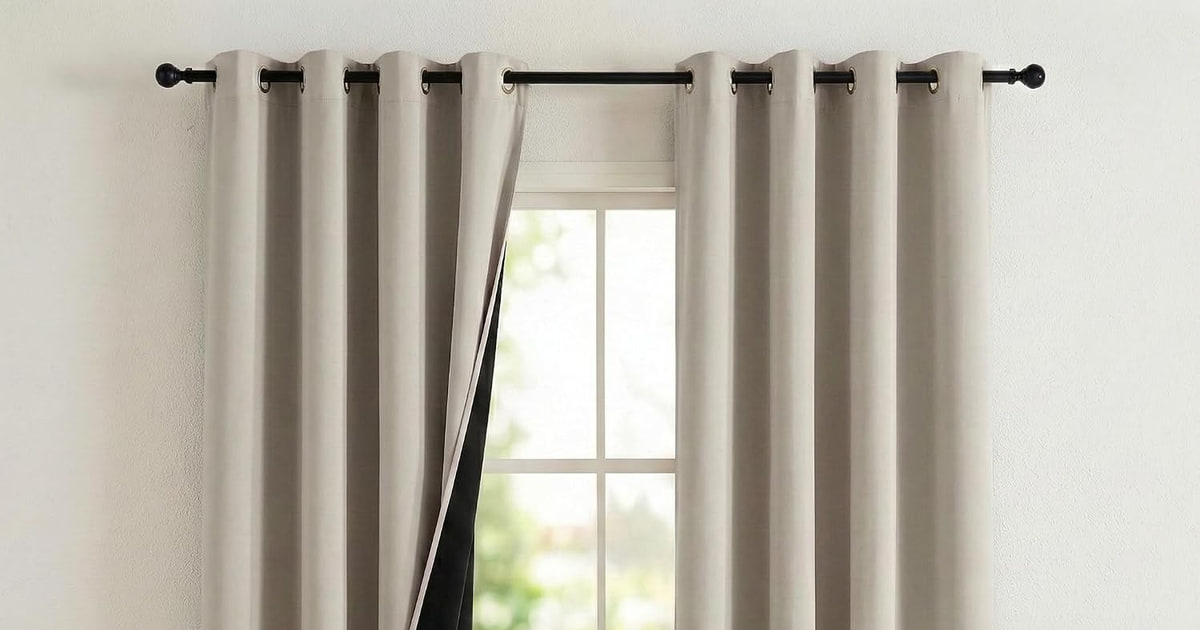
These faux-linen panels have a textured, slubby face that reads as real linen from across the room, backed with a white blackout lining. They're for anyone who's avoided blackout curtains because most of them look flat and institutional in a nicely furnished space.
$27.95fromAmazonList priceMost blackout fabric has a dull, matte look that gives away what it's doing. H.VERSAILTEX gets around that with a linen-look polyester face that has visible texture and depth, then hides a full blackout lining behind it. From inside the room, you see linen. The result works well in a bedroom that doubles as a sitting area, or a guest room where the curtains are part of the decor rather than just hardware.
The white backing is the detail worth knowing about. Most blackout liners are a dingy grey, which is what your neighbors see from the street. These use a white flocked backing instead, so the outside of your house looks tidier and more uniform if you have several windows facing the same direction. It's a small thing until you notice it on somebody else's house.
Owner feedback here skews strongly positive on the light blocking, and the pattern in it is telling: people mention east-facing bedrooms, patio doors and full-sun kitchens, and they describe rooms getting noticeably cooler, not just darker. A few say it darkens rather than fully blacks out — usually in rooms where the panels don't overlap the frame. That's the same fit issue that affects every curtain here.
Eight anti-rust grommets fit rods up to about 1.5 inches, and the pair covers 104 inches of rod when closed. The panels arrive wrinkled — that's the one consistent complaint — but a low iron or a pass with a steamer takes care of it in a few minutes. After that they hold their shape well; the fabric is stiff enough to keep a clean vertical fold.
Flaws but not dealbreakers
The textured face grabs lint and pet hair more readily than a smooth panel does, and it's harder to brush off because the fibers catch. If you have a shedding dog, factor that in.
Panels top out at 52 inches wide, so a wide window or a sliding door needs several. And while the thermal performance is real, a dense flat weave will hold heat back a bit better than a textured face will.
Budget pickOn sale
Solid room darkening for the price, with less of everything else
Deconovo Blackout Curtains 84 Inches Long
Deconovo's panels come as a pair of 52-by-84-inch curtains with both back tabs and a rod pocket, so you can hang them two ways. They block a lot of light without claiming to block all of it, which is a more honest framing than most of the category offers.
$15.98fromAmazonList priceThe listing says 85 to 99% light blocking, and that range is the point. This is room darkening done well rather than true blackout, and for a lot of people that's exactly right. If you're covering a bedroom window that faces a streetlight, or a kid's room that gets the morning sun, this handles it. Owners who bought them specifically for east-facing rooms consistently say the morning sun stops being a problem.
The dual header is more useful than it sounds. Back tabs give you a clean, tailored fold with no visible hardware. The rod pocket lets you slide them onto a tension rod with no drilling — useful in a rental where you can't put holes in the wall. Most panels commit to one style. Being able to switch after you've hung them means you're not stuck if the look isn't right.
These carry OEKO-TEX Standard 100 certification, tested against formaldehyde, heavy metals and a hundred-plus other standards. That's the same certification the top pick's factory holds, and it's unusual to find at this end of the market. If you're outfitting a nursery on a budget, it matters.
The pair weighs about three and a quarter pounds, which is noticeably lighter than the top pick. That's a trade-off in both directions: they're easier on a lightweight rod and simpler to wash, but they don't hang with the same weighty drape and they won't sit as flat against the wall. The fabric is wrinkle-resistant, so they come out of the dryer ready to hang.
Flaws but not dealbreakers
The fabric feels like what it costs. Several owners describe it as looking cheap up close, even while being happy with how it performs. From a few feet away it's fine; standing next to it, you can tell.
This won't get you a genuinely pitch-black room. Owners who need real blackout — night-shift workers especially — describe having to work at it: overlapping the panels, mounting the rod high, sometimes adding a second layer. If total darkness is the requirement, spend more.
Runner-upOn sale
Made for the small, awkward windows the standard sizes miss
RYB HOME Grey Blackout Curtains - Thermal
RYB HOME sells this pair at 42 by 45 inches, a short-and-narrow size aimed at bathrooms, kitchens, basements and RVs. It's a triple-weave fabric with a three-inch rod pocket that also works with clip rings if you want a different look.
$13.95fromAmazonList priceMost blackout curtains come in 84 inches long because most windows are that tall. But plenty aren't. A basement window sitting high on the wall, a kitchen window over the sink, a bathroom window you need covered for privacy — an 84-inch panel puddles on the floor or looks absurd. This size fills a real gap, and it's why it earns a spot here rather than a mention in the competition.
Privacy is the underrated job these do. A thick, opaque panel on a ground-floor bathroom or a street-facing kitchen window means nobody sees a silhouette at night. Sheers and light-filtering panels don't do that once the lights are on inside. If you've been putting off dealing with a window that faces a sidewalk, this is the straightforward fix.
The triple-weave fabric blocks 85 to 99% of light in the darker colors like grey and black, and less in the lighter shades — RYB HOME says so directly in the listing, which is more candor than the category usually offers. Owners back this up. The consistent theme is thick fabric that keeps rooms cooler and takes the edge off street light, described as good enough rather than total.
The three-inch rod pocket takes most standard rods, or you can skip it and use clip rings for a more relaxed, casual hang. In a kitchen or a laundry room, clip rings look less formal and make it easier to push the panels aside when you need the window open.
Flaws but not dealbreakers
Don't buy these expecting a dark bedroom. The most common critical note from owners is exactly that — nice curtains, not blackout curtains — and it comes up most often in rooms with west-facing windows and strong afternoon sun. For a bedroom where you need real darkness, look at the top pick.
Panels arrive creased from shipping and need a steam or a low-heat iron before they'll hang properly. And at 42 by 45 inches, the size that makes them useful for small windows also makes them useless for anything standard.
Who this is for
Buy these if light is waking you up earlier than you want, or keeping you from sleeping at all. Night-shift workers get the biggest benefit, since a bedroom in full daylight is dramatically brighter than anything your body expects during sleep. Parents of babies and toddlers are next — a dark room reliably stretches naps. And if you live somewhere with brutal summers or drafty single-pane windows, a dense panel over the glass makes a real dent in how hard your HVAC works.
This guide covers ready-made polyester blackout panels for residential windows, the kind you buy off the shelf and hang the same day. It doesn't cover custom drapery, blackout roller shades, cellular blinds or the temporary stick-on film people use in hotels. If you're chasing total darkness and you've already tried curtains, a blackout shade mounted inside the window frame will beat any panel, because the frame stops the light at the edges. Curtains are the better choice when you want the window to look like part of a room rather than a piece of equipment.
How we picked
We built the shortlist around five things. Light blocking: we set manufacturer claims against what owners describe in their own rooms, and trusted the gap between them more than either one alone. Construction: woven blackout layers beat coatings and foam backings, which crack and delaminate over a few years of washing. Sizing: panel dimensions had to fit real windows, including the short and narrow ones that standard 84-inch panels ignore. Upkeep: everything here washes in cold water on a gentle cycle, and we read owner feedback for fading and shrinkage. Materials safety: for nurseries, OEKO-TEX Standard 100 certification carried real weight, since it requires independent testing against formaldehyde and heavy metals.
The competition
This is what our research surfaced among widely sold blackout panels, not a survey of everything available. The category is enormous and turns over constantly, and plenty of good curtains never come up in a search for the popular ones. Here's the remaining product we looked at and why it didn't make the picks.
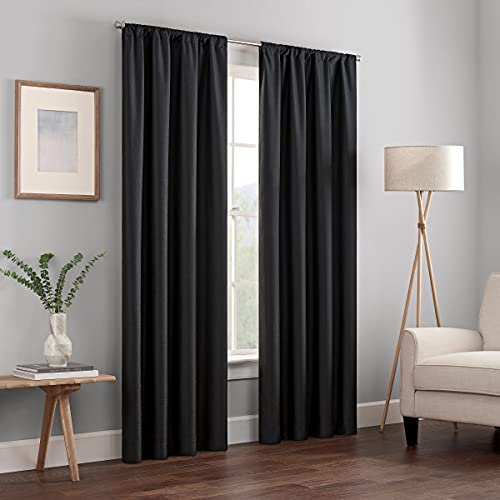
The ECLIPSE Kendall Modern Blackout Thermal Rod Pocket ($13.22) — Eclipse's Kendall panel is one of the most widely bought window treatments in the country, and its Thermaback foam backing genuinely helps with heat — owners in hot climates keep coming back to that. But it's sold as a single panel at 42 inches wide, so a standard bedroom window needs two purchases and a wide one needs more. Eclipse's own listing says 98 to 99.9% light blocking, and owner feedback backs that up with a recurring theme of visible light coming through. A few describe it as closer to 70% darkening in practice. The foam backing is also the weak point over time; it's the layer most likely to stiffen or separate after repeated washing, and owners who kept these for years mention that they don't wash well. Buy it if you want the thermal benefit at the lowest outlay and you're covering a narrow window, or if you'd rather pick it up locally and return it easily. For a bedroom where you need real darkness, the top pick is a better use of the money.
Hanging and sizing notes
Two adjustments matter more than which brand you buy. First, get more width than your window. Your panels together should span four to six inches wider than the opening, two or three inches past the frame on each side, so the fabric overlaps the wall instead of stopping at the glass. Second, mount the rod four to six inches above the casing, not right on top of it. That kills the bright band that otherwise appears above the curtain at sunrise. Beyond that: wash in cold water on a gentle cycle, tumble dry low, skip the bleach, and use a low iron or a steamer on the creases that come from being folded in a bag. Heavy panels need a sturdy rod with brackets anchored properly — a thin tension rod will bow in the middle under five pounds of fabric.
Questions we get
What's the difference between blackout and room-darkening curtains?
Room-darkening panels block roughly 85 to 99% of light, which leaves a faint glow through the fabric when the sun hits the window directly. True blackout uses a triple-weave or a full blocking liner and stops essentially all of it. The distinction matters most for night-shift workers, babies and anyone who wakes at the first hint of light. But either type will leak around the edges if the panels are too narrow or the rod sits too low, so fit determines your results as much as fabric does.
Do blackout curtains actually lower energy bills?
They help, though the effect depends on your windows. A dense panel over the glass slows heat coming in during summer and slows it leaving during winter, and manufacturers across the category cite thermal insulation as a core benefit. Owners in hot climates consistently report rooms staying noticeably cooler and their air conditioning cycling less. The gain is biggest on old single-pane windows with south or west exposure, and much smaller on modern double-pane glass.
Which of these is best for a nursery?
The Deconovo panels and the NICETOWN panels both come from OEKO-TEX Standard 100 certified fabric, which means independent testing against formaldehyde, heavy metals and more than a hundred other standards. That matters in a small room where a baby spends most of the day. Between the two, NICETOWN blocks light more completely, so it's the better call if naps are the whole point. Deconovo costs less and still darkens a room well.
How wide should my curtains be?
Add four to six inches to your window's total width — two or three inches of overlap past the frame on each side. For a 40-inch window with two panels, each panel should be at least 42 inches wide. Then mount the rod four to six inches above the casing. These two moves eliminate most complaints about light gaps, and they matter more than which brand you buy.
Can blackout curtains cut down on noise?
A little, not a lot. Dense multi-layer fabric adds mass at the window, and several of these listings mention noise reduction as a secondary benefit. It's enough to soften traffic hum or a barking dog, roughly the difference light earplugs make. It won't do much about bass, sirens or a leaf blower, so pair it with a white noise machine if sound is your main problem.
How do I hang these in a rental without drilling?
A tension rod inside the window frame works for lighter panels on openings up to about four feet. The rod-pocket header on the RYB HOME and Deconovo panels slides straight onto one. Heavier panels are harder — five pounds of fabric will bow a tension rod, so use adhesive rod hooks rated for the weight instead. Mounting inside the frame also costs you the wall overlap that stops side light, so expect a bit more glow at the edges.
Why you should trust us
For this guide:
- We read the full specification sheet and manufacturer claims for every panel in this guide, and compared those claims against each other rather than taking them at face value.
- We went through published owner feedback for each product, looking for patterns in what people report about light leakage, washing durability and how the fabric holds up over years rather than weeks.
- We weighted independent certifications like OEKO-TEX Standard 100 because they represent third-party laboratory verification rather than a marketing claim.
- We read owner reviews on every listing, weighted toward the critical ones, because that is where the recurring failures show up.
- We have a systematic way of automatically fetching the latest prices, so the numbers on this page stay current.
- This is a research-focused guide, so the team may not own every product listed — though we often do own the top winners, which gives us extra context for the recommendations.
- We don't accept free products, and the retailer commission never changes which product we recommend.
Sources
Best Blackout Curtains of 2026 — Wirecutter, The New York Times, Wirecutter / The New York Times
Best Blackout Curtains Tested by Good Housekeeping Institute, Good Housekeeping
Best Blackout Curtains — Bob Vila Expert Reviews, Bob Vila
Window Coverings Energy Savings Guide — U.S. Department of Energy, U.S. Department of Energy
Best Blackout Curtains for Every Budget — Forbes Home, Forbes Home
Blackout Curtain Reviews and Buying Guide — Sleep Foundation, Sleep Foundation
How Blackout Curtains Affect Sleep Quality — National Sleep Foundation, National Sleep Foundation
Best Blackout Curtains — Real Simple Home Lab Tests, Real Simple
Amazon product listings and owner reviews for all 5 products
Manufacturer specification pages for each product
Some passages in this guide may be paraphrased with AI help. Prices are refreshed automatically.
More like this.
Continue exploring home reviews and recommendations.

The Best Blackout Curtains for Bedrooms
A dark bedroom is one of the simplest sleep upgrades you can make. Research published in the Journal of Clinical Sleep Medicine found that even dim light…

The Best Blackout Roller Shades for Bedrooms
A bedroom that stays dark past sunrise changes how you sleep. The Sleep Foundation notes that light exposure during sleep suppresses melatonin and shifts…

The Best Shower Curtain Liners
A liner has one job: keep water in the tub and stay clean while it does. Most people don't think about it until the bottom edge turns pink and speckled.…

The Best Humidifiers for Large Rooms and Bedrooms
Dry indoor air is a problem you feel before you name it. You wake up with a scratchy throat, your lips crack, static shocks you every time you touch a…

The Best Smart RGB LED Strip Lights for Bedrooms
Bedroom light gets used in a specific way. You want a soft glow behind the headboard at night, something bright enough to find a charging cable, and a…

The Best Blackout Silk Sleep Masks
A sleep mask has one job, and most of them do it about halfway. You put it on, close your eyes, and then a thin wedge of streetlight or a partner's phone…