The Best Clumping Cat Litter for Odor Control
A litter box lives in your home, usually in a bathroom or a laundry room with the door shut. So the litter you buy is really a decision about what your house smells like. The two things that matter most are how hard the clumps set and whether the formula neutralizes ammonia or just covers it. Weak clumps crumble when you scoop, and the leftover residue sinks to the bottom of the box where no deodorizer reaches it. That's the smell you notice three days later.
Here's the honest part: no litter fixes a box you don't scoop. Every formula in this guide is rated for somewhere between two weeks and a month, and owners of two or more cats routinely report getting about half that. Dust is the other universal compromise. Clay litters that clump hard grind down into powder over time, and owners of even the low-dust formulas describe a haze when they pour a fresh bag or dig through an old one. Lightweight plant-based litters solve the dust and the hauling, but they cost more per pound and clump softer.
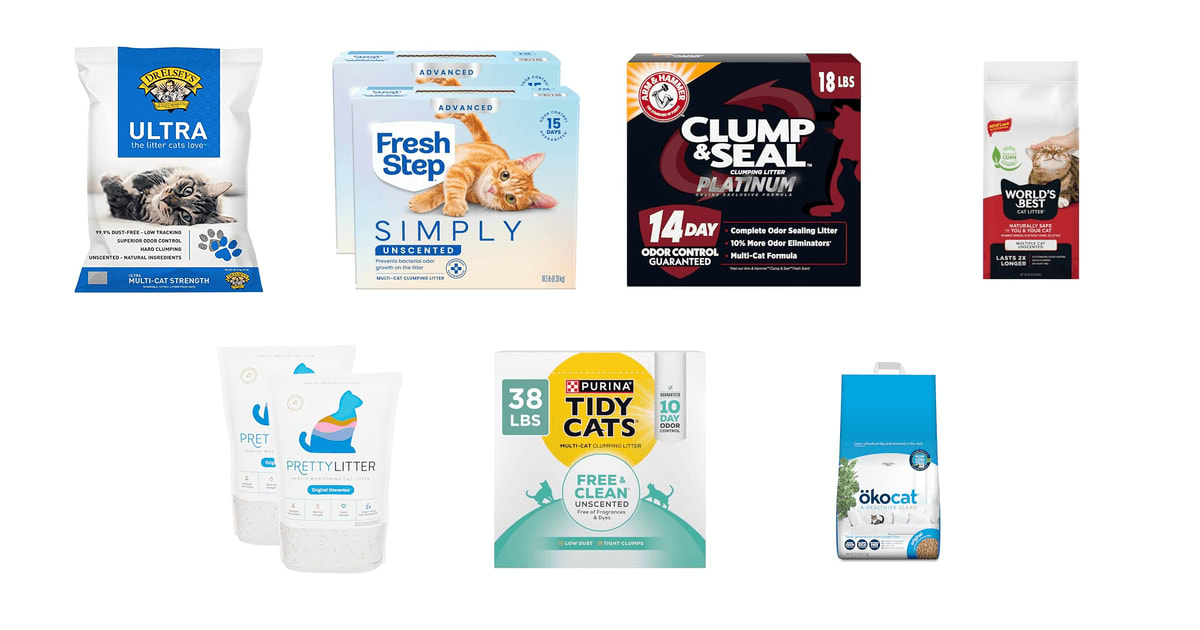
We think that the Dr. Elsey's Ultra UnScented is the best clumping cat litter for odor control for most people, and that the ARM & Hammer Clump & Seal Platinum is the one to buy if you have several cats or a small apartment where odor has nowhere to go.
Everything we recommend

Hard clumps and low dust, in a bag you'll have to lift

The strongest odor sealing here, in a smaller bag

Fragrance-free charcoal clay that's easy to find anywhere
Flushable corn that clumps, if you'll pay more per pound
At a glance
| Product | Material Type | Odor Control Claim | Price | |
|---|---|---|---|---|
| Dr. Elsey's Ultra UnScented Clumping Clay CatTop pick | Bentonite Clay | Superior Odor Control | $20.99On sale |
 | Fresh Step Advanced Simply Unscented Multi CatAlso consider | — | 15-Day Odor Control | $25.99 |
| ARM & Hammer Clump & Seal PlatinumRunner-up | — | 14-Day Odor Control | $17.99 |
| WORLD'S BEST CAT LITTER Multiple Cat UnscentedAlso great | Whole-Kernel Corn | Outstanding Odor Control | $39.94 |
 | PrettyLitter Health Monitoring Cat LitterAlso in lineup | Silica Gel Crystals | Advanced Odor Control | $48.98 |
| Purina Tidy Cats Free and Clean UnscentedBudget pick | Clay | Litter Box Odor Control | $25.99 |
 | ökocat Original Wood Clumping Cat LitterAlso consider | Wood Fiber | Exceptional Odor Control | $19.97 |
How we picked
Clump strength. We weighted clump firmness above almost everything else, because a clump that breaks leaves ammonia residue at the bottom of the box. We looked for formulas that owners repeatedly describe scooping out whole, not in crumbs.
Odor chemistry. We favored litters that neutralize ammonia — baking soda, activated charcoal, plant enzymes — over anything that leans on fragrance. Spec sheets tell you the mechanism; owner feedback tells you whether it survives a real box.
Dust and airways. We looked for a stated dust rating of 99% or better and then checked whether owners with asthmatic cats agreed. Several litters that certify well out of the bag get dustier as granules break down, and we noted that where it came up.
Weight and handling. We compared bag weights against how long each one lasts, since a cheap 40-pound bag isn't cheap if you can't carry it. Plant and crystal formats earned credit here.
Cat acceptance. We prioritized unscented formulas, because fragrance is one of the most common reasons cats stop using a box. Where a litter has an unusual texture, we flagged the transition period owners describe.
Top pickOn sale
Hard clumps and low dust, in a bag you'll have to lift
Dr. Elsey's Ultra UnScented Clumping Clay Cat
Dr. Elsey's Ultra is plain bentonite clay with no fragrance, no dye and no gimmicks. It clumps hard enough that scoops come out whole instead of crumbling, which is the single biggest factor in whether your box smells by day three.
$20.99fromAmazonList priceClump strength is the whole game, and this is where Dr. Elsey's wins. The medium-grain clay packs tight around urine within seconds and sets solid. When you scoop, the clump lifts out in one piece instead of shattering into damp crumbs. Those crumbs are what settles at the bottom of the box and turns into the ammonia smell you can't scoop away. Owners who've cycled through half a dozen brands consistently single this out as the one that clumps harder than what they used before.
It's unscented, and that's deliberate rather than cheap. Cats have far more sensitive noses than we do, and a floral or "fresh linen" litter is one of the more common reasons a cat starts going next to the box instead of in it. Fragrance also just masks — it sits on top of the ammonia rather than dealing with it. If someone in your house is sensitive to smells too, an unscented clay box is a lot easier to live with.
The dust claim is a certified 99.9% dust-free formulation, and owners with asthmatic cats or their own allergies buy it specifically for that. Pouring a bag doesn't throw the cloud that cheaper clay does. Worth knowing, though: owner feedback is split here. Several people report that dust climbs noticeably once the granules have been broken down by weeks of scooping. It's dust-free out of the bag, not dust-free forever.
The bag is 40 pounds, which is both the reason it's cheap per pound and the reason some people won't buy it. That's a real amount of weight to get from the porch to the litter closet. If you can handle it, though, the math is hard to argue with — this is one of the least expensive litters here on a per-pound basis and it outperforms plenty of formulas that cost more.
Flaws but not dealbreakers
Forty pounds of clay is genuinely unwieldy. There's no handle worth the name, and if you have stairs, a bad back or limited mobility, this is the wrong bag. The plant-based options weigh a third as much for a comparable number of weeks.
It's clay, so it goes in the trash and stays in a landfill. Never flush it. And tracking is moderate — medium grain migrates out of the box on paws more than larger wood pellets or crystals do, so plan on a mat and a regular sweep.
Runner-up
The strongest odor sealing here, in a smaller bag
ARM & Hammer Clump & Seal Platinum
Clump & Seal Platinum embeds baking soda micro-granules through the clay that activate on contact with moisture. If you have three cats, or a studio apartment where the box is fifteen feet from the couch, this is the formula to reach for.
$17.99fromAmazonBaking soda neutralizes ammonia chemically, which is different from absorbing it. Ammonia is alkaline; baking soda reacts with it. That's why this formula holds up in high-traffic boxes where a clay-only litter starts losing ground by day four. Arm & Hammer rates the Platinum tier for 14 days in multi-cat homes, and owners of one or two cats generally back that up.
The clumps set rock-hard — arguably harder than anything else here. Several owners who run automatic litter boxes and litter robots chose it for exactly that reason, because a crumbling clump is what jams a rake mechanism. The listing confirms it's cleared for automatic boxes. If you've had a self-cleaning box throw errors on a softer litter, this is a sensible swap.
Set expectations on the 14 days, though. Owner reports on that number vary a lot with cat count. With two cats and daily scooping, several people describe getting closer to a week before they want a full change. That's still good — it's just not the number on the bag. Treat 14 days as the ceiling for a single-cat box, not the floor for a busy one.
The bag is 18 pounds, less than half the Dr. Elsey's, so you'll reorder more often and pay more per pound. What you get for that is the most aggressive odor chemistry in this guide. In an apartment with a bathroom that has no window, that trade is easy to make.
Flaws but not dealbreakers
It's sold as an odor-control litter rather than a scent-free one, and there's a light fragrance to it. Most owners don't mind and some like it, but a few specifically wish it came unscented. If your cat has already rejected a scented litter, start elsewhere.
The small bag adds up. You're buying more often and spending more per pound than the top pick, and it's clay, so there's no flushing or composting it.
Budget pick
Fragrance-free charcoal clay that's easy to find anywhere
Purina Tidy Cats Free and Clean Unscented
Tidy Cats Free and Clean pairs natural clay with activated charcoal and skips the dyes and perfumes entirely. For one cat and a daily scoop, it holds odor about as well as formulas that cost noticeably more per pound.
$25.99fromAmazonActivated charcoal works by trapping odor molecules in a huge amount of pore surface, and it does the job here without any added scent. Owners with allergy-prone cats and asthmatic households pick this one specifically because there's nothing in it to irritate anybody. If your cat has walked away from a perfumed litter before, this is a safe landing spot.
The clumps are tight and the box is easy to keep clean. That matters more than the marketing on the front of the box. Owners describe firm clumps that lift out whole and a dust level they'd call low but not zero — pour it slowly and you'll be fine. For a single-cat box scooped every day, plenty of people report their house simply doesn't smell.
It comes in a 38-pound box that's stocked at basically every grocery and pet store, which is worth something on the Sunday you realize you're out. The downside of the box format is the same one owners keep raising: there's no good handle, so carrying it in from the car is awkward.
Where it gives ground is heavy multi-cat use. With three or more cats, odor accumulates faster than charcoal alone keeps up with, and you'll notice the box sooner than you would with the Arm & Hammer. For one or two cats, that gap mostly disappears.
Flaws but not dealbreakers
It's not the pick for a crowded house. Owners with several cats find the odor control fades faster than the sealing formulas, and no amount of scooping frequency fully closes that gap.
Poured fast, it kicks up a moderate amount of dust. It's clay, so it's landfill-bound and never flushable.
Also great
Flushable corn that clumps, if you'll pay more per pound
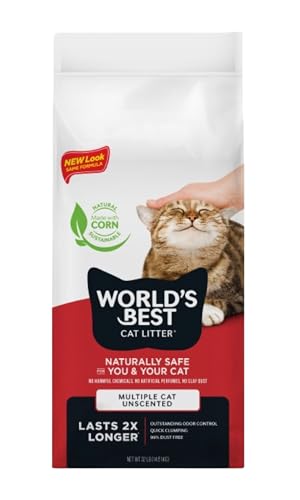
WORLD'S BEST CAT LITTER Multiple Cat Unscented
World's Best is whole-kernel corn rather than clay, which makes it flushable, biodegradable and much lighter to carry. Owners who switch from clay for environmental reasons generally report the odor control holds up, which isn't true of every plant-based litter.
$39.94fromAmazonCorn starch clumps on contact, and that's the mechanism, not a marketing line. The granules bind around urine fast enough that you're not chiseling anything off the bottom of the pan. The clumps set a bit softer than premium clay — owners notice — but they hold together well enough to scoop cleanly, which is the bar that actually matters.
Because it's plant fiber, it's naturally free of clay dust. There's no silica processing byproduct in it at all, which is a genuine benefit if your cat has respiratory trouble or you're the one who ends up breathing the box. Owners repeatedly describe the pour as clean compared with the clay they came from.
It's flushable, which is the reason a lot of people buy it. Check your municipality first, because some systems prohibit flushing cat waste regardless of the litter. One manufacturer instruction is worth following literally: don't mix this with a non-clumping litter, because it wrecks the clump integrity you're paying for.
It's a 32-pound bag, considerably lighter to handle than the top pick, and owners with several cats report it lasts a long time between full changes. Per pound it's a good deal more expensive than clay. Whether that's worth it comes down to how much you care about what leaves your house in a trash bag.
Flaws but not dealbreakers
There's a faint corn smell to it. Most owners don't mind and some prefer it to perfume, but it's detectable and it isn't for everyone.
The clumps are softer than the clay picks, so a gentle scoop hand helps. Some tracking is normal, and switching a clay-raised cat over usually needs a gradual mix rather than a hard swap.
Who this is for
This guide is for anyone whose litter box has started announcing itself — you scoop, and by the middle of the week the room smells anyway. If that's you, the fix is usually a harder-clumping litter, a deeper fill of three to four inches, and a full box change and wash every two to four weeks. Any of the picks here will improve a box that's currently on a cheap, crumbly clay. If your cat is already happy and your house doesn't smell, there's no reason to switch.
We stuck to litters you can buy in a bag or box and pour into a standard pan, which is what the vast majority of people need. We're not covering litter boxes, mats, deodorizing additives or subscription-only formulas here. One product in this lineup isn't technically a clumping litter at all — we included it because it competes directly for the same shelf space and the same problem, and we say so plainly below.
How we picked
Clumping: we ranked hard, non-crumbling clumps first, because broken clumps leave ammonia-saturated residue that no deodorizer overcomes. Odor chemistry: we favored neutralization — baking soda, activated charcoal, plant enzymes, silica micropores — over fragrance masking, and we checked manufacturer odor-control windows against what owners actually report. Dust: we looked for 99% dust-free or better and cross-checked against feedback from allergy and asthma households, including complaints about dust rising as granules break down. Weight: we weighed bag size against how long it lasts, since the per-pound bargain stops being one if the bag is too heavy to carry. Acceptance: we prioritized unscented formulas and flagged textures that need a slow transition.
Other clumping cat litter for odor control worth considering
If you run an automatic litter box and want no fragrance at all: The Fresh Step Advanced Simply Unscented Multi Cat ($25.99) — Fresh Step Advanced Simply Unscented is clay with activated charcoal and what Fresh Step calls Ammonia Block Technology, rated for 15 days — the longest stated window in this lineup. It's explicitly certified for automatic self-cleaning boxes, and it ships as two 18.5-pound boxes rather than one back-breaking bag, which is easier to carry and easier to store. Owners are consistently positive about the odor control and the tight clumps. The recurring complaint is dust: several people describe a real cloud when they scoop, enough to settle on everything in the laundry room. It also tracks more than some. Per pound it costs more than our top pick, so buy it for the automatic-box certification and the two-box format rather than on price.
If you want a compostable litter and a light bag: The ökocat Original Wood Clumping Cat Litter ($19.97) — ökocat Original Wood uses precision-cut reclaimed wood fiber that blocks the enzymes responsible for producing ammonia in the first place — a different approach from clay or corn. It's 99% dust-free with no clay-processing residue, compostable, and at 12.6 pounds it's the easiest bag here to carry upstairs. Owners who love it really love it, and they describe the box smelling like fresh-cut lumber rather than anything else. But it's the most expensive litter here per pound by a wide margin, the wood scent is noticeable enough that some cats and some people object, and the tracking complaints are frequent and emphatic — especially from owners of long-haired cats. Feedback on this one is more polarized than on any other product in the guide, so buy a small bag before you commit.
The competition
This is what our research surfaced in this category, not a map of everything on the shelf. The litter aisle is enormous and turns over constantly. The product below didn't lose on quality — it's a different kind of thing solving an adjacent problem, and it's worth understanding before you rule it in or out.
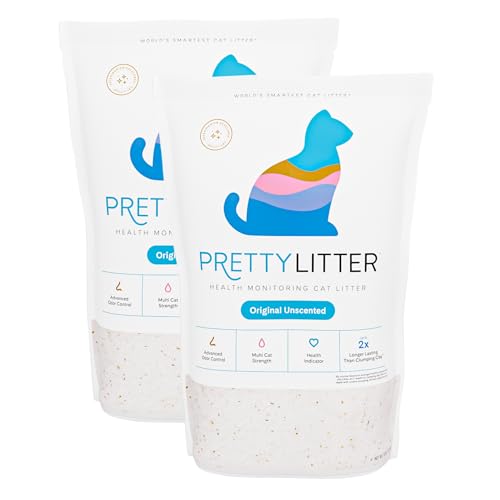
The PrettyLitter Health Monitoring Cat Litter ($48.98) — PrettyLitter Health Monitoring is silica gel crystal, and it doesn't clump at all — the crystals absorb urine through micropores and dehydrate solid waste, so you scoop the poop and stir the rest. That's a genuine departure from everything else in this guide, and it's the reason it isn't a pick: if you came here for clumping, this isn't it. What it does that nothing else can is change color based on urinary pH and the presence of blood, flagging possible UTIs, kidney disease or bladder crystals early. For a senior cat, or one with a urinary history, that's worth real money. It's also up to 80% lighter than clay, low-tracking, and 12 pounds covers roughly two months for one cat. Owners are enthusiastic, and the main hesitations they raise are cost and the crystal texture, which some cats refuse. Choose it for the health monitoring, not the odor control — though the odor control is genuinely good.
Switching litters without a protest
Cats notice texture and scent changes immediately, and the usual protest is going next to the box instead of in it. Switch gradually: mix a quarter new litter into three quarters old for the first three days, go half and half through day seven, then three quarters new through day ten. That slow ramp matters most when you're crossing material types — clay to corn, or clay to wood — because the feel underfoot changes more than the smell does. Give crystals up to two weeks, since the texture gap from clay is the biggest of any switch here. While you're at it, keep the litter three to four inches deep so clumps have room to set, and wash and fully dry the box every two to four weeks. Fresh litter poured into a dirty pan will smell within days.
Questions we get
What's the best cat litter for multiple cats?
ARM & Hammer Clump & Seal Platinum is the strongest option here for a busy box — the baking soda micro-granules neutralize ammonia chemically and it's specifically formulated for multi-cat homes. Fresh Step Advanced Simply Unscented is a close second with a 15-day stated window and activated charcoal. Both treat ammonia rather than covering it, which is the distinction that matters when waste volume is high. Expect the stated day counts to shrink with three or more cats.
Is unscented or scented litter better for odor control?
Unscented, almost always. Fragrance sits on top of ammonia rather than neutralizing it, so you get perfume plus litter box instead of neither. Cats also have far more sensitive noses than we do, and scented litter is one of the most common triggers for a cat abandoning the box. Unscented formulas built around charcoal, baking soda or plant enzymes deal with the ammonia itself.
How often should you change the litter completely?
With daily scooping, plan on a full change every two to four weeks for clay litters and every three to four weeks for corn. Crystal litters like PrettyLitter are designed around a monthly change per cat. Wash the empty box with soap and water and dry it completely before refilling — bacteria and ammonia residue on the plastic will out-stink any fresh litter you pour on top.
Does baking soda actually help?
Yes. Ammonia is alkaline and baking soda reacts with it directly, so it neutralizes rather than just absorbing. That's the mechanism behind ARM & Hammer Clump & Seal Platinum, which distributes the micro-granules throughout the clay so they activate wherever moisture lands. Sprinkling plain baking soda into any litter helps a little, but it settles to the bottom instead of staying where the urine is.
Why does my box still smell even though I scoop daily?
It's usually one of three things. Your clumps are breaking during scooping and leaving ammonia-soaked residue at the bottom of the pan, the box itself is overdue for a wash, or the litter is too shallow for clumps to form properly — three to four inches is the working minimum. Switching to a harder-clumping formula fixes the first one, and it's the most common culprit by far.
What's the best low-dust litter for an asthmatic cat?
Dr. Elsey's Ultra is certified 99.9% dust-free and is the usual recommendation, though some owners note dust rising once the granules break down over weeks of scooping. ökocat Original Wood and World's Best are 99% dust-free with no clay processing at all, which sidesteps the problem entirely. All three are fragrance-free, which matters just as much — perfume is a second airway irritant on top of the dust.
Why you should trust us
For this guide:
- We compared manufacturer spec sheets and listing claims for every litter here — dust ratings, clumping mechanism, stated odor-control windows and automatic-box compatibility.
- We read published reviews and owner feedback across all seven products, weighting recurring themes like dust, tracking and how long the odor-control window actually lasts over one-off complaints.
- We did not test, pour or scoop any of these litters ourselves; every claim here traces back to a specification, a published review or the pattern of what owners report.
- We read owner reviews on every listing, weighted toward the critical ones, because that is where the recurring failures show up.
- We have a systematic way of automatically fetching the latest prices, so the numbers on this page stay current.
- This is a research-focused guide, so the team may not own every product listed — though we often do own the top winners, which gives us extra context for the recommendations.
- We don't accept free products, and the retailer commission never changes which product we recommend.
Sources
Best Cat Litter of 2026 — The Spruce Pets, The Spruce Pets
The Best Cat Litter, Tested by Our Editors — Good Housekeeping, Good Housekeeping
Best Cat Litter 2026: Tried and Tested Options — Forbes Vetted, Forbes Vetted
Cat Litter Reviews and Ratings — Consumer Reports, Consumer Reports
Clumping vs. Non-Clumping Cat Litter: Which Is Better? — PetMD, PetMD
Litter Box Problems in Cats — Cornell Feline Health Center, Cornell Feline Health Center
Cat Litter Box Problems — ASPCA, ASPCA
Feline Environmental Needs Guidelines — American Association of Feline Practitioners, American Association of Feline Practitioners
Amazon product listings and owner reviews for all 7 products
Manufacturer specification pages for each product
Some passages in this guide may be paraphrased with AI help. Prices are refreshed automatically.
More like this.
Continue exploring pet reviews and recommendations.

The Best Self-Cleaning Litter Boxes
A litter box is the one piece of pet gear that quietly runs your schedule. Miss a day of scooping and the whole room lets you know. A self-cleaning box…

The Best Robot Litter Boxes
Scooping is the chore nobody in the house volunteers for. A robot litter box takes it off your plate: it senses when your cat steps out, waits a few…

The Best Pet Stain and Odor Removers
Pet accidents never happen at a convenient hour. You find the damp patch on the rug at midnight, or you smell it before you see it, and the clock starts…

The Best Smart Thermostats With Voice Control
A thermostat is one of the few gadgets in your house that you interact with while half-asleep, mid-argument about the temperature, or with both hands full…

The Best Quiet Ceiling Fans With Remote Control
A ceiling fan is one of the few appliances that runs while you sleep, so noise is the thing that decides whether you love it or resent it. A good one…

The Best Car Air Fresheners and Odor Eliminators
Your car is a small, sealed box that sits in the sun. Whatever happens in it stays in it - the gym bag, the spilled coffee, the wet dog, the fries that…