The Best Self-Cleaning Litter Boxes
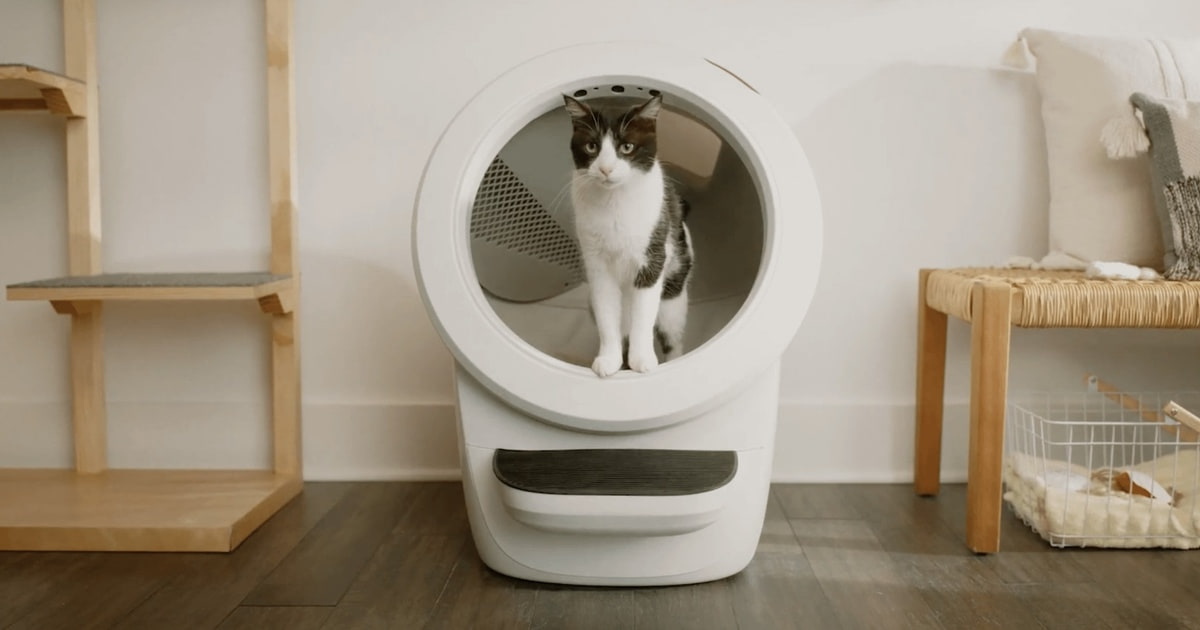
A litter box is the one piece of pet gear that quietly runs your schedule. Miss a day of scooping and the whole room lets you know. A self-cleaning box breaks that loop by sifting waste into a sealed drawer within minutes of each visit, so odor never gets the eight-hour head start it does with a manual box. That's the real payoff — not the novelty of a rotating globe, but the fact that a daily chore becomes a weekly one. If you've ever come home to a smell you could identify from the hallway, you already understand the appeal.
Here's the honest part. No self-cleaning box eliminates work. You still empty a drawer, top off litter, and pull the whole thing apart every month or two to scrub it. Cats need time to adjust — enclosed globe designs typically take two to four weeks before a cat uses them without hesitation, and open-top designs cut that in roughly half for skittish cats. These are motorized appliances with sensors and moving parts, and owner feedback across brands keeps circling back to the same worry: what happens in year three. Consumer Reports survey data points to motor and sensor failure over two-plus years as the single biggest factor in whether owners recommend their box at all.
We also want to be clear about scope. This guide covers automatic and mechanical self-cleaning boxes for indoor cats, and the lineup here reflects what our research surfaced rather than every model sold. We think that the Whisker Litter-Robot 4 is the best self-cleaning litter box for most people, and that the PETKIT PuraMax 2 is the one to buy if you want most of the same automation and app data without the premium price.
Everything we recommend

The most refined globe box, if you can pay for it
Nearly the same automation for a lot less money

Crystal trays and weeks of hands-off use, with a catch

The quietest globe, and the one that looks like furniture
No motor, no app, no subscription — just a roll and a tray
Prices as of Oct 22, 7:36 AM PT · Details
At a glance
| Product | Price | |
|---|---|---|
| Whisker Litter-Robot 4 with Step & FenceTop pick | $699 |
| PETKIT PuraMax 2 Odor Free Automatic CatRunner-up | $299.99 |
| Casa Leo Automatic Self-Cleaning Cat Litter BoxAlso great | $599 |
| PetSafe ScoopFree Crystal Pro Legacy Self-Cleaning LitterBudget pick | $129.99 |
 | PetSafe Healthy Pet Simply Feed Auto FeederAlso in lineup | $83.99 |
| Omega Paw Roll 'n Clean Self CleaningBudget pick | $66.99 |
Prices as of Oct 22, 7:36 AM PT · Details
How we picked
Cleaning mechanism. We favored designs that seal waste away within minutes of a visit, since that's the mechanism behind measurable odor reduction. Globe-rotation and sealed-drawer systems earned priority over open rake designs.
Cat safety sensors. We read specification sheets and published reviews for sensor type, count, and documented response times. Anything without redundant detection — infrared plus weight, or radar plus anti-pinch — didn't make the picks.
Size and cat weight. We compared interior dimensions and manufacturer weight ratings against real breed sizes. Boxes that top out below 20 pounds got flagged as unsuitable for Maine Coons, Ragdolls, and Siberians.
Noise and placement. We compared published decibel figures because a box near a bedroom lives or dies on this. Roughly 30 dB is unobtrusive, 50 dB is conversational, and past 65 dB is dishwasher territory.
Long-term reliability. We weighed owner feedback themes about motor and sensor failure past the two-year mark, which Consumer Reports survey data identifies as the top driver of whether owners recommend their box.
Cost of ownership. We accounted for proprietary trays, replacement filters, and subscription requirements rather than the sticker alone. Boxes that lock you into refills had to justify it with a real convenience gain.
Top pick
The most refined globe box, if you can pay for it
Whisker Litter-Robot 4 with Step & Fence
The Litter-Robot 4 sifts waste into a sealed carbon-filtered drawer after every visit and weighs your cat on the way out. Its globe fits cats up to 25 pounds, and the drawer typically goes eight to ten days for one cat before it needs emptying.
$699fromAmazonPrices as of Oct 22, 7:36 AM PT · Details
If you want one box to stop thinking about, this is it. The globe rotates after your cat leaves, drops clumps into a sealed drawer below, and returns clean litter to the bed. Whisker rates the interior at 16.5 inches wide and 18 inches tall, which fits cats north of 25 pounds — genuinely useful if you've got a Maine Coon who spills out of a standard pan. The included step and fence also cut down on litter tracked across your floor.
The drawer is the part you'll actually notice. Popular Science puts capacity at roughly eight to ten days for one average cat, so emptying becomes a weekly errand rather than a daily one. Whisker rates the box for up to four cats, though a busy three-cat home will realistically empty it twice a week. The app tells you when it's filling, which spares you the guessing.
Noise matters more than people expect, especially if the box lives near a bedroom. The LR4 runs at about 51 dB during a cycle — normal conversation volume. Rake-style boxes can spike past 65 dB, closer to a dishwasher. It's not silent, and you'll hear it rotate from the next room. But it won't jolt you awake.
The built-in scale is the feature that earns the price. It tracks each cat from 3 pounds up past 25 and logs weight trends in the Whisker app. Vets treat a sustained 5 to 10 percent change as an early flag for kidney disease, hyperthyroidism, or diabetes — the kind of drift you'd never catch by eye. Usage logs help too. A cat suddenly visiting six times a night is telling you something.
Whisker's customer support comes up again and again in owner feedback as the reason people stick with the brand, and that counts for a machine with a motor in it. Long-time owners report running the same unit for years and converting friends. That's a real signal in a category where post-sale service is often the weak link.
Flaws but not dealbreakers
It's the most expensive box here by a wide margin, and it can't be pushed against a wall — Whisker specifies clearance on all sides, which makes its already large footprint feel larger in a small apartment.
Owner feedback includes a recurring complaint about units losing their settings after the warranty window, with a base replacement as the fix. That isn't universal, but it's cited often enough that we'd take the extended warranty seriously if you plan to keep this for five years.
Not every cat converts. In multi-cat homes, owners commonly report one holdout who keeps using the old box while the others adapt. Plan for a few weeks of overlap, and don't retire your manual box on day one.
The Litter-Robot 4 comes with a one-year WhiskerCare consumer warranty, an optional extended plan, and a 90-day return window.
Runner-up
Nearly the same automation for a lot less money
PETKIT PuraMax 2 Odor Free Automatic Cat
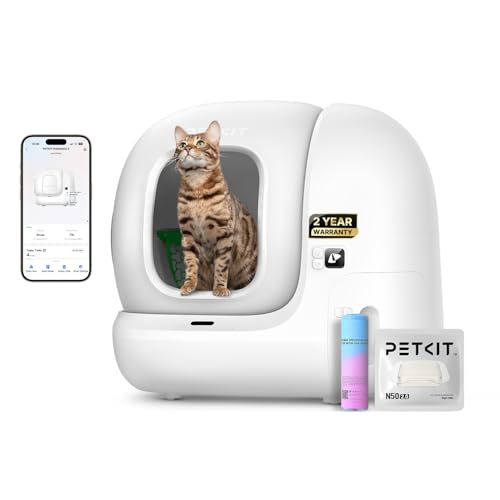
The PuraMax 2 gives you globe rotation, app control, weight-based cat identification, and a 76-liter interior that suits big cats. Its 7-liter waste bin runs about 15 days on the timer modes, and seven infrared sensors pause the drum when a cat comes near.
$299.99fromAmazonPrices as of Oct 22, 7:36 AM PT · Details
The pitch is simple: most of what the Litter-Robot does, for considerably less. You get a rotating drum, a sealed base, remote control from the PETKIT app, and automatic cat identification by weight. Owners who cross-shopped the premium brands and landed here consistently say they don't feel like they gave much up. That's the whole reason it's the runner-up rather than an also-ran.
Safety is where this box quietly overperforms. Seven infrared sensors and four weight sensors watch the entry zone, and the drum pauses when a cat approaches — not just when one is already inside. PETKIT's earlier Pura X used a dual-infrared system that stopped a cycle within 0.2 seconds of re-entry in independent lab testing. If nervousness about a motorized box is what's kept you on the fence, this is the reassurance worth reading twice.
The 76-liter interior handles cats from about 3.3 to 22 pounds, which covers most large breeds short of a genuinely enormous Maine Coon. Owners with three cats report it keeping up without constant intervention. The 7-liter bin claims roughly 15 days between changes, though that's a single-cat number — with three cats you'll be emptying it weekly, same as anything else.
It leans hard on Wi-Fi, and that's a real caveat rather than a footnote. Setup runs through the app on 2.4 GHz, and owners in homes with spotty coverage have found the experience diminished — you lose the usage data and remote modes that justify buying a smart box in the first place. If your litter box lives in a basement corner where your phone drops to one bar, check your signal before you order.
Deep cleaning is straightforward, which matters more over years than it does on day one. The sealed ShieldBase design keeps urine from working into seams, the litter pad has elastic edges to stay put, and the bundle includes a sifter and a magnetic litter remover. Small things, but they're the difference between a monthly scrub you'll do and one you'll skip.
Flaws but not dealbreakers
The app is central to the experience, not optional garnish. Without a solid 2.4 GHz signal at the box, you're left with a fairly ordinary automatic litter box and none of the tracking.
PETKIT says not to use it for kittens under six months, so this isn't the box for a household that's about to add a young cat. You'll need a conventional pan alongside it for a while.
Owner feedback is more mixed than the top pick's. Most people are happy, but the complaints that do appear tend to be about setup friction and connectivity rather than easily fixed one-offs.
PETKIT lists two-year coverage with this bundle.
Budget pick
Crystal trays and weeks of hands-off use, with a catch
PetSafe ScoopFree Crystal Pro Legacy Self-Cleaning Litter
The ScoopFree Crystal Pro Legacy rakes waste into a covered disposable tray filled with silica crystals that dry solids and absorb urine. For one cat, PetSafe says a tray lasts up to 30 days, and there's no app or Wi-Fi to configure.
$129.99fromAmazonPrices as of Oct 22, 7:36 AM PT · Details
This is the least complicated way to stop scooping. There's no globe, no app, no pairing process — a rake sweeps waste into a covered compartment on a timer, and the crystal litter handles the rest. The uncovered design also helps with cats who won't commit to an enclosed box. PetKeen's data suggests open-top self-cleaners win over hesitant cats in roughly half the time an enclosed globe takes.
Crystal litter is the whole argument here. Silica absorbs urine and dries solid waste, and PetSafe rates a tray at up to 30 days for a single cat. Forbes Vetted editors describe similar behavior — crystals holding odor for weeks where standard clumping clay starts announcing itself around day 7 to 10 in a room without much airflow. The crystals are also low-tracking and nearly dust-free, so less of the box ends up on your floor.
The trade-off is the trays themselves. You're buying proprietary refills forever, and per-month that costs more than scooping bulk clumping clay into a regular box. Run the math on your own cat before you commit. For one cat in an apartment, many owners decide the convenience is worth it. For three cats, the numbers get harder to defend fast.
The health counter is a modest but genuinely useful feature. Motion sensors log how often the box gets used, so a spike or a drop-off shows up as a number rather than a vague sense that something's off. It's nowhere near the per-cat weight tracking on the pricier picks. It's still better than nothing.
Long-run owner feedback on this one is encouraging in a category where that's rare. Multiple owners report three years of steady use, and it's one of the most widely bought automatic boxes on the market — which means the failure modes are well documented rather than surprising.
Flaws but not dealbreakers
Odor control depends entirely on changing trays on schedule. Owners who stretch a tray past its life report urine soaking through to the base and the smell escaping, and the tray lid doesn't always seat cleanly.
It's less hands-off than the marketing suggests. You're still swapping a full tray, wiping the rake, and buying refills — the work shrinks, it doesn't vanish.
The single-cat 30-day figure won't survive a multi-cat home. Two or more cats and you're changing trays weekly, which erodes the economics quickly.
Also great
The quietest globe, and the one that looks like furniture
Casa Leo Automatic Self-Cleaning Cat Litter Box
Leo's Loo Too pairs a rotating globe with UV odor control, a 1.5-gallon sealed drawer, and app-based weight tracking with no subscription. It runs at about 30 dB, which makes it the easiest pick to live with in a bedroom or studio.
$599fromAmazonPrices as of Oct 22, 7:36 AM PT · Details
Noise is the reason to look here first. Smarty Pear rates it at roughly 30 dB — quieter than the Litter-Robot's 51 dB and far below rake-style boxes that push past 65. If your only sensible spot for a litter box is a bedroom corner or a one-room studio, that gap is the whole decision. It also comes in colors that don't look like lab equipment, which sounds trivial until you're the one staring at it.
Odor control is more aggressive than most. The 1.5-gallon drawer is fully sealed, bamboo carbon filters sit in the airflow path, and a UV lamp targets bacteria in the drum. Good Housekeeping Institute testing found sealed-drawer automatic boxes cut ambient room odor by about 60 percent versus open boxes in identical 200-square-foot rooms. In a small apartment that difference is not subtle.
The app covers the essentials without charging you monthly: start a cycle remotely, watch the waste level, get alerts, delay cleaning, and track each cat's weight over time. It works with Alexa and Google Assistant too. No subscription fees is worth calling out — a few competitors gate features behind one.
Safety layers are thorough. Radar motion detection, four weight sensors, and anti-pinch protection all pause the drum when a cat approaches or steps in. The rated range runs from 1 to 20 pounds, which comfortably covers kittens on the low end. On the high end, a 22-pound cat is outside spec, and that's where the LR4 pulls ahead.
Flaws but not dealbreakers
The 20-pound ceiling and a drum that owners describe as slightly smaller than the Litter-Robot's make this the wrong choice for genuinely large breeds.
Owner feedback flags the control buttons as a weak spot — cats who urinate near the panel have degraded them, and replacements have been hit or miss. The company's support gets consistently good marks for handling it, but the part itself is the known failure point.
Longer-term owners are more measured than first-week owners. The pattern suggests small annoyances accumulate over six months rather than any single defect, so read this as good-not-flawless.
Smarty Pear provides a one-year limited warranty.
Budget pick
No motor, no app, no subscription — just a roll and a tray
Omega Paw Roll 'n Clean Self Cleaning
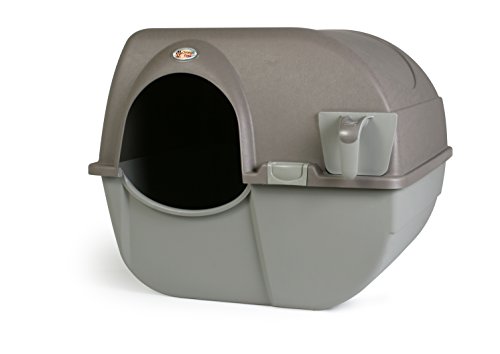
The Omega Paw Roll 'n Clean sifts waste through an internal grate when you tip it onto its top and roll it back. It needs no electricity, filters, or liners, and the whole cycle takes a few seconds of your time.
$66.99fromAmazonPrices as of Oct 22, 7:36 AM PT · Details
This is the answer if you don't want an appliance in your home. You roll the box over, roll it back, pull out a tray, and dump it. No motor to burn out, no sensor to misread a cat, no firmware update, no Wi-Fi. For renters, minimalists, or anyone who's watched a motorized box die in year three, the appeal is obvious and it costs a fraction of everything else here.
It handles big cats better than the price suggests. The large size measures about 21.5 by 18.5 inches at the base, and owners with cats up to 19 pounds — including Maine Coon mixes — report it working where standard pans didn't. It also runs on whatever clumping clay you already buy, so there's no proprietary supply chain attached.
The honest framing is that it's semi-automatic. You still perform the cleaning motion, you just don't scoop. That's a smaller convenience gain than a globe box that fires on its own after every visit. If your goal is never thinking about the box, this isn't that. If your goal is making a two-minute chore into a five-second one, it delivers.
It's also the most power-outage-proof option in this guide, and the one you can put anywhere — a closet, a basement, a spot with no outlet nearby. That flexibility genuinely matters in older apartments where outlets and litter box locations rarely line up.
Flaws but not dealbreakers
Plastic quality is the recurring complaint. Owners report rough cutouts, drawers that don't sit flush, and the interior grate popping loose — especially if you overfill the litter or your cat urinates against the grate.
Clumps that form against the grate can end up in the clean-litter chamber instead of the tray, which means periodically checking that the sifting is actually working.
Owner sentiment on this one is the most divided in the lineup. People who like it really like it, but the failure stories cluster around construction rather than concept.
Who this is for
Buy one of these if scooping is the part of cat ownership you've come to resent, or if you're away from home enough that the box goes untended for a day at a time. Multi-cat households get the most out of automation, because a box that cleans after every visit stays usable in a way a manual pan simply can't by dinnertime. If you're the kind of owner who'd like data on your cat's habits, the models with per-cat weight tracking turn the litter box into a quiet health monitor — and sustained weight drift is one of the earliest signals of kidney disease, hyperthyroidism, or diabetes.
Skip these if you have a kitten under six months, a cat recovering from surgery, or a genuinely fearful cat who's already particular about boxes. Most manufacturers set a minimum weight around 3 pounds, some exclude young cats outright, and acclimation to an enclosed globe runs two to four weeks. This guide covers automatic and mechanical self-cleaning boxes for indoor cats only. It doesn't cover litter itself, standard covered pans, litter cabinets, or accessories and replacement parts for boxes you already own.
How we picked
We started from specification sheets, published reviews, and owner feedback themes, then filtered on the things that determine whether a box still works a year in. Cleaning mechanism: waste has to be sealed away within minutes of a visit, not left exposed until the next timer fires. Safety: redundant detection — infrared plus weight sensors, radar, anti-pinch — with a documented pause response. Size: interior dimensions and weight ratings checked against real breeds, because a 22-pound cat rules out several popular models. Noise: published decibel figures, since a box in a bedroom lives or dies on this. Reliability: owner feedback about motors and sensors past two years, the factor Consumer Reports survey data ties most closely to whether owners recommend their box. Cost of ownership: proprietary trays, filters, and subscriptions counted alongside the box itself.
The competition
This is what our research surfaced, not a complete map of the category. Self-cleaning boxes turn over quickly and plenty of models sold elsewhere aren't represented here. The one product below is worth understanding, even though it's solving a different problem than the picks.
The PetSafe Healthy Pet Simply Feed Auto Feeder — The PetSafe Healthy Pet Simply Feed is an automatic food dispenser, not a litter box — it holds 24 cups, schedules up to 12 meals a day, and portions from an eighth of a cup to four cups. We're mentioning it because it comes up constantly alongside litter boxes in the same shopping trip, and for good reason: owner feedback includes units running five and eight years, which is far longer than most motorized pet gear lasts. If you're automating cat care generally, it's a sensible companion purchase. It just won't clean anything.
Care and getting your cat on board
Give the transition three to four weeks and don't rush it. Put the new box where the old one sat, leave the old one nearby, and run the new box in manual mode at first so the motion doesn't startle anyone. Some owners find the last step is removing the old box entirely — cats who ignored the new one for weeks often commit within days once there's no alternative. Fill litter only to the marked line, since overfilling is the most common cause of jammed sifting and clumps ending up back in the clean bed. Empty the drawer on schedule rather than waiting for a smell, and swap carbon filters when odor starts creeping past the seal. Every month or two, take the unit apart and wash the drum and drawer with unscented soap. Skip that step and no amount of filtering will keep up.
Questions we get
What's the best self-cleaning litter box for a large cat?
The Litter-Robot 4, by a clear margin. Whisker rates the globe interior at 16.5 inches wide and 18 inches tall and supports cats past 25 pounds, which covers Maine Coons and Ragdolls comfortably. The PETKIT PuraMax 2 tops out around 22 pounds and is a reasonable second choice. Leo's Loo Too caps at 20 pounds, so skip it for a very big cat.
Which self-cleaning boxes work with regular clumping litter?
Most of them. The Litter-Robot 4, PETKIT PuraMax 2, Leo's Loo Too, and Omega Paw Roll 'n Clean all use standard clumping clay, which keeps ongoing costs low. The ScoopFree Crystal Pro is the exception — it requires proprietary crystal trays, and those are a permanent line item. Factor that in before comparing sticker prices.
How often do you actually have to empty one?
For one average cat, the Litter-Robot 4's drawer runs about eight to ten days, so call it weekly. The PuraMax 2's 7-liter bin claims up to 15 days on a single cat. Add a second or third cat and every one of these numbers roughly halves. A crystal tray in the ScoopFree lasts up to 30 days for one cat but far less in a multi-cat home.
Are self-cleaning litter boxes safe for cats?
The picks here all use redundant detection. The PuraMax 2 has seven infrared sensors and four weight sensors and pauses when a cat merely approaches. Leo's Loo Too adds radar and anti-pinch protection. PETKIT's Pura X halted a cycle within 0.2 seconds of re-entry in independent lab testing. Kittens are the real exception — most manufacturers set a 3-pound minimum, and PETKIT excludes cats under six months entirely.
Do they really control odor better than a regular box?
Yes, and the reason is timing. Good Housekeeping Institute testing found sealed-drawer automatic boxes reduced ambient room odor by roughly 60 percent versus open boxes in identical 200-square-foot rooms. The mechanism is simple: waste gets sealed within minutes rather than sitting exposed for eight hours or more between scoops.
How long do these last before something fails?
This is the category's weak spot. Consumer Reports survey data identifies motor and sensor failure past two years as the single most cited factor in whether owners recommend their box. Owner feedback for the Litter-Robot includes people on their second unit after several years, and Whisker's support gets consistently good marks. If you want to opt out of the failure question entirely, the Omega Paw has no motor to fail.
Do any of these require a subscription?
None of our picks charge a monthly fee for core features. Leo's Loo Too states this explicitly. The recurring costs to watch are consumables instead — carbon filters for the globe boxes, and crystal trays for the ScoopFree, which are proprietary and the largest ongoing expense in this guide.
Why you should trust us
For this guide:
- We read manufacturer specification sheets for interior dimensions, cat weight ranges, waste capacity, sensor counts, and published decibel figures across every box in this lineup.
- We compared findings from published reviews and institute testing — including Good Housekeeping's odor measurements, Consumer Reports survey data on long-term reliability, and lab-confirmed sensor response times — rather than relying on manufacturer claims alone.
- We read owner feedback across these listings for recurring themes about acclimation time, drawer capacity in real homes, control-panel durability, and post-sale support.
- We read owner reviews on every listing, weighted toward the critical ones, because that is where the recurring failures show up.
- We have a systematic way of automatically fetching the latest prices, so the numbers on this page stay current.
- This is a research-focused guide, so the team may not own every product listed — though we often do own the top winners, which gives us extra context for the recommendations.
- We don't accept free products, and the retailer commission never changes which product we recommend.
Sources
Best Self-Cleaning Litter Boxes — Wirecutter / NYT, Wirecutter
Best Self-Cleaning Litter Boxes — The Spruce Pets, The Spruce Pets
Best Self-Cleaning Litter Boxes — Good Housekeeping Institute, Good Housekeeping
Best Automatic Litter Boxes — Forbes Vetted, Forbes Vetted
Best Self-Cleaning Litter Boxes — Reviewed (USA Today), Reviewed.com / USA Today
Litter-Robot 4 Long-Term Review — CNET, CNET
Best Automatic Litter Boxes — Popular Science, Popular Science
Best Self-Cleaning Litter Boxes — Business Insider, Business Insider
Best Self-Cleaning Litter Boxes — PetKeen, PetKeen
Litter-Robot 4 Official Product Specifications, Whisker (Manufacturer)
PetKit Pura X Official Specifications, PetKit (Manufacturer)
ScoopFree Crystal Litter Tray Specifications, PetSafe (Manufacturer)
Amazon product listings and owner reviews for all 6 products
Manufacturer specification pages for each product
Some passages in this guide may be paraphrased with AI help.
Product prices and availability are accurate as of the date/time indicated and are subject to change. Any price and availability information displayed on Amazon.com at the time of purchase will apply to the purchase of this product.
More like this.
Continue exploring pet reviews and recommendations.

The Best Robot Litter Boxes
Scooping is the chore nobody in the house volunteers for. A robot litter box takes it off your plate: it senses when your cat steps out, waits a few…

The Best Clumping Cat Litter for Odor Control
A litter box lives in your home, usually in a bathroom or a laundry room with the door shut. So the litter you buy is really a decision about what your…

The Best Streak-Free Self Tanners
A self-tanner's whole job is to look like something that happened to you outdoors. That means the color has to land evenly on skin that isn't even - your…

The Best Self-Help Books for Mental Health
A mental health book has to work on your worst week, not your best one. That's the real test. You'll pick it up at 11 at night, read four pages, and put…

The Best Self-Tanners
A good self-tanner does one job well: it makes you look like you spent a nice weekend outside, without any of the sun damage. The formula matters less…

The Best Self-Help Books for Personal Growth
A self-help book only works if you finish it and then do something with it. That sounds obvious. It's also the step most buyers skip. You buy the title…