The Best Cat Trees for Large Breeds
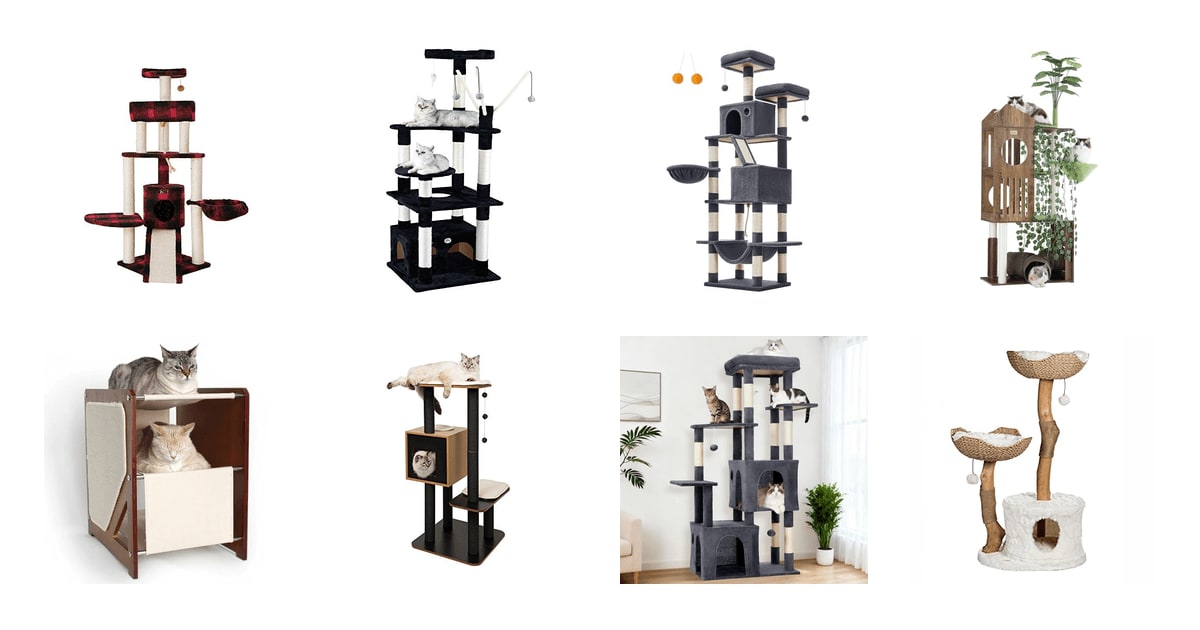
A 20-pound Maine Coon uses a cat tree differently than a 9-pound tabby does. He doesn't hop onto a perch — he launches, lands hard, and then wants to sprawl out with all four legs extended. That means the top platform has to be wide enough for a cat who's three feet long nose to tail, and the base has to absorb the sideways shove of a heavy landing without rocking. Most cat trees on the shelf aren't built for that. They're designed around a 10-pound average cat, and it shows the first time a big one jumps.
Here's the honest part: no freestanding cat tree is tip-proof with a heavy cat on top. Physics doesn't care how good the marketing copy is. A tall tower with a narrow footprint will sway, and the taller it goes, the worse it gets. Nearly every good option ships with a wall-anchor strap, and you should use it — Good Housekeeping Institute testers found those straps cut lateral sway on 70-inch towers by roughly 80 percent. Also worth knowing: sisal wears out. Even thick rope shreds under a determined big cat, and you'll be replacing or re-wrapping posts eventually.
We looked at height, platform width, base footprint, frame material and what owners of genuinely large cats say after months of use. Trees that only work for a 12-pound cat didn't make the cut, no matter how nice they look. We think that the Feandrea 81.1-Inch Cat Tree is the best cat tree for large breeds for most people, and that the Vesper Cat Tree High Base is the one to buy if you want something that looks like furniture and stays put in a small room.
Everything we recommend

The most climbing and lounging room for a big, busy cat

Furniture-grade looks and a wide base, in half the height

A tall tower for big cats without the premium price
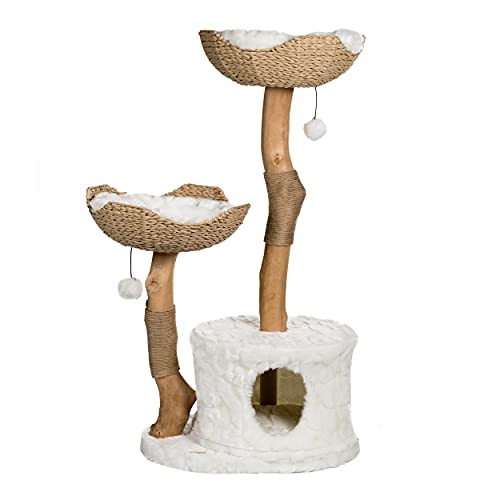
Real wood and woven baskets, rated for cats up to 23 pounds

Two full condos and an oversized top perch for hideout-loving cats
Prices as of Oct 22, 7:36 AM PT · Details
At a glance
| Product | Height | Base Footprint | Price | |
|---|---|---|---|---|
| Go Pet Club 66" Cat Tree ScratcherBudget pick | 65.5" | 28.5"x29" | $98.48 |
| Feandrea Cat TreeTop pick | 81.1" | 19.7"x23.6" | $75.99 |
 | FourFurPets Large Cat Tree with LeavesAlso consider | 72.8" | 15.6"x28.9" | $169.99 |
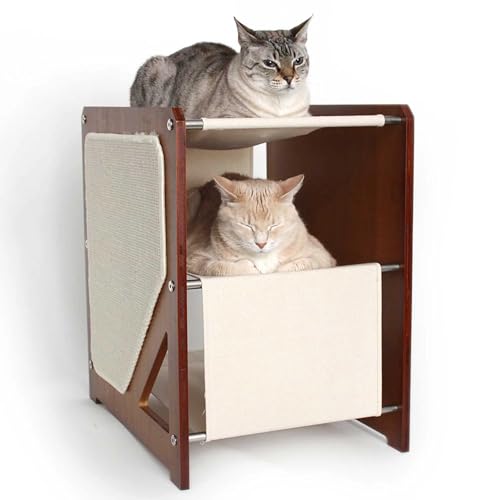 | Catastrophic Creations The Grotto Cat CondoAlso in lineup | 21" | 22"x15.2" | $220 |
| Vesper Cat TreeRunner-up | 47.9" | 22.1"x22.1" | $159.99 |
| 61 Inch Sturdy Cat Tower for LargeAlso great | 61" | — | $75.99 |
| Mau - Modern Cat Tree TowerUpgrade pick | 46" | 18"x23.5" | $299 |
Prices as of Oct 22, 7:36 AM PT · Details
How we picked
Platform size. We looked for top perches and condos wide enough that a long-bodied cat can lie down fully rather than hanging his legs over the edge. Anything with a top perch under roughly 12 inches across got downgraded, since veterinary reviewers link small platforms to lower use.
Base footprint. We compared each tree's base width against its height, using the finding that bases narrower than 18 inches tip noticeably when a 20-pound cat jumps from the top. Tall towers needed a wall-anchor kit in the box to stay in consideration.
Frame material. We read spec sheets for what's actually under the fabric — solid wood, MDF, particleboard or cardboard tube. Solid wood and reinforced board went to the top, because published long-term reports find cheap-core trees developing measurable sway within months under a heavy cat.
Sisal quality. We favored posts fully wrapped in thick natural sisal over carpet or thin craft rope, since controlled trials show cats prefer sisal by a wide margin. We also weighed how often owners report having to replace shredded posts.
Owner reports at weight. We looked specifically for feedback from people with cats over 18 pounds, not general praise. A tree that four small cats love tells you nothing about how it handles one Maine Coon landing on it.
Top pick
The most climbing and lounging room for a big, busy cat
Feandrea Cat Tree
This is a 5-foot-9 tower with two caves, two padded perches and a hammock, plus scratching surfaces on every level. Owners of cats over 20 pounds report the hammock and platforms hold up, and the short gaps between levels mean a heavy cat can walk up instead of leaping.
$75.99fromAmazonPrices as of Oct 22, 7:36 AM PT · Details
For a large cat, the spacing between levels matters as much as the height. Feandrea keeps the gaps to 12 to 16 inches. That's a step, not a jump. A 20-pound cat with stiff hips can work his way to the top without launching, and he can come back down the same way instead of dropping five feet onto your floor. Taller trees with big gaps look impressive and then go unused above the second platform.
You get two caves, two perches and a hammock spread across five levels. That's the layout you want in a multi-cat house, because the big cat and the small cat can both claim territory without negotiating. Veterinary behaviorists generally suggest one perch per cat plus one extra, and this single tower gets you there for two or three cats. Research in the Journal of Feline Medicine and Surgery links elevated resting spots to meaningfully lower stress hormone levels.
The base is reinforced and an anti-tip kit comes in the box. Use it. At 81 inches this thing is taller than most people, and the footprint is under two feet square — that's a ratio that needs a wall anchor, not a suggestion of one. Anchored, owners describe it as solid even when a heavy cat sprints up it at full speed.
There are 14 scratching areas, including a ramp that doubles as a ladder. That's a lot of sisal for a cat who otherwise redirects to your couch arm. And a 2024 scratching trial reported by Veterinary Practice News found cats chose sisal rope over carpet posts about 73 percent of the time, so the material choice here is the right one.
Flaws but not dealbreakers
The manufacturer rates it for cats up to 15.4 pounds each, which is below what a full-grown Maine Coon or Ragdoll male weighs. Owners of cats over 20 pounds report it holding fine in practice, but you're operating past the stated spec, and that's worth knowing before you buy. If your cat is at the very top of the range, treat the wall anchor as required.
It's particleboard, not solid wood. That's the tradeoff for the size and the price, and it means the platforms will show wear sooner than a hardwood-core tree. Some owners who've bought several Feandrea trees over the years say the bases have gotten a bit smaller and the cushions thinner than older versions.
The caves are the annoying part of assembly. Everything else goes together like flat-pack furniture, but expect to wrestle with the enclosed boxes for a while. Set aside an afternoon and don't do it on carpet where screws disappear.
Runner-up
Furniture-grade looks and a wide base, in half the height
Vesper Cat Tree
The Vesper stands under four feet tall on a 22-inch square base, which is the widest footprint here relative to its height. Memory-foam cushions and a wood-toned finish make it something you can put in a living room without wincing.
$159.99fromAmazonPrices as of Oct 22, 7:36 AM PT · Details
A wide, low tower is the safer shape for a heavy cat, full stop. At 47.8 inches on a 22-by-22-inch base, the Vesper has a footprint wider than Wirecutter's 18-inch tipping threshold and less than two-thirds the height of our top pick. Owners with cats around 19 pounds describe no wobble even when their cat launches onto it. If your cat is heavy and enthusiastic and you don't want to drill into a wall, this is the shape to buy.
It also doesn't look like a cat tree. The Vesper uses a wood-look finish and clean lines instead of beige carpet, and owners consistently mention putting it in a main living room rather than a spare bedroom. That matters more than it sounds — a tree your cat can't reach because it's stuck in a back room isn't doing anything for him.
The memory-foam cushions are the underrated feature. A big cat carries more weight per square inch on his joints, and a firm foam pad supports him better than a thin quilted square. The cube underneath has multiple exits, which is the layout anxious cats prefer — they won't use a hideout with only one way out.
Assembly is unusually painless. The instructions are wordless IKEA-style diagrams, and owners routinely report finishing in under an hour without needing the assembly video.
Flaws but not dealbreakers
The top perch is flat with no lip or rim. A cat who sleeps hard can roll toward the edge, and several owners flag this as the design's one real miss. It's not dangerous at this height, but it does mean some cats won't fully relax up there.
A few owners describe some wobble at the top despite the wide base, particularly during rough play between two cats. It's a modest amount of sway rather than a tipping concern, but it's there.
It's short. If your goal is getting your cat to ceiling height for the view out a high window, this isn't the tree — you'd be adding wall shelves above it, which several owners end up doing.
Budget pick
A tall tower for big cats without the premium price
Go Pet Club 66" Cat Tree Scratcher
This 65.5-inch Go Pet Club tower gives you a full-height tree with a center condo, multiple perches and sisal posts for considerably less than the other tall options here. The tradeoff is thinner materials and a top perch that's tight for the biggest cats.
$98.48fromAmazonPrices as of Oct 22, 7:36 AM PT · Details
If you're upgrading from a two-foot kitten tree and your cat has outgrown it, this gets you real vertical space cheaply. Owners with cats in the 13-to-15-pound range consistently say their cat fits well on the platforms and uses the whole thing. The middle shelves in particular come up often as being sized well for a chunky cat.
The center condo is genuinely large. That's the piece most budget trees skimp on — they'll give you a box a kitten fits in and call it a condo. Here there's room for a substantial cat to curl up out of sight, which matters in a busy household where your cat wants somewhere to disappear.
Assembly is fast. Multiple owners report finishing in well under an hour with the included hardware and tools, and the MDF condo panels give the structure more rigidity than the cardboard-tube construction some cheap trees use.
Put it in a corner or against a wall. Owners are direct about this: the tower is wobbly standing free in a room. The base is square and reasonably wide, but at 65 inches tall with lighter materials than our top pick, it needs a wall behind it. That's not a dealbreaker — it's just a placement requirement you should plan around before you assemble it.
Flaws but not dealbreakers
The sisal shreds. This is the most common complaint by a wide margin, and owners with aggressive scratchers report replacing posts more than once. If your cat scratches hard, budget for that or plan to re-wrap the posts yourself with rope.
The top perch is small for a very large cat. Owners with a 13-pound cat say he curls up on it fine; at least one Maine Coon owner reports the top perch wasn't sturdy enough and the fabric started coming off. If your cat is over 18 pounds and wants to sleep at the very top, look at our other picks.
The fabric is a weak point overall. Faux fur pulling away from the boards comes up repeatedly, and it tends to show up within months rather than years under heavy use.
Upgrade pick
Real wood and woven baskets, rated for cats up to 23 pounds
Mau - Modern Cat Tree Tower
The Mau uses real branch-wood trunks and hand-woven wicker baskets instead of carpeted plywood, and it's explicitly rated for cats up to 23 pounds. It's the best-looking tree here and the one you'd actually put in a formal living room.
$299fromAmazonPrices as of Oct 22, 7:36 AM PT · Details
Mau rates this for a single cat up to 23 pounds, which is one of the few honest large-cat ratings in the category. Most manufacturers quote a combined capacity — 100 pounds across the whole tree — which tells you nothing about whether one platform holds one heavy cat. A per-cat rating that high, on real wood trunks rather than pressed board, is the specification that actually matters for a Maine Coon or a Norwegian Forest Cat.
The cushions come out and go in the washing machine. If you have a Siberian or another heavy-shedding breed, that single feature will save you more aggravation than any other on this list. You can also buy replacement cushions in different colors, and Mau sells replacement parts for essentially every component — so a chewed basket or a worn trunk doesn't retire the whole tree.
It's 46 inches tall on a 23.5-inch base, which is a low, stable shape. Owners repeatedly describe the base as very sturdy and say they don't worry about tipping when a heavy cat jumps to the top perch. Combined with the wood construction, this is the tree most likely to still be standing in five years.
The wicker baskets deserve a mention. They're deeper and more enclosing than a flat platform, and cats who like to feel walls around them settle in faster. Owners with an older or arthritic cat find the height easy to reach without a big jump.
Flaws but not dealbreakers
It's the most expensive tree here by a wide margin. You're paying for materials and looks, and you get less climbing structure than a cheaper tall tower gives you — two levels of baskets rather than five levels of platforms.
The enclosed hut is a frustrating assembly step. It has interior supports that hold up the roof and anchor a trunk, and owners describe fighting with the alignment. The rest goes together in about twenty minutes.
It's short. At 46 inches, an athletic cat who wants to survey the room from ceiling height won't get what he's after here.
Also great
Two full condos and an oversized top perch for hideout-loving cats
61 Inch Sturdy Cat Tower for Large
This 61-inch Jojoka tower is built around two enclosed condos and an extra-wide top lounge, with full sisal wrapping on the posts. It's aimed squarely at large breeds and suits a household where one cat wants a view and another wants to hide.
$75.99fromAmazonPrices as of Oct 22, 7:36 AM PT · Details
Two enclosed condos is unusual at this height. Most towers give you one box and fill the rest with open shelves. If you have a shy cat and a bold cat, or a big cat who claims the top perch and a smaller one who gets displaced, having two separate hideouts prevents the standoff that leaves one cat sleeping on the floor.
The top perch is the reason to consider this over a taller tower. It's a widened open lounge rather than a small round cup, so a long-bodied cat can stretch out fully instead of hanging his back legs over the edge. The Spruce Pets veterinary reviewers note that platforms under 12 inches force exactly that, and cats use those perches less as a result.
At 61 inches the whole structure is shorter than our top pick, which helps stability, and the posts are fully wrapped in natural sisal rather than partially covered. Full wrapping matters because cats pick a spot and stay with it — a post with sisal only in the middle third gets scratched right at the seam.
Flaws but not dealbreakers
This is a new listing with very little owner feedback so far. The construction description reads well, but there's no accumulated record of how it holds up after a year of a heavy cat using it daily. That's a real unknown, and it's why this isn't a higher pick.
The manufacturer doesn't publish a per-platform weight rating in the listing, so you're relying on the general anti-tip and reinforced-frame claims rather than a number you can check against your cat's weight.
Who this is for
This guide is for you if your cat is genuinely big — a Maine Coon, Ragdoll, Norwegian Forest Cat, Siberian, or just a large domestic shorthair in the 15-to-25-pound range. The Cat Fanciers' Association puts male Maine Coons at 13 to 18 pounds at maturity, with some reaching 25, and TICA documents Ragdoll males at 15 to 20. That's roughly double the 10-pound average indoor cat that most cat trees are engineered around. If your cat is under 12 pounds, you can safely shop from the much larger pool of standard trees and save money.
It's also for multi-cat homes where one cat is much larger than the others, and for apartment dwellers who need to go vertical because there's no floor space left. We're covering freestanding and hybrid floor towers here, not full wall-mounted shelf systems — those solve the tipping problem completely but require studs, drilling and planning that's outside what most renters can do. If you're an owner who cares how the thing looks in your living room, we've flagged the options that pass as furniture.
How we picked
Platform size: the top perch and condos have to be wide enough for a long cat to stretch out, since small platforms leave limbs hanging and go unused. Base footprint: we compared listed base width against total height, because bases narrower than 18 inches tip noticeably when a heavy cat launches from the top. Frame material: solid wood and reinforced board beat particleboard and cardboard tube, which develop sway within months under a 20-pound cat. Sisal quality: thick natural rope, fully wrapped, since cats choose sisal over carpet by a wide margin and thin craft rope unwraps fast. Owner reports at weight: we weighted feedback from people whose cats actually weigh 18 pounds or more over general five-star enthusiasm.
Other cat trees for large breeds worth considering
If you want a cat tree you're not embarrassed by: The FourFurPets Large Cat Tree with Leaves — The FourFurPets tree wraps a 72.8-inch tower in artificial foliage, and the effect works better than it sounds — owners consistently put this one in the main living room rather than hiding it. Underneath the leaves you get a large perch, tunnels, a scratching post and a self-groomer, plus removable washable cushions and a wipeable platform veneer. Cats seem to genuinely like batting at the foliage. What it gives up is stability: owners describe it as a little shaky, and it ships with wall screws that you'll want to use. It's also a long build. Reports from owners with cats around 13 pounds are positive, but there's less feedback from the 20-pound crowd than we'd like.
The competition
These are the trees our research surfaced alongside the picks, not a survey of everything sold. Cat furniture is a category with enormous churn — new listings appear constantly and old ones vanish — so treat this as the set we could evaluate against real specifications and accumulated owner feedback.
The Catastrophic Creations The Grotto Cat Condo — The Catastrophic Creations Grotto is a wall-mounted three-level condo in bamboo and canvas, with shelves, hammocks and a scratching mat. Mounting to studs eliminates the tipping problem entirely, which makes this category the safest option for a very heavy or very athletic cat, and the bamboo and metal-tube construction is a clear step above carpeted particleboard. It's not a pick for two reasons. At 21 inches tall and 22 inches wide, it's a small module rather than a full climbing structure — you'd want several of these plus shelves to replace a tower, which changes the math considerably. And owners find the fabric-stretching step of assembly genuinely confusing. If you own your home, have a drill and want to build out a wall system over time, this is a good starting piece.
Care and placement
Put the tree where your cat already wants to be — near a window with a view, or in the room where you spend evenings. A tower in a spare bedroom gets ignored. Anchor anything over about 60 inches to a wall stud using the included strap; it takes ten minutes and it's the single biggest safety improvement you can make. For cleaning, a rubber squeegee or a stiff brush pulls embedded fur out of carpet and plush far better than a vacuum does, which matters a lot with a Siberian or a Maine Coon in shedding season. Wash removable cushions on cold and air dry them so the foam doesn't break down. Check the sisal every few months and re-wrap posts before the rope unravels completely — once a cat finds bare cardboard, he'll often move to your couch instead.
Questions we get
What weight capacity should I look for if I have a Maine Coon?
International Cat Care suggests cat furniture rated to at least twice the cat's body weight, because a jumping cat generates far more force than a standing one. For an 18-pound Maine Coon, that means you want a per-platform rating around 36 pounds or more. Be careful with combined-capacity numbers — a tree advertised at 100 pounds total may still have a top perch designed for a 10-pound cat. Look for a per-level or per-cat figure, and if the listing doesn't publish one, treat that as a warning.
How do I keep a tall cat tree from wobbling with a big cat on top?
Use the wall-anchor strap. Good Housekeeping Institute testers found anti-tip straps cut lateral sway on 70-inch towers by roughly 80 percent, which is a bigger improvement than any base design gives you. Beyond that, place the tree in a corner or flat against a wall rather than free in the middle of a room, and put it on hard floor rather than thick carpet, since plush carpet lets the base rock. If it's still moving, shim the low corner.
Are wall-mounted systems better than freestanding towers for large cats?
For pure safety, yes — a properly mounted shelf can't tip, and that removes the main risk with a heavy cat. But they're a bigger commitment. You need to hit studs, you'll be patching drywall if you move, and building out enough shelves to equal a full tower costs more than one tower does. Most people are better served by a wide-based freestanding tree with the anchor strap installed. Consider wall mounting if you own your home or your cat is at the extreme end of size and activity.
How big does the top perch need to be for a Ragdoll or Norwegian Forest Cat?
Aim for at least 14 inches across. The Spruce Pets veterinary reviewers note that platforms under 12 inches force large cats to hang their limbs over the edge, which reduces how often they use the perch and may stress joints over time. A cat that size wants to lie fully stretched, not curled into a ball because that's all that fits. If a listing only gives you overall dimensions, look at photos of a big cat on the perch before you buy.
Can two large cats share one cat tree?
They can, but you need more resting spots than cats. Veterinary behaviorists generally recommend one perch per cat plus one extra, each big enough for the largest cat to stretch out on. With two large cats, look for a tree with at least three well-separated platforms and ideally two enclosed hideouts, so neither cat gets displaced to the floor. Trees with everything stacked on one vertical line tend to produce more conflict than ones with perches on different sides.
How long should a cat tree last with a heavy cat using it daily?
It depends almost entirely on what's under the fabric. Long-term reports find that cheap-core trees develop noticeable structural sway within about six months of daily use by a 22-pound cat, while steel-reinforced and solid-wood models hold up much longer. Sisal is the other clock — expect to re-wrap or replace posts on any tree if your cat scratches hard. A well-built tree with replaceable parts can go years; a thin one may not make it through a year.
Why you should trust us
For this guide:
- We compared manufacturer spec sheets across all eight trees for stated weight ratings, base dimensions, platform sizes and core materials.
- We read published findings from Wirecutter, Good Housekeeping Institute, Forbes Vetted, PetMD and The Spruce Pets on base stability, anti-tip anchoring and platform sizing for large breeds.
- We read owner feedback themes with particular attention to reports from people whose cats weigh 18 pounds or more, since general praise from small-cat households doesn't predict how a tree handles a Maine Coon.
- We read owner reviews on every listing, weighted toward the critical ones, because that is where the recurring failures show up.
- We have a systematic way of automatically fetching the latest prices, so the numbers on this page stay current.
- This is a research-focused guide, so the team may not own every product listed — though we often do own the top winners, which gives us extra context for the recommendations.
- We don't accept free products, and the retailer commission never changes which product we recommend.
Sources
Best Cat Trees for Large Cats – Wirecutter, Wirecutter
Cat Tree Buying Guide – Consumer Reports, Consumer Reports
Best Cat Trees for Large Cats – Spruce Pets, The Spruce Pets
FEANDREA UPCT710W01 Review – Chewy Editorial, Chewy
Armarkat Cat Tree Review – PetMD, PetMD
Cat Tree Safety and Stability – International Cat Care, International Cat Care
Maine Coon Size and Weight Data – The Cat Fanciers' Association, Cat Fanciers' Association
Ragdoll Breed Profile – TICA, The International Cat Association (TICA)
Sisal vs. Carpet Cat Scratchers – Veterinary Practice News, Veterinary Practice News
Best Cat Trees 2025 – Forbes Vetted, Forbes Vetted
Cat Enrichment and Vertical Space – Journal of Feline Medicine and Surgery, Journal of Feline Medicine and Surgery
Best Cat Furniture – Good Housekeeping Institute, Good Housekeeping Institute
Amazon product listings and owner reviews for all 7 products
Manufacturer specification pages for each product
Some passages in this guide may be paraphrased with AI help.
Product prices and availability are accurate as of the date/time indicated and are subject to change. Any price and availability information displayed on Amazon.com at the time of purchase will apply to the purchase of this product.
More like this.
Continue exploring pet reviews and recommendations.

The Best Cat Trees For Large Cats
A big cat changes what a cat tree has to do. A 20-pound Maine Coon doesn't step onto a perch - he lands on it, and the whole frame feels it. Platforms…

The Best Orthopedic Dog Beds for Large Breeds
A big dog puts a lot of weight on four small points. If your Lab sleeps on tile or thin carpet, you'll see it in the bald patches on their elbows and hear…

The Best Heavy-Duty Dog Crates for Large Breeds
A crate for a 90-pound dog has a different job than one built for a beagle. It has to hold when your dog throws a shoulder into the door at six in the…

The Best Cat Trees and Condos for Indoor Cats
A cat tree isn't decoration. For an indoor cat, it's the closest thing to territory - a high spot to nap, a post to shred instead of your sofa arm, and a…

The Best Cat Trees And Scratching Posts of 2026
A cat tree isn't decoration. Scratching is how cats shed the outer sheath of their claws, stretch their backs, and leave scent marks that tell them the…

The Best Large Hamster Cages
A hamster spends almost its whole life inside one box, so the box matters more than anything else you'll buy. What it needs is floor - one long, unbroken…