The Best Cat Trees For Large Cats
A big cat changes what a cat tree has to do. A 20-pound Maine Coon doesn't step onto a perch — he lands on it, and the whole frame feels it. Platforms that work fine for an eight-pound tabby leave a Ragdoll's back legs dangling off the edge, and most cats just stop using a perch that doesn't fit. So the specs that matter here aren't height or the number of levels. They're perch width, base width, post thickness, and how much weight each individual platform is rated to hold.
Here's the honest part: almost nothing sold as a cat tree is built for a 20-pound cat. Manufacturers publish total capacity numbers that assume the weight is spread across every level at once, which is not how cats work. Per-perch ratings, when listed at all, usually land between 11 and 15 pounds. Sisal rope frays under big claws in months. And nearly every tree in this price range is particleboard wrapped in fabric — it will loosen, and you'll be retightening bolts a couple of times a year no matter what you buy.
We looked for the trees that get the fundamentals right: perches wide enough to lie flat on, a base wide enough that a jump from the top doesn't rock it, and hardware that holds. We think that the Armarkat B5701 Real Wood 57-Inch Cat Tree is the best cat tree for large cats for most people, and that the Feandrea 59.5-Inch Cat Tree is the one to buy if you want more enclosed hiding spots and a lighter, easier build.
Everything we recommend

The sturdiest frame here, and big cats actually use it

More hiding spots and an easier build, with a lower weight ceiling

The biggest footprint here, if you have the floor space
At a glance
| Product | Height | Perch Diameter | Price | |
|---|---|---|---|---|
| Feandrea Cat TreeRunner-up | 59.5 Inches | — | $45.04On sale |
| Go Pet Club 66" Cat Tree ScratcherAlso great | 65.5" | — | $98.48 |
| Armarkat B5701 Real Wood 57-Inch Cat TreeTop pick | 57" | — | $130.76 |
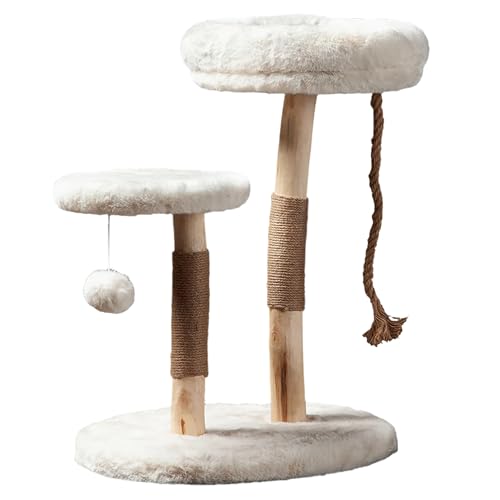 | Habitat Haven The Oasis Cat Tree -Also in lineup | 28.5-Inch | — | $99 |
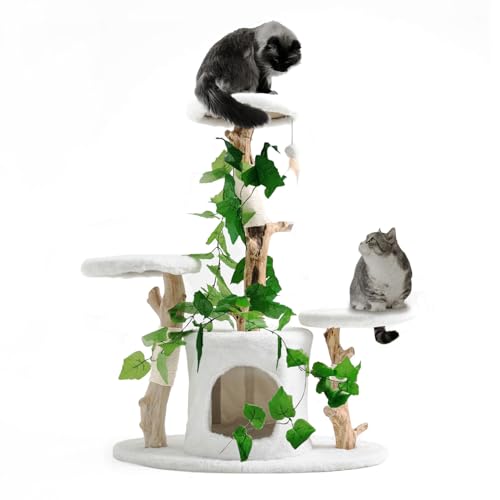 | Petest Cat Tree 38 Inch Real WoodAlso in lineup | 38 Inches | — | $69.99 |
 | BEWISHOME Cat Tree with Scratching PostAlso in lineup | 18.9 inches | — | $29.99 |
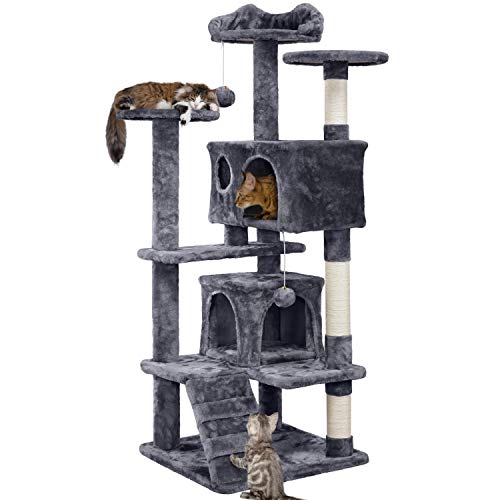 | Yaheetech 54in Cat Tree TowerAlso consider | 54in | — | $39.40On sale |
How we picked
Per-perch weight rating. We read manufacturer spec sheets for individual platform ratings rather than total capacity, because total figures assume weight spread across every level. Anything under 15 pounds per perch we treated as a caution for large-breed owners.
Platform dimensions. We compared published perch widths against the 12-by-12-inch minimum that The Spruce Pets identifies for cats over 12 pounds, favoring trees in the 14- to 16-inch range where a big cat can lie flat.
Base width and anti-tip. Wirecutter's research pinned narrow bases as the top stability failure in budget trees, so we prioritized footprints well over 16 inches and noted which trees include wall-anchor hardware.
Post and sisal quality. Forbes Vetted found thicker posts outlasting thin ones by two to three times under heavy scratching, so we looked at post diameter and whether the wrap is sisal rope or the more durable sisal fabric.
Owner reports from big-cat homes. We weighted feedback from people who named their cat's weight or breed, since a review from a 20-pound Maine Coon's owner tells you far more than a general five-star note.
Top pick
The sturdiest frame here, and big cats actually use it
Armarkat B5701 Real Wood 57-Inch Cat Tree
The Armarkat B5701 pairs a 28-by-25-inch footprint with thicker 15mm pressed wood than most trees use, so it stays planted when a heavy cat launches off the top. Four levels, real sisal-wrapped posts, and a build that owners of 16- to 20-pound cats keep coming back to.
$130.76fromAmazonThe base is what separates this from the rest of the field. At 28 by 25 inches, it's wider than the tree is deep in most directions, and that matters more than any other number on the box. Wirecutter's research identified narrow bases as the single biggest stability failure across budget cat trees — anything under 16 inches tipped noticeably when a 16-pound cat jumped down. You're getting well past that here.
Armarkat builds this from 15mm pressed wood rather than the thin MDF that shows up in cheaper towers. That's a meaningful difference when a 20-pound cat is landing on the same platform several times a day for years. The posts are 3.5-inch cardboard tubes wrapped in 6mm sisal rope, joined with 10mm metal hardware — heavier fasteners than the cam locks you find on lighter trees.
Owner feedback from people with genuinely large cats is the strongest signal here. Households with 18- and 20-pound cats report the tree holding up over years of daily use, and several mention it after having tried and returned smaller towers. The faux fleece is permanently glued to the wood rather than stapled, so it doesn't peel away at the corners the way carpet-wrapped platforms tend to.
At 57 inches, this isn't the tallest option, and that's arguably a feature for a heavy cat. Cornell's guidance is that overweight cats over 20 pounds take real joint and spinal stress coming down from tall perches without intermediate steps. Four stacked levels over 57 inches means shorter hops between them. If you have a senior Ragdoll or a chunky Maine Coon, that's the version of tall you want.
Flaws but not dealbreakers
Armarkat doesn't publish a per-perch weight rating, which is frustrating when that's the number you most want. You're going on the construction spec and owner reports instead. Cats over about 22 pounds will still overhang the top perch somewhat.
It's pressed wood underneath the fleece, not solid lumber. Expect to snug up the bolts once or twice a year, especially on the upper levels. And the sisal is rope rather than fabric — under an aggressive scratcher, rope wears roughly two to three times faster.
The ivory colorway shows dirt. It vacuums clean easily enough, but a light tree in a house with a shedding long-haired cat needs attention more often than a dark one would.
Runner-upOn sale
More hiding spots and an easier build, with a lower weight ceiling
Feandrea Cat Tree
The Feandrea gives you two top perches and two enclosed caves in a 59.5-inch tower that one person can assemble with the included hex key. It's the pick if your cat likes to disappear, though Feandrea rates it for cats up to 11 pounds each.
$45.04fromAmazonList priceTwo caves is the real draw. Big cats den — a Norwegian Forest Cat that won't come down off a perch all afternoon will still choose an enclosed box when the house gets loud. Most towers give you one hideout at the bottom. This one has two, plus two open perches up top, so in a two-cat house nobody has to negotiate.
The published weight rating is the catch, and we won't paper over it. Feandrea lists this for up to five cats at a maximum of 11 pounds each. That's a manufacturer figure aimed at the average household, and owner reports from people with heavier cats are broadly positive — but it's below what we'd want to see printed on a tree marketed to large-cat owners. Treat the upper perches as suited to cats in the mid-teens, not the mid-twenties.
Assembly is genuinely easy, which is not a small thing when the box weighs nearly 30 pounds. Everything uses universal screws and the included Allen key, and one person can do it. Owners consistently describe the instructions as clear. An anti-tip kit comes in the box — use it, because at 59.5 inches this is right at the height where Consumer Reports' safety guidance calls for wall anchoring in a home with a cat over 15 pounds.
The 15.7-inch platform width is right in the range large cats need. The Spruce Pets puts the minimum viable perch at 12 by 12 inches for any cat over 12 pounds, and 14 to 16 inches is where a big cat can actually stretch out flat. Feandrea clears that. The pompoms with bells are a toy, not a feature you should pay attention to, but cats do bat at them.
Flaws but not dealbreakers
A recurring theme in owner feedback is that the top platform is the weak link — a few report it flexing or failing during assembly if overtightened. Go carefully on that piece and don't force it.
The light gray fabric and the 11-pound-per-cat rating both point the same direction: this is a tree designed for the general market that happens to have large-cat-appropriate perch dimensions. If your cat is over 20 pounds, the Armarkat is the safer buy.
Assembly is easy but not fast. Plan on a couple of hours if you're organizing parts carefully rather than the ten-minute claims you see on other listings.
Also great
The biggest footprint here, if you have the floor space
Go Pet Club 66" Cat Tree Scratcher
At 29 by 28.5 inches and 46 pounds, the Go Pet Club is the heaviest and widest tree in this lineup. That mass is the whole argument — a big cat can't easily rock something this bottom-heavy, and the large center condo fits a Ragdoll without a squeeze.
$98.48fromAmazonForty-six pounds of tree is a stability strategy all by itself. This is the heaviest option here by a wide margin, built from 0.6-inch MDF boards, and the 29-by-28.5-inch base is the widest footprint in the lineup. If your concern is a tower rocking when a heavy cat jumps off the top, sheer mass solves a lot of that.
The center condo is the standout feature. It's sized so a 14- or 15-pound cat can get in and turn around, which is the actual threshold — large cats need roughly 12 by 14 inches of interior clearance to use an enclosed space instead of ignoring it. Owners with cats in the 12- to 15-pound range report it fitting comfortably.
The scratching posts are where this one falls down. Owner feedback is consistent and unflattering: the sisal rope shreds fast under a determined scratcher, and replacement posts are expensive enough that a couple of rounds eats up whatever you saved on the tree. Forbes Vetted's research found large-breed cats destroying thin posts in as little as three or four months of daily use. That tracks with what buyers here describe.
There's a real tension in this tree's reputation. Some owners call it rock solid; others describe wobble at the top and recommend putting it in a corner or against a wall. Our read is that the lower two-thirds are very stable given the mass, and the upper perch is not. If your cat mostly camps at mid-height, that's fine. If she wants the summit, anchor it.
Flaws but not dealbreakers
The top perch draws the most criticism. One Maine Coon owner reports the black fabric coming away and the top level not holding up. For the largest breeds, the upper levels are the part to be skeptical about.
Sisal rope on the posts wears through quickly and replacements are costly. Budget for that, or plan to re-wrap the posts yourself with sisal fabric.
It's enormous. Twenty-nine inches deep and forty-six pounds is a piece of furniture, not an accessory — measure your corner before ordering, and know that moving it to vacuum is a two-person job.
Who this is for
This guide is for you if you share a home with a cat in the 15- to 25-pound range — a Maine Coon, a Ragdoll, a Norwegian Forest Cat, or a well-fed rescue who outgrew the tree you already own. Cornell's figures put Norwegian Forest Cats at 13 to 20 pounds and Ragdolls at 12 to 20, and PetMD notes Maine Coon males sometimes clear 25. Those weights break the assumptions most cat furniture is built on. It's also for multi-cat households where at least one cat is big, since the tree has to hold the heaviest resident, not the average one.
If your cats are all under about 12 pounds, you don't need any of this and you'll pay for structure you won't use. This guide also sticks to freestanding floor trees. Wall-mounted shelf systems and cat-specific window perches can be great for big cats in small apartments, but they're a different buying decision with different anchoring requirements, and we don't cover them here. One thing worth internalizing regardless of what you buy: International Cat Care's research links adequate vertical territory to fewer stress behaviors — less inappropriate scratching, less inter-cat friction, less hiding — and that effect is strongest in multi-cat homes.
How we picked
Per-perch capacity: we looked for individual platform ratings, not the total-capacity number on the box, since totals assume every cat is on a different level at once. Perch size: 12 by 12 inches is the floor for a cat over 12 pounds, and 14 to 16 inches is where a big cat can actually stretch out instead of hanging a leg off the edge. Base and anti-tip: a wide footprint does most of the stability work, and any tree over 60 inches in a large-cat home should be anchored to the wall. Posts and sisal: thicker posts last two to three times longer under heavy claws, and sisal fabric outlasts sisal rope. Build quality: thicker pressed wood and metal bolt hardware hold up better than thin MDF and cam locks under years of 20-pound landings.
Other cat trees for large cats worth considering
If you want the most levels in the smallest footprint: The Yaheetech 54in Cat Tree Tower ($39.40) — The Yaheetech 54-inch tower packs seven levels and two condos into a 19.5-by-19.5-inch base, and it publishes the kind of per-component ratings we wish everyone did — 22 pounds for each condo, 11 pounds for each perch. That split tells you exactly how to use it: a big cat belongs in the condos and on the lower structure, not on the top perches. It's a genuinely good apartment tree with an anti-tip strap included and FSC-certified, CARB P2-compliant materials. But the narrow base and 11-pound perch rating mean a 20-pound cat is right at the edge of what the upper levels are meant for. Owner feedback includes several notes about the scratching posts wearing through quickly.
The competition
These are the trees our research turned up alongside the picks, not a survey of everything on the market. A few landed here because they're built for smaller cats than this guide covers, and one or two because a better option does the same job with more structure underneath it.
The Petest Cat Tree 38 Inch Real Wood ($69.99) — The Petest 38-inch real wood tower is the most interesting near-miss. It claims a 44-pound capacity on a reinforced 31-by-18-inch base — the widest single dimension in this lineup — with real branches wrapped in sisal, an enclosed condo, three perches, and washable cushions. On paper that's a strong large-cat spec. The problem is that it's new enough that there's essentially no owner history behind it, and for a piece of furniture whose whole job is surviving years of 20-pound impacts, track record matters more than a spec sheet. At 38 inches it also gives up a lot of vertical territory. Worth watching; hard to recommend yet.
The Habitat Haven The Oasis Cat Tree - ($99) — Habitat Haven's Oasis is the best-looking thing here by a distance — natural willow branches, faux rabbit fur, a modern silhouette that doesn't scream pet furniture. If aesthetics are driving your decision, this is the one. But the platforms are rated to 15 pounds, which is the floor rather than the ceiling for a Maine Coon, and at 28.5 inches tall it's a lounging piece rather than a climbing structure. Owner feedback also flags a hard screw head in the middle of the top bed and no padding on the upper perch, which one buyer with an arthritic senior had to solve with an aftermarket cushion. Good for a large cat who mostly wants a soft place to nap in view of the room.
The BEWISHOME Cat Tree with Scratching Post ($29.99) — The BEWISHOME tower is a small, well-made bedroom piece — a coffin-shaped bed, one sisal post, an anti-tipping strap, and a spider toy that owners genuinely like. It's about 21.7 inches tall and 16.5 inches wide, which puts it in kitten and small-cat territory. Buyers say as much: it's frequently described as smaller than the photos suggest, and one bought it for a kitten expecting to size up later. If you have a big cat and a tiny apartment, this won't be enough tree. If you want a second small perch in a bedroom for a modest-sized cat, it's a reasonable buy.
Setup and upkeep
Anchor it. Every tree over 60 inches in a house with a cat over 15 pounds should be strapped to a wall stud, and most of these ship with the hardware — Consumer Reports' safety guidance is clear that unanchored tall trees tip more often in heavy-cat households. Put the tree in a corner if you can, so two walls back it up. Then set a reminder to retighten every bolt twice a year, because pressed-wood joints work loose under repeated landings and a wobbly tree is one your cat will quit using. When the sisal shreds, re-wrap the posts with sisal fabric rather than rope; it lasts two to three times longer under big claws. Vacuum the platforms and run a lint roller over the fleece, and if a cushion is removable, wash it.
Questions we get
What cat tree can hold a 20-pound cat?
Look at the per-perch rating, not the total capacity — totals assume weight is spread over every level. For a 20-pound cat you want at least 18 pounds per platform, and the Armarkat B5701's thicker 15mm pressed wood and wide base make it our pick for cats that size. Owners of 18- and 20-pound cats report it holding up over years.
What size platforms do I need on a cat tree for a large cat?
Twelve by twelve inches is the absolute minimum for any cat over 12 pounds, and 14 to 16 inches is where a big cat can lie flat without legs hanging off. Undersized perches are the main reason large cats abandon a tree entirely. For enclosed condos, you need roughly 12 by 14 inches of interior clearance so your cat can get in and turn around.
Are budget cat trees safe for heavy cats over 15 pounds?
Some are, but the failure points are predictable. Cheaper trees use thin MDF, 2.5-inch posts, and bases under 16 inches wide — and narrow bases are the number one stability problem, tipping noticeably when a 16-pound cat jumps from the top. If you buy budget, prioritize footprint width over height and anchor it to the wall.
Is sisal rope or sisal fabric better for large cats that scratch aggressively?
Sisal fabric, by a wide margin — roughly two to three times the lifespan under heavy scratching. Most trees ship with rope because it's cheaper to wrap. The practical move is to buy the tree with the best structure and re-wrap the posts in sisal fabric when the rope gives out, which for a large-breed cat can be as soon as three or four months.
Do I need to anchor a cat tree to the wall if I have a large cat?
For anything over 60 inches, yes. Veterinary safety guidance recommends it for tall trees, and tipping incidents are more common in homes with cats over 15 pounds. Most of the trees here include anti-tip hardware. Even if the tree feels rock solid during assembly, a 20-pound cat launching sideways off the top applies more lateral force than you'd expect.
Should I get a tall tree or one with more steps for a heavy cat?
More steps. Cornell's guidance notes that cats over 20 pounds take real joint and spinal stress coming down from high perches without intermediate landings. A 57-inch tree with four closely stacked levels is better for a heavy or senior cat than a 72-inch tree with big gaps between platforms. Height is nice; the descent path matters more.
Why you should trust us
For this guide:
- We compared published spec sheets across the lineup for per-perch weight ratings, platform dimensions, base width, post diameter, and construction material.
- We read owner feedback with particular attention to reports from households that named a cat's breed or weight, since those tell you far more about large-cat durability than general praise.
- We drew on published research and veterinary guidance from PetMD, Cornell Feline Health Center, The Spruce Pets, Forbes Vetted, Wirecutter, Consumer Reports, and International Cat Care for the thresholds behind our criteria.
- We read owner reviews on every listing, weighted toward the critical ones, because that is where the recurring failures show up.
- We have a systematic way of automatically fetching the latest prices, so the numbers on this page stay current.
- This is a research-focused guide, so the team may not own every product listed — though we often do own the top winners, which gives us extra context for the recommendations.
- We don't accept free products, and the retailer commission never changes which product we recommend.
Sources
Best Cat Trees — Wirecutter / New York Times, Wirecutter
Best Cat Trees for Large Cats — The Spruce Pets, The Spruce Pets
Cat Tree Buying Guide — PetMD, PetMD
Best Cat Trees 2026 — Forbes Vetted, Forbes Vetted
Best Cat Trees — All About Cats, All About Cats
Molly and Friends Cat Furniture — Manufacturer Specifications, Molly and Friends
Cat Vertical Territory and Behavior — International Cat Care, International Cat Care
Cornell Feline Health Center — Large Breed & Overweight Cat Care, Cornell Feline Health Center
Best Cat Trees — Chewy Editorial, Chewy
American Pet Products Association — APPA National Pet Owners Survey, American Pet Products Association
Amazon product listings and owner reviews for all 7 products
Manufacturer specification pages for each product
Some passages in this guide may be paraphrased with AI help. Prices are refreshed automatically.
More like this.
Continue exploring pet reviews and recommendations.

The Best Cat Trees for Large Breeds
A 20-pound Maine Coon uses a cat tree differently than a 9-pound tabby does. He doesn't hop onto a perch - he launches, lands hard, and then wants to…

The Best Cat Trees And Scratching Posts
A cat tree isn't decoration. Scratching is how cats shed the outer sheath of their claws, stretch their backs, and leave scent marks that tell them the…

The Best Cat Trees and Condos for Indoor Cats
A cat tree isn't decoration. For an indoor cat, it's the closest thing to territory - a high spot to nap, a post to shred instead of your sofa arm, and a…

The Best Artificial Christmas Trees
An artificial tree is something you own for a decade and use for six weeks a year. So the things that matter aren't the ones printed on the box. You care…

The Best Heavy-Duty Dog Crates for Large Breeds
A crate for a 90-pound dog has a different job than one built for a beagle. It has to hold when your dog throws a shoulder into the door at six in the…

The Best Large Hamster Cages
A hamster cage isn't furniture. It's the entire world your animal lives in, and two things matter more than everything else combined: how much…