The Best Compression Socks for Travel
Long flights are hard on your legs. You sit still for hours, the cabin pressure drops, and fluid settles in your ankles until your shoes feel a size too small. Graduated compression socks push back. They squeeze hardest at the ankle and ease off toward the knee, which helps blood move back up the leg instead of pooling. That's the whole idea, and it's the one leg-health habit for flyers with real trial evidence behind it. Knee-high length matters too, because the deep calf veins are where trouble starts.
No sock is a force field, though. Graduated stockings lower the odds of a symptomless clot on flights over four hours. They don't erase the risk, and they're no substitute for standing up, walking the aisle and drinking water. Sizing is the other weak spot in this whole category. A sock that's too big does almost nothing, and one that's too small digs a trench into your calf. Every pair loses pressure with washing, so the ancient pair in your drawer probably isn't doing much anymore.
So think about how often you fly, how long your routes run, and whether a doctor has ever mentioned your veins. Healthy travelers on an eight-hour hop do fine at 15–20 mmHg. If you have varicose veins, a prior clot, or a family history of venous disease, ask about 20–30 mmHg first. We think that the CEP Women's Allday Knee High Compression Wool Socks are the best travel compression socks for most people, and that the JOBST Relief Knee High is the one to buy if you want the brand your physician is most likely to name.
Everything we recommend

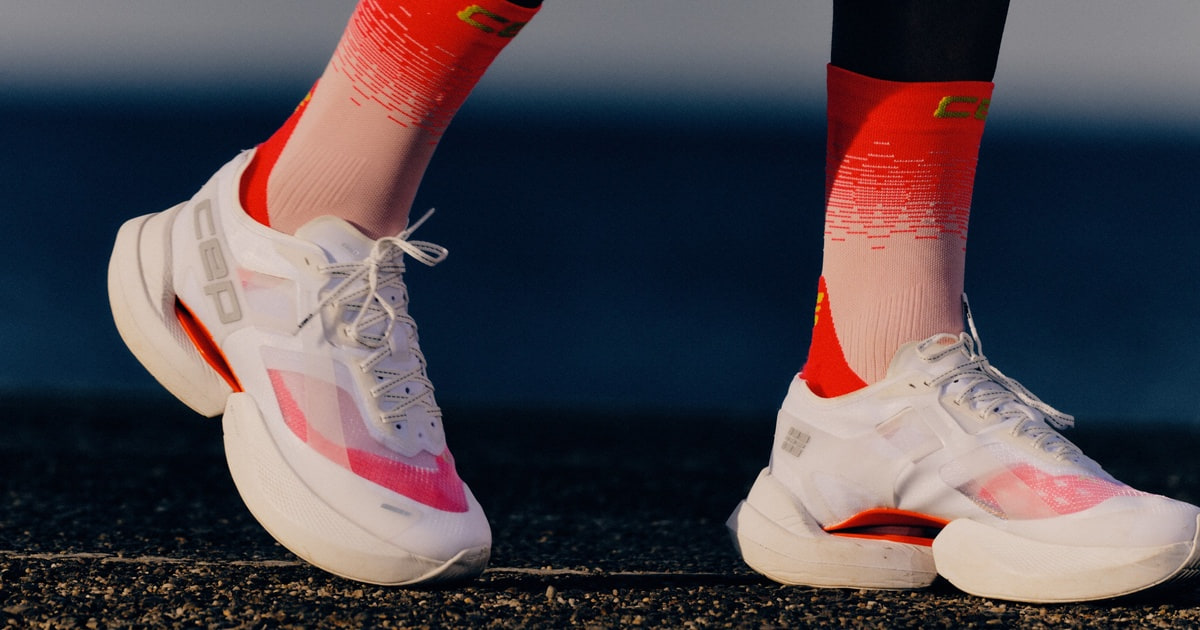
Firm medical-grade squeeze in a wool blend that breathes

Medical-garment build and a slim toe, at gentler pressure
Firm compression on a budget, if you replace them often

Four zones of firm support and a sole built for walking
At a glance
| Product | Compression | Sock Length | Price | |
|---|---|---|---|---|
| CEP Women’s Allday Knee High Compression WoolTop pick | 20-30 mmHg | Knee High | $45 |
| Sockwell Men's Elevation Firm Graduated Compression SocksAlso great | 20-30 mmHg | Over the Calf | $32.95 |
 | Comrad Recycled Cotton Knee High Socks -Also consider | 15-20 mmHg | Knee High | $37.99 |
 | Physix Gear Sport Plantar Fasciitis Socks withAlso in lineup | — | Ankle | $13.86 |
 | Sigvaris Men's Casual Cotton 186 Calf HighAlso consider | 15-20 mmHg | Calf High | $36.76 |
| JOBST Relief Knee High Graduated Compression SocksRunner-up | 15-20 mmHg | Knee High | $30.39On sale |
| Compression Socks for Women & Men 20-30Budget pick | 20-30 mmHg | — | $9.93 |
 | 2XU Flight Compression SocksAlso in lineup | — | Knee High | $35 |
How we picked
Graduated, not uniform. We only considered socks whose listings and spec sheets state true graduated compression, tightest at the ankle and easing toward the knee. That's the design behind the trial evidence for air travel; uniform-compression socks have no equivalent support.
Stated compression level. We looked for a published mmHg range — 15–20 for healthy travelers, 20–30 for people with venous risk factors. A sock that won't name its pressure can't be compared to one that does.
Knee-high length. Clots on flights form in the deep calf veins, and every trial behind the compression advice used below-knee stockings. Anything that stops at the ankle got read as a foot-pain product, not a travel sock.
Fabric for long hauls. We favored merino blends for temperature regulation on flights past eight hours, and moisture-wicking synthetics for people who sweat or travel somewhere hot. Cotton blends got credit for softness against sensitive skin.
Sizing and durability. Published reviews and owner feedback in this category come back to two complaints again and again: socks that slide down, and socks that go slack after months of washing. We weighted brands with real size charts and documented fiber longevity.
Top pick
Firm medical-grade squeeze in a wool blend that breathes
CEP Women’s Allday Knee High Compression Wool
These are knee-high socks with 20–30 mmHg of graduated, medical-grade compression in a wool blend that keeps your feet from cooking in dry cabin air. Padded zones under the foot and a ribbed leg keep them in place from the departure gate to baggage claim.
$45fromAmazonTwenty to thirty millimeters of mercury is serious compression, and that's the point. Most travel socks stop at 15–20 mmHg, which is plenty if you're healthy and taking a daytime flight. If you've had a clot, or your calves puff up on every trip, the firmer band is the one clinicians point to. CEP grades this pair as medical-grade and tapers the pressure from ankle to knee, so it works with your calf muscle rather than just clamping it.
Wool is the reason we'd reach for these on a ten-hour flight. Cabin air is bone dry and your feet are trapped in shoes for most of a day. The wool blend cuts both ways: it keeps your toes warm when the cabin goes cold overnight, and it doesn't turn clammy when you sprint a terminal. Synthetics wick sweat fine, but they don't regulate temperature the way wool does. The knit is thin enough to wear inside normal shoes.
They stay where you put them. Cheap compression socks slide down the calf, and a sock bunched at the ankle isn't giving you a gradient anymore. CEP builds this pair around a ribbed, wrinkle-free fit that holds position through a full travel day. Padded zones cushion the miles you walk between gates and the joints that take the pounding. If you've fought with sagging socks before, this is the fix.
They don't look medical. The colors are muted enough to wear with work clothes, and at a glance the knit reads as a normal dress sock. That sounds cosmetic. It isn't. The socks you'll actually keep wearing are the ones you don't mind being seen in, and you can put these on at home, fly, and walk into a meeting without changing anything.
Flaws but not dealbreakers
Getting them on takes real effort. At 20–30 mmHg, that first pull over the heel is a wrestling match, especially early in the morning or if your hands ache. A donning aid — a plastic frame that holds the sock open while you slide your foot in — solves most of it. Budget for one, or step down to a 15–20 mmHg pair instead.
This listing is women's sizing only, and wool asks for careful laundering. Men should look at the Sockwell pair below. Wool blends want cool water and air drying, which is one more chore if you wash socks after every flight. Skip the dryer and they'll hold their pressure far longer. Run them hot and you'll be shopping again sooner than you should be.
Runner-upOn sale
Medical-garment build and a slim toe, at gentler pressure
JOBST Relief Knee High Graduated Compression Socks
JOBST Relief is a unisex knee-high with 15–20 mmHg of graduated compression, built to medical-garment standards rather than athletic-sock ones. It disappears under dress shoes, it comes in a wide size range, and it's the brand a vascular doctor is most likely to write down for you.
$30.39fromAmazonList priceThis is a medical garment that happens to be great for flying. JOBST is the number one physician-recommended compression brand in the US among doctors who name a brand, and the Relief line is the everyday workhorse behind that reputation. The fibers are specified for daily medical wear, and the pressure profile is held across the size chart rather than approximated. If you already see a cardiologist or a vein specialist, this is the pair you can mention without a raised eyebrow.
Fifteen to twenty is the right number for most healthy flyers. It's the band used in most of the trials behind flight compression advice, and it's what guidance points to for economy passengers on flights past four hours. It's also far easier to pull on than a firm 20–30 mmHg sock, which matters more than it sounds — the pair you can get on in a hotel room at five in the morning is the pair you'll actually wear.
The closed toe and slim profile fit under real shoes. These don't bunch inside leather oxfords or heels, so you can wear them through a travel day and into a client dinner. That's the difference between a sock you pack and a sock you use. For anyone flying in work clothes, it's the single most practical thing about this pair.
The size range is wide and the fit is honest. JOBST sells these ready-to-wear across an extensive chart, and fit is where most compression socks fail. Too loose and you get nothing; too tight and the top band cuts in. Measuring your calf and matching the chart takes five minutes and is the highest-leverage thing you can do in this whole category.
Flaws but not dealbreakers
They look like what they are. The aesthetic is classic pharmacy compression — plain black, limited color choices in this listing, no styling to speak of. Under trousers nobody will know. In shorts on a road trip, you'll know.
Fifteen to twenty isn't enough for everyone. If you've had a DVT, or you have moderate varicose veins, your doctor may want you in a firmer band, and this pair won't get you there. Availability of specific sizes also comes and goes, so check that your size is actually in stock before you commit to the brand.
Budget pick
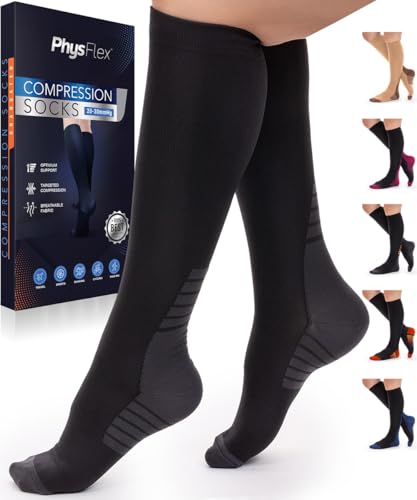
Firm compression on a budget, if you replace them often
Compression Socks for Women & Men 20-30
The PhysFlex pair claims the same 20–30 mmHg graduated band as the premium socks here, in a light, moisture-wicking knit meant for flights, shifts and workouts. It's the pair to buy when you'd rather own three or four in rotation than one perfect pair.
$9.93fromAmazonYou get the firm compression band without the premium price. PhysFlex specifies 20–30 mmHg graduated compression, the same range as our top pick, for a small fraction of the outlay. For an occasional flyer with no known risk factors, that's a sensible trade. You're paying for the pressure and skipping the pedigree.
A rotation beats one perfect pair. Compression fades with every wash, and no sock lasts forever. Owning several cheap pairs and replacing them on a schedule keeps you closer to the pressure printed on the label than babying one expensive pair for years. If you fly a handful of times a year, this is the pragmatic way to do it.
The synthetic knit suits hot, sweaty travel. The fabric is built to wick moisture and breathe, which is what you want on a summer connection through a humid airport or a long layover spent walking. It's also fine under running shoes, so the same pair covers a flight and the run you take when you land.
Flaws but not dealbreakers
Nobody independent has checked the pressure claim. This is a generic brand with no published validation of its compression accuracy, so the number on the package is the manufacturer's word. The medical brands here publish and stand behind theirs. If a doctor has told you a specific band matters for your health, buy from a brand that documents it.
Treat these as a consumable. Budget compression fabric loses meaningful pressure well before the premium stuff does — think months of regular use, not years. Plan on replacing them a couple of times a year if you travel often, and don't be fooled when they get easier to pull on. That's the compression leaving, not the sock breaking in.
Also great
Four zones of firm support and a sole built for walking
Sockwell Men's Elevation Firm Graduated Compression Socks
Sockwell's Elevation is a firm 20–30 mmHg merino-blend knee-high with four compression zones and a light cushion under the foot. If you're a man who wants our top pick's pressure with more padding for terminal marathons and trade-show floors, get these instead.
$32.95fromAmazonFour zones instead of one long squeeze. Sockwell shapes the compression across the ankle, arch, calf and turn-welt top rather than treating the leg as a single tube. Its Accu-fit construction means the gradient is engineered instead of approximated, which is the part that actually does the work of moving blood upward. For a consumer sock at this level, that's unusual anatomical specificity.
The cushioned sole earns its keep. Travel days aren't just sitting. You walk a mile to your gate, stand in a customs line, and then wander a strange city on no sleep. The ultra-light cushion under the foot takes the edge off all of that, and the arch support helps if your feet ache by evening. Most firm compression socks are thin and unforgiving here.
The turn-welt top doesn't dig in. Cheaper socks finish the leg with a tight elastic band, and that band leaves a ring in your calf by hour six. Sockwell folds the top instead, so it holds without pinching. The toe's seamless too, so nothing rubs your foot raw mid-flight.
Merino handles overnight flights well. The high-performance yarns manage moisture and regulate temperature, so your feet don't swing between clammy and freezing on a transoceanic red-eye. It's the same argument as our top pick, in a men's cut. If you run hot, this holds up better than a pure synthetic.
Flaws but not dealbreakers
This listing is L/XL only. That covers roughly a men's 10.5 to 13, so smaller feet are out of luck here even though the line runs wider. Check the size chart against your shoe size before you order — a compression sock in the wrong size delivers the wrong pressure, which defeats the purpose.
Merino adds laundry friction, and there's no clinical data on this specific model. Cool water, gentle cycle, no tumble drying. If you wash socks after every wear, that's a small ongoing tax. And while the 20–30 mmHg rating follows the standard scale, Sockwell hasn't published trial data for this sock the way the medical brands have for theirs.
Who this is for
This guide is for anyone who flies long enough to arrive with swollen ankles, and for anyone whose doctor has raised the subject of clots, varicose veins or venous disease before a trip. If your usual flight runs under three hours and you're healthy, you probably don't need any of this. If you're regularly on flights past four hours — or you're pregnant, recovering from surgery, or you've had a DVT — a knee-high graduated sock is a cheap, low-risk thing to add to your bag.
We're covering knee-high graduated compression hosiery meant for travel, at over-the-counter pressures. We're not covering prescription-strength 30–40 mmHg garments, medical stockings fitted by a clinician, or foot-pain sleeves that stop at the ankle. And one group should talk to a doctor before wearing any of these: people with peripheral arterial disease, where compression can make blood flow worse rather than better.
How we picked
Gradient: We required true graduated compression — firmest at the ankle, easing toward the knee — because that's the design the flight research actually tested. Pressure: We looked for a published mmHg range, 15–20 for healthy flyers and 20–30 for anyone with venous risk factors, and treated an unstated rating as a real gap. Length: Knee-high only, since clots start in the deep calf veins and ankle sleeves don't reach them. Fabric: Merino blends won on flights past eight hours; wicking synthetics won for sweat and heat; cotton earned points for sensitive skin. Fit and durability: We favored brands with genuine size charts and fibers documented to hold their pressure, because a sock that sags or goes slack is a sock that's stopped working.
Other compression socks for travel worth considering
If you want cotton against sensitive skin: The Sigvaris Men's Casual Cotton 186 Calf High ($36.76) — The Sigvaris Casual Cotton 186 is a Swiss-made calf-high with 15–20 mmHg of guaranteed graduated compression in a 66% Supima cotton blend. Supima is a longer, stronger fiber than standard cotton, so the sock holds its shape through more washes than a cheap cotton knit would, and the flat, low-friction toe seam keeps irritation down over a long day. Vascular physicians know the brand by name, which is worth something if you're managing mild varicose veins. What you give up is moisture management: cotton holds sweat in a way synthetics don't, so this isn't the pair for a humid destination or a sprint between gates.
If you want one unisex pair that's easy to pull on: The Comrad Recycled Cotton Knee High Socks - ($37.99) — Comrad's Recycled Cotton Knee High offers 15–20 mmHg of true graduated compression in a 60% recycled cotton blend, in unisex sizing that fits men and women off the same chart. The premium yarn stretches enough that donning is genuinely easy — a relief if firm socks have defeated you before — and the contoured leg follows the shape of your calf instead of fighting it. It's a good pick for a healthy traveler on flights up to about eight hours who likes the recycled-materials angle. The cotton content is the catch: it hangs onto moisture, and 15–20 mmHg won't cover you if you're in a higher-risk group.
The competition
Here's what our research surfaced beyond the picks — not a census of every compression sock on the market. Plenty of good pairs exist from brands we couldn't compare on published specifications, and a few here fall short mostly because of what their listings leave out.
The 2XU Flight Compression Socks ($35) — The 2XU Flight is a knee-high sock from an Australian performance brand with deep roots in athletic compression, and it's designed explicitly for travel days, long-haul flights and long stretches of sitting. The anatomical fit through the calf, heel and foot is a real advantage — it sits more naturally than generic tubes and bunches less over ten hours — and the 67% nylon, 18% cotton, 15% elastane blend stays comfortable from check-in to baggage claim. It lost to our picks on transparency: the listing never publishes an mmHg rating, so you can't line it up against the medical brands or match it to a doctor's advice. This listing is also XL only. If you're an endurance athlete who wants one sock for the flight and the road, and the exact number doesn't matter to you, it's still a reasonable buy.
Fit, wear and washing
Put your socks on at home or in the terminal, while you're still moving — the benefit comes from getting ahead of the pooling, not from reacting to it once your ankles are already swollen. Size by calf circumference and shoe size together, not by shoe size alone, and size up if you're between. They should feel snug, clearly firmer at the ankle than the calf, and never painful. If your feet go numb, turn cold, or change color, take them off and call a doctor. Wash in cool water on gentle, lay them flat to dry, and keep them out of the dryer. When a pair starts sliding on easily, that's the compression fading, and it's time to replace them.
Questions we get
What compression level do I need for a long flight?
For most healthy adults, 15–20 mmHg graduated compression is the standard recommendation, and it's the band used in most of the clinical trials. If you have varicose veins, a prior DVT, a family history of venous disease, or you're pregnant, ask a doctor about 20–30 mmHg. In this guide, the CEP, Sockwell and PhysFlex socks sit at 20–30 mmHg, while the JOBST, Sigvaris and Comrad pairs are 15–20.
Do compression socks actually prevent blood clots on planes?
They lower the risk — they don't remove it. A Cochrane systematic review of ten randomized trials found that below-knee graduated compression stockings cut the incidence of symptomless DVT in airline passengers by roughly 12.5 percent. The benefit shows up on flights over four hours, and it works best alongside drinking water and getting up to move every hour or two.
Should I bother on a short flight?
Probably not, if you're healthy and the flight is under three hours. Absolute clot risk on short hops is very low, and guidance starts recommending hosiery for at-risk passengers at around the four-hour mark. But if you've had a DVT, recent surgery, or noticeable varicose veins, wearing them on any flight is a cheap, low-risk precaution.
Knee-high or ankle-length?
Knee-high, without much debate. Flight-related clots usually form in the deep calf veins, and only a below-knee stocking supports that whole pathway. Every trial behind the compression advice used knee-high stockings. Ankle sleeves are for plantar fasciitis and arch pain, which is a real problem — just a different one.
How long does a pair last before it stops working?
Premium socks from the medical brands hold clinical pressure for roughly 150 to 200 wash cycles when you treat them right: gentle cycle, cool water, laid flat to dry. Budget pairs typically start slipping after 80 to 100 washes. If you fly often and wash after every use, plan on replacing premium pairs about once or twice a year and budget pairs more frequently.
Can I wear them through airport security?
Yes. There's no metal in compression socks, so they won't set off a metal detector or a body scanner, and you don't need to take them off. Keeping them on is actually better — security lines involve a lot of standing still, which is exactly when you want the compression working.
Why you should trust us
For this guide:
- We read the published specifications and manufacturer claims for every sock here, and compared their stated compression bands against the guidance clinicians use for air travel.
- We leaned on the systematic-review evidence for below-knee graduated stockings on flights over four hours, and on the WHO's work identifying the four-hour threshold.
- We tracked the complaints that recur across published reviews and owner feedback in this category — socks that slide down the calf, sizing that misses, and pressure that fades after months of washing — and weighted our picks accordingly.
- We read owner reviews on every listing, weighted toward the critical ones, because that is where the recurring failures show up.
- We have a systematic way of automatically fetching the latest prices, so the numbers on this page stay current.
- This is a research-focused guide, so the team may not own every product listed — though we often do own the top winners, which gives us extra context for the recommendations.
- We don't accept free products, and the retailer commission never changes which product we recommend.
Sources
Best Compression Socks 2026 — Wirecutter, Wirecutter
Compression Stockings for Prevention of Deep Vein Thrombosis in Airline Passengers — Cochrane Database of Systematic Reviews, Cochrane Library
WHO Research into Global Hazards of Travel (WRIGHT) — Deep Vein Thrombosis Findings, World Health Organization
Economy Class Syndrome — NEJM Review of Venous Thromboembolism in Air Travel, New England Journal of Medicine
Best Compression Socks — Good Housekeeping Lab Tested, Good Housekeeping
Amazon product listings and owner reviews for all 8 products
Manufacturer specification pages for each product
Some passages in this guide may be paraphrased with AI help. Prices are refreshed automatically.
More like this.
Continue exploring health reviews and recommendations.

The Best Compression Socks for Circulation
If you're on your feet for twelve hours, or wedged into a middle seat for nine, your calves are doing a lot of quiet work. Compression socks help with…

The Best Heated Compression Knee Massagers
Knee pain rarely shows up at a convenient moment. It's the first ten minutes after you get out of bed, or the ache that settles in after a long drive, a…

The Best Compression Clothing for Workout Recovery
Compression clothing sits in an odd spot in your gym bag. It isn't a shoe or a barbell, and it won't make you faster on the day you wear it. What it does…

The Best Lightweight Travel Wheelchairs
A travel wheelchair earns its keep in the ten seconds it takes to get it out of the trunk. If you're the one lifting, weight is everything. Twenty pounds…

The Best Duffel Bags for Travel and Weekenders
A duffel is the bag you grab when a suitcase feels like too much. Three days at a friend's place, a Friday flight straight from the office, a weekend at…

The Best Travel Blankets for Airplanes
Cabin air runs cold. You're sitting still for hours in thin clothes, usually next to a window that's a lot colder than the seat, and the vent above you…