The Best Electric Toothbrushes for Whitening
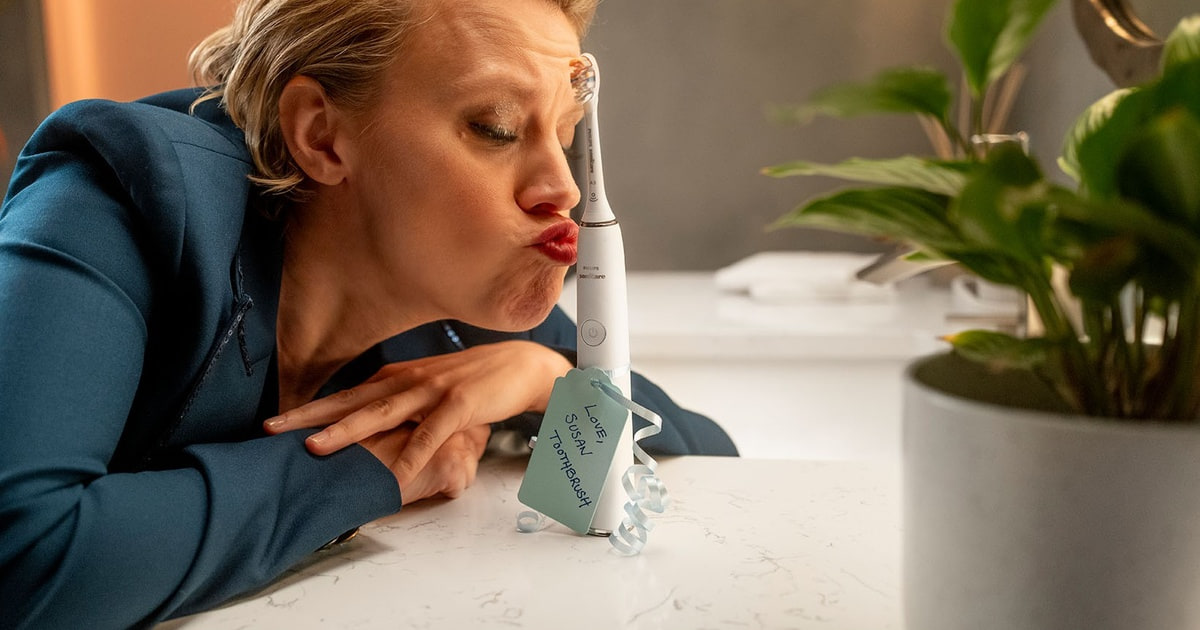
Coffee in the morning, tea in the afternoon, a glass of red with dinner. The color those leave behind builds up slowly on the outside of your enamel, and the thing that keeps scrubbing it back off is the brush you pick up twice a day. What matters isn't the number of modes printed on the handle. It's whether the brush polishes every surface, whether it stops you from bearing down too hard, and whether you like using it enough to keep going for years.
Here's the part the packaging won't tell you. No electric toothbrush whitens your teeth. It lifts the stains sitting on top of them, which makes your smile look brighter, but the natural shade of your enamel doesn't budge. If your discoloration comes from inside the tooth — aging, medication, fluorosis — brushing won't touch it, and no setting with "white" in its name will change that. A brush maintains a bright smile. It can't create one from scratch.
So we read the specs, the published reviews and the owner feedback for all eleven brushes here, looking for the things that actually move stain off enamel: a working pressure sensor, a polishing mode that changes the motion instead of just running faster, and replacement heads you'll still be able to buy years from now. We think that the Oral-B iO Series 9 is the best electric toothbrush for whitening for most people, and that the Philips Sonicare ProtectiveClean 5100 is the one to buy if you want proven sonic cleaning without paying for app features.
Everything we recommend

The best polishing and the smartest coaching, if you'll use it

Sonic polishing and a pressure sensor, minus the smart clutter

The gentle basics done right, with a real pressure sensor
The gentlest way to polish stains off sensitive teeth

Two handles, two cases — the pick for a two-person bathroom
At a glance
| Product | Modes | Speed | Price | |
|---|---|---|---|---|
| Oral-B iO Series 9 Electric Toothbrush withTop pick | 7 Settings | — | $328.99 |
| Philips Sonicare DiamondClean Prestige 9900 Rechargeable ElectricUpgrade pick | — | — | $429.99 |
| Oral-B iO Series 7s Rechargeable Toothbrush withAlso great | — | — | $349.99 |
| Philips Sonicare ProtectiveClean 5100 Electric Rechargeable ElectricRunner-up | 3 Modes | 62,000/min | $91 |
 | Colgate Total Battery Powered Electric ToothbrushAlso in lineup | 2 Modes | — | $12.99 |
 | Oclean X Pro Digital Set Smart SonicAlso consider | — | 84,000/min | $89.99 |
| Philips Sonicare 4100 Series Electric Toothbrush -Budget pick | 2 Settings | — | $47.99 |
 | Oral-B Pro 1000 Rechargeable Electric ToothbrushAlso consider | 3 Modes | — | $49.90 |
 | Burst Original Sonic Electric Toothbrush for AdultsAlso consider | 3 Modes | 33,000/min | $59.99 |
 | Waterpik Sonic-Fusion 2.0 Professional Flossing Electric ToothbrushAlso consider | 3 Modes | 2 Speeds | $179.99On sale |
 | COSLUS Sonic Electric Toothbrush for Adults: 3Also in lineup | 5 Modes | 3 Intensities | $9.99On sale |
How we picked
Pressure protection. We treated a working pressure sensor as the price of entry, because brushing too hard thins enamel and makes teeth look darker over time. Brushes that warn you visually, buzz the handle, or cut the motion outright ranked above ones that leave it to your judgment.
A real polishing mode. We read the spec sheets closely to see whether a whitening mode changes the brushing motion or just runs the standard pattern faster. Only the former does much for surface stains.
Head supply and cost. We checked how easy each brush's replacement heads are to find and whether whitening-specific versions exist. A brush is only as good as the bristles you're willing to keep buying for it.
Timers and coaching. Two full minutes across all four quadrants is what produces visible change, and most people fall short. We favored brushes with quadrant pacing, and gave extra credit to coverage feedback that shows which teeth you skip.
Long-term durability. We looked at owner feedback several months out, where battery fade, cracked seals and dead motors tend to surface. Brushes with recurring complaints in that window dropped out of contention for a pick.
Top pick
The best polishing and the smartest coaching, if you'll use it
Oral-B iO Series 9 Electric Toothbrush with
This is Oral-B's most advanced handle, with a magnetic drive, seven settings and a pressure ring that tells you the moment you push too hard. If your stains come from coffee and you want a brush that coaches you into better habits, it's the one to get.
$328.99fromAmazonThe magnetic drive is built for polishing, not just scrubbing. Instead of the buzzy rotation you get from cheaper oscillating brushes, the iO layers micro-vibrations onto the round head. Oral-B says the combination removes 100% more plaque in a week than a manual brush. What you notice day to day is the finish: the head cups each tooth and works the surface instead of skating across it.
The whitening setting changes the motion, and that's the whole point. Plenty of brushes advertise a whitening mode that just runs the same pattern faster. The iO shifts to tighter, quicker movements aimed at the thin film where coffee and tea stains settle. You get seven settings in all, so there's a gentle one for days when your gums are unhappy and a deeper one for the morning after red wine.
The pressure ring stops you from undoing your own work. Press too hard and you wear enamel down, which makes teeth look darker over time — exactly the opposite of what you're after. The iO's sensor glows red when you're leaning on it and green when you've got it right. Owners of pressure-sensing brushes consistently report that this is the feature that finally broke their scrubbing habit.
The app tells you which teeth you keep skipping. Whitening is a consistency problem more than a technology problem. If you rush the inside of your lower molars every morning, they'll stay dull no matter which handle you're holding. The Oral-B app maps your coverage as you brush, and a couple of weeks of that feedback is usually enough to fix the habit permanently. After that you can ignore it.
Four heads in the box means you're set for a long stretch. Bristles stop polishing well after about three months, and the cost of refills is the part most buyers forget to budget for. Starting with four heads pushes that first reorder well down the road. The iO head range is wide, too, so you can swap in a whitening-specific head or a gentler one without changing brushes.
Flaws but not dealbreakers
It's the most expensive Oral-B here, and the refills keep coming. iO heads use a different fitting from Oral-B's standard round refills, and they cost more. You'll need a fresh one roughly every three months for the polishing to stay effective. If you're buying for a household, that adds up faster than the sticker suggests.
The handle is heavy. It's noticeably chunkier than a basic rechargeable brush, and some owners find their wrist tiring before the two minutes are up. If you have limited grip strength or arthritis, hold one in a store before you commit.
Most of the smart features stop mattering once your technique is fixed. The display and the coverage map are genuinely useful for the first month. After that, if you're already brushing well, you're carrying a screen you don't look at. That's fine — you're still getting the drive and the sensor — but don't buy this for the software alone.
Runner-up
Sonic polishing and a pressure sensor, minus the smart clutter
Philips Sonicare ProtectiveClean 5100 Electric Rechargeable Electric
The ProtectiveClean 5100 gives you a dedicated White mode, a pressure sensor and Philips' whole brush head catalog, without an app or a screen. It's the sensible middle of the Sonicare range and the one to buy if you'd never open the app anyway.
$91fromAmazonThe White mode is a real mode, not a marketing sticker. Philips rates the 5100 at up to 62,000 brush movements per minute, which is in the same neighborhood as its far pricier handles. Sonic brushing works differently from Oral-B's: the vibration drives fluid between your teeth and along the gumline, so you get cleaning in the gaps where stains like to start.
Three modes cover everything most people need. Clean for daily use, White when you want the polishing pass, Gum Care when your gums are tender. That's it, and the simplicity is a feature. There's no menu to scroll and no phone to prop against the mirror, so you're more likely to just pick up the brush and go.
The pressure sensor and the head reminder work together. BrushSync flags you when you're pushing too hard, and it also tracks how long and how firmly you've been brushing so it can tell you when the head is spent. Worn bristles polish badly, and almost nobody replaces heads on schedule without a nudge. For stain removal specifically, that nudge matters more than another mode.
Philips heads are everywhere. You can buy them at the grocery store, and every Sonicare snap-on head fits, including the premium whitening ones. That means you're not locked into one refill line or one retailer, and you can upgrade the head without upgrading the handle. It's the quiet reason a mid-range Sonicare stays useful for years.
Flaws but not dealbreakers
There's no app and no display. You get LED lights for battery and mode, and nothing else. If you want coverage mapping or a session history, this isn't the brush.
Fewer intensity steps than the premium Sonicares. If your teeth are genuinely sensitive, the gentler Gum Care mode helps, but you can't dial the power down within a mode the way you can on the Prestige. Some people with recession find even Clean mode a bit much at first.
Budget pick
The gentle basics done right, with a real pressure sensor
Philips Sonicare 4100 Series Electric Toothbrush -
The Sonicare 4100 is the least expensive brush here that still protects your enamel from your own hand. You give up a whitening mode and get sonic cleaning, a pressure sensor and a two-week battery — the essentials, and nothing you'd pay extra for.
$47.99fromAmazonA pressure sensor at this level is unusual, and it's the reason to buy this one. Push too hard and the handle pulses at you until you ease off. Cheap brushes almost never include this, which is a problem, because roughly a third of people brush too hard and wear their enamel thinner. Thinner enamel shows more of the yellow dentin underneath. Protecting it is whitening.
The C2 head is cut for stain removal. Philips says the soft, flexible bristles lift up to 700% more plaque than a manual brush and are shaped to polish as they go. Paired with sonic vibration that pushes fluid between teeth, it handles the film left by coffee and tea about as well as anything at this level.
The timers actually change how you brush. SmarTimer tells you when two minutes are up and QuadPacer nudges you every thirty seconds so you split your mouth into four sections. If you're coming off a manual brush, you're probably brushing for less than a minute and mostly hitting the front teeth. Fixing that does more for the color of your smile than any mode.
EasyStart makes the switch bearable. The first weeks with a powered brush can feel harsh if you're not used to it, and plenty of people quit right there. EasyStart ramps the power up gradually over your first sessions instead of hitting you with full strength on day one. Battery life runs about two weeks per charge, so it travels fine.
Flaws but not dealbreakers
There's no whitening mode. You get two intensity settings and that's the extent of your control. The head does the polishing work here, not the motion, so it's a step behind the 5100 for surface stains.
No app, no display, no head-change tracking. You'll have to remember the three-month replacement yourself, or watch for the bristles splaying. Given how much worn bristles hurt polishing, that's a real thing to stay on top of.
Upgrade pick
The gentlest way to polish stains off sensitive teeth
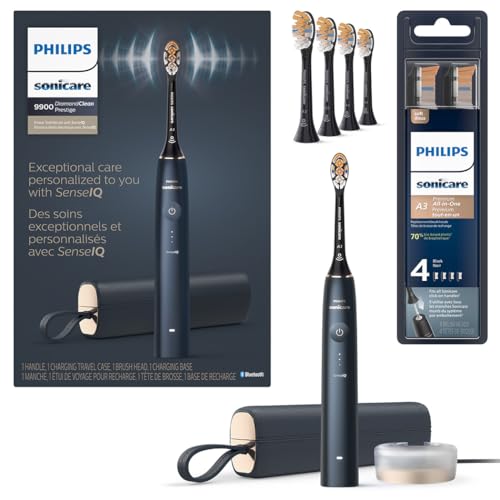
Philips Sonicare DiamondClean Prestige 9900 Rechargeable Electric
The DiamondClean Prestige 9900 reads how hard you're brushing and quietly adjusts as you go. If your gums have receded or your teeth twinge at cold water, this is the brush that cleans seriously without making you flinch.
$429.99fromAmazonSenseIQ handles the pressure problem for you. Most sensors warn you and leave the rest up to you. This one senses what you're doing moment to moment and dials the intensity back on its own. If your teeth are sensitive, that's the difference between a brush you use twice a day and one you start skipping.
The cleaning numbers are the highest Philips claims. Up to 20 times more plaque removed than a manual brush, and up to 15 times healthier gums after six weeks. Healthy gums matter more for whitening than people expect — inflamed, receding tissue exposes darker root surface and makes every whitening product sting.
Five Premium All-in-One heads come in the box. They're meant to cover plaque, gum care and whitening in one head rather than making you swap between specialists. Five of them is a long runway before your first reorder, and the polishing bristles work on stains without the scratchy feel of an aggressive whitening head.
The travel setup is genuinely good. You get a leatherette case that charges over USB, so you can top the brush up from a laptop or a hotel outlet rather than hunting for a socket for a charging stand. The handle uses a single touch control, which is the least fussy interface of any smart brush here.
Flaws but not dealbreakers
It's the most expensive brush in this guide by a clear margin. You're paying for the sensor and the head bundle. If you don't have sensitivity issues, the top pick does the polishing job for less.
SenseIQ can feel like it's nannying you. When it decides you're pressing too hard, it quietly backs the power off — even if that firmer feeling is exactly what you like. There's no way to override it, and some owners find that frustrating.
The charging stand stays home. It's a handsome glass-style base that isn't going anywhere in a suitcase. You'll be relying on the case for trips, which works but means keeping track of one more cable.
Also great
Two handles, two cases — the pick for a two-person bathroom
Oral-B iO Series 7s Rechargeable Toothbrush with
The iO Series 7s set gives you the same magnetic drive as our top pick, twice over, with two chargers and two travel cases. For a couple buying together, it's the sensible way into Oral-B's best brushing technology.
$349.99fromAmazonIt's the same drive that makes the Series 9 good. The magnetic micro-vibration system is identical, and that's the part doing the polishing. The Series 9 adds AI coverage guidance and a couple of extra modes on top. For most people, the motion is what matters and the analytics are a bonus.
Buying as a pair changes the math entirely. Two handles, two chargers, three heads and two deluxe travel cases in one box. If you and a partner both want to move off manual brushes, this costs far less than two flagship handles and gets you most of the way to the same clean.
You still get the pressure sensor and the color display. The handle warns you when you're bearing down, and the screen handles mode selection and timing. That's the safety net that matters most for whitening. What's missing is the machine-learning coverage map, which you'll probably stop consulting after the first month anyway.
It takes the whole iO head range. Whitening heads, gentle heads, interdental heads — all of them snap on. Two people with different needs can share a set and still brush the way each of them should.
Flaws but not dealbreakers
Three heads for two people isn't much of a head start. Split between two brushers on a three-month cycle, you'll be reordering sooner than you would with the top pick's four-head bundle.
Solo buyers are paying for a handle they'll never use. If you're the only electric brusher in the house, skip this and get a single flagship handle instead.
Five modes instead of seven. In practice you'll live in two or three of them, but if you want the full range of specialized settings, the Series 9 is the one.
Who this is for
Buy one of these if your teeth look duller than they used to and you drink coffee, tea, or red wine most days. That kind of dulling is surface staining, and it's exactly what a good brush handles. You're also a strong candidate if you know you brush too hard, or if you've had professional whitening and want to keep the results from fading — a pressure sensor and a consistent two minutes will stretch that investment much further than any toothpaste will.
Skip this if your discoloration is inside the tooth. Yellowing from age, gray banding from tetracycline, white mottling from fluorosis — none of that responds to brushing, and buying a more expensive handle won't change the answer. Talk to a dentist about bleaching, bonding or veneers instead. This guide covers rechargeable and battery-powered brushes for adults. It doesn't cover kids' brushes, whitening strips, LED kits, standalone water flossers, or in-office treatments.
How we picked
Five things decided the order here. Pressure protection: a sensor that warns you, or cuts power, before you scrub enamel thin — non-negotiable, since worn enamel reads as darker teeth. Polishing mode: whether a whitening setting genuinely changes the motion rather than running the usual pattern faster. Head supply: how easy and affordable the replacement heads are, because bristles stop polishing after about three months and a brush you won't refill is worthless. Coaching: quadrant pacers, two-minute timers and coverage feedback, all of which fix the consistency problem that actually drives results. Durability: what owners say after six months or a year, when batteries fade and seals fail.
Other electric toothbrushes for whitening worth considering
If you know you'll never floss: The Waterpik Sonic-Fusion 2.0 Professional Flossing Electric Toothbrush ($179.99) — The Waterpik Sonic-Fusion 2.0 puts a water flosser and a sonic brush in the same handle, so you can brush, floss, or do both at once. Waterpik says it's clinically proven up to twice as effective as brushing and flossing separately for plaque and gum health, and it carries the ADA Seal for safety and effectiveness. That matters for whitening indirectly: inflamed gums pull back and expose darker root surface, and they make every whitening product hurt more. The trade-offs are physical. It's bulky, it's heavy in the hand, and you're filling a reservoir every day. Waterpik backs it with a three-year limited warranty.
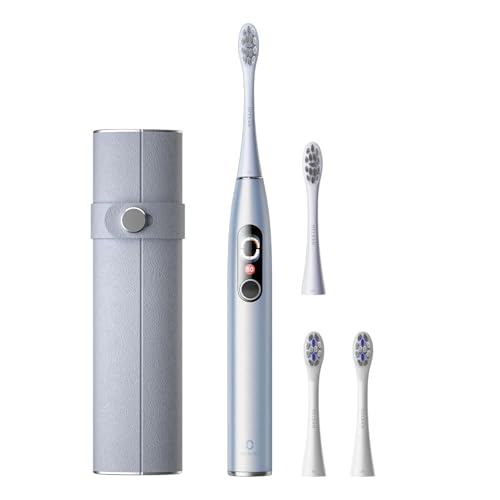
If you want coaching on the handle instead of on your phone: The Oclean X Pro Digital Set Smart Sonic ($89.99) — The Oclean X Pro Digital puts a screen right on the brush that shows your coverage as you go and scores the session when you finish. No propping a phone against the mirror. Its magnetic levitation motor runs at 84,000 movements per minute, the highest figure of any brush here, and Oclean claims up to 30 days per charge. It comes with extra heads and a travel case. What you give up is the safety net of an established brand: fewer independent clinical studies, a smaller head catalog, and an app that owners describe as capable but rougher than Oral-B's.
If you want the simplest dentist-style clean: The Oral-B Pro 1000 Rechargeable Electric Toothbrush ($49.90) — The Oral-B Pro 1000 is the plain version of what makes Oral-B work — a small round head that cups each tooth, three modes, a quadrant timer, and Gum Pressure Control that stops the pulsations outright when you push too hard. That's an unusually firm pressure feature at this level, and CrossAction refills are available at any drugstore, including whitening versions. What's missing is a dedicated whitening mode; the polishing comes from head geometry alone. There's no display, no app and no charm to the design. But if you want the proven motion and nothing else, this is the one.
If you like the idea of fresh heads showing up automatically: The Burst Original Sonic Electric Toothbrush for Adults ($59.99) — The Burst Original runs at 33,000 sonic vibrations per minute with three modes, one of them a dedicated whitening setting. The bristles are ultra-soft PBT nylon cut at varying lengths to reach between teeth, and Burst says the brush cuts gum bleeding up to three times more than a manual brush within two weeks. Battery life runs about a month. The catch is the subscription: replacement heads arrive on a schedule rather than sitting on a store shelf, which is either a solved problem or an annoyance depending on how you live. Burst offers a one-year device warranty, extended to a limited lifetime warranty for subscribers.
The competition
This is what our research turned up in this category, not a census of everything for sale. The two brushes below are real options that lost out to the picks for specific reasons, and both could still be the right call in a narrow set of circumstances.
The Colgate Total Battery Powered Electric Toothbrush ($12.99) — The Colgate Total Battery Powered Electric Toothbrush is the gentlest possible way to test whether powered brushing suits you. It runs on two AAA batteries, includes a two-minute timer, and offers Sensitive and Regular modes with soft tapered Floss-Tip bristles meant to reach along the gumline. Colgate says the bristles work against plaque, gingivitis, tartar and stains. But the vibration is mild next to any rechargeable sonic brush, there's no pressure sensor at all, and you'll keep buying batteries. For whitening specifically, the polishing action just isn't there. Buy it as a trial run or a travel spare, not as the brush you rely on.
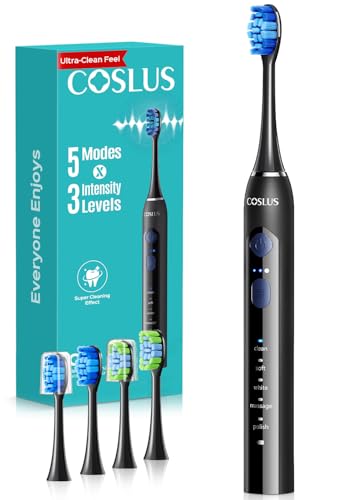
The COSLUS Sonic Electric Toothbrush for Adults: 3 ($9.99) — The COSLUS C30 is the most brush you can get for the least money here, and it isn't a token effort. There's a genuine magnetic levitation motor rated for over 1,000 hours, five modes, three intensity levels and two hardnesses of head so different people in a house can share it. COSLUS claims the bristles last three months or more. What holds it back is the absence of a pressure sensor, which is the one feature we'd insist on for anyone worried about enamel, plus an unfamiliar brand with no independent clinical backing and a thin head catalog. It's a fine gift or travel spare. It's not the brush to build a whitening routine around.
Care and brush head replacement
Replace the head every three months, and sooner if the bristles splay or fray. This is the part people skip, and it costs them more than any feature on the handle. Worn bristles lose their polishing edge fast, so a four-month-old head on a flagship brush does less for stains than a fresh head on a basic one. Most manufacturers print a blue stripe across the bristles that fades to white when it's time — trust it. Rinse the head after each use, shake it dry and store it upright so water doesn't pool in the collar, which is where mildew starts. Wipe the handle and the charging base every week or so; toothpaste film builds up under the seam and gets stubborn.
Questions we get
Do electric toothbrushes really whiten better than manual ones?
For surface stains, yes. Research consistently shows electric brushes remove 20% to 100% more plaque than manual brushing, and that polishing action is what lifts the film coffee and tea leave behind. But neither type touches discoloration inside the tooth. If your teeth are yellowing from age or medication, that needs a dentist, not a better brush.
Sonic or oscillating-rotating — which one whitens more?
Oscillating-rotating brushes like Oral-B's spin a small round head back and forth so it physically polishes each tooth. Sonic brushes like Philips Sonicare vibrate at high frequency and push fluid between teeth and under the gumline. Bench studies give oscillating-rotating a slight edge on direct surface stain removal, while sonic tends to do better for gum health. Honestly, pick whichever feels comfortable, because the brush you use twice a day beats the one you abandon.
How long before I see a difference?
Most people notice less surface staining within two to four weeks of consistent twice-daily brushing. How fast depends on how stained your teeth are now, how much coffee and tea you keep drinking, and whether you're actually covering every surface. Rinsing with water right after a staining drink speeds things up more than you'd think.
Can an electric toothbrush damage my enamel or gums?
It can, but only if you press down while the brush is already doing its own work. That's why a pressure sensor is the feature we'd insist on. Let the head glide across the surface and guide it — don't scrub. Roughly a third of people brush too hard by habit, and for them a brush without a sensor is a genuine risk.
Should I use whitening toothpaste with it?
Yes, and it helps. The brush spreads the mildly abrasive particles more evenly than your hand would. Look for an ADA-accepted paste with an RDA abrasivity value under 250 — most mainstream whitening pastes land between 100 and 200. Skip the DIY routes like straight baking soda or activated charcoal, which can be abrasive enough to wear enamel permanently.
Can I use my electric brush right after professional whitening?
Wait 48 hours. Bleaching temporarily opens the pores in your enamel and leaves the surface more vulnerable to mechanical wear. Use a manual brush or your gentlest mode during that window. Once the sensitivity fades, go back to normal — daily brushing is the main thing that keeps professional results from washing out.
Why you should trust us
For this guide:
- We read the manufacturer spec sheets and clinical claims for all eleven brushes here, then checked them against published reviews and dental guidance on abrasivity and brushing pressure.
- We paid close attention to owner feedback from several months into ownership, where battery fade, cracked handle seals and head-supply problems tend to show up.
- We compared the two dominant brushing technologies on what the research says about stain removal and gum health, rather than on marketing language about whitening modes.
- We read owner reviews on every listing, weighted toward the critical ones, because that is where the recurring failures show up.
- We have a systematic way of automatically fetching the latest prices, so the numbers on this page stay current.
- This is a research-focused guide, so the team may not own every product listed — though we often do own the top winners, which gives us extra context for the recommendations.
- We don't accept free products, and the retailer commission never changes which product we recommend.
Sources
Best Electric Toothbrushes 2026 — Wirecutter, Wirecutter / NYT
Electric Toothbrush Reviews — Consumer Reports, Consumer Reports
Powered Toothbrushes — American Dental Association, ADA
Best Electric Toothbrushes — Good Housekeeping, Good Housekeeping
Best Electric Toothbrushes for Whitening — Healthline, Healthline
Amazon product listings and owner reviews for all 11 products
Manufacturer specification pages for each product
Some passages in this guide may be paraphrased with AI help. Prices are refreshed automatically.
More like this.
Continue exploring health reviews and recommendations.

The Best Dentist-Recommended Electric Toothbrushes
Brushing is the one health habit you repeat twice a day for your whole life, and most people do it badly. Survey data from the ADA Health Policy Institute…

The Best Electric Toothbrushes for Sensitive Teeth
If your gums bleed when you brush, or a sip of cold water makes you wince, the problem often isn't the toothbrush - it's how hard you're pushing it.…

The Best Teeth Whitening Kits
Coffee, tea and red wine don't stain your teeth overnight. They do it slowly, over years, until you notice it in a photo. That's what an at-home kit is…

The Best Dog Toothbrushes and Dental Chews
Dental disease sneaks up on dogs. It starts as a film you can't see, hardens into tartar along the gumline, and by the time your dog's breath makes you…

The Best Electric Shavers for Men
Shaving with an electric razor is a daily habit, so the small things compound. A shaver that tugs at your neck, needs three passes over your jawline, or…

The Best Electric Snow Shovels
An electric snow shovel isn't a snow blower, and that's the whole point. You carry it out one-handed, walk it down the sidewalk, and a spinning paddle…